
Life, 1918-05-23 · page 24 of 40
Life — May 23, 1918 — page 24: what you’re looking at
What you’re looking at
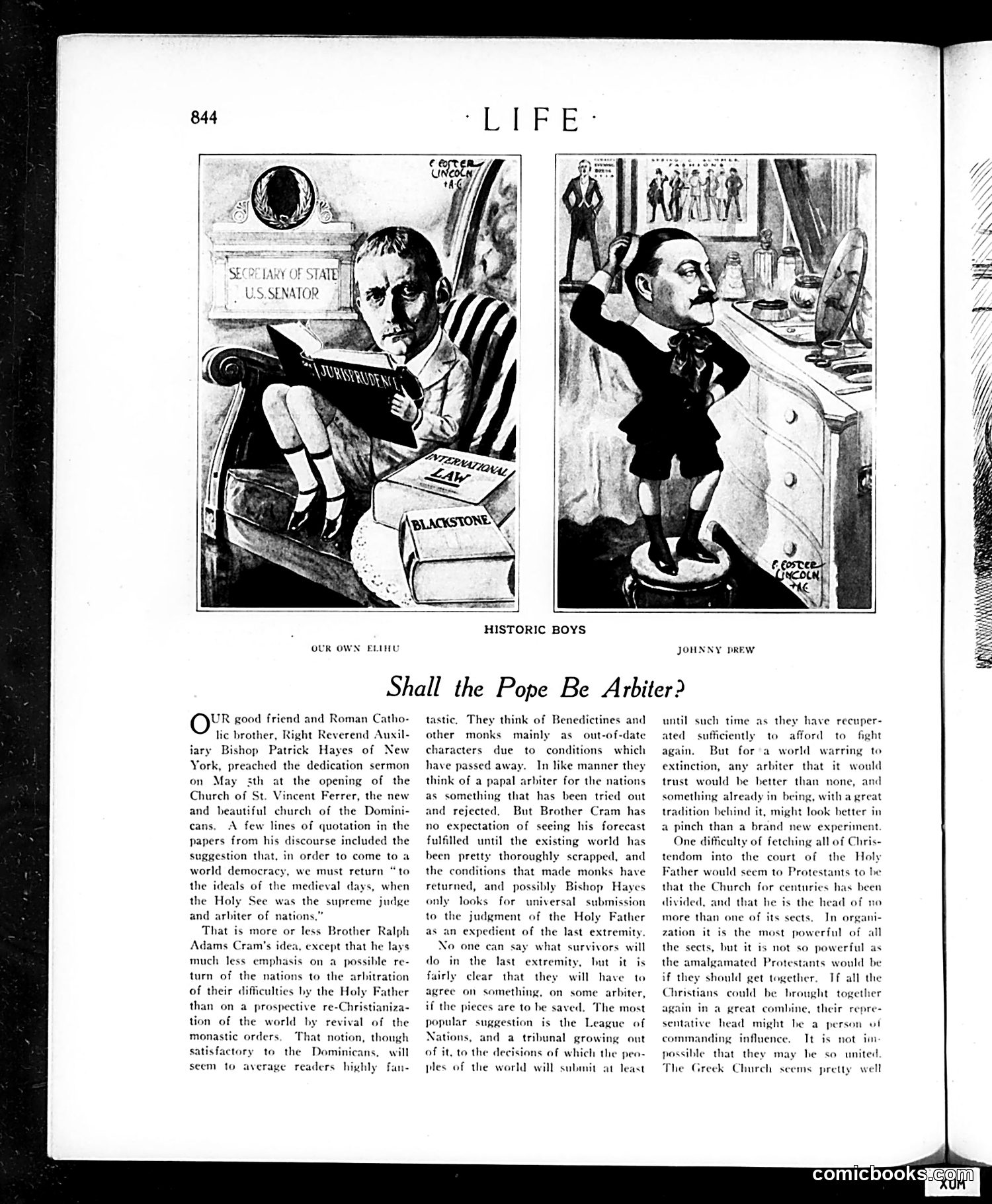
This page satirizes a proposal by Catholic Bishop Patrick Hayes of New York, who suggested that in achieving world democracy, nations should return to medieval ideals where the Pope served as supreme judge and arbiter of international disputes. The two cartoons labeled "Historic Boys" mock this notion by depicting figures studying outdated concepts: one labeled "Our Own Elihu" (likely Secretary of State Elihu Root) reads about papal authority, while "Johnny Drew" examines similarly obsolete ideas. The accompanying article ridicules the suggestion as fantastical, noting that while a papal arbiter might theoretically work as a "last extremity" solution post-war, Protestants would never accept a divided Christendom under Catholic leadership. The piece implies that modern League of Nations solutions are more realistic than reviving medieval religious authority—a sharp critique of both clerical nostalgia and post-WWI idealism about international governance.
📄 Transcribed text from this page (OCR, searchable)
Machine-transcribed from the original scan — historical spelling and the odd misread are preserved.
OC IARY OF STATE} _ US.SENATOR 7 OUR OWN ELINU HISTORIC BOYS JOUNNY DREW Shall the Pope Be Arbiter? UR good friend and Roman Catho- lic brother, Right Reverend Auxil- jary Bishop Patrick Hayes of New York, preached the dedication sermon on May sth at the opening of the Church of St. Vincent Ferrer, the new and beautiful church of the Domini- cans. A few lines of quotation in the papers from his discourse included the suggestion that, in order to come to a world democracy, we must return “to the ideals of the medieval days, when the Holy See was the supreme judge and arbiter of nations,” That is more or less Brother Ralph Adams Cram’s idea, except that he lays much less emphasis on a possible re- turn of the nations to the arbitration of their difficulties hy the Holy Father than on a prospective re-Christianiza- tion of the world by revival of the monastic orders. That notion, though satisfactory to the Domin will seem to average readers highly fan- ans, tastic. They think of Benedictines and other monks mainly as out-of-date characters due to conditions which have passed away. In like manner they think of a papal arbiter for the nations as something that has been tried out and rejected. But Brother Cram has no expectation of seeing his forecast fulfilled until the existing world has been pretty thoroughly scrapped, and the cond ns that made monks have returned, and possibly Bishop Hayes only looks for universal submission to the judgment of the Holy Father as an expedient of the last extremity. No one can say what survivors will do in the last extremity, but it is clear that they will have to agree on something, on some arbiter, if the pieces a fairly re to be saved. The most popular suggestion is the League of Nations, and a tribunal growing out of it, to the decisions af which the peo- ples of the world will submit at least until such time as they have recuper- ated sufficiently to afford to. fight again. But for a world warring to extinction, any arbiter that it would trust would he better than none, and something already in being, with a great tradition behind it, might look better in a pinch than a brand new experiment One difficulty of fetching all of Chris- tendom into the court of the Holy Father would seem to Protestants to be that the Church fe divides centuries has been and that he is the head of no more than one of its sects. In organi- zation it is the most powerful of all the sects, but it is not so powerful as the amalgamated Protestants would be if they should get together, If all the Christians could be brought together again in a great combine, their repre- sentative head might he a person of commanding influence. It is not im possible that they may he so united The Greek Church seems pretty well comicbooksieanay