
Life, 1918-05-23 · page 18 of 40
Life — May 23, 1918 — page 18: what you’re looking at
What you’re looking at
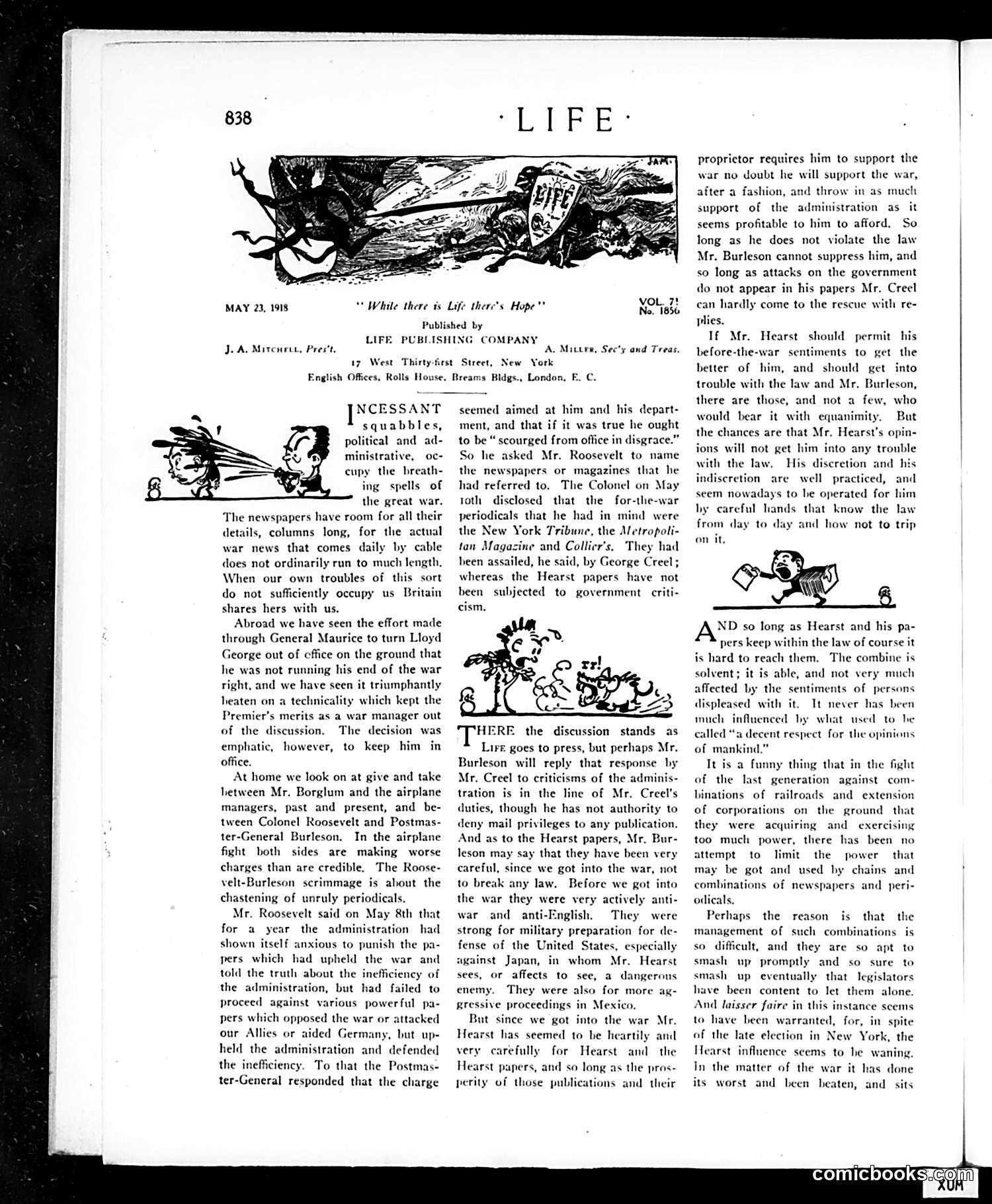
This editorial discusses tensions between the Roosevelt administration and media outlets during World War I. The cartoon (top) depicts a figure being attacked, illustrating the "squabbles" consuming wartime political attention. **The Core Dispute:** Colonel Roosevelt accused Postmaster-General Burleson of selectively punishing pro-war publications (the *Tribune*, *Metropolitan Magazine*, *Collier's*) while ignoring William Hearst's newspapers, which had previously been anti-war but now support the war effort. **The Satire:** The editorial mocks how Hearst conveniently switched from opposing war to supporting it once war became profitable for his media empire. It suggests his patriotism is cynical—he'll support whatever position benefits his business interests while staying within legal bounds. **Historical Context:** This reflects real 1918 anxieties about press freedom versus wartime censorship control, and Hearst's notorious reputation for sensationalism and opportunism.
📄 Transcribed text from this page (OCR, searchable)
Machine-transcribed from the original scan — historical spelling and the odd misread are preserved.
MAY 23, 1918 ‘* White there ts Life there's Hope"* VOL. 7! No, 1856 Published by LIFE J. A. Mitenrit, Pres't. 17 West PUBLISHIN ‘Thirty-first Street, COMPANY A. Mitte, Secty and Treas. New York English Offices, Rolls House, Breams Bldgs., London, F. C. NCESSANT quabbles, political and ad- ministrative, cupy the breath- ing spells of the great war. The newspapers have room for all their details, columns long, for the actual war news that comes daily by cable does not ordinarily run to much length, When our own troubles of this sort do not sufficiently occupy us Britain shares hers with us. Abroad we have seen the effort made through General Maurice to turn Lloyd George out of cffice on the ground that he was not running his end of the war right, and we have seen it triumphantly heaten on a technicality which kept the Premier’s merits as a war manager out of the discussion. The decision was , to keep him in oc emphatic, howev office. At home we look on at give and take letween Mr. Borglum and the airplane managers, past and present, and be- tween Colonel Roosevelt and Postmas- ter-General Burleson. In the airplane fight both sides are making worse charges than are credible. The Roose- velt-Burleson scrimmage is about the chastening of unruly periodicals. Mr. Roosevelt said on May 8th that for a y had shown itself anxious to punish the pa- pers which had upheld the war and told the truth about the inefficiency of the administration, but had failed to proceed against various powerful pa- pers which opposed the war or attacked our Allies or aided Germany, but up- held the administration and defended the inefficiency. To that the Postmas- ter-General responded that the charge rr the administration seemed aimed at him and his depart- ment, and that if it was true he ought to be “ scourged from office in disgrace.” So he asked Mr. Roosevelt to name the newspapers or magazines that he had referred to, The Colonel on May loth disclosed that the for-the-war periodicals that he had in mind were the New York Tribune, the Metropoli- tan Magazine and Collier's, They had heen assailed, he said, by George Creel; whereas the Hearst papers have not subjected to government criti- been cism. tr! c BP:, HERE the discussion stands as Lire goes to press, but perhaps Mr. Burleson will reply that response by Mr. Creel to criticisms of the adminis- tration is in the line of Mr. Creel's duties, though he has not authority to deny mail privileges to any publication. And as to the Hearst papers, Mr, Bu leson may say that they have been very careful, since we got into the war, not to break any law. Before we got into the war they were very actively anti- war and anti-English. They strong for military preparation for de- fense of the United States, especially against Japan, in whom Mr. Hearst sees, or affects to see, a dangerous enemy. They were also for more a gressive proceedings in Mexico. But since we got into the Hearst has seemed to be heartily and very carefully for Hearst and the Hearst papers, and so long as the pros- perity of those publications and their were ar Mr. proprictor requires him to support the war no doubt he will support the war, after a fashion, and throw in as muc’ support of the administration as it seems profitable to him to afford, So long as he does not violate the law Mr. Burleson cannot suppress him, and so long as attacks on the government do not appear in his papers Mr. Creel can hardly come to the rescue with re- plies. If Mr. Hearst should before-the-war sentiments to get the better of him, and should get into trouble with the law and Mr. Burleson, there are those, and not a few, who would bear it with equanimity, But the chances are that Mr. Hearst's opin- ions will not get him into any trouble with the law. His discretion and his indiscretion are well practiced, and seem nowadays to he operated for him by careful hands that know the law from day to day and how not to trip on it, permit his YD so long as Hearst and his pa- pers keep within the law of course it is hard to reach them. The combine is solvent; it is able, and not very much affected by the sentiments of persons displeased with it. It never has been much influenced by what used to he called “a decent respect for the opinions. of mankind.” It is a funny thing that in the fight of the last generation against com- Linations of ra of corporations on the ground that they were acquiring and too much power, there has been no attempt to limit the power that may be got and used by chains and combinations of newspapers and peri- odicals, Perhaps the reason is that the management of such combinations is so difficult, and they are so apt to smash up promptly and so sure to smash up eventually that legislators have been content to let them alone. And laisser faire in this instance seems to have been warranted, for, in spite of the late election in New York, the Hearst influence seems to be waning. In the matter of the war it has done its worst and been beaten, and sits jlroads and extension exercising comicbook