
Life, 1918-05-23 · page 22 of 40
Life — May 23, 1918 — page 22: what you’re looking at
What you’re looking at
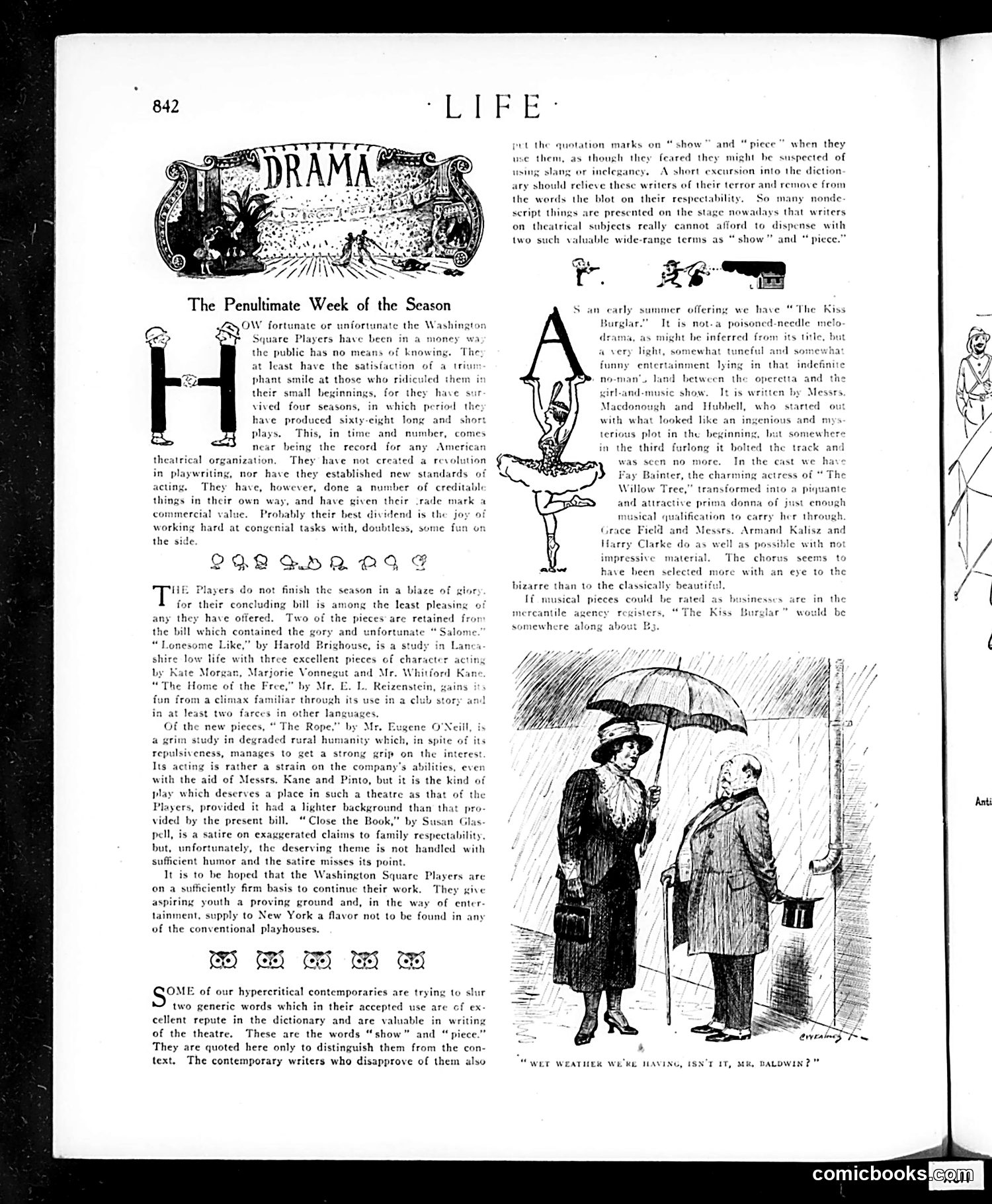
This page reviews the Washington Square Players' theatrical season. The main cartoon (bottom right) depicts two figures in rain—likely characters from one of the reviewed plays—with the caption "WET WEATHER WE'RE HAVING, ISN'T IT, MR. BALDWIN?" The article criticizes the Players' final bill as mediocre, discussing several plays including works by Harold Brighouse and Eugene O'Neill. It praises the organization for surviving four seasons and producing 68 plays, establishing themselves as a legitimate experimental theater company. A secondary editorial note debates theatrical terminology, defending critics' use of "show" and "piece" as valid descriptive terms despite contemporary disapproval. The article describes "The Kiss Burglar" as a light musical entertainment—neither quite operetta nor girl-and-music show—featuring actress Fay Bainter. The overall tone celebrates the Players' legitimacy while critiquing their current offerings as uneven.
📄 Transcribed text from this page (OCR, searchable)
Machine-transcribed from the original scan — historical spelling and the odd misread are preserved.
“LIFE: > OW fort nate the Washin Square Players have been in a money the public has no m at least have the satisfaction of a trius phant smile at those who ridiculed them i: their small beginnings, for they have sur vived four seasons, in which period the have produced sixty-eight long and short This, in time and number, comes near being the record for any American theatrical org They have not created in playwriting, nor have they established new standards of They have, however, done a number of creditable things in their own way, and have given their rade mark a commercial value. s of knowing. The nization, revolution Probably their best d working hard at congenial tasks with, doubtless, some fun on the side O9R FAR A942 HE Players do not finish the season in a blaze of gior for their concluding bill is among the least pleasing o y they have offered. Two of the pieces a the bill which contained the gory and unfortu “Lonesome Like,” by Harold Brighouse, studs shire low life with three excellent pieces of characte by Kate Morgan, Marjorie Vonnegut and Mr. WI “The Home of the Free,” by Mr. E. L. Reizenstei fun from a climax f i fend is the jos e retained fror liar through its use i in at least two farces in other la The Rope, y a grim study in degraded rural humanity which, in spite of its repulsiveness, manages to get a strong grip on the in Its acting is rather a strain on the company’s abilities, even with the aid of Messrs, Kane and Pinto, but it is the kind of play which deserves a place in such a theatre as that Players, provided it had a lighter background than that pr vided by the present bill. “Close the Book,” by pell, is a satire on exaggerated claims to family respectability, but, unfortunately, the deserving theme is not handled with sufficient humor and the satire misses its point. It is to be hoped that the Washington Square Players 2 on a sufficiently firm basis to continue their work. They aspiring youth a proving ground and, in the way of enter taininent, supply to New York a flavor not to be found in any of the conventional playhouses. OME of our hypercritical contemporaries are tryi two generic words which in their accepted use are of ex- cellent repute in the dictionary and are valuable in writin: of the theatre. These are the words “show” and “ piece. They are quoted here only to distinguish them from the con- text. The contemporary writers who disapprove of them also Of the new pieces, prt the quotation marks on “show and “piece” when they use them, ay though they feared they might he suspected of using or incl A short excursion into the diction ary should relieve these writers of their terror and remove from the words the blot on their resp ty, So many nonde script things are presented on the stage nowadays that writers on theatrical subjects really cannot afford to dispense with two such valuable wide-range terms as IG “2 an carly summer offering we have “The Kiss show" and “ piece.” It is not-a poisoned-needle ht be infer very light, somewhat tun funny entertainment lying no-man’s Jand between the operetta and ¢ xirl-and-music show. It is written by Messrs Macdonough and Hubbell, who started out with what looked like an ingenious and but somewhere terious plot in the beginnin; in the third furlong it bolted the t and have y The Willow a piquante and att Pree,” transformed i ive prima donna of just enough musical qualification to carry her through, Grace Field and Messrs, Armand Kalisz and Harry Clarke de material. The chorus seems to as possible with not have heen selected 1 with an eye to the n to the classically beaut If musical pieces could be rated as businesses are in the nereantile 4 Kiss Burglar” would be somewhere 4 “WEE WEATHER WE'KE HAVING, ISN'T IT, atk, BALDWIN?” comicbooks Rainy