
A complete issue · 40 pages · 1918
Life — April 25, 1918
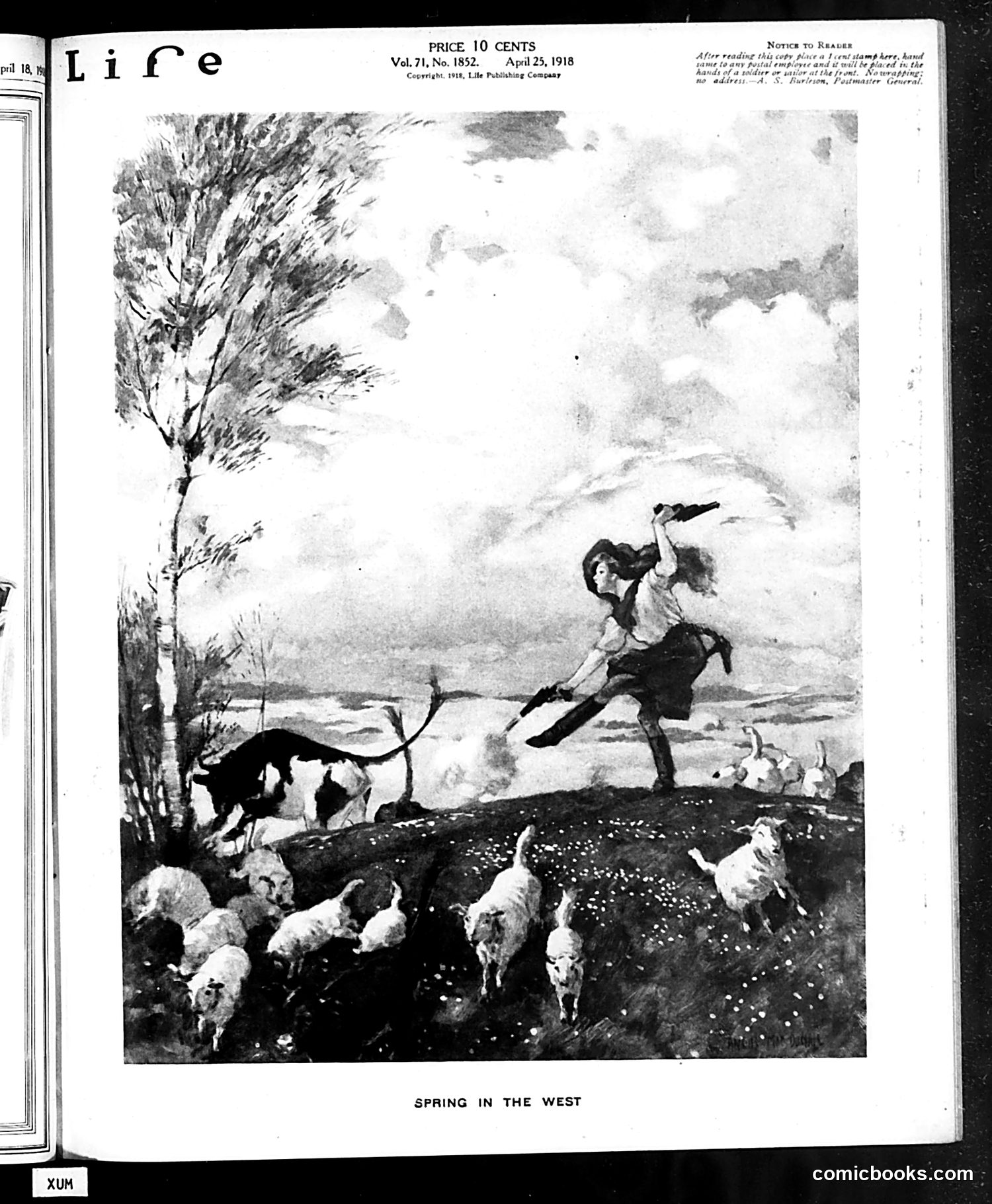
This illustration depicts a pastoral scene titled "Spring in the West," showing a woman herding sheep and goats across farmland, with a dog assisting. The woman appears to be performing agricultural labor, leaping energetically over terrain while managing the livestock. In 1918—during America's involvement in World War I—this image likely celebrates women's expanded roles in farming and agricultural production, as men were away serving in the military. The dynamic, athletic pose of the woman suggests approval of female farm labor as patriotic wartime contribution. The pastoral setting contrasts sharply with the industrial war effort, perhaps offering idealized vision of domestic agricultural abundance supporting the nation during conflict. The illustration romanticizes women's essential economic work on the home front.
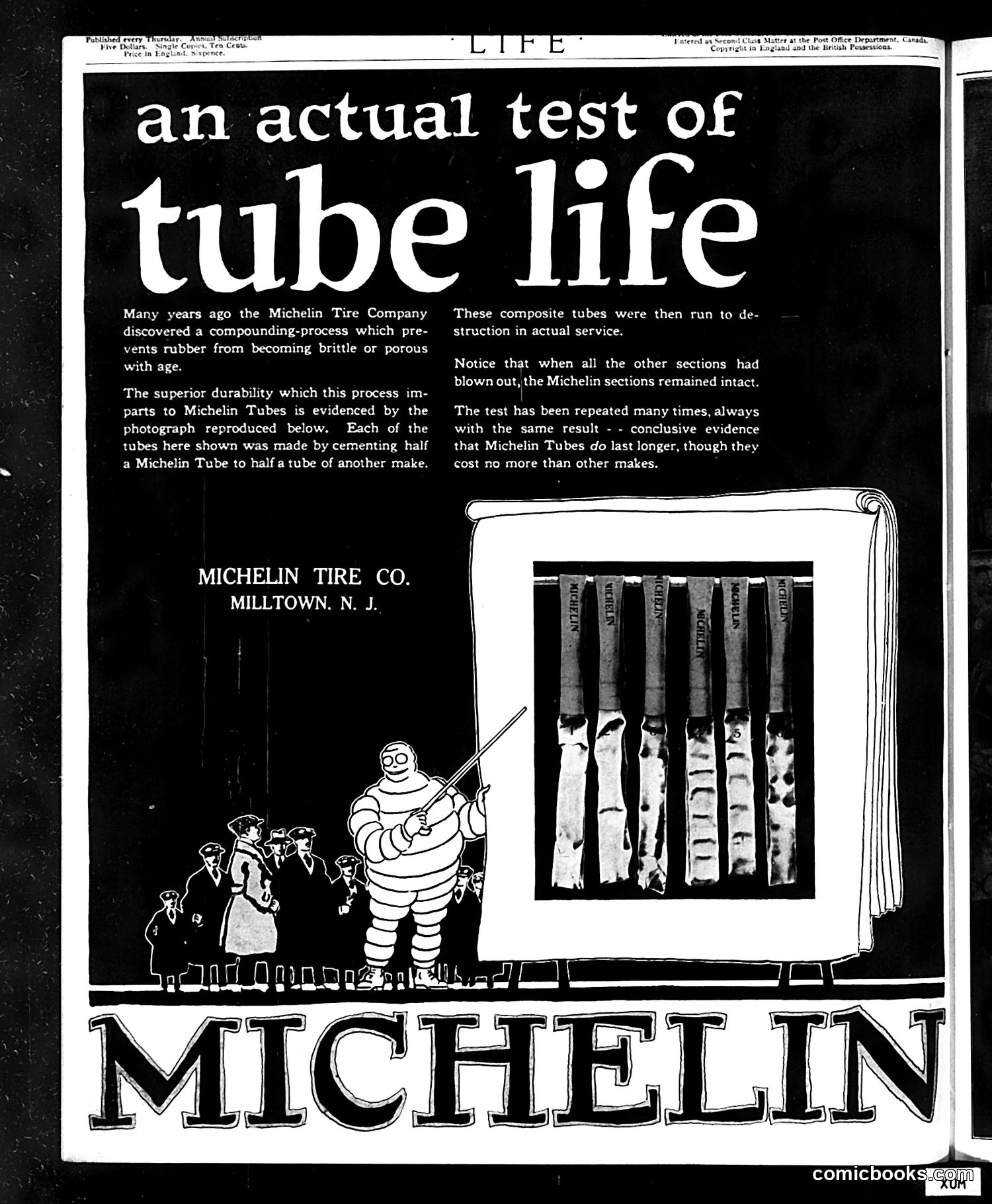
This page is primarily **advertising, not satire**. It's a Michelin Tire Company advertisement from *Life* magazine promoting Michelin Tubes. The ad claims that Michelin discovered a compounding process preventing rubber degradation. The illustration shows six tire tubes under test—apparently half-Michelin, half-competitor tubes cemented together—demonstrating durability through actual use and destruction testing. The cartoon figure (the famous Michelin Man mascot) oversees the demonstration. The ad argues Michelin tubes "last longer" despite costing "no more than other makes," with tests supposedly repeated "many times, always with the same result." This is straightforward product promotion using comparative testing as evidence, not political or social satire.
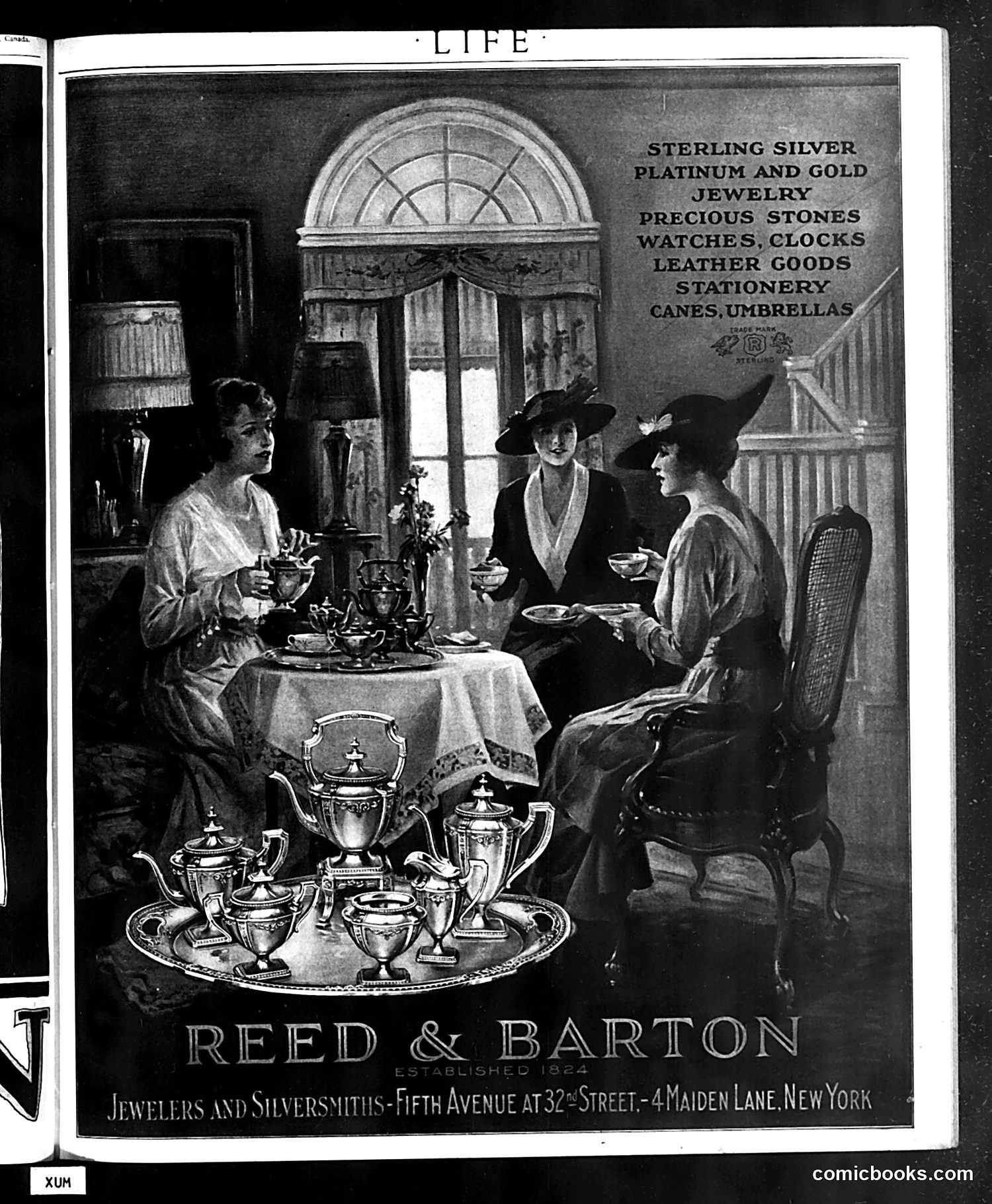
This page is primarily a **luxury advertisement**, not satire or political commentary. It depicts an elegant tea service scene featuring four well-dressed women in early 20th-century attire (wearing elaborate hats typical of the era) gathered around a table displaying fine silverware. The ad is for **Reed & Barton**, established 1824, a prestigious jeweler and silversmith located on Fifth Avenue in New York. The advertised products include sterling silver, platinum and gold jewelry, precious stones, watches, clocks, leather goods, stationery, canes, and umbrellas. The imagery appeals to wealthy consumers by associating the brand with refined, genteel domesticity and social status. The elaborate tea service displayed in the foreground showcases the quality craftsmanship Reed & Barton wanted to highlight to affluent readers of *Life* magazine.
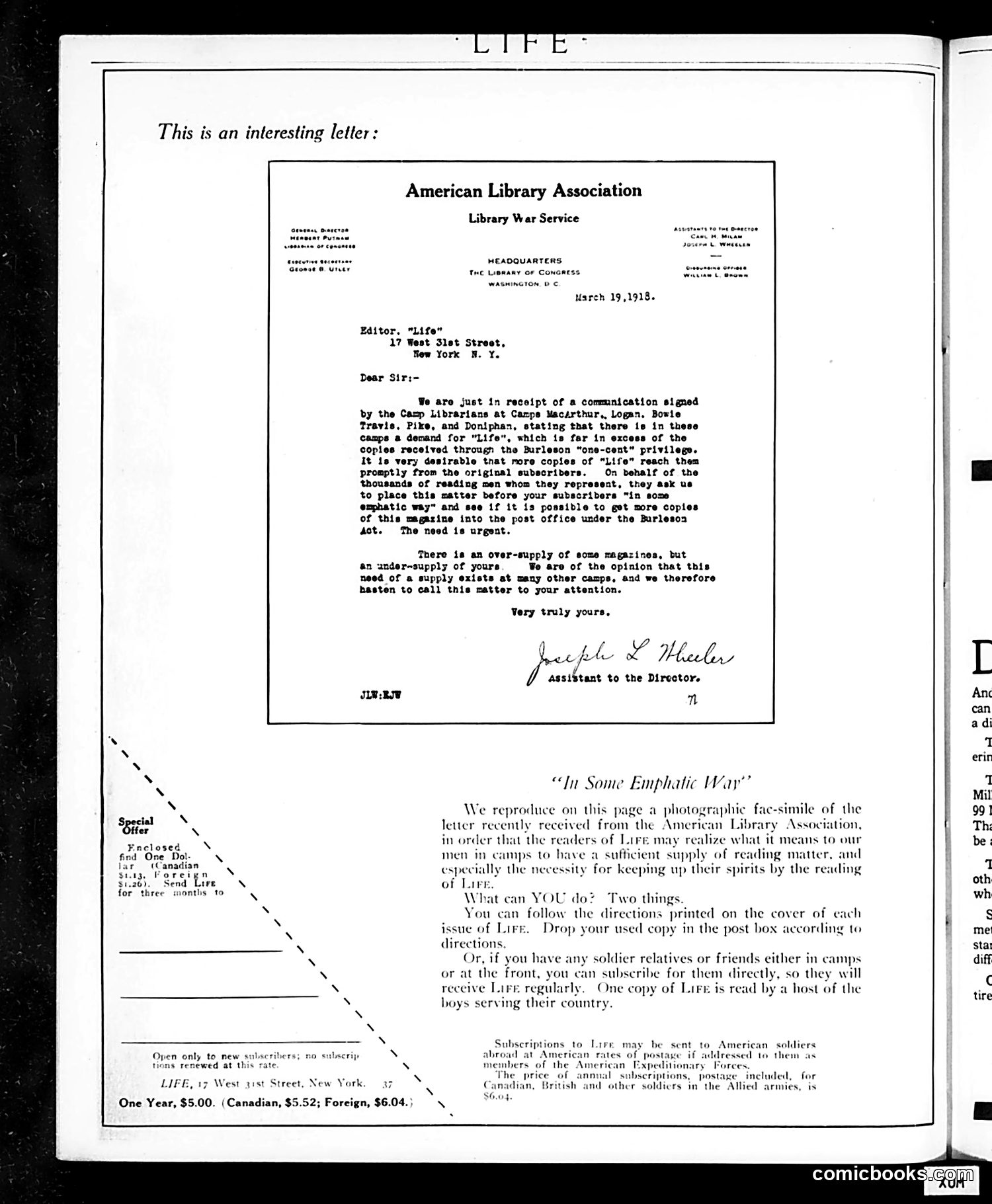
This page primarily contains a **letter from the American Library Association's Library War Service** (dated March 19, 1918) requesting Life magazine's help distributing copies to soldiers in camps. The letter notes a shortage of Life magazines at military camps despite high demand from troops. Below the letter, an explanatory section titled "In Some Emphatic Way" urges readers to support this effort by either: - Mailing used copies to camps via post box directions - Subscribing directly for soldier relatives/friends The page is essentially **wartime advocacy material**, not satire or political cartoon. It reflects WWI-era efforts to boost soldier morale through magazine distribution, emphasizing Life's role in maintaining troop spirits during the war.
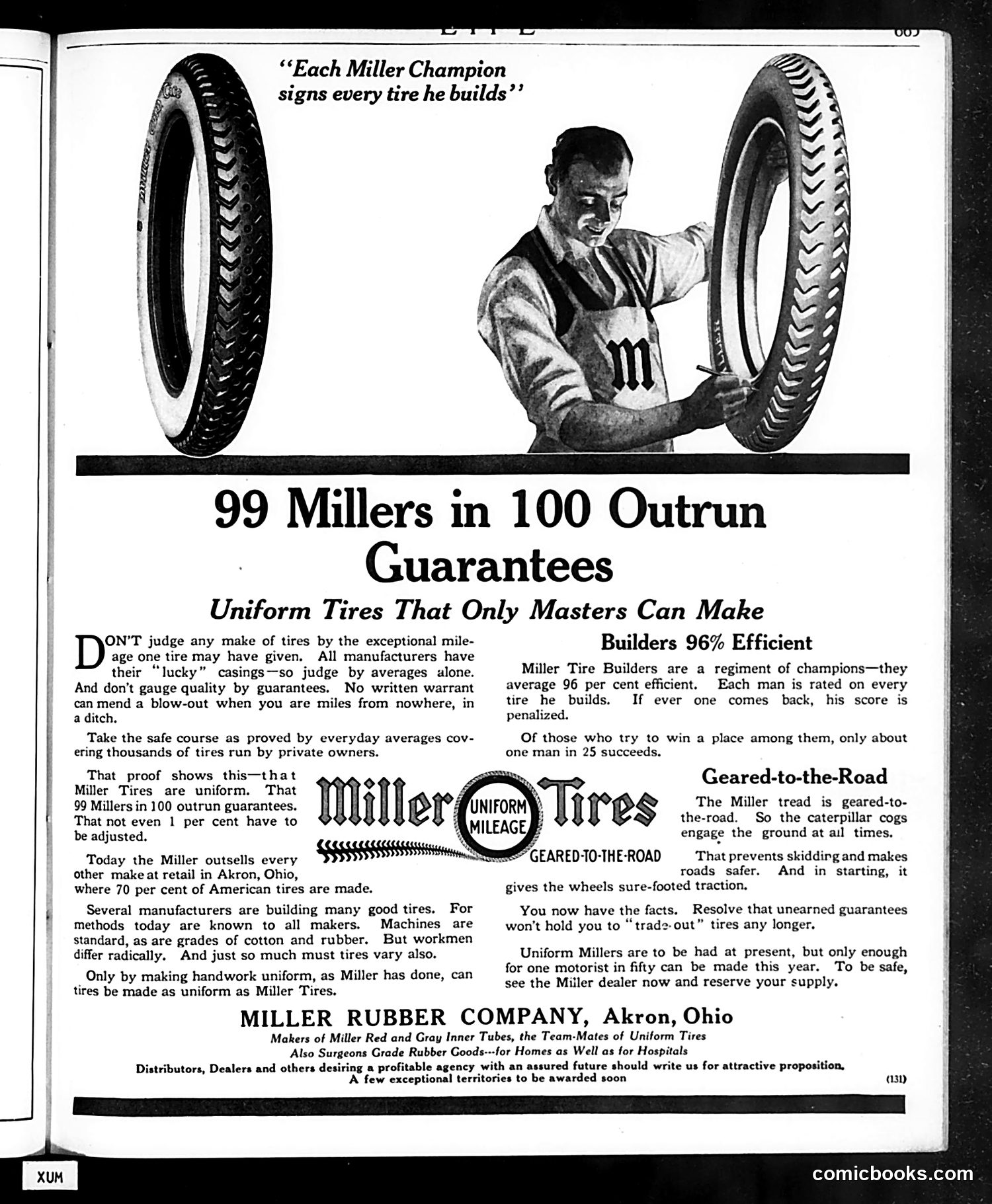
This is primarily a **product advertisement**, not political satire. The page promotes Miller Uniform Tires from Akron, Ohio, circa early 20th century. The central image shows a man in a Miller jersey signing a tire—a marketing claim that company builders personally inspected each product. The headline "99 Millers in 100 Outrun Guarantees" plays on the company name, suggesting reliability. Key selling points include uniformity, safety features ("geared-to-the-road" treads for traction), and that Miller tires outsold competitors at retail. The advertisement emphasizes quality control and craftmanship, contrasting Miller's consistency against competitors' variable standards. There is **no political or satirical content**—this is straightforward early automotive industry marketing.
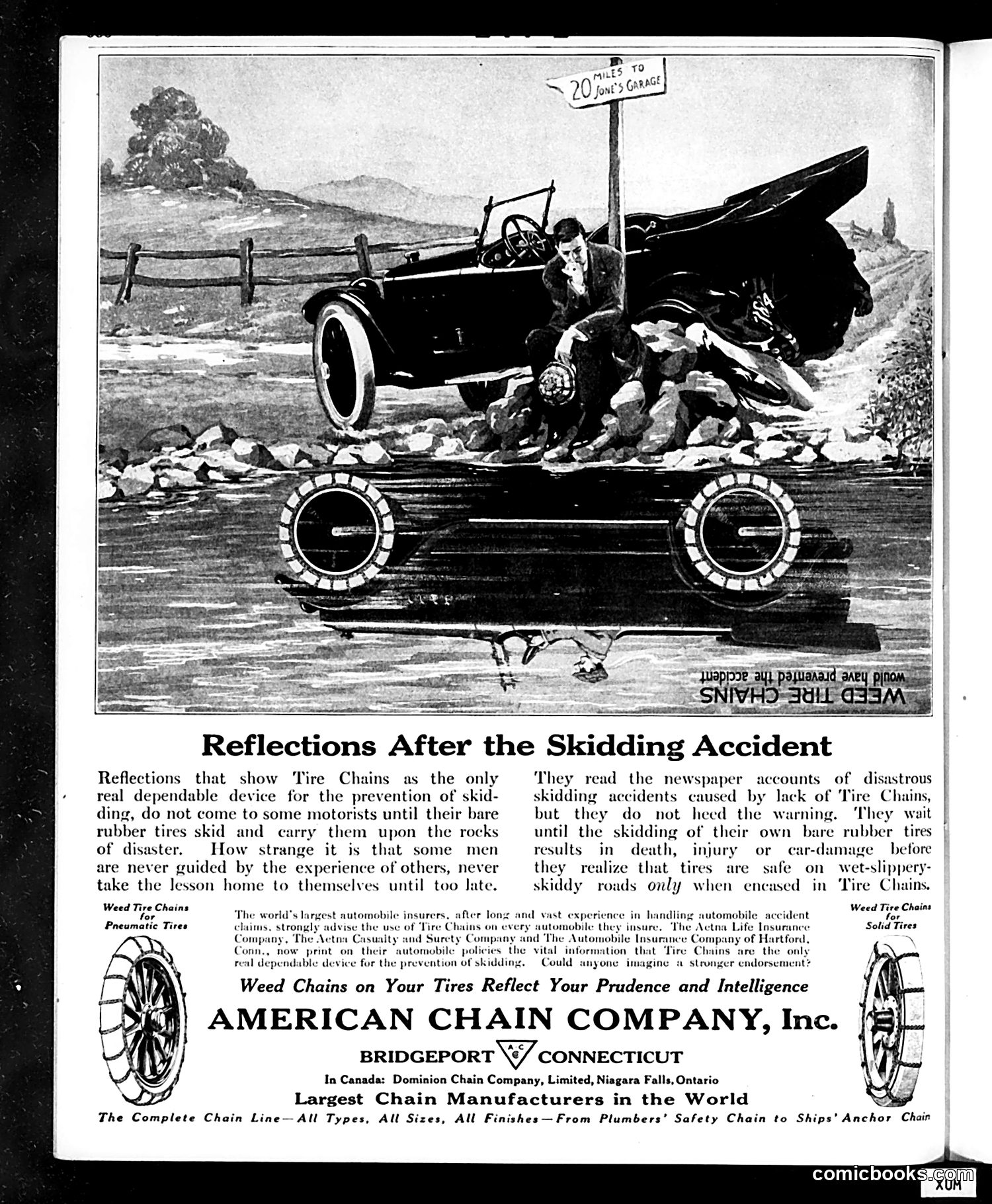
This page is primarily **advertising, not satire**. It's a vintage advertisement for Weed Tire Chains, manufactured by the American Chain Company in Bridgeport, Connecticut. The illustration shows a car accident scene—a wrecked automobile near a signpost—presented as a cautionary image. The accompanying text argues that tire chains prevent skidding accidents on wet or icy roads. The ad criticizes motorists who ignore warnings about unsafe tire conditions, claiming they don't believe in tire chains' necessity until experiencing disasters themselves. The satirical element is mild: the ad mocks drivers' resistance to safety precautions, suggesting they lack "prudence and intelligence" by ignoring insurance companies' recommendations for chain use. This reflects early 20th-century automotive safety concerns when winter driving was genuinely hazardous.
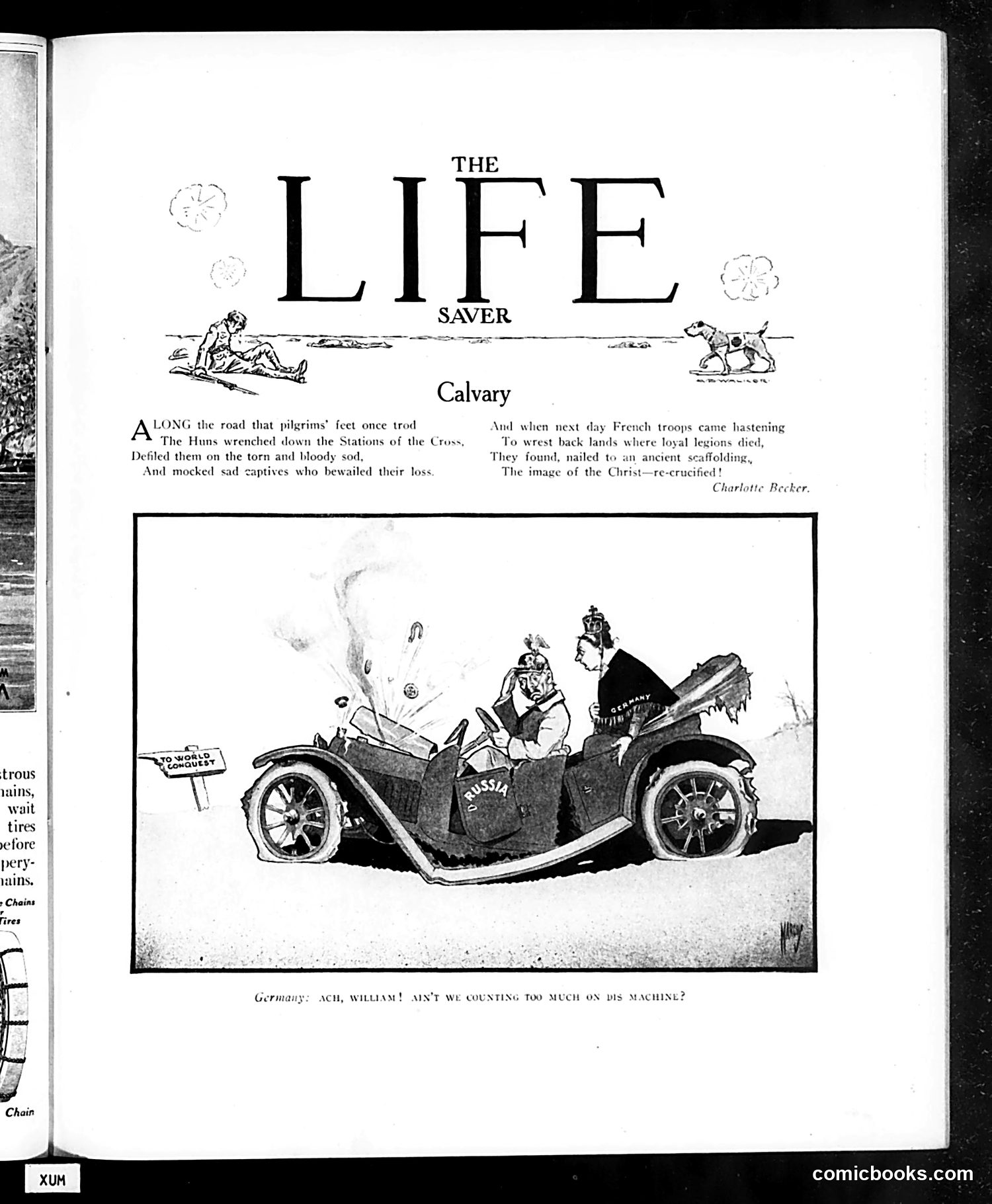
This is a WWI-era political cartoon satirizing Germany's military situation. The main illustration shows a damaged car labeled "RUSSIA" with German and Austrian military figures inside, appearing distressed as the vehicle breaks down on a road marked "TO BERLIN." The cartoon's point: Germany is losing the Russian front (likely referencing Russia's 1917 exit from the war), and this loss is crippling German military capability—portrayed as a broken-down vehicle unable to reach Berlin. The poem above by Charlotte Becker invokes religious imagery, comparing the pilgrimage of soldiers to Calvary (Christ's crucifixion site), suggesting the senseless carnage of war. The caption has Germany asking Austria, "Ach, William! ain't we counting too much on his machine?"—questioning whether their alliance can survive without Russian opposition.
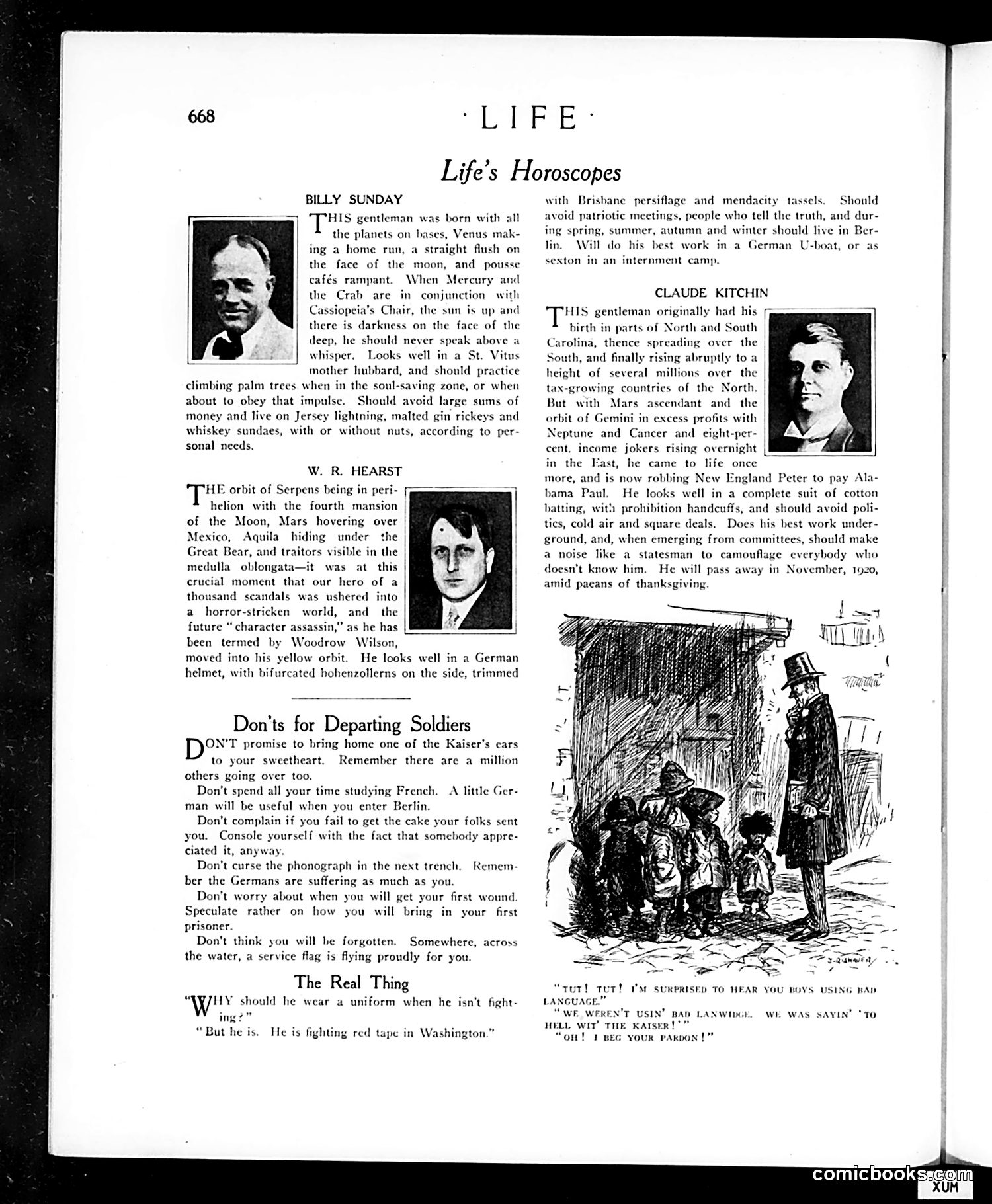
This page contains astrological character sketches of public figures (Billy Sunday, W.R. Hearst, Claude Kitchin) and WWI-era satirical content. The main cartoon depicts soldiers departing for war, with the caption showing an officer scolding soldiers for using "bad language," while they protest they were "savin' to hell wit' the Kaiser!" The satire mocks military discipline: officers enforce linguistic propriety while soldiers are literally going to fight and die in combat—absurd priorities given the brutal reality of war. The "Don'ts for Departing Soldiers" section offers cynical advice to enlisted men about fraternization, homesickness, and combat experiences, reflecting American anxieties about young men entering WWI. The final exchange—"Why should he wear a uniform when he isn't fighting?" / "But he is. He is fighting red tape in Washington"—satirizes military bureaucracy as the real enemy soldiers face.
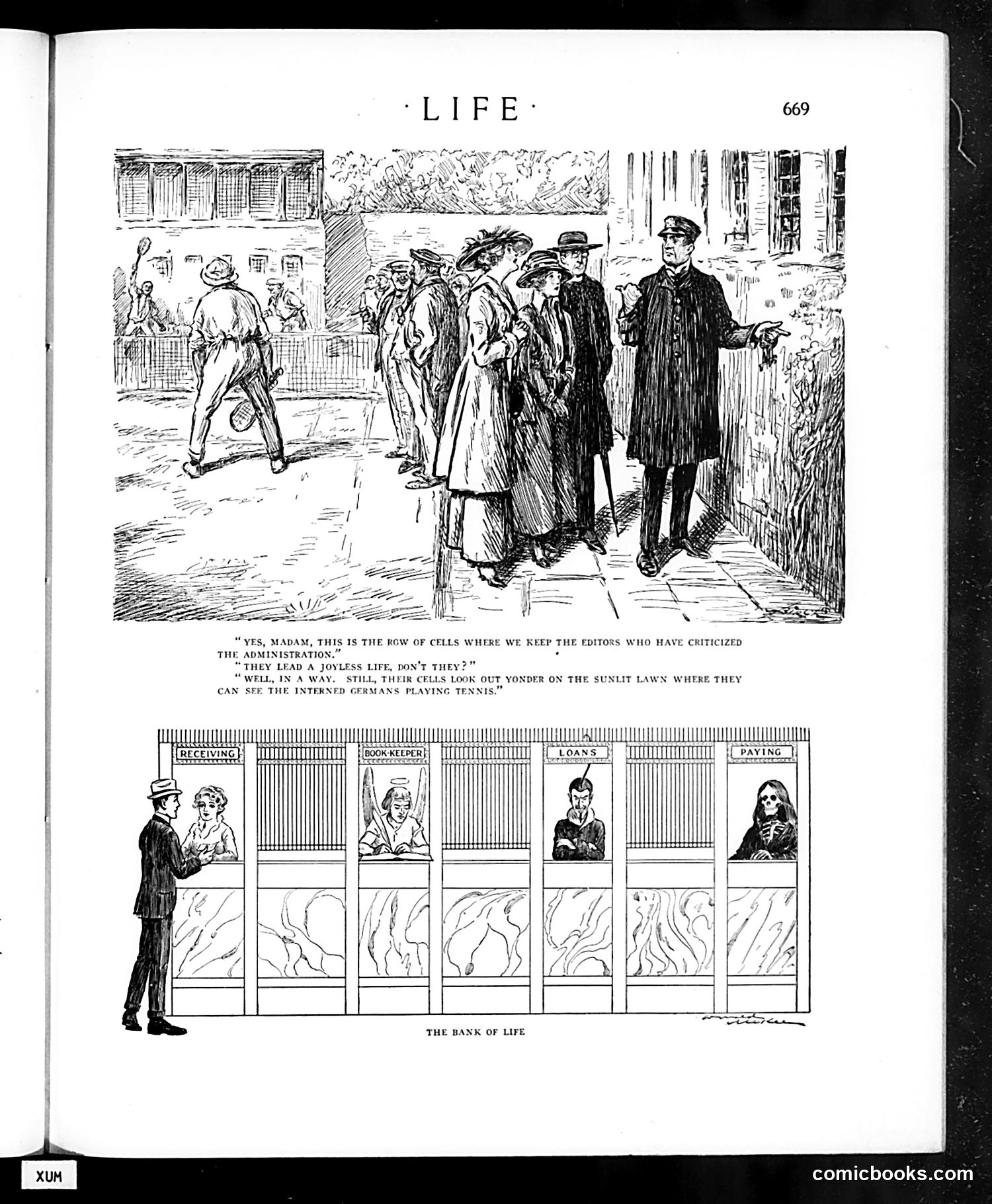
This page contains two satirical cartoons about press freedom and editorial criticism. The **top cartoon** depicts officials touring a prison, explaining they house "editors who have criticized the administration." The joke is darkly ironic: one official notes the imprisoned editors seem content because they can see German prisoners playing tennis outside—suggesting that even censored, imprisoned critics have better conditions than some foreigners. The **bottom cartoon**, titled "The Bank of Life," shows a bank teller window where different character types (labeled with occupations like "Clothing" and "Loans") are displayed as if depositing or withdrawing from life itself—a metaphorical commentary on how different social roles engage with opportunity and resources. Both cartoons satirize institutional power and social hierarchy.
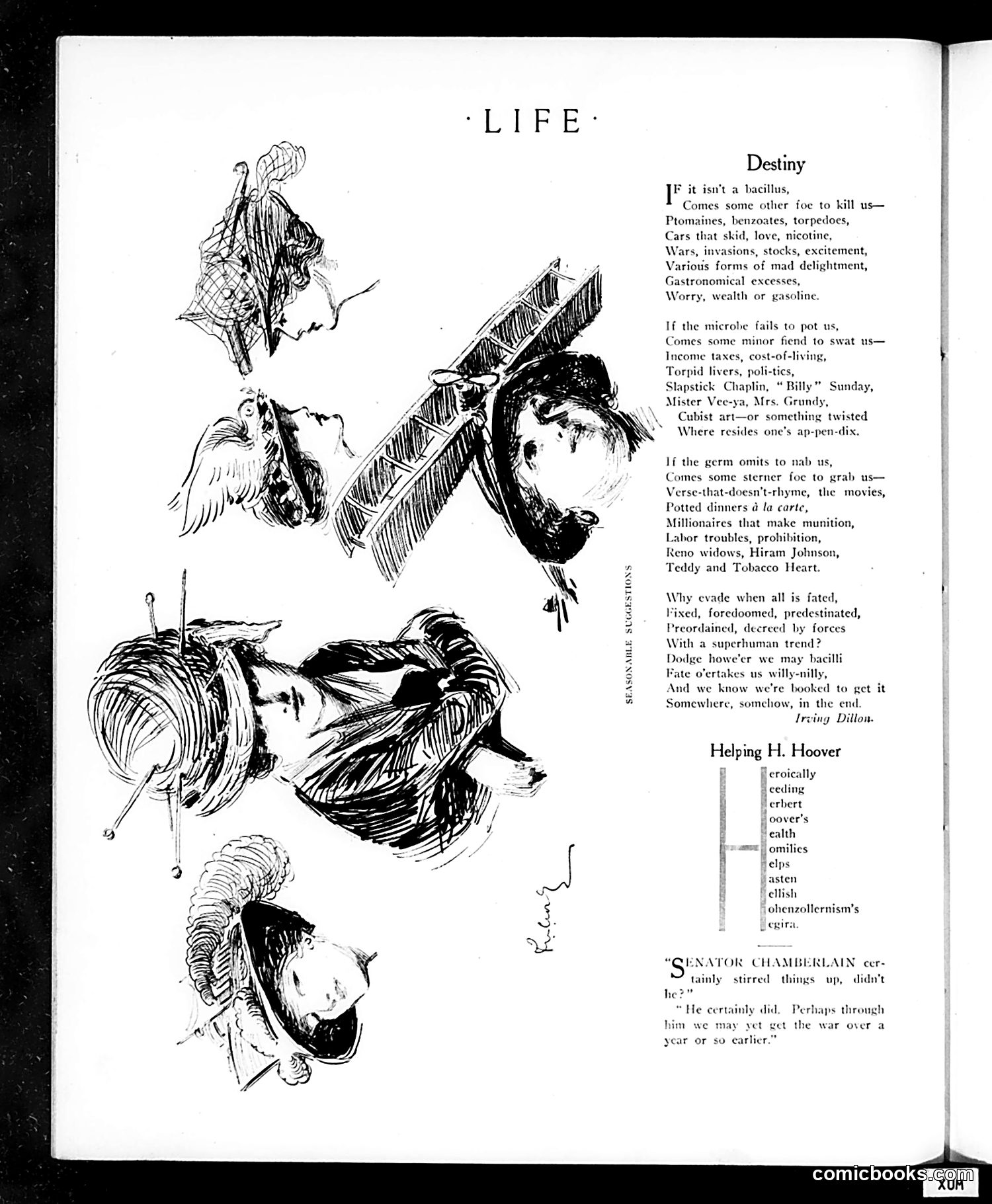
This page presents a satirical poem titled "Destiny" alongside ink sketches of various figures. The poem humorously catalogs life's inevitable troubles—from "bacilli" and "promises" to "wars, invasions, stocks, excitement" and "gastronomy excesses." It suggests that if one threat fails to kill us, another will inevitably arrive: taxes, bad entertainment (mentioning "Chaplin," "Billy" Sunday), or disease. The accompanying sketches appear to depict personified abstract concepts or caricatured figures representing these life obstacles. The lower section includes "Helping H. Hoover"—likely referencing President Herbert Hoover—with a wordplay list of tongue-twister phrases. The final dialogue references "Senator Chamberlain," possibly discussing war prospects. The overall message mocks life's inescapable hardships with dark humor characteristic of 1920s-era satire.
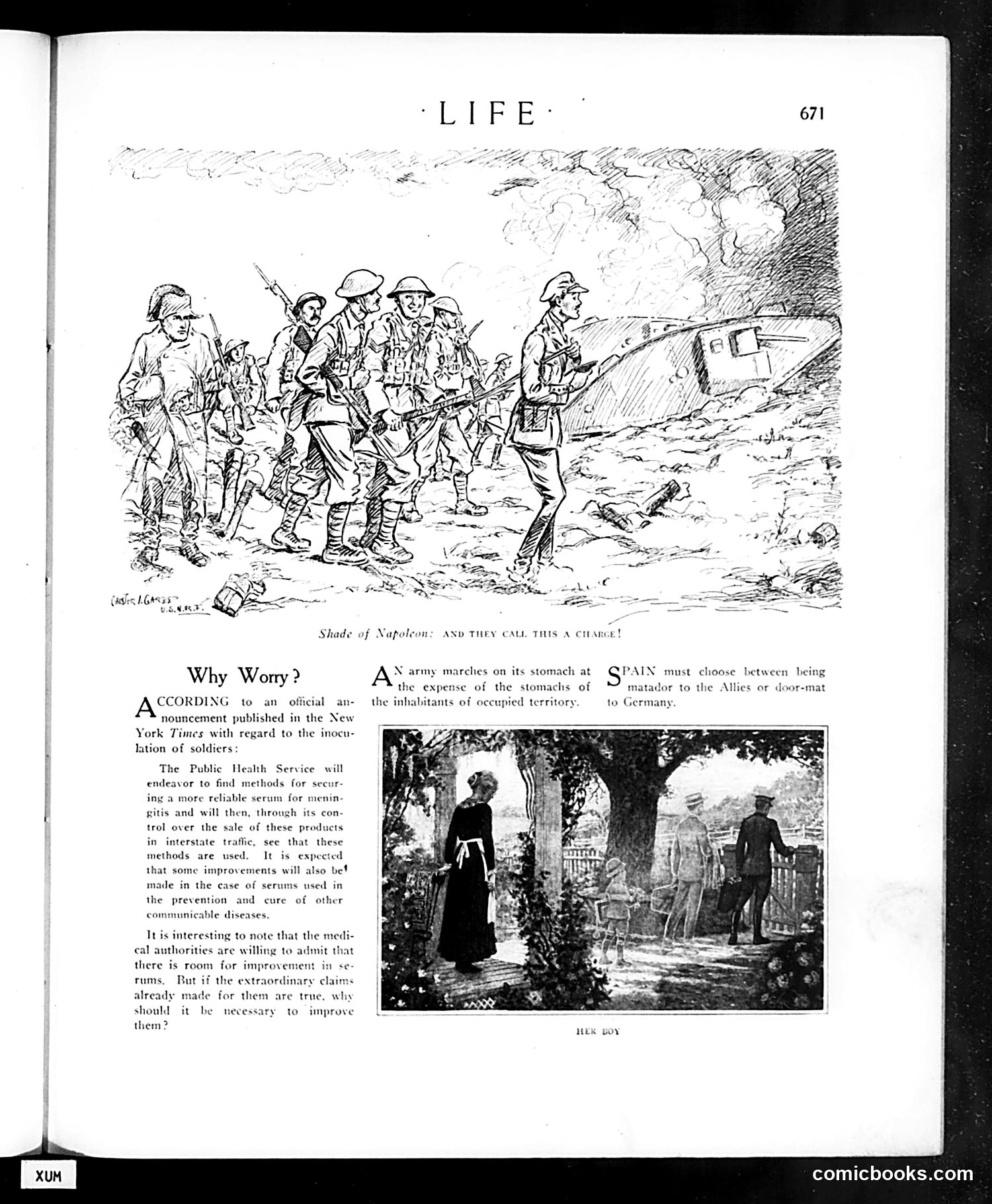
**Top Cartoon:** Titled "Shade of Napoleon: AND THEY CALL THIS A CHARGE!" depicts WWI soldiers in a trench with a tank nearby. The satire compares modern mechanized warfare unfavorably to Napoleon's military strategies—suggesting that despite technological advances, soldiers still face brutal conditions and the concept of a meaningful "charge" has become absurd. The ghostly reference to Napoleon implies nostalgia for supposedly more glorious warfare. **"Why Worry?" Article:** Discusses public health concerns about soldier inoculations and disease control during wartime. It notes medical authorities acknowledge room for improvement in serum safety, while questioning whether extraordinary claims about these serums are justified if improvements are still needed. **Bottom Photograph:** Captioned "Her Boy," shows a woman in period dress meeting with a uniformed soldier—likely depicting the emotional human cost of war through a personal reunion.
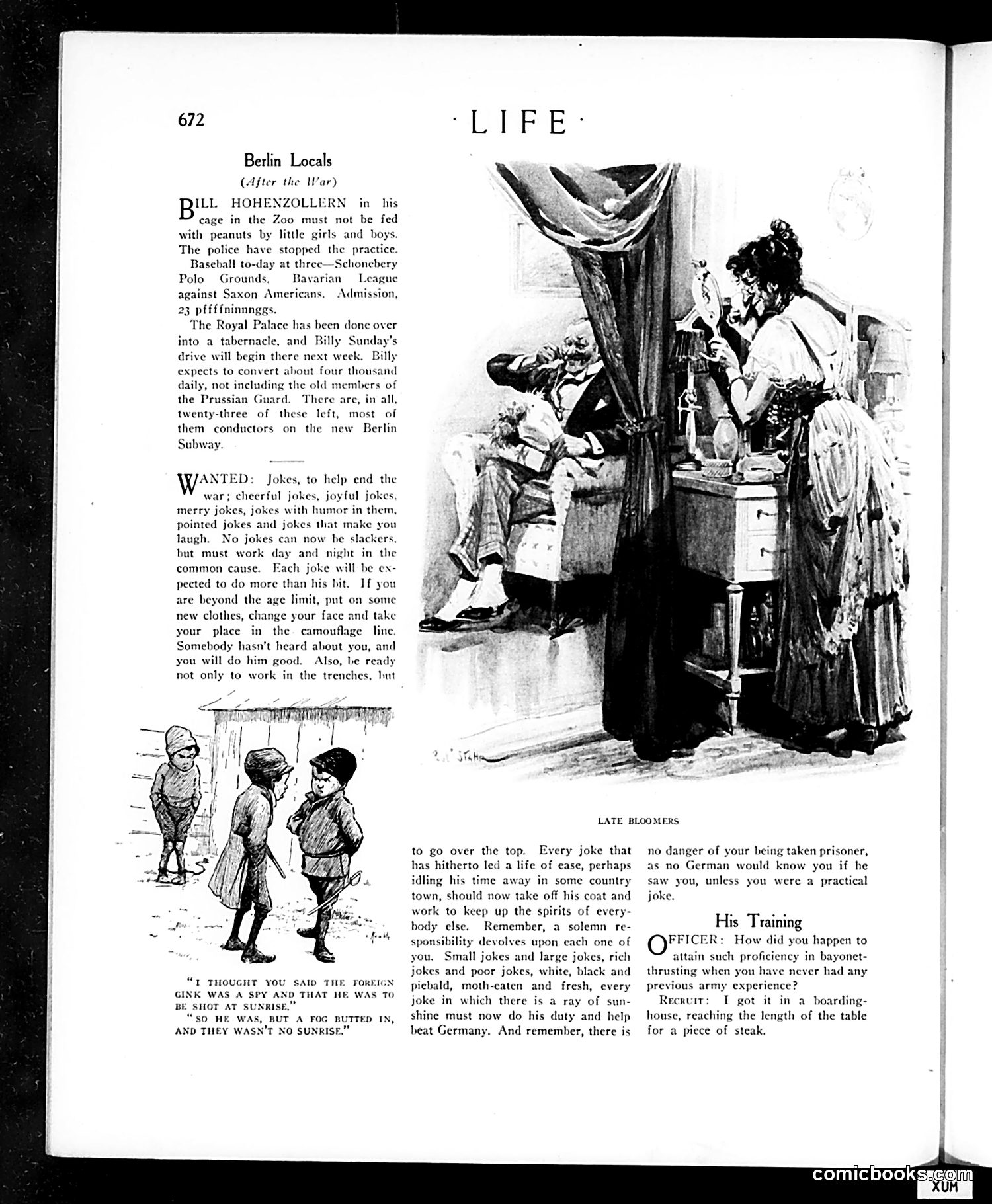
This page from *Life* magazine presents post-WWI Berlin commentary through two sections: **Top section**: Text about Bill Hohenzollern (likely a satirical reference to Kaiser Wilhelm II or German nobility) and Berlin's post-war transformations—the Royal Palace becoming a tabernacle, Billy Sunday's evangelical revival meetings drawing crowds, and twenty-three former German military conductors now leading the Berlin Subway orchestra. **"Late Bloomers" illustration**: Shows women in period dress, apparently depicting post-war Berlin's changing social dynamics. **Bottom section**: "His Training" discusses military recruit bayonet training in boarding houses. The satire mocks Germany's post-war upheaval—religious revival replacing imperial authority, militarism persisting in civilian life, and social disruption. The tone is darkly humorous about Germany's struggling transition from imperial power to Weimar Republic.
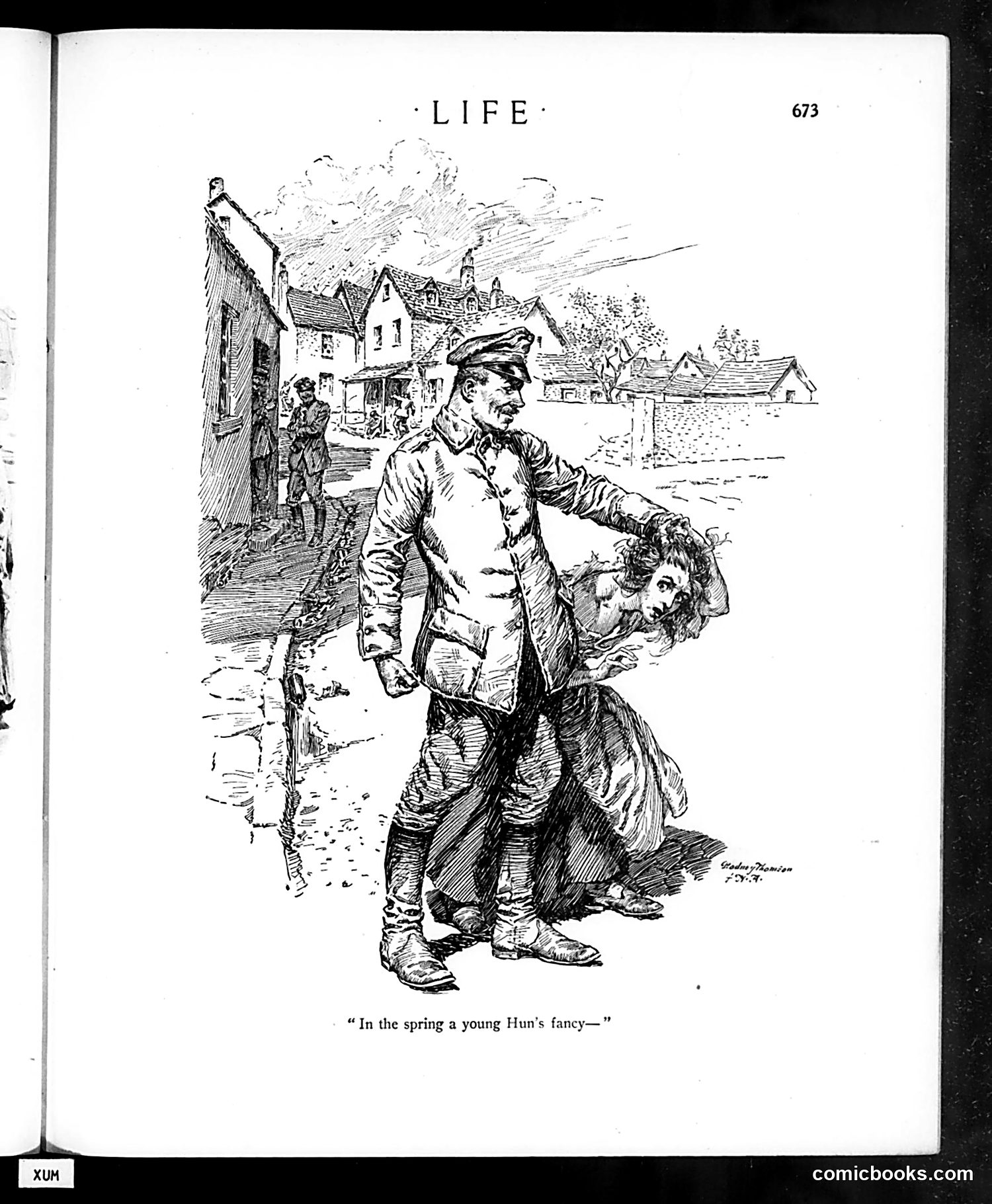
This illustration depicts a military officer in what appears to be early 20th-century uniform, playfully holding a young child. The caption reads: "In the spring a young Hun's fancy—" The cartoon is a satirical play on the famous opening line of Robert Browning's poem "Pied Piper": "In the spring a young man's fancy lightly turns to love." Here, "Hun" is a dehumanizing term for Germans, particularly common during World War I propaganda. The joke suggests German military aggression and conquest—instead of romantic thoughts in spring, this "Hun" officer's fancy turns to dominating or "acquiring" children/territory. It's wartime propaganda commentary on German imperialism, presenting Germans as brutal rather than civilized.
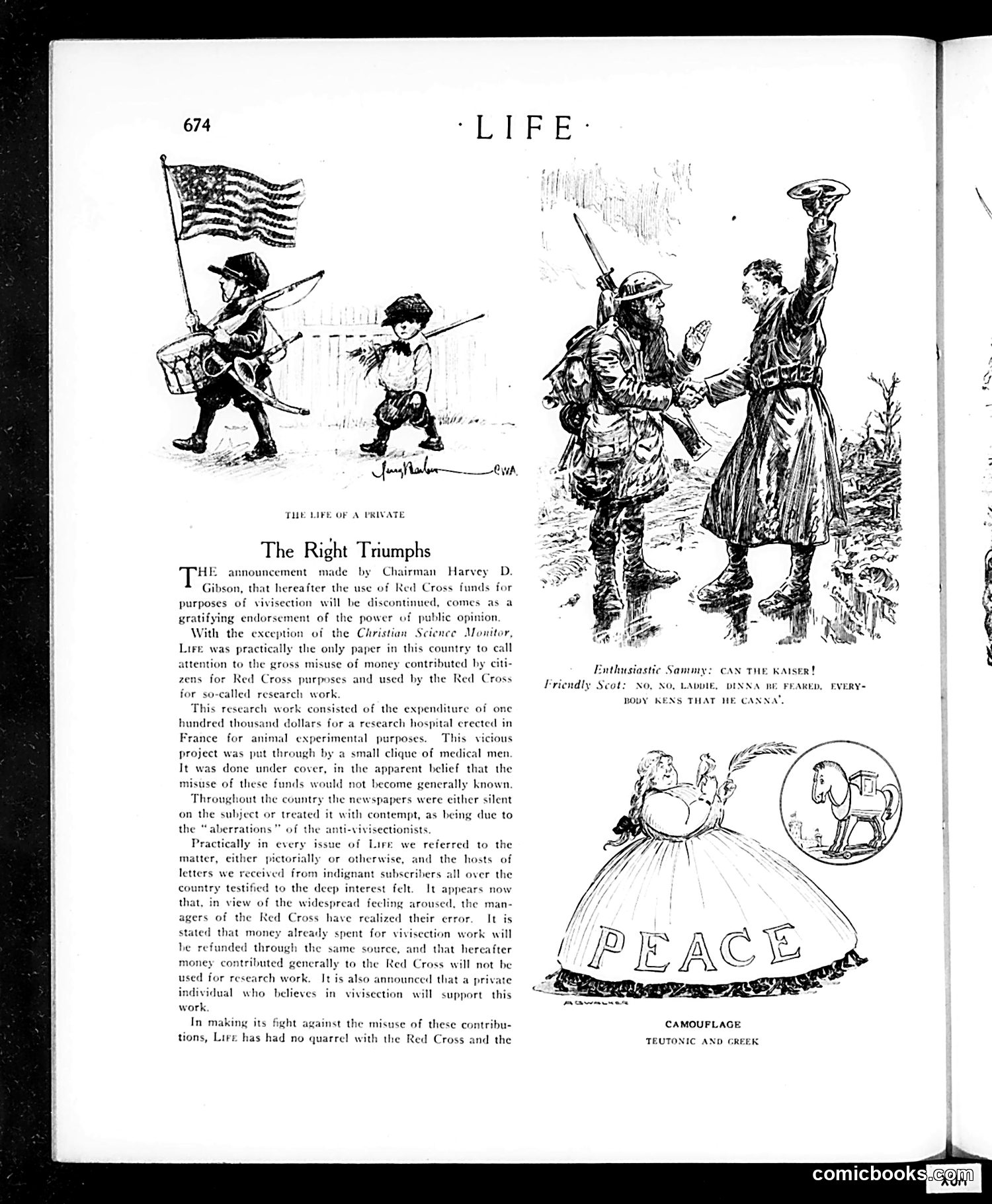
This page critiques the Red Cross's misuse of charitable donations. Chairman Harvey D. Gibson announced that Red Cross funds contributed for inspection purposes were instead spent on animal experimentation at a French research hospital—a practice kept secret from donors. **Left cartoon** ("The Life of a Private"): Shows a soldier with American flag, satirizing how public donations were diverted. **Top right cartoon**: Depicts military figures, likely representing Red Cross leadership's deception of the public. **Bottom illustration** ("Peace"): A dove carrying an olive branch, symbolizing the ironic contrast between the Red Cross's humanitarian mission and its actual misappropriation of funds. Life's editorial victory here celebrates exposing this fraud through public pressure, forcing the Red Cross to reverse course and refund misused money.
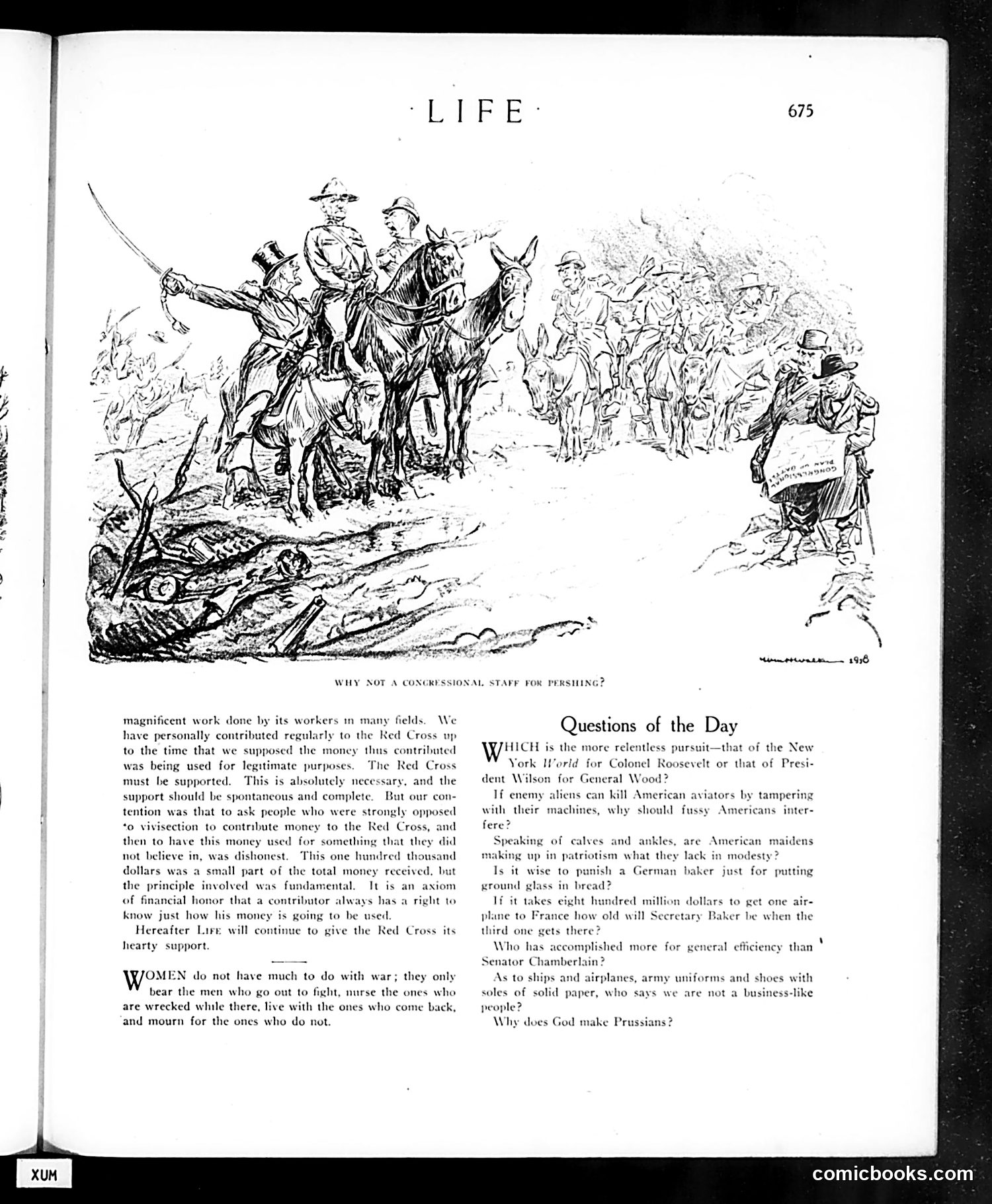
This 1916 Life magazine page contains a political cartoon titled "Why Not a Congressional Staff for Pershing?" The sketch depicts General John J. Pershing (identifiable by military uniform and context) on horseback, pointing a sword toward a large group of soldiers or congressional figures on the right. The satire criticizes Congress, suggesting they should provide better military staff support to Pershing rather than interfering with his command. The cartoon appears to mock Congressional micromanagement of military operations during World War I. The "Questions of the Day" section below poses rhetorical questions about war-related topics, including comparisons between Roosevelt and Wilson, treatment of German aliens, and military efficiency—typical wartime political debates of 1916.
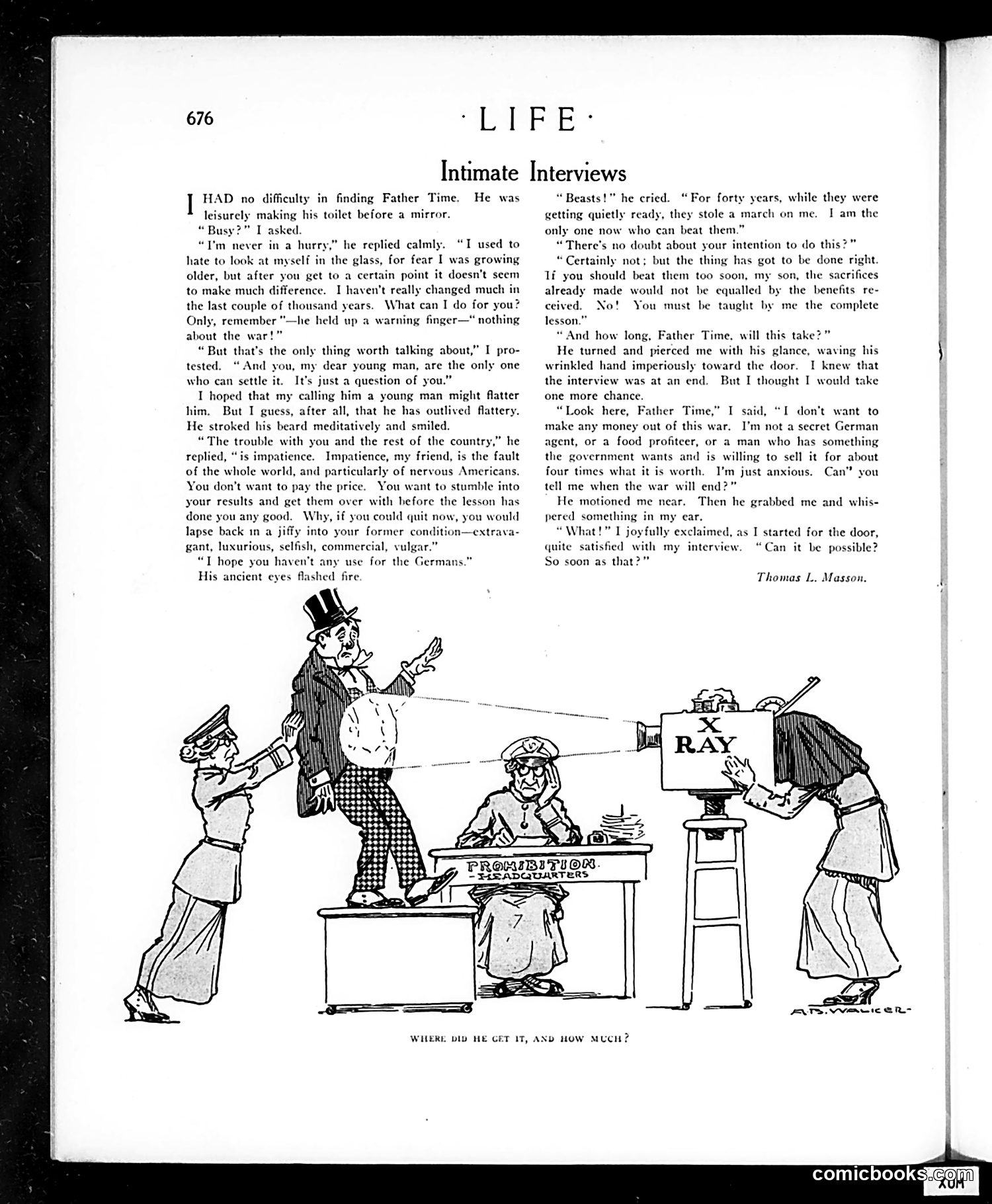
This is a satirical interview piece by Thomas L. Masson featuring personified **Father Time** as a character who refuses to discuss the war (World War I, based on context clues like "Germans" and prohibition references). **The satire's targets:** The main joke is that Father Time—ancient, impartial, all-knowing—lectures Americans about **impatience**. He warns that Americans want quick victory without paying the moral price, and that rushing would only let them revert to "extravagant, luxurious, selfish, commercial" behavior. This criticizes American eagerness to end the war without proper reformation. **The cartoon below** shows prohibition headquarters under interrogation ("Where did he get it, and how much?"), satirizing how Americans concern themselves with enforcing prohibition while ignoring weightier wartime issues. **The deeper point:** Americans are portrayed as shallow—obsessed with consumer excess and petty enforcement—rather than focused on genuine moral improvement through sacrifice.
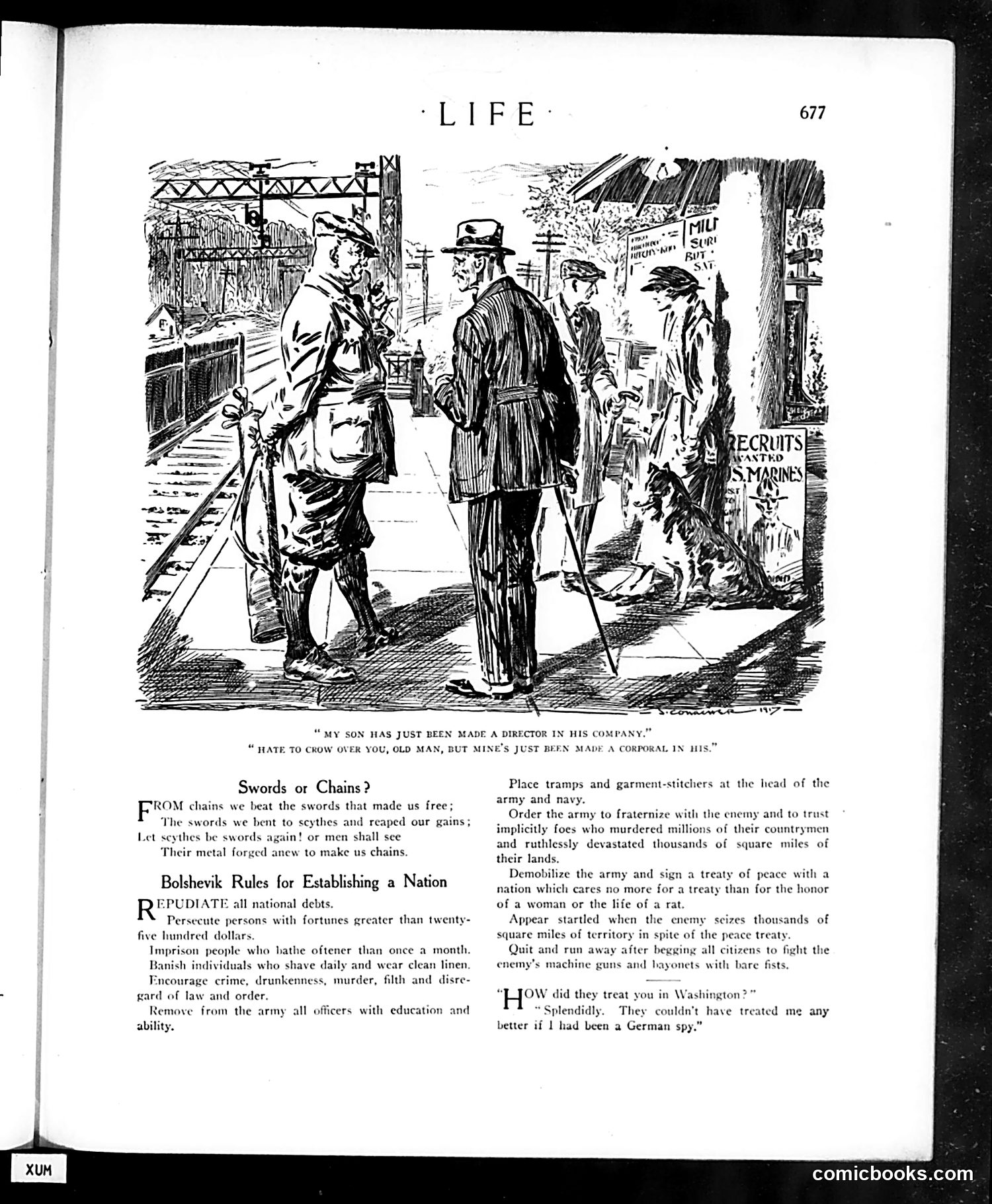
**The Main Cartoon:** Military officers compare their sons' promotions—one's son became a director, the other a corporal. The joke mocks competitive boasting about military advancement, suggesting even modest rank feels worthy of pride. **"Swords or Chains?"** This poem appears to reference post-WWI concerns, suggesting America's weapons of freedom could become instruments of oppression if misused. **"Bolshevik Rules for Establishing a Nation":** This is savage anti-communist satire, likely responding to the 1917 Russian Revolution and Bolshevik consolidation of power. It caricatures Bolshevik ideology through absurd "rules"—persecuting the wealthy, encouraging crime, removing educated officers, fraternizing with enemies, and abandoning citizens. The satire attacks communism as destructive chaos disguised as reform. **Final Exchange:** A soldier reports being treated well in Washington, joking they'd receive better treatment if identified as a "German spy"—reflecting post-WWI suspicion of foreigners and satirizing American attitudes toward enemy nationals. The page reflects 1920s American anticommunist anxiety and post-war social tensions.
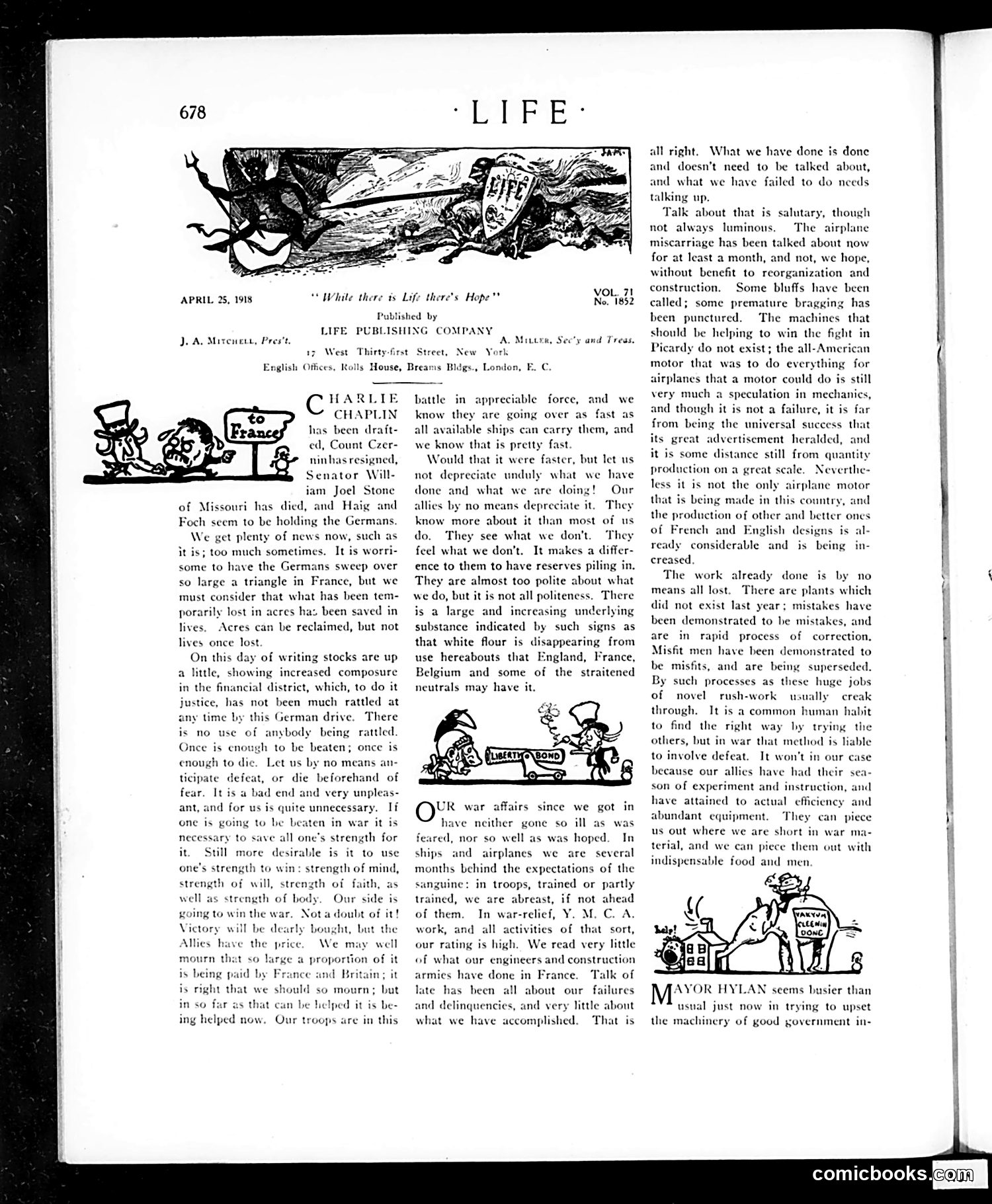
This page is primarily editorial text addressing American war efforts during World War I, with decorative cartoon vignettes rather than a single coherent political cartoon. **Context:** The article discusses recent military developments—Charlie Chaplin's draft, various political deaths, and the German spring offensive in France. The author urges Americans to maintain morale and avoid anticipatory defeat, while acknowledging real shortcomings. **Key references:** - American troops being shipped to France rapidly - Failures in airplane production (a genuine scandal of 1918) - Y.M.C.A. war relief efforts - Allies' appreciation for American support **The cartoons' apparent point:** The small illustrations reinforce the editorial's message about resilience and steady effort rather than panic. The motto "While there is Life there's Hope" encapsulates the piece's optimistic but realistic tone during a critical war moment. **For modern readers:** This reflects 1918 American anxieties—industrial failures, troop deployment logistics, and maintaining civilian morale during a grinding conflict.
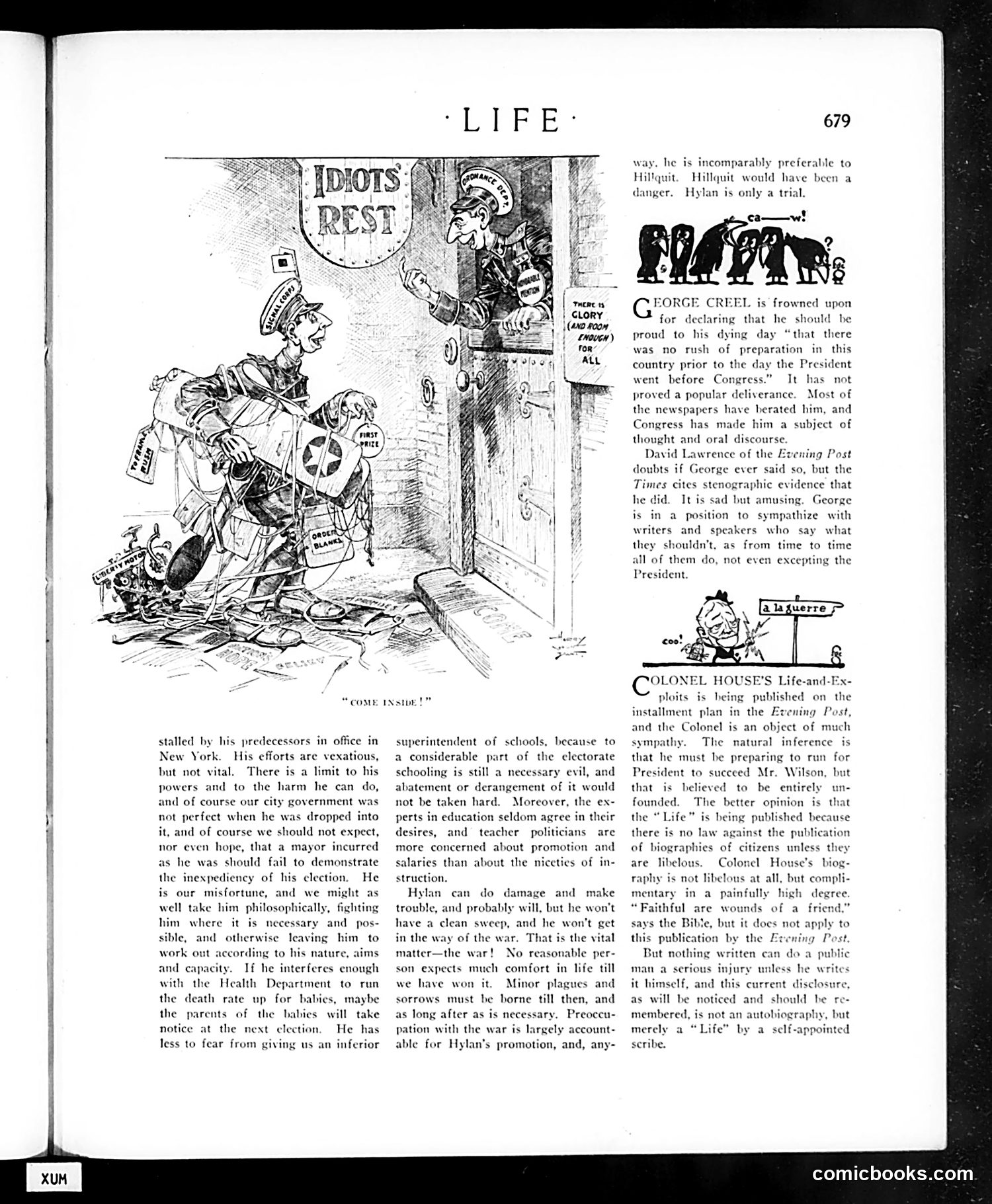
This page contains three separate editorial commentaries rather than traditional cartoons. **The Mayor Hylan cartoon** (left) depicts a disheveled new mayor entering office amid chaos—labeled "Idiots Rest"—surrounded by symbols of previous administrative failures. The text dismisses Mayor Hylan as a "misfortune" but argues he's preferable to his opponent Hillquit (apparently a socialist candidate). The key point: readers shouldn't worry about Hylan's incompetence because wartime preoccupation (WWI context) makes him a minor concern compared to keeping a dangerous radical out of office. **The George Creel commentary** discusses criticism of Creel's statement that America wasn't rushing to prepare for war before Congressional approval. The author finds this amusing and sympathetic to public figures who misspeak. **The Colonel House section** addresses serialized biography of Woodrow Wilson's advisor being published in the *Evening Post*, noting it's not libelous but merely flattering—and crucially, self-appointed commentary rather than autobiography. All three pieces reflect wartime political anxieties and media criticism from approximately 1917-1918.
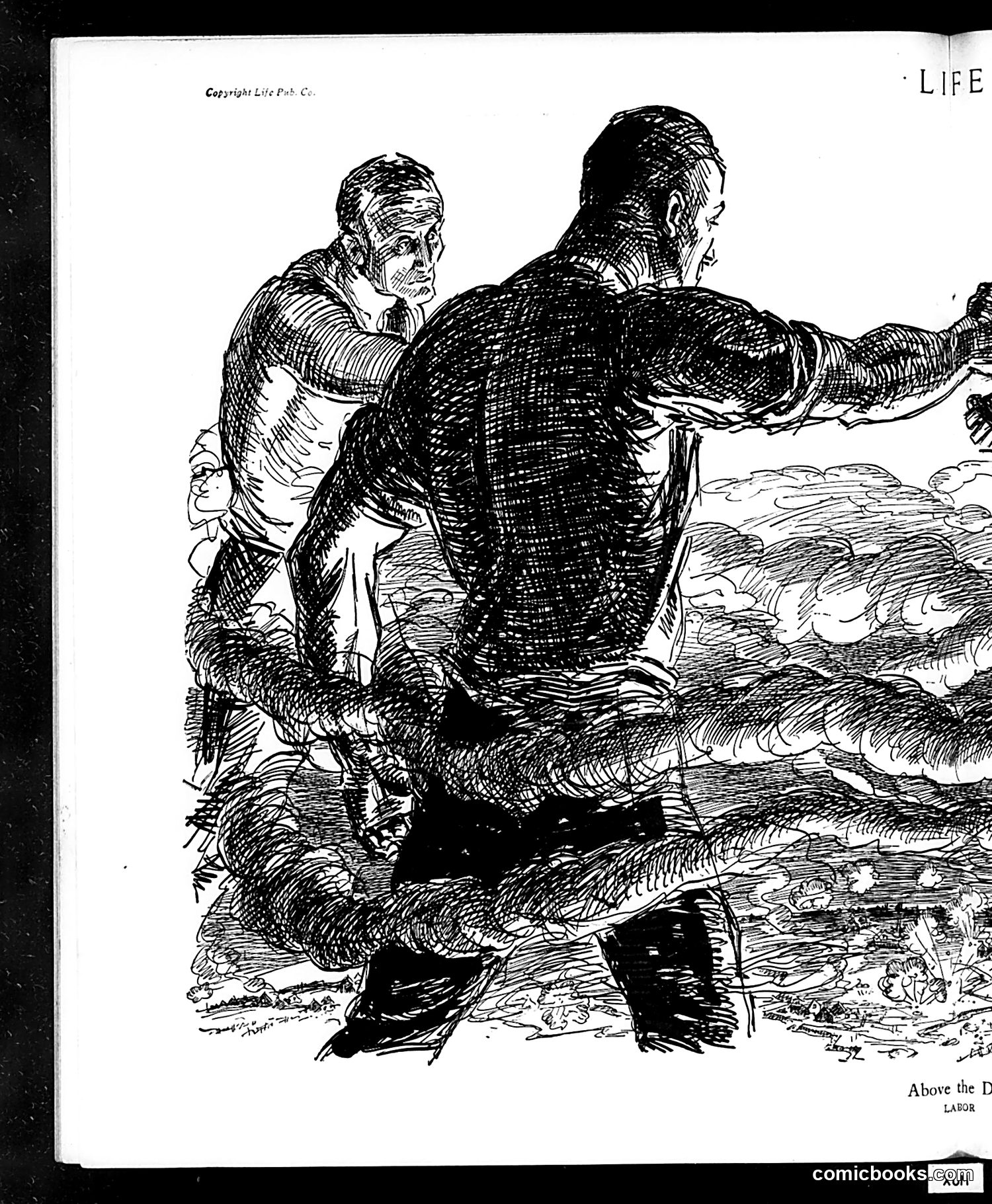
This is a political cartoon from *Life* magazine titled "Above the D[...] Labor" (the full title appears cut off). The illustration shows two men in formal attire standing on what appears to be rocky or mountainous terrain. One man, positioned behind, gestures expansively outward with his arm extended. The other, smaller figure stands ahead of him. The artistic style—heavy cross-hatching and caricatured facial features—is typical of early-20th-century satirical illustration. Based on the "Labor" caption, this likely comments on labor-management relations or class dynamics of the era. The positioning suggests one figure (possibly a capitalist or employer) directing or commanding the other (possibly a worker or labor representative). However, without the complete title or publication date visible, the specific historical event or individuals being satirized cannot be definitively identified.
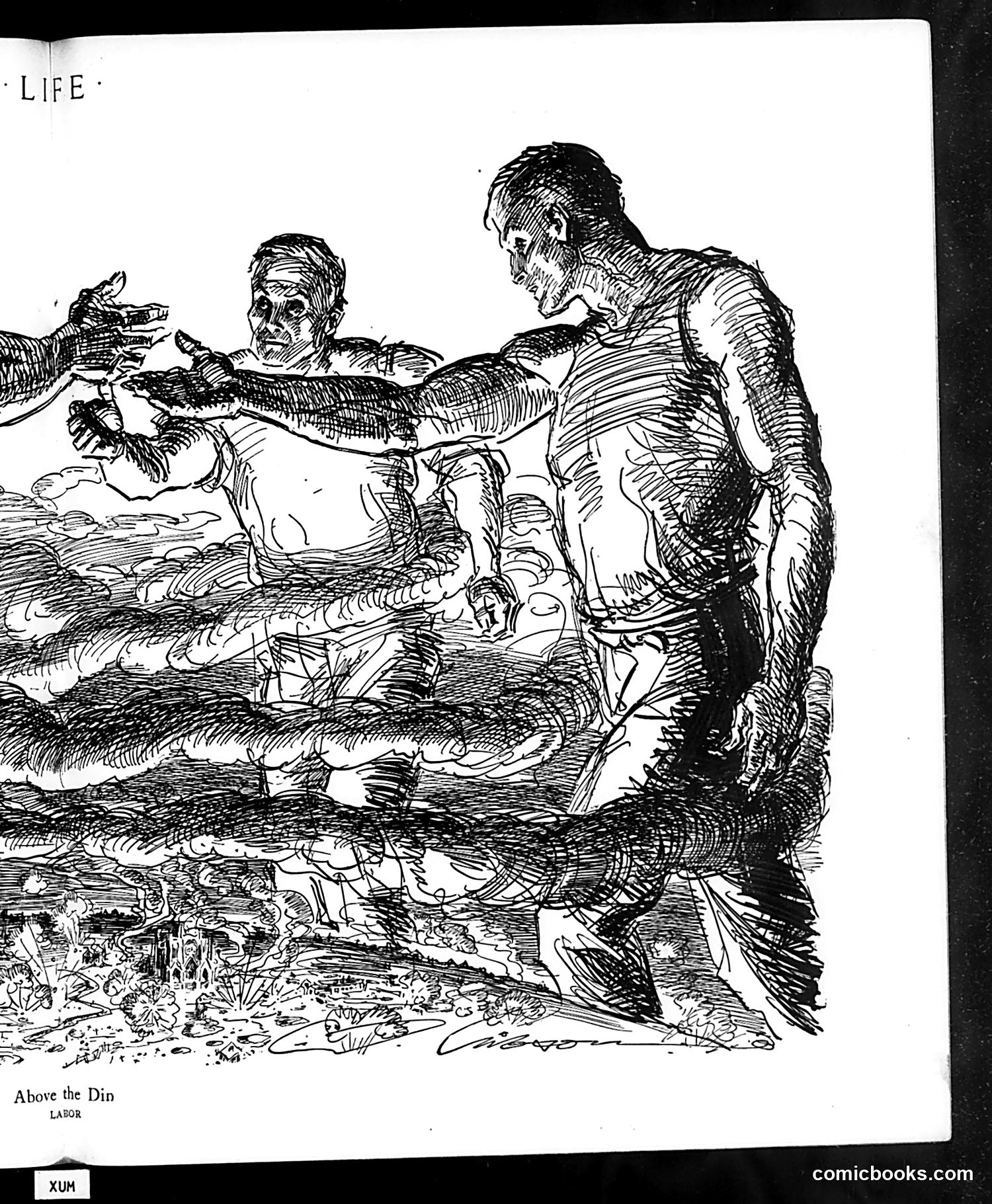
This political cartoon depicts two men engaged in a physical struggle over what appears to be a large fish or catch, with additional figures visible in the background. The title "Above the Din" combined with the "Labor" caption suggests commentary on labor disputes or class conflict. The cartoon likely satirizes disagreement between labor and management—the two figures probably represent opposing sides fighting over economic benefits or resources (symbolized by the fish). The struggle is depicted as chaotic and undignified, with the surrounding commotion ("din") implying the public discord caused by labor disputes. Without clearer identification of the figures or specific date, the precise historical labor conflict referenced remains unclear, though this reflects Life magazine's frequent satirization of early-to-mid 20th century labor tensions in America.
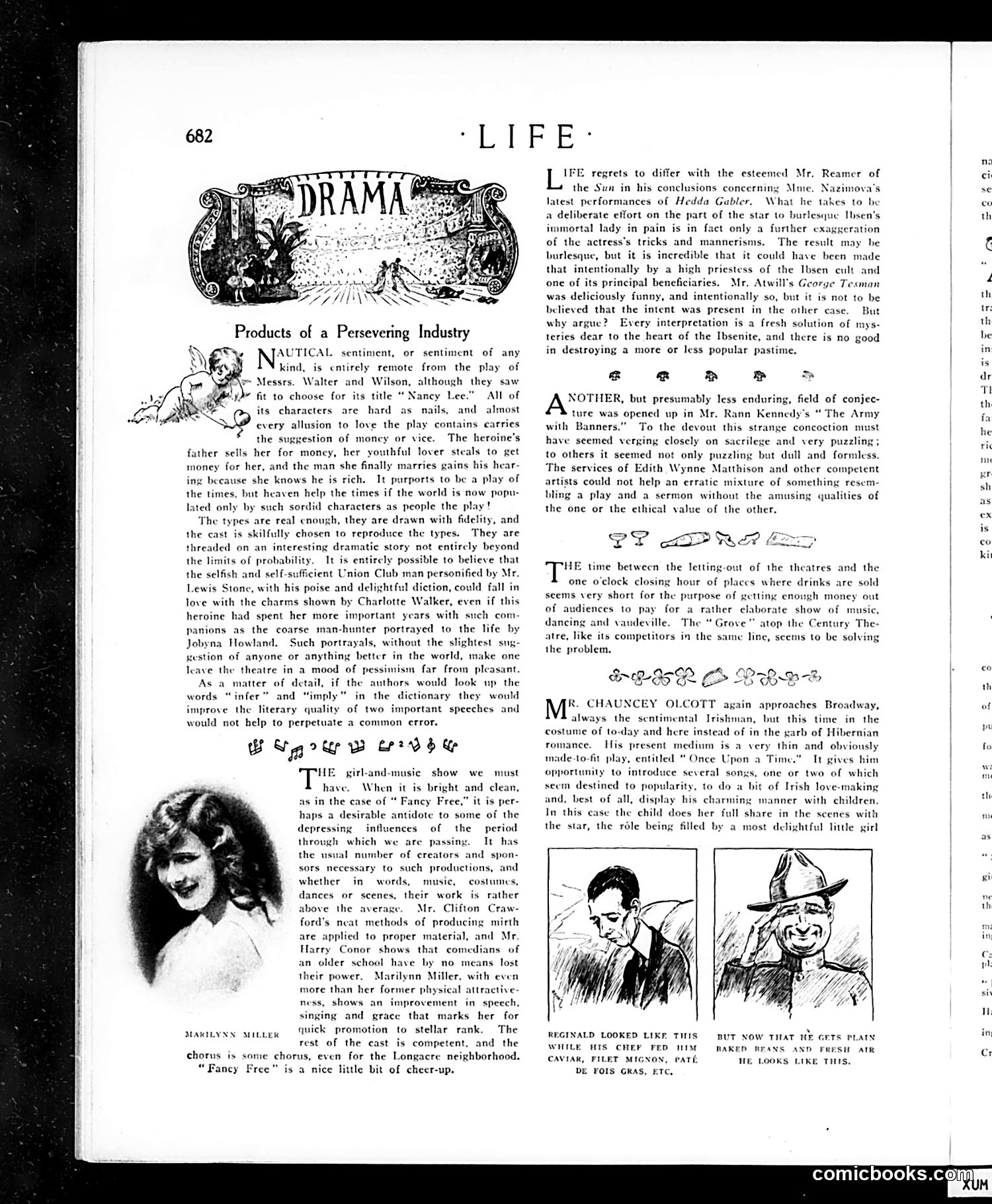
This page reviews three Broadway productions with characteristic satirical commentary: **"Nancy Lee"**: Criticized as cynically mercenary—characters motivated entirely by money and vice rather than sentiment. The reviewer praises the skilled cast (Lewis Stone, Charlotte Walker, Jobyna Howland) for authentically portraying sordid types, but condemns the play's pessimistic worldview. **"Fancy Free"**: A light musical praised as uplifting entertainment. Highlights include comedian Clifton Crawford's humor, Harry Conor (noted as representing older-school comedy talent), and Marilynn Miller, whose improved singing and grace promise "quick promotion to stellar rank." **Hedda Gabler**: Disputes critic Reamer's claim that Nazimova intentionally burlesques Ibsen. The reviewer argues her exaggerated mannerisms are unintentional, though the result appears comedic anyway—particularly Atwill's "deliciously funny" George Tesman. The satirical tone targets playwrights for moral emptiness while praising talented performers elevating mediocre material.
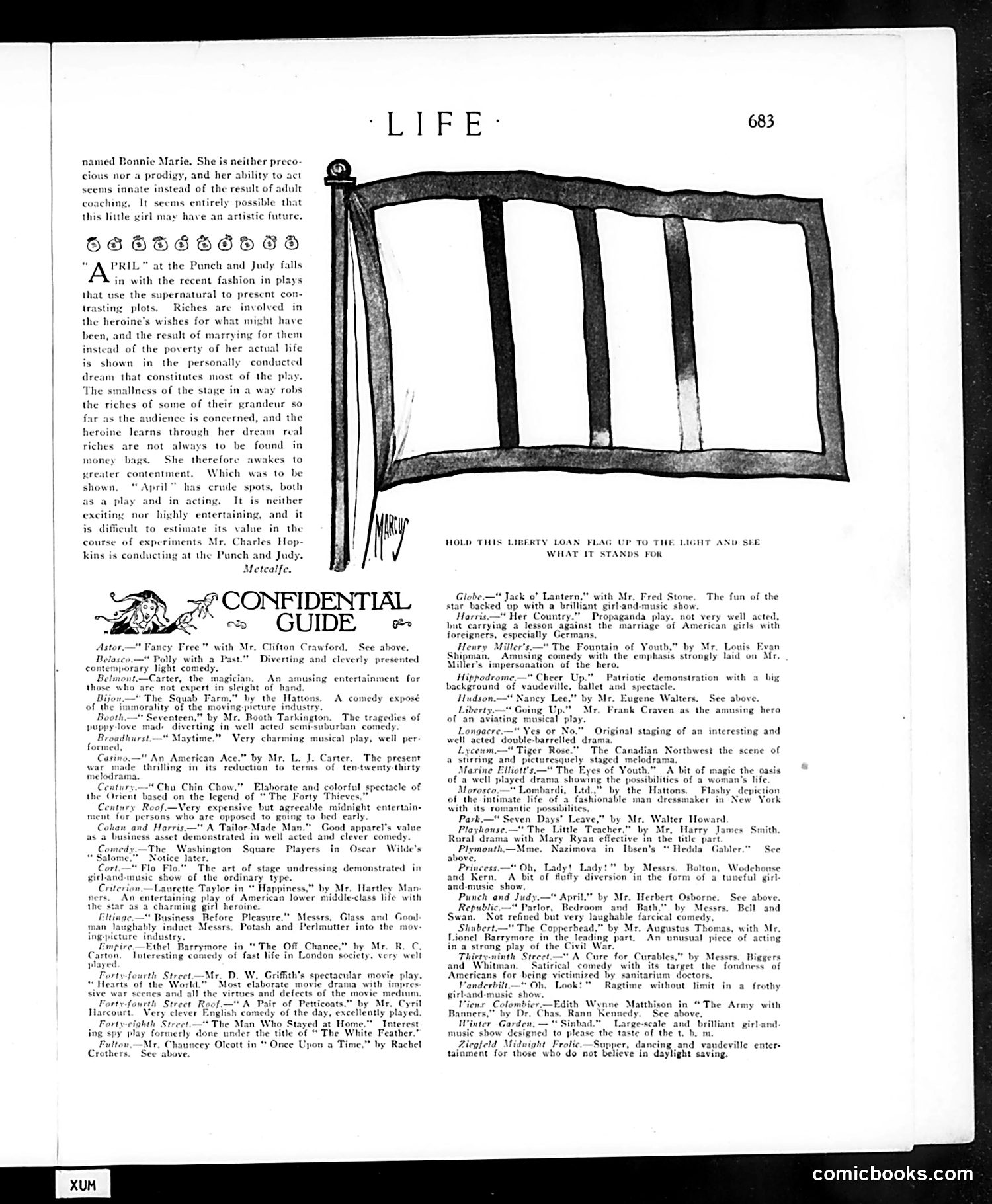
This page from *Life* magazine contains theatrical reviews and a "Confidential Guide" to Broadway shows, typical of the publication's entertainment coverage. The main visual element is a **Liberty Loan flag illustration** with text instructing readers to hold it up to light to see "what it stands for"—likely revealing a patriotic image or message, reflecting WWI-era bond drives. The reviews critique contemporary plays, including *April* (criticized for crude spots and supernatural plot devices), and mention propaganda plays like *Her Country*, which explicitly carries "a lesson against the marriage of American girls with foreigners, especially Germans." This anti-German sentiment reflects post-WWI American attitudes. The theatrical notices document Broadway's commercial entertainment ecosystem while occasionally embedding patriotic or moral messaging aligned with American interests during the period.
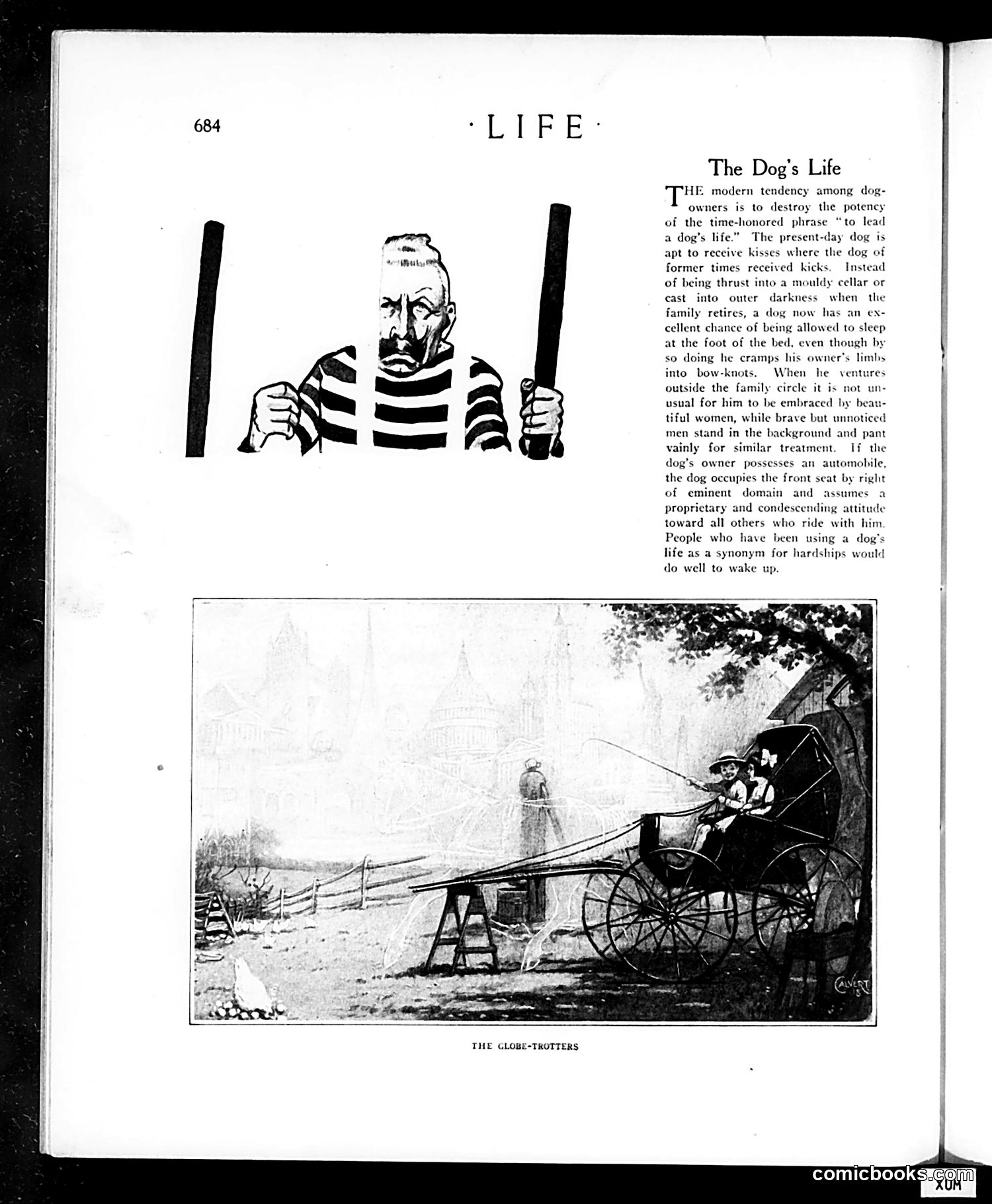
This satirical piece critiques the changing treatment of dogs among modern pet owners, contrasting past and present. **The cartoon's point:** The article argues that the phrase "leading a dog's life" (meaning hardship) has become obsolete. Modern dogs—particularly among the wealthy—receive luxurious treatment: sleeping in beds, receiving affection from women, occupying car front seats with proprietary attitudes, and receiving public admiration. **The satire:** The piece mocks contemporary dog owners for indulging their pets excessively, elevating dogs' status above that of unattended men who "pant vainly for similar treatment." The humor derives from inverting the traditional hierarchy—dogs now enjoy privileges once reserved for humans or the upper class. **Supporting imagery:** The top cartoon shows a man imprisoned or caged (suggesting constraint), while the bottom illustration, "The Globe-Trotters," depicts people traveling by carriage, possibly implying the leisurely lifestyle dogs now enjoy. This reflects early-20th-century class anxieties about leisure, consumption, and changing social norms around pet ownership and human relationships.
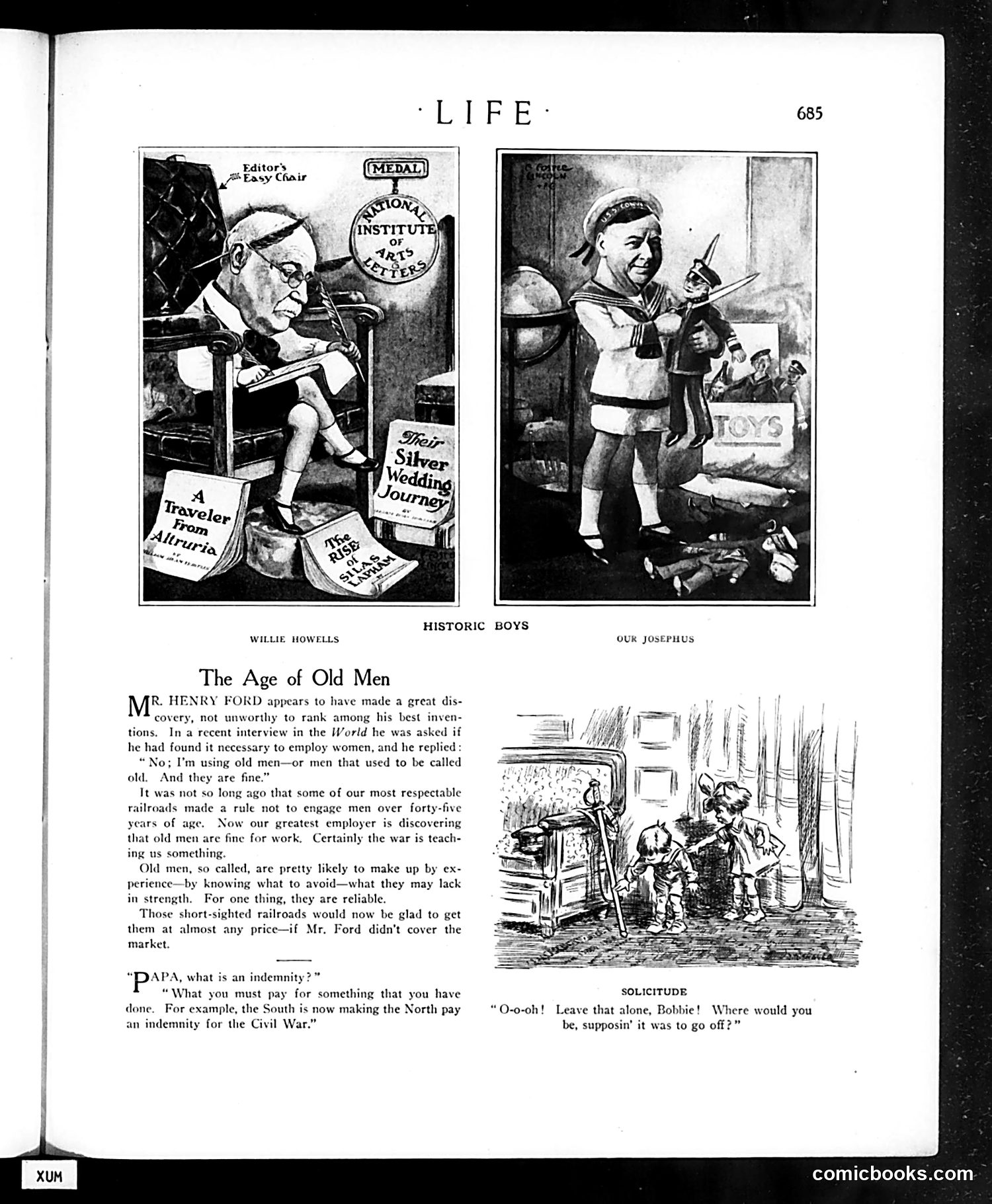
This *Life* magazine page satirizes Henry Ford's recent hiring of older workers. The article mocks Ford's supposed "discovery" that elderly men work reliably—noting the irony that railroads once refused to hire anyone over 45, yet now desperately want these same workers since Ford employs them. The top cartoons titled "Historic Boys" appear to be separate satirical pieces: "Willie Howells" shows an editor figure receiving medals and publishing achievements, while "Our Josephus" depicts a child playing soldier with toys. The bottom sketch, "Solitude," shows a domestic scene where a parent warns a child away from something dangerous, likely a gun or explosive device—a dark joke about wartime anxieties seeping into home life. The final dialogue about indemnities references post-Civil War reparations, sardonically suggesting the North still owes the South compensation—commentary on ongoing sectional tensions.
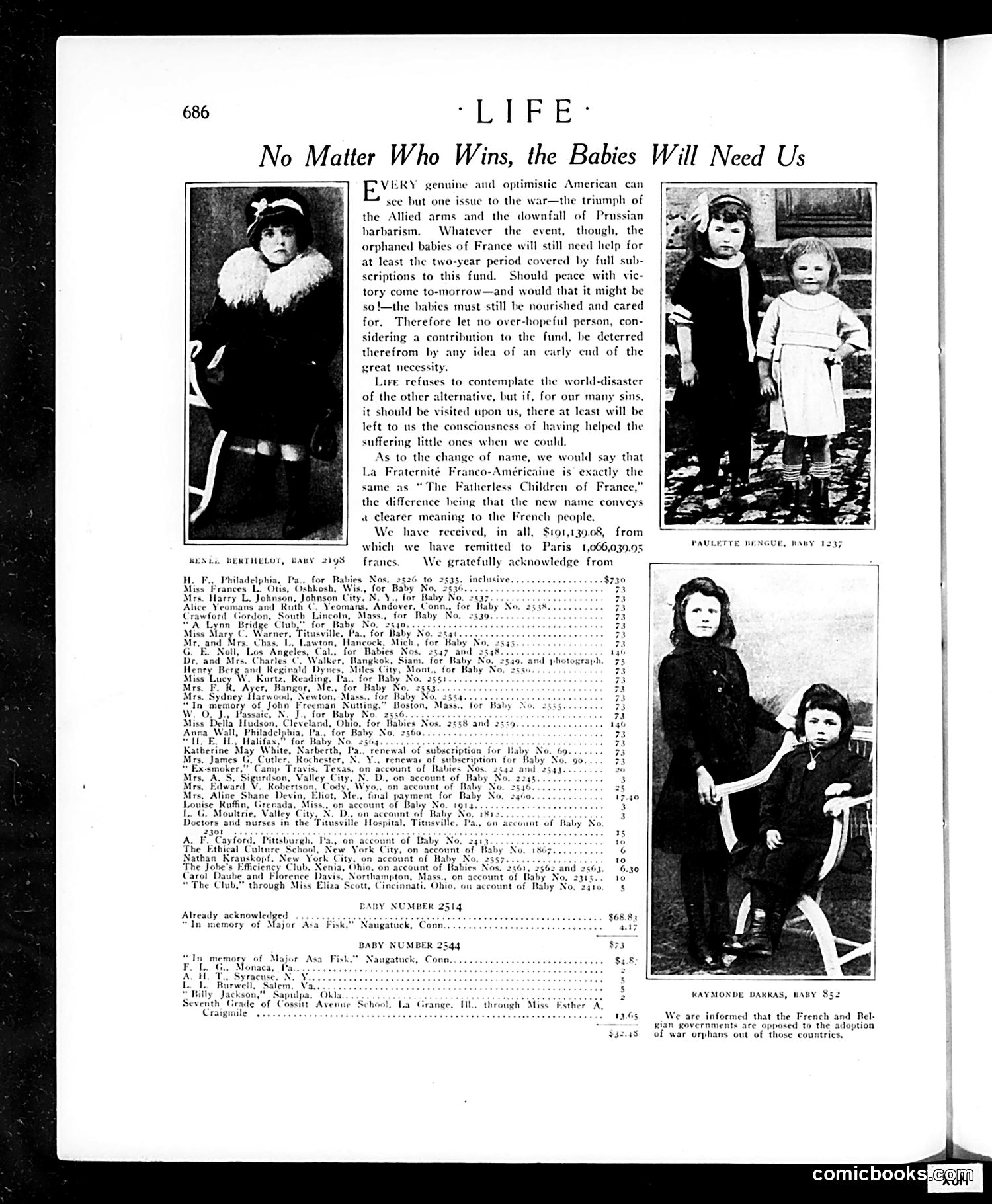
This page documents a charitable fundraising campaign for French war orphans during World War I. The heading "No Matter Who Wins, the Babies Will Need Us" emphasizes that regardless of the war's outcome, orphaned French children require ongoing support. The article explains that the fund, originally called "The Fatherless Children of France," has been renamed "La Fraternité Franco-Américaine" to resonate better with French people. It notes that $101,139.08 has been collected, with $1,066,030.95 francs remitted to Paris. The bulk of the page lists donors' names and contributions—ranging from individuals ($730) to small donations ($2-5)—along with the babies they sponsored. Photos show three French orphans being supported by the fund. A final note indicates that French and Belgian governments opposed adoption of war orphans out of those countries, suggesting this fund prioritized direct financial support rather than international adoption. This represents American charitable mobilization during WWI, combining patriotic sentiment with practical humanitarian aid.
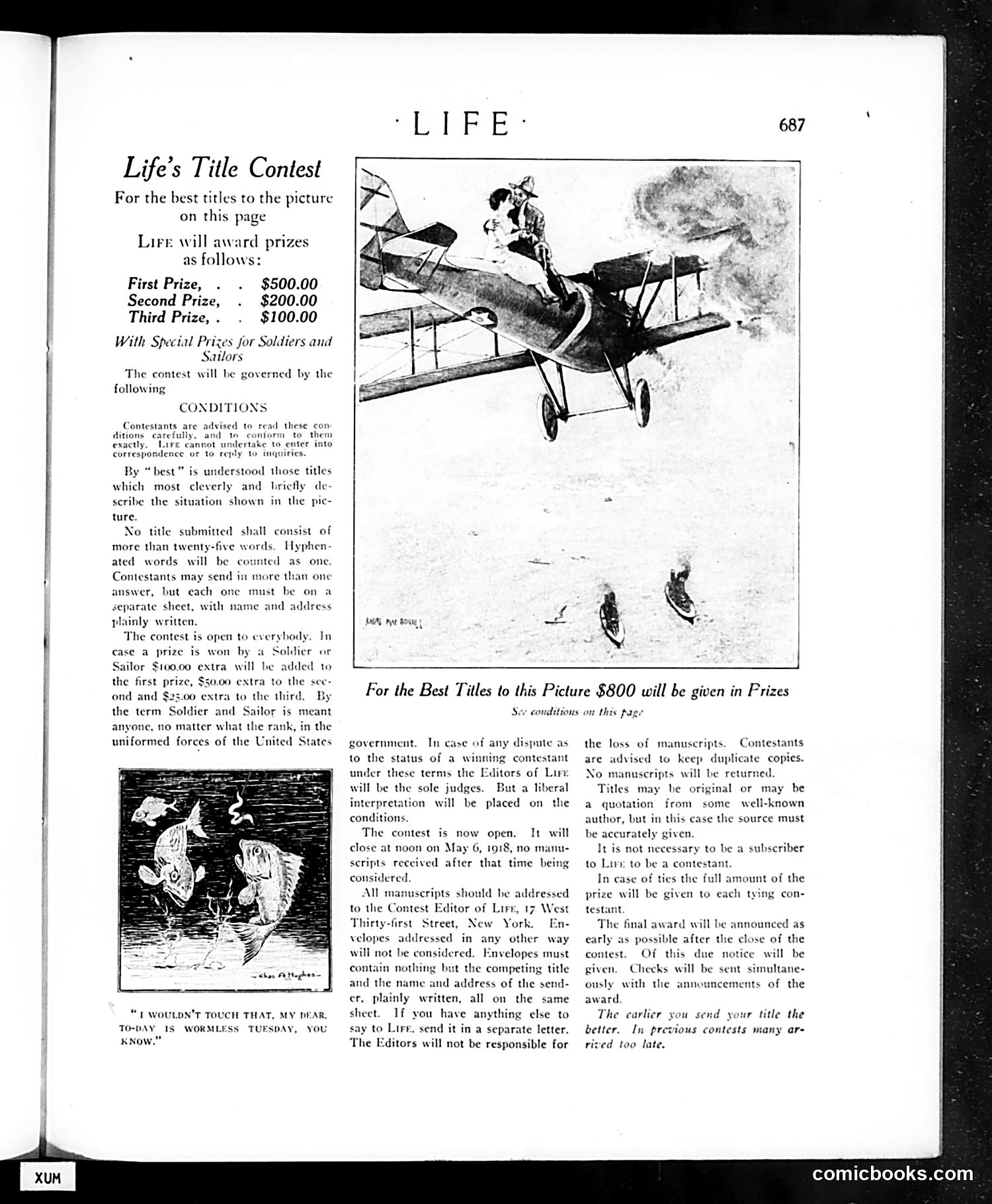
This page announces a contest for readers to submit witty captions for two images. The main picture shows a WWI-era biplane with figures in precarious positions—one person appears to be falling or dangling from the aircraft. The contest offers substantial prizes ($500 first prize), with bonus amounts specifically for soldiers and sailors, reflecting America's active involvement in World War I (the contest closes May 6, 1918). The smaller cartoon below depicts two figures with a dead bird, with one saying "I wouldn't touch that, my dear—today is wormless Tuesday, you know," likely a joke about meatless days or wartime food rationing. The contest rules emphasize brevity (max 25 words) and encourage military participation through enhanced prize money—reflecting the magazine's patriotic support during the war.
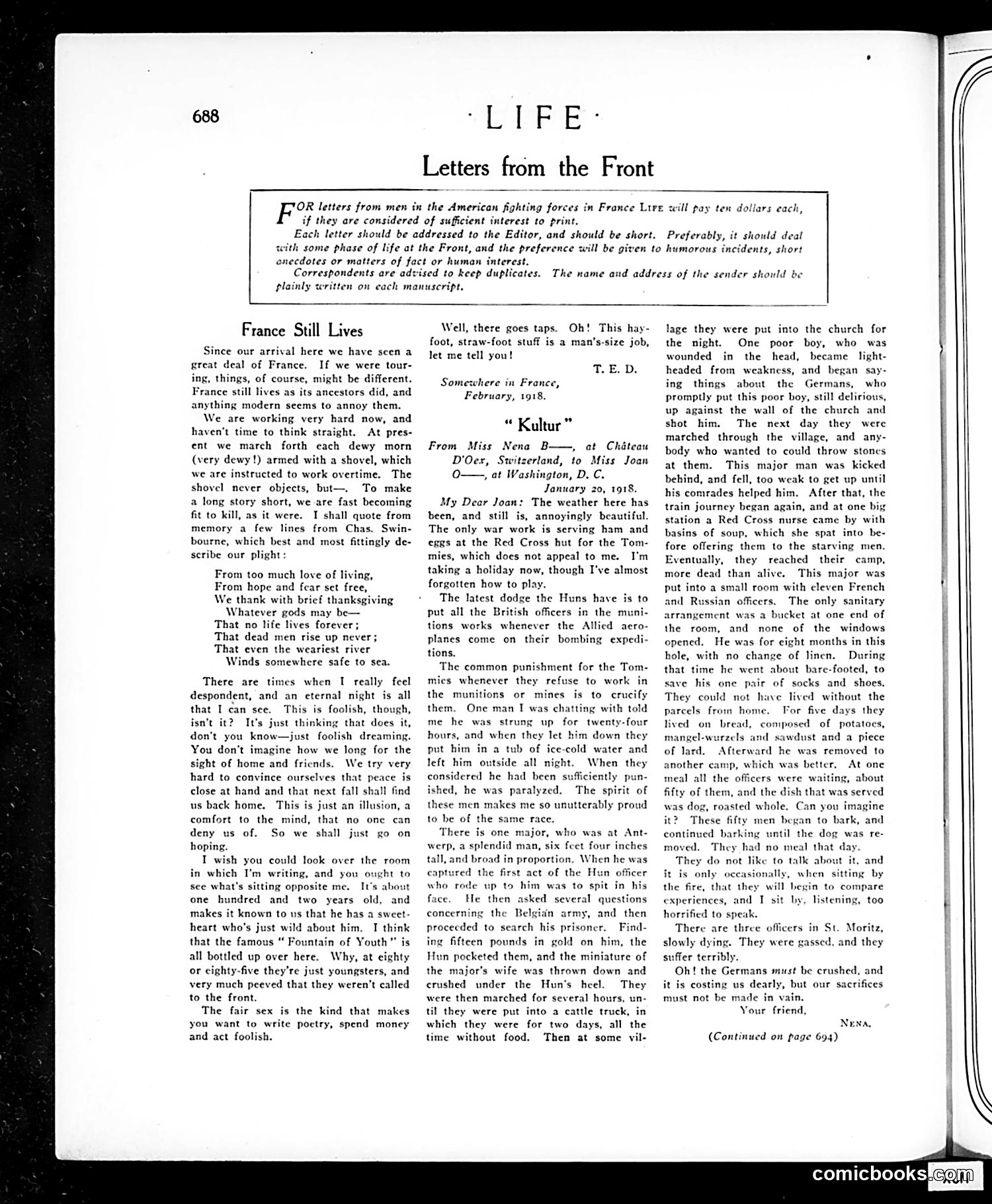
This page is not a cartoon but rather a **letters column** soliciting correspondence from American soldiers fighting in France during World War I. Life offered ten dollars per letter deemed sufficiently interesting for publication. The page contains two letters. The first, signed T.E.D., describes mundane military life—marching with shovels, the contrast between modern and traditional French village life, and homesickness. The second, from "Nena B—" in Switzerland to a friend in Washington, D.C., references German atrocities: the Huns (Germans) crucifying British soldiers and subjecting them to torture as punishment for refusing to work in munitions factories. For modern readers, this illustrates how wartime propaganda often exaggerated enemy brutality. The "Kultur" reference mocks German culture while depicting Germans as barbaric. These letters served dual purposes: authentic soldier voices and morale-building wartime messaging emphasizing German villainy to justify American involvement.
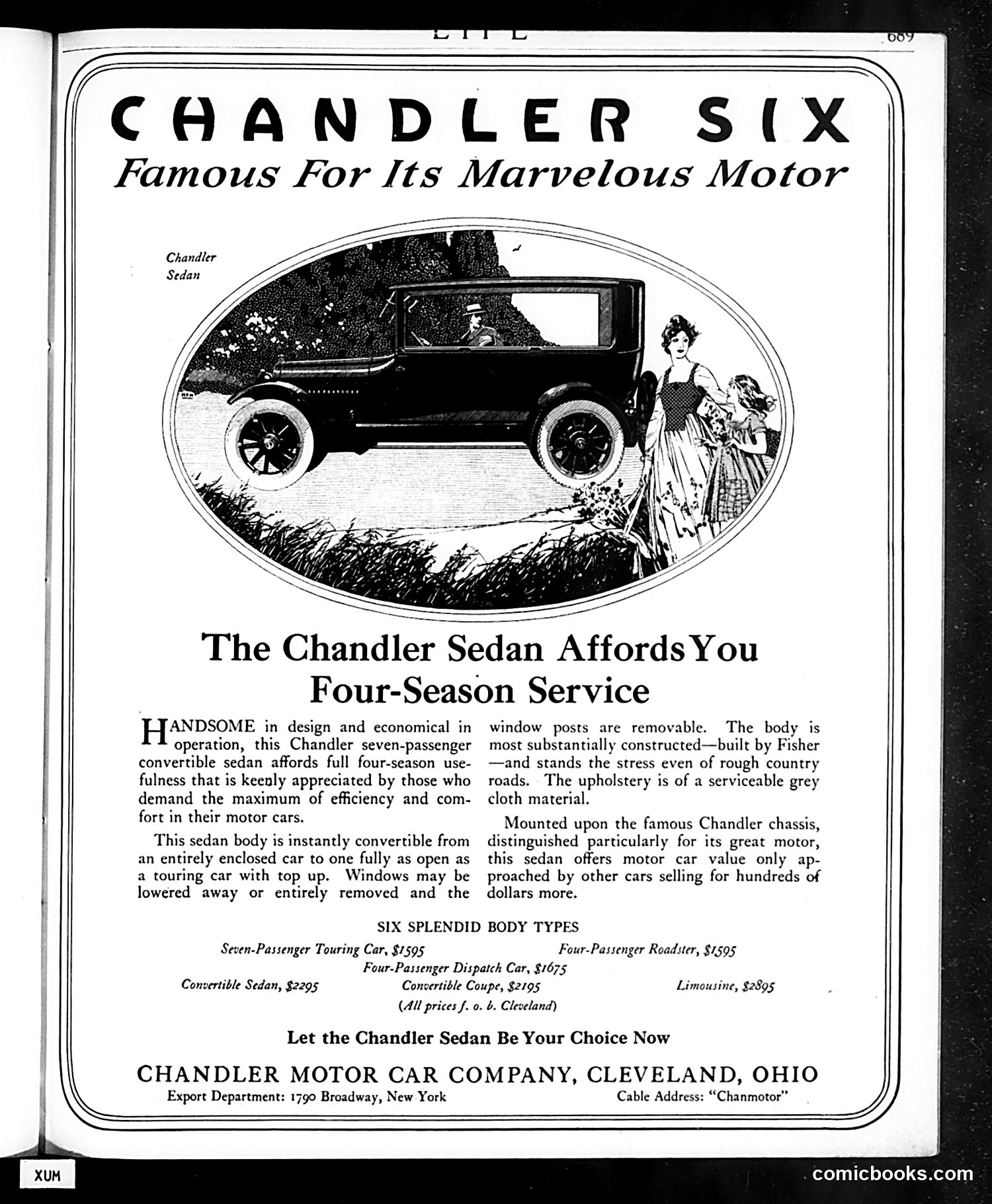
This is not a political cartoon—it's a full-page automobile advertisement for the Chandler Motor Car Company of Cleveland, Ohio. The page features an illustration of a convertible sedan with two elegantly dressed figures (a woman and child) posed beside it in an idealized outdoor setting. The ad emphasizes the car's versatility as a "four-season" vehicle with a convertible body, removable windows, and Fisher construction. It highlights the "famous Chandler chassis" and its motor as competitive advantages. Six body types are listed with prices ranging from $1,595 to $2,895 (f.o.b. Cleveland). This represents typical 1920s automotive marketing: aspirational imagery combining luxury, practicality, and family appeal to sell mid-to-upper-class consumers on the Chandler brand's quality and value proposition.
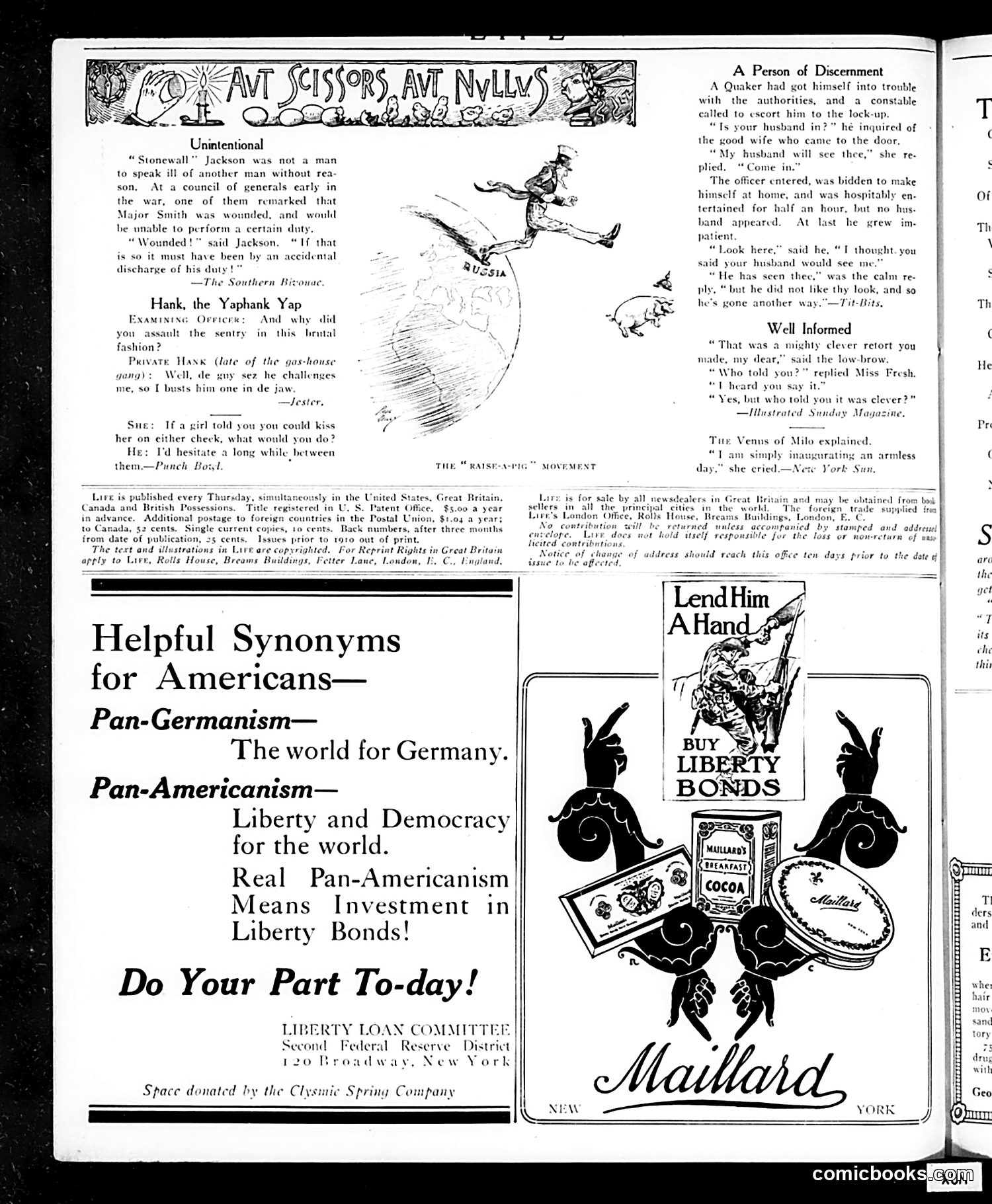
This page contains satirical humor and wartime propaganda from approximately WWI era (based on Liberty Bonds advertising). **The cartoons/jokes:** - "Unintentional" mocks a Confederate general's backhanded insult about a wounded officer - "Hank, the Yaphank Yap" features a German immigrant soldier ("Private Hans") explaining his brutal assault on a sentry, implying cultural/ethnic stereotyping of German-Americans - Brief anecdotes mock Quakers, clever women, and classical sculpture **The propaganda:** The "Helpful Synonyms" section explicitly contrasts Pan-Germanism ("the world for Germany") with Pan-Americanism ("Liberty and Democracy for the world"), then urges Americans to buy Liberty Bonds as patriotic duty. This reflects WWI-era messaging positioning the conflict as democracy versus militarism. The Maillard advertisement appears separate. **Context for modern readers:** This reflects wartime xenophobia and bond-drive messaging, where ethnic caricature served propagandistic purposes.
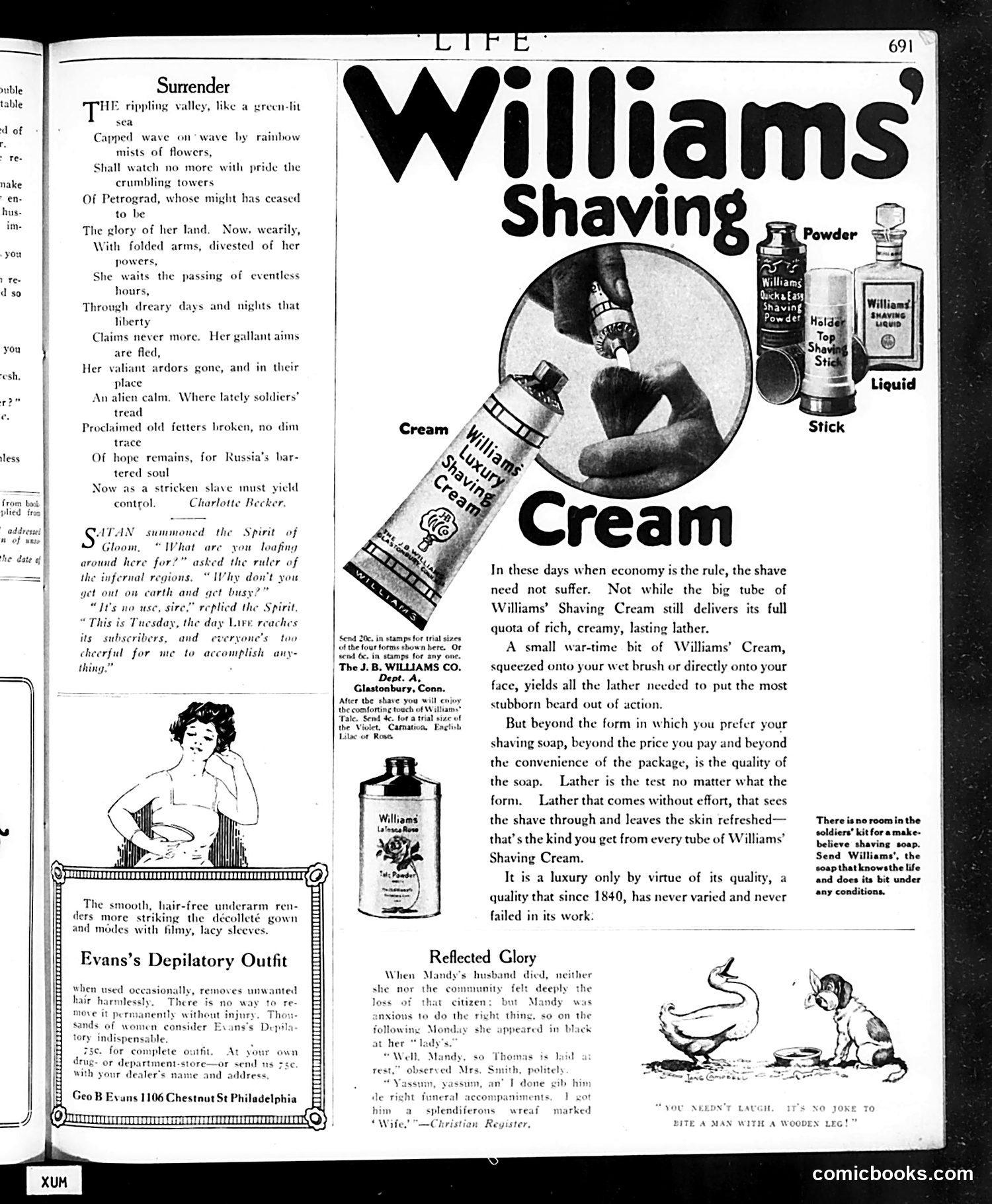
This page is primarily **advertising**, dominated by a large Williams' Shaving Cream advertisement. The ad emphasizes wartime economy—promoting that a small amount of cream produces sufficient lather, making it economical during WWI rationing. The page also contains three literary pieces: 1. **"Surrender"** (poem by Charlotte Becker): A somber meditation on Russia's collapse after the 1917 Revolution, lamenting lost liberty and national glory as Russia becomes a "stricken slave." 2. **"Satan" anecdote**: A humorous short piece where Satan complains he cannot tempt people on Tuesdays because *Life* magazine arrives and makes readers too cheerful. 3. **"Reflected Glory"** (from *Christian Register*): A brief comedic story about a Black woman named Mandy who wears mourning clothes to impress her employer after her husband's death, using social pretense for approval. The page reflects early-1920s American concerns: WWI economic constraints, anxieties about Russian communism, and racial dynamics in the Jim Crow era.
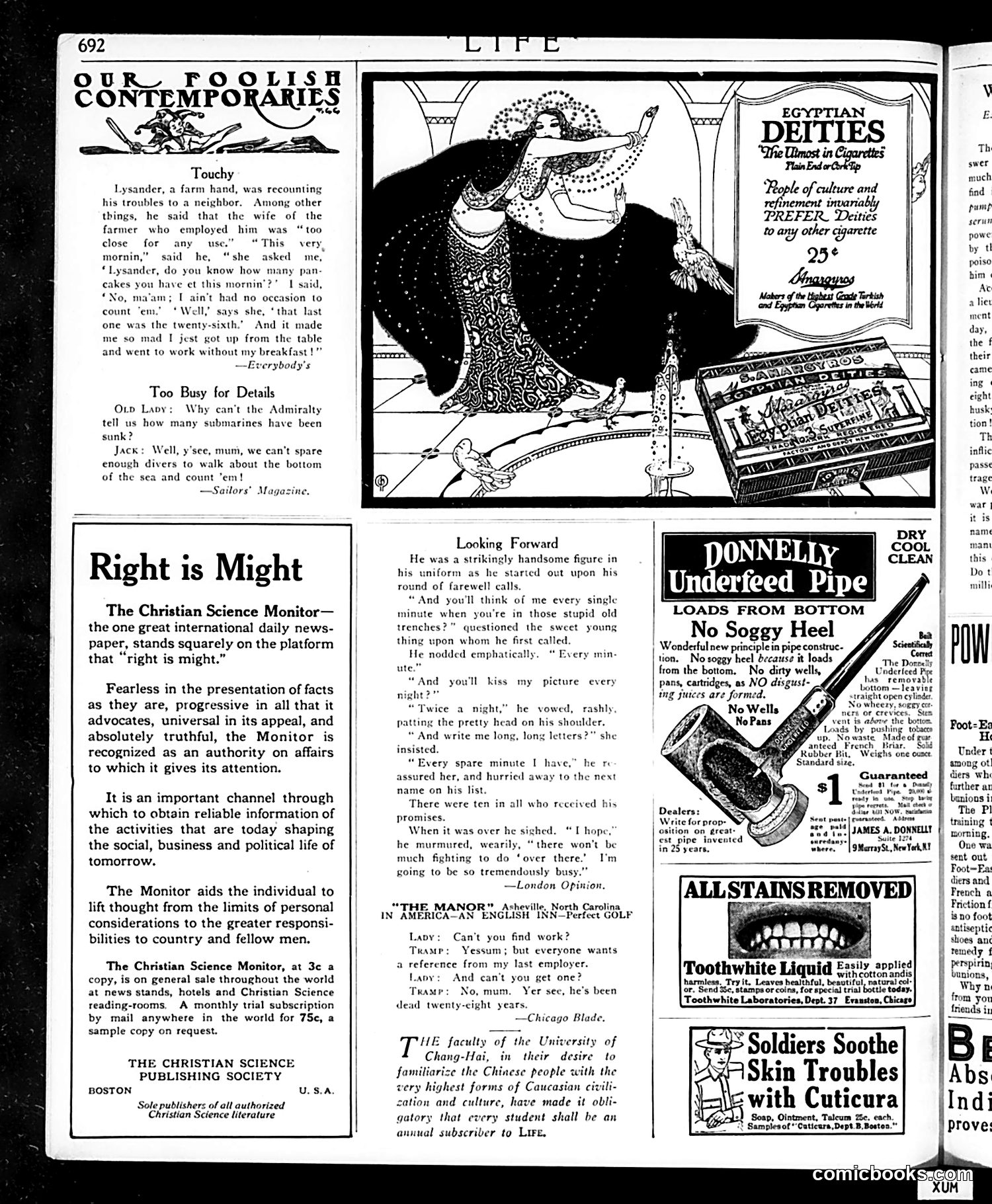
This page contains satirical humor pieces and advertisements typical of early 20th-century Life magazine. **"Our Foolish Contemporaries"** presents two brief comic anecdotes mocking everyday absurdities: a farm worker resents being counted eating pancakes (establishing his employer's wife as annoyingly penny-pinching), and a naval officer jokes about submarine casualty counts being impossible to verify—both gently ridiculing human logic and bureaucratic evasion. **"Looking Forward"** satirizes romantic soldiers departing for WWI trenches. A uniformed man receives farewell visits from ten young women, each extracting promises of devoted letters and constant thoughts. After assuring each he'll think of them "twice a night," he admits to a friend he'll actually be "tremendously busy"—mocking soldiers' insincere romantic pledges and young women's romantic naïveté during wartime. The page is otherwise dominated by period advertisements (Christian Science Monitor, cigarettes, pipes, dental products, skin remedies), reflecting Life's revenue model alongside editorial content.
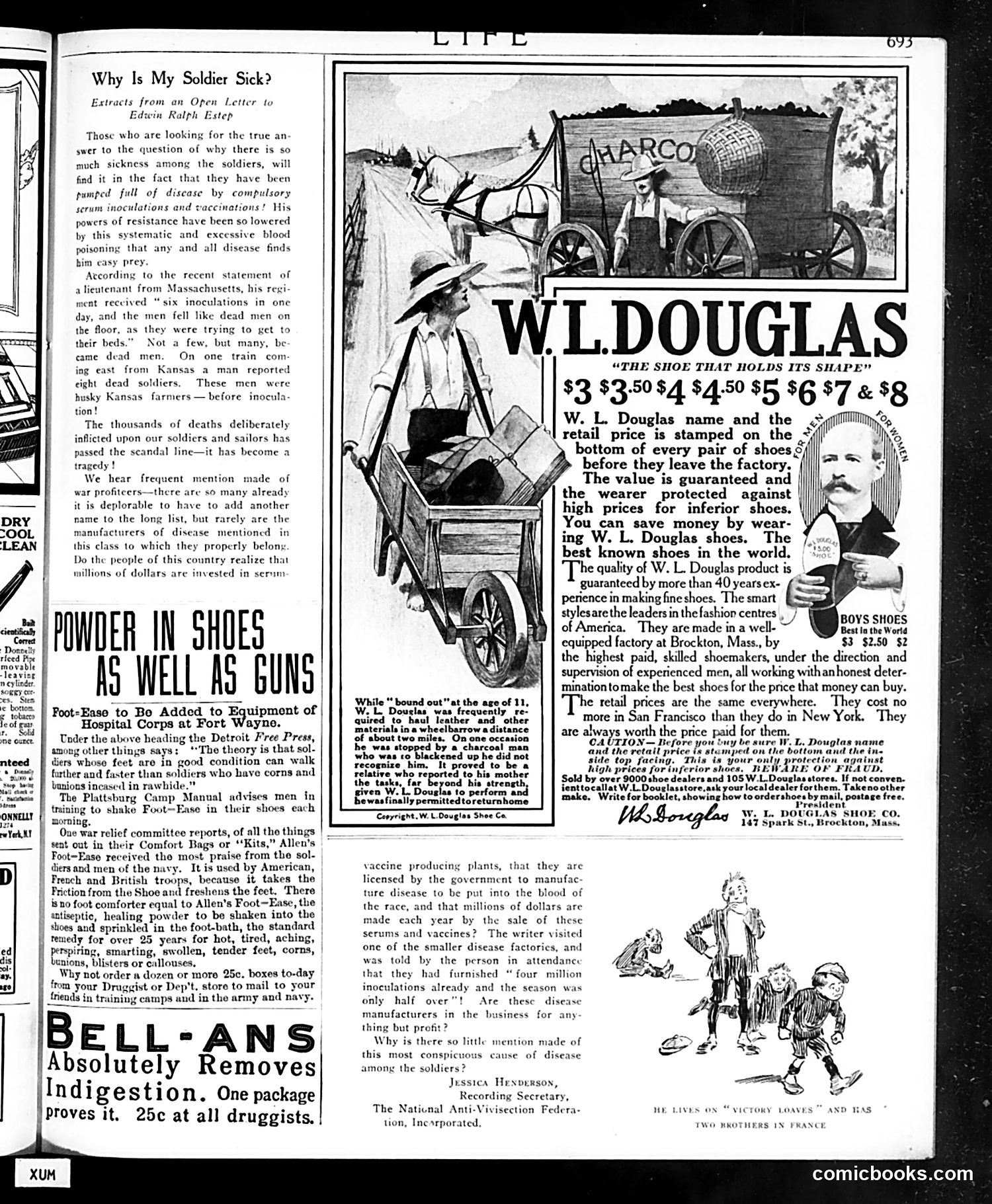
This page contains a bitter anti-vaccination polemic alongside commercial advertisements, reflecting early 20th-century vaccine skepticism. ## Main Content: "Why Is My Soldier Sick?" The left column presents an open letter attacking mandatory military inoculations and vaccinations, claiming they cause soldier deaths rather than prevent disease. It alleges "six inoculations in one day" caused men to "fall like dead men," and cites reports of soldiers dying on trains post-vaccination. The author, Jessica Henderson (Recording Secretary of the National Anti-Vivisection Federation), argues that vaccine manufacturers are "war profiteers" deliberately poisoning soldiers for profit. ## Advertisements The right side features W.L. Douglas shoes ($3-$8) and Bell-Ans indigestion remedy—standard commercial content unrelated to the polemic. ## Historical Context This represents genuine anti-vaccination sentiment during WWI, before modern epidemiology established vaccine safety. The piece reflects conspiracy thinking about pharmaceutical companies and distrust of government medical mandates—concerns that persisted throughout the 20th century.
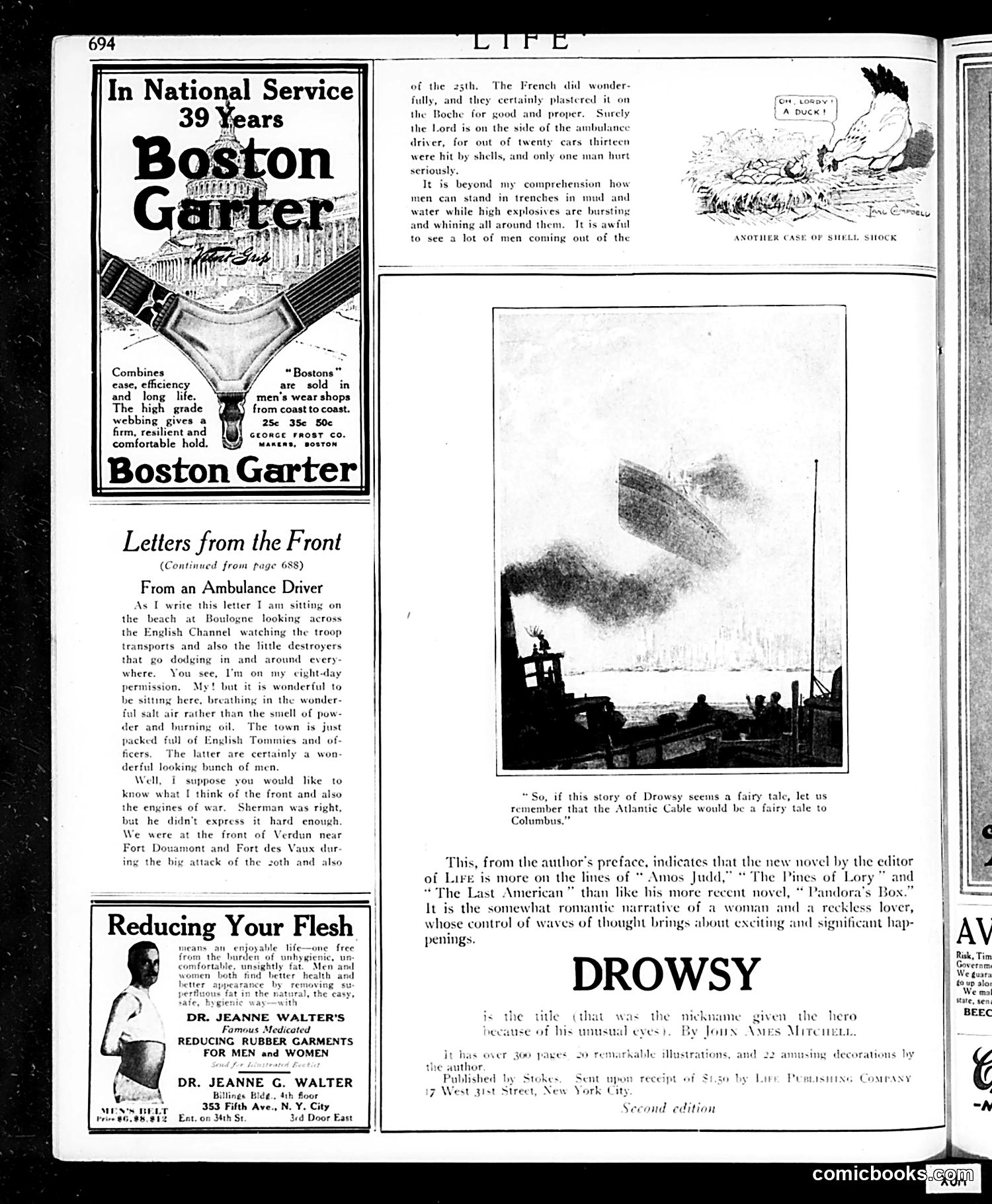
This page mixes advertising, war correspondence, and book promotion typical of Life magazine during WWI era. **Main Content:** The "Letters from the Front" section features a first-person account from an ambulance driver stationed at Boulogne, France, describing the horror of trench warfare near Verdun and Fort Douaumont. He witnesses shell explosions, destroyed vehicles, and traumatized soldiers—conveying the brutal reality of combat to American readers. **Advertisements:** - **Boston Garter**: A men's garter claiming 39 years of service - **Dr. Jeanne Walter's Reducing Garments**: Weight-loss corsets for men and women - **"Drowsy"**: A novel about a woman whose "control of waves of thought" creates romantic complications The juxtaposition is striking: amid graphic war descriptions sits an ad for reducing rubber garments, reflecting how American consumer culture operated largely uninterrupted during the war, with advertising normalized on pages documenting soldiers' suffering.
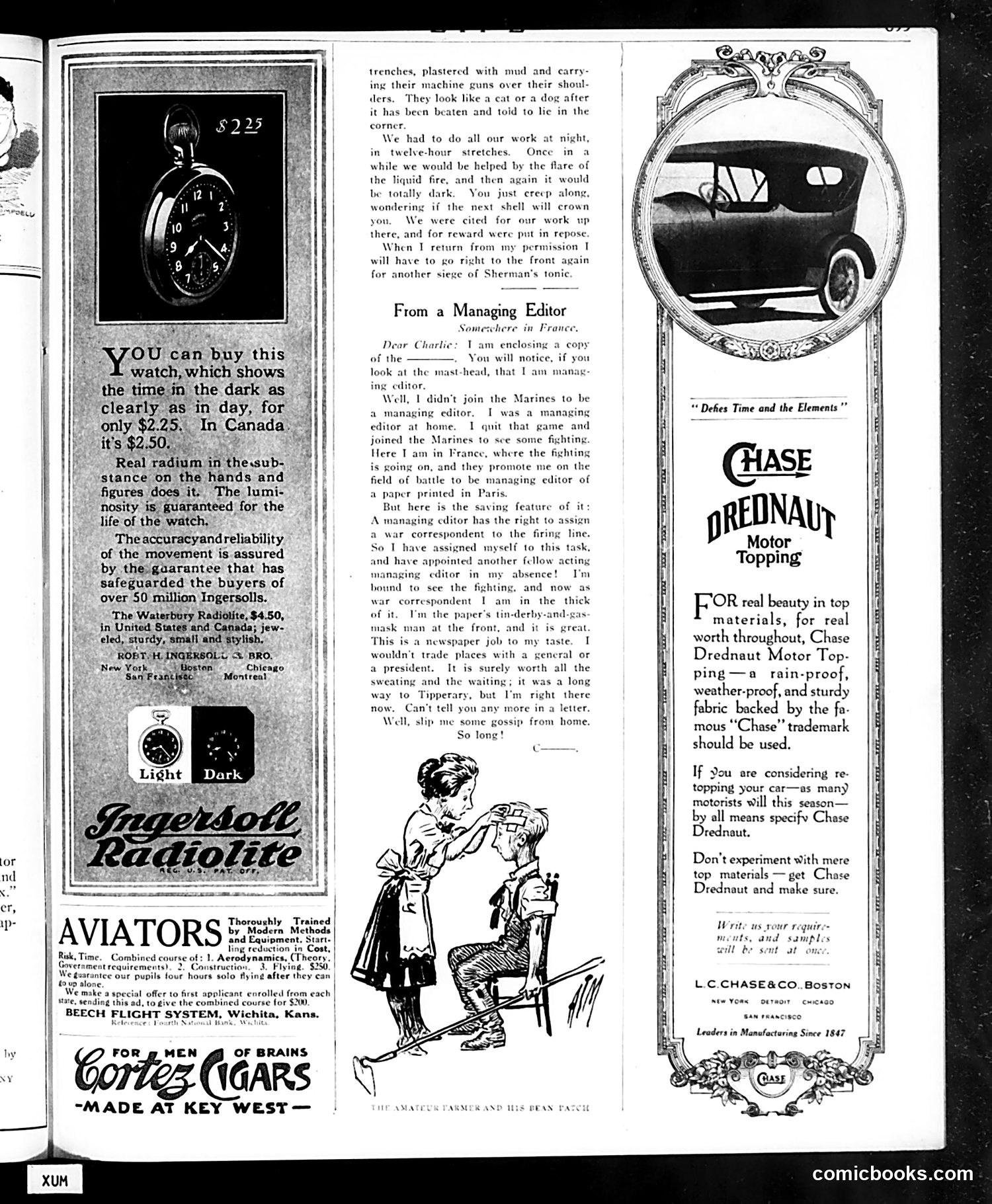
This page is primarily **advertisements and letters** rather than political satire. The main content includes: **Letters Section ("From a Managing Editor"):** A soldier serving as a Marine in France during WWI describes combat conditions—trenches, mud, machine guns, and night operations. He humorously notes that despite joining the Marines to see fighting, he's been promoted to managing editor of a military newspaper, then cleverly assigned himself as a war correspondent to get back to the front lines. **Advertisements:** The page features vintage product ads typical of the WWI era—luminous watches, aviation training courses, cigars, and automobile motor topings (weatherproof car tops). **The Cartoon:** A small illustration titled "The Amateur's Farmer and His Bean Patch" shows what appears to be a domestic scene, likely humorous commentary on home-front activities. The satire is gentle—poking fun at bureaucratic absurdity (promotion away from desired combat duty) rather than making sharp political points. This reflects Life's role as a lighter satirical publication during wartime.
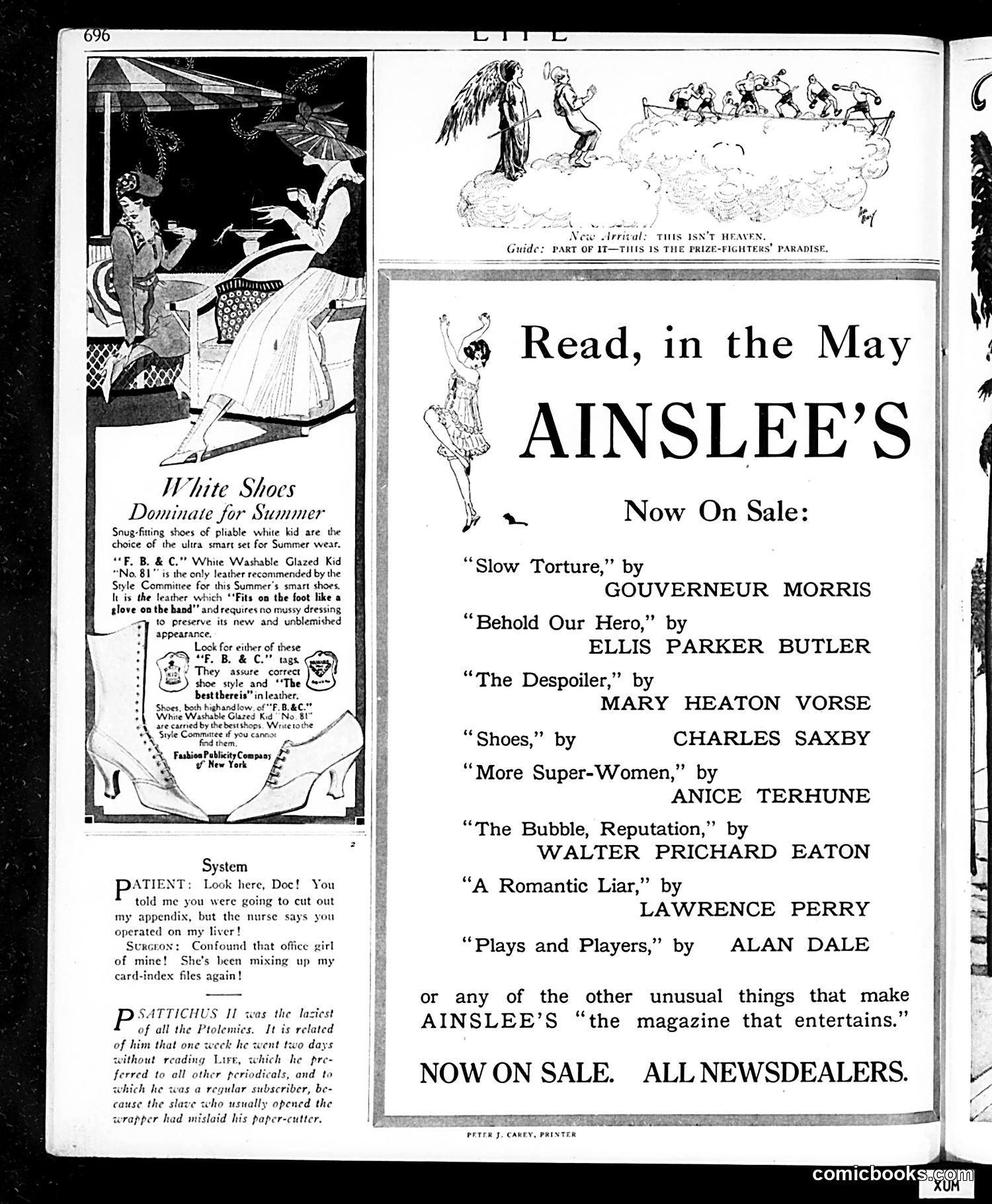
This page mixes fashion advertising with satirical humor typical of Life magazine's format. **Left side:** An advertisement for "F. B. & C." white kid leather shoes, marketed as the choice of the fashionable elite for summer wear. The illustration shows a woman in elegant 1920s attire admiring shoes. **Bottom left:** A brief comedic dialogue between a patient and surgeon about mixed medical records—a joke about bureaucratic incompetence. The patient expected liver surgery but got appendix surgery due to a careless office assistant. **Below that:** A humorous anecdote about Ptolemy II, presented as so lazy he couldn't read *Life* magazine for two days because his slave forgot to use the paper-cutter to open the wrapper—a tongue-in-cheek advertisement claiming even ancient royalty preferred *Life* to all other periodicals. **Right side:** Advertisement for *Ainslee's* magazine, listing current story titles and authors, promoting it as "the magazine that entertains." The page is primarily **promotional material** using light humor and satire to market both shoes and magazines to readers of this era.
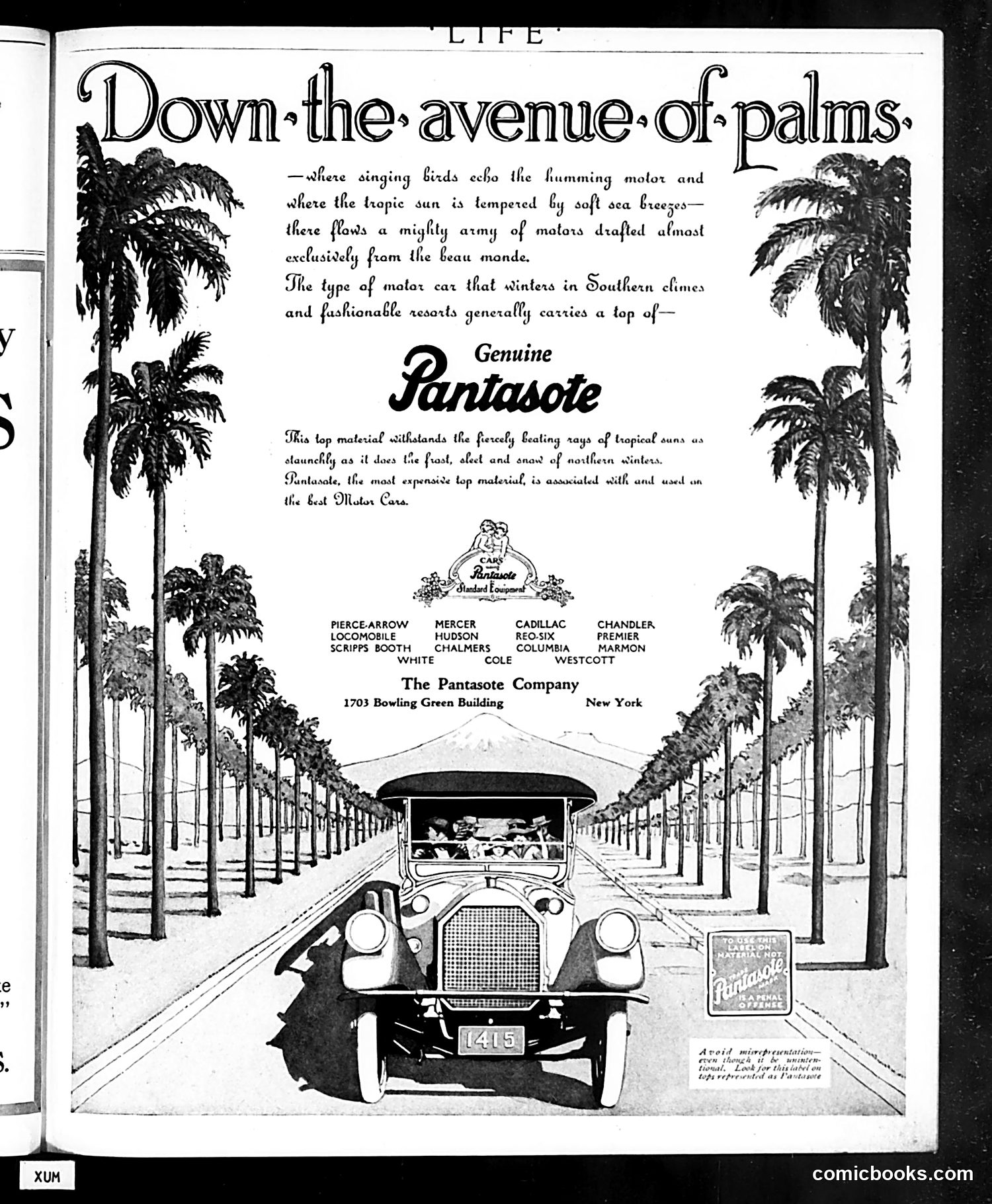
This is primarily a **car-top advertisement**, not political satire. The Pantasote Company promotes their automobile convertible-top material through aspirational imagery rather than humor or social criticism. The "cartoon" element is the romanticized illustration: a luxurious motor car driving down a palm-lined avenue (evoking Florida or Southern resort destinations), with elegantly dressed passengers. The visual appeals to wealthy consumers who winter in fashionable resorts. The satirical *implication*—typical of 1920s advertising—is subtle: it suggests that Pantasote tops are used by elite automobile manufacturers (Pierce-Arrow, Cadillac, Mercer, etc.), thereby positioning the material as a luxury product. The text emphasizes durability in both tropical and harsh northern climates, addressing practical concerns while maintaining the aspirational tone. There's no obvious political target or recognizable caricature. This represents consumer advertising dressed up in aesthetic language to appeal to affluent readers of *Life* magazine.
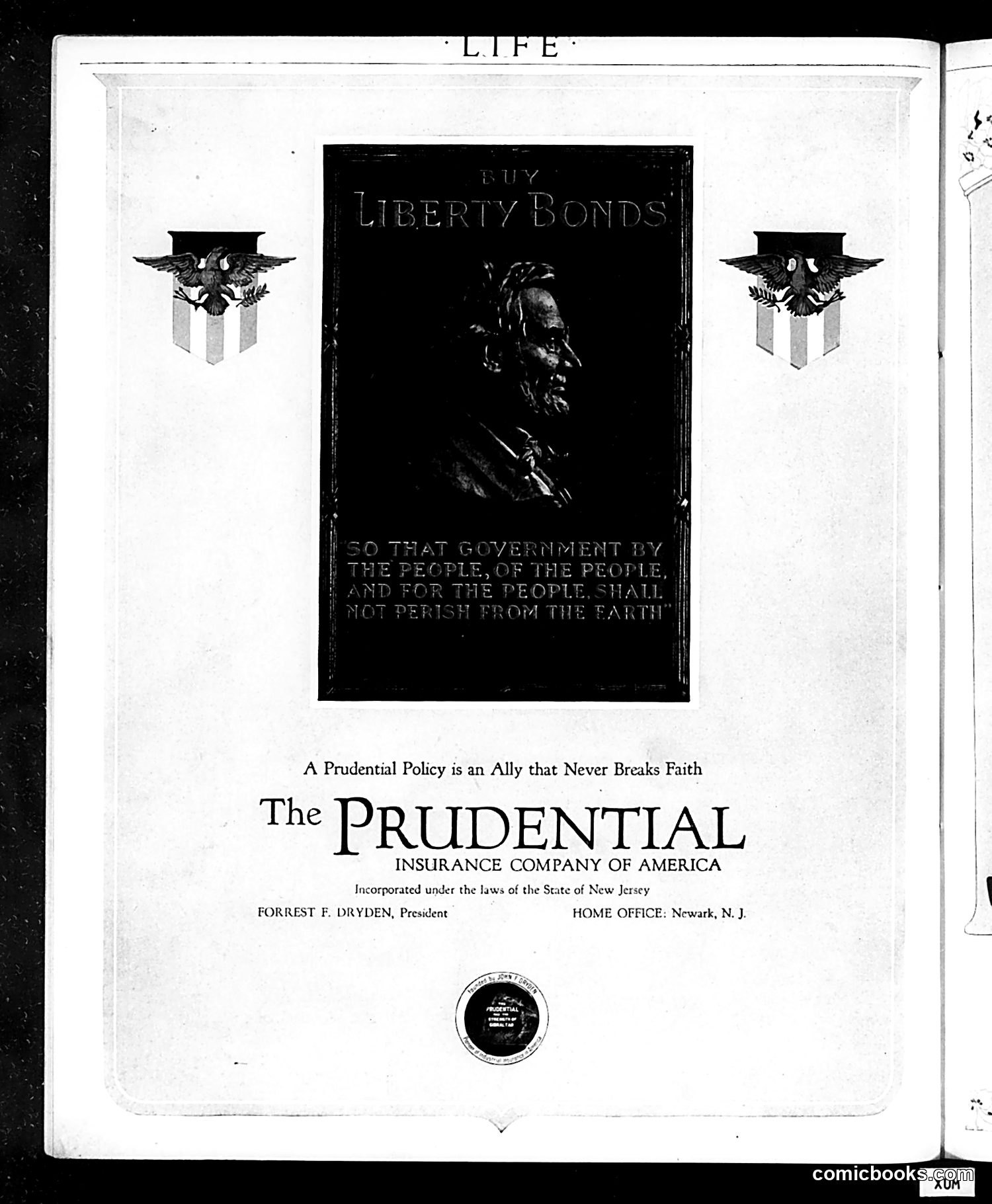
This is a **full-page advertisement** for Prudential Insurance, not political satire. The ad features a Liberty Bonds poster in the center—showing a profile portrait (likely Abraham Lincoln) with the famous Gettysburg Address quote about government "of the people, by the people, and for the people." Two eagle seals flank the image. The advertisement leverages patriotic World War I imagery (Liberty Bonds were war-financing instruments) to position insurance as a trustworthy, patriotic investment. The tagline "A Prudential Policy is an Ally that Never Breaks Faith" directly connects insurance reliability to national loyalty and security. This is corporate propaganda using wartime patriotism, not editorial commentary or satire.
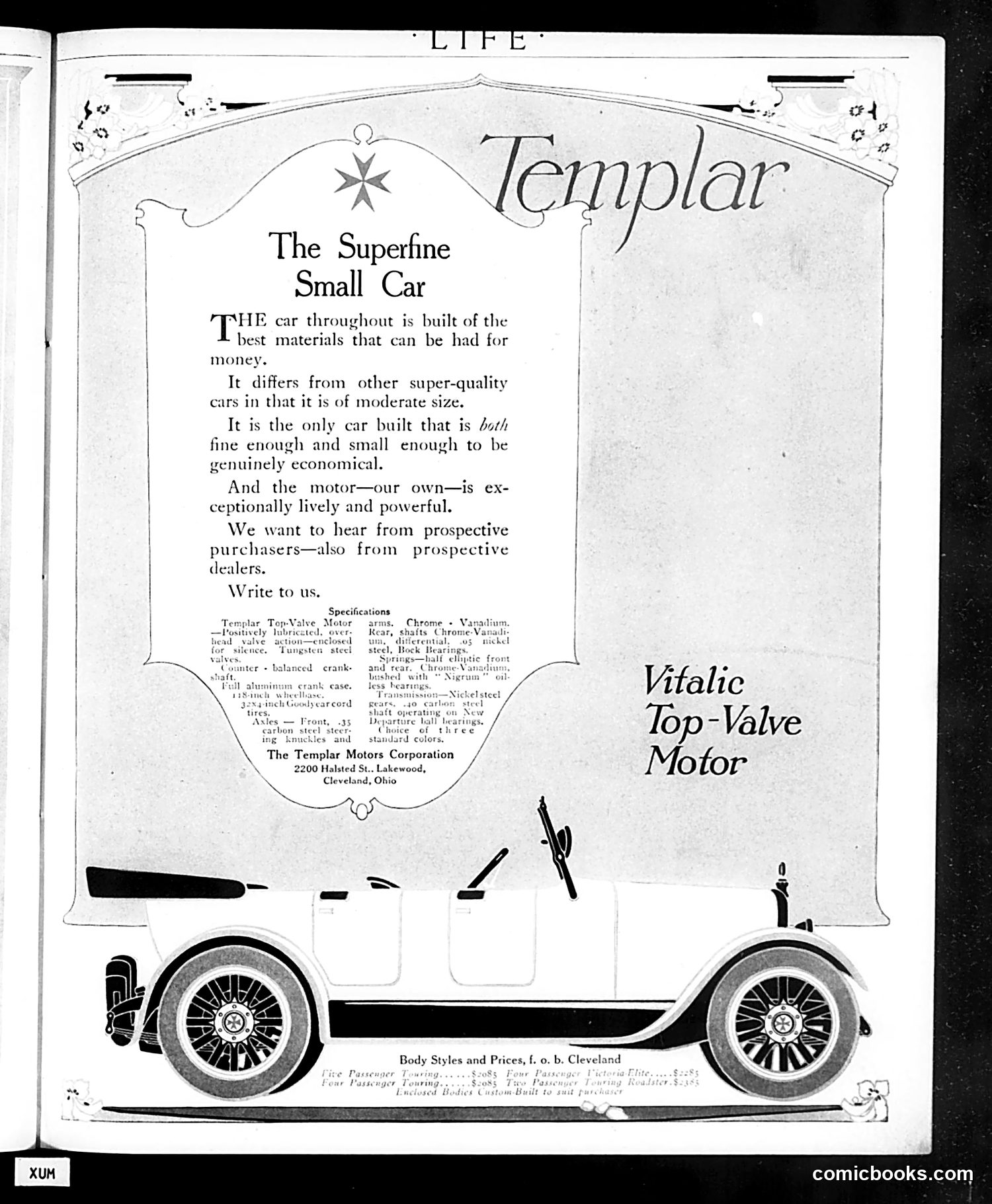
This is primarily a **car advertisement**, not a political cartoon. It advertises the Templar, a small automobile manufactured by the Templar Motors Corporation of Cleveland, Ohio. The page uses decorative framing and typography typical of early 20th-century luxury advertising. The selling points emphasize that the Templar combines quality materials with moderate size and price—positioning it as an "economical" alternative to larger, more expensive "super-quality cars." The illustration shows a side-view of the vehicle with prominent spoked wheels, characteristic of 1920s automotive design. The ad highlights the car's own "Vitalic Top-Valve Motor" as a key feature. **For modern readers:** This represents early automotive marketing when small cars were still novel luxuries. The emphasis on being "both fine enough and small enough to be genuinely economical" suggests the target market was affluent but price-conscious buyers seeking quality in a compact package—a positioning concept that persists in automotive marketing today.
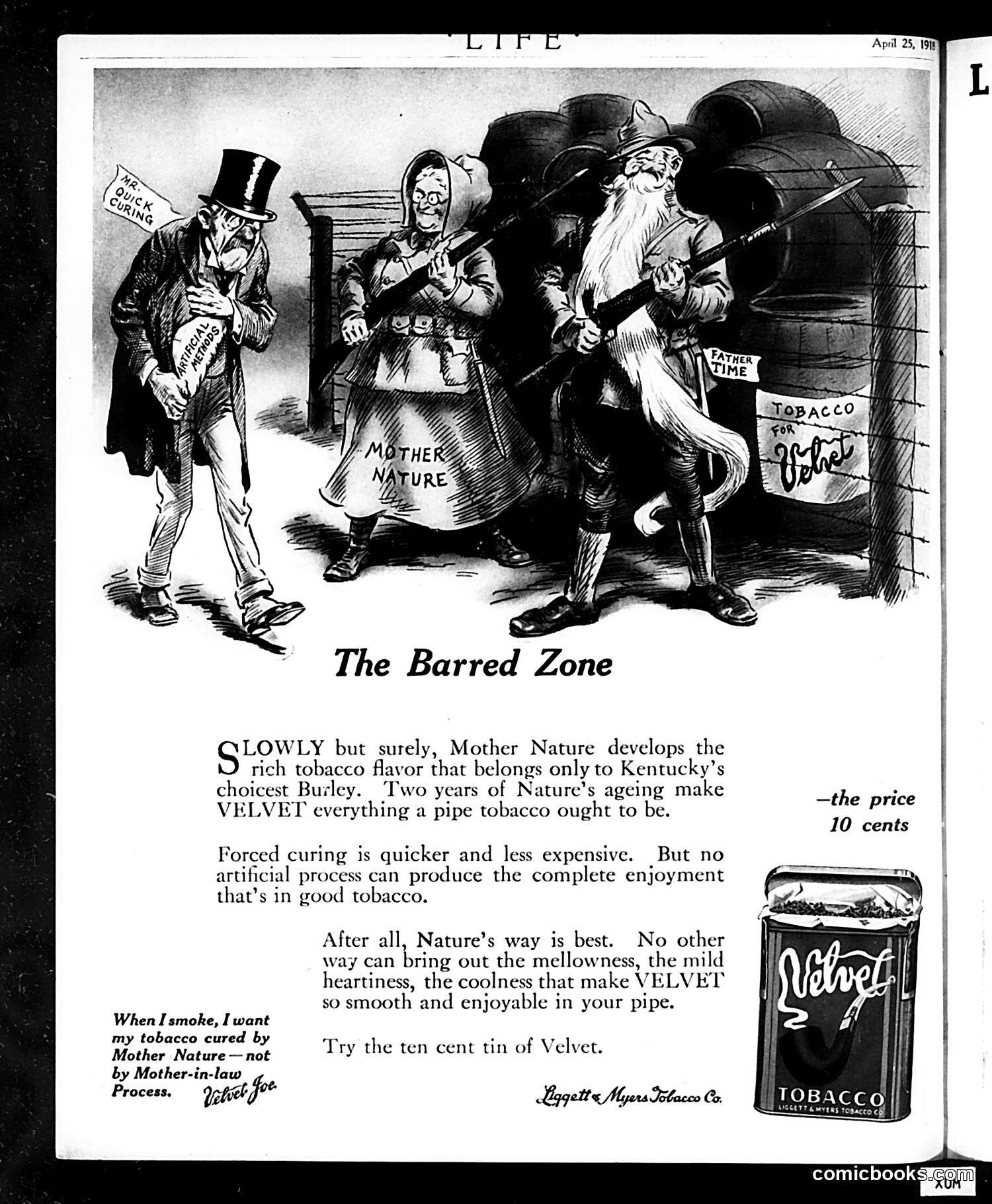
This is primarily a **Velvet pipe tobacco advertisement** from April 23, 1918, using political satire as its hook. The cartoon depicts three figures labeled "The Barred Zone"—likely representing **Uncle Sam** (top hat, left), **Mother Nature** (center), and an older bearded man (right)—guarding barrels marked "Battletime Tobacco for Other Uses." The satire plays on **WWI-era tobacco rationing and restrictions**. The ad argues that natural aging ("Mother Nature's way") produces superior tobacco, contrasting it with wartime "forced curing" processes. The joke appears to be that even amid government controls on tobacco supplies, Velvet's naturally-aged product remains superior. The inclusion of "Mother-in-law Process" as a joke reference is unclear without additional context, though it seems to mock inferior artificial methods. The ad costs 10 cents and is from Liggett & Myers Tobacco Co.