
Life, 1918-04-25 · page 28 of 40
Life — April 25, 1918 — page 28: what you’re looking at
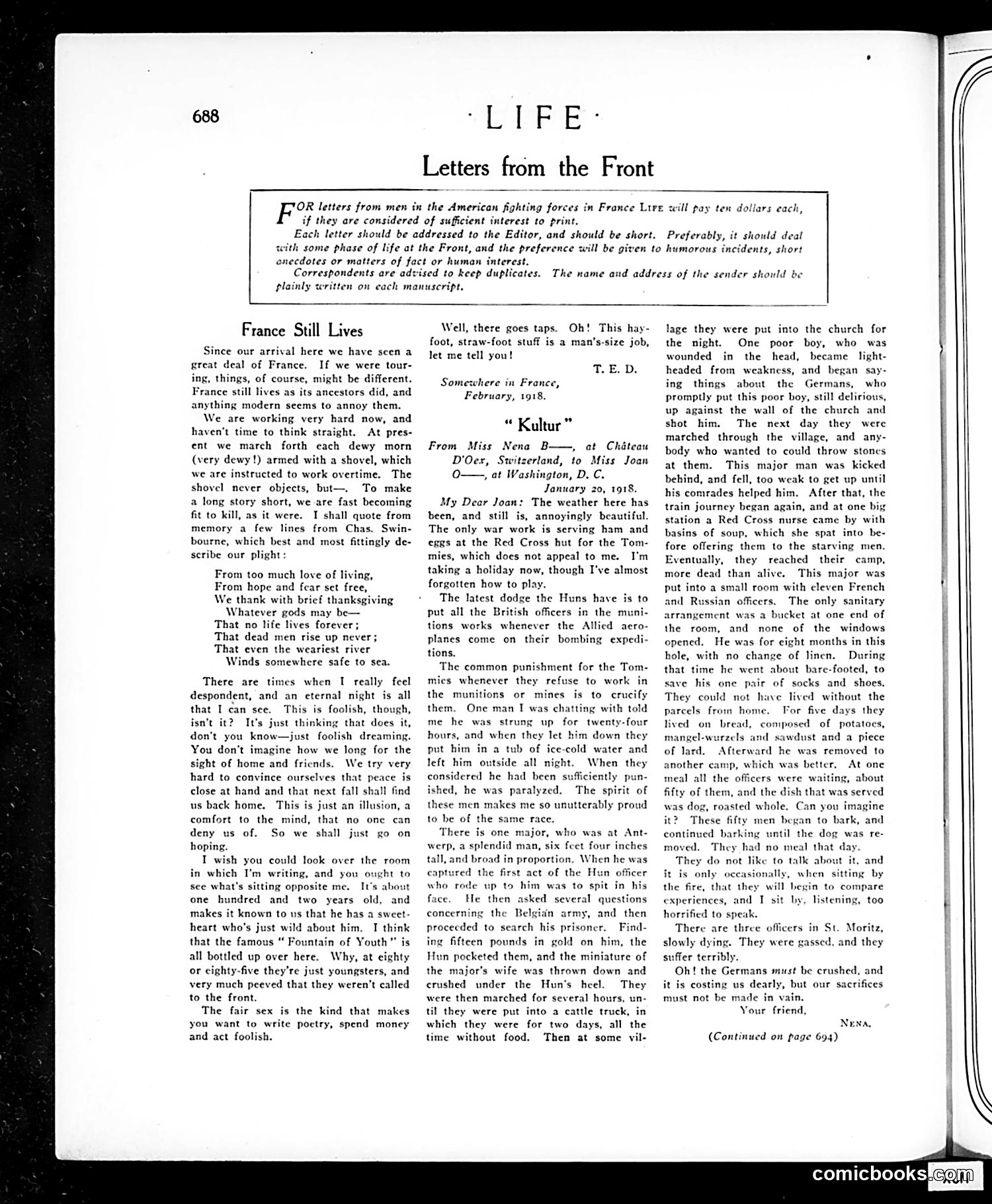
What you’re looking at
This page is not a cartoon but rather a **letters column** soliciting correspondence from American soldiers fighting in France during World War I. Life offered ten dollars per letter deemed sufficiently interesting for publication. The page contains two letters. The first, signed T.E.D., describes mundane military life—marching with shovels, the contrast between modern and traditional French village life, and homesickness. The second, from "Nena B—" in Switzerland to a friend in Washington, D.C., references German atrocities: the Huns (Germans) crucifying British soldiers and subjecting them to torture as punishment for refusing to work in munitions factories. For modern readers, this illustrates how wartime propaganda often exaggerated enemy brutality. The "Kultur" reference mocks German culture while depicting Germans as barbaric. These letters served dual purposes: authentic soldier voices and morale-building wartime messaging emphasizing German villainy to justify American involvement.
📄 Transcribed text from this page (OCR, searchable)
Machine-transcribed from the original scan — historical spelling and the odd misread are preserved.
TIP P*E Letters from the Front OR letters from men in the American fighting forces in France Lire will pay ten doliars each, if they are considered of sufficient interest to print. Each letter should be addressed to the Editor, and should be short. hi some phase of life at the Front, and the preference will be given to humorous incidents, short onecdotes or matters of fact or human interest. Correspondents are ad: ised to keep duplicates. plainly written on each manuscript. Preferably, it should deal The name and address of the sender should be France Still Lives Since our arrival here we have seen a great deal of France. If we were tour- ing, things, of course, might be different. ance still lives as its ancestors did, and anything modern seems to annoy them. We are working very hard now, and haven't time to think straight. At pres- ent we march forth each dewy morn (very dewy!) armed with a shovel, which we are instructed to work overtime. The shovel never objects, but—. To make a long story short, we are fast becoming fit to kill, as it were. I shall quote from memory a few lines from Chas. Swin- bourne, which best and most fittingly de- scribe our plight: From too much love of living, From hope and fear set free, We thank with brief thanksgiving Whatever gods may be— That no life lives forever; That dead men rise up never; That even the weariest river Winds somewhere safe to sea. There are times when I really feel despondent, and an eternal night is all that I can see. This is foolish, though, isn't it?) It's just thinking that does it, don't you know—just foolish dreaming. You don't imagine how we long for the sight of home and friends. We try very hard to convince ourselves that peace is close at hand and that next fall shall find us back home, This is just an illusion, a comfort to the mind, that no one can deny us of. So we shall just go on hoping. I wish you could look over the room in which I'm writing, and you ought to see what's sitting opposite me. It's about one hundred and two years old, and makes it known to us that he has a sweet- heart who's just wild about him. T think that the famous “ Fountain of Youth all bottled up over here. Why, at eighty or cighty-five they're just youngsters, and very much peeved that they weren't called to the front. The fair sex is the kind that makes you want to write poetry, spend money and act foolish. Well, there goes taps. Oh! This hay- foot, straw-foot stuff is a man’s-size job, let me tell you! T.E.D. Somewhere in France, February, 1918. “ Kultur” From Miss Nena B—, at Chéteau D'Oex, Switzerland, to Miss Joan O— , at Washington, D.C. January 20, 1918. My Dear Joan: The weather here has been, and still is, annoyingly beautiful. The only war work is serving ham and eggs at the Red Cross hut for the Tom- mies, which does not appeal to me. I'm taking a holiday now, though I've almost forgotten how to play. The latest dodge the Huns have is to put all the British officers in the muni- tions works whenever the Allied aero- planes come on their bombing expedi- tions, The common punishment for the Tom- mics whenever they refuse to work in the munitions or mines is to crucify them. One man I was chatting with told me he wa strung up for twenty-four hours, and when they let him down they put him in a tub of ice-cold water and left him outside all night. When they considered he had been sufficiently pun- ished, he was paralyzed. The spirit of these men makes me so unutterably proud to be of the same race. There is one major, who was at Ant- werp, a splendid man, six feet four inches tall, and broad in proportion. When he was captured the first act of the Hun officer who rode up to him was to spit in his face. He then asked several questions concerning the Belgian army, and then procecded to search his prisoner. Find- ing fifteen pounds in gold on him, the Hun pocketed them, and the miniature of the major’s wife was thrown down and crushed under the Hun’s heel. They were then marched for several hours, un- til they were put into a cattle truck, in which they were for two days, all the time without food. Then at some vil- lage they were put into the church for the night. One poor boy, who was wounded in the head, became light- headed from weakness, and began sa: ing things about the Germans, who promptly put this poor boy, still delirious, up against the wall of the church and shot him, The next day they were marched through the village, and any- body who wanted to could throw stones at them. This major man was kicked behind, and fell, too weak to get up until his comrades helped him, After that, the train journey began again, and at one big station a Red Cross nurse came by with basins of soup, which she spat into be- g them to the starving men. reached their camp, This major was fore offeri entually, they more dead than alive, put into a small room with eleven French and Russian officers, The only sanitary arrangement was a bucket at one end of the room, and none of the windows opened, He was for eight months in this hole, with no change of linen. During that time he went about bare-footed, to save his one pair of socks and shoes. They could not have lived without the For five days they mposed of potatocs, mangel-wurzels and sawdust and a piece of lard. Afterward he was removed to another camp, which was better, At one meal all the officers were waiting, about fifty of them, and the dish that was served was dog, roasted whole. Can you imagine it? These fifty men began to bark, and continued barking until the dog was re- moved. They had no meal that da They do not like to talk about it, and casionally n sitting by they will begin to compare parcels froin home. lived on bread, wh it is only o the fire, th experiences, and T sit by, listening, too horrified to speak. There are three officers in St. Moritz, slowly dying. They were gassed, and they suffer terribly. Oh! the Germans must be crushed, and it is costing us dearly, but our sacrifices must not be made in vain, Your friend, (Continued on page 694) comicbooks!¢om|