
Life, 1918-04-25 · page 22 of 40
Life — April 25, 1918 — page 22: what you’re looking at
What you’re looking at
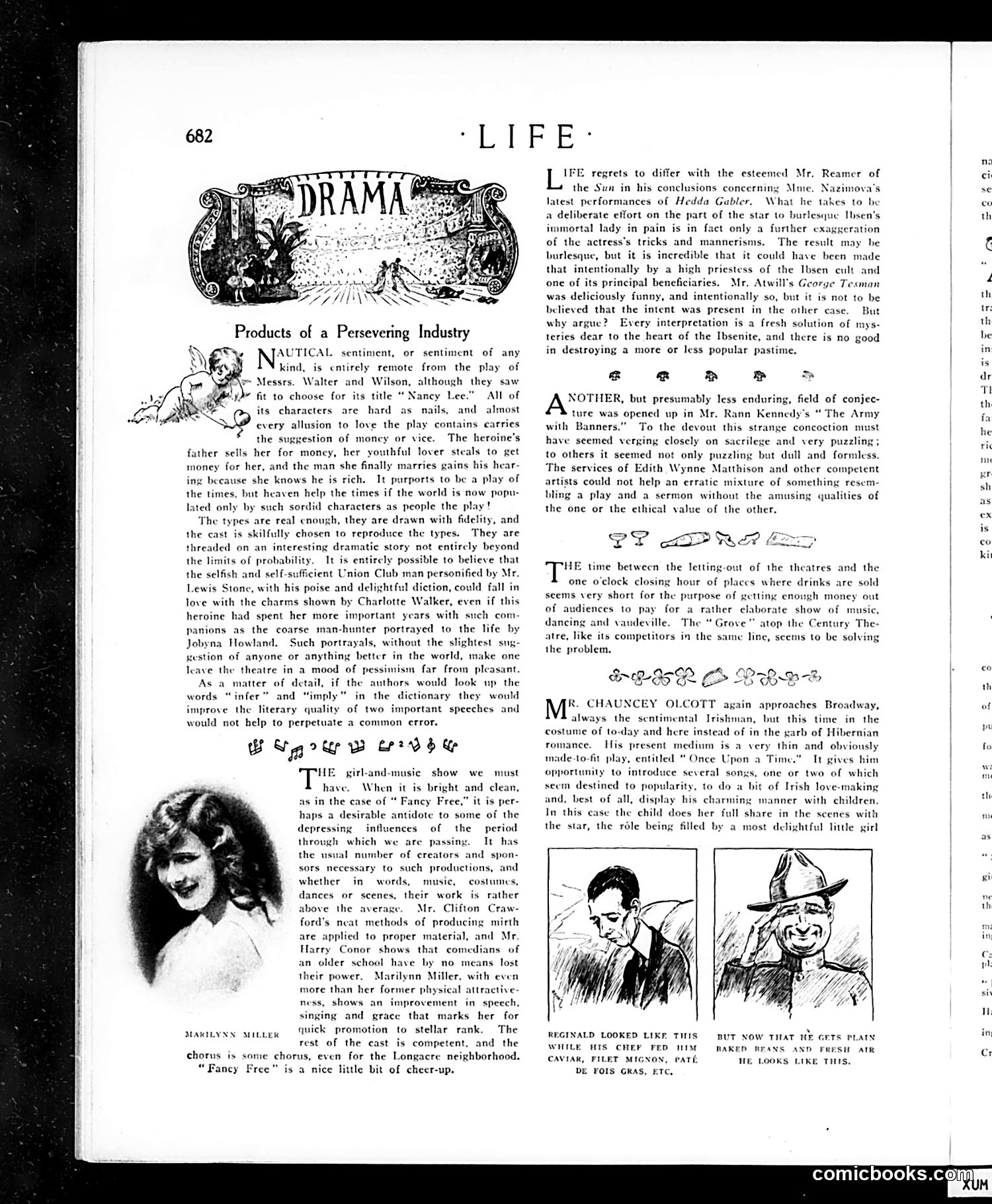
This page reviews three Broadway productions with characteristic satirical commentary: **"Nancy Lee"**: Criticized as cynically mercenary—characters motivated entirely by money and vice rather than sentiment. The reviewer praises the skilled cast (Lewis Stone, Charlotte Walker, Jobyna Howland) for authentically portraying sordid types, but condemns the play's pessimistic worldview. **"Fancy Free"**: A light musical praised as uplifting entertainment. Highlights include comedian Clifton Crawford's humor, Harry Conor (noted as representing older-school comedy talent), and Marilynn Miller, whose improved singing and grace promise "quick promotion to stellar rank." **Hedda Gabler**: Disputes critic Reamer's claim that Nazimova intentionally burlesques Ibsen. The reviewer argues her exaggerated mannerisms are unintentional, though the result appears comedic anyway—particularly Atwill's "deliciously funny" George Tesman. The satirical tone targets playwrights for moral emptiness while praising talented performers elevating mediocre material.
📄 Transcribed text from this page (OCR, searchable)
Machine-transcribed from the original scan — historical spelling and the odd misread are preserved.
682 “LIFE: Products of a Persevering Industry AUTICAL sentiment, or sentiment of any kind, is entirely remote from the play of Messrs. Walter and Wilson, although they saw fit to choose for its title “Nancy Lee.” All of its characters are every allusion to love the play contains the suggestion of moncy or vice. The heroine's father sells her for money, her youthful lover steals to get money for her, and the man she finally marries gains his hear- ing because she knows he is rich. It purports to be a play of the times, but heaven help the times if the world is now popu- lated only by such sordid characters as people the play! The types are real cnough, they are drawn with fidelity, and the cast is skilfully chosen to reproduce the types. They are threaded on an interesting dramatic story not entirely beyond the limits of probability. It is entirely possible to believe that the selfish and self-sufficient Union Club man personified by Mr. Lewis Stone, with his poise and delightful diction, could fall in love with the charms shown by Charlotte Walker, even if this heroine had spent her more important years with such cor panions as the coarse man-hunter portrayed to the life by Jobyna Howland. Such portrayals, without the slightest. sug- xestion of anyone or anything better in the world, make one leave the theatre in a mood of pessimism far from pleasant. As a matter of detail, if the authors would look up the words “infer” and “imply” in the dictionary they would improve the literary quality of two important speeches and would not help to perpetuate a common error. Egy w bP?) > & HE girl-and-mus have. When it is bright and clean, as in the case of “ Fancy Free,” it is per- haps a desirable antidote to some of the depressing influences of the period hard as nails, and almost arries: ic show we must through which we are passing. It has the usual number of creators and spon- sors necessary to such productions, and whether in words, music, costumes, dances or scenes, their work is rather above the average. Mr. Clifton Craw- ford’s neat methods of producing mirth are applied to proper material, and Mr. Harry Conor shows that comedians of an older school have by no means lost their power. Marilynn Miller, with even more than her former physical attractive ness, shows an improvement in speech, singing and grace that marks her for quick promotion to stellar rank. The rest of the cast is competent, and the chorus is some chorus, even for the Longacre neighborhood. “Fancy Free” is a nice little bit of cheer-up. MAKILYNN MILLER IFE regrets to differ with the esteemed Mr. Reamer of the Sun in his conclusions concerning Mme. Nazimova’s latest performances of Hedda Gabler. What he takes to be a deliberate effort on the part of the star to burlesque Ibsen's mortal lady in pain is in fact only a further exaggeration of the actress's tricks and mannerisms. The result. may he burlesque, but it is incredible that it could have been made that intentionally by a high priestess of the Ibsen cult and one of its principal beneficiaries. Mr. Atwill’s George Tesman was deliciously funny, and intentionally so, but it not to be believed that the intent was present in the other case. But why argue? Every interpretation is a fresh solution of mys- teries dear to the heart of the Ibsenite, and there is no good in destroying a more or less popular pastime. ced a R ® = NOTHER, but presumably less enduring, field of conjec- ture was opened up in Mr. Rann Kennedy's “ The Army rst with Banners.” To the devout this strange concoction m have seemed verging closely on sacrilege and very puzzling; to others it seemed not only puzzling but dull and formless. The services of Edith Wynne Matthison and other competent artists could not help an erratic mixture of something resem- bling a play and a sermon without the amusing qualities of the one or the ethical value of the other. Pl eDPRe? > HE time between the letting-o of the theatres and the one o'clock closing hour of places where drinks are sold scems very short for the purpose of getting enough money out of audiences to pay for a rather claborate show of music, dancing and vaudeville. The “Grove” atop the Century The- atre, like its competitors in the same line, scems to be solving the problem. R, CHAUNCEY OLCOTT again approaches Broadway, always the sentimental Irishman, but this time in the costume of to-day and here instead of in the garb of Hibernian mance. His present medium is a very thin and obviously Je-to-fit play, entitled “Once Upon a Time.” It opportunity to introduce several sonzs, one or two of which secm destined to popularity, to do a bit of Irish love-making and, best of all, display his charmin| In this the star, the role being filled by a most deli ma sives him manner with children ase the child does her full share in the scenes with htful little girl ALD LOOKED LIKE THIS BUT NOW THAT HE GETS PLAIN WHILE HIS CHEF FED HIM RAKED RFANS AND FRESH AIR CAVIAR, FILET MIGNON, PATE HE LOOKS LIKE THIS. DE FOIS GRAS, ETC, comicbooks.com ci