
Life, 1918-04-25 · page 16 of 40
Life — April 25, 1918 — page 16: what you’re looking at
What you’re looking at
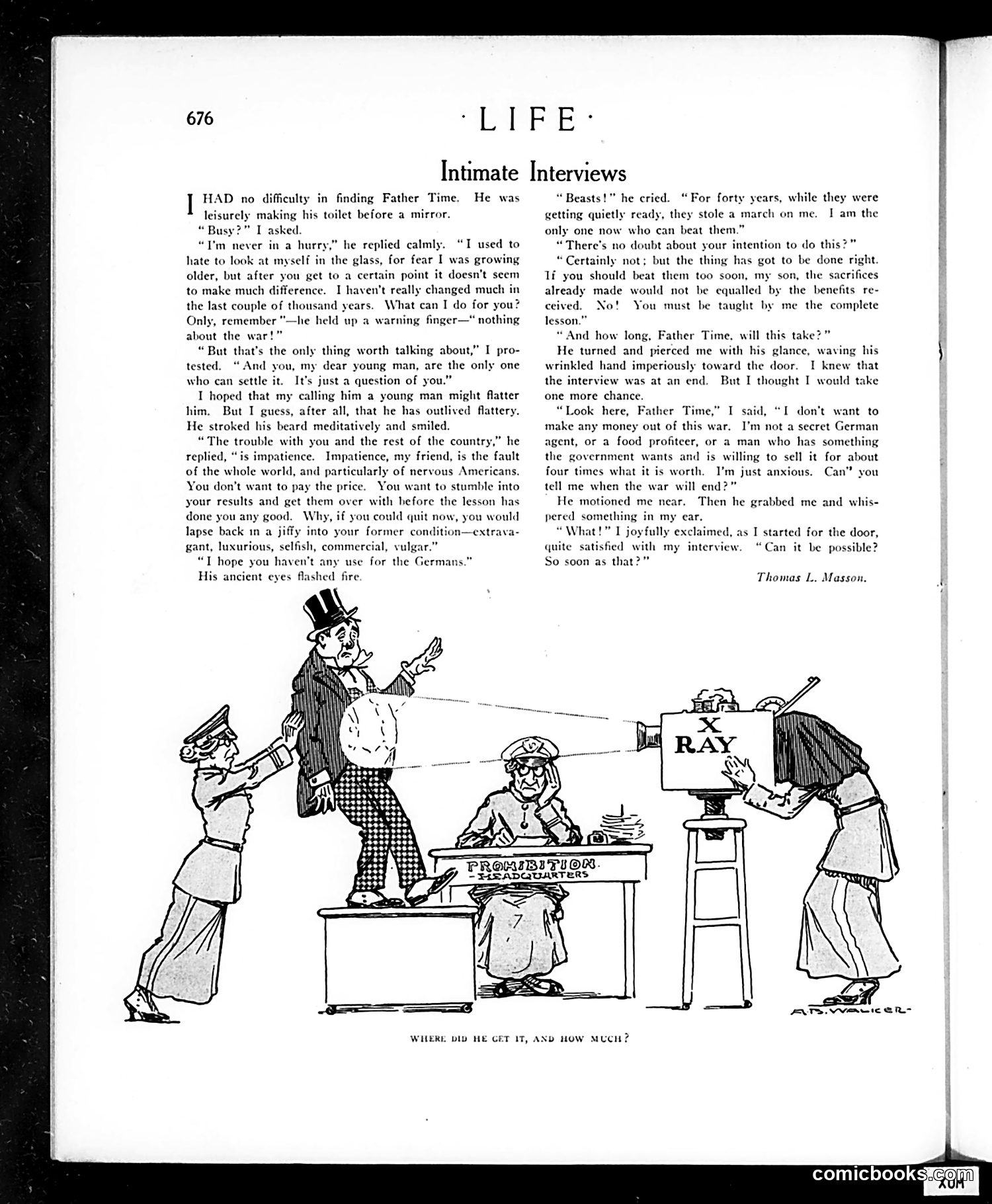
This is a satirical interview piece by Thomas L. Masson featuring personified **Father Time** as a character who refuses to discuss the war (World War I, based on context clues like "Germans" and prohibition references). **The satire's targets:** The main joke is that Father Time—ancient, impartial, all-knowing—lectures Americans about **impatience**. He warns that Americans want quick victory without paying the moral price, and that rushing would only let them revert to "extravagant, luxurious, selfish, commercial" behavior. This criticizes American eagerness to end the war without proper reformation. **The cartoon below** shows prohibition headquarters under interrogation ("Where did he get it, and how much?"), satirizing how Americans concern themselves with enforcing prohibition while ignoring weightier wartime issues. **The deeper point:** Americans are portrayed as shallow—obsessed with consumer excess and petty enforcement—rather than focused on genuine moral improvement through sacrifice.
📄 Transcribed text from this page (OCR, searchable)
Machine-transcribed from the original scan — historical spelling and the odd misread are preserved.
Intimate HAD no difficulty in finding Father Time. He was leisurely making his toilet before a mirror. “Busy?” I asked. “T'm never in a hurry,” he replied calmly, “I used to hate to look at myself in the glass, for fear I was growing older, but after you get to ac in point it doesn’t seem to make much difference. I haven't really changed much in the last couple of thousand years. What can I do for you? Only, remember "—he held up a warning finger—“ nothing about the war!" “But that’s the only thing worth talking about,” I pro- tested. “And you, my dear young man, are the only one who can settle it. It’s just a question of you.” I hoped that my calling him a young man might flatter him. But I guess, after all, that he has outlived flattery. He stroked his beard meditatively and smiled. “The trouble with you and the rest of the country,” he replied, “is impatience. Impatience, my friend, is the fault of the whole world, and particularly of nervous Americans. You don’t want to pay the price. You want to stumble into your results and get them over with hefore the lesson h: done you any good. Why, if you could quit now, you would lapse back in a jiffy into your former condition—extrava- gant, luxurious, selfish, commercial, vulgar.” “T hope you haven't any use for the Germans.” His ancient eyes flashed fire. SEE E * Interviews he cried. “For forty years, while they were I am the “ Beasts getting quietly ready, they stole a march on me. only one now who can beat them.” “There's no doubt about your intention to do this?” “Certainly not; but the thing has got to be done right. Tf you should beat them too soon, my son, the sacrifices already made would not be equalled by the benefits re- No! You must be taught by me the complete ceived. lesson.” “And how long, Father Time, will this tak: He turned and pierced me with his glance, waving his wrinkled hand imperiously toward the door. I knew that the interview was at an end. But I thought I would take one more chance. “Look here, Father Time,” I said, “I don’t want to make any money out of this war. I'm not a secret German gent, or a food profiteer, or a man who has something the government wants and is willing to sell it for about four times what it is worth. I’m just anxious. Can” you tell me when the war will end?” He motioned me near. Then he grabbed me and whis- pered something in my ear. “What!” I joyfully exclaimed, as I started for the door, quite satisfied with my interview. “Can it be possible? So soon as that?” Thomas L. Masson. PROMIBITION. — EESADQUARTERS WHERE DID HE GET IT, AND HOW MUCH? AR weer: comicbookseena