
A complete issue · 40 pages · 1918
Life — April 18, 1918
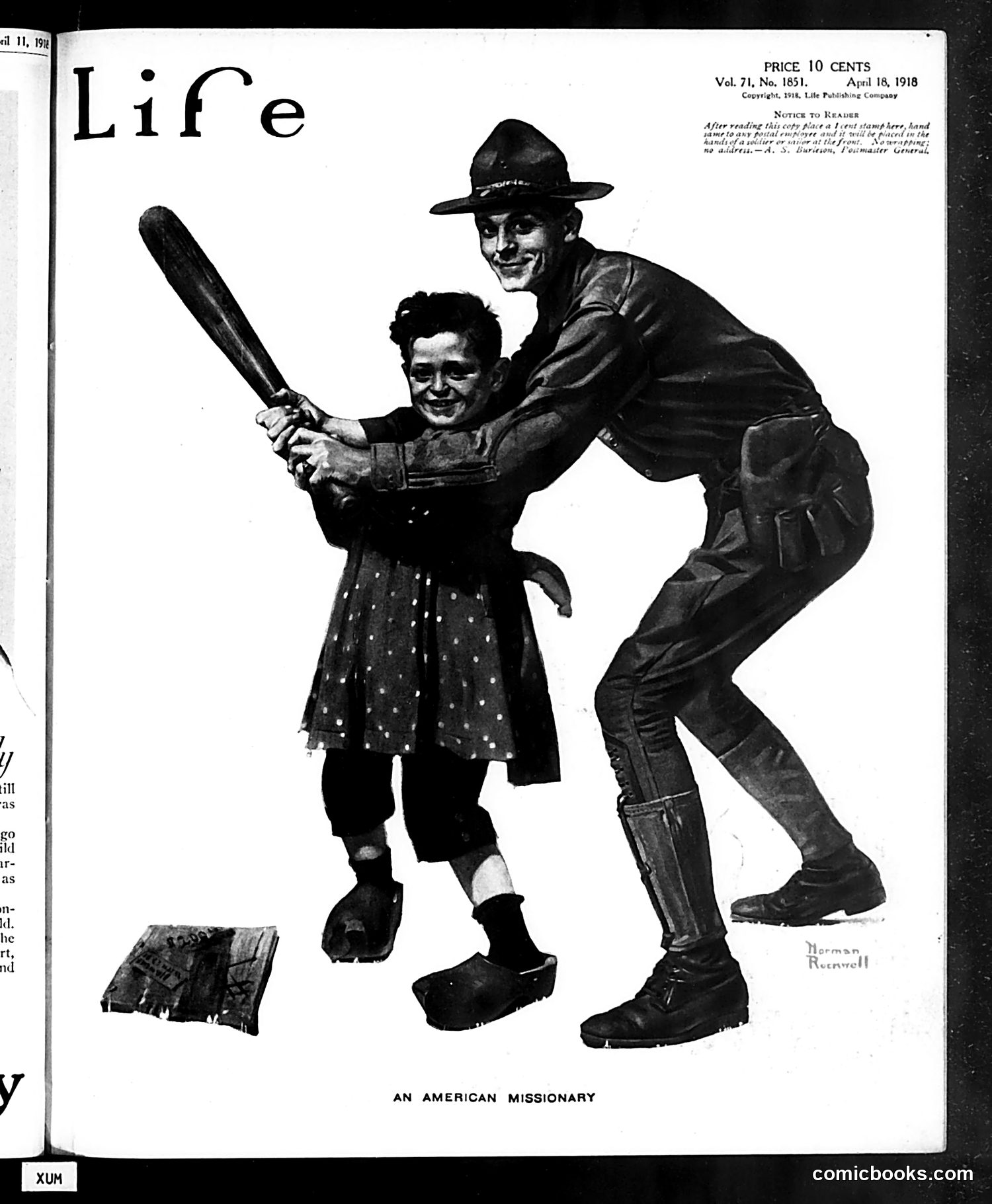
This Norman Rockwell illustration satirizes American missionary work abroad during World War I. The drawing shows a U.S. soldier in military uniform teaching baseball to a young foreign child, presenting an idealized vision of American cultural influence. The satire likely critiques how American military intervention was framed as "civilizing" or "missionary" work — spreading American values and culture alongside military presence. By depicting baseball instruction as the core of this "missionary" activity, Rockwell humorously suggests that American cultural exports (particularly sports) represented the nation's true global mission, perhaps more than genuine humanitarian concerns. The title transforms the soldier into a "missionary" of American culture rather than Christianity, pointing to America's expanding soft-power influence during the war era.

This is primarily a **Fisk Cord tire advertisement**, not political satire. The page promotes Fisk brand automobile tires through the "Life" magazine, a humor publication that also carried advertisements. The ad emphasizes six selling points: size, strength, safety, appearance, economy, and quality. The central image displays a Fisk tire's distinctive tread pattern and sidewall branding. A small Fisk Company logo—their trademark mascot, the "Fisk Boy"—appears in the lower left corner. The copy claims that Fisk Service Branches throughout the country provide customer care that "adds miles to your tires—and dollars to your pocket," a typical early-20th-century advertising pitch emphasizing both product quality and customer service infrastructure. This represents standard commercial advertising from the tire industry's early automotive era.
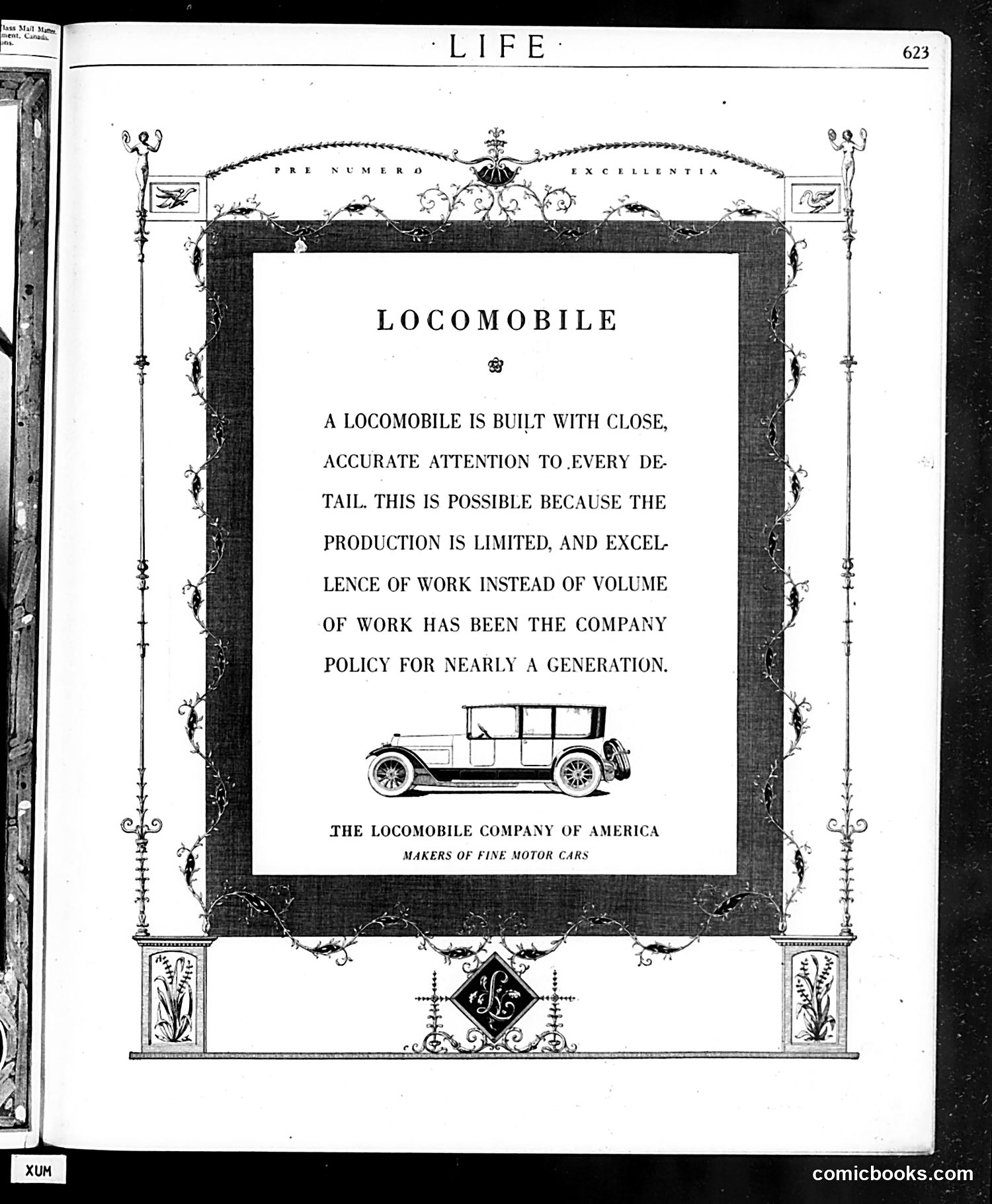
This is not a cartoon or satire—it's a **straightforward advertisement** for the Locomobile Company of America, appearing in *Life* magazine (page 623). The ad promotes Locomobile automobiles by emphasizing their manufacturing philosophy: limited production with meticulous craftsmanship rather than mass production. The text explains that this approach has been "the company policy for nearly a generation." The ornate Art Deco border and small illustration of an early automobile are typical design elements of period advertising. There is no political satire or caricature present. The page simply showcases the brand's positioning as a maker of "fine motor cars" distinguished by quality over quantity—a luxury market appeal common to early automotive advertising.
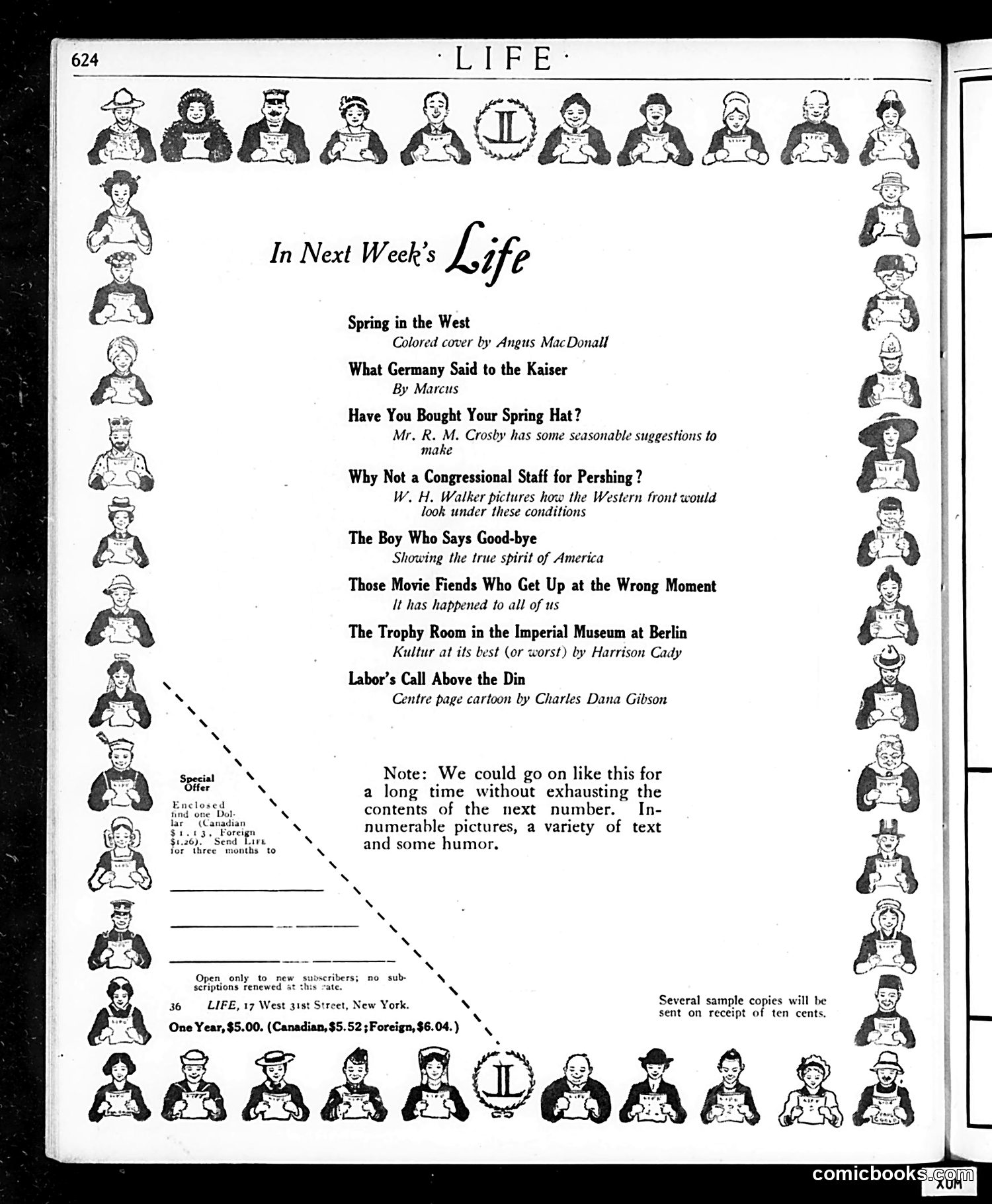
This is a **table of contents** for the upcoming issue, not a political cartoon. The page announces several articles: - **"Spring in the West"** (cover story) - **"What Germany Said to the Kaiser"** — appears to reference World War I diplomatic communications - **"The Boy Who Says Good-bye"** — described as "showing the true spirit of America," likely about American soldiers departing for WWI - **"Why Not a Congressional Staff for Pershing?"** — references General John J. Pershing, American commander in WWI - **"Labor's Call Above the Din"** — a center-page cartoon by Charles Dana Gibson The decorative border features illustrated faces of various types of people, typical of Life's satirical style. The page emphasizes the magazine's mix of "innumerable pictures, a variety of text and some humor." This predates modern magazine design significantly.
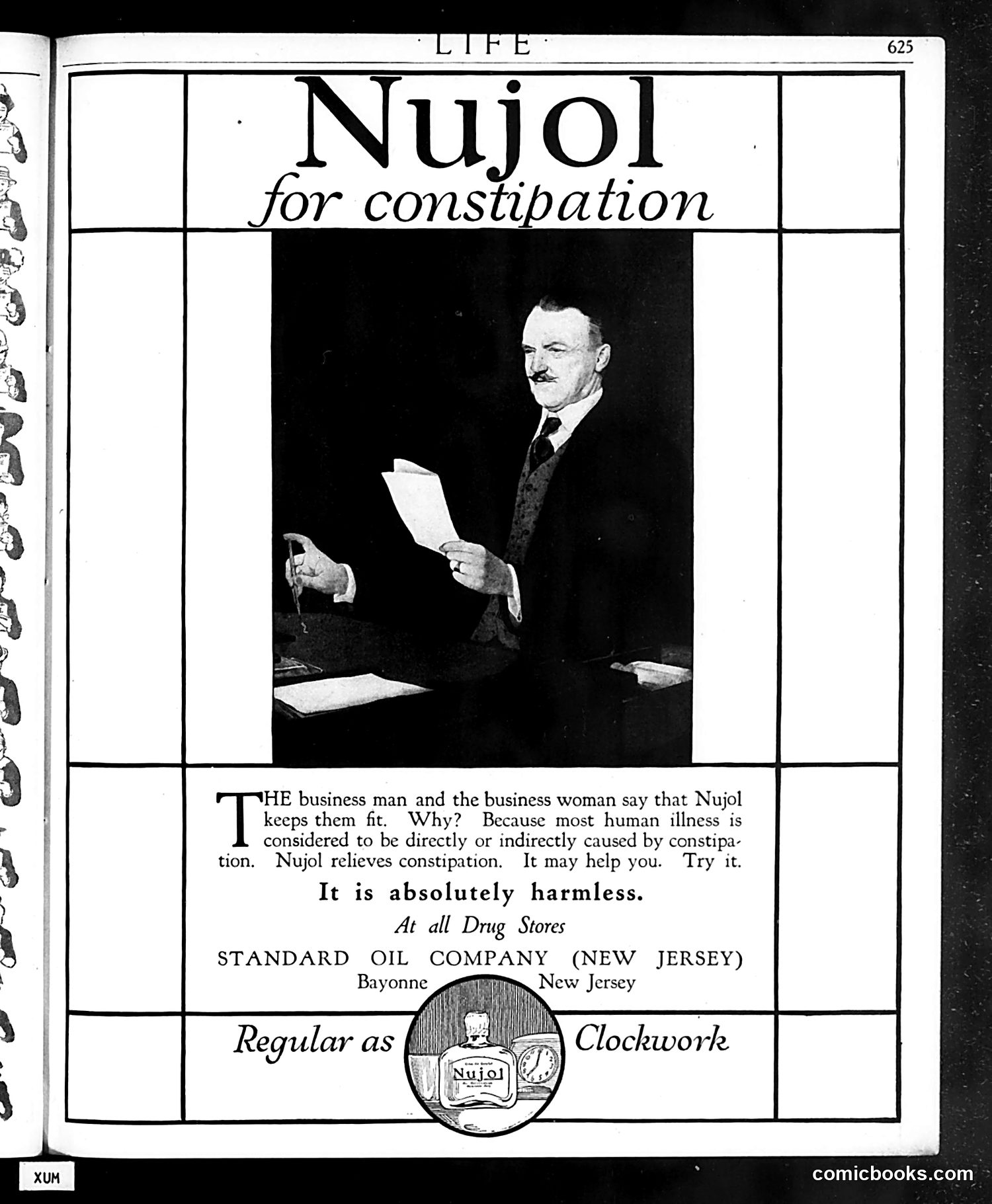
This is primarily a **product advertisement**, not a political cartoon. It advertises Nujol, a laxative made by Standard Oil Company (New Jersey), positioned as a constipation remedy. The advertisement features a businessman reading documents at his desk—a figure meant to represent the target demographic of successful, busy professionals. The ad's humor relies on the era's common belief that "most human illness is directly or indirectly caused by constipation," positioning Nujol as a cure-all solution. The tagline "Regular as Clockwork" plays on the product name and promises reliable, predictable digestive function. The claim "absolutely harmless" reflects early 20th-century advertising's need to assure consumers about proprietary medicines, many of which contained questionable ingredients. This represents dated medical thinking that modern readers would recognize as pseudoscience.
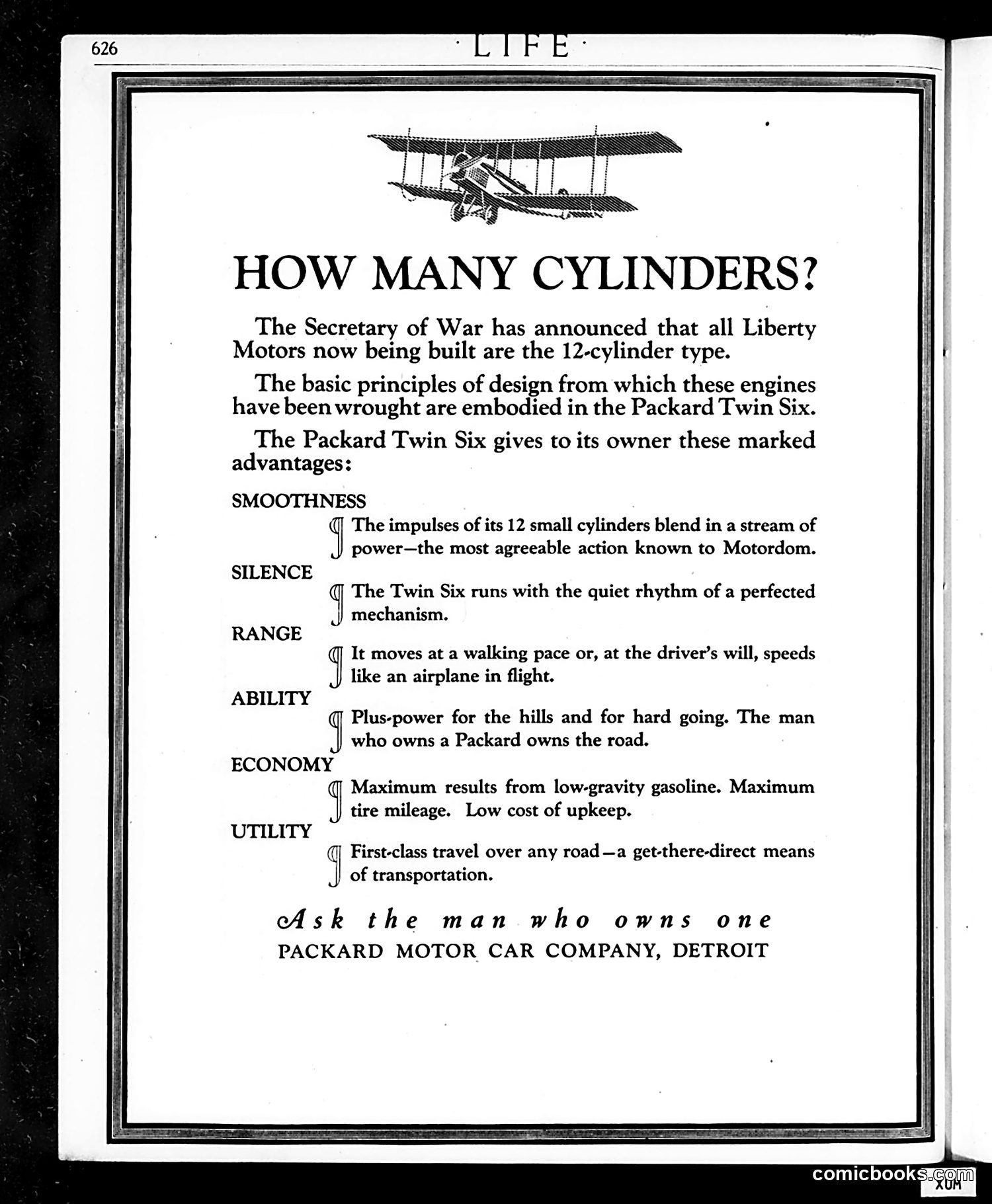
This page is **primarily an advertisement**, not satire or political commentary. It's a Packard Motor Car Company ad from Life magazine promoting the Packard Twin Six automobile. The headline "HOW MANY CYLINDERS?" references a contemporary competitive discussion in the automotive industry about engine specifications. The ad notes that the U.S. Secretary of War announced Liberty Motors (military aircraft engines) now use 12 cylinders, and argues that Packard's Twin Six incorporates similar design principles. The small biplane illustration at top connects to this military-industrial context—Liberty Motors powered WWI-era aircraft. The ad lists six consumer benefits (smoothness, silence, range, ability, economy, utility) to persuade buyers. The closing tagline encourages potential customers to consult current Packard owners. This reflects early 20th-century automotive marketing strategy: leveraging military specifications to establish civilian product credibility.
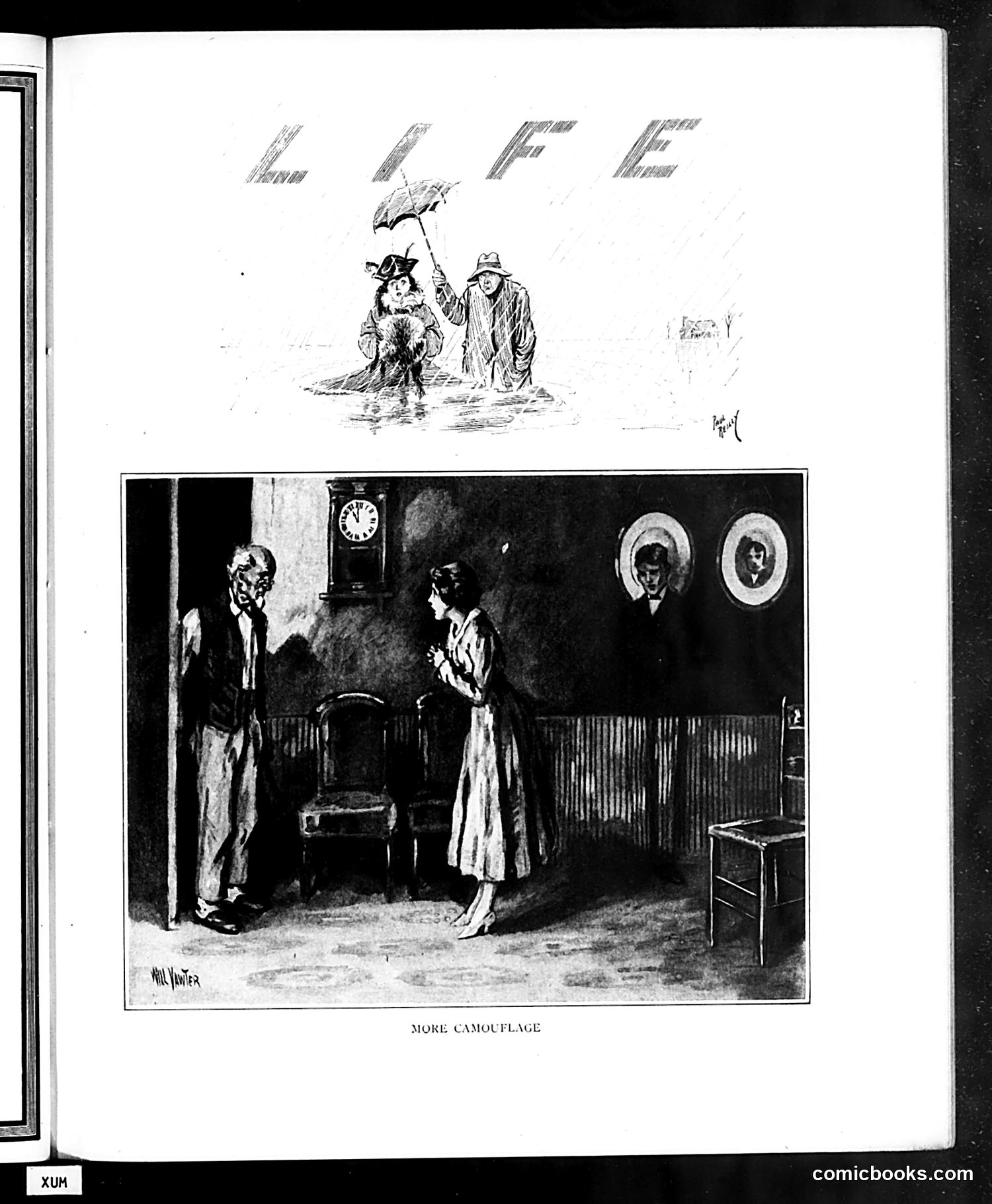
The page contains two cartoons about camouflage and deception. The **top cartoon** shows two figures in heavy rain with an umbrella during what appears to be a storm, with "LIFE" spelled out above in hatched letters—likely a visual pun on the magazine's title merging with the stormy scene. The **bottom cartoon**, titled "MORE CAMOUFLAGE," depicts an interior scene where a woman confronts a man. Two framed portraits hang on the wall behind them. The satire appears to address domestic deception or infidelity—the man's presence or explanation requires "camouflage" (concealment). The formal interior setting and the woman's suspicious posture suggest marital discord being masked or hidden beneath a veneer of normalcy. This reflects Life magazine's frequent satirical commentary on American domestic life and social pretense.
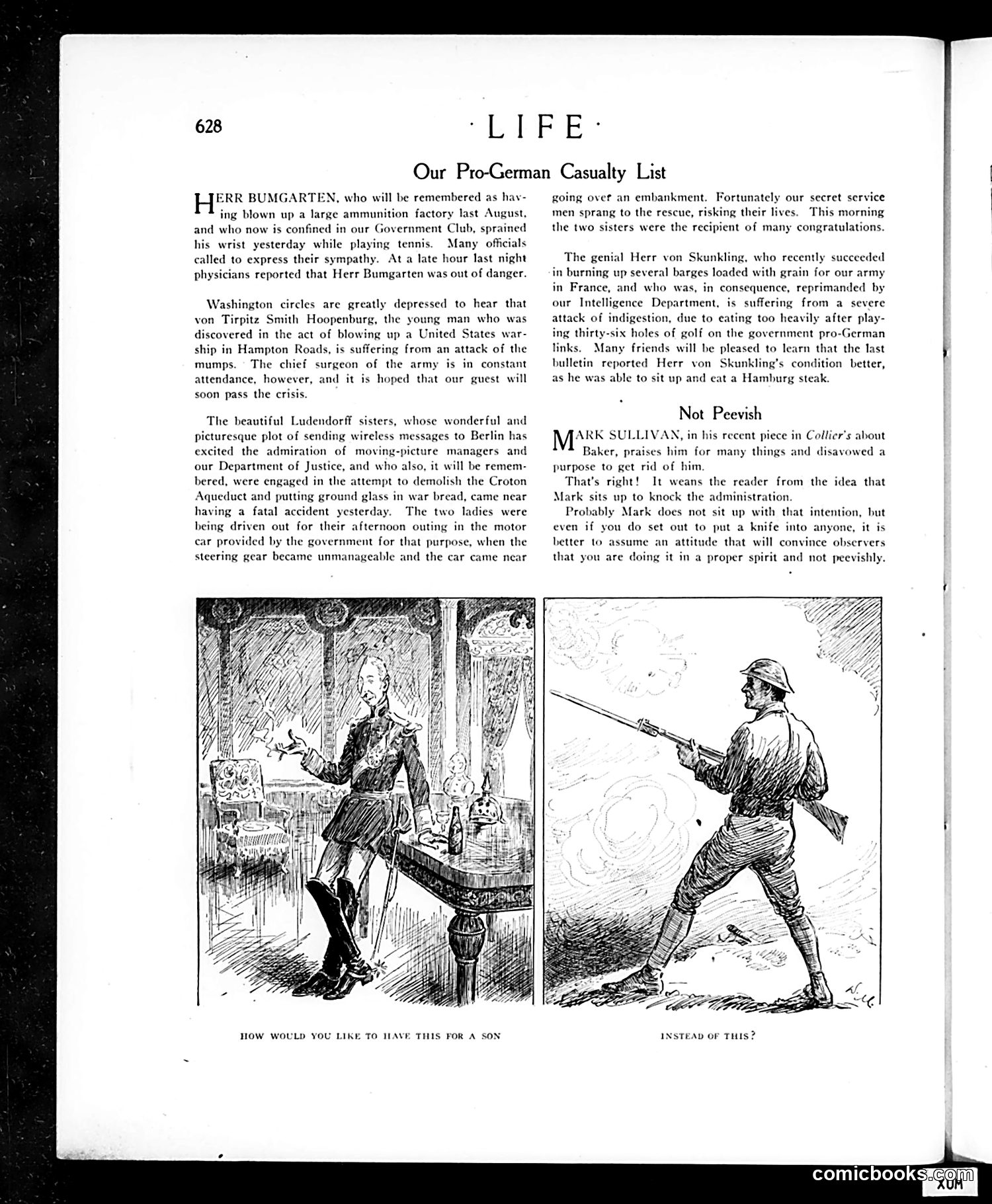
This page satirizes German sympathizers among American elites during World War I. The text mocks prominent pro-German figures suffering embarrassing incidents—von Tirpitz Smith Hoopenburg (likely a fictional composite) accused of sabotaging a U.S. warship, and the Ludendorff sisters (a fictional parallel to actual German generals) in a motor car accident. The bottom cartoon contrasts two scenarios: left shows a luxurious officer in comfort; right shows a soldier in combat. The caption "How would you like to have this for a son / Instead of this?" sarcastically criticizes wealthy Americans who supported Germany while others' sons died in war—a pointed rebuke of pro-German elites enjoying safety and privilege.
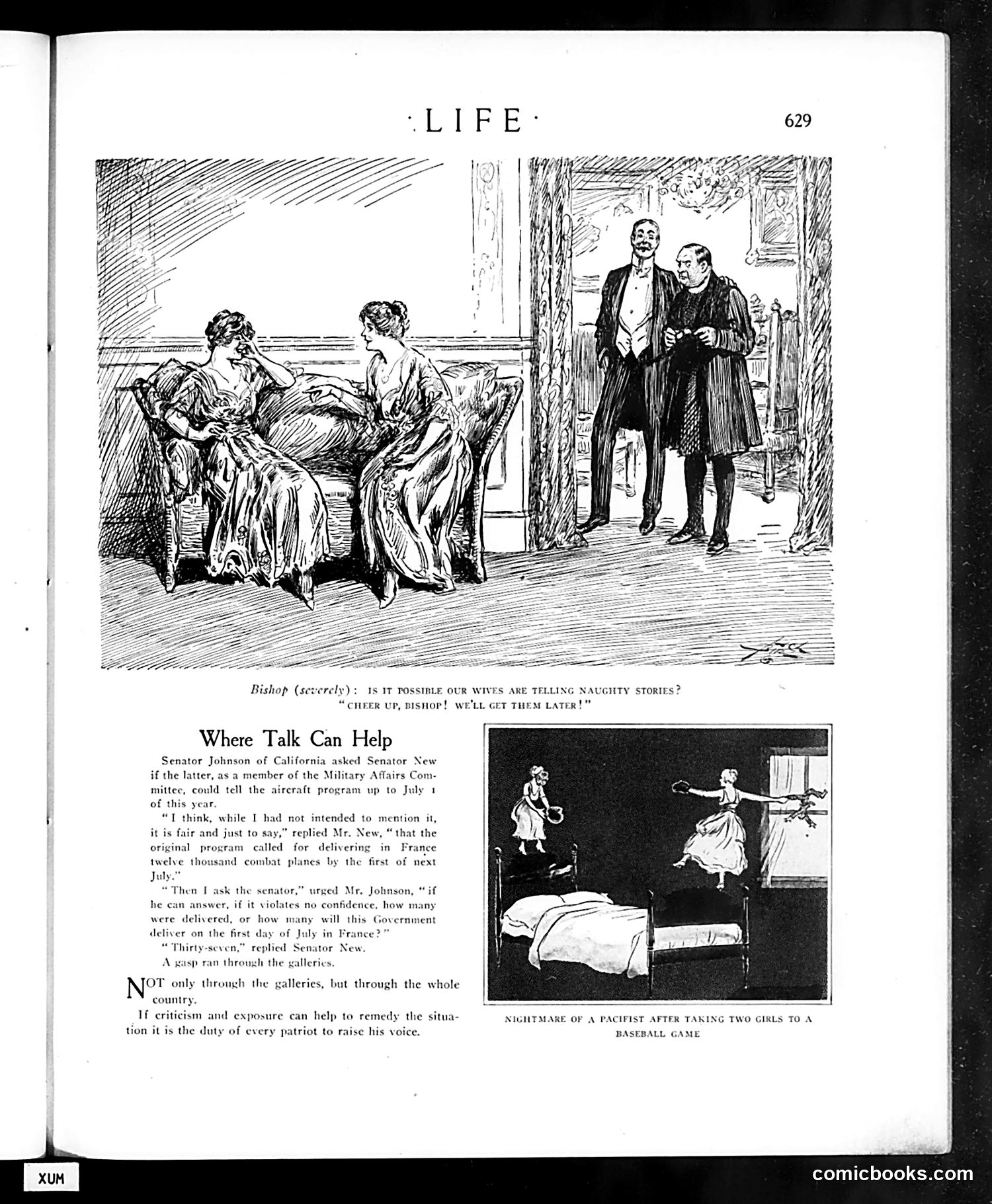
The top cartoon depicts a Bishop interrupting two women telling stories, with the caption suggesting the women are sharing "naughty stories." The joke plays on Victorian-era propriety—the Bishop's presence causes alarm that indecorous tales are being told in mixed company. The article "Where Talk Can Help" discusses Senator Johnson of California questioning Senator New about aircraft production delays. Johnson requests information about how many planes were delivered by July 1st, and New responds that "thirty-nine" were delivered—prompting gasps from gallery observers. The bottom cartoon shows a pacifist's nightmare: a man dreaming that two girls he took to a baseball game are fighting in bed, apparently turned violent by the sport's competitive nature. Both cartoons use humor to comment on social propriety and contemporary anxieties.
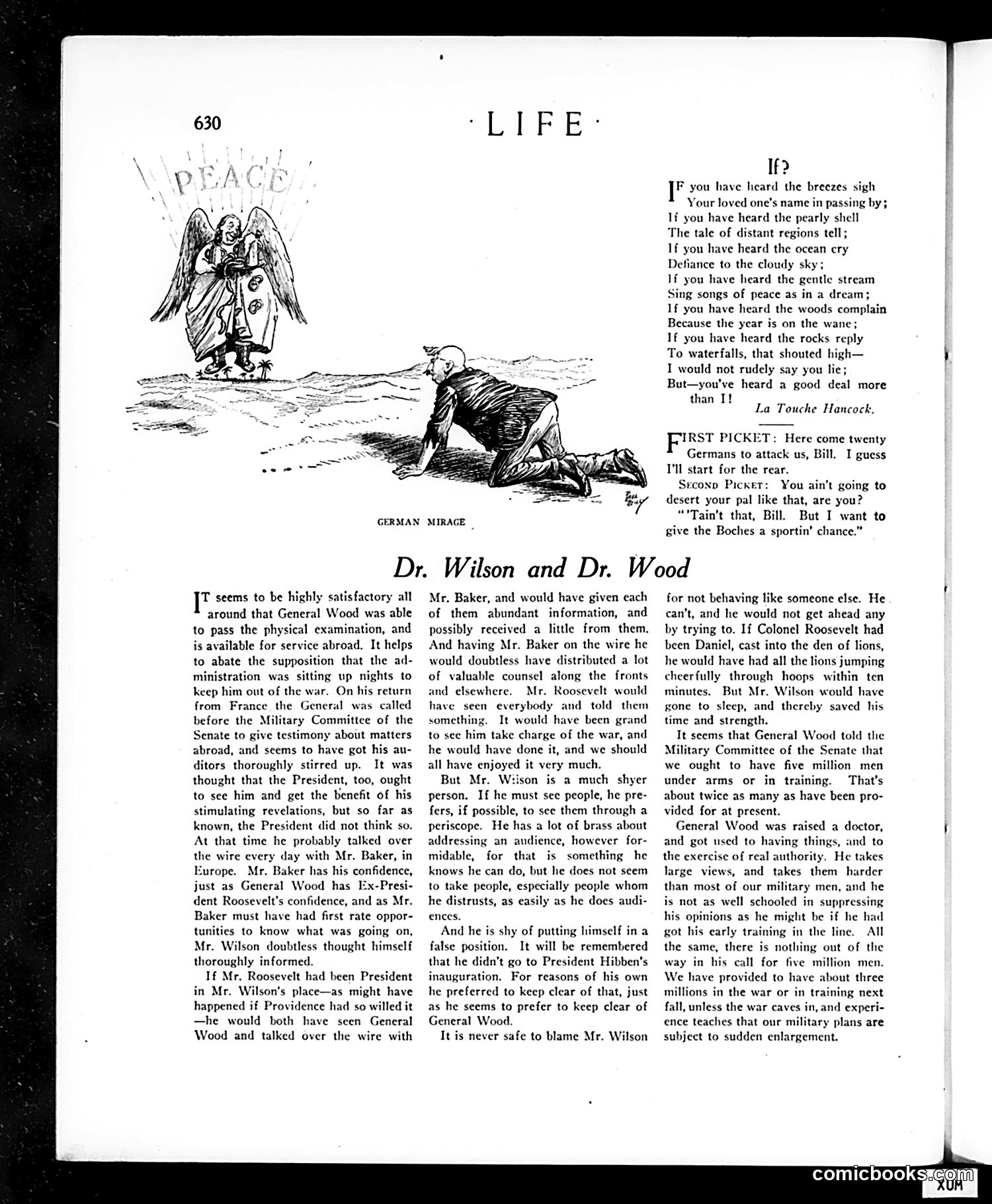
**The "German Mirage" cartoon** depicts a crawling soldier approaching an angelic "Peace" figure—satirizing false hopes that Germany might surrender or make peace during World War I. The soldier's desperate posture suggests Germany's deteriorating military position, while the unrealistic "mirage" of peace mocks both German wishful thinking and perhaps Allied negotiation proposals. **"Dr. Wilson and Dr. Wood"** article discusses President Woodrow Wilson's reluctance to involve General Leonard Wood in war strategy, despite Wood's military experience and proposals for troop training. The piece criticizes Wilson's preference for confidant Secretary of State Robert Lansing over experienced military figures, suggesting Wilson's management style prioritized loyalty over military expertise during wartime.
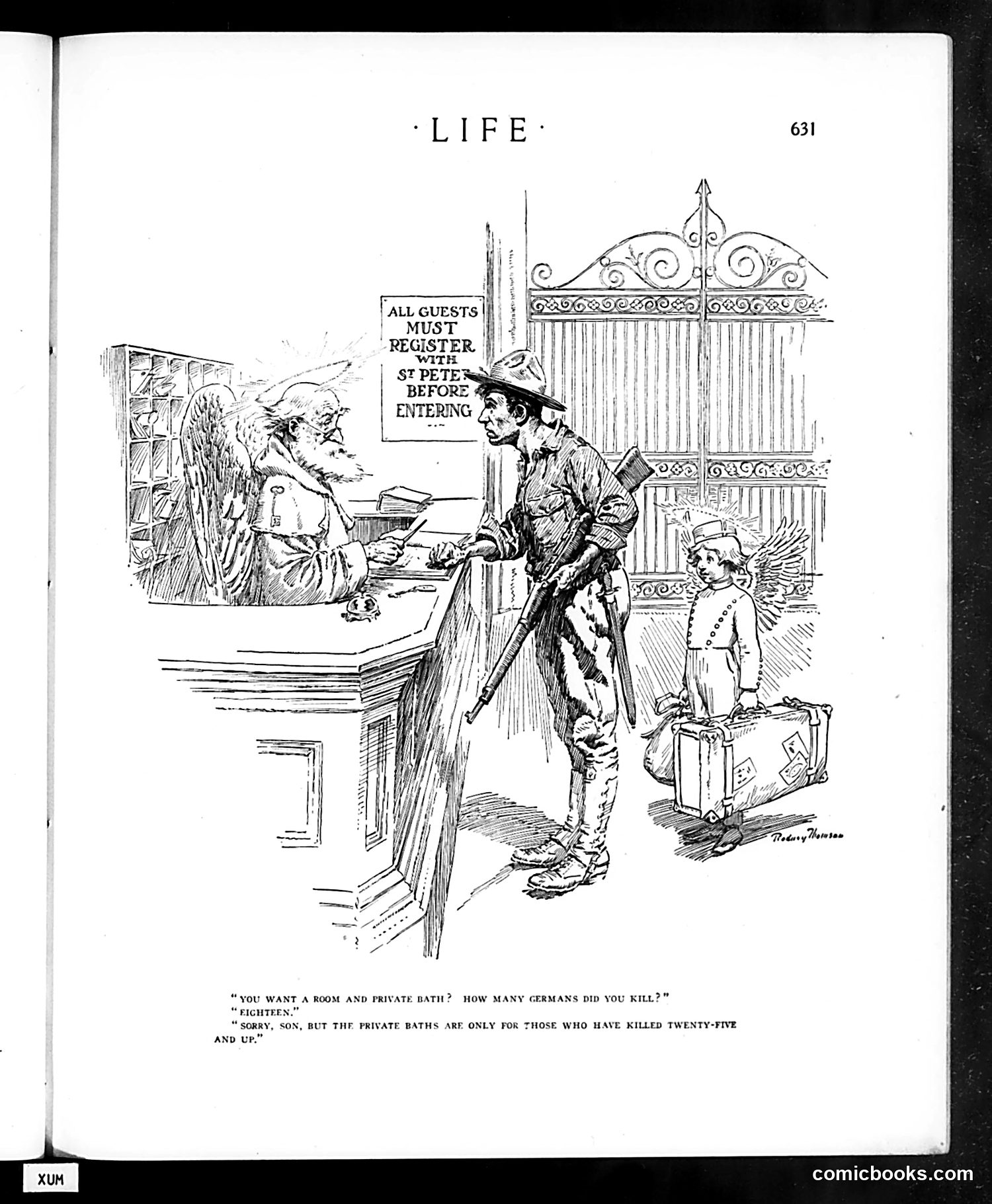
This WWI-era cartoon satirizes military recruitment standards and class distinctions. A grizzled soldier at the gates of heaven (indicated by the ornate gate and cherub) is registering new arrivals. An angel-like figure approaches with luggage, seeking "a room and private bath." The soldier's response—requiring soldiers to have killed "twenty-five and up" Germans to access private bathing facilities—mocks the hierarchy of military privilege. The joke targets the absurdity of reserving comfort amenities based on body count, while simultaneously satirizing how wartime creates brutal incentive structures and class divisions even in death. The cartoon criticizes both military bureaucracy and the dehumanizing nature of combat through dark, gallows humor typical of WWI-era American satire.
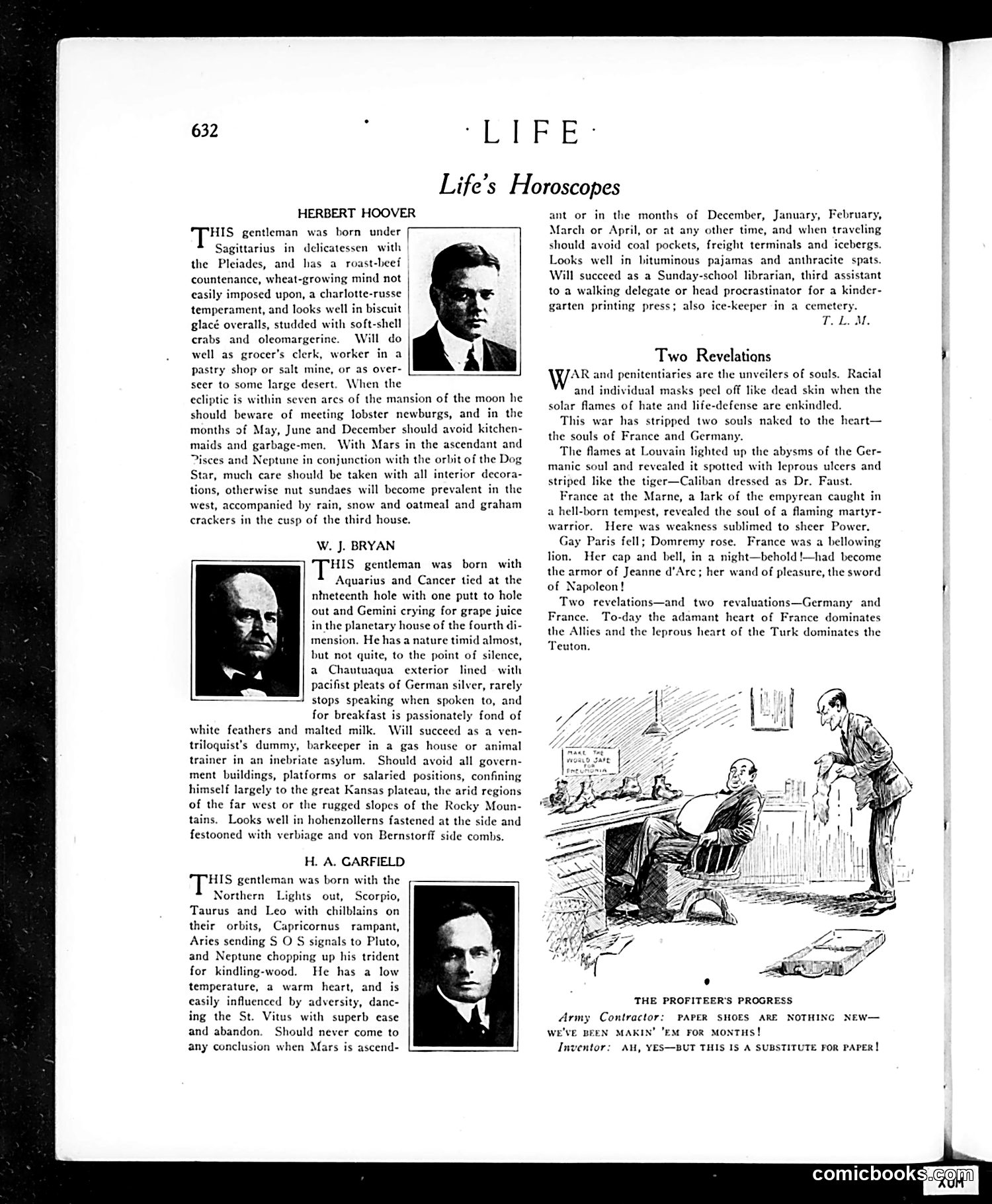
This page contains horoscopes for three men (Herbert Hoover, W. J. Bryan, and H. A. Garfield) based on their astrological signs. The satirical premise appears to mock these political figures by reducing their futures to zodiac predictions—a humorous commentary on their public personas and perceived limitations. Below is a cartoon titled "The Profiteer's Progress" depicting a wartime exchange between an Army Contractor and an Inventor about substitute materials. The contractor boasts of using "paper shoes" for months, while the inventor suggests paper as a substitute for an unspecified material. The satire targets wartime profiteering and the use of inferior substitute goods during WWI, mocking both industrial efficiency claims and commercial exploitation of wartime shortages.
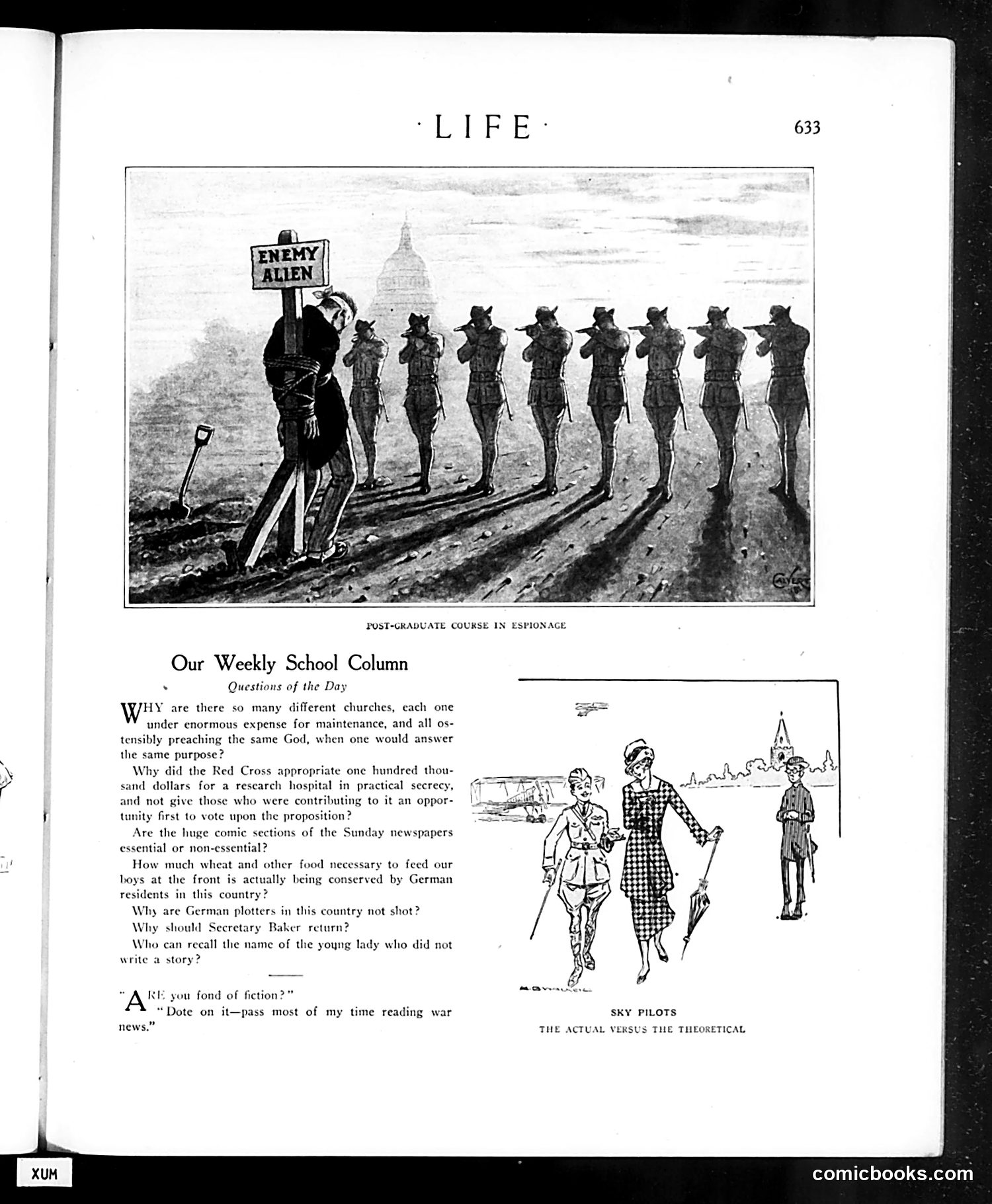
**Top Cartoon: "Post-Graduate Course in Espionage"** This satirical illustration shows a figure in dark clothing holding a sign reading "ENEMY ALIEN" while instructing a line of soldiers in military formation, with the U.S. Capitol visible in the background. The cartoon critiques wartime suspicion and paranoia, suggesting that "enemy aliens" were being used—or potentially could be used—to train or infiltrate American military forces. This reflects WWI-era anxieties about foreign nationals and domestic security threats. **Bottom Section: "Sky Pilots"** The illustration contrasts theoretical versus actual chaplains (military clergy), showing uniformed officers alongside civilians in a rural setting, likely commenting on the gap between idealized military religious service and wartime reality. **School Column** addresses contemporary questions about churches, hospital funding, and wartime resource allocation.
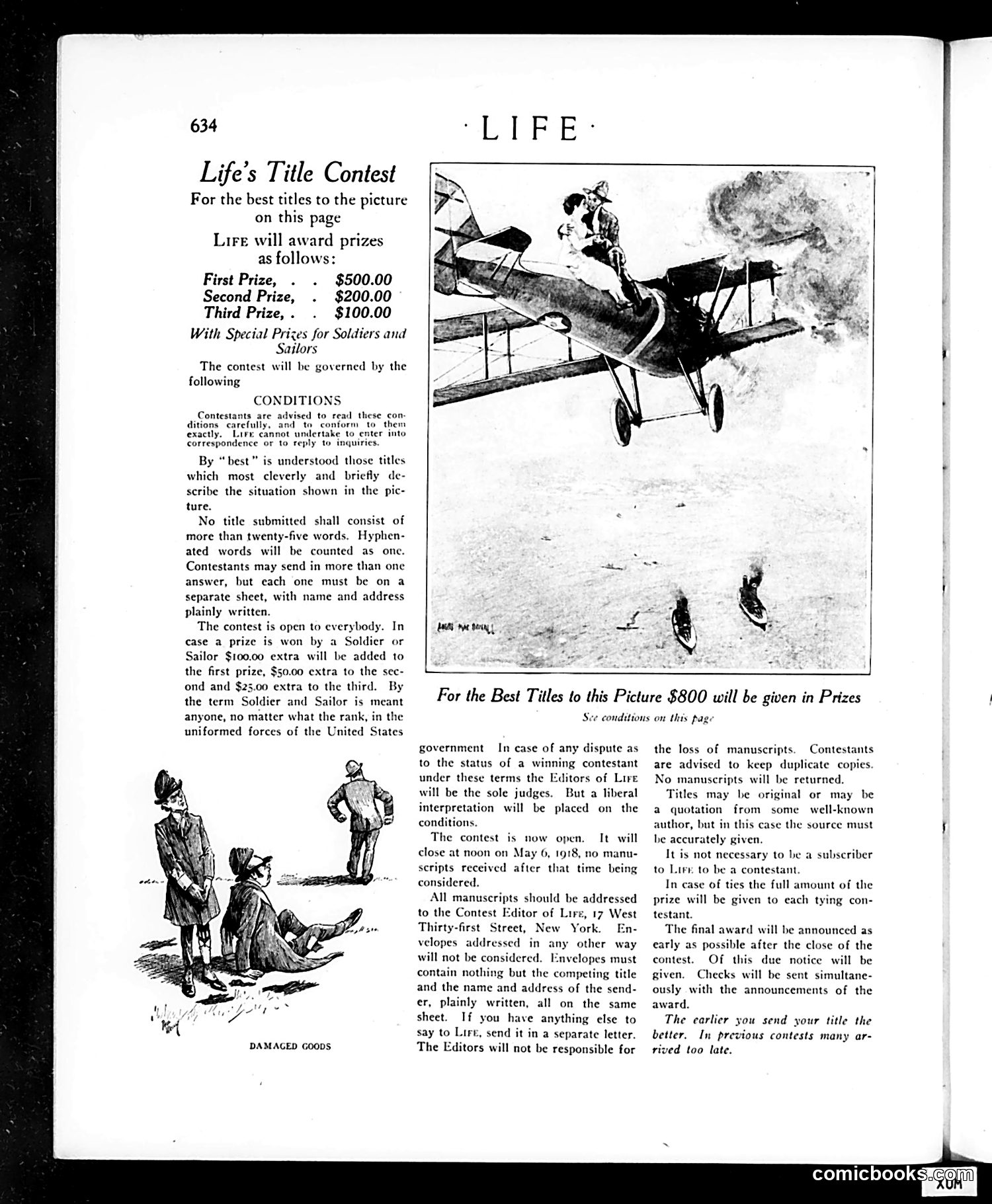
This page announces a Life magazine contest inviting readers to submit titles for the featured photograph—an airplane in an unusual position with figures nearby, apparently depicting some kind of accident or mishap. The main illustration labeled "Damaged Goods" (lower left) appears to be a satirical cartoon about poor-quality or defective merchandise, showing figures examining or dealing with broken items. The contest offers $500 for the best title, with special prizes for soldiers and sailors. The detailed conditions specify titles must be 25 words or fewer and emphasizes this is a serious creative competition open to all readers, particularly military personnel. The "damaged goods" reference likely carries double meaning—both literal product quality and possibly social commentary typical of Life's satirical approach.
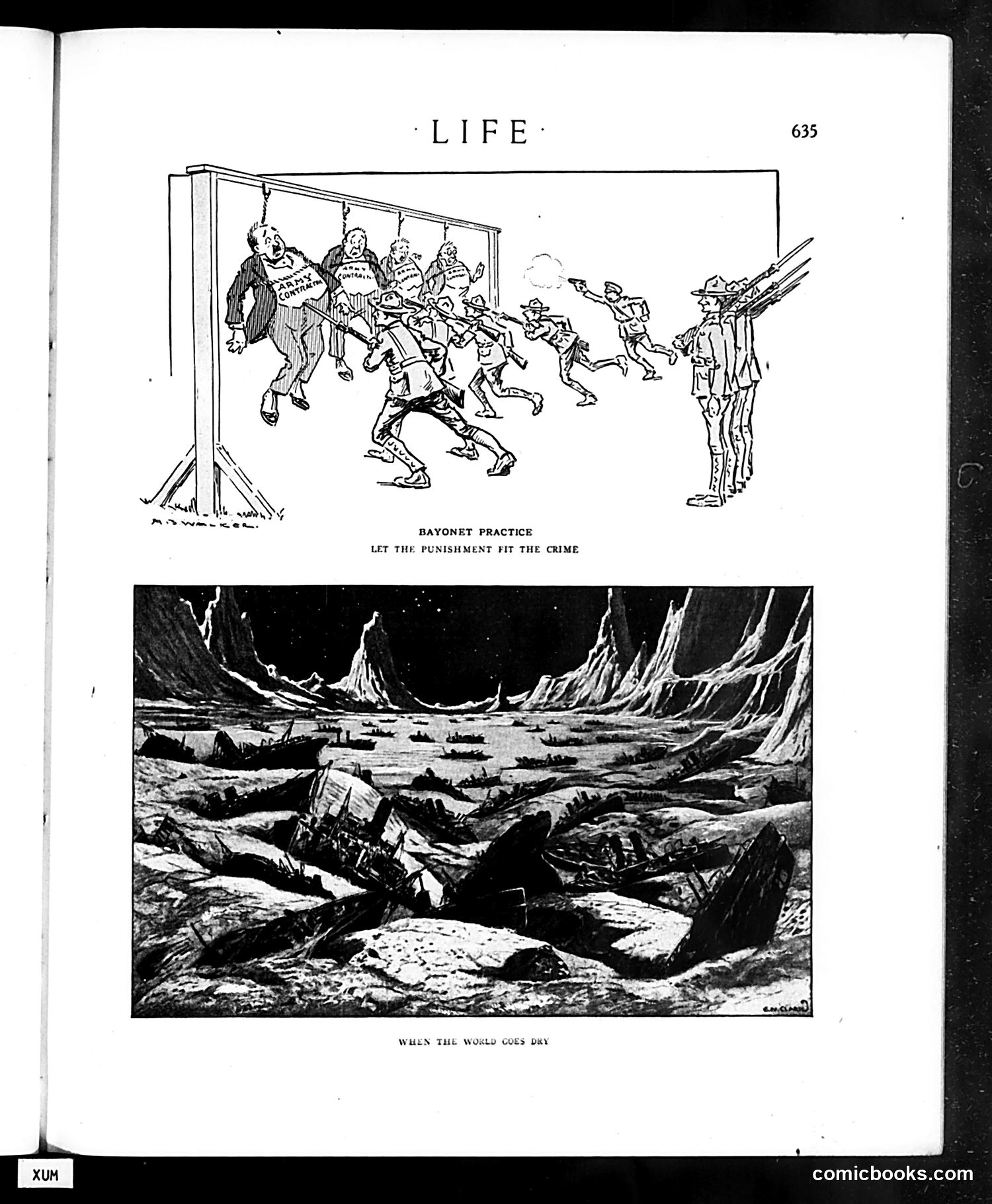
This page contains two distinct editorial cartoons from *Life* magazine: **Top cartoon** ("Bayonet Practice—Let the Punishment Fit the Crime"): Depicts soldiers executing civilians by bayonet, with a figure (possibly representing military authority or justice) overseeing the brutal punishment. The caption suggests dark satire about military justice or war crimes presented as proportional punishment. **Bottom cartoon** ("When the World Goes Dry"): Shows a post-apocalyptic wasteland with destroyed ships and desolate terrain beneath towering cliffs. This likely satirizes Prohibition—the ban on alcohol (1920-1933)—suggesting that a world without alcohol would be similarly barren and ruined. The stark, dystopian imagery mocks those supporting alcohol prohibition. Both cartoons employ satire to critique government policies and military actions.
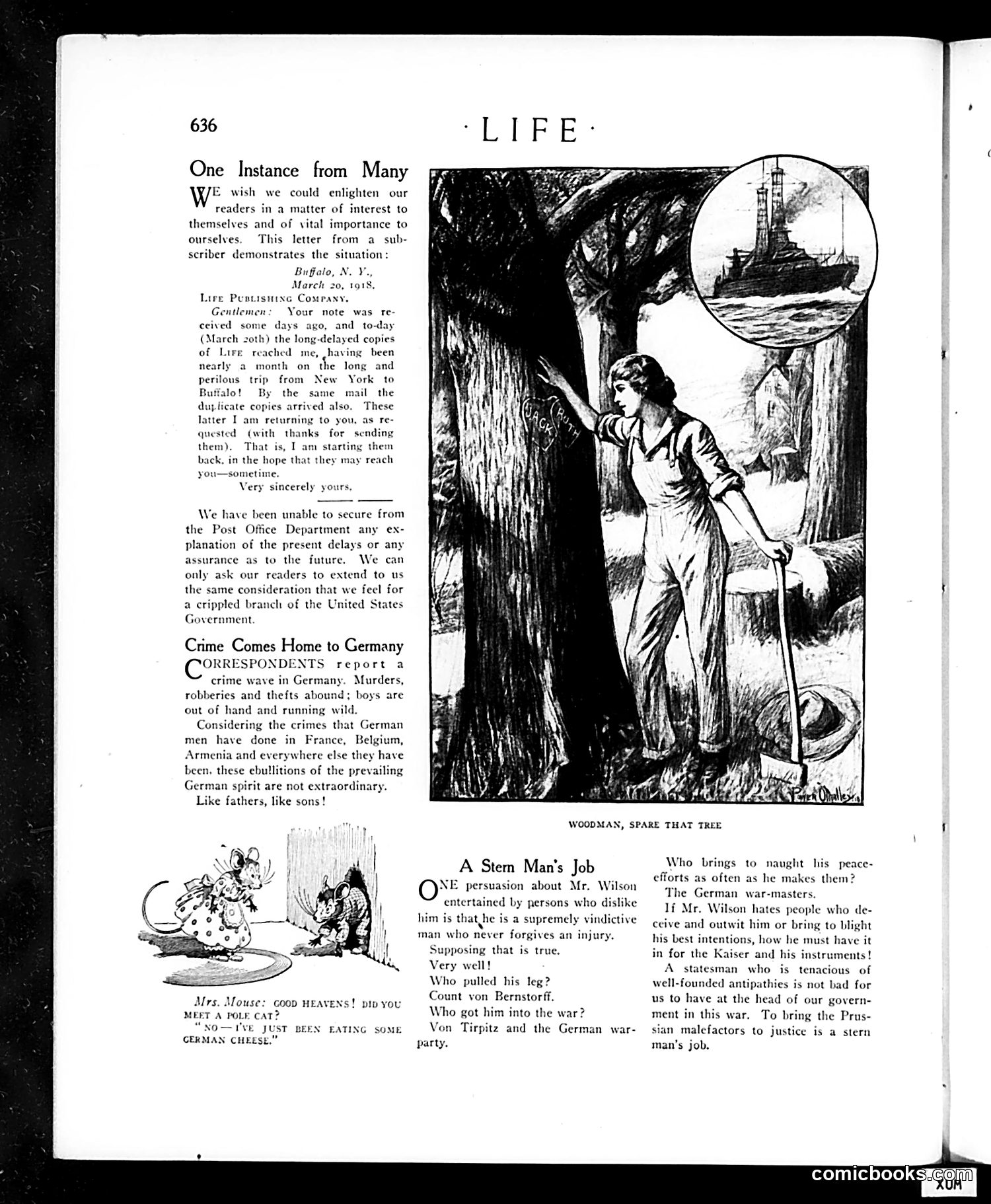
This page contains three separate items reflecting American sentiment during World War I: **Top Section:** A letter complaining about postal delays—Life magazine copies took a month to reach Buffalo from New York. The editors use this to critique the "crippled" U.S. Post Office, suggesting wartime inefficiencies. **Middle Section:** "Crime Comes Home to Germany"—A satirical commentary claiming Germany is experiencing a crime wave (murders, theft, lawlessness). The joke: German soldiers committed atrocities in France, Belgium, and Armenia, so Germans shouldn't be surprised their own society is now violent. The accompanying cartoon shows Mrs. Mouse asking if she met a polecat; she replies she ate German cheese instead—implying German food is as repulsive as a skunk. **Bottom Section:** "A Stern Man's Job"—A defense of President Wilson's vindictiveness toward Germany. The author argues that if Wilson holds grudges against those who deceived him (Count von Bernstorff, Von Tirpitz, the Kaiser), that's actually *good* leadership during wartime. Punishing German "malefactors" requires an unforgiving temperament. All three items reinforce anti-German, pro-American war sentiment.
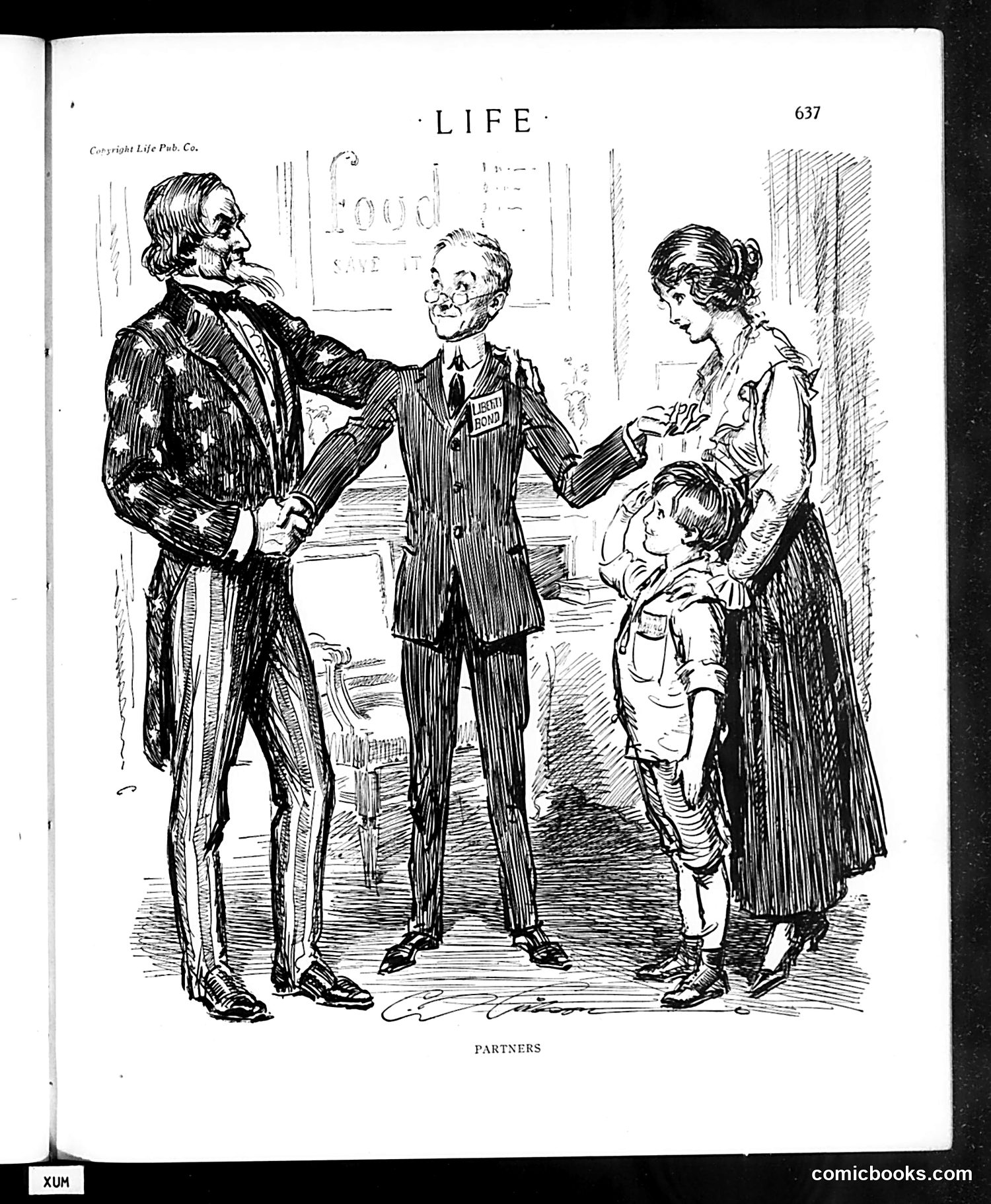
This cartoon depicts four figures in what appears to be a business or professional setting. The title "Partners" suggests a commentary on unlikely or questionable alliances. The image shows two well-dressed men in suits engaged with a woman and child, rendered in the satirical pen-and-ink style typical of early 20th-century Life magazine. The specific identities of these figures are unclear from the image alone, as are the particular political or social references intended. Without additional context about the publication date or accompanying text, the exact satirical point remains uncertain. The composition suggests commentary on business dealings, partnerships, or social relationships of the era, but the specific targets of the satire cannot be definitively identified from the visual information provided.
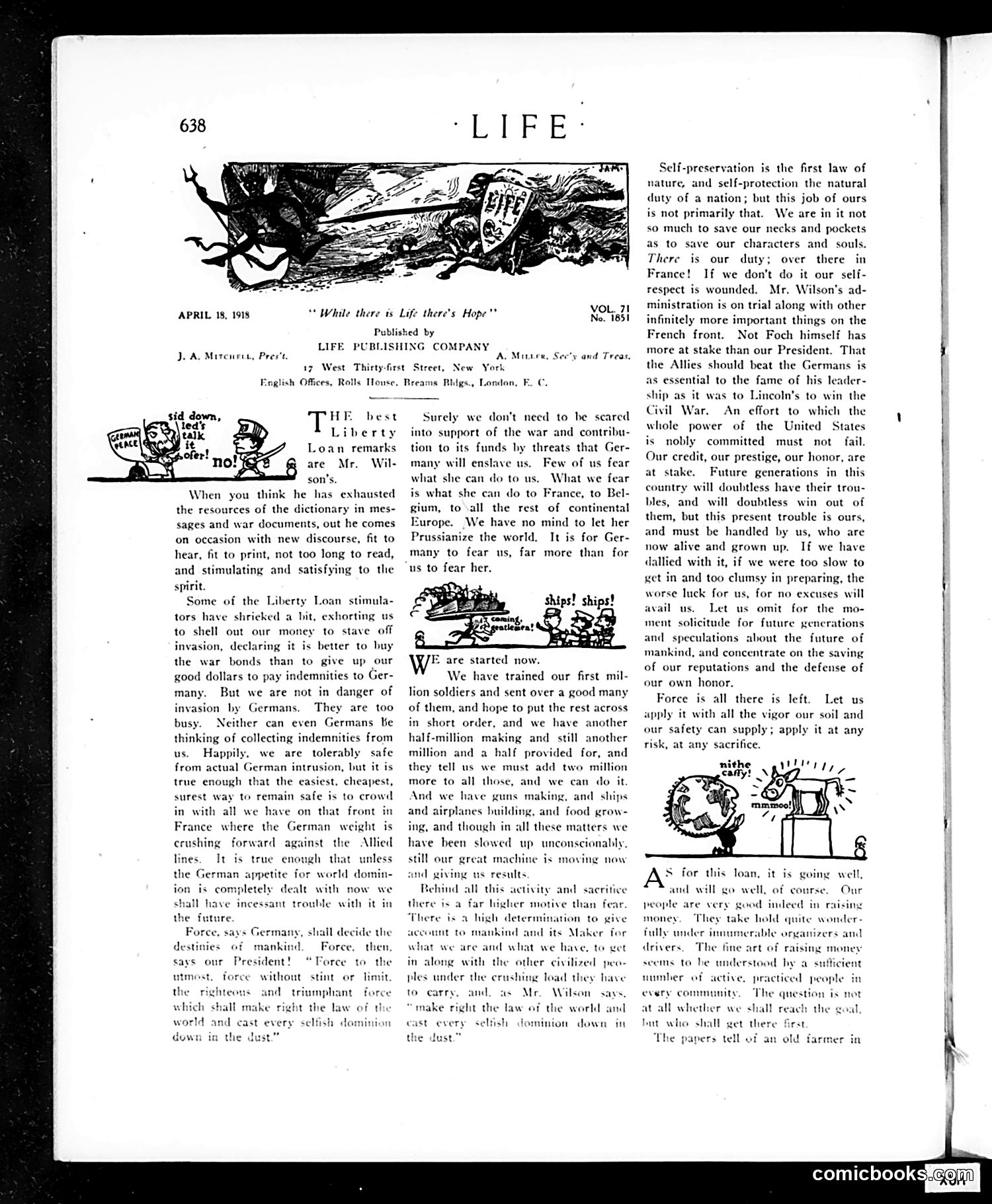
This editorial page argues for American commitment to World War I, specifically supporting Liberty Loan fundraising. The text praises President Wilson's rhetoric while reframing why Americans should fight: not from fear of German invasion (which the author dismisses as unlikely), but from moral obligation to protect France, Belgium, and European civilization from "Prussianization." The cartoons appear satirical in tone—one shows what appears to be a figure labeled "BIFF" (unclear reference), another depicts ships and soldiers. The article emphasizes that American soldiers are already deployed, millions more are being trained, and military production (guns, ships, airplanes) is ramping up, though "slowed up unconscionably." The core argument: Americans must contribute financially and militarily not for self-preservation but to "save our characters and souls" and uphold President Wilson's stated goal to "make right the law of the world." Wilson's administration's reputation is tied to Allied victory as Lincoln's was to Civil War success.
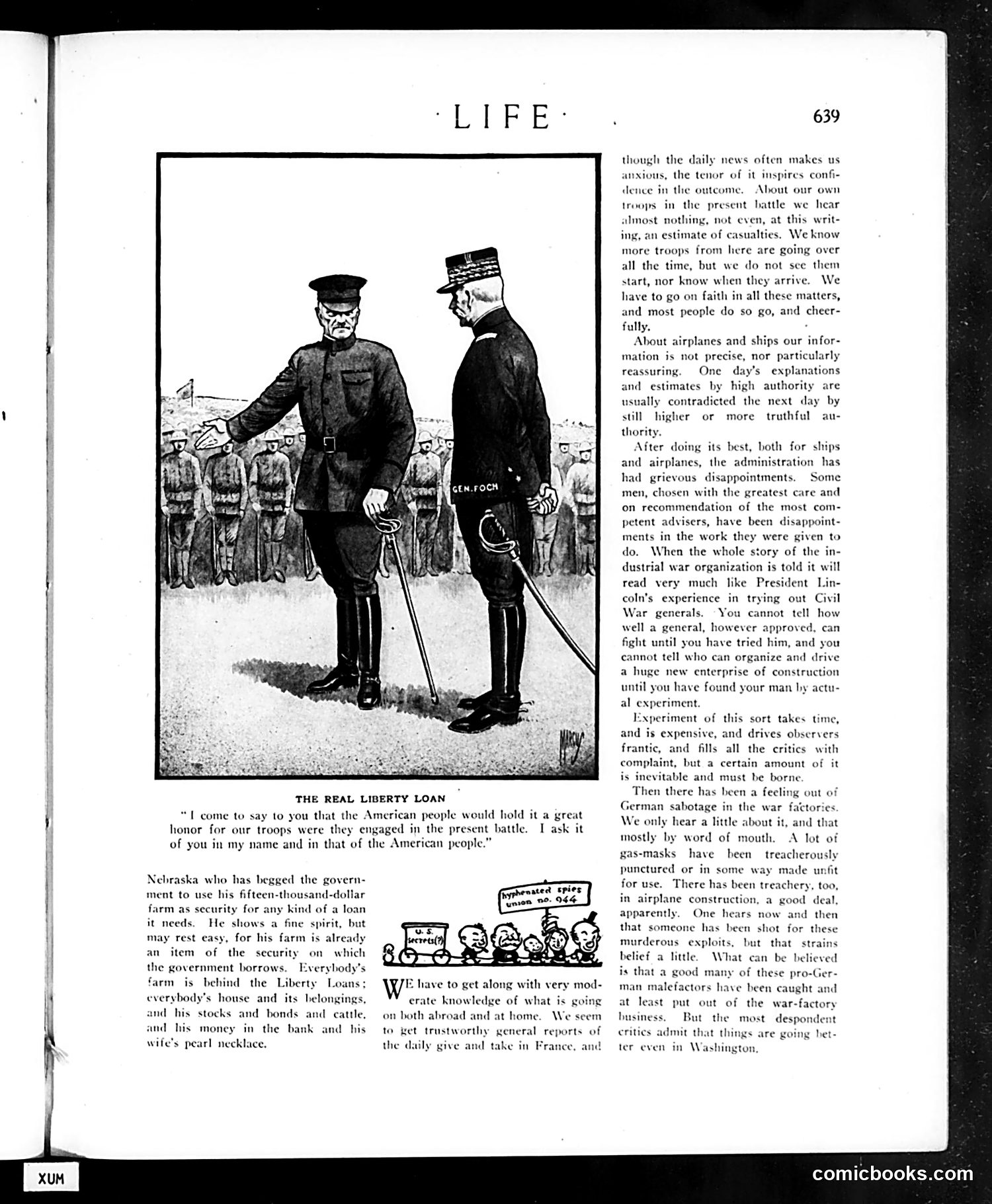
This page critiques American war finance during World War I. The cartoon depicts a military officer presenting a farmer's property to another official, illustrating the text's central point: Liberty Loans (government bonds to finance the war) are nominally voluntary, but citizens' assets—farms, homes, stocks, cattle, even "wife's pearl necklace"—effectively serve as collateral whether they participate or not. The satire argues that ordinary Americans bear the financial burden of war regardless of choice. A Nebraska farmer offering his $15,000 farm as security demonstrates patriotic intent, but the article notes this is unnecessary since all citizens' assets already back government borrowing. The broader text discusses wartime anxieties: vague casualty reports, contradictory military information, administrative failures, and suspected German sabotage in factories—frustrations common to civilian populations during WWI. The tone is cautiously optimistic but notes inevitable wartime inefficiencies and disappointments.
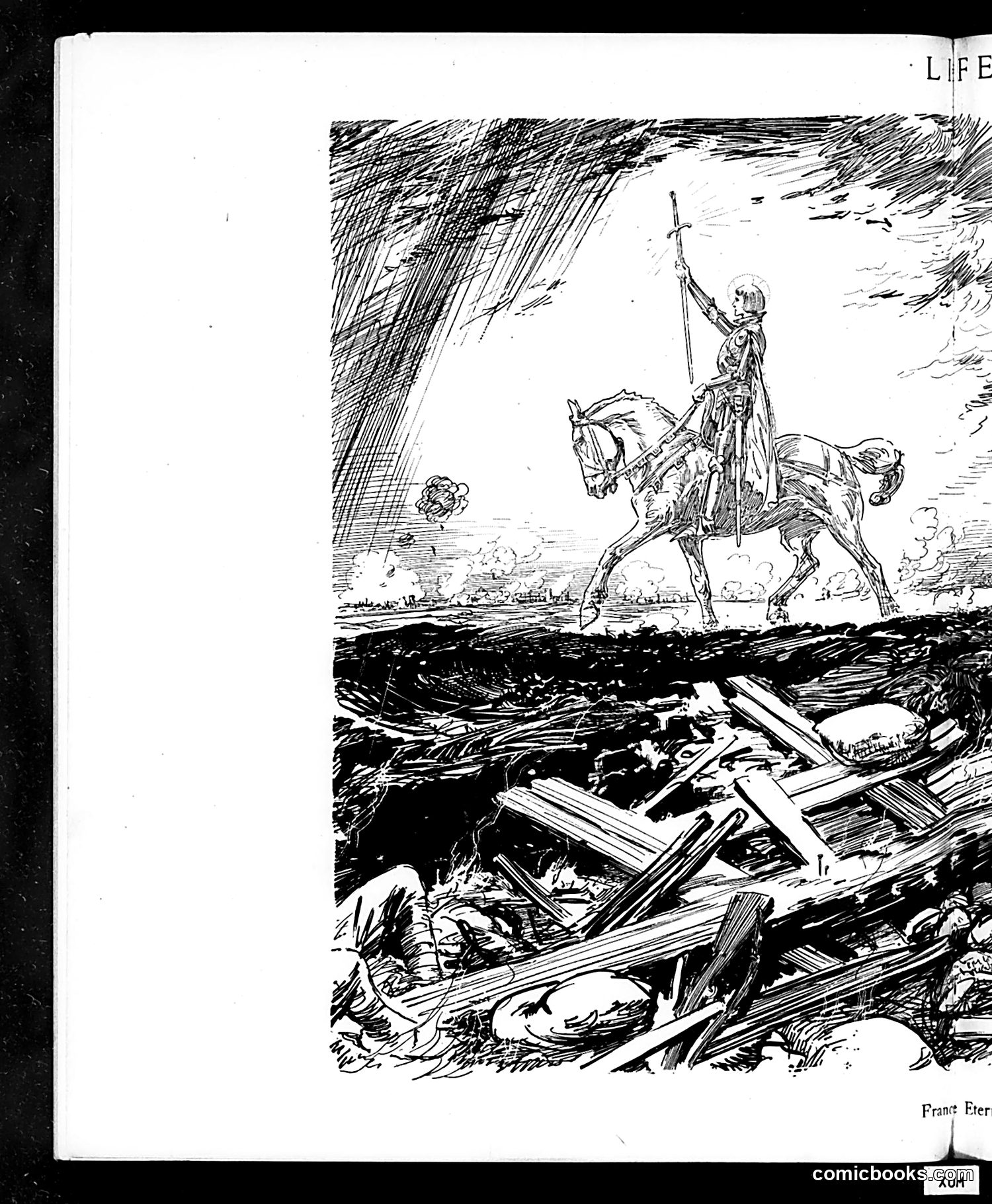
This is a dramatic ink illustration signed by Frans Pier showing a mounted knight or armored soldier on horseback, holding a lance aloft against a stormy sky. The figure stands triumphantly over a devastated battlefield strewn with wreckage, debris, and fallen bodies. The imagery appears to be **World War I-related satire**. The contrast between the heroic, idealized mounted warrior (evoking medieval chivalry) and the industrial carnage below suggests the cartoon critiques the **romanticization of modern warfare**—mocking the gap between propagandistic depictions of noble combat and the brutal, mechanized reality of trench warfare. The destruction and casualties visible below undercut any heroic narrative the mounted figure might represent.
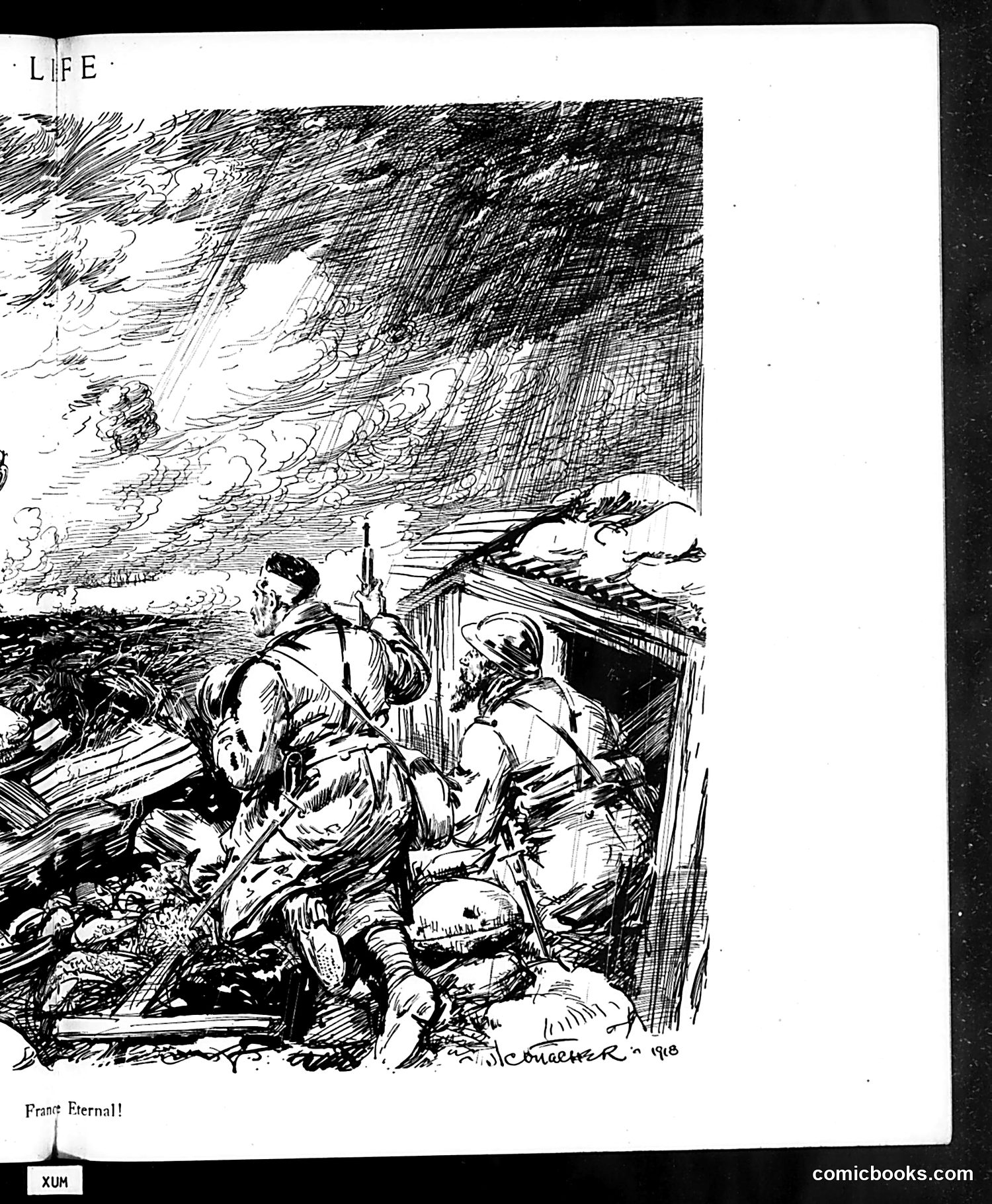
This appears to be a WWI-era satirical illustration from *Life* magazine, signed and dated 1918. The caption "Franc Eternal!" (playing on "France Eternal") depicts soldiers in a trench or fortification during combat, with explosions and warfare visible above. The satire likely comments on France's continued struggle and sacrifice during World War I—the pun on "franc" (French currency) suggests commentary on France's economic and military costs. The soldiers shown actively defending their position embody French resilience and determination. The inscription's wordplay transforms "France" into "Franc," implying France itself has become synonymous with currency—possibly critiquing the financial burden of the war on the French nation, while simultaneously celebrating French persistence in the conflict.
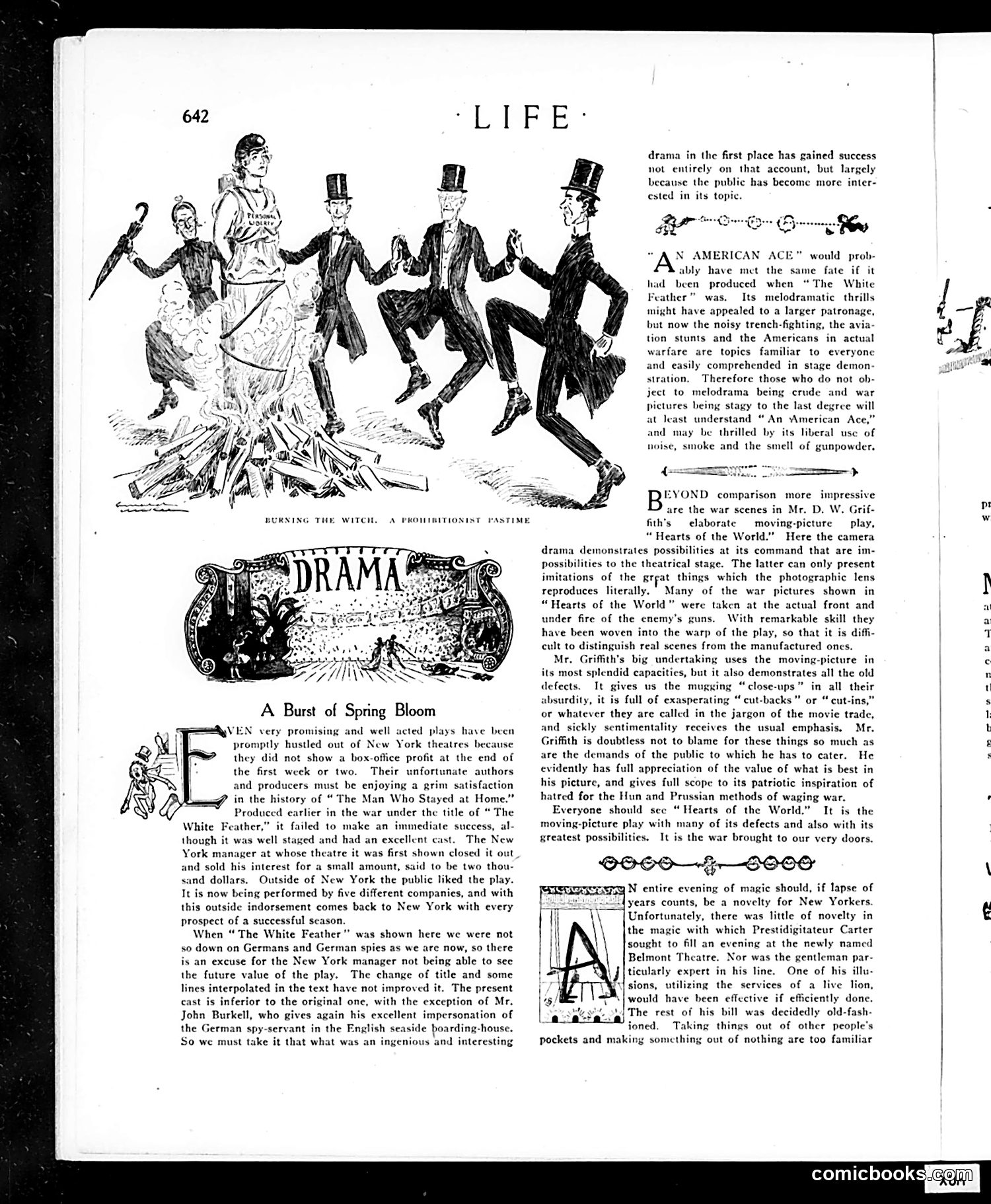
The cartoon depicts five men in formal dress dancing around a bonfire, celebrating the destruction of a bottle. This is satirical commentary on Prohibition—specifically mocking prohibitionists' zealous campaign to ban alcohol. The title's reference to "burning the witch" equates alcohol with witchcraft, sarcastically echoing prohibitionist rhetoric that treated liquor as an evil to be eradicated. The gleeful, almost frenzied dancing suggests the page's author views prohibition advocates as overly zealous, irrational crusaders rather than serious reformers. The accompanying drama reviews discuss wartime theatrical productions, but the cartoon stands apart as social satire targeting the growing Prohibition movement in America. This placement suggests Life magazine was skeptical of prohibitionist activism gaining momentum during the World War I era, ultimately leading to the 18th Amendment (ratified 1919).
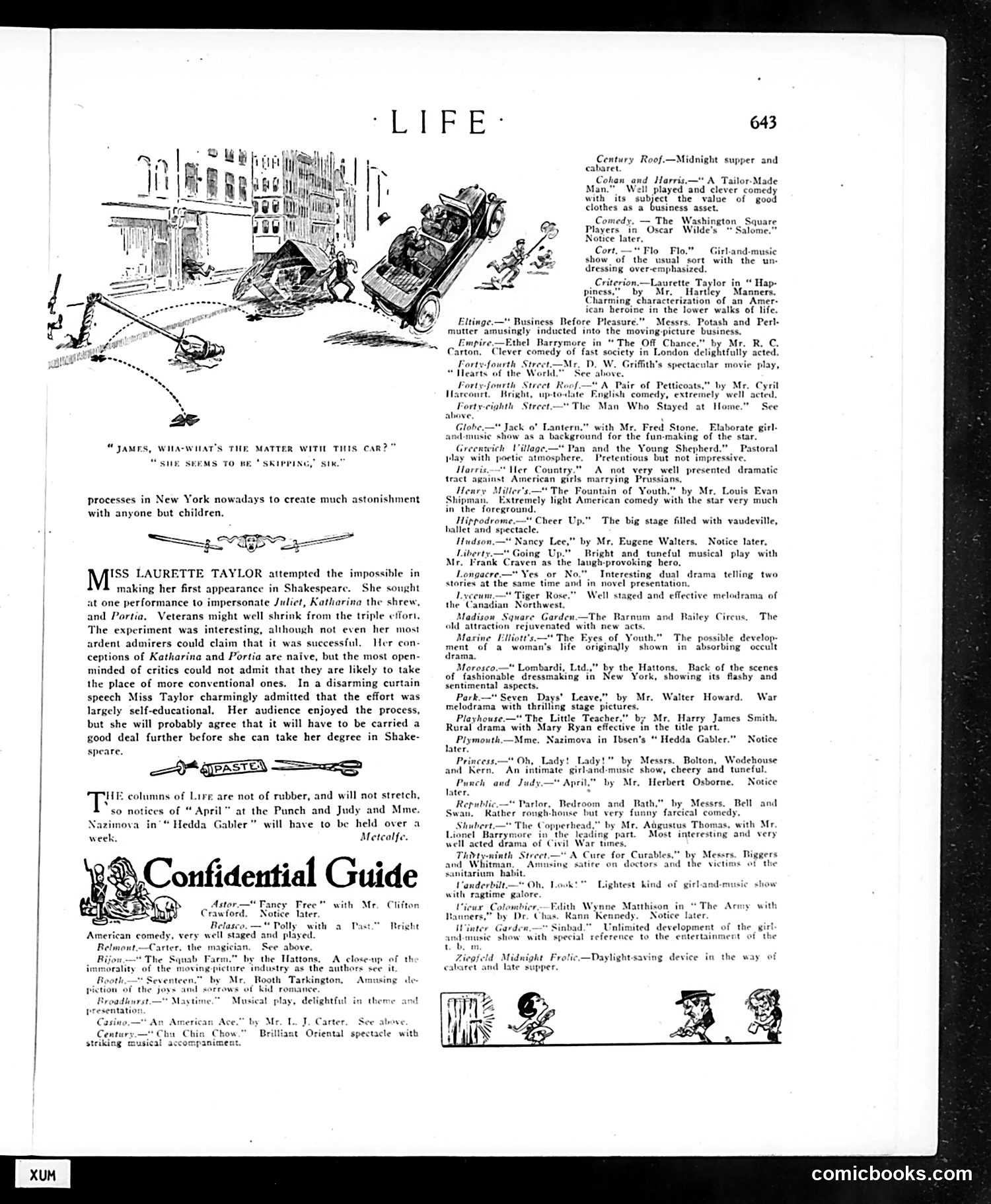
This *Life* magazine page contains theater reviews and a cartoon about an automobile malfunction. The main cartoon depicts a man asking "James, what's the matter with this car?" with the response "She seems to be skipping, sir." The joke relies on the novelty of automobiles in early 20th-century New York—the caption notes that car problems "processes in New York nowadays" were astonishing even to children, suggesting vehicles were still relatively new and remarkable to the public. The bulk of the page is a "Confidential Guide" to Broadway theaters and productions, reviewing current shows. Notable is the discussion of actress Laurette Taylor attempting to perform three Shakespeare roles (Juliet, Katharina, Portia) in a single performance—the writer finds this ambitious but ultimately unsuccessful, though praises her effort as "self-educational." The page reflects early-20th-century New York entertainment culture and the fascination with emerging automobile technology.
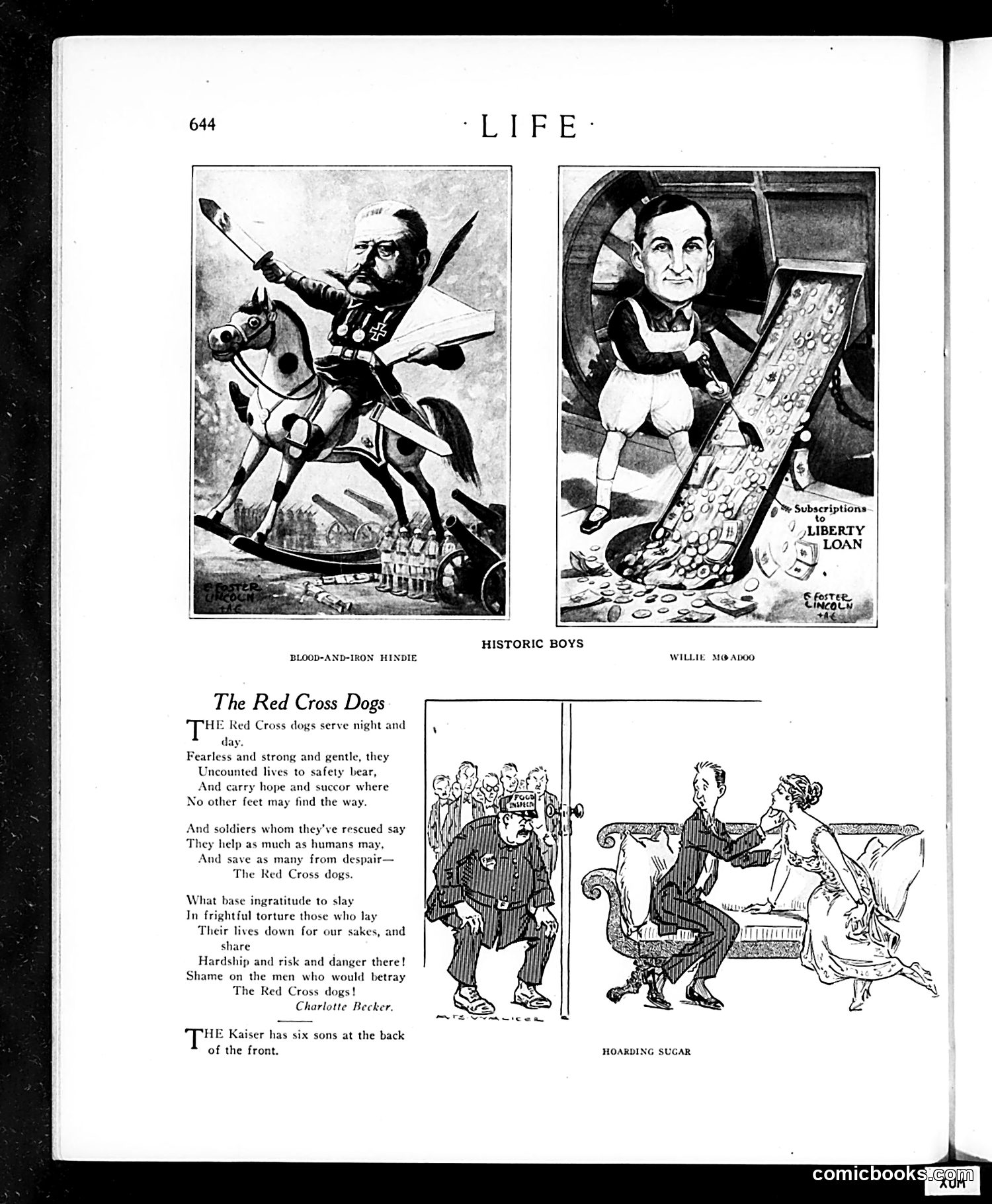
This page contains WWI-era American satire. The top section, "Historic Boys," shows two caricatures mocking German and American figures. The left cartoon depicts a military figure (labeled "Blood-and-Iron Hindie," likely Kaiser Wilhelm II) in aggressive, militaristic pose—referencing Bismarck's "blood and iron" philosophy. The right shows "Willie McAdoo" (William McAdoo, U.S. Treasury Secretary) hoarding money for the Liberty Loan. Below, Charlotte Becker's poem "The Red Cross Dogs" praises rescue animals while condemning German treatment of them—a propaganda point about enemy brutality. The final cartoon, "Hoarding Sugar," satirizes domestic profiteering: civilians illegally stockpiling rationed sugar while soldiers fight. The caption's joke about "Kaiser's six sons at the back of the front" is unclear but appears to mock German military strategy or propaganda. The page conflates foreign enemy villainy with American civilian selfishness during wartime.
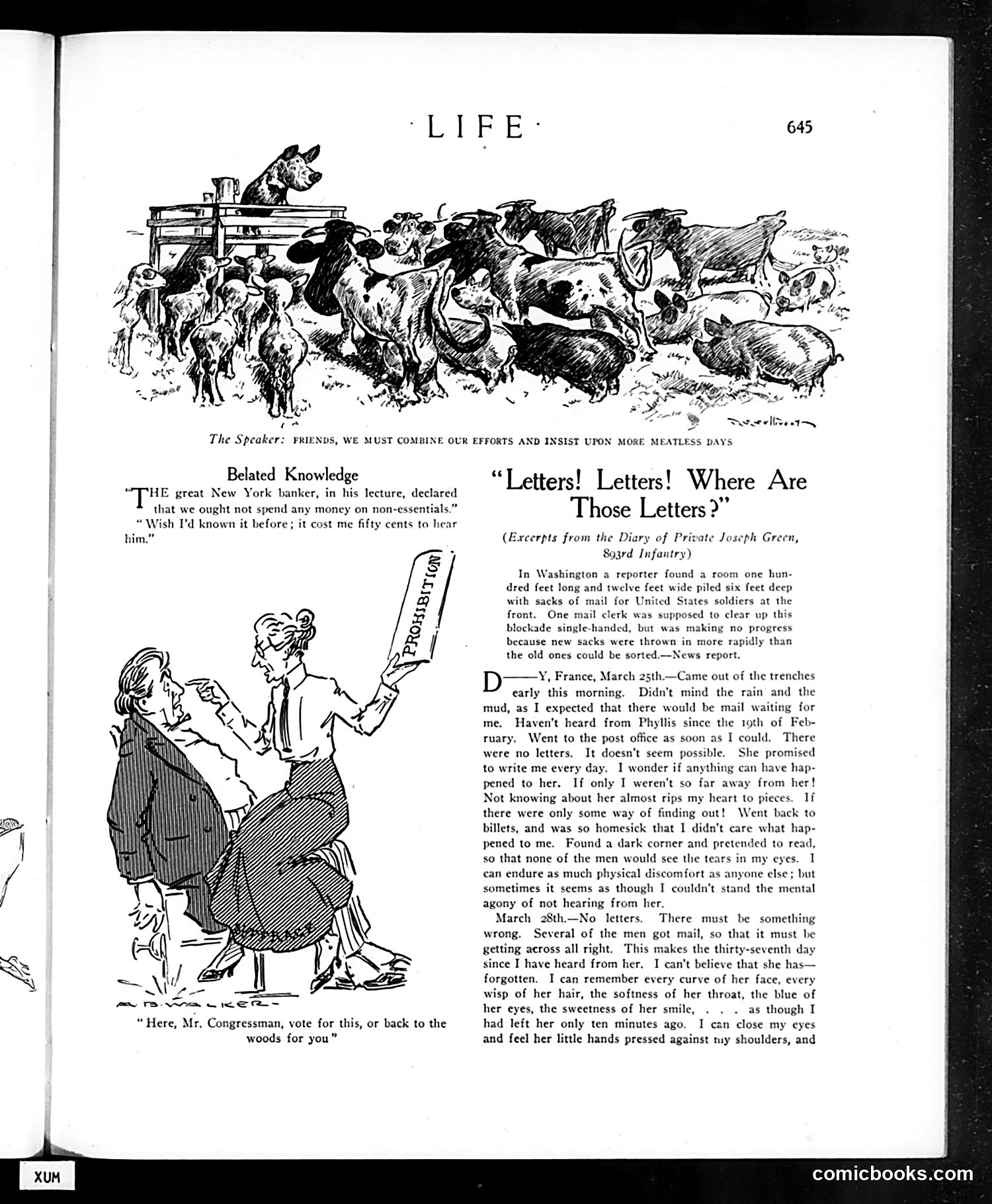
**Top cartoon:** A banker lectures against spending on "non-essentials," then charges fifty cents admission—the irony being his lecture itself is non-essential. The satire mocks wealthy financiers for hypocrisy about frugality while profiting from it. **Middle cartoon:** A politician threatens a congressman with political exile ("back to the woods") if he doesn't vote for something—likely a wartime measure. This satirizes coercive legislative tactics and backroom pressure during WWI. **Top illustration:** Shows farm animals and a speaker demanding "meatless days," referencing actual WWI-era rationing programs to conserve resources for troops. **Main feature:** A soldier's diary excerpts describing the backlog of military mail—a real Washington Post report about one clerk managing six feet of accumulated letters. The poignant narrative contrasts with a news problem: soldiers' morale suffering from delayed correspondence with loved ones, while mail *is* reaching some troops. The satire highlights governmental inefficiency during wartime.
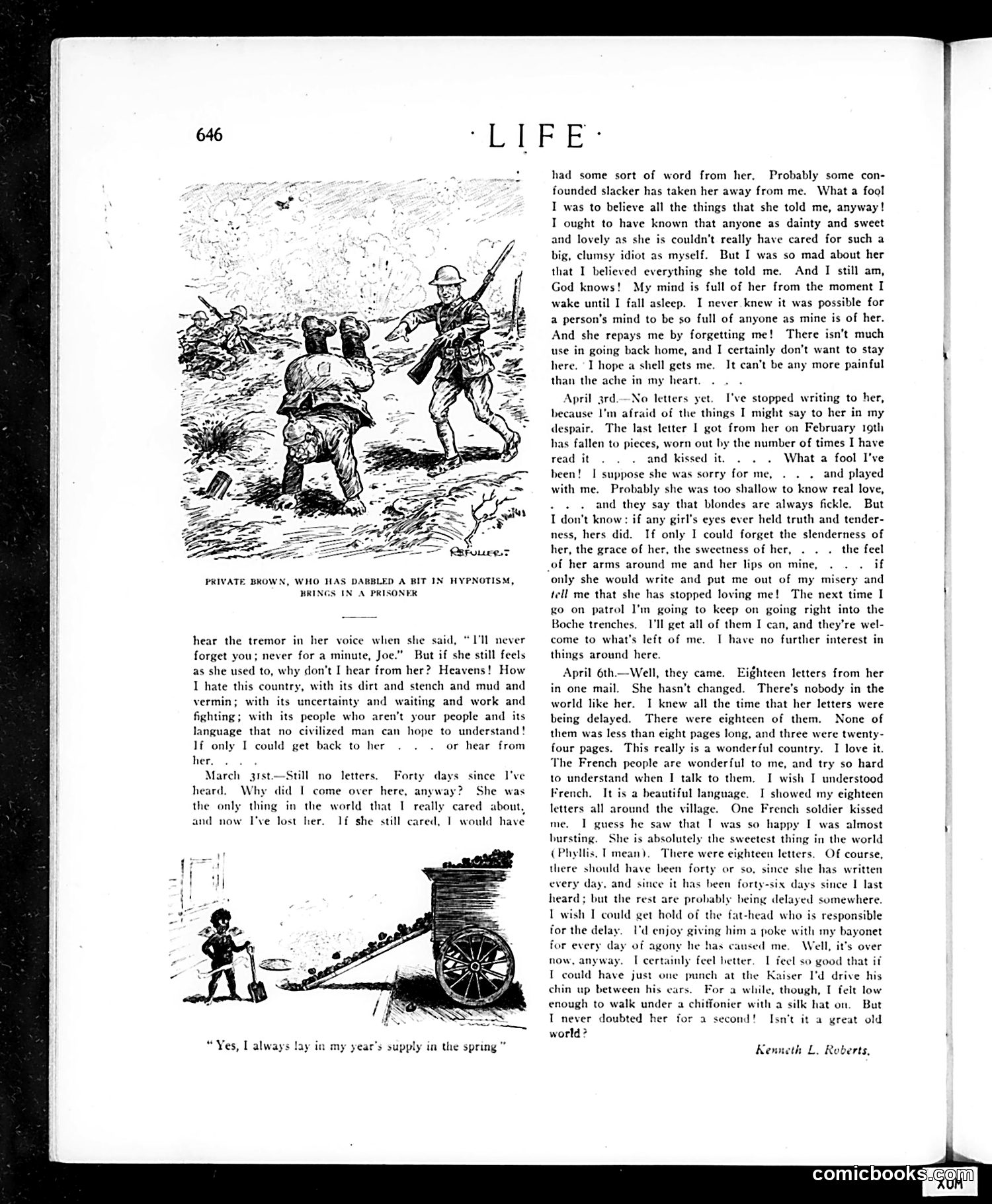
This page from *Life* magazine presents a soldier's diary entries (March 31–April 6) describing his emotional turmoil during World War I, separated from his beloved "Phyllis." **The cartoons illustrate the narrative:** - Top: "Private Brown, Who Has Dabbled a Bit in Hypnotism, Brings in a Prisoner"—a soldier using crude hypnotic techniques on a captured enemy - Bottom: "Yes, I always lay in my year's supply in the spring"—appears to show soldier logistics/supply humor **The satire's point:** The dramatic contrast between the soldier's despair (no letters for 40 days, contemplating suicide via the enemy trenches) and his instant emotional reversal upon receiving eighteen letters transforms him from suicidal to euphoric. The piece gently mocks the intensity of wartime romance and soldiers' emotional vulnerability, while also commenting on mail delays plaguing the war effort—a practical frustration affecting morale. The hypnotism cartoon may joke about soldiers' gullibility or psychological states during combat.
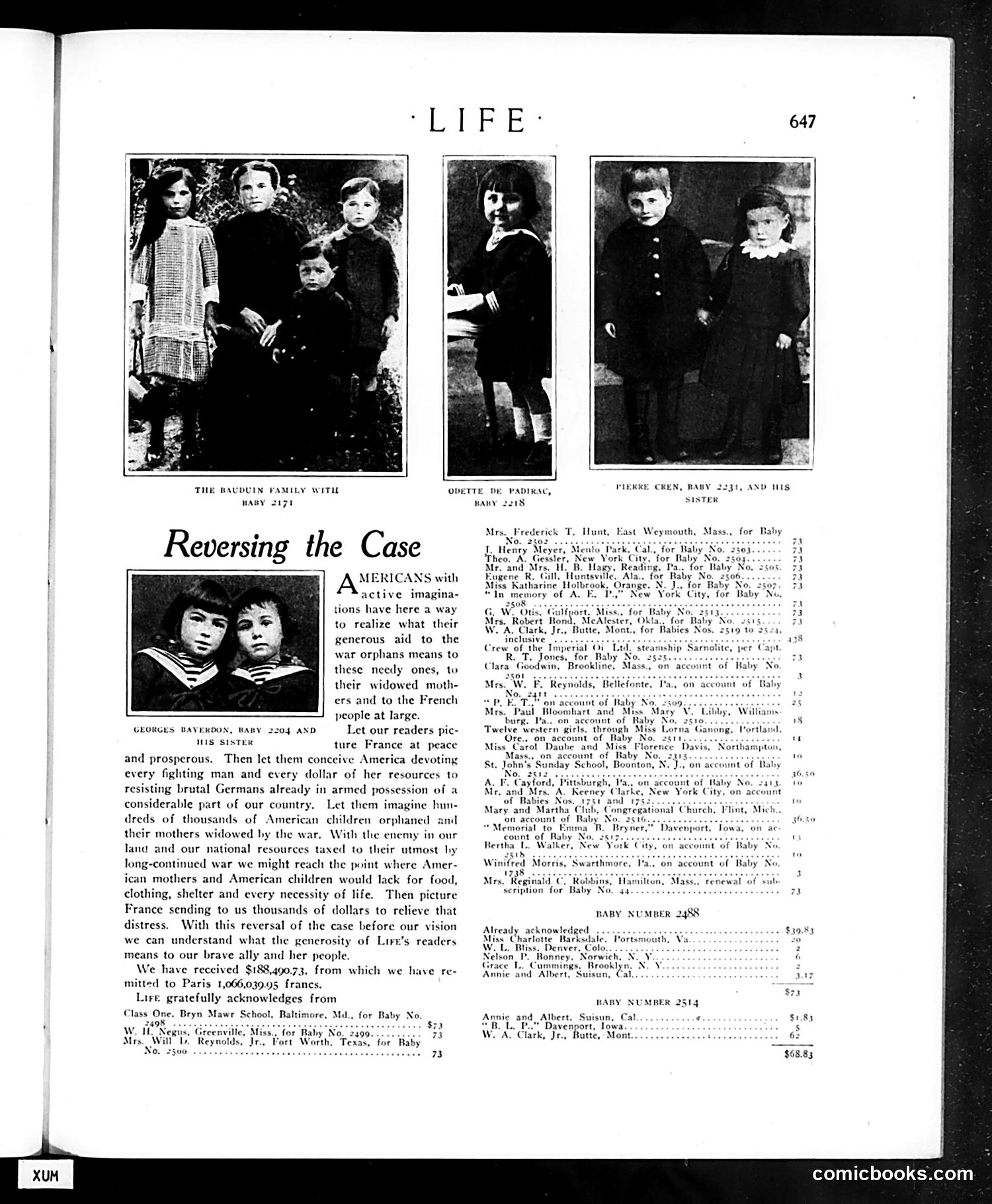
This page presents a fundraising campaign for French war orphans during World War I. The article uses a rhetorical device—asking American readers to imagine *their own* country invaded, devastated, and dependent on French charity—to build empathy and justify donations. The photographs show actual French orphans and American war orphans being supported through Life magazine's relief fund. The text emphasizes that France, America's ally, is suffering catastrophically: hundreds of thousands of children orphaned, mothers widowed, resources exhausted by fighting Germans on French soil. The appeal works by reversing perspective: if America faced such devastation, wouldn't Americans desperately need international aid? Therefore, supporting French orphans is both humanitarian *and* practical solidarity with an embattled ally. The financial acknowledgments listing donors and babies supported demonstrate the campaign's scale and legitimacy, encouraging further contributions.
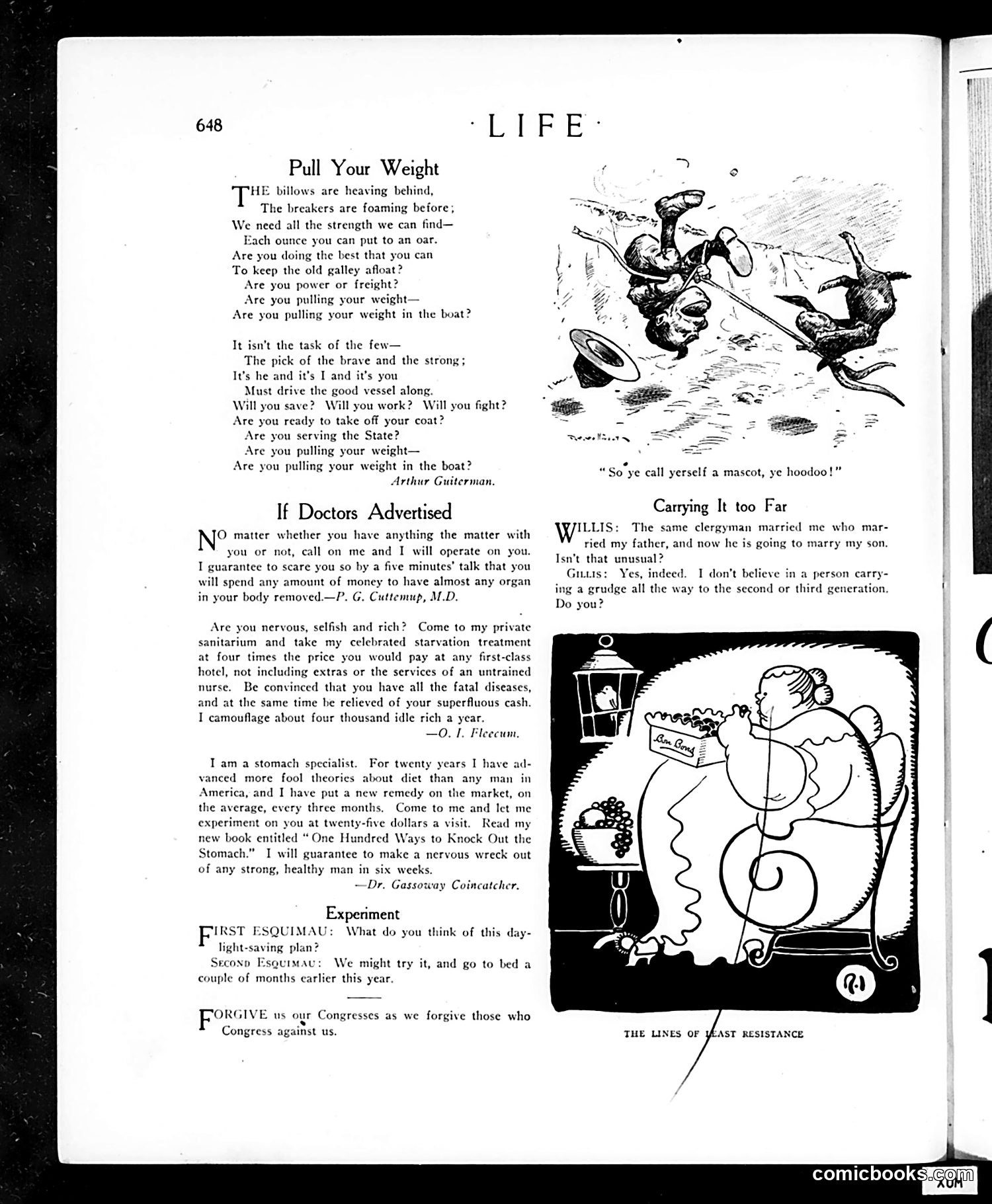
This page contains several distinct satirical pieces mocking early 20th-century social concerns: **"Pull Your Weight"** — A patriotic poem (by Arthur Guiterman) uses nautical metaphor to pressure readers into civic contribution, likely referencing wartime or national emergency sacrifice. **"If Doctors Advertised"** — Sharp satire attacking medical quackery: fake doctors hawking unnecessary surgeries, dubious diet theories, and expensive sanitariums to wealthy hypochondriacs. The "Dr. Gassoway Coincatcher" character exemplifies the charlatan specialist. **"Carrying It Too Far"** — A joke about a clergyman marrying three generations of the same family, with the punchline suggesting the minister holds a grudge. **"The Lines of Yeast Resistance"** cartoon shows a portly woman resisting temptation (a bread basket), playing on contemporary diet culture and the double meaning of "yeast" (baking/fermentation). The page satirizes medical fraud, false economy schemes targeting the wealthy, and emerging weight-consciousness—reflecting 1920s anxieties about health, consumerism, and bodily discipline.
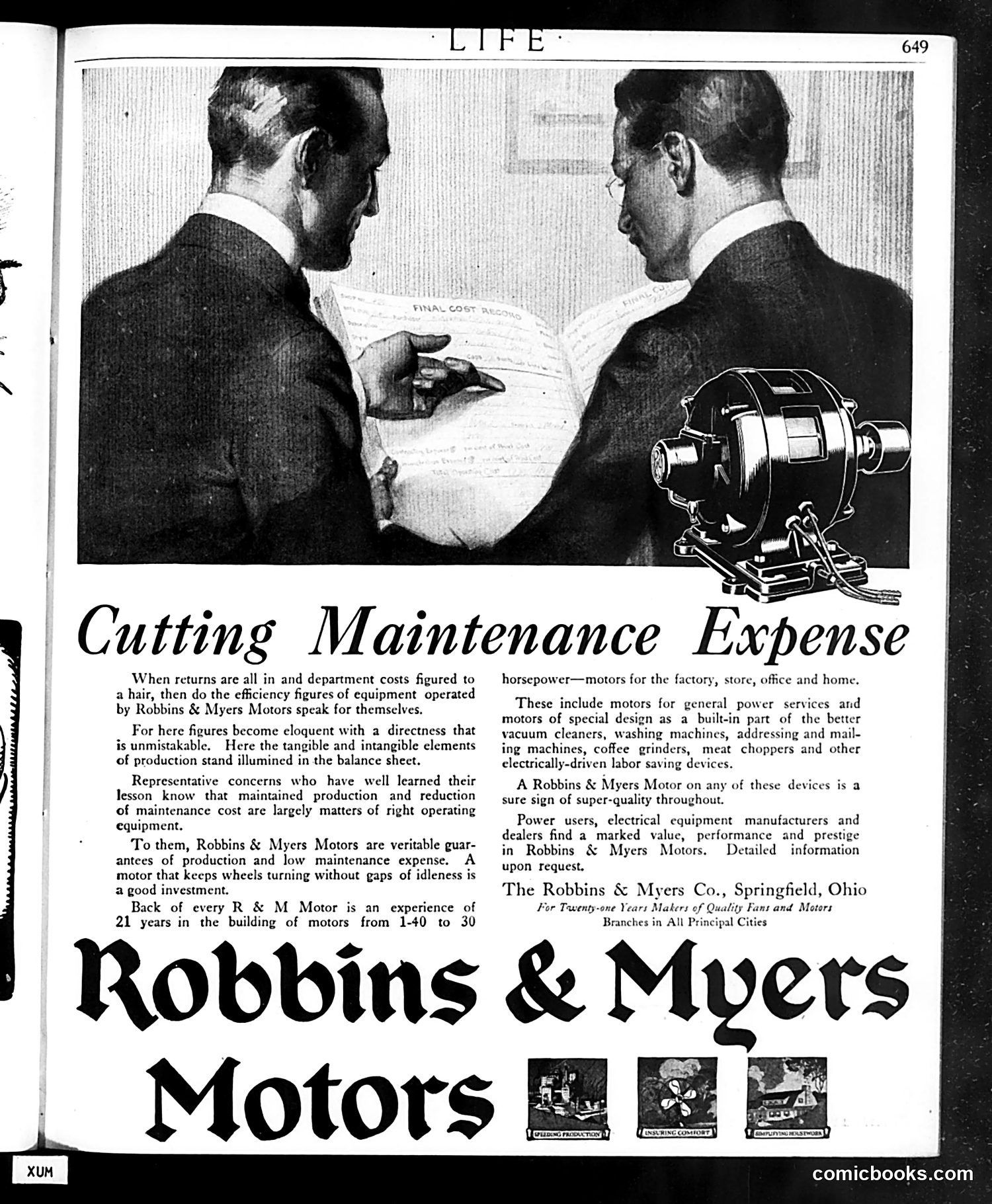
This is a **full-page advertisement**, not satire or political commentary. It promotes Robbins & Myers Motors, a Springfield, Ohio manufacturer of electric motors. The image shows two businessmen in suits reviewing what appears to be a "Final Cost Report" or similar document, with an electric motor displayed prominently. This visual establishes the advertisement's premise: efficient motors reduce operational costs. The text argues that by maintaining production equipment and reducing maintenance expenses through reliable motors, businesses increase profitability. The ad emphasizes the company's 21 years of experience manufacturing motors ranging from 1-40 to 30 horsepower for factories, stores, offices, and homes—including applications in vacuum cleaners, washing machines, and other electrical appliances. This represents typical early-20th-century industrial advertising: appealing to business managers' desire for cost efficiency and reliability. The tone is earnest and corporate, not humorous or satirical.
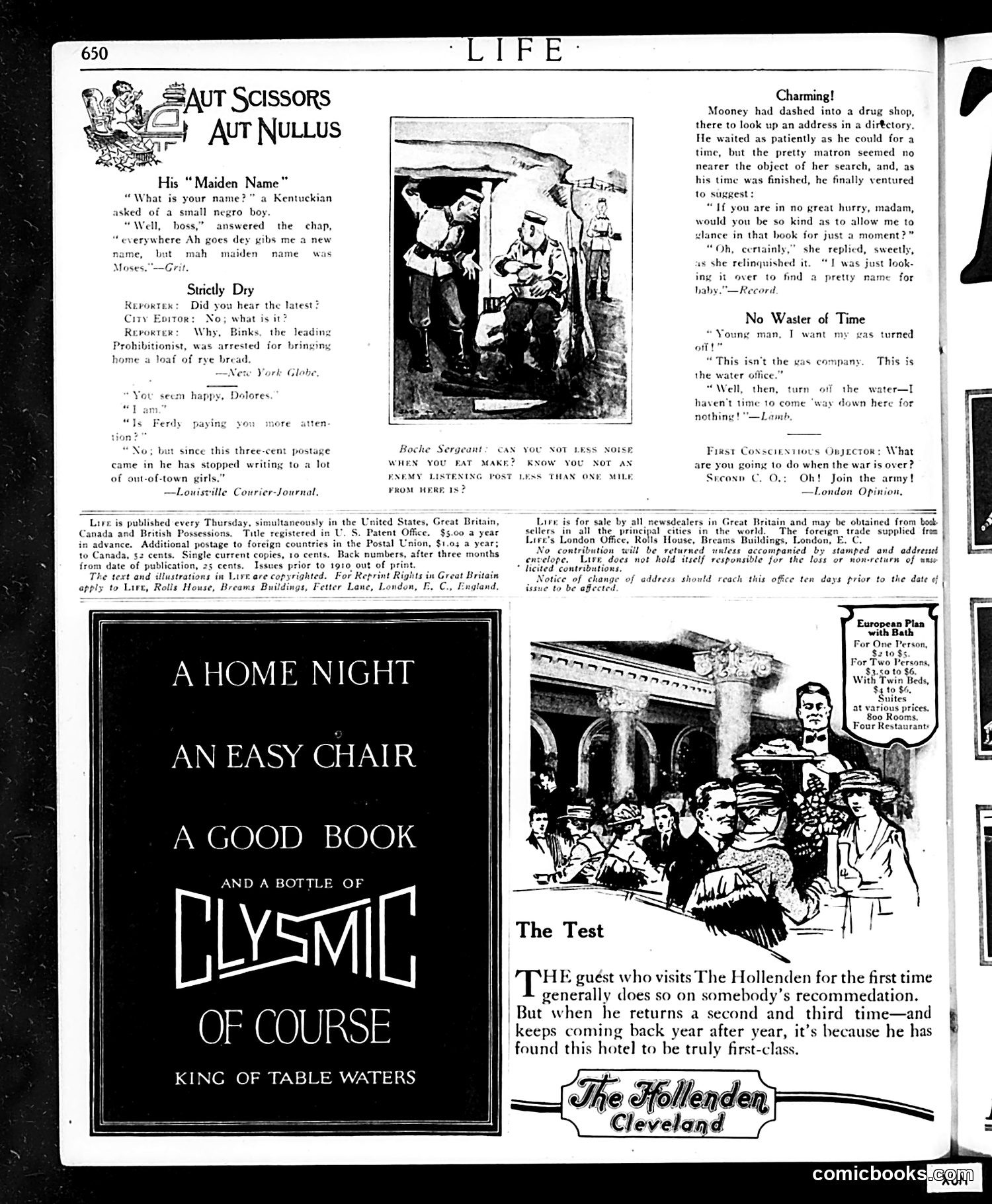
This page contains several short humorous anecdotes typical of Life's satirical humor, plus advertisements. **The cartoons/jokes:** The "Aut Scissors / Aut Nullus" section presents brief comic sketches. "His Maiden Name" plays on racist stereotypes, depicting a Black boy receiving a new name wherever he goes. "Strictly Dry" satirizes Prohibition enforcement—a city editor arrests a prohibitionist for bringing home rye bread, mocking the era's absurd enforcement. "Roche Sergeant" appears to reference wartime conditions with a sergeant warning about enemy listening posts. **Historical context:** This is clearly WWI-era (references to gas being turned off, conscientious objectors). Life magazine used racial caricatures routinely in this period. Prohibition (1920-1933) is actively mocked. The "First Conscientious Objector" joke shows anti-draft sentiment, with the punchline being a CO joining the army anyway—contemporary satire of pacifism. The page is primarily **advertising**—Plimsoll beverages, The Hollenden hotel—with humor scattered between ads rather than as the main content.
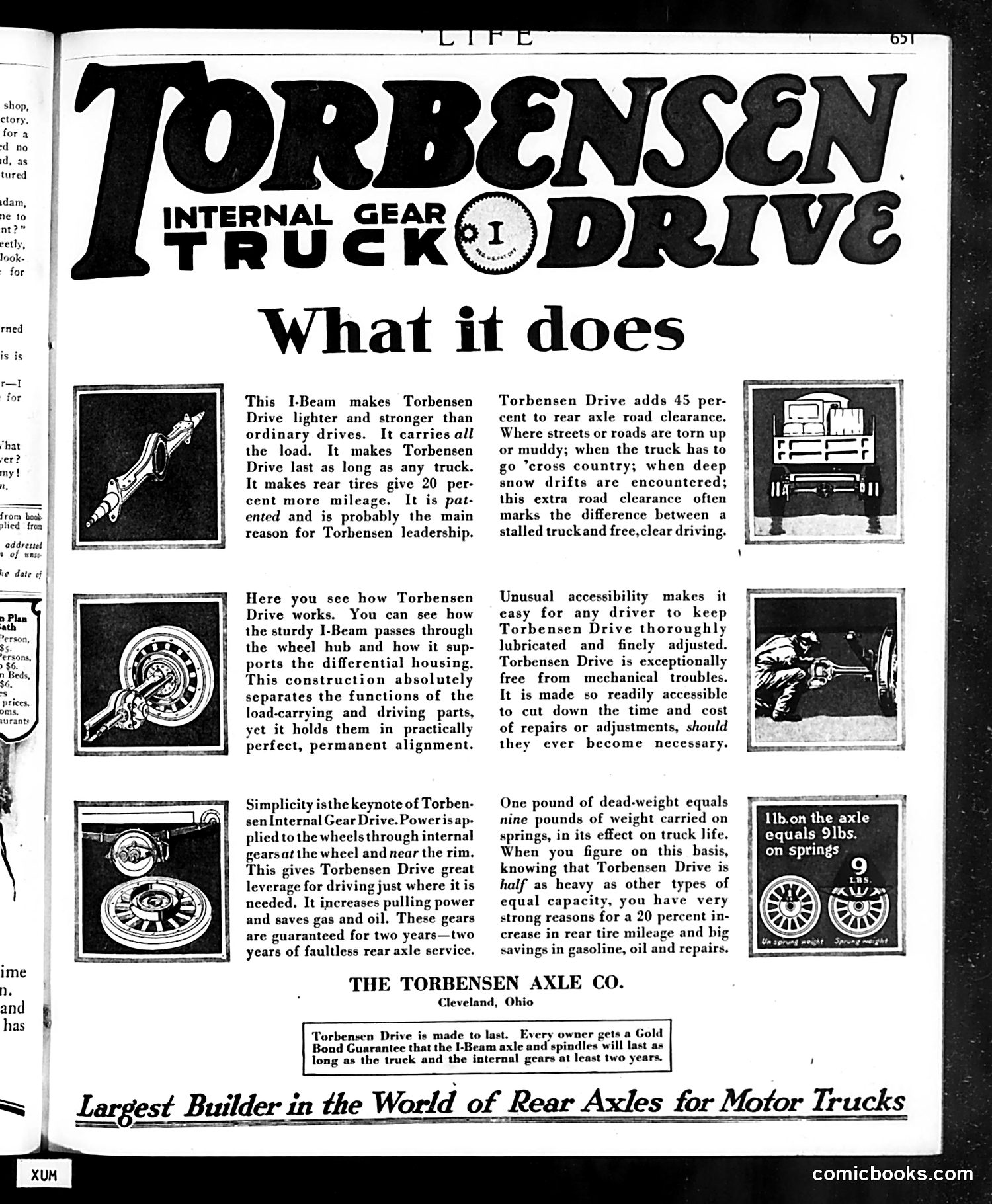
This is **not a cartoon or satire**—it's a straightforward advertisement for the Torbensen Internal Gear Drive, a truck rear-axle component manufactured by The Torbensen Axle Co. of Cleveland, Ohio. The page features technical diagrams and mechanical specifications explaining the product's engineering advantages: the I-Beam design distributes load more efficiently, adds ground clearance for off-road conditions, reduces tire wear by 20%, and simplifies maintenance through accessible design. Key selling points include the weight-to-load ratio analogy ("1 lb. on the axle equals 9 lbs. on springs") and a two-year guarantee on internal gears. The tagline declares Torbensen the "Largest Builder in the World of Rear Axles for Motor Trucks." This represents typical early-20th-century industrial advertising in *Life* magazine, targeting commercial fleet operators and truck owners with detailed product information rather than humor or satire.
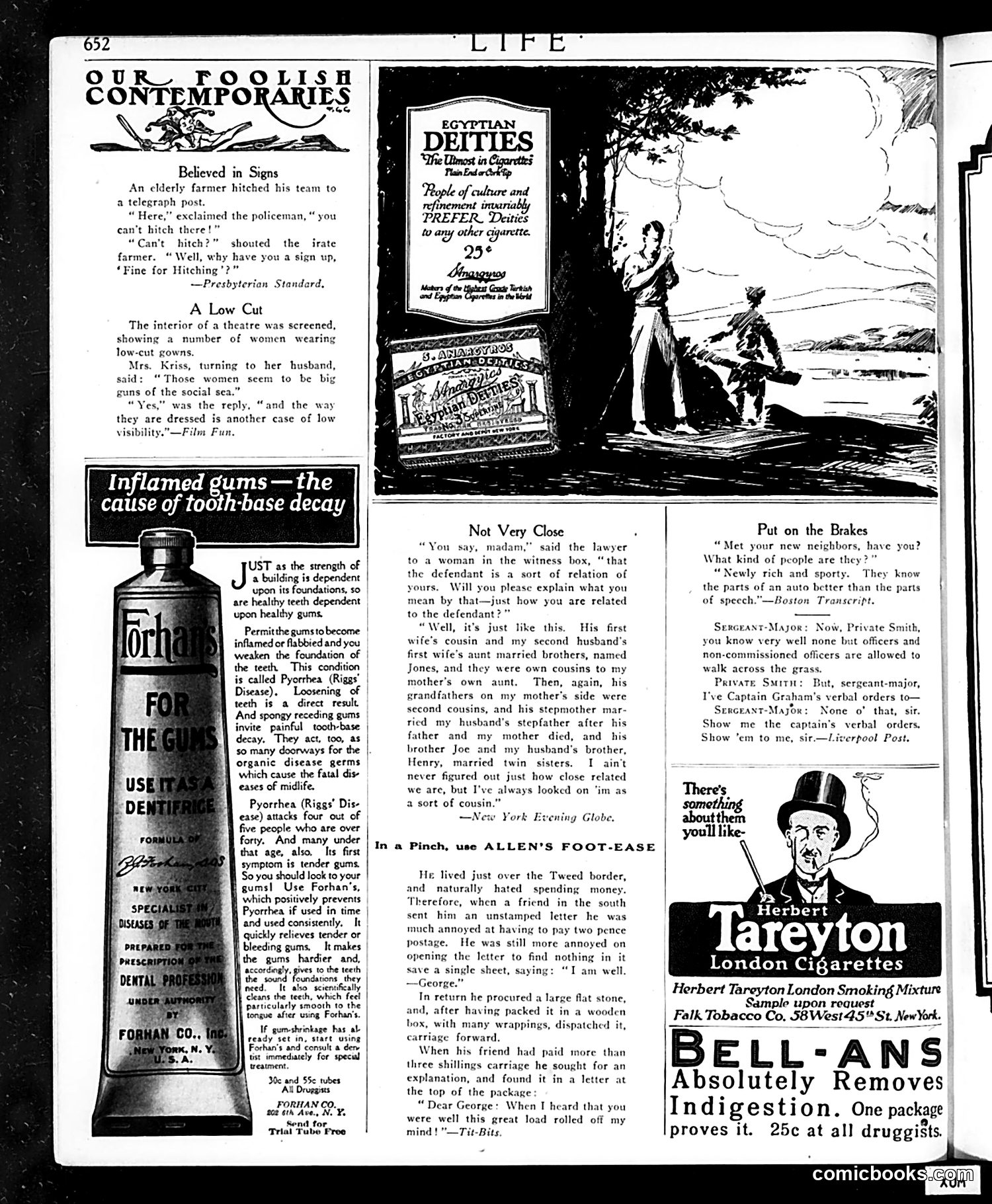
This page from *Life* magazine contains several brief humorous anecdotes rather than political cartoons. The jokes satirize everyday social absurdities: **"Believed in Signs"** mocks a farmer who complains about a "Fine for Hitching" sign at a telegraph post—he's taken it literally as permission to hitch his team there. **"A Low Cut"** makes a pun about women wearing revealing evening gowns at a theater: they're described as "big guns" (important people) but also represent "low visibility" in their dress. **"Not Very Close"** features a witness attempting to explain her convoluted family relationship to a lawyer—she's so distantly related through marriages and step-relations that the relationship is nearly incomprehensible. **"In a Pinch"** describes a Scottish man's irritation at receiving an unstamped letter; he retaliates by mailing his friend a heavy stone in an expensive wooden box, costing more in postage than the original letter. The page is primarily advertisements (dental products, cigarettes, digestive aids), typical of the era's magazine format.
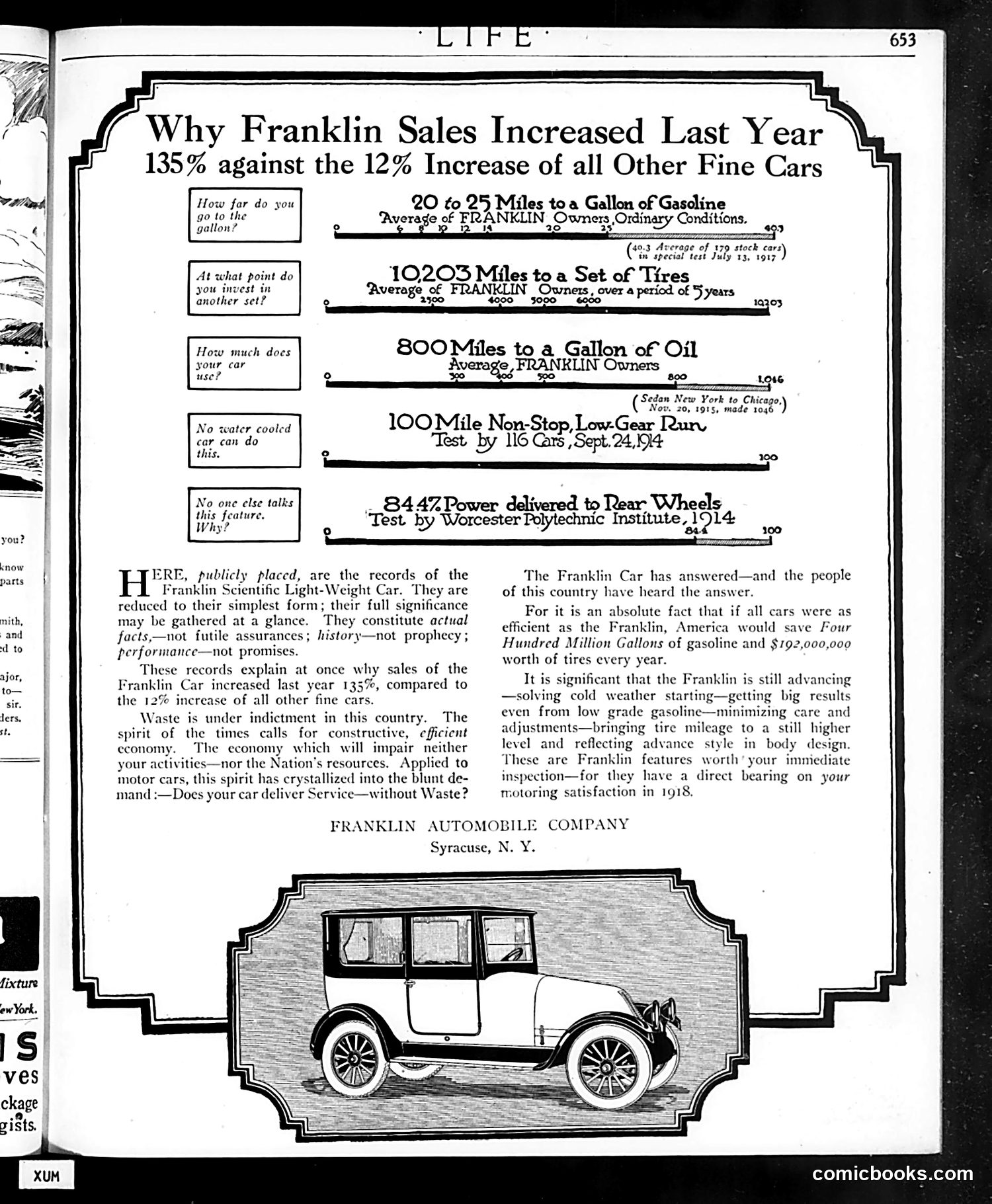
This is **not a political cartoon** but a **corporate advertisement** for the Franklin Automobile Company (Syracuse, NY), appearing in *Life* magazine circa 1917-1918. The page presents performance data comparing Franklin cars favorably to competitors: 135% sales increase versus 12% for other luxury cars. It highlights efficiency metrics (fuel economy, tire mileage, oil consumption, power output) through bar charts and test results. The rhetoric appeals to wartime values of **efficiency and conservation**—a major theme during WWI. The ad frames Franklin ownership as patriotic waste-reduction: "Does your car deliver Service—without Waste?" It claims that if all Americans drove Franklins, the nation would save "Four Hundred Million Gallons of gasoline and $192,000,000" annually. The accompanying illustration shows a typical period sedan in profile. **Modern context**: This represents early automotive marketing using data visualization and appeals to civic duty rather than luxury or status—reflecting 1910s-era values and wartime resource consciousness.
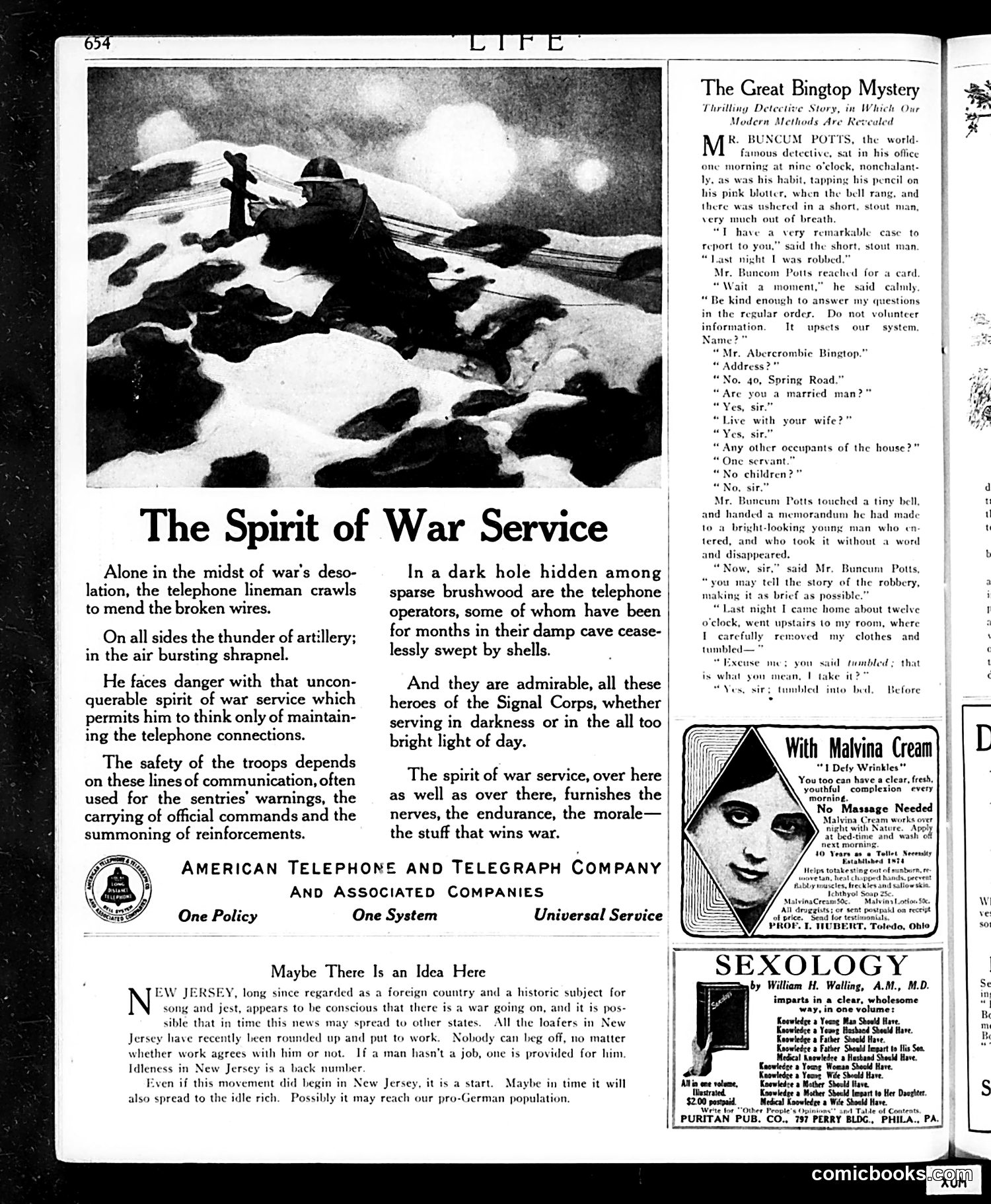
This page contains WWI-era propaganda and advertising typical of American magazines during World War I. **"The Spirit of War Service"** is a patriotic tribute to telephone linemen and Signal Corps operators maintaining communications amid battlefield chaos. It's both genuine praise for their dangerous work and subtle advertising for AT&T, positioning the company as essential to military victory. The dramatic illustration shows a lineman repairing wires near a cross (likely a grave) amid shell-swept terrain. **"Maybe There Is an Idea Here"** satirizes New Jersey's employment drive, mocking the state as backward ("a foreign country") while sardonically suggesting its roundup of unemployed loafers might eventually reach "the idle rich" and "pro-German population"—a xenophobic jab typical of wartime sentiment. **"The Great Bingtop Mystery"** begins a serialized detective story showcasing modern investigative methods. The remaining advertisements (Malvina Cream, Sexology book) are typical period product endorsements.
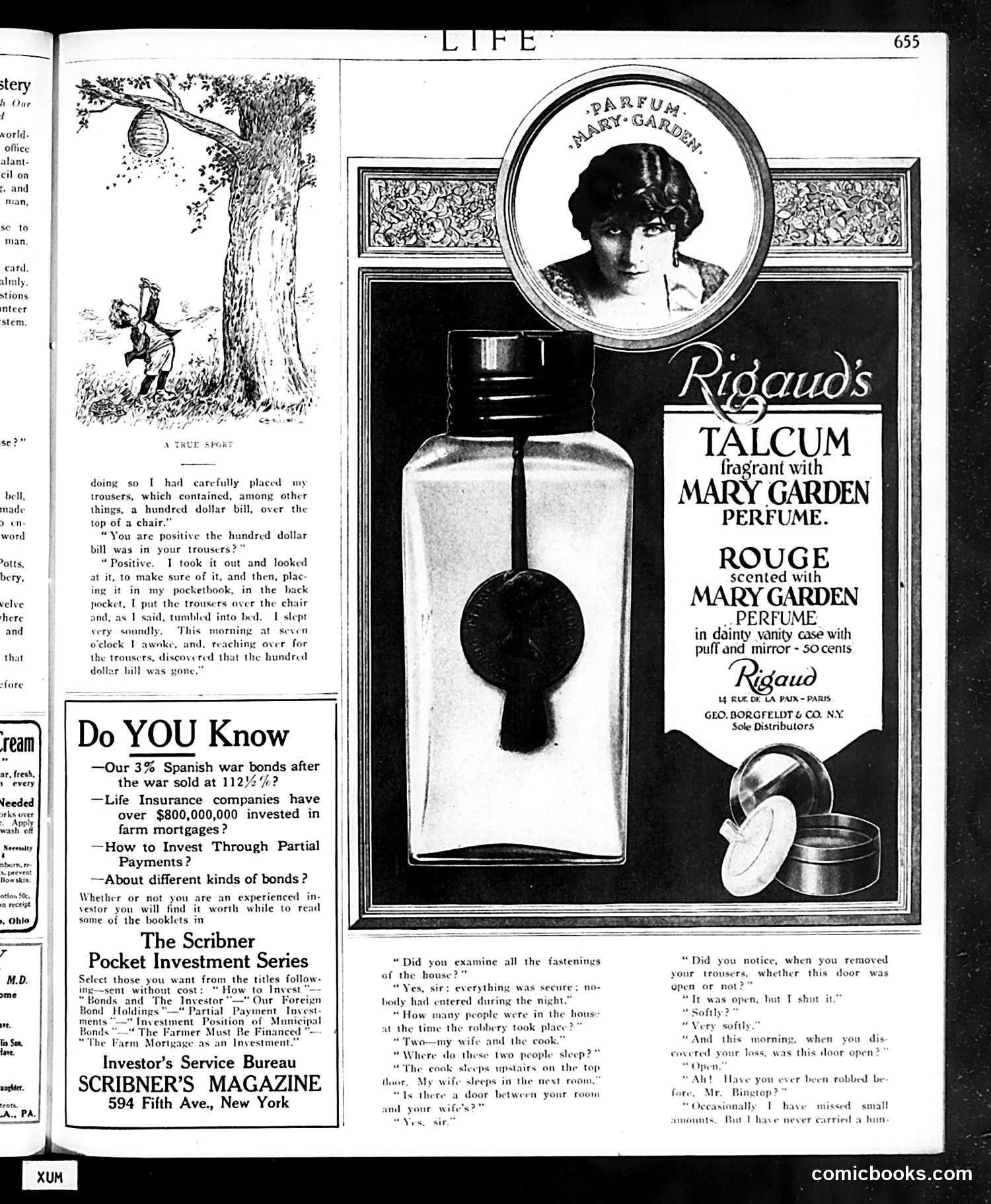
This page mixes editorial content with advertising. The main cartoon (upper left) depicts a simple line-drawing scene of a figure near a tree, labeled "A TRUE STORY," illustrating a narrative about a missing hundred-dollar bill from trousers left on a chair. Below this is a dialogue—likely from a mystery story or serialized fiction—where someone questions a witness (Mr. Bington) about a robbery. The exchange humorously details the domestic arrangements of the house (where people sleep, door locations) as the questioner tries to establish facts about the theft. The right side is entirely a **Rigaud's Talcum and Mary Garden Perfume advertisement** featuring a woman's portrait in a circular frame above product bottles. The lower left contains investment educational content from Scribner's Magazine, promoting their "Pocket Investment Series" on bonds and mortgages. The page reflects early 20th-century magazine layout, mixing fiction, practical financial advice, and commercial advertising without clear visual separation.
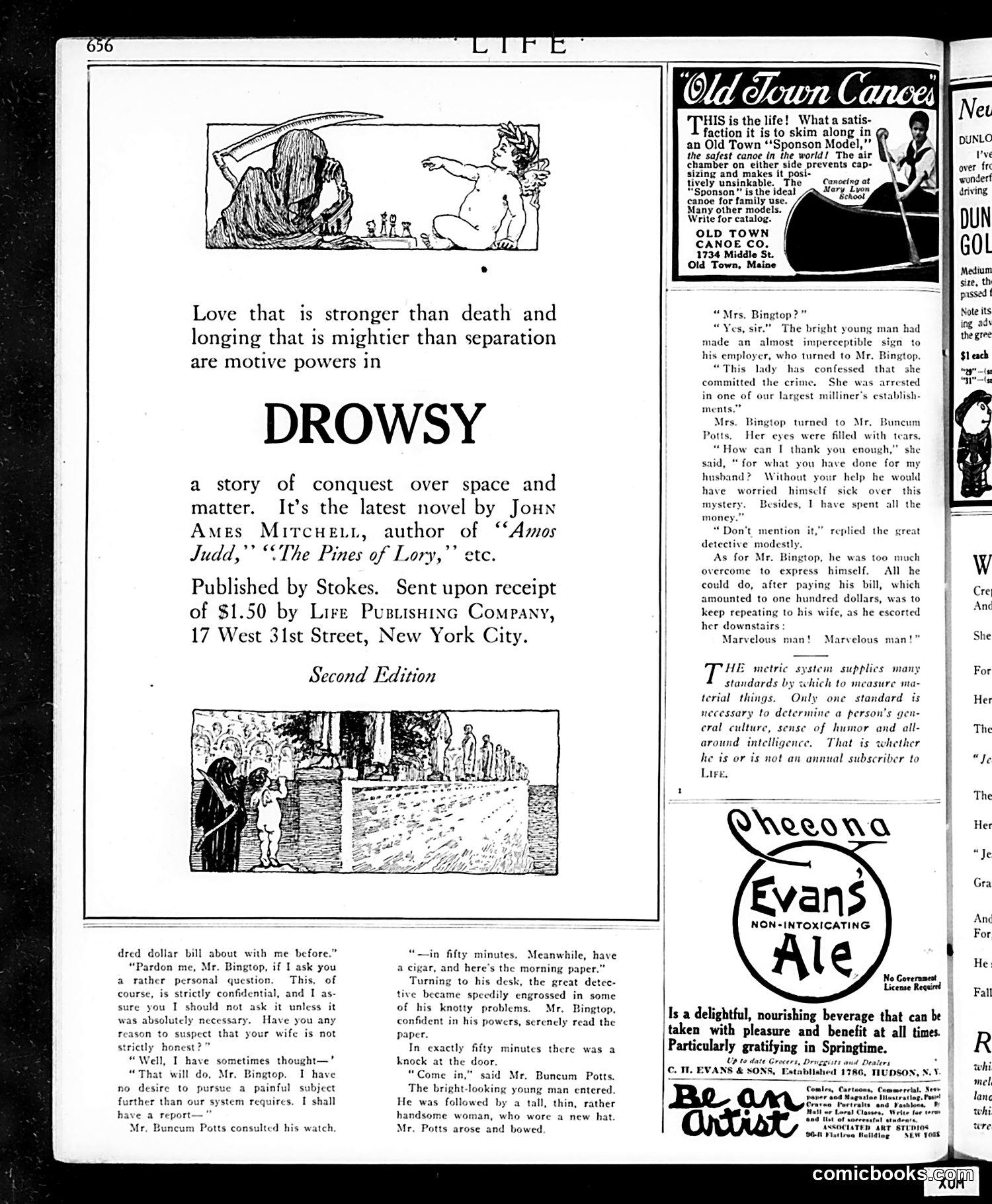
This page primarily advertises John Ames Mitchell's novel *Drowsy*, a detective story about a private investigator named Mr. Buncum Potts solving a theft at a millinery (hat) shop. The excerpt shown depicts Potts reassuring a worried husband (Mr. Bingtop) that his wife wasn't the actual thief, then dramatically producing the real culprit within exactly fifty minutes—a comedic beat emphasizing the detective's competence. The satire is gentle: the melodramatic detective-story genre itself, with its convenient plot resolutions and emotional wife-characters. The page also mocks Life magazine subscribers as the measure of cultured intelligence (a humorous self-promotion by the magazine). The remaining content consists of period advertisements: Old Town Canoes and Cheona Evans Ale. No political cartoons or caricatures appear on this page.
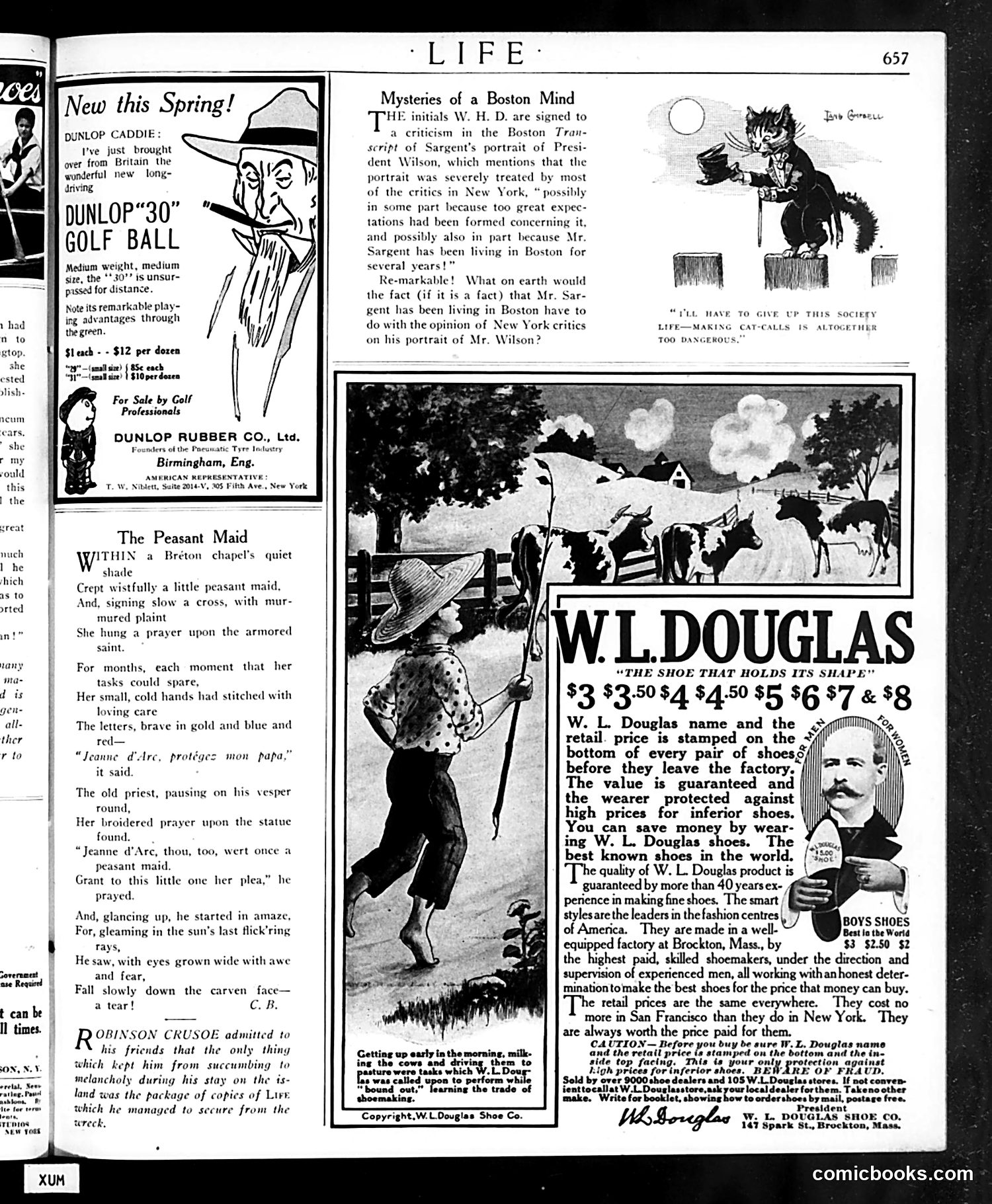
This page contains mostly **advertisements** (Dunlop golf balls, W.L. Douglas shoes) and lighter content rather than political satire. The main satirical piece is "Mysteries of a Boston Mind," which mocks a Boston *Transcript* critic (W.H.D.) who defended John Singer Sargent's portrait of President Wilson by claiming critics were unfair partly because Sargent had lived in Boston for years. The joke: **a person's residence has nothing to do with the artistic merit of their work**—yet this Boston reviewer somehow thought it relevant. This satirizes parochial Boston intellectualism and circular reasoning. The page also includes "The Peasant Maid," a sentimental poem about a French peasant girl praying to Joan of Arc, and a brief joke about Robinson Crusoe reading *Life* magazine on a deserted island. The overall tone is light humor and whimsy rather than sharp political commentary.
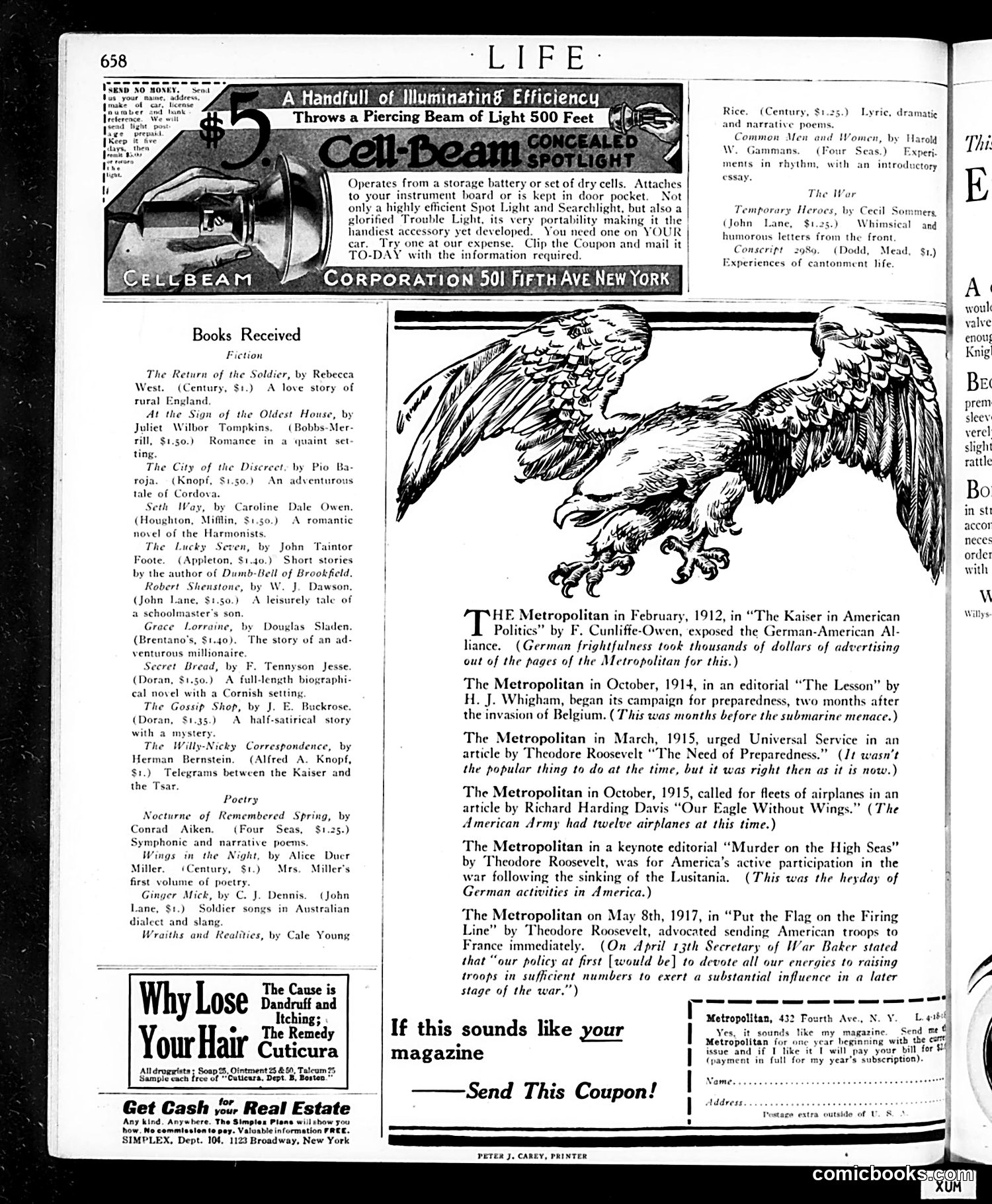
This page combines advertisements with editorial content promoting *The Metropolitan* magazine's prescient war-preparedness coverage. **The Eagle Illustration:** A dramatic engraving of an American eagle appears to symbolize national strength and patriotism—a visual anchor for the surrounding text. **Editorial Content:** The boxed text catalogs *The Metropolitan*'s articles from 1912-1917, arguing the magazine had warned America about coming threats: exposing German-American alliances, advocating preparedness before it was popular, and calling for intervention after the *Lusitania* sinking. Notably, it mocks the U.S. military's weakness (twelve airplanes in 1915). **The Point:** This is essentially an advertisement dressed as editorial—*The Metropolitan* congratulating itself for having been right about American entry into World War I before the public consensus shifted. The page appeals to readers' patriotic hindsight. **Historical Context:** Published during America's active WWI involvement (post-April 1917), it uses nationalist imagery and self-congratulation to sell subscriptions.
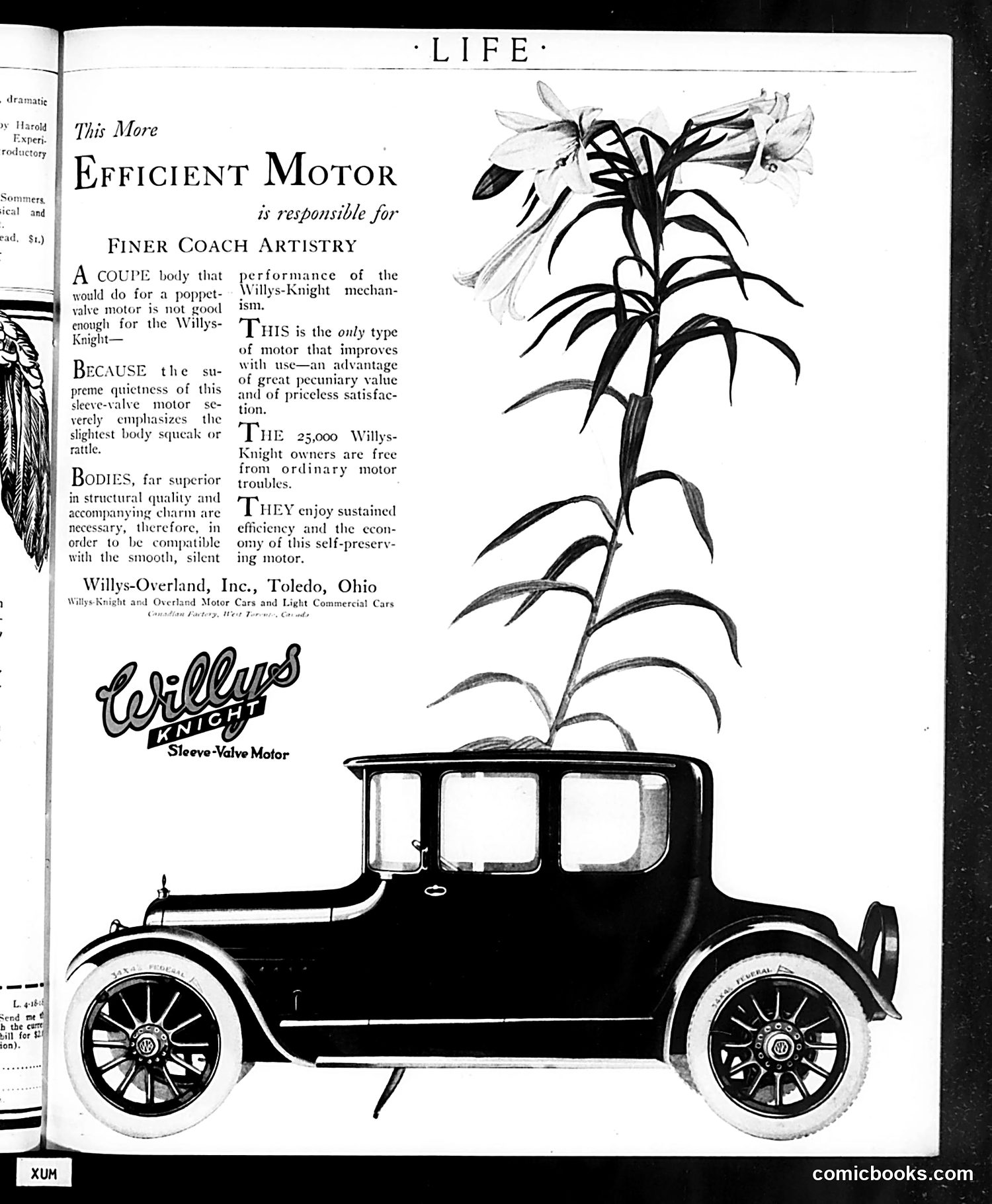
This is **not a political cartoon or satire**—it's a straightforward automobile advertisement from Life magazine's early automotive era. The page advertises the Willys-Knight automobile, specifically promoting its "sleeve-valve motor" as superior to competitors' "poppet-valve" engines. The ad argues that the motor's exceptional quietness demands finer coach construction, positioning Willys-Knight as a premium product. The visual metaphor—a blooming flower growing from the car—suggests growth, refinement, and natural superiority. The text emphasizes that 25,000 owners enjoy reliability and efficiency. **For modern readers:** This reflects pre-1920s automotive competition when different engine technologies competed for market dominance. The sleeve-valve motor was indeed a real engineering alternative. The ad uses pseudo-technical language to convince middle-class consumers they're purchasing quality and sophistication, a common advertising strategy of that era.
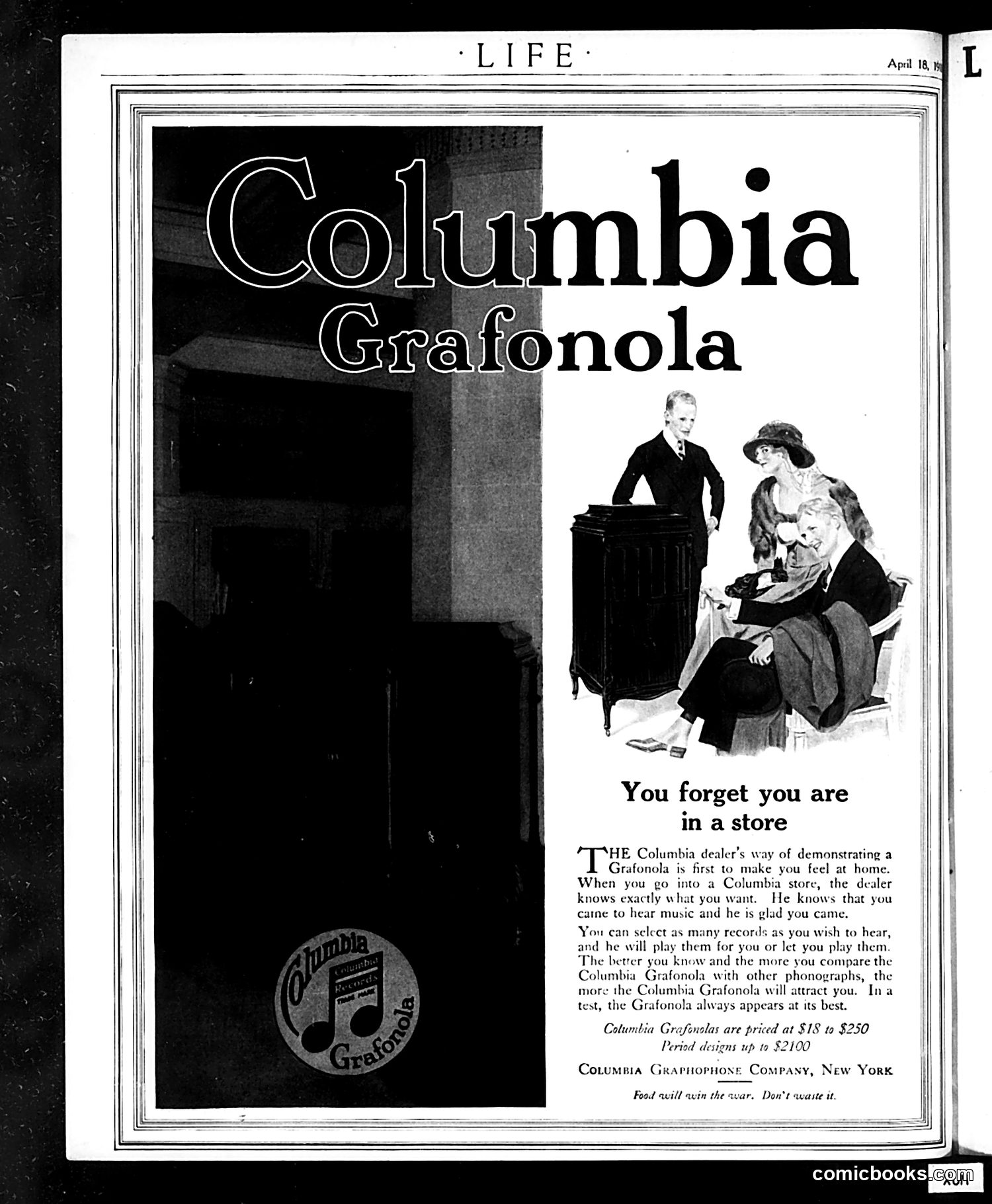
This is a **Columbia Grafonola advertisement**, not political satire. The "cartoon" consists of an illustration showing a dealer demonstrating a gramophone (early record player) to customers in a store setting. The tagline "You forget you are in a store" is the advertising hook—the point being that Columbia dealers create such a welcoming, home-like atmosphere that customers feel comfortable and at ease while shopping. The ad emphasizes the dealer's attentiveness: he knows customers came to hear music and will let them select and play multiple records before purchasing. This reflects early 20th-century retail strategy: positioning the phonograph seller as a knowledgeable, hospitable guide rather than a hard-selling merchant. The pricing ($18–$250) indicates these were substantial consumer purchases requiring customer confidence. There is no political content or satire on this page—it is straightforward commercial advertising for the Columbia Graphophone Company of New York.