
Life, 1918-04-18 · page 6 of 40
Life — April 18, 1918 — page 6: what you’re looking at
What you’re looking at
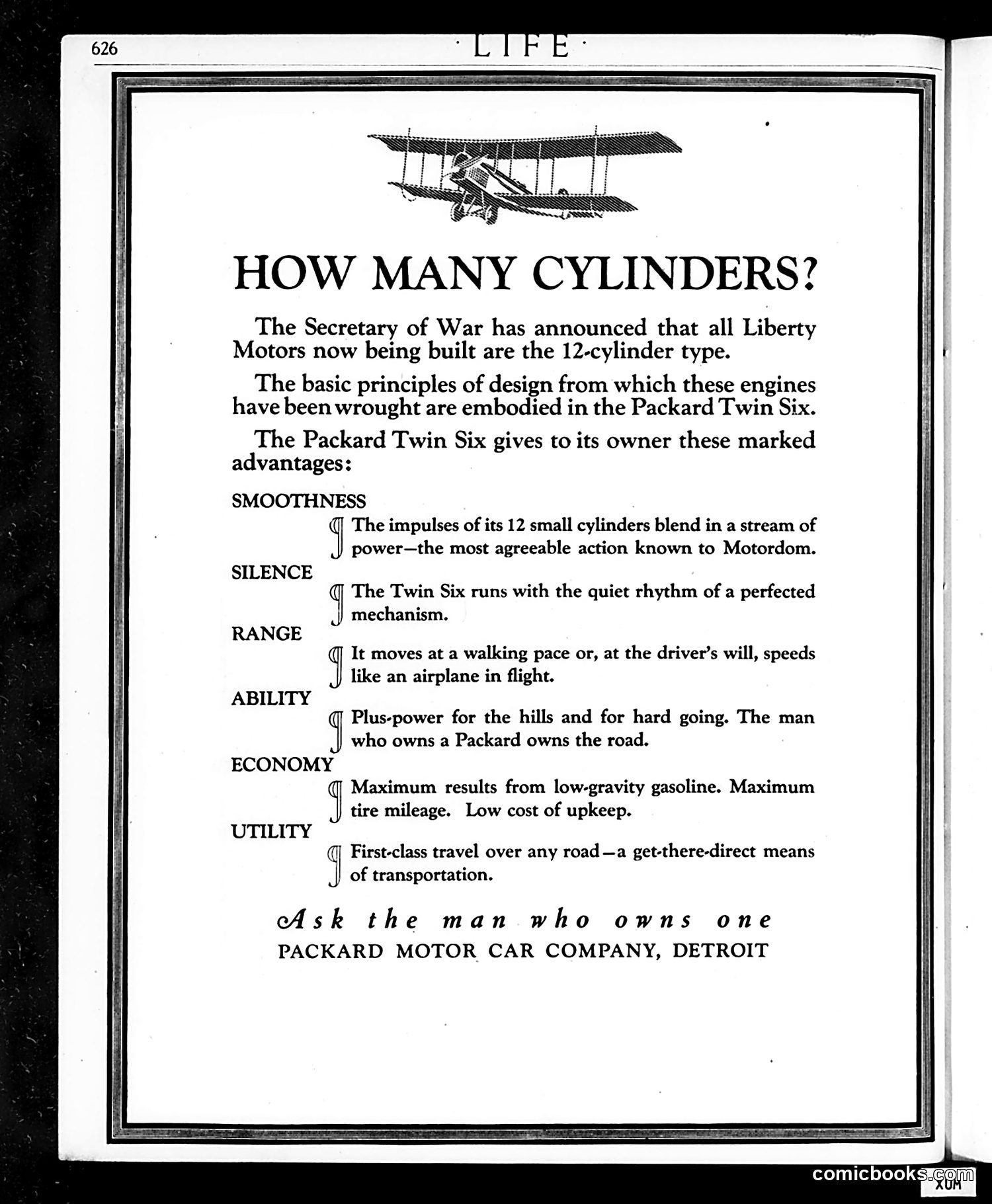
This page is **primarily an advertisement**, not satire or political commentary. It's a Packard Motor Car Company ad from Life magazine promoting the Packard Twin Six automobile. The headline "HOW MANY CYLINDERS?" references a contemporary competitive discussion in the automotive industry about engine specifications. The ad notes that the U.S. Secretary of War announced Liberty Motors (military aircraft engines) now use 12 cylinders, and argues that Packard's Twin Six incorporates similar design principles. The small biplane illustration at top connects to this military-industrial context—Liberty Motors powered WWI-era aircraft. The ad lists six consumer benefits (smoothness, silence, range, ability, economy, utility) to persuade buyers. The closing tagline encourages potential customers to consult current Packard owners. This reflects early 20th-century automotive marketing strategy: leveraging military specifications to establish civilian product credibility.
📄 Transcribed text from this page (OCR, searchable)
Machine-transcribed from the original scan — historical spelling and the odd misread are preserved.
HOW MANY CYLINDERS? The Secretary of War has announced that all Liberty Motors now being built are the 12-cylinder type. The basic principles of design from which these engines have been wrought are embodied in the Packard Twin Six. The Packard Twin Six gives to its owner these marked advantages: SMOOTHNESS ( The impulses of its 12 small cylinders blend in a stream of J) power—the most agreeable action known to Motordom. SILENCE The Twin Six runs with the quiet rhythm of a perfected J} mechanism. RANGE It moves at a walking pace or, at the driver’s will, speeds J like an airplane in flight. ABILITY @ Plus-power for the hills and for hard going. The man J) who owns a Packard owns the road. ECONOMY @ Maximum results from low-gravity gasoline. Maximum J) tire mileage. Low cost of upkeep. UTILITY @ First-class travel over any road —a get-there-direct means of transportation. J Ask the man who owns one PACKARD MOTOR CAR COMPANY, DETROIT comicbookssmg