
Life, 1918-04-18 · page 18 of 40
Life — April 18, 1918 — page 18: what you’re looking at
What you’re looking at
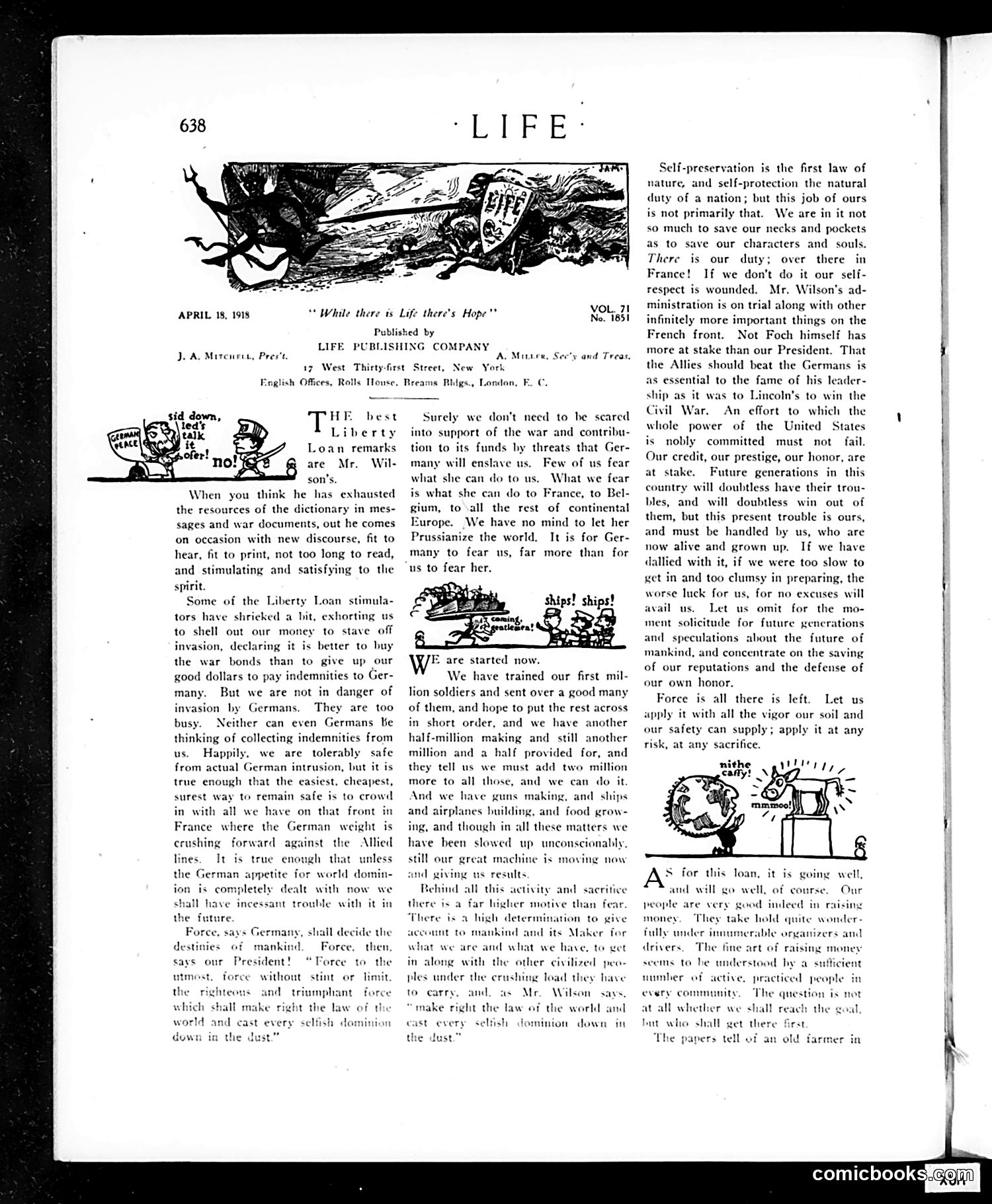
This editorial page argues for American commitment to World War I, specifically supporting Liberty Loan fundraising. The text praises President Wilson's rhetoric while reframing why Americans should fight: not from fear of German invasion (which the author dismisses as unlikely), but from moral obligation to protect France, Belgium, and European civilization from "Prussianization." The cartoons appear satirical in tone—one shows what appears to be a figure labeled "BIFF" (unclear reference), another depicts ships and soldiers. The article emphasizes that American soldiers are already deployed, millions more are being trained, and military production (guns, ships, airplanes) is ramping up, though "slowed up unconscionably." The core argument: Americans must contribute financially and militarily not for self-preservation but to "save our characters and souls" and uphold President Wilson's stated goal to "make right the law of the world." Wilson's administration's reputation is tied to Allied victory as Lincoln's was to Civil War success.
📄 Transcribed text from this page (OCR, searchable)
Machine-transcribed from the original scan — historical spelling and the odd misread are preserved.
APRIL 18, 1918 “While there ts Life there's Hope"* VOL. 71 No. 1851 Published by LIFE PUBLISHING COMPANY J. A. Mireuret, Pres't. 17 West Thirty-first glish Offices, Rolls House, Rreams Bligs., Lo HE best Liberty Loan remarks are Mr. Wil- son's. When you think he has exhausted the resources of the dictionary in mes- sages and war documents, out he comes on occasion with new discourse, fit to hear, fit to print, not too long to read, and stimulating and satisfying to the spirit. Some of the Liberty Loan stimula- tors have shricked a bit, exhorting us to shell out our money to stave off aring it is better to buy invasion, de the war bonds than to give up our good dollars to pay indemnities to Ger- many. But we are not in danger of invasion by Germans. They are too bu ither can even Germans Ke thinking of collecting indemnities from us. Happily, we are tolerably safe from actual German intrusion, but it is true enough that the easiest, cheapest, surest way to remain safe is to crowd in with all we have on that front in France where the German weight is tinst the Allied lines. It is true enough that unless crushing forward a; the German appetite for world domin- It with now we M have incessant trouble with it in ion is completely ¢ the future. Force, says Germany, shail decide the destinies. of mank Force, then, says our President! “Force to the utmost, force without stint or limit. righteous and triumphant force ake right the law of the and cast every selfish dominion A. Minter, Street, New York *y and Treas. Surely we don’t need to be scared into support of the war and contribu- tion to its funds by threats that Ger- ar many will enslave us. Few of us what she can do to us. What we fear is what she can do to France, to Bel- gium, to .all the rest of continental Europe. We have no mind to let her Prussianize the world. It is for Ger- many to fear us, far more than for us to fear her. are started now. We have trained our first mil lion soldiers and sent over a good many of them, and hope to put the rest across in short order, and we have another half-million making and still another million and a half provided for, and they tell us we must add two million more to all those, and we can do it And we have guns making, and ships and airplanes building, and food grow- ing, and though in all these matters we have been slowed up unconscionably, still our great machine is moving now dg Behind all this activity and sacritice there is a far higher motive than fe determination to give ng us results. There is a higl account to mankind and its Maker for what we are and what we have, to get n along with the other civilized pec under the crushing load they have Wilson says. “make right the law of the world and to carry. and. as Mr cast every selfish dominion down in the dust.” Self-preservation is the first law of nature, and self-protection the natural duty of a nation; but this job of ours is not primarily that. We are in it not so much to save our necks and pockets as to save our characters and souls. There is our duty; over there in France! If we don't do it our seli- respect is wounded. Mr. Wi ministration is on trial along with other infinitely more important things on the French front. Not Foch himself has more at stake than our President. That the Allies should beat the Germans i: as essential to the fame of his leader- ship as it was to Lincoln’s to win the Civil War. An effort to which the whole power of the United States is nobly committed must not fail. Our credit, our prestige, our honor, are at stake, Future generations in this country will doubtless have their trou- bles, and will doubtless win out of them, but this present trouble is ours, and must be handled by us, who are now alive and grown up. If we have lied with it, if we were too slow to get in and too clumsy in preparing, the worse luck for us, for no excuses will avail us. Let us omit for the mo- ment solicitude for future generations and speculations about the future of mankind, and concentrate on the saving of our reputations and the defense of our own honor, Force is all there is left. Let us apply it with all the vigor our soil and our safety can supply; apply it at any risk, at any sacrifice. for this loan, it is going well, nd will go well, of course. Our people are very good indeed in raising They take he fully under innumerable money dl quite wonder- wanizers and drivers. The fine art of raising money seems to he understood by a sufficient number of active. practiced people every community, ‘The question is not at all whether we shall reach the goal hut who shall get there frst The papers tell of an old farmer in comicbooksie@ra}