
Life, 1918-04-18 · page 19 of 40
Life — April 18, 1918 — page 19: what you’re looking at
What you’re looking at
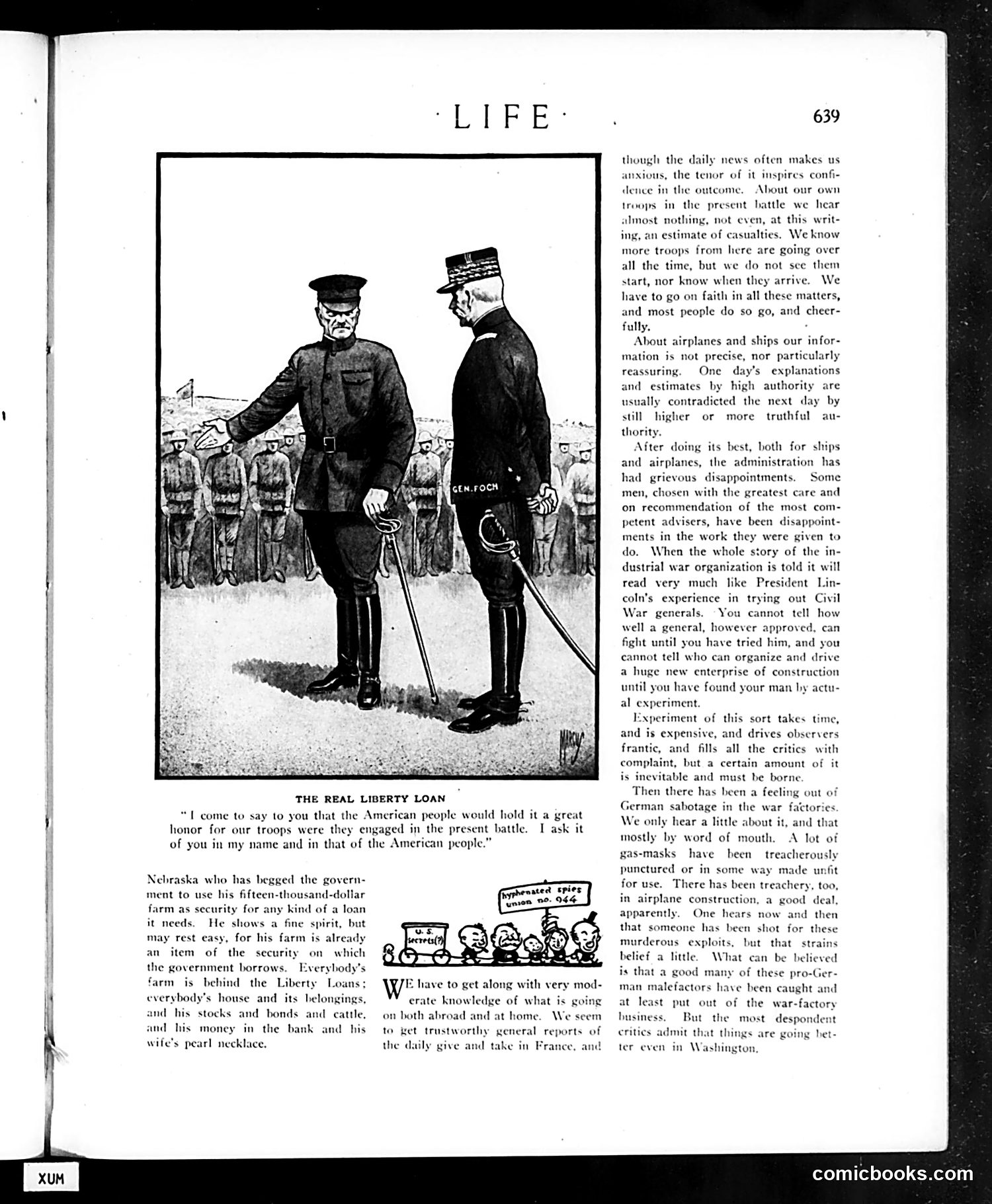
This page critiques American war finance during World War I. The cartoon depicts a military officer presenting a farmer's property to another official, illustrating the text's central point: Liberty Loans (government bonds to finance the war) are nominally voluntary, but citizens' assets—farms, homes, stocks, cattle, even "wife's pearl necklace"—effectively serve as collateral whether they participate or not. The satire argues that ordinary Americans bear the financial burden of war regardless of choice. A Nebraska farmer offering his $15,000 farm as security demonstrates patriotic intent, but the article notes this is unnecessary since all citizens' assets already back government borrowing. The broader text discusses wartime anxieties: vague casualty reports, contradictory military information, administrative failures, and suspected German sabotage in factories—frustrations common to civilian populations during WWI. The tone is cautiously optimistic but notes inevitable wartime inefficiencies and disappointments.
📄 Transcribed text from this page (OCR, searchable)
Machine-transcribed from the original scan — historical spelling and the odd misread are preserved.
THE REAL LIBERTY LOAN “LT come to say to you ti a the American people would hold it a great honor for our troops were they engaged in the present battle. I ask it of you in my name and in that of the American people.” Nebraska who has begged the govern- ment to use his fifteen-thousand-dollar ‘m as security for any kind of a loan it needs. He shows a fine spirit, but may rest easy, for his farm is already an item of the security on which the government borrows. Everybody's farm is behind the Liberty [ ybody’s house and its belongings ans ; nd his stocks and bonds and cattle, and his money in the bank and his wife's pearl necklace. have to get along with very mod- ¢ knowledge of what is going on both abroad and at home. We seem to Ket trustworthy general reports ¢ the daily give and take 639 though the daily news often makes us anxious, the tenor of it inspires confi- dence in the outcome. About our own troops in the present battle we hear almost nothing, not even, at this writ- Ities. We know more troops from here are going over all the time, but we do not see them start, nor know when they arrive. We have to go on faith in all these matters, and most people do so go, and cheer- fully. About airplanes and ships our infor- mation is not precise, nor particularly reassuring. One day's explanations and estimates by high authority are usually contradicted the next day by still higher or more truthful au- thority. After doing its best, both for ships and airplanes, the administration has ing, an estimate of casu had grievous disappointments. Some men, chosen with the greatest care and on recommendation of the most com- petent advisers, have been disappoint- ments in the work they were given to do. When the whole story of the in- dustrial war organization is told it will read very much like President Lin- coln’s experience in trying out Civil War generals. You cannot tell how well a general, however approved, can fight until you have tried him, and you cannot tell who can organize and drive a huge new enterprise of construction until you have found your man by actu- al experiment. Experiment of this sort takes time, and is expensive, and drives observers frantic, and fills all the critics with complaint, but a certain amount of it is inevitable and must be borne. Then there has been a feeling out of rman sabotage in the war factories We only hear a little about it, and that mostly by word of mouth. A lot of as-masks have heen treacherously punctured or in some way made unfit for use. There has been treachery, too, in airplane construction, a good deal, apparently. One hears now and then that someone has been shot for these murderous exploits, but that. strains belief a little. What can be believed is that a man male good many of these pro-Ger- ‘actors have been caught and at least put out of the war-factory business, But the most despondent critics admit that things are going het- ter even in Washington, comicbooks.com