
Life, 1918-04-18 · page 25 of 40
Life — April 18, 1918 — page 25: what you’re looking at
What you’re looking at
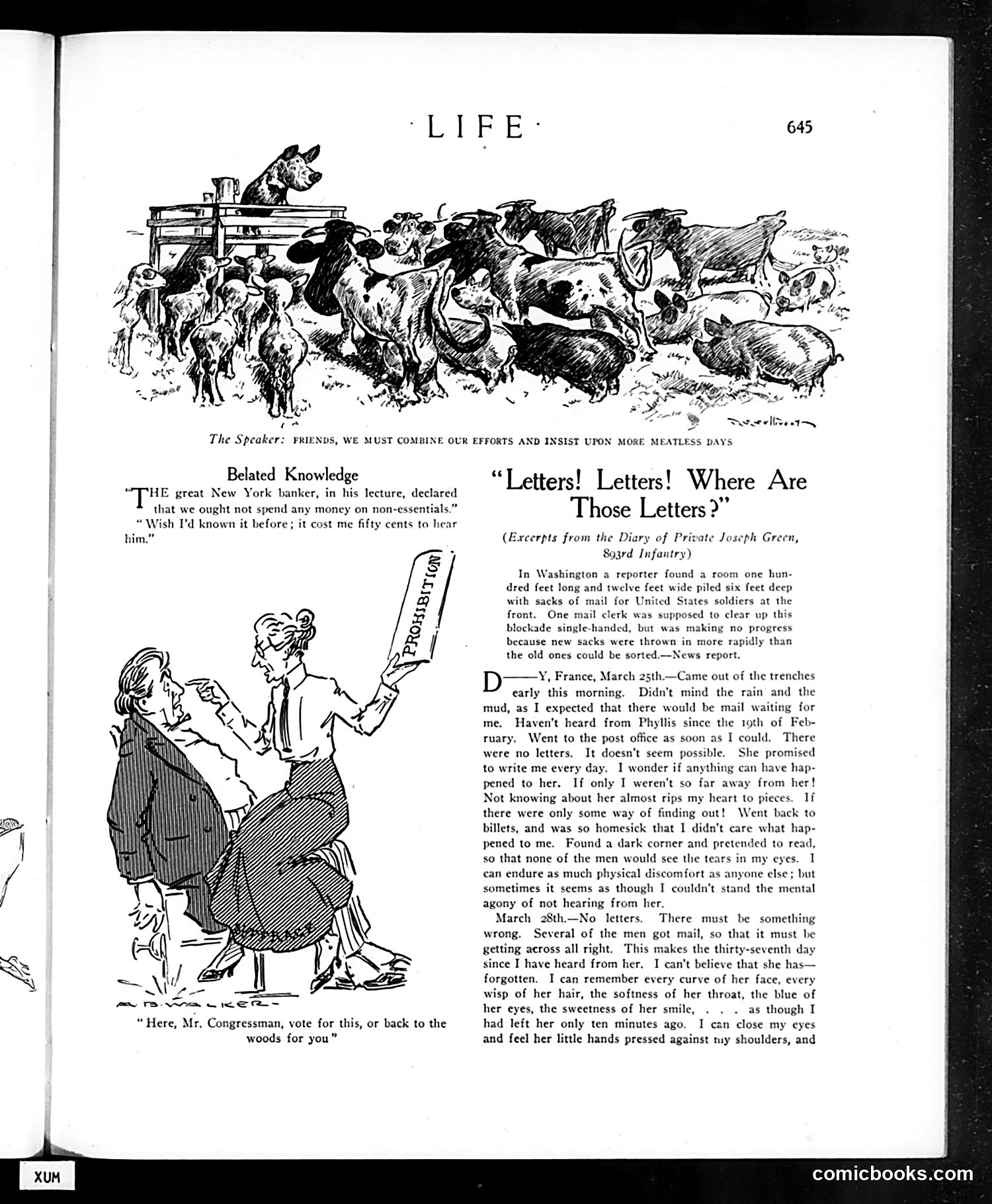
**Top cartoon:** A banker lectures against spending on "non-essentials," then charges fifty cents admission—the irony being his lecture itself is non-essential. The satire mocks wealthy financiers for hypocrisy about frugality while profiting from it. **Middle cartoon:** A politician threatens a congressman with political exile ("back to the woods") if he doesn't vote for something—likely a wartime measure. This satirizes coercive legislative tactics and backroom pressure during WWI. **Top illustration:** Shows farm animals and a speaker demanding "meatless days," referencing actual WWI-era rationing programs to conserve resources for troops. **Main feature:** A soldier's diary excerpts describing the backlog of military mail—a real Washington Post report about one clerk managing six feet of accumulated letters. The poignant narrative contrasts with a news problem: soldiers' morale suffering from delayed correspondence with loved ones, while mail *is* reaching some troops. The satire highlights governmental inefficiency during wartime.
📄 Transcribed text from this page (OCR, searchable)
Machine-transcribed from the original scan — historical spelling and the odd misread are preserved.
Belated Knowledge “THE great New York banker, in his lecture, declared that we ought not spend any money on non-essentials.” “Wish I'd known it before; it cost me fifty cents to hear him.” & Ss 3 & 2 EI | Hi PN ie A ii =: i “| al / j \ A\l al “Here, Mr. Congressman, vote for this, or back to the woods for you” Dew le The Speaker: FRIENDS, WE MUST COMBINE OUR EFFORTS AND INSIST UPON MORE MEATLESS DAYS “Letters! Letters! Where Are Those Letters >” (Excerpts from the Diary of Private Joseph Green, 8o3rd Infantry) In Washington a reporter found a room one hun- dred feet long and twelve feet wide piled six feet deep with sacks of mail for United States soldiers at the front. One mail clerk was supposed to clear up this blockade single-handed, but was making no progress because new sacks were thrown in more rapidly than the old ones could be sorted.—News report. D Y, France, March 25th.—Came out of the trenches. early this morning. Didn't mind the rain and the mud, as I expected that there would be mail waiting for me, Haven't heard from Phyllis since the 19th of Feb- ruary. Went to the post office as soon as I could. There were no letters. It doesn’t seem possible. She promised to write me every day. I wonder if anything can have hap- pened to her. If only I weren't so far away from her! Not knowing about her almost rips my heart to pieces. If there were only some way of finding out! Went back to billets, and was so homesick that I didn’t care what hap- pened to me. Found a dark corner and pretended to read, so that none of the men would see the tears in my eyes. I can endure as much physical discomfort as anyone else; but sometimes it seems as though I couldn't stand the mental agony of not hearing from her. March 28th.—No letters. There must be something wrong. Several of the men got mail, so that it must be getting across all right. This makes the thirty-seventh day since I have heard from her, I can't believe that she has— forgotten. I can remember every curve of her face, every wisp of her hair, the softness of her throat, the blue of her eyes, the sweetness of her smile, as though I had left her only ten minutes ago. I can close my eyes and feel her little hands pressed against my shoulders, and comicbooks.com