
Life, 1918-04-18 · page 22 of 40
Life — April 18, 1918 — page 22: what you’re looking at
What you’re looking at
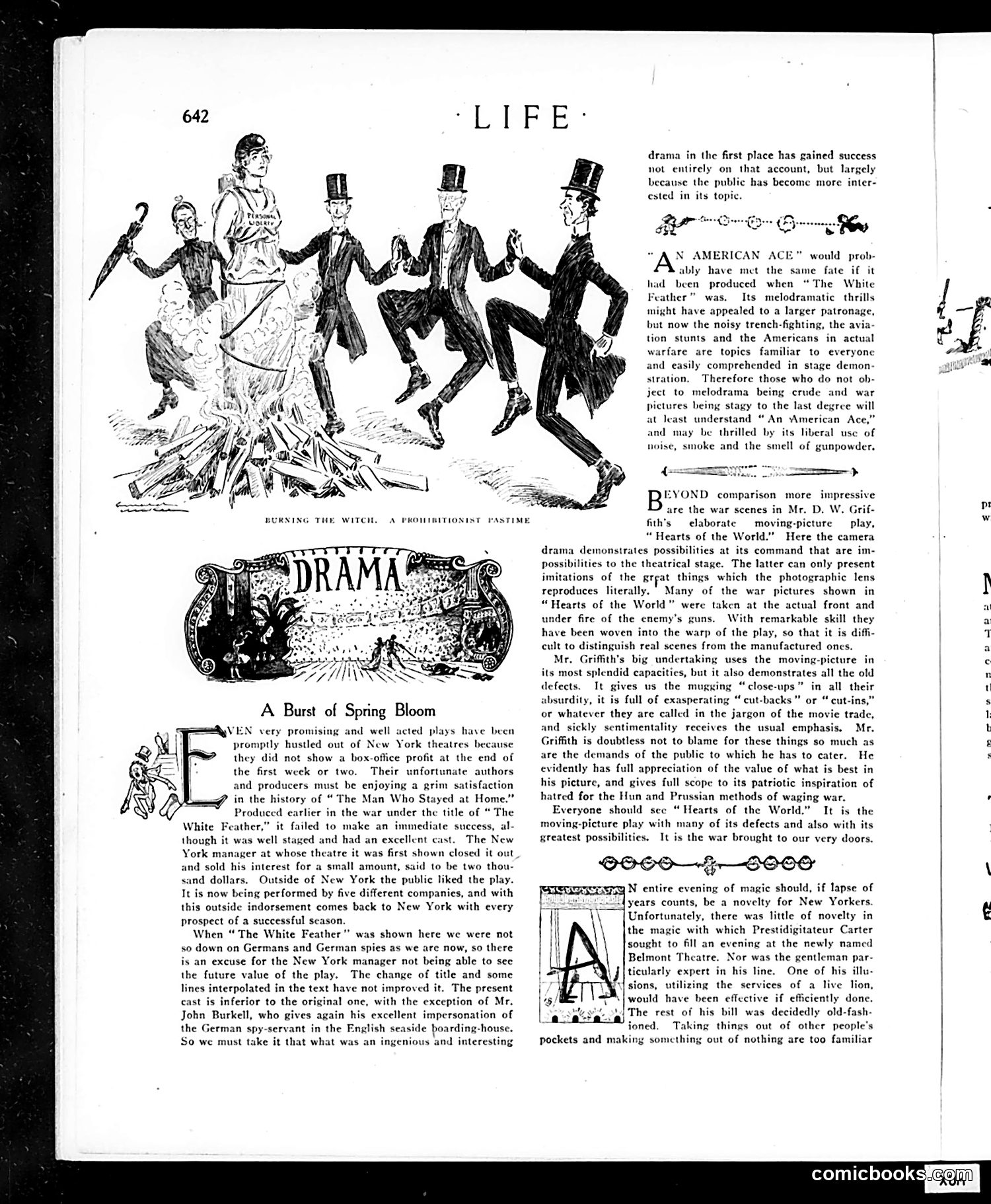
The cartoon depicts five men in formal dress dancing around a bonfire, celebrating the destruction of a bottle. This is satirical commentary on Prohibition—specifically mocking prohibitionists' zealous campaign to ban alcohol. The title's reference to "burning the witch" equates alcohol with witchcraft, sarcastically echoing prohibitionist rhetoric that treated liquor as an evil to be eradicated. The gleeful, almost frenzied dancing suggests the page's author views prohibition advocates as overly zealous, irrational crusaders rather than serious reformers. The accompanying drama reviews discuss wartime theatrical productions, but the cartoon stands apart as social satire targeting the growing Prohibition movement in America. This placement suggests Life magazine was skeptical of prohibitionist activism gaining momentum during the World War I era, ultimately leading to the 18th Amendment (ratified 1919).
📄 Transcribed text from this page (OCR, searchable)
Machine-transcribed from the original scan — historical spelling and the odd misread are preserved.
642 “LUE -° BURNING TH WITCH. A PRONIMITIONIST PASTIME A Burst of Spring Bloom very promising and well a promptly hustled out of New York theatres because they did not show a box-office profit at the end of the first week or two. Their unfortunate authors and producers must be enjoying a grim satisfaction in the history of “ The Man Who Stayed at Home.” Produced earlier in the war under the title of “ The White Feather,” it failed to make an immediate success, al- though it was well staged and had an excellent cast. The New York manager at whose theatre it was first shown closed it out_ and sold his interest for a small amount, s to be two thou- sand dollars. Outside of New York the public liked the play. It is now being performed by five different companies, and with this outside indorsement comes back to New York with every prospect of a successful season. When “The White Feather" was shown here we were not so down on Germans and German spies as we are now, so there is an excuse for the New York manager not being able to see the future value of the play. The change of title and some lines interpolated in the text have not improved it. The present cast is inferior to the original one, with the exception of Mr. John Burkell, who gives again his excellent impersonation of the German spy-servant in the English seaside boarding-house. So we must take it that what was an ingenious and interesti ted plays have been drama in the first place has gained success not entirely on that account, but largely because the public has become more inter- cal a N AMERICAN AC would prob- ably have met the same fate if it had been produced when “The White Feather" was. Its melodramatic thrills might have appealed to a larger patronage, but now the noisy trench-fighting, the avia- tion stunts and the Americans in actual warfare are topics familiar to everyone and easily comprehended in stage demon- stration, Therefore those who do not ob- ject to melodrama being crude and war pictures being stagy to the last degree will at least understand “An Ymerican Ace,” and may be thrilled by its liberal use of smoke and the smell of gunpowder. noise, x > 4a EYOND comparison more impressive are the war scenes in Mr. D. W. Grif- fith's elaborate moving-picture play, “ Hearts of the World.” Here the camera drama demonstrates possibilities at its command that are im- possibilities to the theatrical stage. The latter can only present imitations of the grpat things which the photographic lens reproduces literally.' Many of the war pictures shown in “Hearts of the World” were taken at the actual front and under fire of the enemy's guns. With remarkable skill they have been woven into the warp of the play, so that it is diffi- cult to distinguish real scenes from the manufactured ones. Mr. Griffith's big undertaking uses the moving-picture in its most splendid capacities, but it also demonstrates all the old defects. It gives us the mugging “close-ups” in all their absurdity, it is full of exasperat cut-backs " or “ cut-ins,’ or whatever they are called in the jargon of the movie trade and ‘kly sentimentality receives the usual emphasi: Mr. Griffith is doubtless not to blame for these things so much as are the demands of the public to which he has to cater. He evidently has full appreciation of the value of what is best in his picture, and gives full scope to its patriotic inspiration of hatred for the Hun and Prussian methods of waging war. veryone should sec “Hearts of the World.” It is the moving-picture play with many of its defects and also with its greatest possibilities, It is the war brought to our very doors. GOCO—-f- SOOO N entire evening of magic should, if lapse of <lyears counts, be a novelty for New Yorkers Unfortunately, there was little of novelty in the magic with which Prestidigitateur Carter sought to fill an evening at the newly named Belmont Theatre. Nor was the gentleman par- ticularly expert in his line. One of his illu- ‘| sions, utilizing the services of a live lion, would have been effective if efficiently done. The rest of his bill was decidedly old-fash- joned. Taking things out of other people's pockets and making something out of nothing are too familiar