
A complete issue · 44 pages · 1918
Life — April 11, 1918
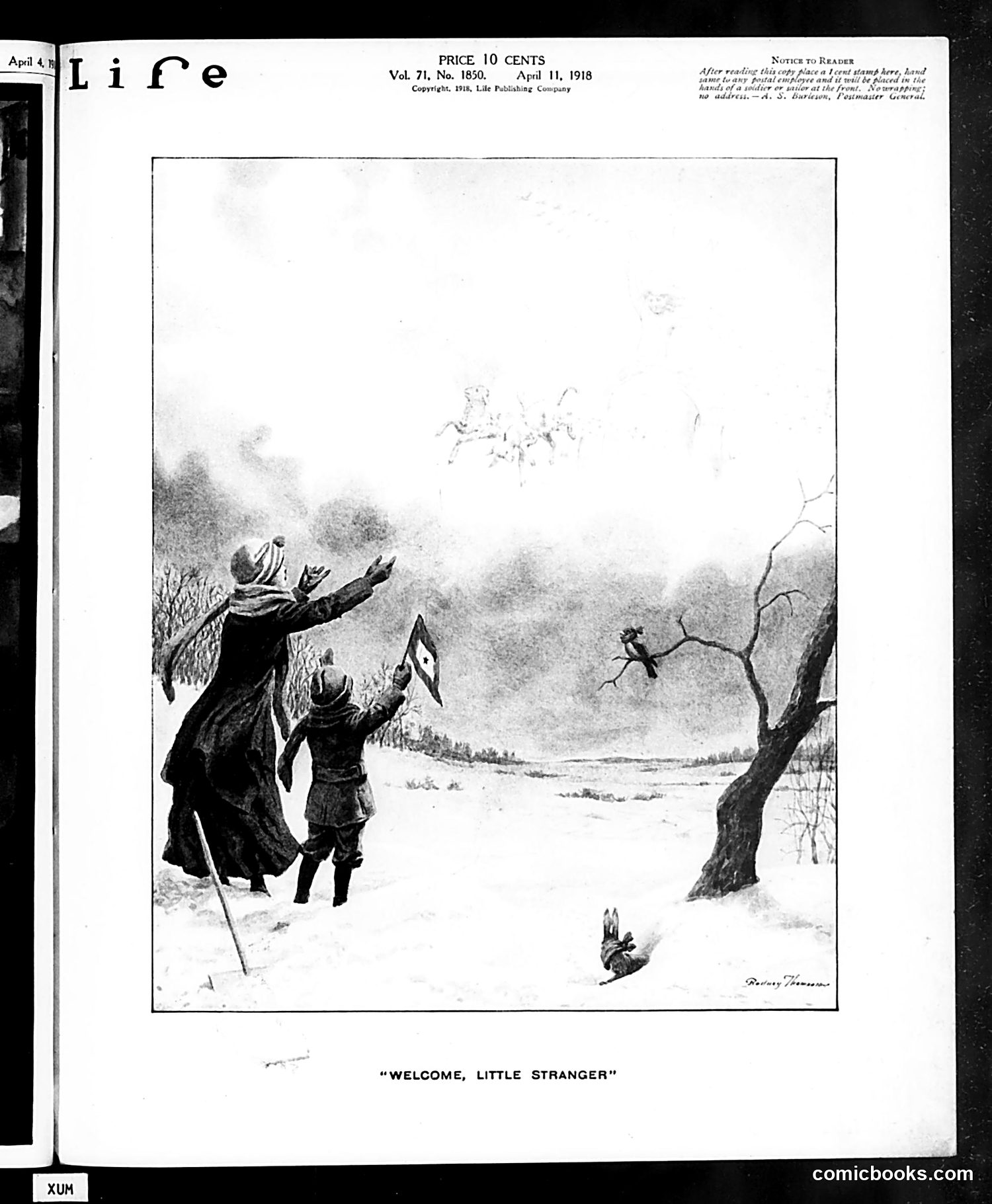
This April 1918 *Life* cartoon depicts a winter scene where two figures in heavy coats gesture upward at birds flying overhead, welcoming them back. The caption reads "Welcome, Little Stranger." The image likely represents the return of migratory birds in spring. However, given the 1918 publication date—during World War I's final year—this may carry satirical resonance about American involvement or returning soldiers, though the visual content alone suggests a straightforward seasonal theme. The sketch is signed by what appears to be "Sidney Paget" or similar. Without additional context from surrounding pages, the precise satirical target remains unclear, though the juxtaposition of winter hardship and spring renewal suggests themes of hope or rebirth relevant to wartime 1918.
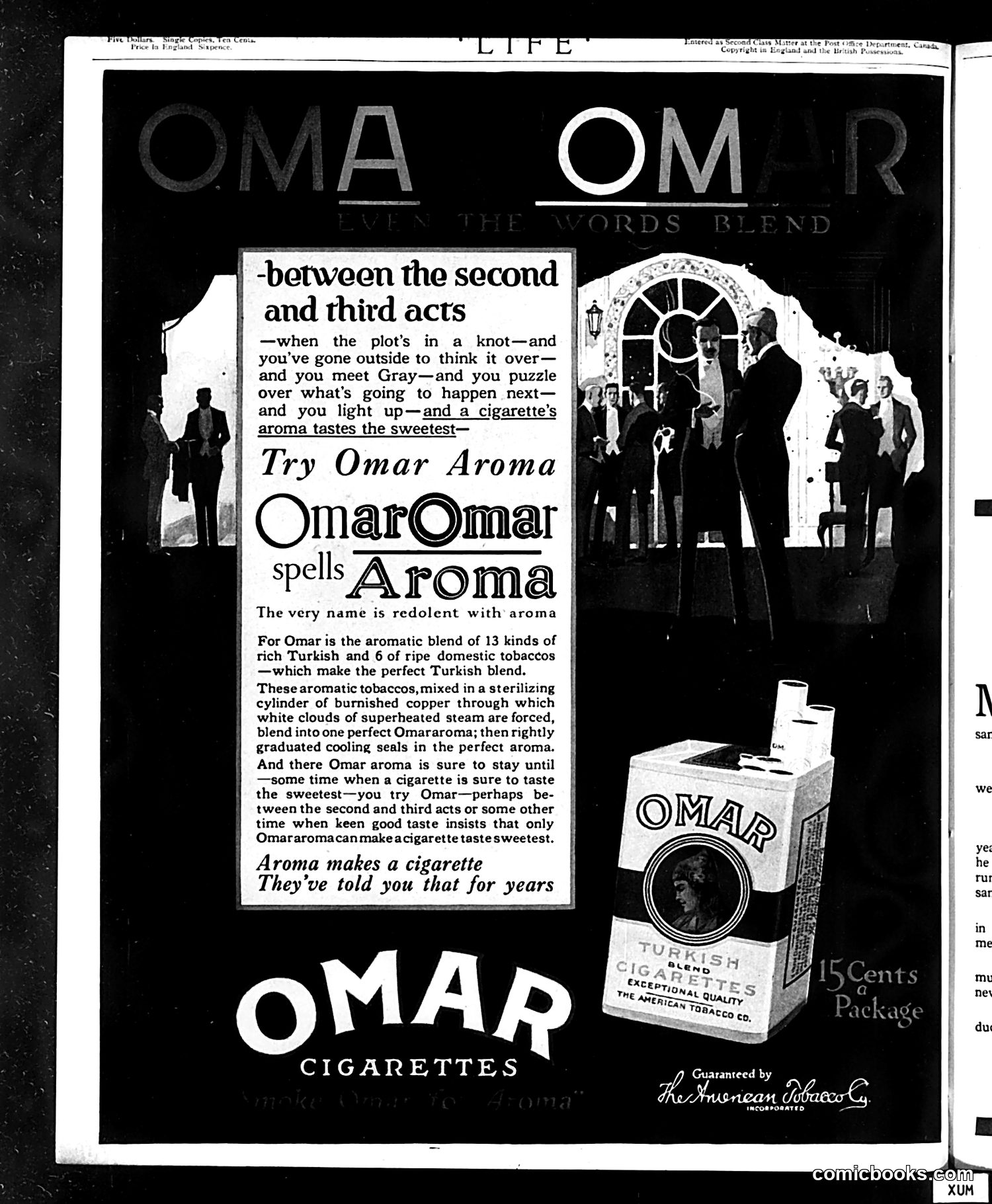
This page is primarily an advertisement for Omar cigarettes, not political satire or a cartoon. The ad uses a theatrical framing device—the headline "OMAR OMAR / between the second and third acts"—to position cigarette smoking as an intermission activity during dramatic entertainment, likely a stage play. The advertisement emphasizes the product's "aroma," claiming Omar cigarettes blend 13 Turkish and 6 domestic tobaccos through a special copper cylinder process. The visual elements show silhouetted figures in formal dress at what appears to be a theater lobby or social gathering. The copywriting strategy appeals to theater-goers by suggesting Omar cigarettes enhance dramatic tension during plot developments. This reflects early-20th-century advertising conventions associating cigarettes with sophistication and leisure.
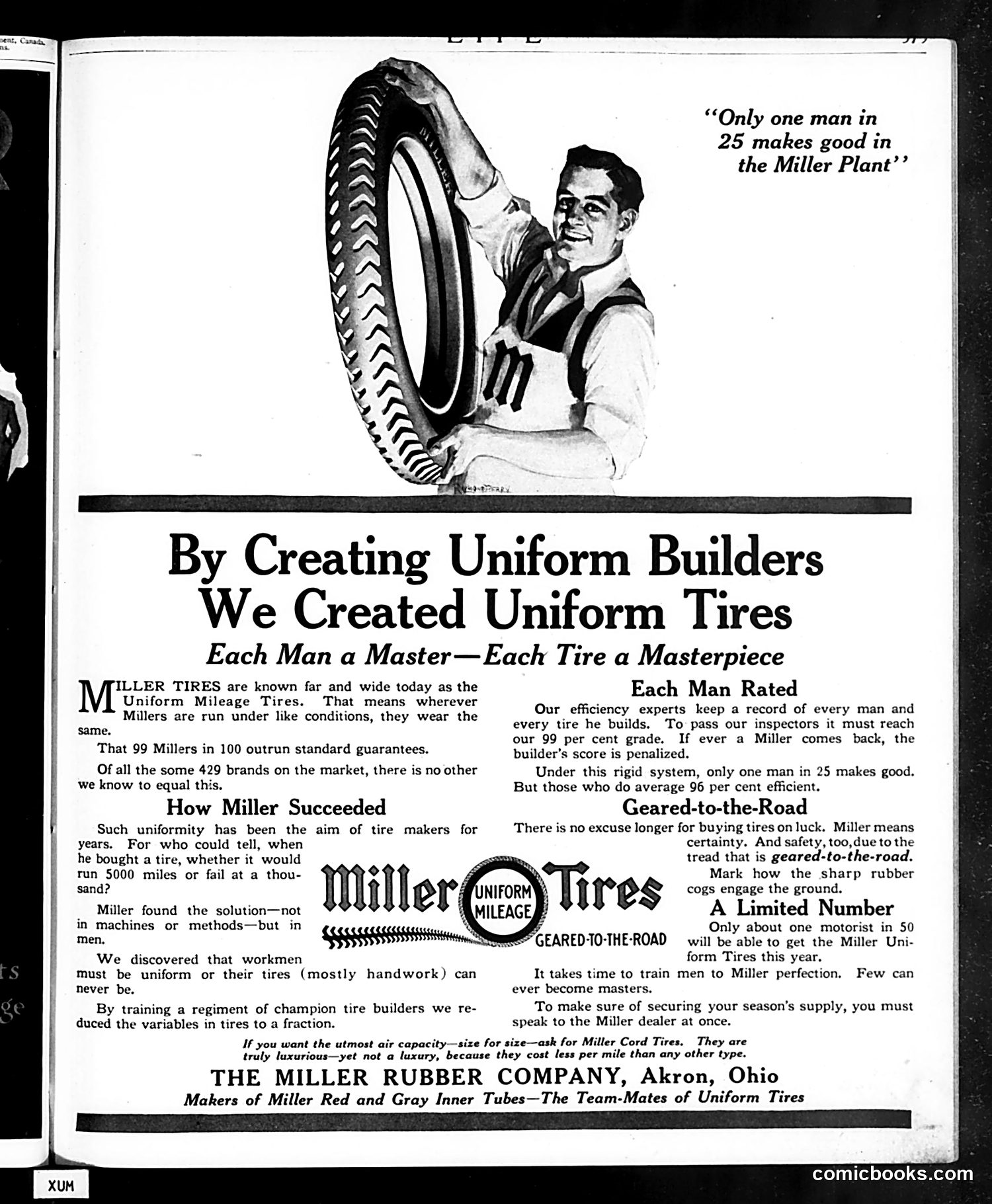
This page is primarily a **vintage advertisement**, not satirical content. It's a Miller Rubber Company ad for "Miller Uniform Mileage Tires," published in *Life* magazine. The ad features a smiling workman holding a large tire, with the caption "Only one man in 25 makes good in the Miller Plant." The marketing strategy emphasizes **quality control through worker selection and training**—Miller claims success comes from hiring and training "champion tire builders" rather than relying on machinery. The ad positions Miller tires as superior through **uniform craftsmanship**: each tire is presented as a "masterpiece" because each builder is rated and held to 96% efficiency standards. The tagline "Geared-to-the-Road" emphasizes reliability. This reflects **early-20th-century manufacturing philosophy**: the belief that handwork and individual worker excellence—not just industrial processes—determined product quality. The competitive claim that "99 Millers in 100 outrun standard guarantees" reflects aggressive marketing common to that era.
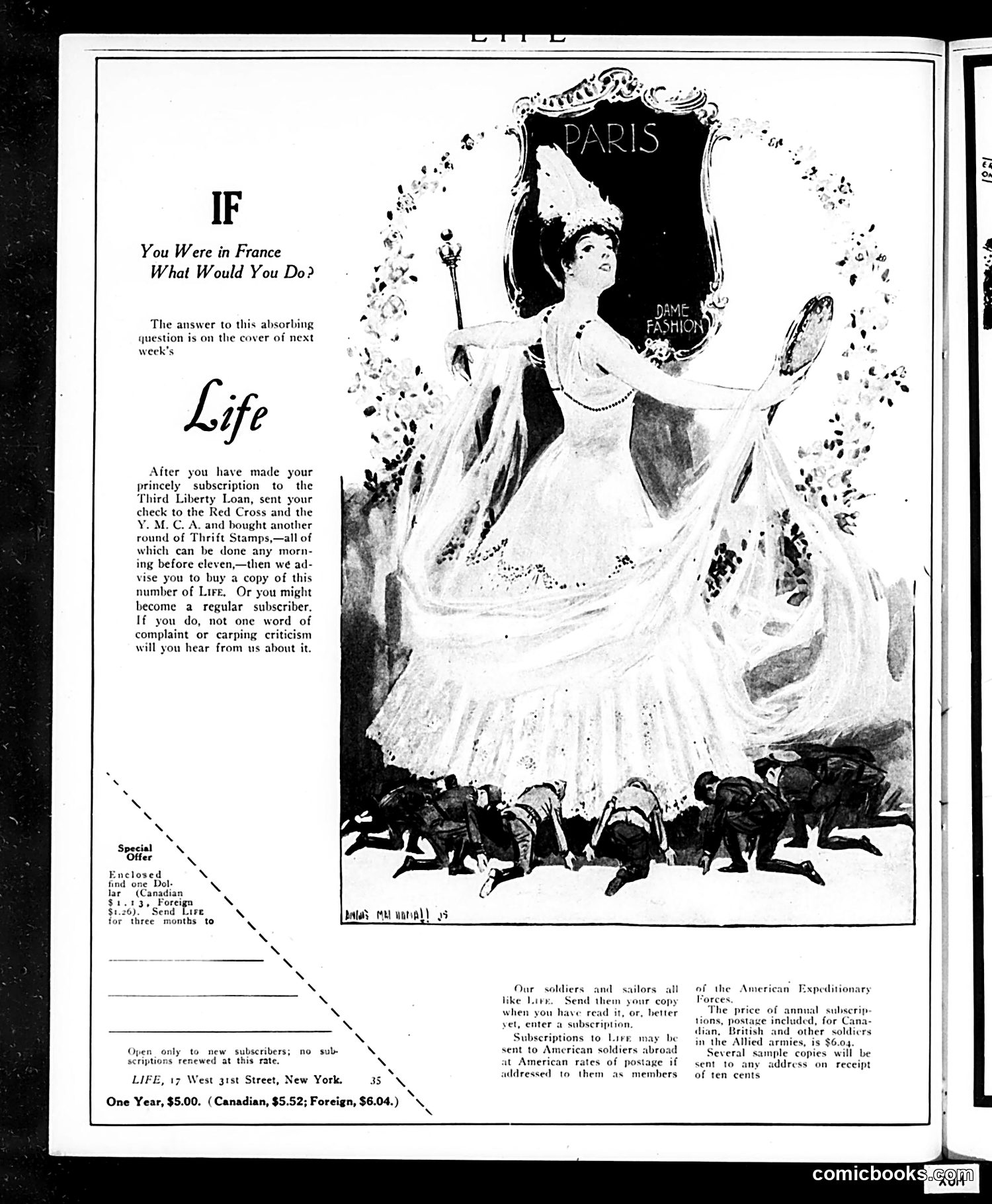
This is primarily a **subscription advertisement** for *Life* magazine, not a political cartoon. The main image depicts an elegantly dressed woman in an ornate frame labeled "Paris" and "Dame Fashion," surrounded by decorative flourishes and small figures at the base. The "IF You Were in France, What Would You Do?" headline poses a rhetorical question whose answer—implied to be reading *Life*—appears on next week's cover. This is a marketing hook. The advertisement emphasizes *Life's* cultural sophistication and connection to Paris fashion, appealing to readers' aspirations for cosmopolitan taste. The text promotes subscriptions while noting that *Life* reaches American soldiers abroad—relevant context suggesting this dates to World War I era, when such patriotic messaging was common in advertising.
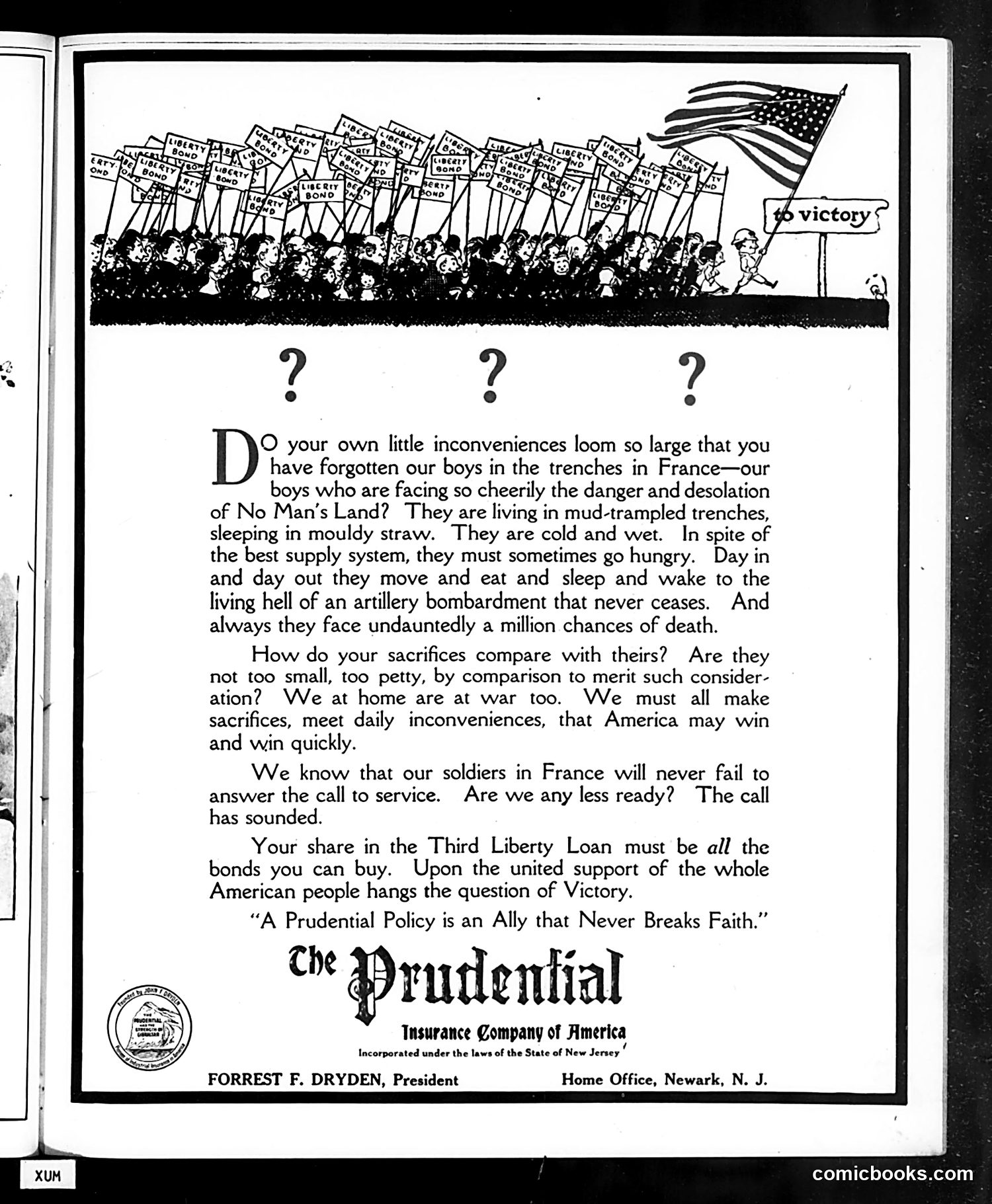
This is a **WWI-era propaganda advertisement**, not satirical content. It's an appeal from Prudential Insurance Company urging Americans to buy Third Liberty Loan bonds to support the war effort. The illustration shows a massive crowd of soldiers holding signs labeled "LIBERTY BONDS," marching toward victory (indicated by the American flag and "to victory" sign). The text shames domestic civilians for their "little inconveniences" while soldiers endure trench warfare in France—mud, cold, hunger, and constant artillery bombardment. It argues that home front sacrifices (buying bonds) pale compared to soldiers' suffering, and appeals to patriotic duty: "Are we any less ready?" The closing quote ("A Prudential Policy is an Ally that Never Breaks Faith") uses patriotic language to associate insurance-buying with supporting the troops.
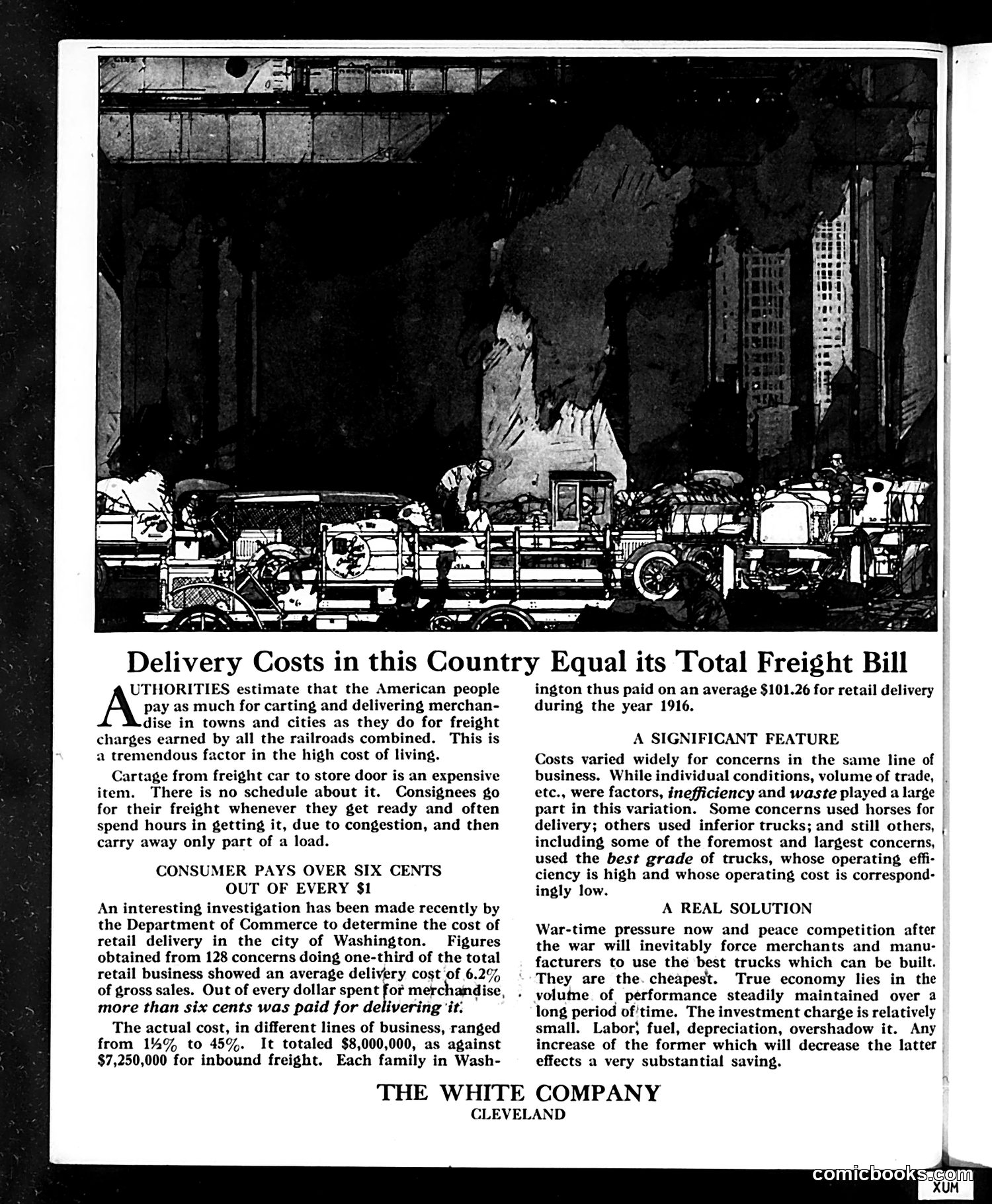
This is **primarily an advertisement**, not satire or political commentary. The White Company of Cleveland is marketing commercial delivery trucks. The top image shows an industrial/warehouse scene with various delivery vehicles and workers, illustrating modern logistics infrastructure. The text argues that delivery costs in America are substantial—consumers pay over six cents per dollar for merchandise delivery. A 1916 Department of Commerce study of Washington, D.C. found delivery costs ($8,000,000) nearly matched inbound freight costs ($7,250,000). The advertisement positions White Company trucks as "a real solution" to inefficient delivery systems, promoting their vehicles as the cheapest and most economical option for merchants. The pitch emphasizes reliability and low operating costs over time. This reflects early-twentieth-century industrial concerns about distribution efficiency.
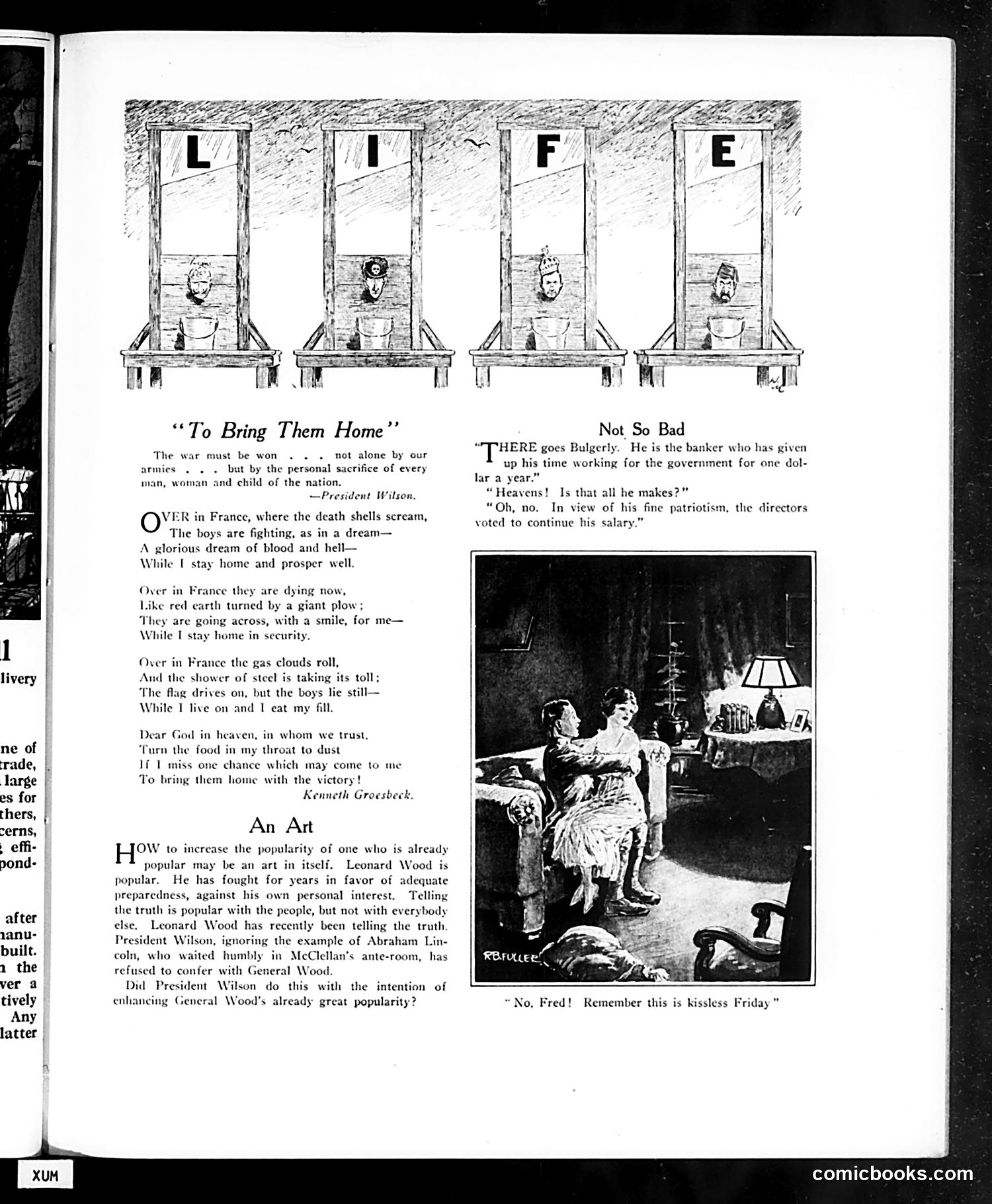
**Top Section - "To Bring Them Home"** A poem by Kenneth Grosvenor expresses the guilt of those remaining safely at home while soldiers die in France during World War I. The speaker acknowledges the contrast between soldiers "fighting as in a dream" abroad while he "stays home and prospers well." **Bottom Section - "Not So Bad" and "An Art"** The first article discusses a banker named Bulgerly who gave up his banking position to work for the government at one dollar per year—presented as patriotic sacrifice. The accompanying illustration shows a domestic scene with the caption "No, Fred! Remember this is kissless Friday," likely referencing wartime rationing or sacrifice campaigns. The page satirizes selective patriotism: celebrating those making symbolic gestures while soldiers suffer.
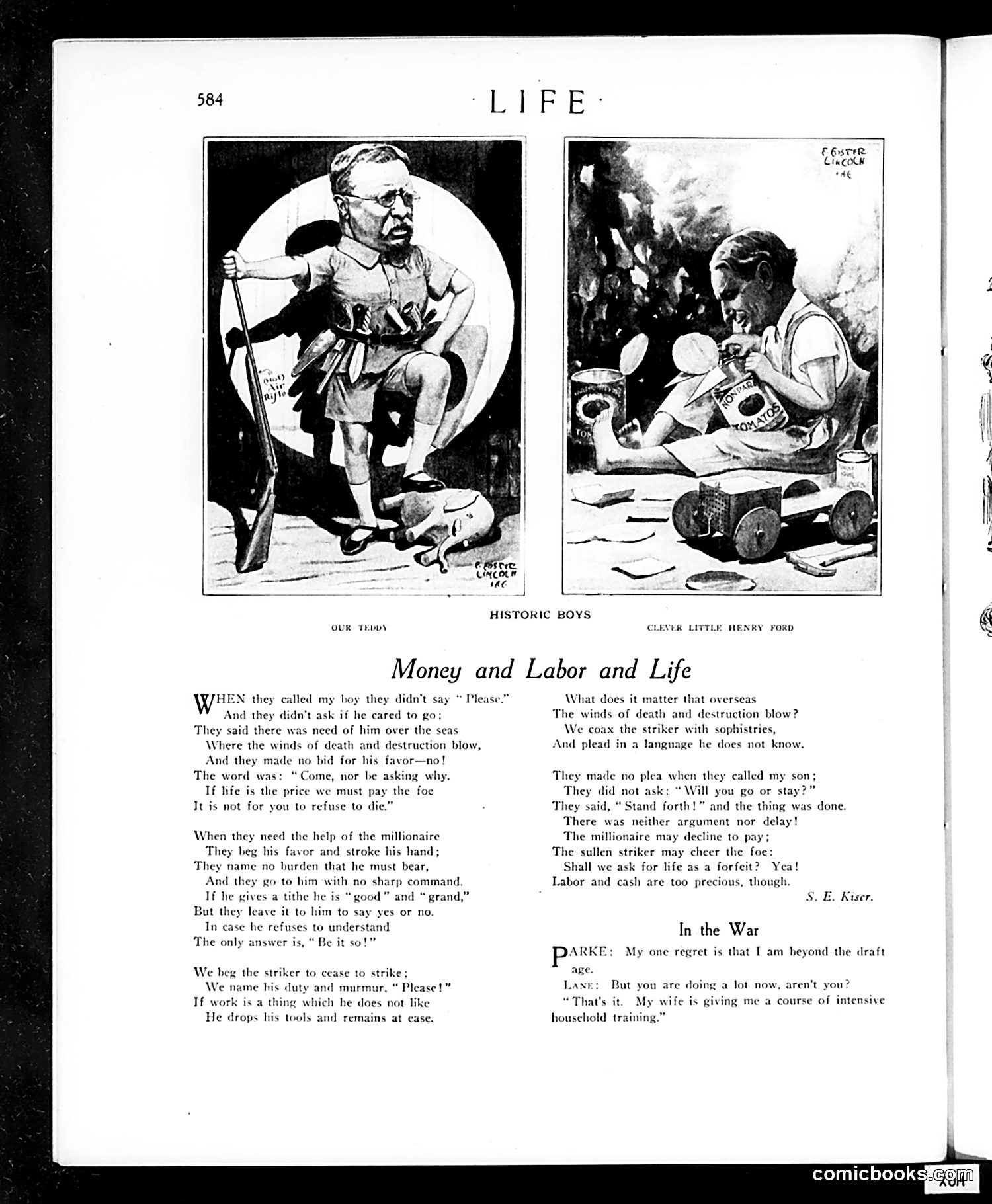
This page presents two satirical cartoons contrasting historical figures with contemporary ones. **Left cartoon ("Our Hero")**: Depicts an adult man dressed as a soldier or military figure, appearing cartoonishly exaggerated. The satire likely critiques someone in a leadership position, possibly mocking their military posturing or authority. **Right cartoon ("Clever Little Henry Ford")**: Shows a child figure assembling or working with mechanical parts and toys, satirizing Henry Ford's famous assembly-line manufacturing methods by depicting them as childishly simple. **The poems** address labor disputes and war. "Money and Labor and Life" critiques wealthy industrialists calling upon workers for sacrifice while avoiding burden themselves. "In the War" briefly discusses military service. The overall message appears critical of both industrial capitalists and militaristic authority figures during what was likely the World War I era.
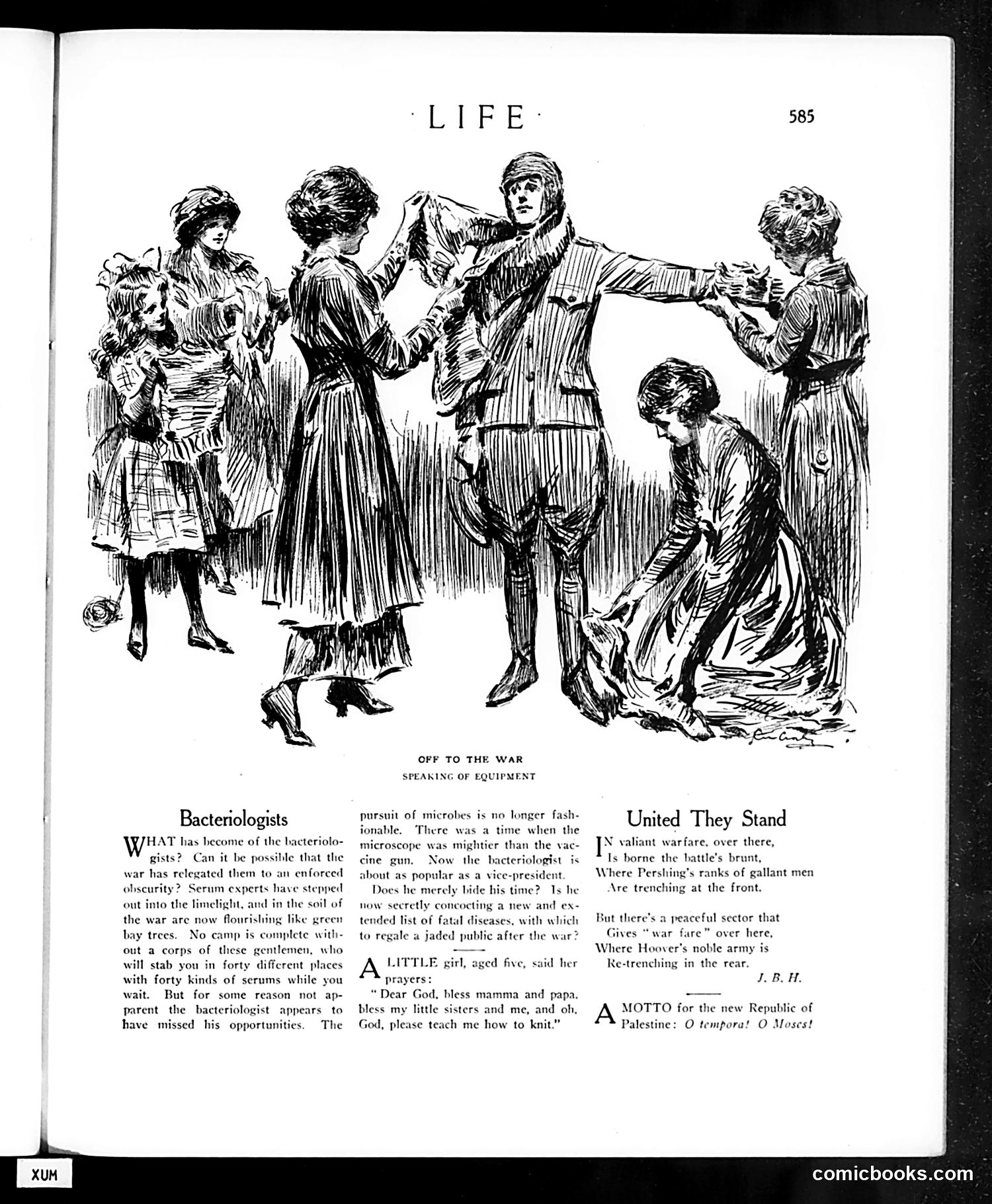
This page contains two separate pieces of satirical content from WWI-era Life magazine. **"Off to the War" (top illustration):** A military officer addresses a group of women and children, apparently discussing equipment or preparations. The caption's ironic title suggests commentary on wartime mobilization. **"Bacteriologists" (left column):** Satirizes how bacteriologists have gained prominence and enforced authority during wartime, being stationed in various camps to test serums. The joke appears to be that this previously obscure scientific role has suddenly become powerful and omnipresent—they're now as important as military officers. **"United They Stand" (right column):** A poem celebrating the "peaceful sector" of the home front, contrasting it with active warfare. The final motto about Palestine's new Republic appears unrelated, possibly a separate editorial comment. The overall theme critiques how war reorganizes civilian society and elevates certain professions to unexpected importance.
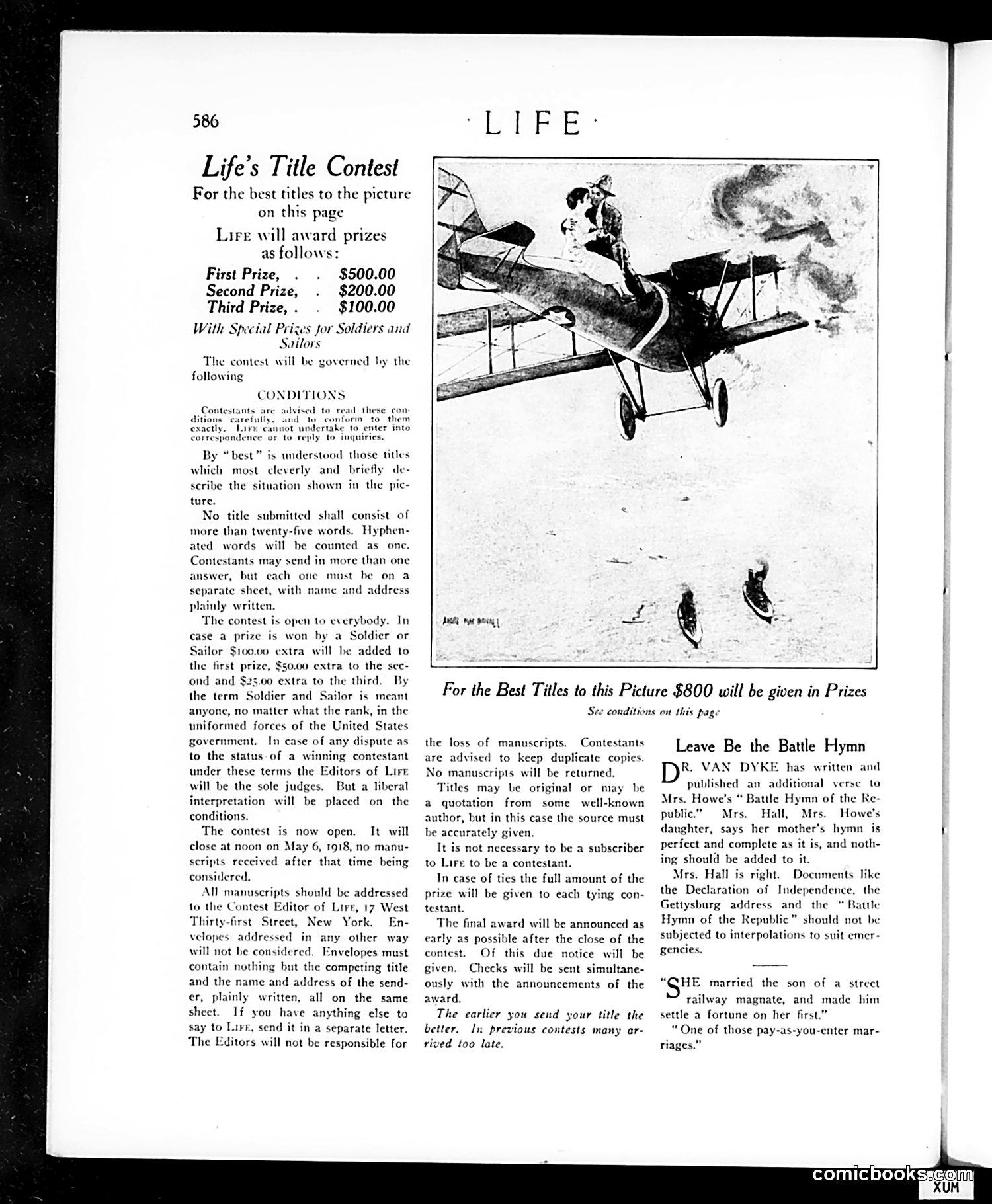
This page announces a **Life magazine contest** inviting readers to submit titles for the photograph above—an aerial image showing a biplane with two figures apparently falling or jumping from it. The contest offers **$800 in prizes** ($500 first prize), with an additional $100 bonus if a soldier or sailor wins. The rules specify titles must be under 25 words and cleverly describe the pictured situation. The timing (May 6, 1918 deadline) and subject matter—airmen in apparent distress during World War I—suggest this is either documenting actual aviation danger or satirizing the hazardous early aviation conditions of the era. The contest format was typical of Life's interactive engagement with readers during this period.
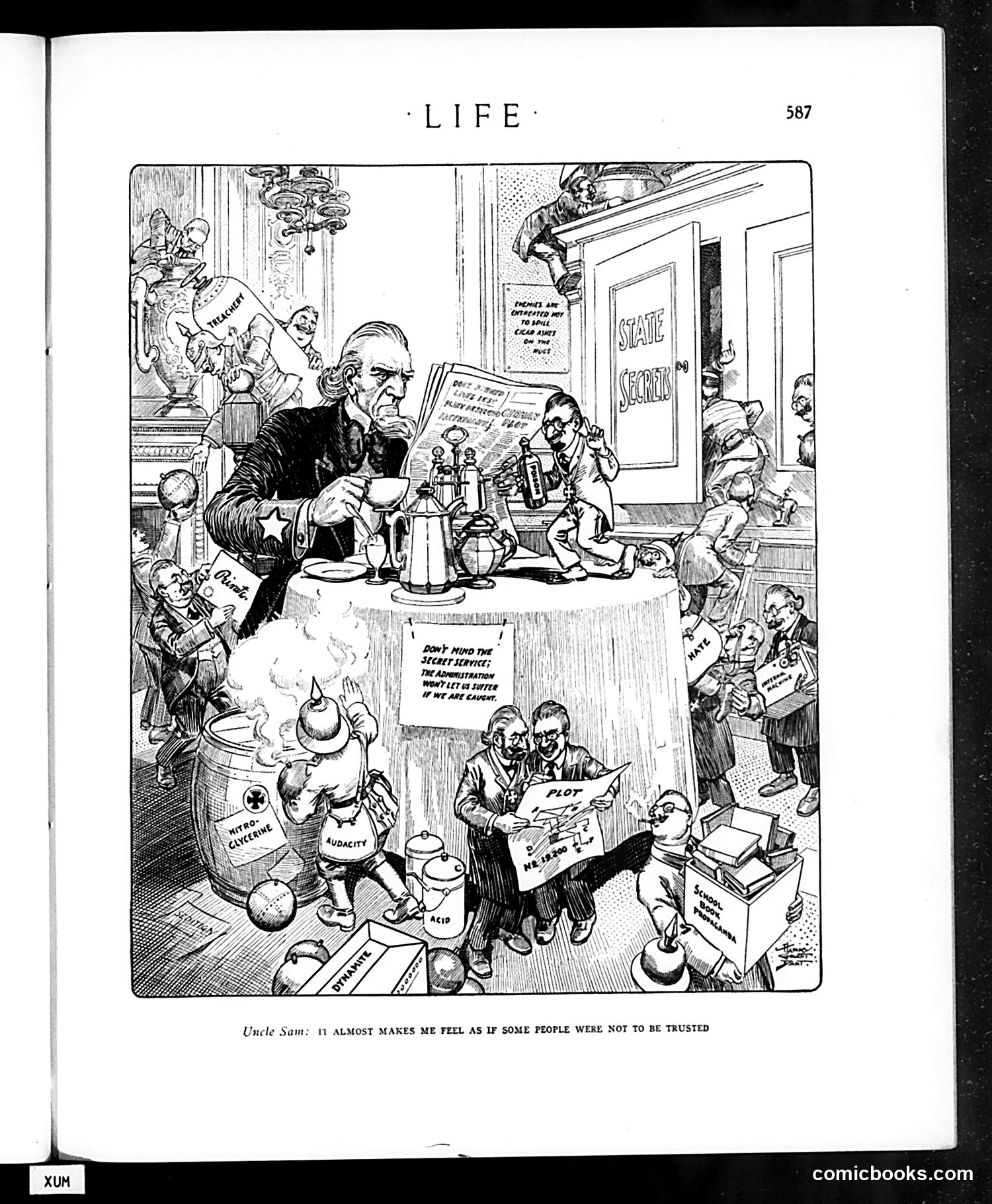
This editorial cartoon depicts Uncle Sam (the tall figure in center-left, identifiable by his characteristic appearance) surrounded by various labeled character figures representing different political or social interests. The labels visible include "Nitric Glycerine," "Audacity," "Acid," and what appears to be references to "Secret Service" and other governmental or institutional entities. The caption suggests Uncle Sam's skepticism about whether certain groups merit trust. The crowded composition, with various small figures holding documents and schemes, satirizes competing interests attempting to influence or manipulate government policy. This appears to be commentary on corruption, lobbying, or competing factions seeking governmental favor during an era of American political turbulence, though the specific historical moment remains unclear from the image alone.
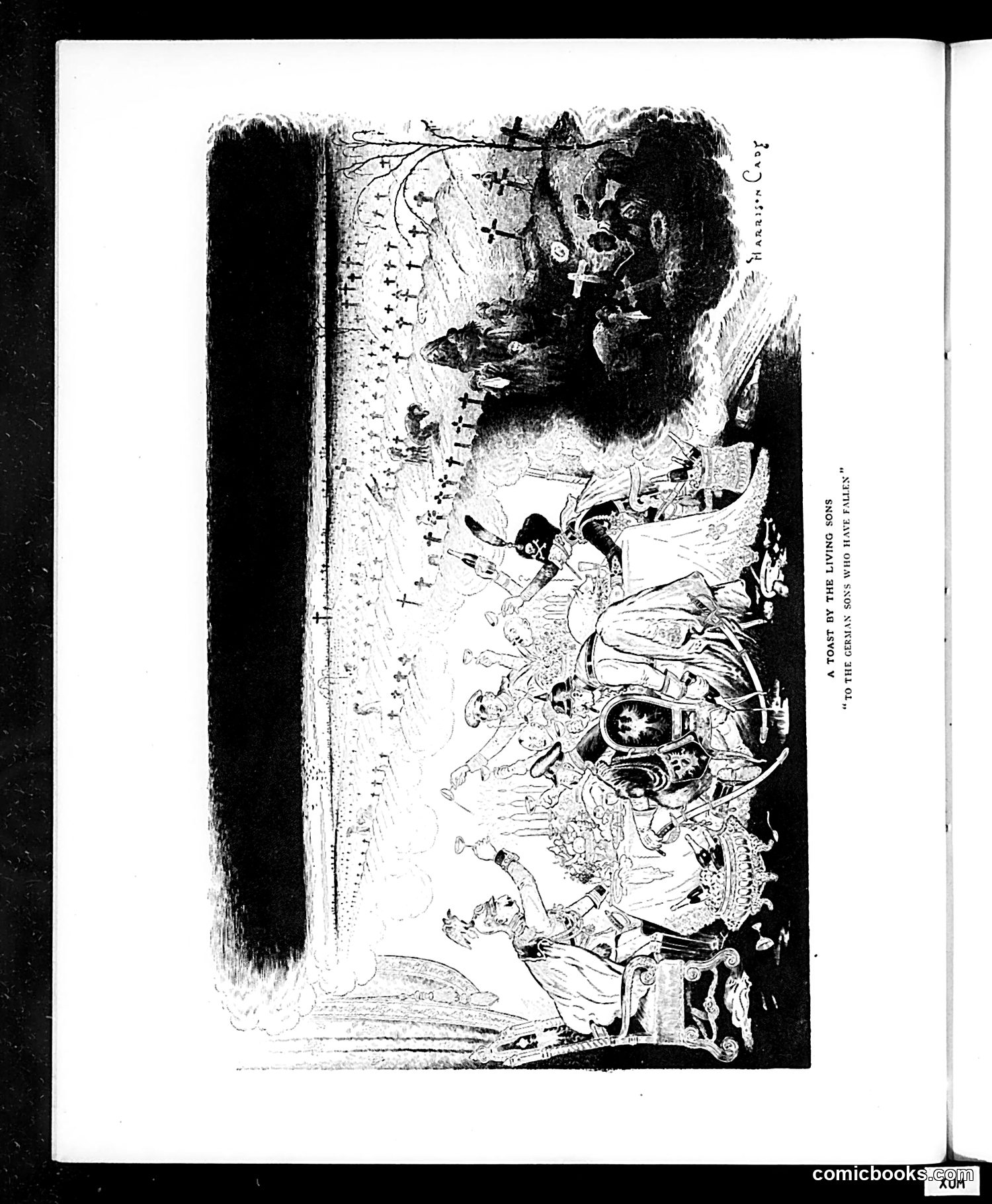
This page contains a single illustration titled "A TOAST BY THE LIVING GODS" with a subtitle referencing "THE GERMAN SONS WITH THEIR FAITHS." The image shows a satirical scene, likely from World War I-era Life magazine, depicting German military and political figures in a mocking toast. The caricatured figures appear to be German leaders toasting, surrounded by military imagery and symbols. The composition uses exaggeration and distortion typical of wartime propaganda satire. The caption suggests the cartoon criticizes German militarism and what Americans viewed as German arrogance or blasphemy—the phrase "living gods" sarcastically references German presumptions of superiority. The specific figures are difficult to identify with certainty from the image alone, but the scene mocks German military culture and leadership during the war period. The satire reflects American anti-German sentiment during the conflict.
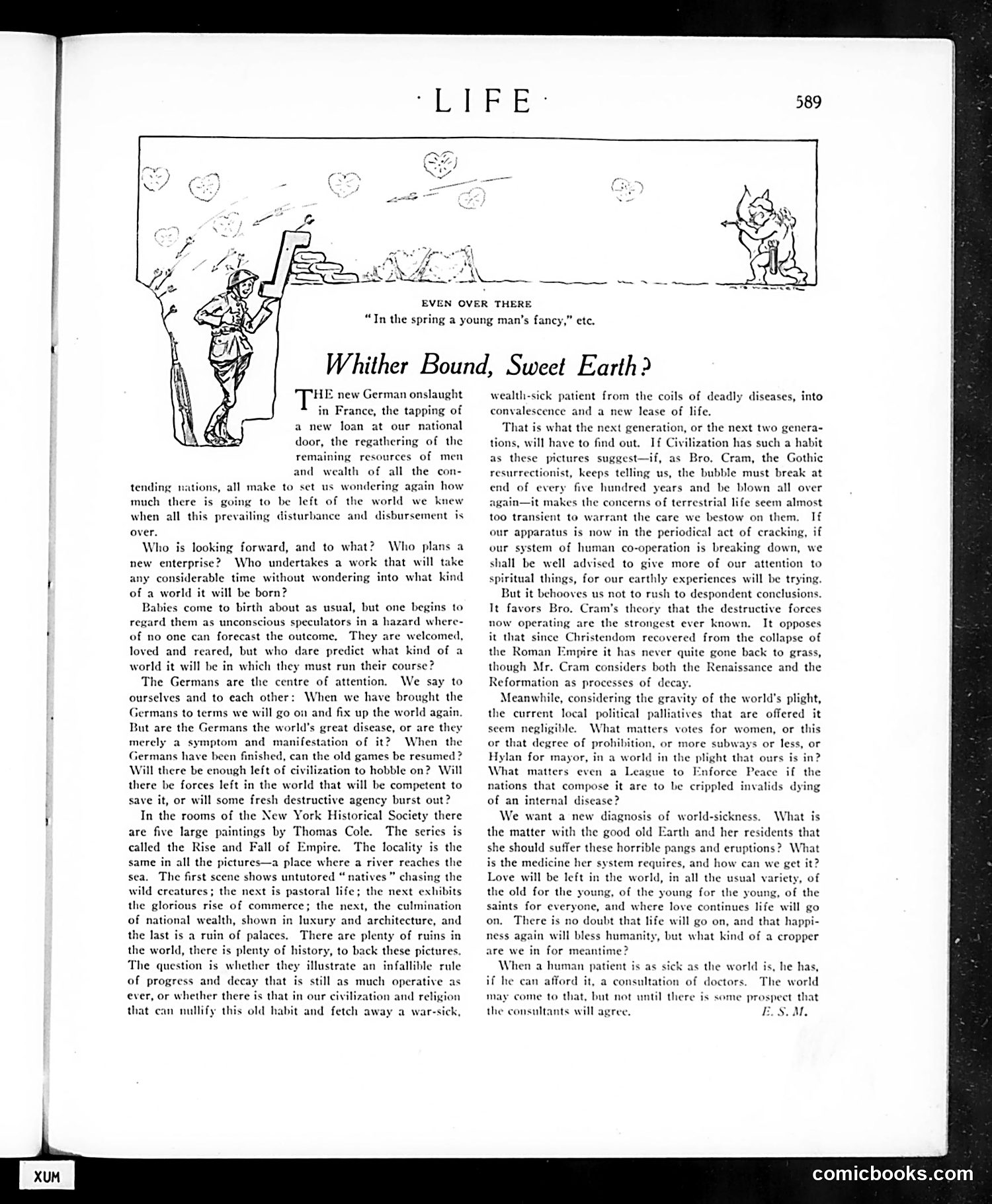
The cartoon depicts a Cupid-like figure shooting hearts across a devastated landscape, while military/demonic figures occupy the right side. This satirizes post-WWI anxieties about civilization's future. The article, signed E.S.M., discusses German "onslaught" and concerns about remaining global resources after the war. It references Thomas Cole's "Rise and Fall of Empire" paintings and invokes civilizational collapse theories. The author warns against complacency, noting that despite Christianity's supposed civilizing influence, societies still decay. The satire juxtaposes romantic love (Cupid's hearts) against warfare and destruction, questioning whether love and spiritual values can save a war-sick world. It's fundamentally pessimistic about post-war recovery and humanity's trajectory.
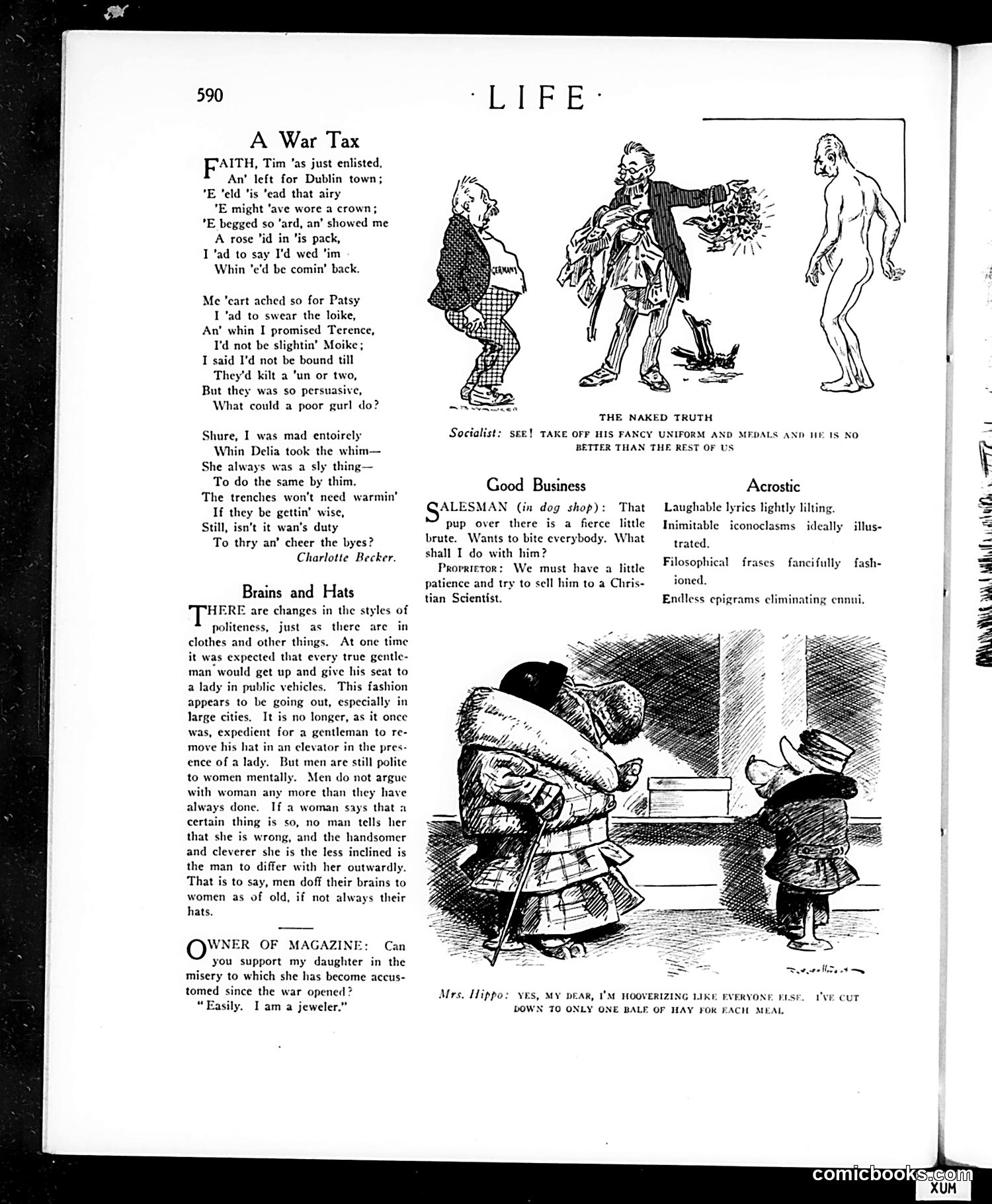
This satirical page from Life magazine contains several pieces mocking social and wartime conditions: **"A War Tax"** (poem by Charlotte Becker): Satirizes the financial burden of World War I on ordinary Irish citizens, describing a woman forced into uncomfortable promises due to economic desperation. **"Brains and Hats"**: Critiques the disappearing custom of gentlemen removing hats in ladies' presence, suggesting modern manners are declining. **"Good Business"**: A brief dialogue mocking both dog trainers and Christian Scientists through absurdist reasoning. **"The Naked Truth"** (cartoon, top right): Depicts a uniformed officer presenting a naked man, likely satirizing military recruitment or the stripping away of civilian dignity through war service. **Bottom cartoon**: Shows Mrs. Hippo rationing hay to stretch her food budget during wartime scarcity—satirizing civilian hardship and rationing measures.
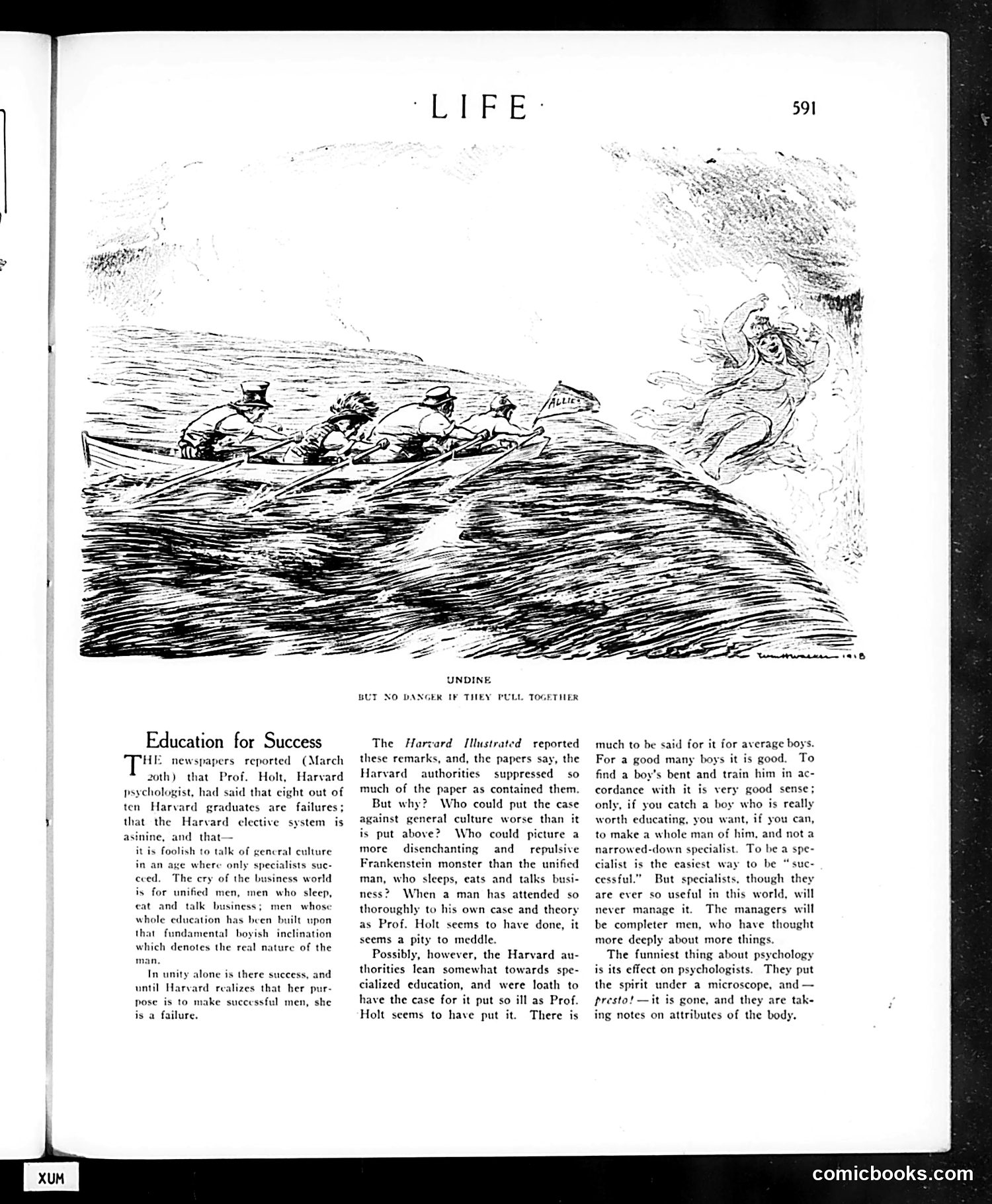
**The Cartoon:** Titled "UNDINK / BUT NO DANGER IF THEY PULL TOGETHER," the sketch shows four rowers in a boat being pulled backward by a mermaid-like figure. The visual joke uses water imagery to suggest drunkenness ("undink" appears to be a play on drinking), while the caption reassures that teamwork prevents disaster. **The Article:** "Education for Success" critiques Harvard's "detective system" of general education, arguing that Harvard suppresses critical details about this approach. The piece defends specialized education against calls for "general culture," claiming specialists—though narrow—remain essential to society. It dismisses psychology as pseudo-scientific, mocking psychologists' claims about human behavior. The page satirizes both academic pretension and educational philosophy circa early 1900s.
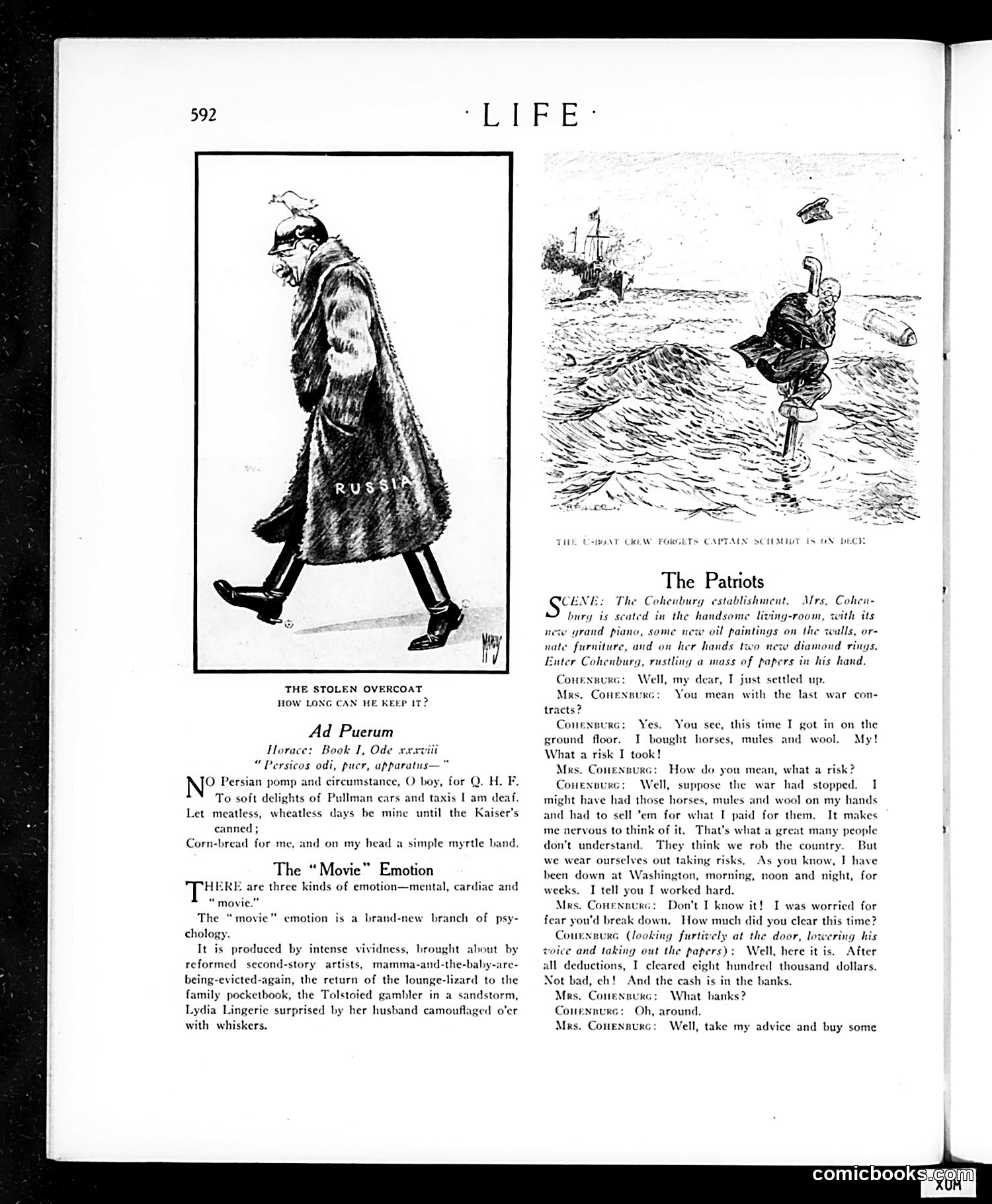
This page contains three distinct pieces of satire from WWI-era *Life* magazine: **"The Stolen Overcoat"** (left): A political cartoon labeled "Russia" depicting a figure in a long coat, captioned "How long can he keep it?" This appears to satirize Russia's uncertain political situation during the war, possibly referencing concerns about Russian stability or territorial claims. **"Ad Puerum"** (center): A poem mocking wartime sacrifice rhetoric, contrasting Persian luxury with patriotic austerity ("meatless, wheatless days...corn-bread for me") to satirize Americans' claimed wartime commitment. **"The Patriots"** (right): A satirical dialogue exposing war profiteering. Mr. Cohenburg boasts of making $800,000 from WWI contracts (horses, mules, wool), framing massive war profits as risky business and personal sacrifice. His evasiveness about which banks hold the cash suggests financial impropriety. The satire attacks wealthy contractors who grew rich from the war while claiming hardship. The overall message: American elites profited enormously from WWI while ordinary citizens sacrificed.
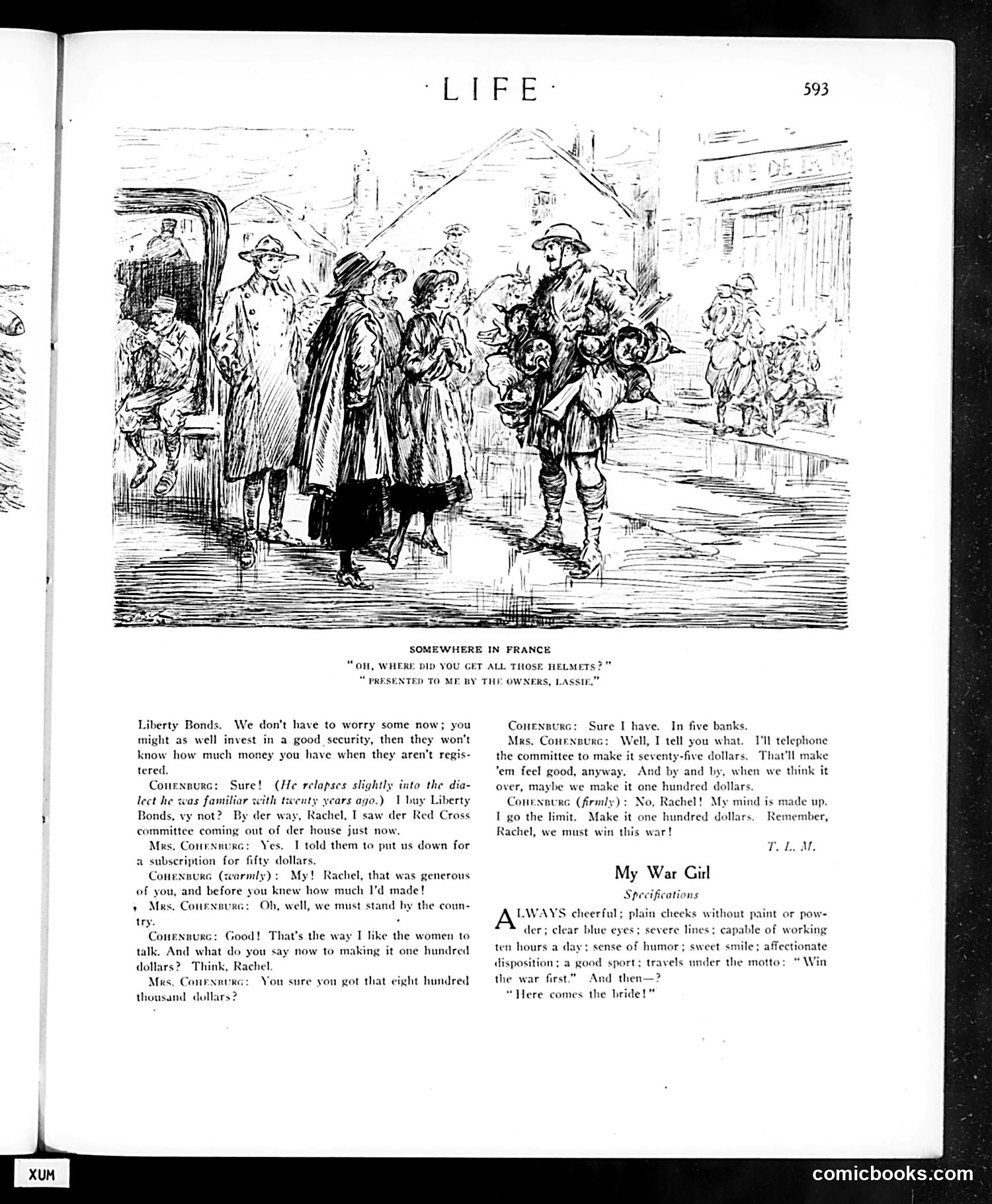
This WWI-era satirical dialogue mocks German-American immigrants' patriotism and financial transparency. The cartoon depicts "Conensburg" (a Germanic name) and his wife Rachel discussing Liberty Bond purchases and Red Cross donations "somewhere in France." The satire operates on multiple levels: Conensburg initially resists registering bonds to hide his wealth from authorities, speaks in a German dialect ("vy not?"), and only agrees to generous donations after his wife prods him—revealing self-interest masquerading as patriotism. His final declaration ("we must win this war!") rings hollow given his earlier reluctance. The implicit message reflects wartime suspicion of German-Americans: their loyalty is questionable, their wealth potentially concealed, and their patriotic gestures performative rather than genuine. The piece plays on contemporary anxieties about immigrant assimilation and divided loyalties during America's WWI involvement. The page's second item, "My War Girl," appears an unrelated advertisement or specification list.
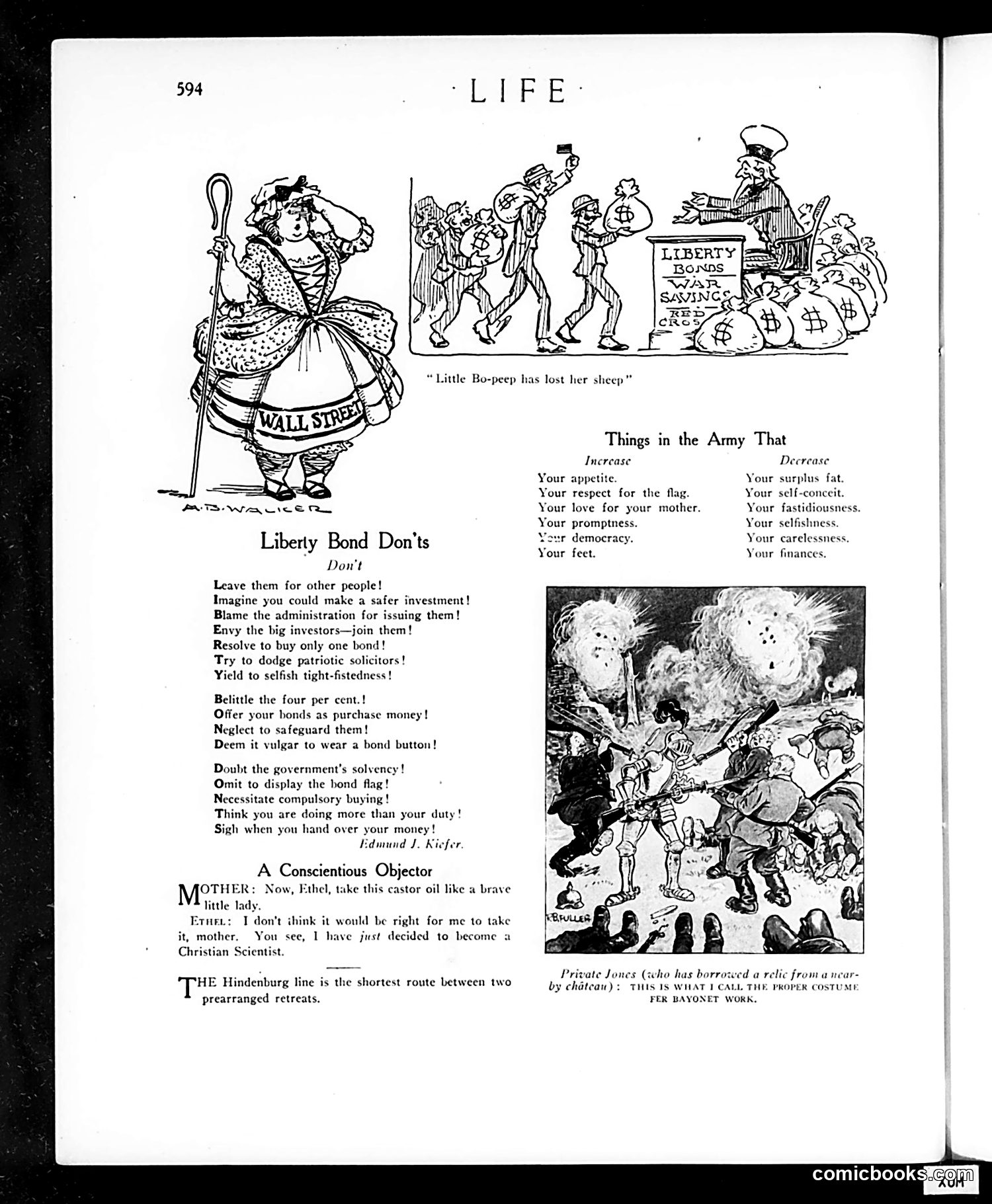
This WWI-era satirical page promotes Liberty Bond purchases—U.S. government war loans—through multiple cartoons attacking objections to buying them. **Top cartoon**: "Wall Street" as a rotund woman labeled "Liberty Bond" conducts soldiers and officials distributing money, implying wealthy interests profit from war financing. **"Liberty Bond Don'ts"**: A sarcastic list mocking reasons people avoid buying bonds—doubting government solvency, considering safer investments, or resisting "patriotic solicitors." It frames financial concerns as unpatriotic selfishness. **"Things in the Army"**: Lists supposedly positive military effects (appetite, respect, love for mother) versus negative ones eliminated, promoting the war's supposed moral benefits. **"Conscientious Objector"**: A child refuses castor oil by claiming Christian Science principles—mocking religious objectors to military service as hypocritical or absurd. **Bottom caption**: Mocks a soldier borrowing a French relic for "bayonet work," using dark humor about actual combat violence. The page overall pressures readers into patriotic compliance and bond purchases by ridiculing resistance as cowardice, selfishness, or intellectual dishonesty.
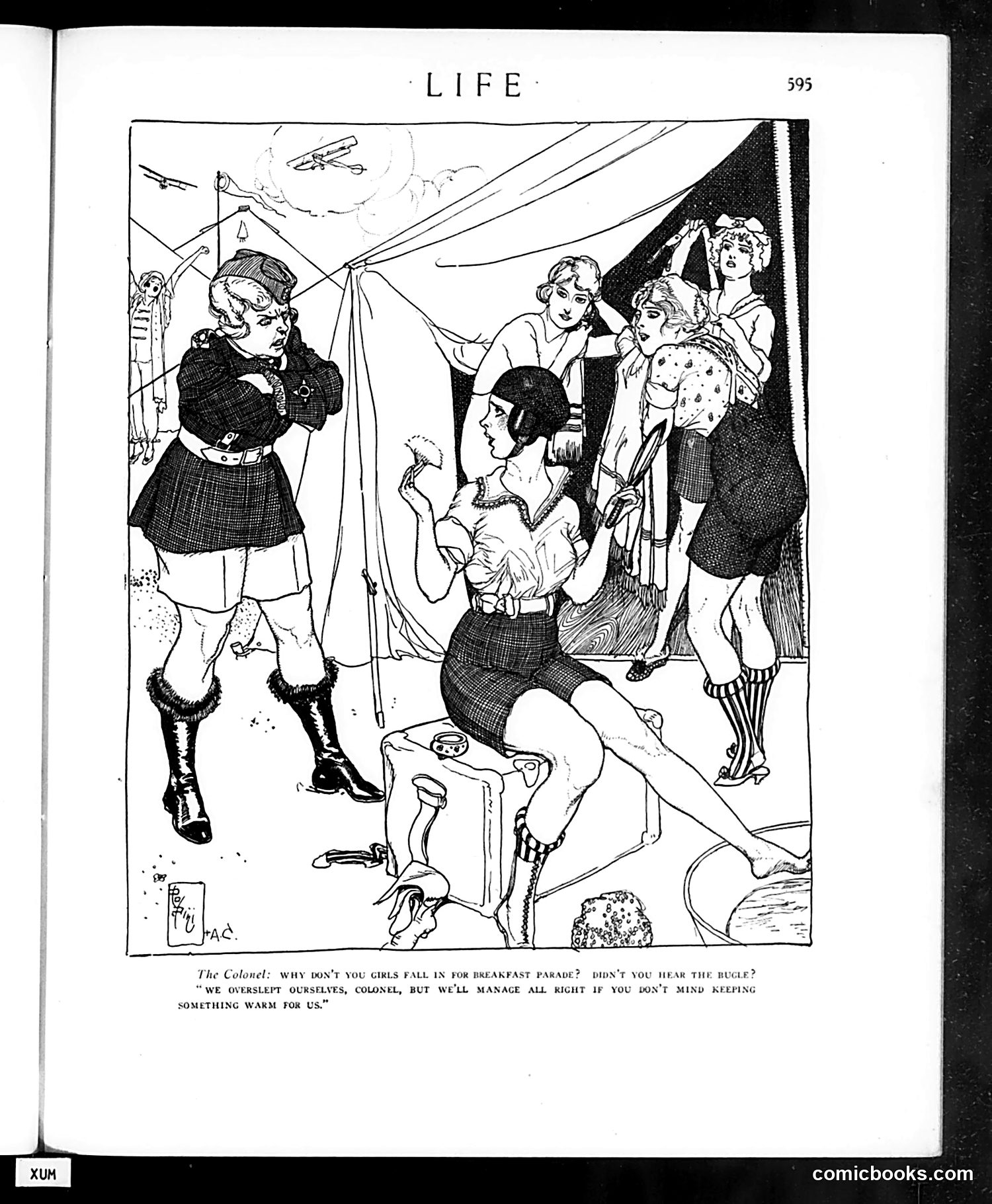
This cartoon satirizes military camp life, likely from World War I era. A Colonel addresses a group of women at what appears to be a military encampment (note the tent, planes overhead). The joke centers on the Colonel's complaint that the women aren't participating in a "breakfast parade" and his suggestion they keep "something warm" for the soldiers. The satire targets the Colonel's transparent attempt to justify the women's presence in camp using military protocol as a thin cover for what's clearly implied as fraternization. The women's casual, amused reactions suggest they understand his euphemistic language. The cartoon mocks both military pomposity and the somewhat uncomfortable reality of women's proximity to troops during wartime.
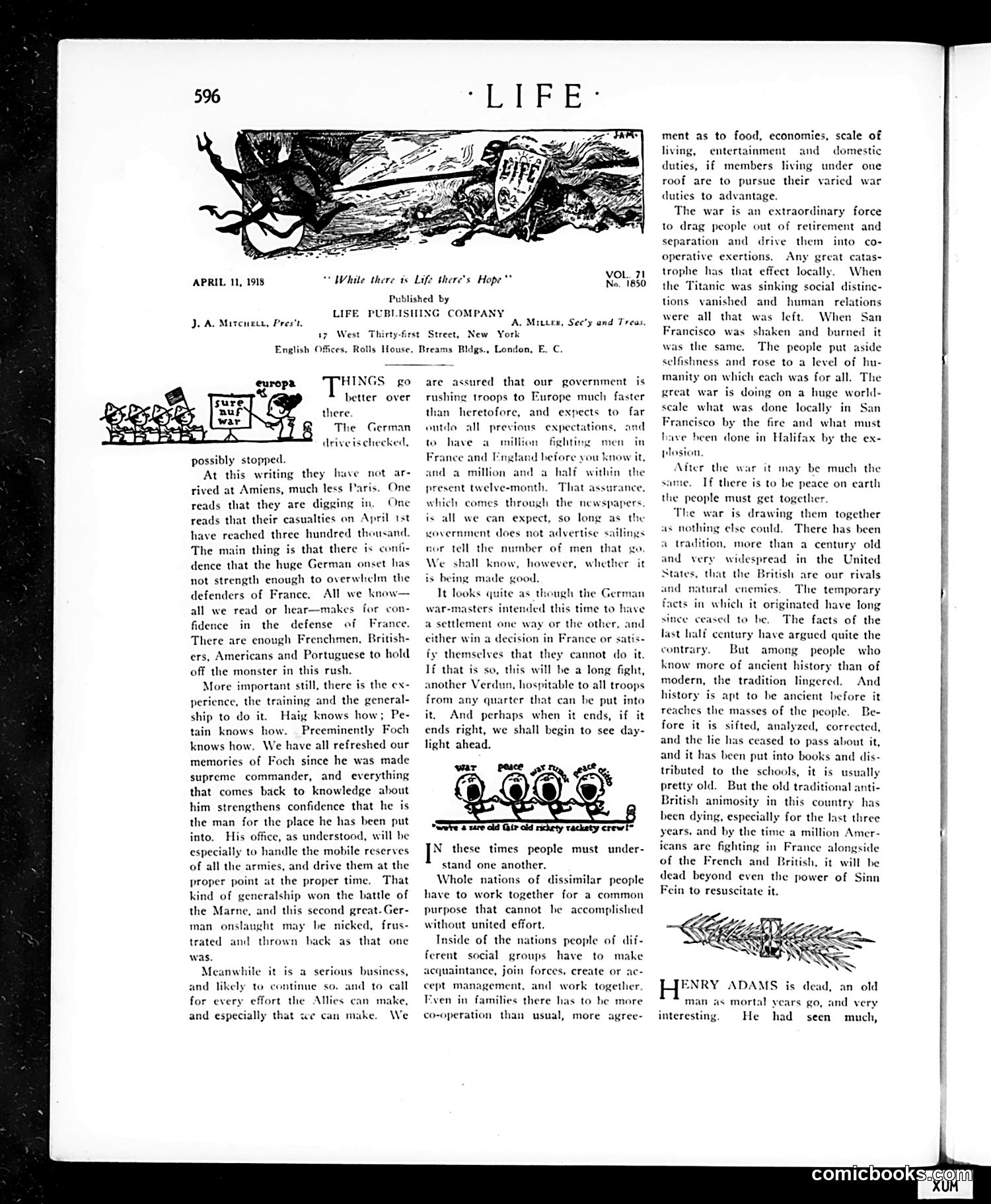
This page contains editorial commentary on the ongoing German spring offensive in World War I (appears to be the Spring Offensive of 1918). The cartoon at top shows a skeletal Death figure labeled "Life" trampling destruction—satirizing the war's devastating toll. The text celebrates Allied confidence, particularly praising generals Haig, Pétain, and Foch for defending France against the German drive toward Amiens and Paris. It expresses optimism that American troop deployments will exceed expectations. The broader editorial argues that war forces social cooperation—comparing wartime unity to disaster scenes like the Titanic sinking, where class distinctions collapse. The author contends that nations, communities, and families must transcend selfishness and work together for victory. This reflects American optimism in spring 1918, before the war's conclusion in November.
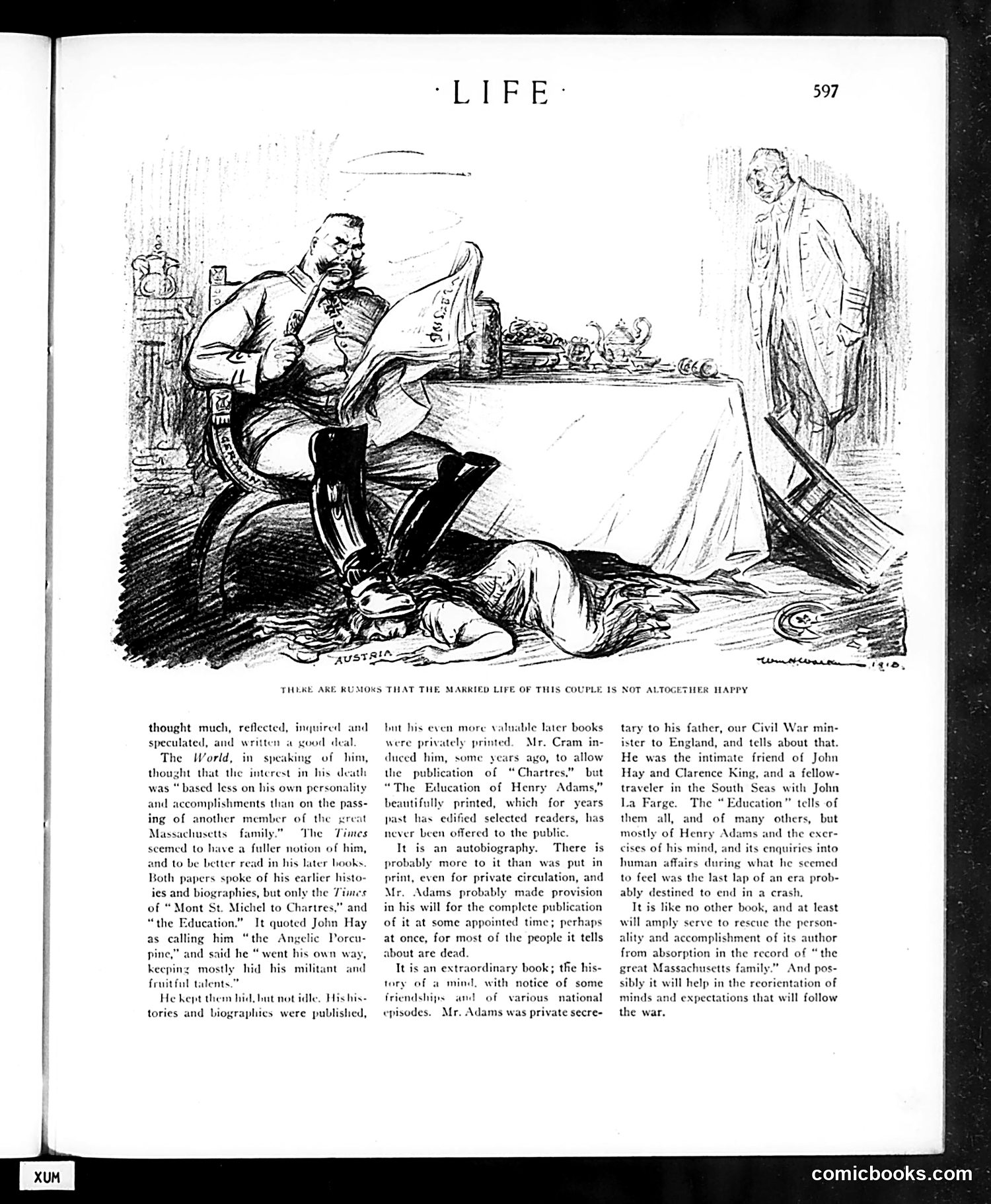
This page from *Life* magazine contains a satirical cartoon about marital discord, paired with text discussing Henry Adams's autobiography "The Education of Henry Adams." **The Cartoon:** The sketch depicts a military officer (likely Austro-Hungarian, suggested by the uniform and imperial décor) seated at a dining table while his wife lies prone on the floor in apparent distress or submission. A servant observes from the doorway. The caption reads: "There are rumors that the married life of this couple is not altogether happy." **The Satire:** The joke relies on obvious understatement—the visual evidence of marital conflict (the woman's prostrate position) starkly contradicts the mild, euphemistic caption claiming merely "rumors" of unhappiness. The humor targets both the absurd gap between observation and language, and likely satirizes Austro-Hungarian court life or military culture as portrayed in contemporary media. **Context:** Without knowing the specific date, this appears to reference European aristocratic or military society, possibly during or around WWI given the historical references in the accompanying text.
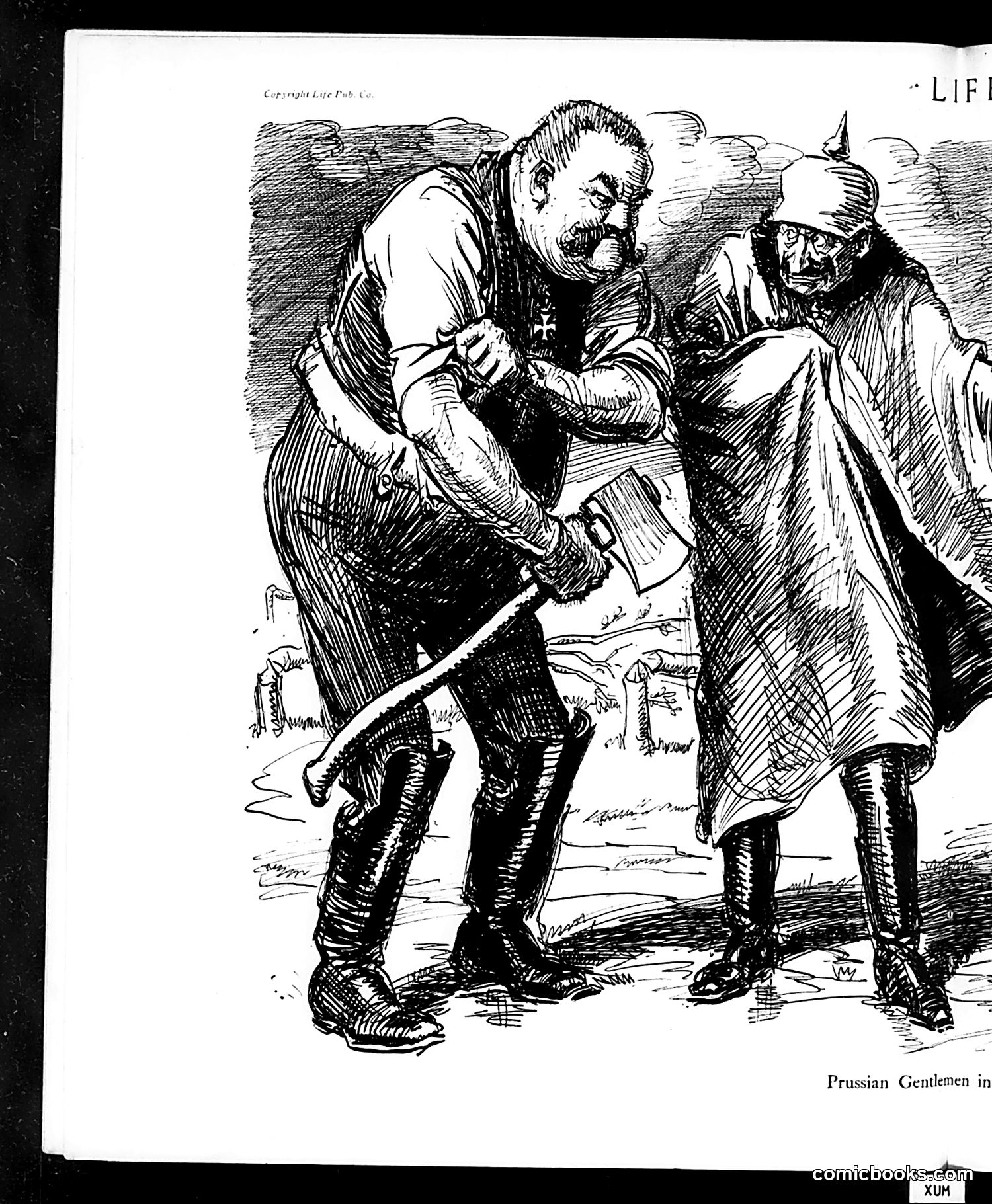
This satirical illustration depicts "Prussian Gentlemen" and appears to be Cold War-era commentary on German or Prussian militarism. The central figure wears a military uniform with a prominent cross decoration (likely the Iron Cross), characteristic of Prussian military iconography. The exaggerated facial features and caricatured style typical of Life magazine's satirical approach suggest mockery of Prussian military culture and its associated values. The scene shows military figures in formal dress with boots, reflecting 19th-20th century Germanic military tradition. Without additional OCR text or caption details visible, the specific political context remains somewhat unclear, but the cartoon likely critiques Prussian authoritarianism, militarism, or post-war German politics depending on Life's publication date.
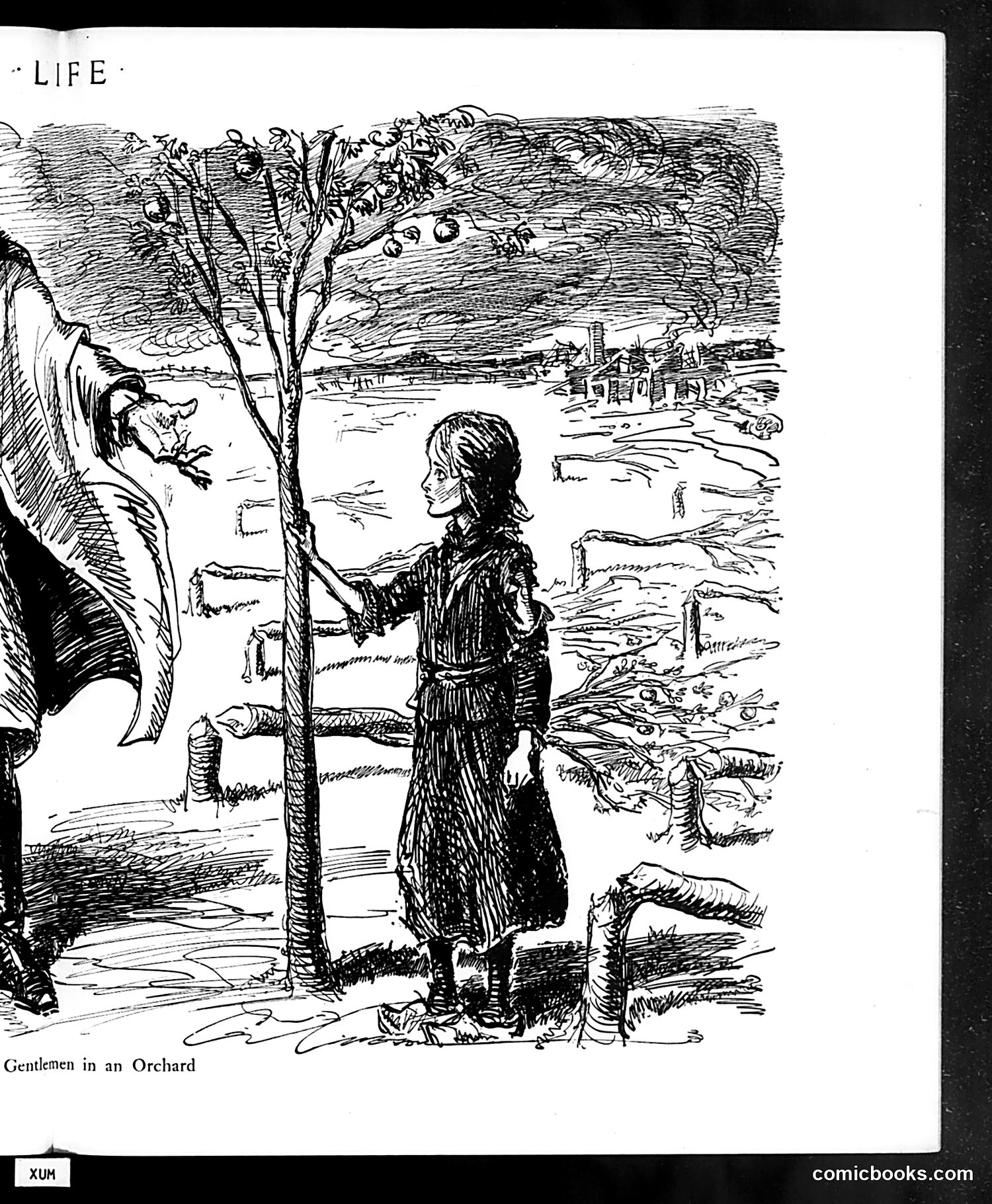
This satirical illustration depicts a woman standing in an orchard, examining a fruit tree with what appears to be an elephant nearby on the left. The caption "Gentlemen in an Orchard" suggests ironic commentary—the "gentlemen" are likely the elephant and possibly other male figures present. Without additional context from the magazine issue, the specific satire remains unclear. It could reference: - Gender dynamics or women's roles in agriculture - Political figures represented as animals (common in period satire) - Class commentary on "gentlemen" conduct The surreal pairing of an elephant in an orchard suggests absurdist humor typical of *Life* magazine's satirical approach. The detailed pen-and-ink style and the woman's focused attention create ambiguity about whether this is mockery of gender, politics, or social pretension. More context would clarify the intended targets.
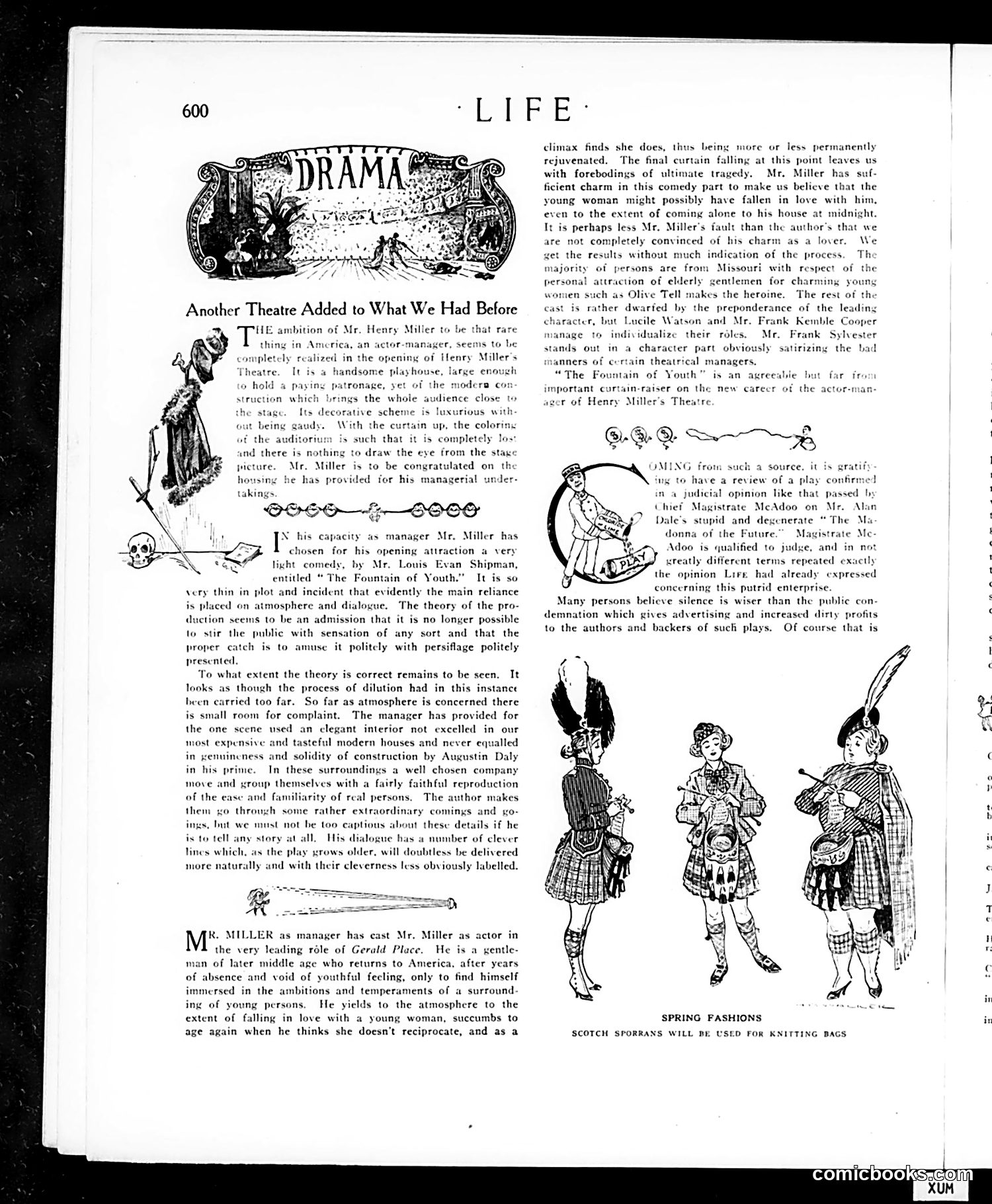
This page reviews Henry Miller's new theater and his opening production, "The Fountain of Youth," a light comedy by Louis Evan Shipman. **The Context:** Henry Miller (1858-1926) was a prominent American actor-manager who built his own playhouse in New York. The review discusses his dual role as both theater owner and star actor in this opening production. **The Satire's Point:** The critic argues the play is so thin in plot that it relies entirely on atmosphere and polished dialogue rather than dramatic substance—admitting the theater industry has abandoned "sensation" to merely "amuse politely." The title itself suggests the play's theme: aging men seeking rejuvenation through contact with youth (Miller plays an older gentleman who falls for a younger woman). **The Joke:** There's gentle mockery that Miller, though charming, must carry a weak script, and that audiences accept this because Miller's star power compensates for the author's limitations. The critic questions whether audiences truly believe an aging man could win a young woman's affection. **The Illustrations:** The bottom shows fashionable "Spring Fashions" with "Scotch sporbans will be used for knitting bags"—typical period fashion commentary unrelated to the theater review.
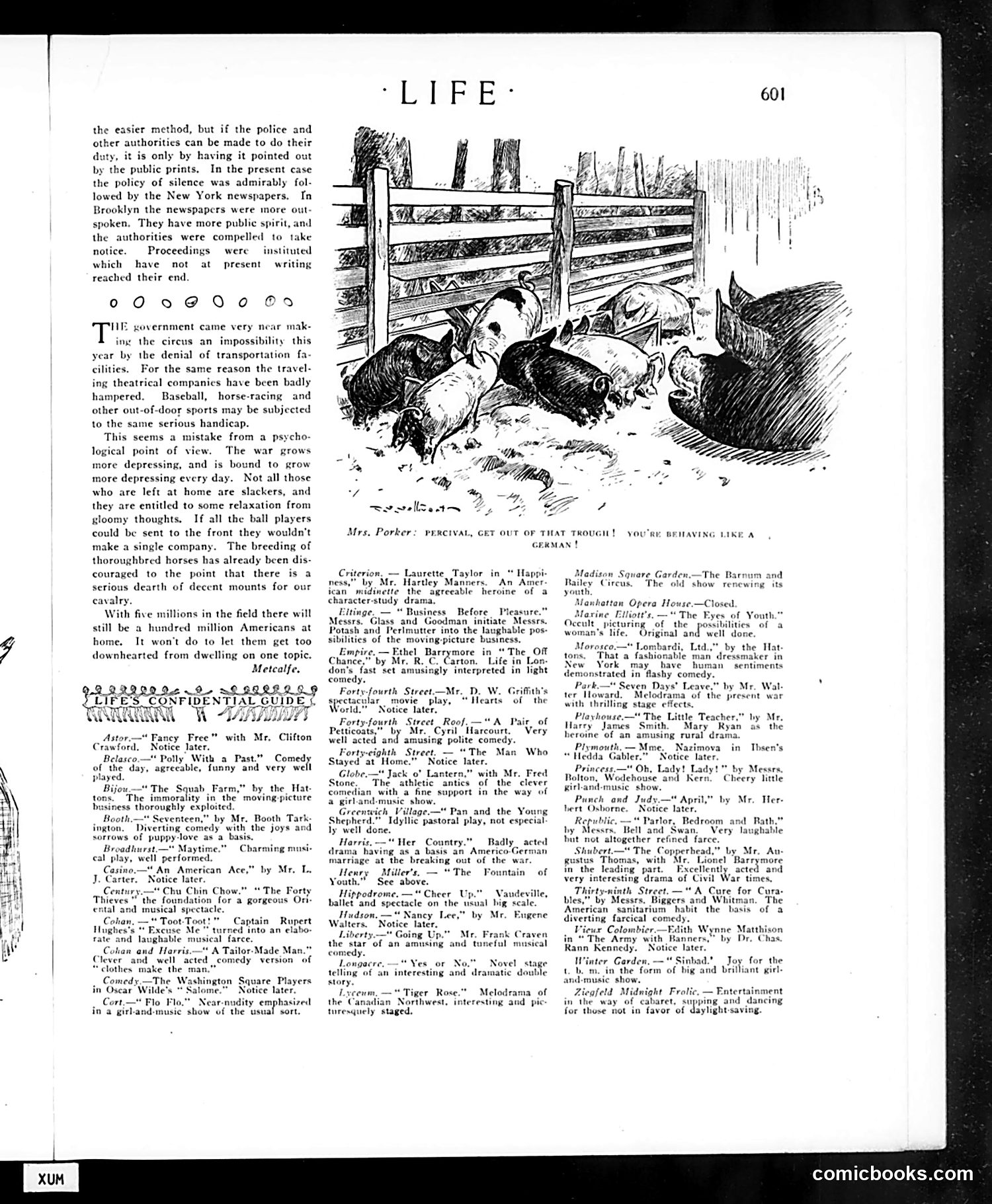
This page contains a political editorial and theater reviews from Life magazine during World War I. The main cartoon depicts a pig at a trough labeled "Mrs. Porker," being scolded by someone saying "PERCIVAL, GET OUT OF THAT TROUGH! you're BEHAVING LIKE A GERMAN!" **The satire:** The cartoon uses the pig as a metaphor for American self-indulgence during wartime. Calling greedy behavior "German" was a common WWI-era insult reflecting anti-German propaganda and the characterization of Germany as barbaric and gluttonous. **The editorial context:** The text argues that the government shouldn't ban circuses, sports, and entertainment—despite wartime austerity pressures. The author contends Americans at home need psychological relief from "depressing" war news and shouldn't become "downhearted." The cartoon likely supports this position, warning against excessive wartime sacrifice that resembles "German" excess in the opposite direction—self-denial that breeds discontent. The page reflects 1917-1918 American attitudes toward morale, entertainment, and national identity during WWI.
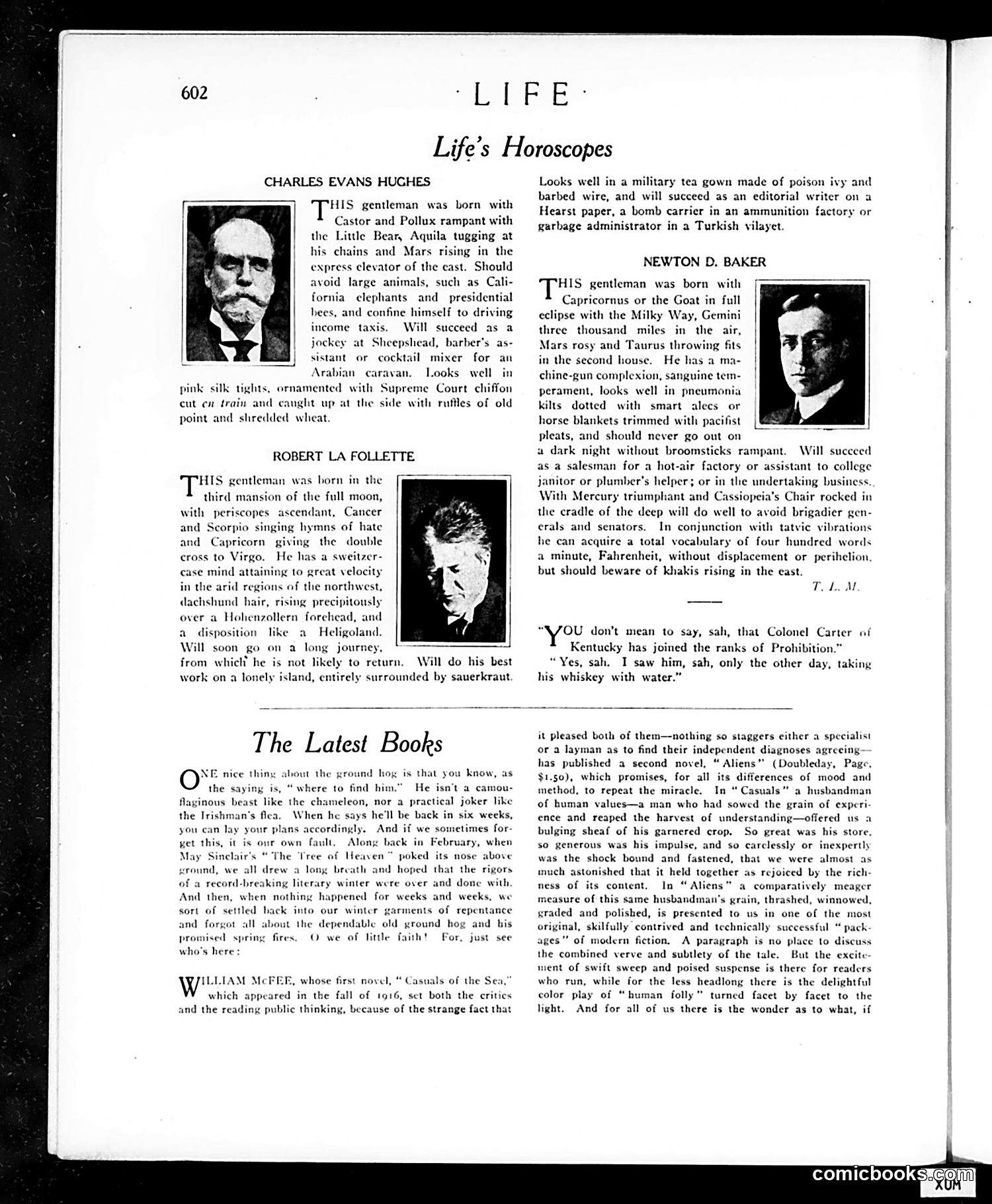
This satirical page mocks three prominent political figures through fake astrological "horoscopes": **Charles Evans Hughes** — The Supreme Court justice and 1916 presidential candidate is ridiculed as effeminate and incompetent, suited only for frivolous jobs like jockey or "cocktail mixer." The "pink silk tights" reference emphasizes mockery of his masculinity. **Robert La Follette** — The Wisconsin Progressive senator is caricatured as foreign and dangerous, with references to "Hohenzollern forehead" (Germanic/Prussian) and being "surrounded by sauerkraut" — implying disloyalty or pro-German sympathies during World War I. **Newton D. Baker** — The Secretary of War is attacked for being a pacifist ("pacifist pleats," "broomsticks rampant"), unfit for military leadership. The humor relies on crude personal attacks and political opposition rather than witty observation. The separate anecdote about Colonel Carter and Prohibition appears unrelated filler.
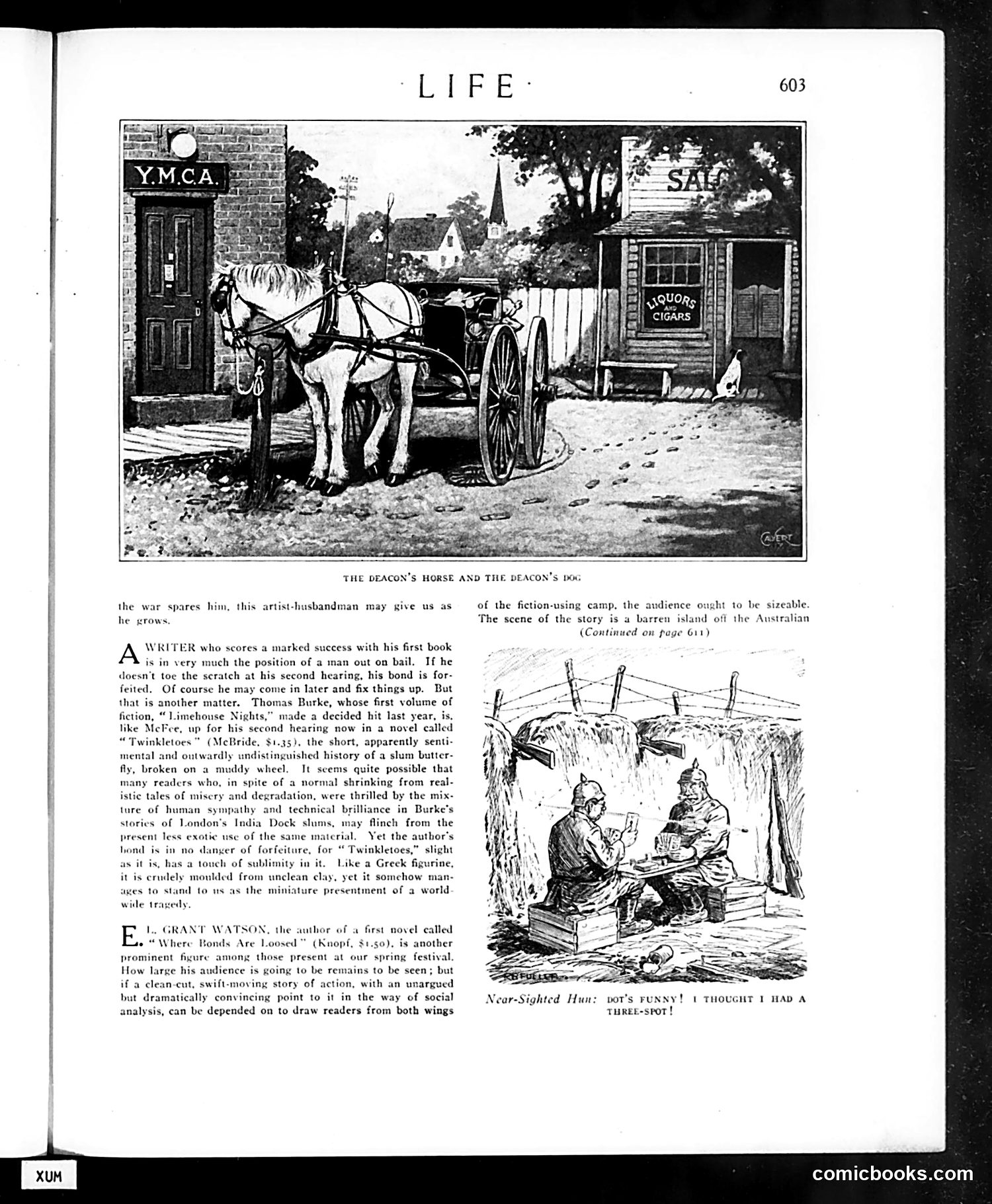
The top illustration, "The Deacon's Horse and the Deacon's Dog," depicts a rural American village scene with a horse-drawn cart outside a YMCA building and a liquor/cigar shop. This appears to be satirizing rural or small-town American life, likely contrasting moral institutions (YMCA) with vice establishments (liquor sales) existing side-by-side. The bottom cartoon, "Near-Sighted Hun," shows two figures in what appears to be a trench or dugout. The caption suggests it's wartime humor: one soldier mistakenly thought he saw three enemy soldiers but only spotted one. "Hun" was American/British WWI slang for German soldiers. The text discusses three contemporary novelists (Thomas Burke, E.L. Grant Watson, and others) and their recent literary successes, analyzing whether they can maintain momentum after debut novels. The page is primarily a book review/literary criticism piece with accompanying illustrations meant to entertain readers alongside the serious literary discussion.
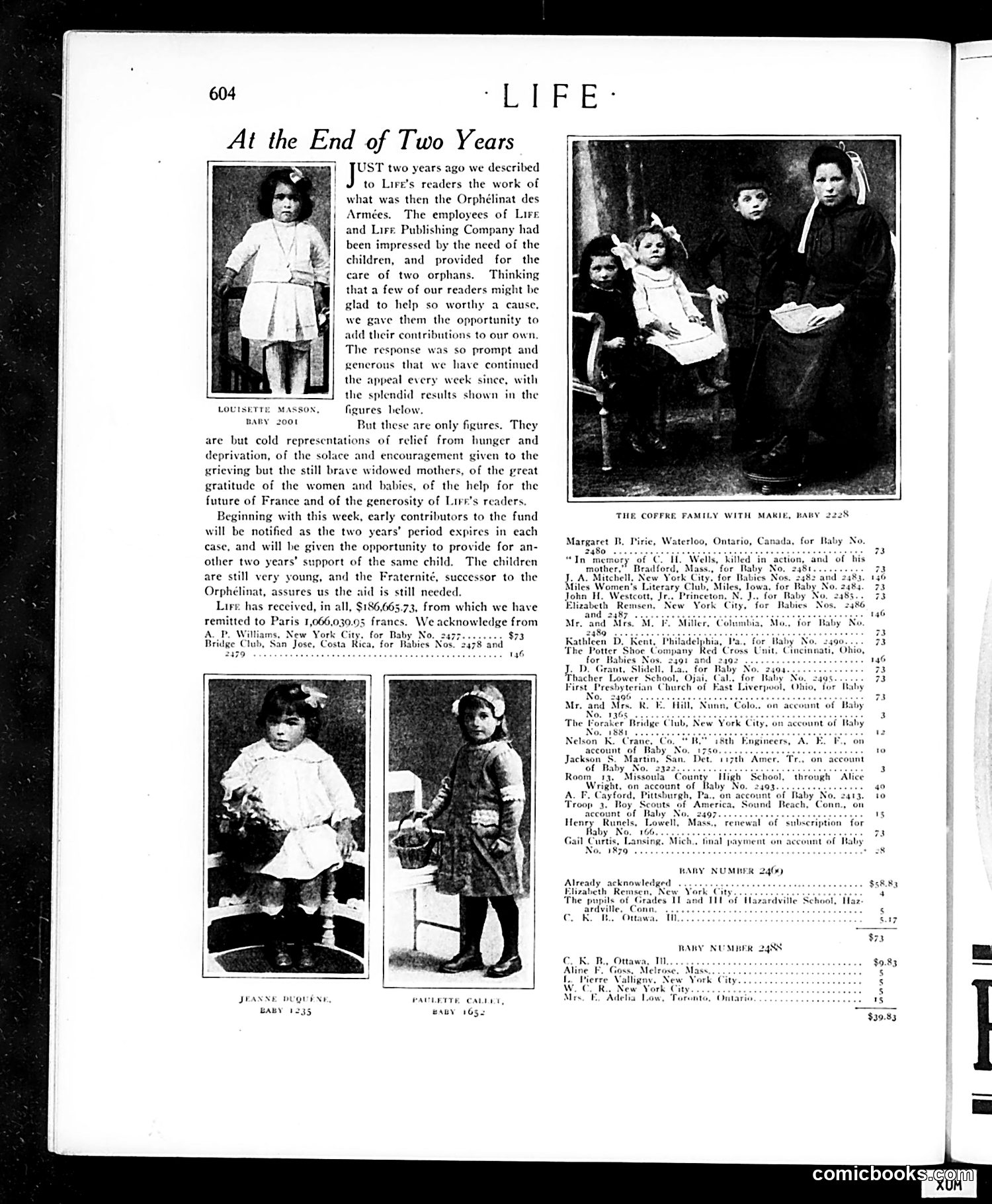
This is not a cartoon but a charitable fundraising appeal. Life magazine reports on its two-year campaign supporting the Orphélinat des Armées (French military orphans' home), likely following World War I. The page features photographs of four French orphan children being supported through reader donations. The text emphasizes that while the financial figures ($186,665.73 raised, 1,066,030.93 francs sent to Paris) are impressive, they represent human relief—providing food, comfort, and hope to widowed mothers and grieving children in post-war France. The appeal announces that two-year sponsorships are expiring and solicits continued support for another two years. A detailed accounting lists individual and organizational contributors' names and amounts, establishing transparency and moral obligation to the cause. This represents early-20th-century magazine-driven charitable fundraising to aid European war orphans.
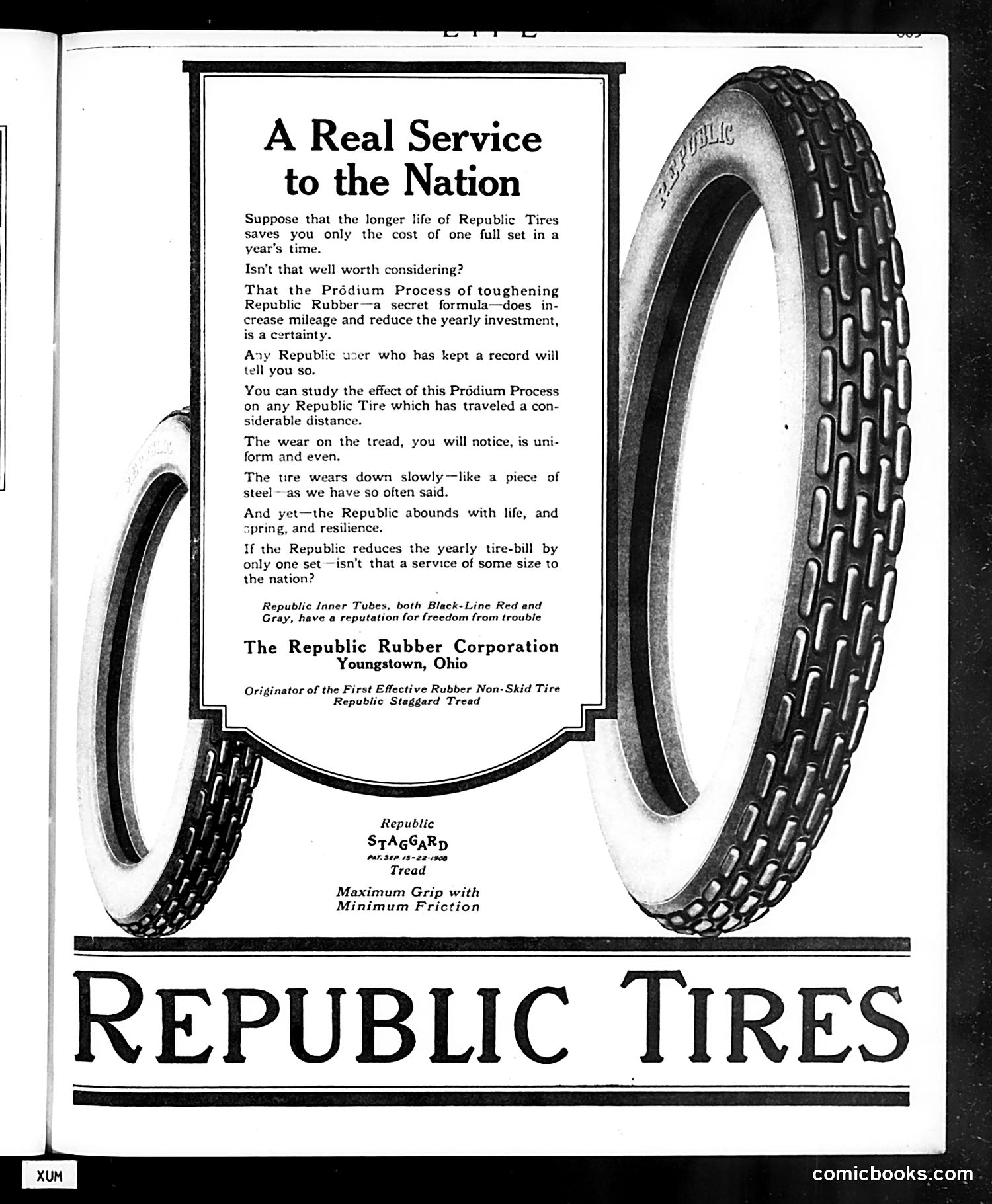
This is **not a cartoon or satire**—it's a straightforward **automobile tire advertisement** from Life magazine (circa 1920s, based on styling). The Republic Rubber Corporation of Youngstown, Ohio is marketing its tires by appealing to patriotic sentiment and economic self-interest. The ad claims their proprietary "Prédium Process" creates longer-lasting tires that save consumers money annually—framed as "a service to the nation" by reducing Americans' yearly tire expenses. The two tire images showcase the "Staggard Tread" design, emphasizing uniform wear and durability. The ad targets middle-class car owners by suggesting that choosing Republic tires is both economically rational and patriotic. There is no political satire or caricature here—this represents typical early-automotive-era advertising that connected consumer product choices to national interest.
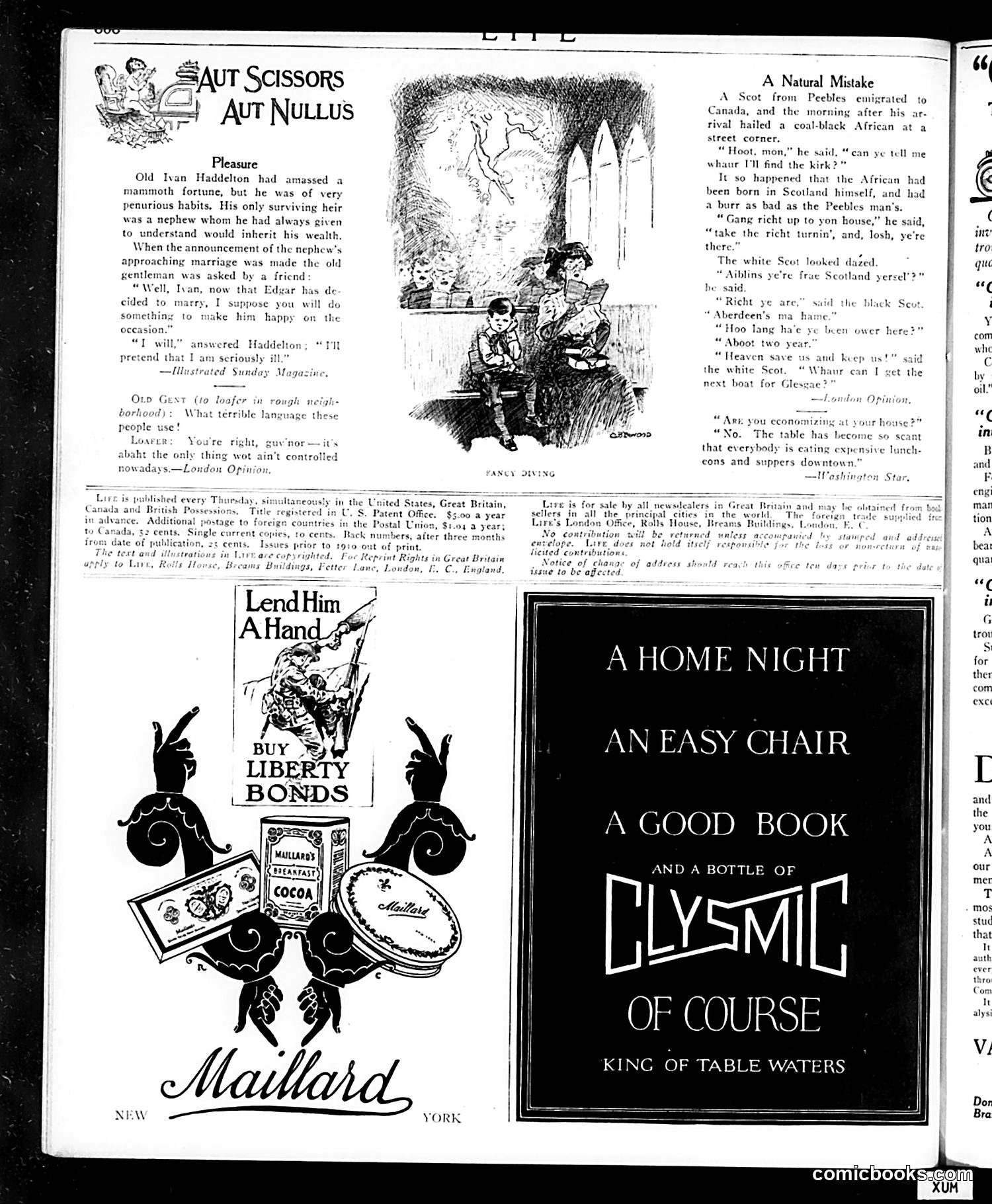
This page contains humor columns and advertisements rather than political cartoons. The "Aut Scissors Aut Nullus" section offers brief comedic anecdotes: one about an elderly man (Ivan Haddleton) using marriage to make his heir happy, and another featuring Scottish and African characters discussing "the right burn" and boat access to Glesca (Glasgow)—playing on dialect humor typical of early 20th-century comedy. The advertisements include a Liberty Bonds recruitment ad (likely WWI-era, urging financial support for the war effort) and a Clysmic brand water promotion. The Liberty Bonds ad uses patriotic imagery of figures lending "a hand" to the war effort, a common propaganda appeal from that period.
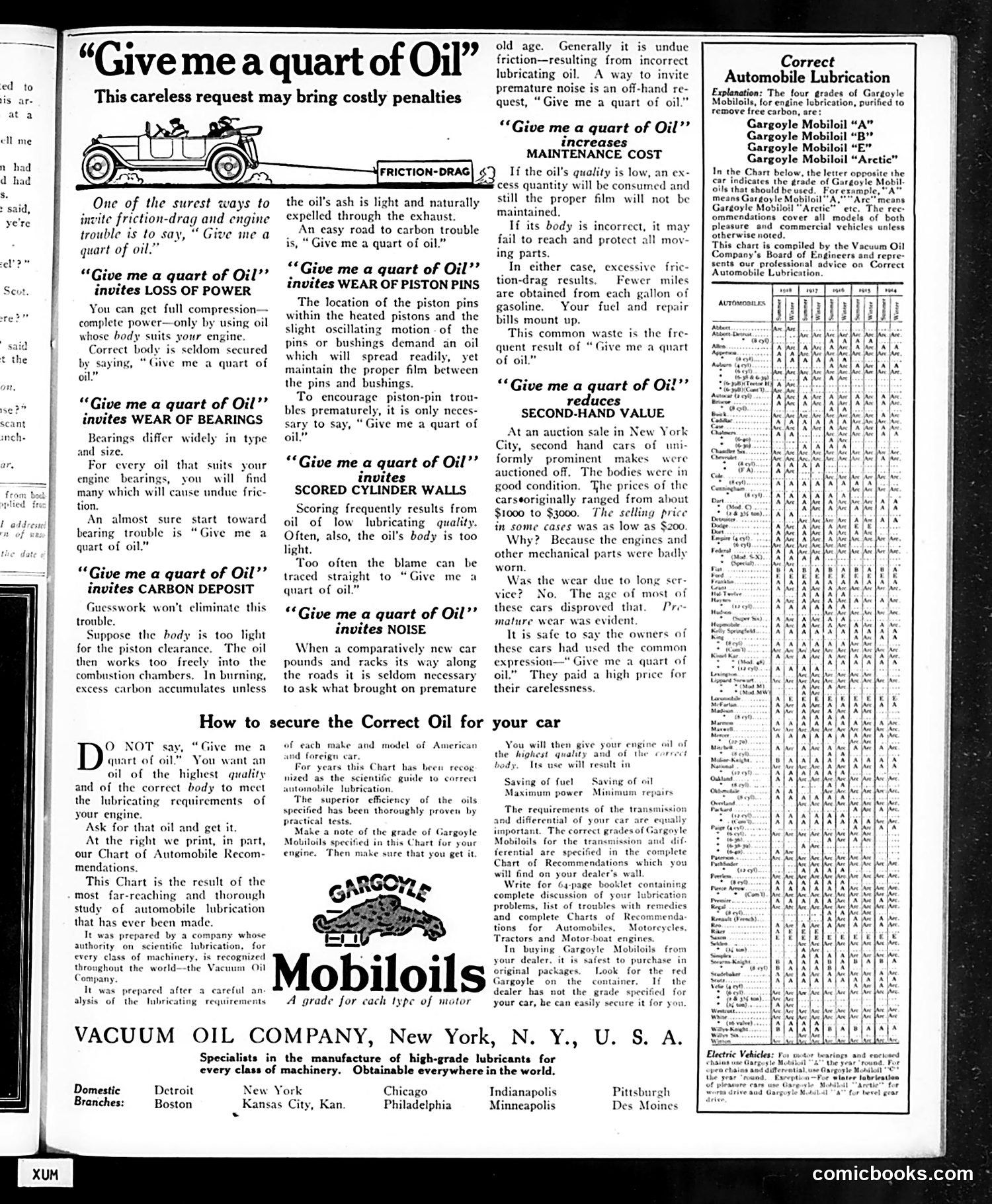
This is primarily **advertising content**, not editorial satire. The page promotes Gargoyle Mobiloils through a public-service message about proper engine lubrication. The cartoon at top shows a car experiencing "friction-drag"—a visual pun depicting the vehicle literally dragging behind itself, illustrating the consequences of using incorrect oil. **The satire's target**: Not politics, but consumer carelessness. The repeated phrase "Give me a quart of oil" represents lazy, generic requests—drivers asking for any oil without specifying the correct type for their engine. This was genuinely problematic in the 1920s-30s, when different automobile engines required different oil viscosities. **The joke**: Each section catalogs specific mechanical failures (worn bearings, carbon deposits, noise) supposedly caused by this casual request, building absurdist humor through repetition and escalation. The accompanying chart and technical specifications serve the actual advertising purpose: convincing readers that only Gargoyle Mobiloils' scientifically-formulated grades would prevent these problems. This represents early **brand differentiation marketing**—positioning a product as superior through technical expertise rather than mere claims.
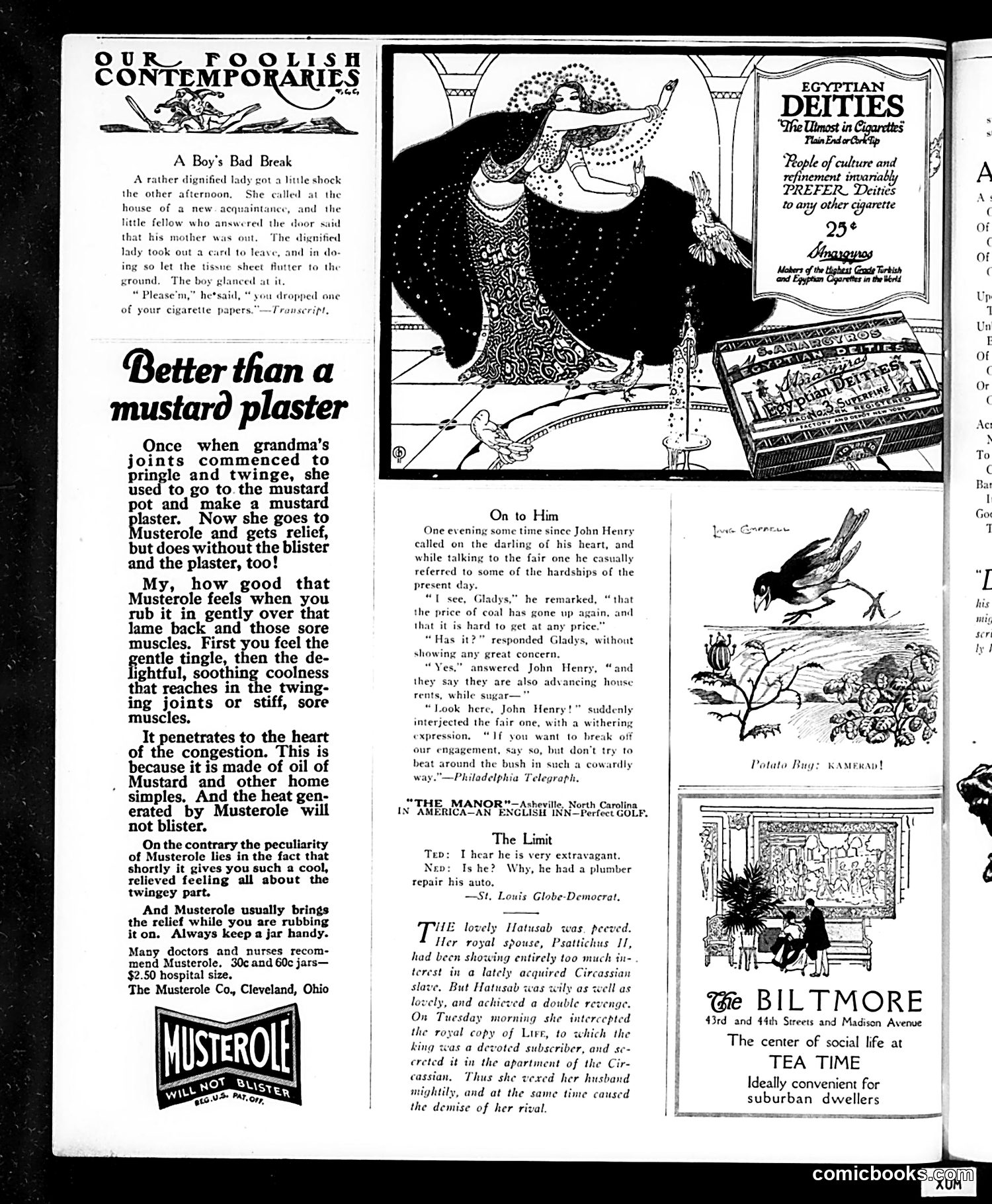
This page combines humorous anecdotes with period advertising, typical of early 20th-century Life magazine. **The humor pieces** mock social conventions and domestic life: - "A Boy's Bad Break": A child innocently mistakes a visiting lady's calling card for cigarette rolling paper—satirizing both class pretensions and changing social mores (women smoking was still somewhat scandalous). - "Better than a mustard plaster": Advertorial comparing old remedies to modern Musterole balm. - "On to Him": A young man's complaints about rising coal and sugar prices backfire when his girlfriend assumes he's making excuses to break up with her—mocking male obtuseness in romance. - "The Limit": Brief joke about extravagance (hiring a plumber for a car). - "Hatusab" story: An ancient Egyptian wife's petty revenge, framed as exotic/comedic. **The advertisements** (Egyptian Deities cigarettes, Biltmore hotel, tea time culture) reflect period consumer aspirations and gender roles. The page overall captures 1920s-era American middle-class humor, social anxieties about modernization, and emerging consumer culture.
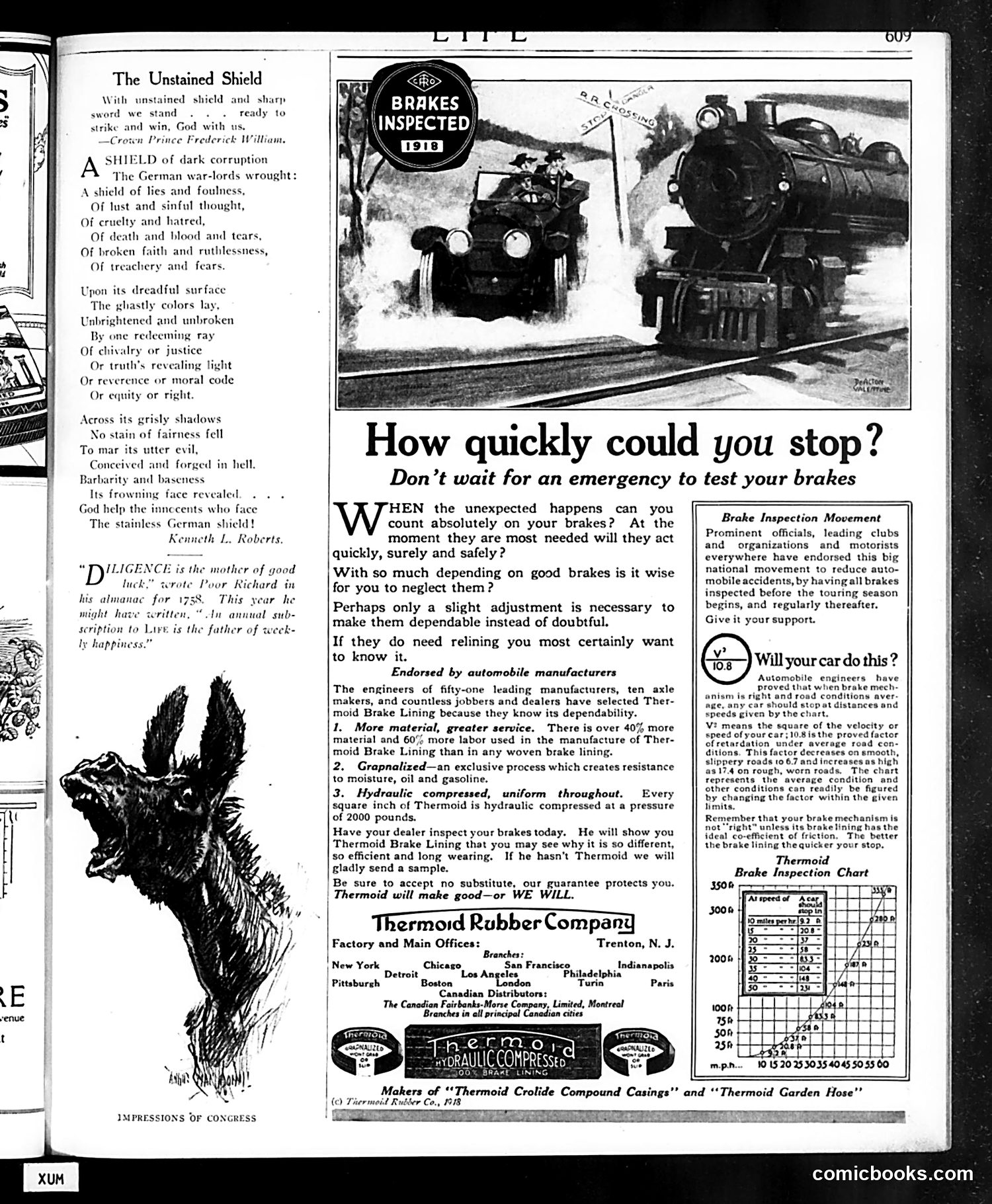
This page combines patriotic war poetry with automobile advertising—typical of WWI-era Life magazine. **Left side:** A poem titled "The Unstained Shield" responds to Crown Prince Frederick William's claim about Germany's moral military conduct. The poem sarcastically describes the German "shield" as corrupt, forged in hell, made of lies and cruelty. It's anti-German propaganda framed as serious verse, invoking God's protection for innocents facing "the stainless German shield"—the irony being Germany's actual conduct. **Right side:** A Thermoid Rubber Company advertisement for brake linings, endorsed by automobile manufacturers. It emphasizes safety and reliability—practical, domestic consumption messaging alongside the war rhetoric. The juxtaposition is striking: patriotic denunciation of German militarism paired with reassuring American consumer products. This reflects how WWI permeated American civilian life, blending moral crusade messaging with ordinary commerce. The page exemplifies Life's role as both satirical commentator and commercial publication.
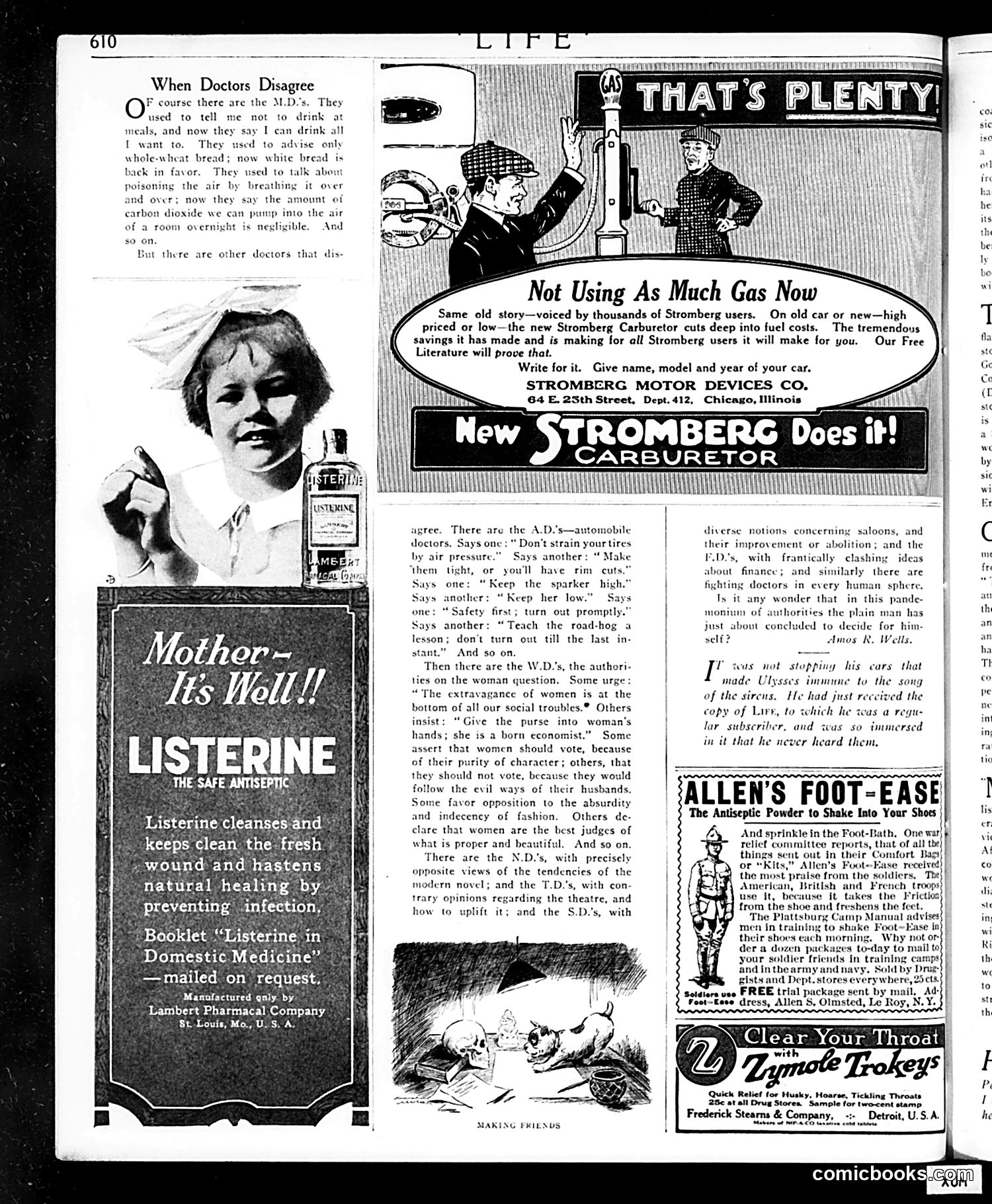
This page satirizes **expert disagreement across multiple fields**. The main article, "When Doctors Disagree," mocks how authorities contradict each other: - **M.D.'s (Medical Doctors)**: reverse advice on diet and air quality - **A.D.'s (Automobile Doctors)**: give opposite guidance on tire pressure and spark plugs - **W.D.'s (Woman Doctors)**: debate women's economic role and voting rights - **Other specialists** (N.D.'s on novels, T.D.'s on theater, S.D.'s on saloons, etc.): all dispute fundamental principles The satirical point: with experts perpetually contradicting each other, ordinary people ("the plain man") must simply decide for themselves rather than defer to authority. The cartoon at bottom shows a man oblivious to sirens because he's absorbed in reading *Life* magazine—a self-promotional joke suggesting the magazine itself is worth more attention than external distractions. The page is otherwise dominated by period product advertisements (Listerine, Stromberg carburetors, Allen's Foot-Ease).
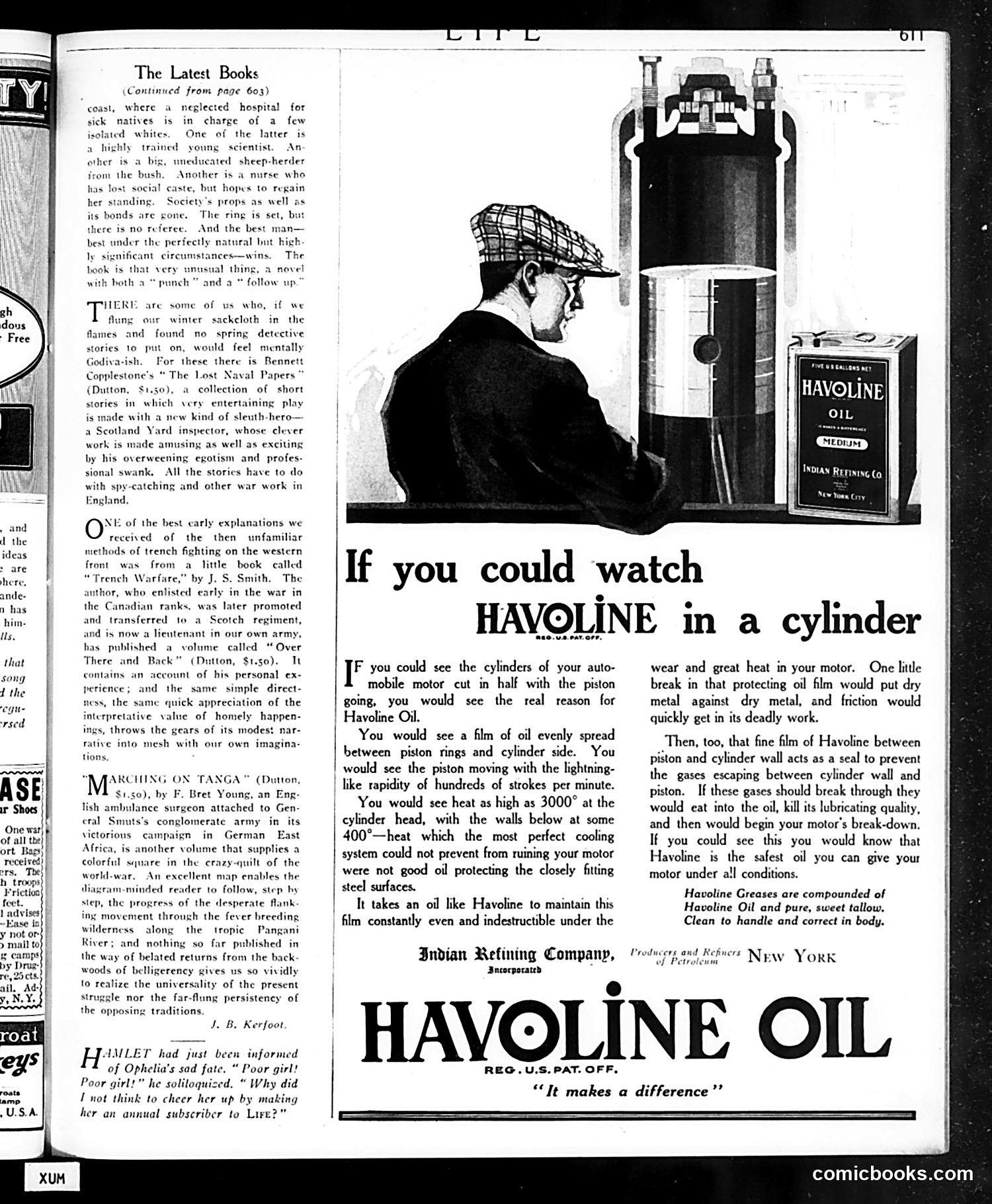
This page combines literary reviews with a full-page **Havoline Oil advertisement**—not political satire. **The Book Reviews Section** ("The Latest Books," continued from page 603) discusses contemporary novels, including war fiction. A brief literary joke at bottom references *Hamlet*: the soliloquy suggests making Ophelia an annual *Life* magazine subscriber would have cheered her—a self-promotional joke typical of the magazine. **The Advertisement** dominates the page. It depicts a man examining an engine cutaway, with accompanying technical copy explaining why Havoline Oil protects motors. The ad uses popular educational rhetoric ("If you could see...") to explain motor mechanics to lay readers. This reflects early-20th-century marketing strategy: explaining product function through pseudo-scientific visualization. **Historical Context**: This appears to be from the World War I era (references to trench warfare, General Smuts's African campaign). The advertisement's emphasis on protective oil film was standard industrial messaging of that period. This is primarily **commercial content**, not satire or political commentary.
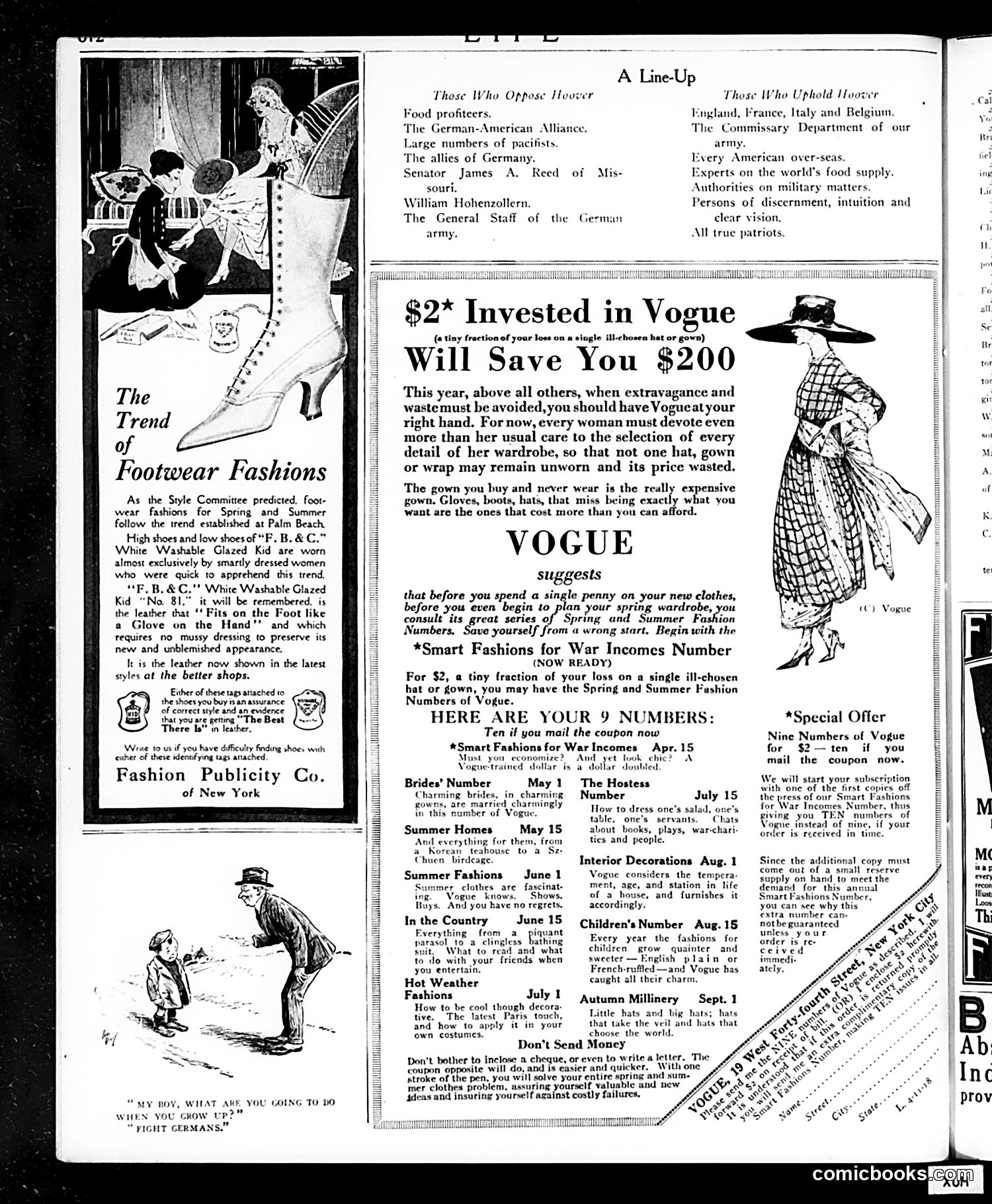
This page combines fashion advertising with WWI-era political commentary. The left side features a satirical cartoon about footwear fashions, illustrated by Fashion Publicity Co., targeting women's consumer choices during wartime. The central feature is a "Line-Up" comparing supporters and opponents of Herbert Hoover, likely regarding his food administration role during WWI. Those opposing him include "food profiteers," pacifists, and notably Kaiser Wilhelm ("William Hohenzollern"). Supporters include Allied nations, military experts, and "all true patriots." The cartoon at bottom shows a child declaring "Fight Germans" as their future ambition—satirizing how wartime rhetoric permeated even children's aspirations. The Vogue advertisement overlay offers fashion guidance for women managing wardrobes during "war incomes," suggesting careful consumption as patriotic duty. The messaging implies that smart fashion choices during wartime demonstrate both patriotism and economic wisdom, framing consumer behavior within nationalist ideology.
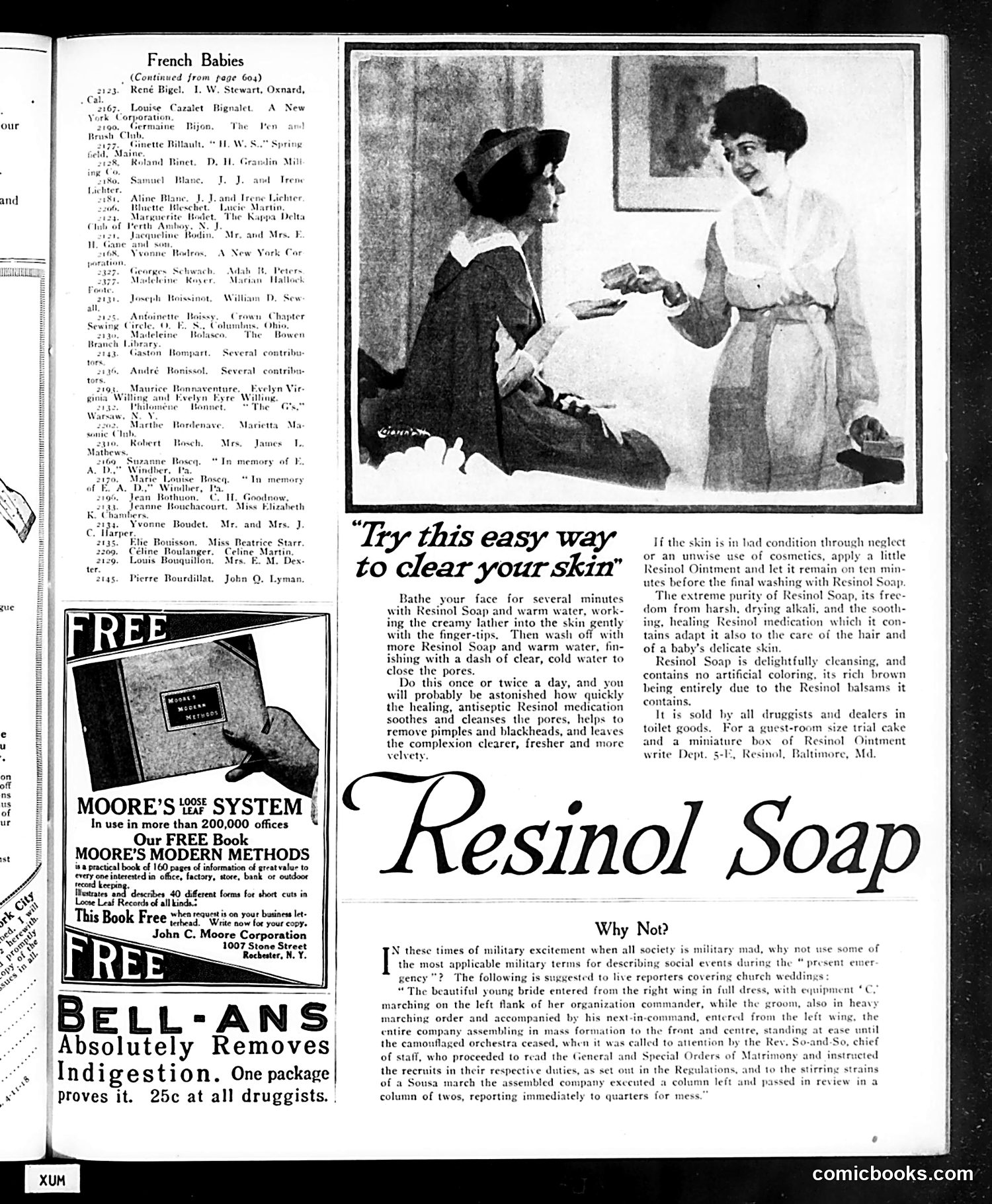
This page is primarily **advertising**, not satire or political commentary. The main features are: **Resinol Soap Advertisement** (center/right): Shows two women demonstrating skincare. The ad promotes Resinol Soap as a treatment for skin conditions like pimples and blackheads, emphasizing its purity and healing properties. This is a straightforward product advertisement typical of the era. **Left Column**: Lists of French babies (likely children born to American servicemen or expatriates during/after WWI), with donor names acknowledging contributions to their care—a charitable record rather than editorial content. **"Why Not?" Column** (bottom right): A brief humorous piece suggesting journalists use military terminology when covering church weddings (describing brides as entering "from the right wing in full dress"). This is light wartime satire playing on the military excitement mentioned, likely written during or shortly after WWI. **Additional Ads**: Moore's Loose Leaf System and Bell-Ans indigestion remedy ads appear as well. The page reflects 1910s-era advertising, philanthropy, and mild military-themed humor.
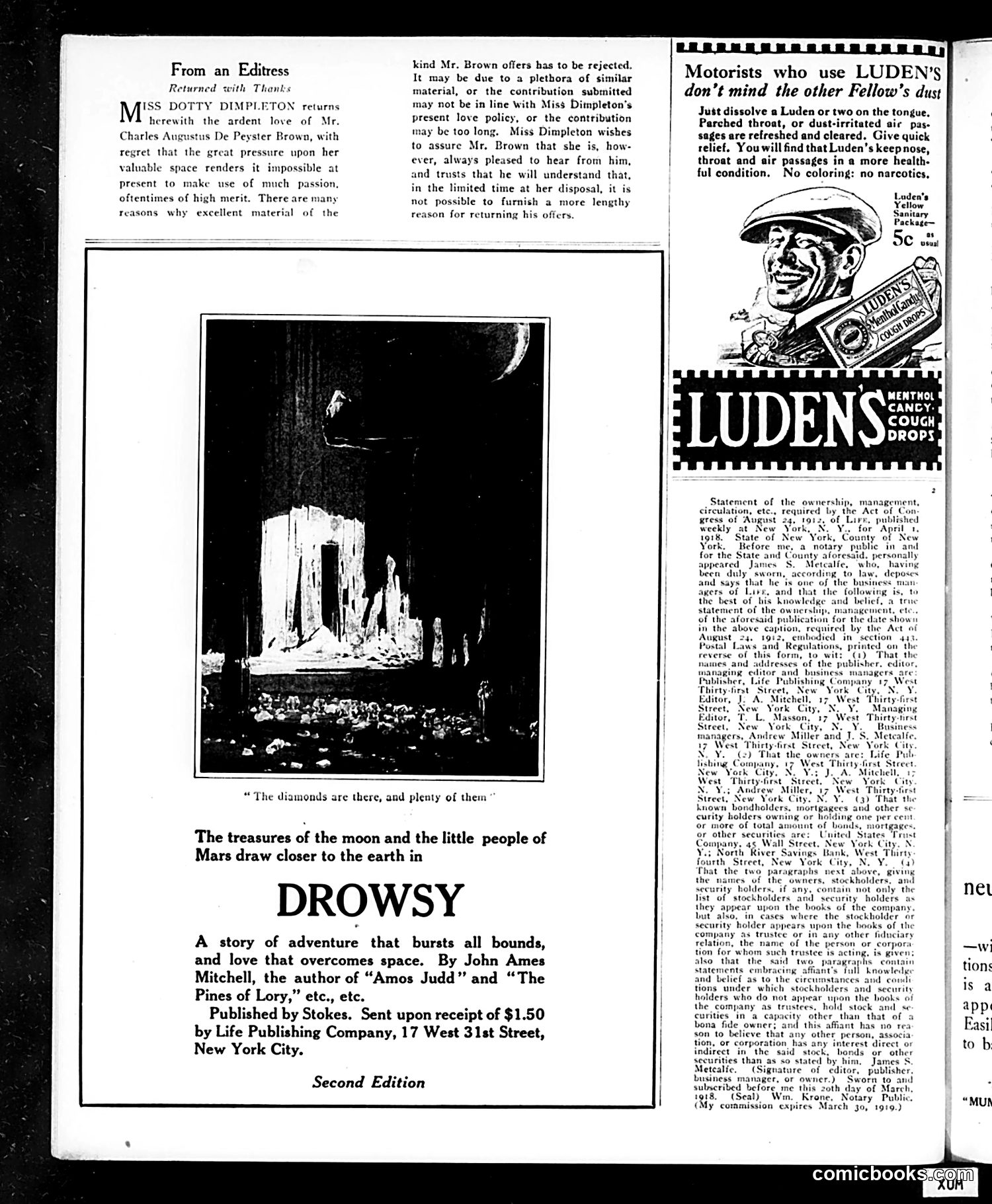
This page contains two distinct elements: **Left side:** A book advertisement for *Drowsy* by John Ames Mitchell (author of *Amos Judd*), published by Stokes. The dramatic image shows a lunar or Martian landscape with small figures and structures, advertising a science-fiction adventure story about "treasures of the moon and the little people of Mars." The quote "The diamonds are there, and plenty of them" suggests a fantastical treasure narrative. This represents early 20th-century pulp sci-fi marketing. **Right side:** A Luden's menthol cough drops advertisement with a caricatured man in a cap, promoting throat relief for motorists bothered by dust—reflecting the era's automobile culture and air-quality concerns. **Below:** Legal ownership/circulation statements required by federal law (Act of Congress, August 24, 1912), listing Life Publishing Company's editors and business managers. The page is primarily **advertising and legal documentation** rather than satirical content, though it reflects period concerns (early aviation/motoring, pulp fiction popularity, patent medicines).
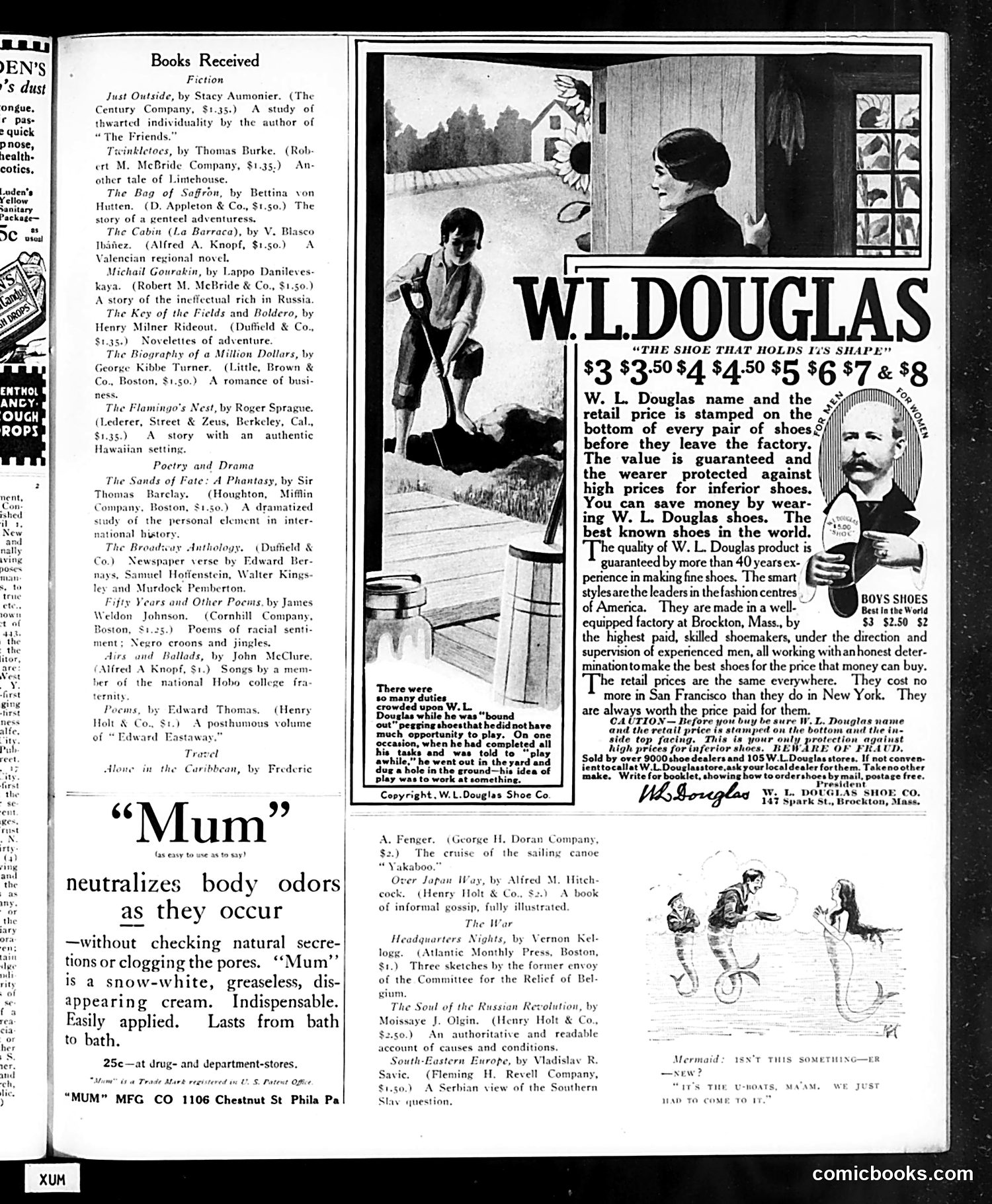
This page is primarily **advertising and book reviews**, not political satire. The dominant content is a **W.L. Douglas shoe advertisement** featuring a photograph of a man and woman examining shoes. The ad emphasizes that Douglas stamps the retail price on every shoe's bottom to guarantee value and protect consumers against inflated pricing—a consumer-protection selling point relevant to early 20th-century commerce. A secondary ad for **"Mum" deodorant cream** claims it neutralizes body odor without clogging pores, marketed as easy to use. The left column lists **fiction and poetry books** recently published, including titles about Russian characters, Limehouse tales, and regional novels—typical literary fare of the period. There is **no political cartoon or satire visible**. The page reflects period consumer culture and literary publishing rather than political commentary.
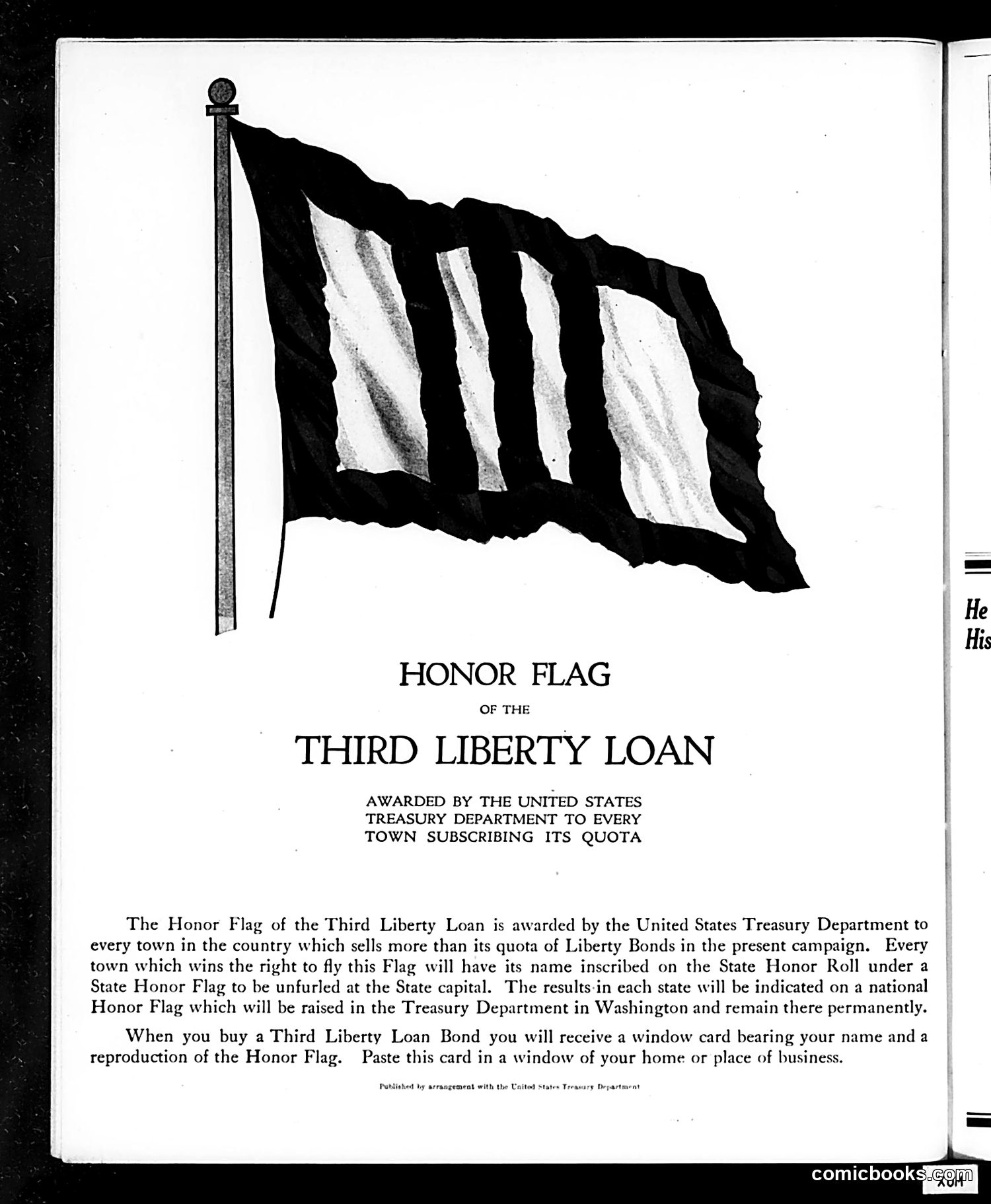
This is informational propaganda, not satire. It promotes the Third Liberty Loan—a U.S. government bond drive during World War I (likely 1918). The "Honor Flag" shown is an incentive: towns exceeding their bond-sales quotas earned the right to display it publicly, with their names inscribed on state and national honor rolls. The mechanism leverages civic pride and social pressure—communities competed to meet quotas, knowing success brought visible recognition. Individual bond purchasers received window cards displaying their names alongside the flag, encouraging public displays of patriotic support. This represents how the U.S. Treasury Department mobilized civilian participation in war financing through competitive honor systems rather than mandatory taxation. Modern readers should recognize this as sophisticated wartime propaganda using peer pressure and community recognition as motivational tools.
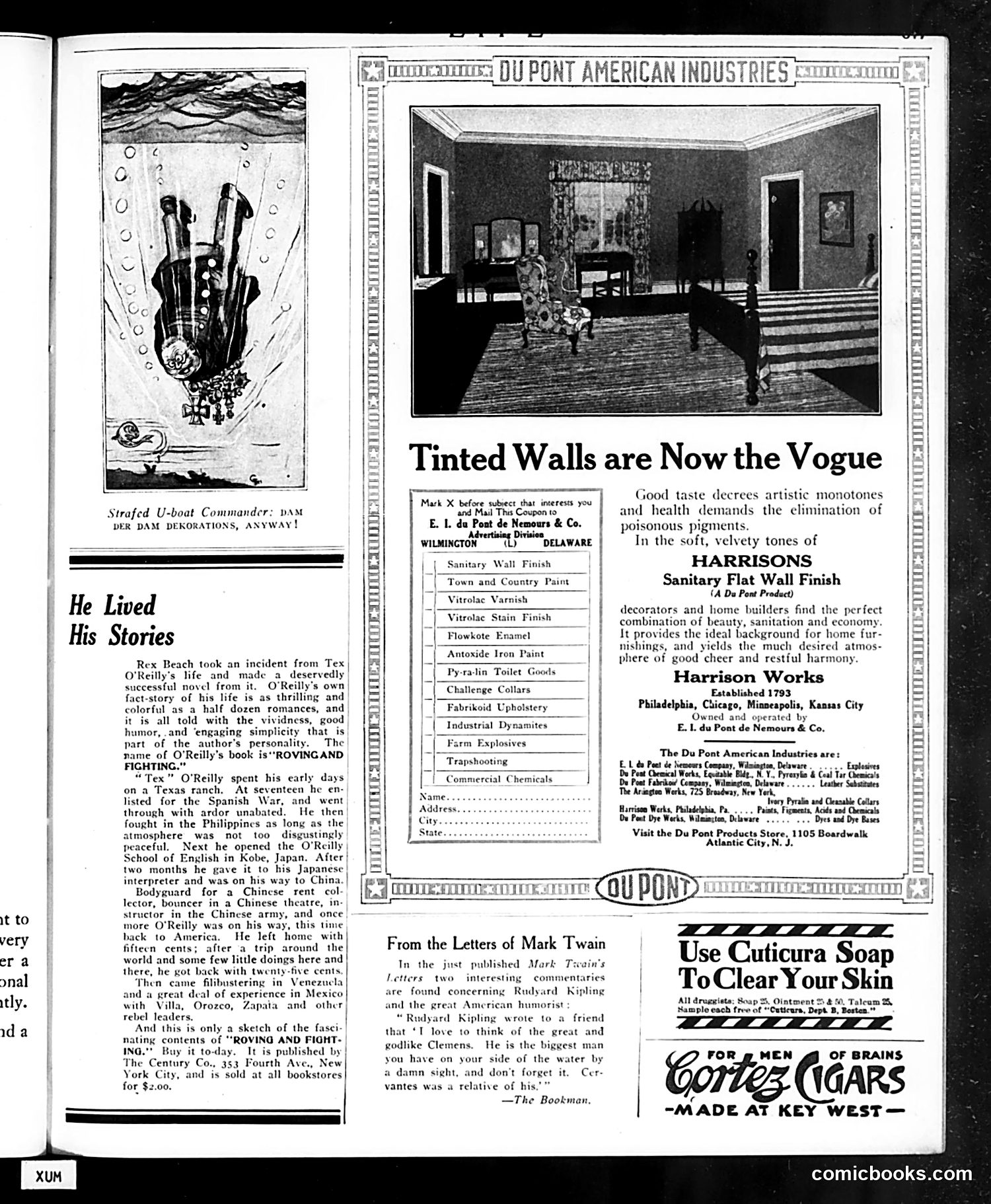
This page combines editorial content with period advertising. The left side features "He Lived His Stories," a biographical sketch of author Rex Beach's subject, "Tex" O'Reilly—a colorful adventurer who served in the Spanish-American War, fought in the Philippines, taught English in Japan, and had various dramatic experiences in Mexico and Venezuela. Beach fictionalized O'Reilly's exploits in his novel "Roving and Fighting." The top left cartoon, labeled "Strafed U-boat Commander," depicts a German submarine officer observing damage to a dam, with the darkly humorous caption "Der dam dekorations, anyway!"—a joke about German accent and the warship's destruction. The right side is primarily a **Du Pont company advertisement** promoting Harrison's Sanitary Flat Wall Finish paint, emphasizing health benefits by eliminating "poisonous pigments" in favor of refined monotones. Bottom advertisements include **Cuticura Soap** and **Cortez Cigars** ("made at Key West"). The Mark Twain excerpt discusses Kipling's admiration for Clemens.
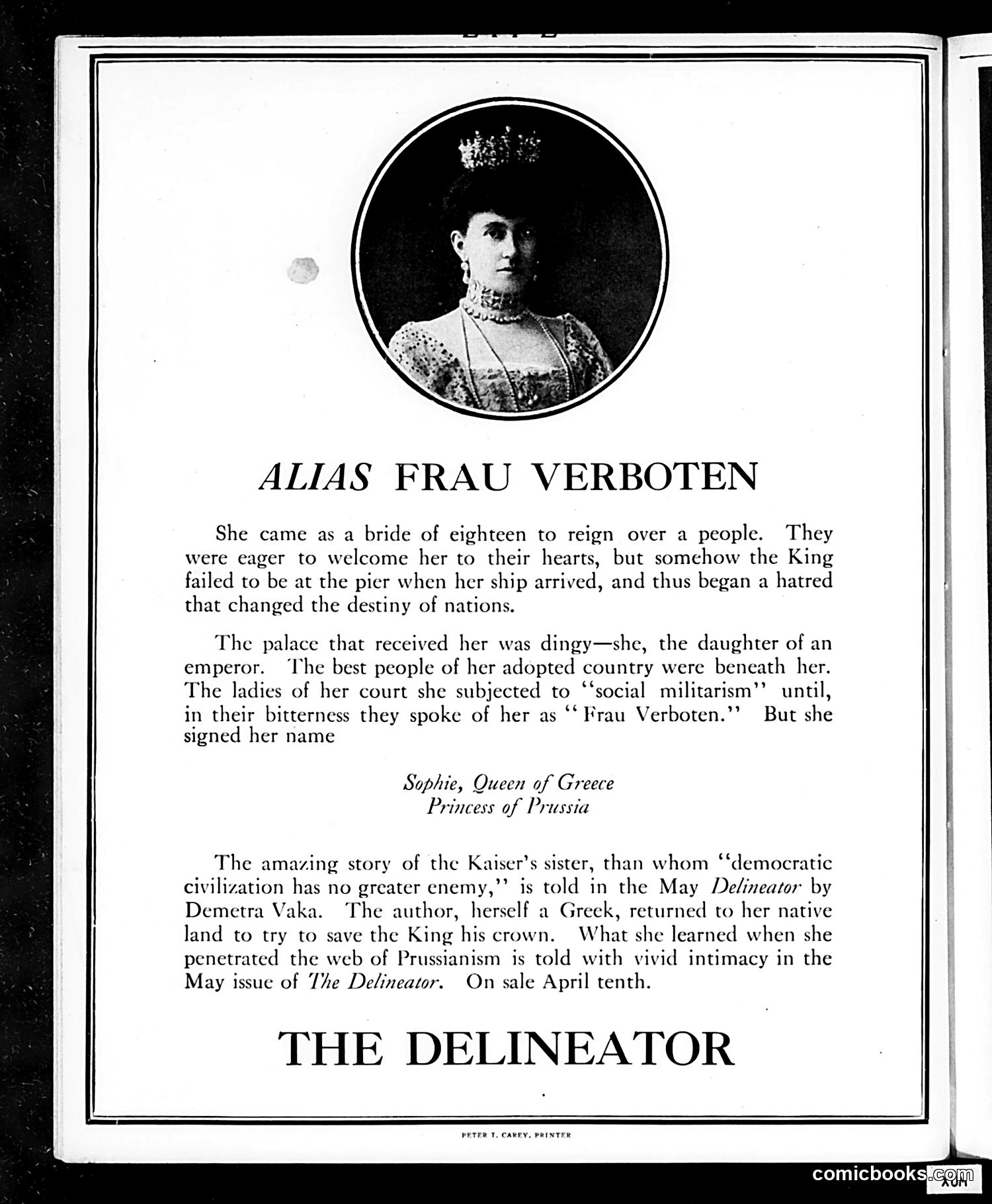
This is an advertisement for *The Delineator* magazine promoting an article about Sophie of Greece, sister of Kaiser Wilhelm II of Germany. The piece portrays Sophie as a cold, domineering Prussian influence ("Frau Verboten"—"Mrs. Forbidden") who alienated Greek society through harsh "social militarism." The narrative emphasizes her rejection upon arrival and her imperial disdain for the Greek people, framing her as embodying German authoritarianism. Published during WWI-era tensions, the ad presents her as "democratic civilization's" enemy—a Prussian agent corrupting Greece. The article by Greek author Demetra Vaka promises an exposé of how Sophie's German influence threatened King Constantine's crown. This reflects American anti-German propaganda prevalent during the period, using Sophie as a symbol of Prussian imperialism infiltrating weaker nations. The advertisement weaponizes her unpopularity to sell magazines while stirring wartime sentiment against German influence abroad.
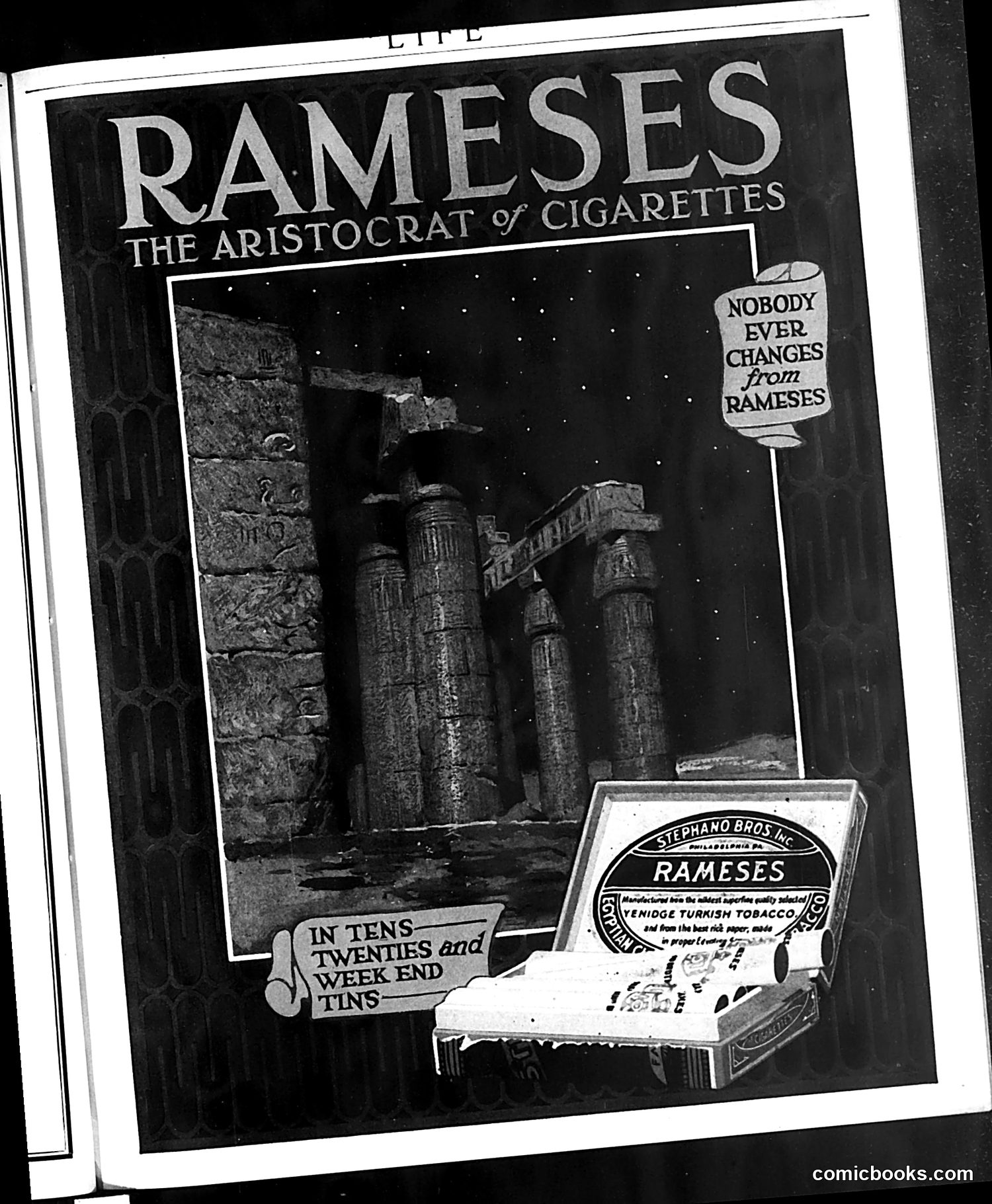
This is primarily a **cigarette advertisement** for Rameses brand, not political satire. The ad features an Egyptian temple setting with massive columns and hieroglyphics, establishing an "aristocratic" brand identity through exotic imagery. The tagline "Nobody Ever Changes from Rameses" emphasizes product loyalty. Text references "Tens, Twenties and Week End Tins," describing available packaging sizes. The manufacturer credit reads "Stephano Bros Inc, Philadelphia Pa," noting the product uses "Vindex Turkish Tobacco." The satirical element is minimal—the humor lies in the pretentious marketing language calling cigarettes "the aristocrat" of their category, typical advertising hyperbole of the era. This appears to be a straightforward commercial advertisement rather than political commentary.
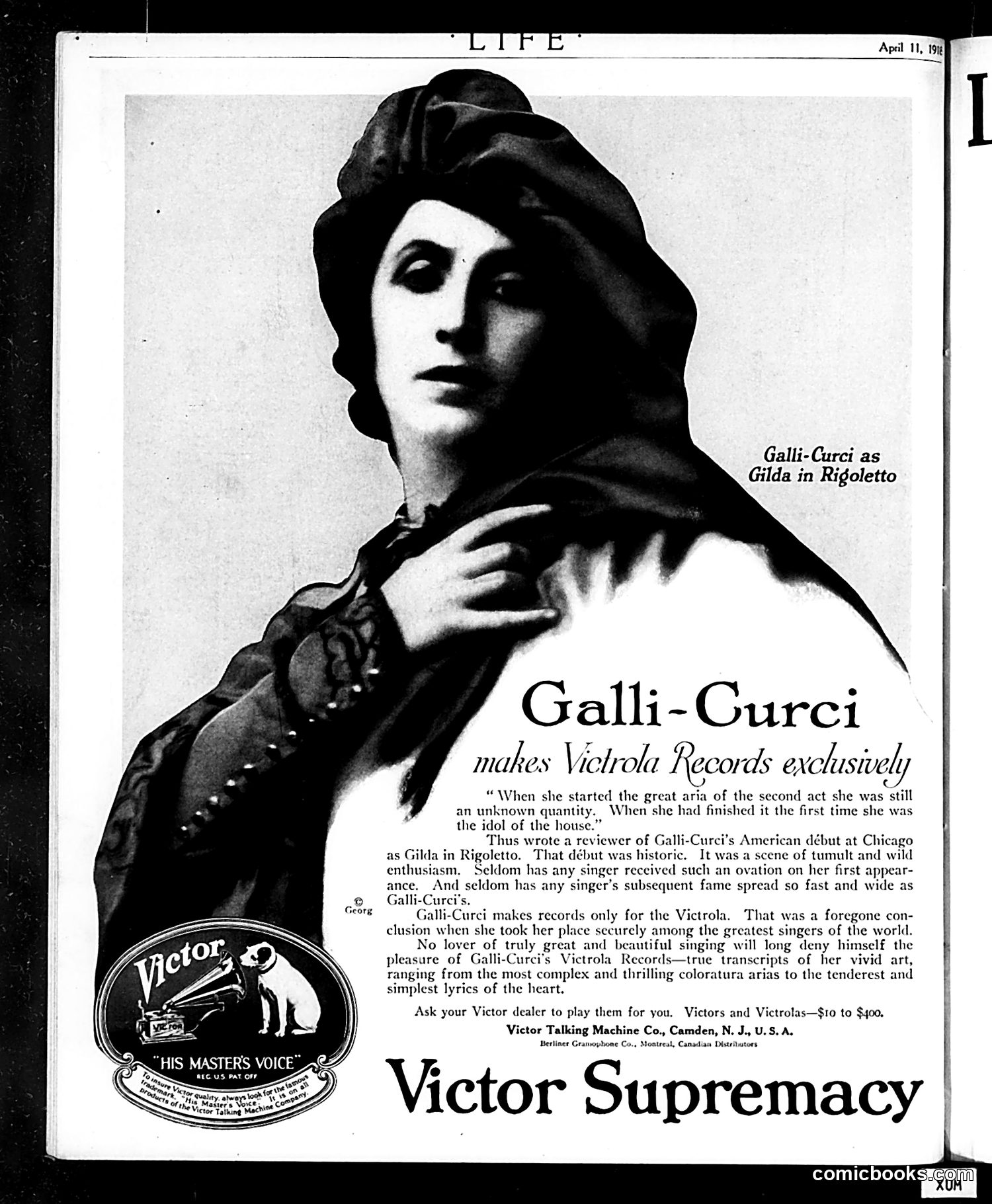
This is **not a political cartoon or satire**—it's a **commercial advertisement** for Victor Victrola recording equipment, circa April 11, 1921. The page features **Amelita Galli-Curci**, an Italian opera singer who made her historic American debut at Chicago performing Gilda in Verdi's *Rigoletto*. The advertisement celebrates her recent triumph and announces that she records **exclusively for Victrola** (a leading phonograph/record player brand). The marketing pitch emphasizes that a singer of her caliber choosing Victrola proves the company's "supremacy" in recording technology—essentially using her prestige to sell expensive phonographs ($10-$400, substantial sums in 1921). The testimonial quote about her electrifying debut performance serves as endorsement by association. The "His Master's Voice" Victor logo is visible at bottom left. This represents typical early-20th-century celebrity endorsement advertising, where major artists' exclusive contracts were publicized as proof of product quality.