
Life, 1918-04-11 · page 24 of 44
Life — April 11, 1918 — page 24: what you’re looking at
What you’re looking at
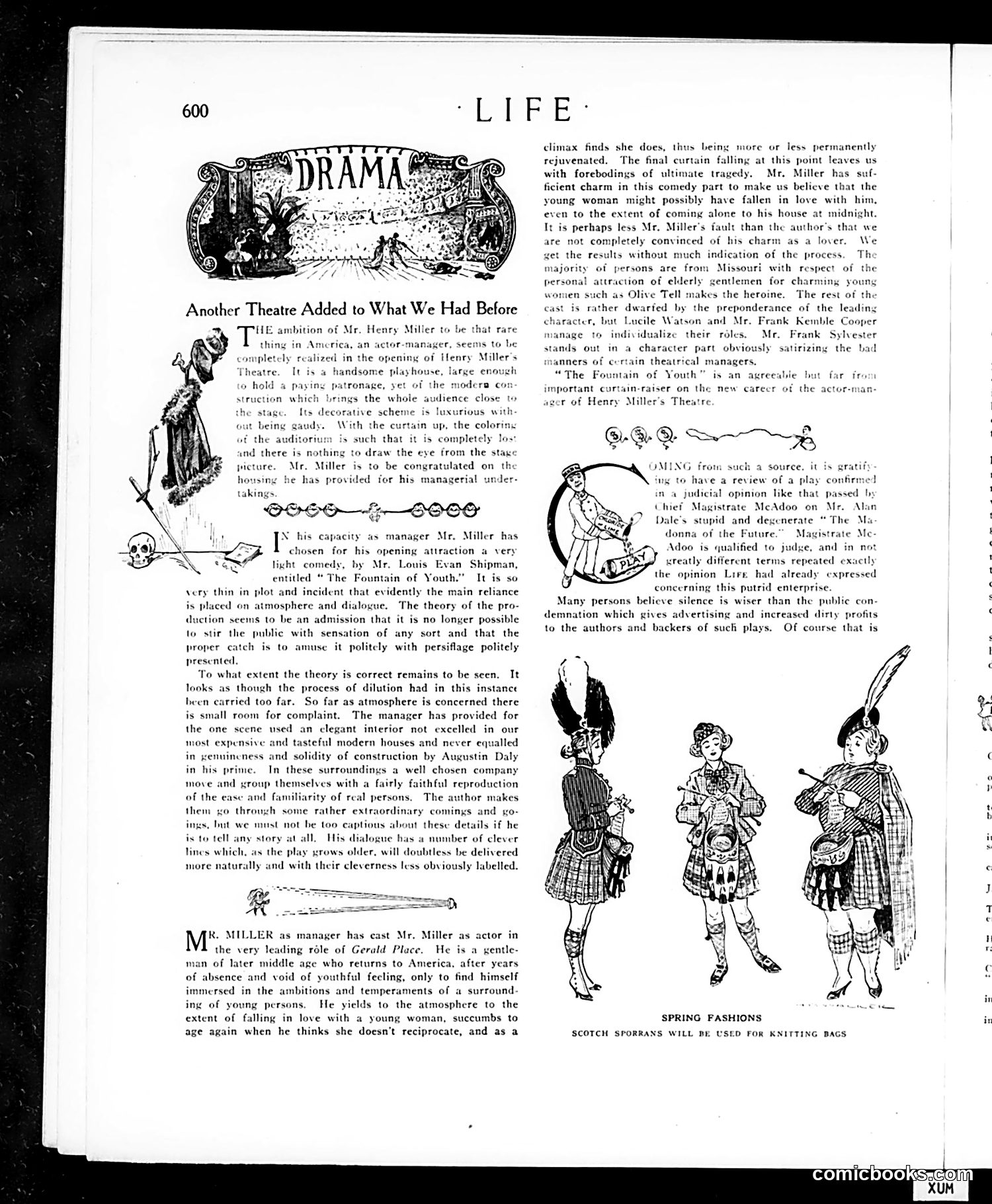
This page reviews Henry Miller's new theater and his opening production, "The Fountain of Youth," a light comedy by Louis Evan Shipman. **The Context:** Henry Miller (1858-1926) was a prominent American actor-manager who built his own playhouse in New York. The review discusses his dual role as both theater owner and star actor in this opening production. **The Satire's Point:** The critic argues the play is so thin in plot that it relies entirely on atmosphere and polished dialogue rather than dramatic substance—admitting the theater industry has abandoned "sensation" to merely "amuse politely." The title itself suggests the play's theme: aging men seeking rejuvenation through contact with youth (Miller plays an older gentleman who falls for a younger woman). **The Joke:** There's gentle mockery that Miller, though charming, must carry a weak script, and that audiences accept this because Miller's star power compensates for the author's limitations. The critic questions whether audiences truly believe an aging man could win a young woman's affection. **The Illustrations:** The bottom shows fashionable "Spring Fashions" with "Scotch sporbans will be used for knitting bags"—typical period fashion commentary unrelated to the theater review.
📄 Transcribed text from this page (OCR, searchable)
Machine-transcribed from the original scan — historical spelling and the odd misread are preserved.
Another Theatre Added to What We Had Before hat rare HE ambition of Mr. Henry Miller to be ser, seems to be r-mana sy of Henry Miller's thing in America, an ac 1 in the open completely realiz Theatre. It is a handsome playhouse hold a paying p struction which t large enough modera co ngs the whole audience close Its decorative scheme is luxurious wit With the curtain up, the coloring is such that it is co ind there is nothin draw the eye from the stax« Mr. Miller is to be congratulated on th of his managerial under- he stage out being gaudy. of the auditorium pictur provided housin ta IX apacity as manager Mr, Miller has —2F } chosen for his opening attraction a very \ STM light comedy, by Mr. Louis Evan Shipman, entitled “ The Fountain of Youth.” very thin in plot and incident that evidently the main reliance is placed on atmosphere and dialogue. The theory of the pro- duction seems to be an admission that it is no longer possible to stir the public with sensation of any sort and that the ch is to amuse it politely with persiflage politely It is so proper c: presented. To what extent the theory is correct remains to be seen, It looks as though the process of dilution had in this instance heen carried too far. So far as atmosphere is concerned there is small room for complaint. The manager has provided for an clegant interior not excelled in our most expensive and ful modern houses and never equalled in xenuineness and solidity of construction by Augustin Daly the one scene used In these surroundings a well chosen company move and group themselves with a fairly faithful reproduction of the e nd familiarity of real persons, The author makes them yo through some rather extraordinary comings and go- in his prime. ings, but we must not be too tious about these details if he is to tell any story at all, His dialogue bas a number of clever lines which, as the play grows older, will doubtless be delivered a bd M*: MILLER as manager has cast Mr. Miller as actor in the very leading rdle of Gerald Place. He is a xentle- man of later middle age who returns to America, after years of absence and void of youthful fecling, only to find himself immersed in the ambitions and temperaments of a surround ing of young persons. He yields to the atmosphere to the extent of falling in love with a young woman, succumbs to age again when he thinks she doesn’t reciprocate, and as a “aE RAE: * climax finds she does, thus being more or less permanently rejuvenated. The final curtain falling at this point leaves us with forebodings of ultimate tragedy. Mr. Miller has suf- ficient charm in this comedy part to make us believe that the young woman might possibly have fallen in love with him, even to the extent of coming alone to his house at midnight. It is perhaps less Mr. Miller's fault than the author's that we masa lover, We are not completely convinced of his ch get the results without much indication of the process. Th majority of persons are from Missouri with respect of the ction of elderly gentlemen for charming young wonten such as Olive Tell makes the heroine. The rest of th cast is rather dwaried by the preponderance of the leading acter, but Lucile Watson and Mr. Frank Kemble Cooper nk Sylvest personal manage to individualize their roles. Mr. er stands out in a character part obviously satirizing the bad certain theatrical managers, puntain of Youth” is an agreeable but far fro anners “The portant curtain-raiser on the new career of the actor-man tif such a source, it is to have a review of a play confirmed in a judicial opinion like that passed b Chief Magistrate McAdoo on Mr. Alan Dale's stupid and degenerate “The Mi donna of the Future.” Magistrate Me Adoo is qualified to ju xreatly different terms rep the opinion Lire had already expressed concerning this putrid enterprise Many persons believe silence is wiser than the public coi demnation whi to the authors and backers of suck plays. sand in not ated exactly h gives advertising and increased dirty profits Of course that is SPRING FASHIONS SCOTCH SPORRANS WILL DE USED FOR KNITTING BAGS ! r ' ' r in in