
Life, 1918-04-11 · page 13 of 44
Life — April 11, 1918 — page 13: what you’re looking at
What you’re looking at
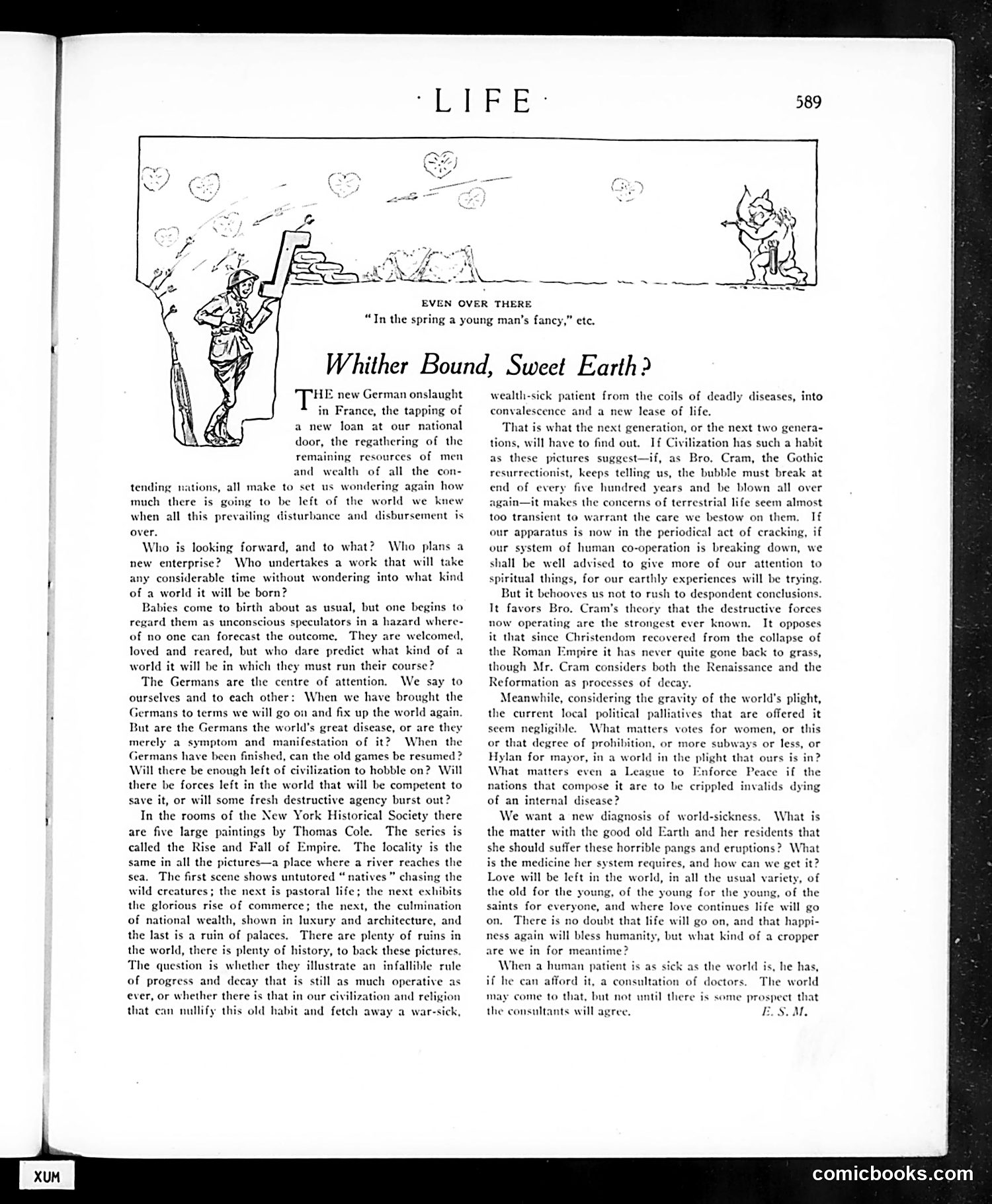
The cartoon depicts a Cupid-like figure shooting hearts across a devastated landscape, while military/demonic figures occupy the right side. This satirizes post-WWI anxieties about civilization's future. The article, signed E.S.M., discusses German "onslaught" and concerns about remaining global resources after the war. It references Thomas Cole's "Rise and Fall of Empire" paintings and invokes civilizational collapse theories. The author warns against complacency, noting that despite Christianity's supposed civilizing influence, societies still decay. The satire juxtaposes romantic love (Cupid's hearts) against warfare and destruction, questioning whether love and spiritual values can save a war-sick world. It's fundamentally pessimistic about post-war recovery and humanity's trajectory.
📄 Transcribed text from this page (OCR, searchable)
Machine-transcribed from the original scan — historical spelling and the odd misread are preserved.
589 HE new German onslaught in France, the tapping of a new loan at our national door, the regathering of the remaining resources of men and wealth of all the con- tending nations, all make to set us wondering again how much there is going to be left of the world we knew when all this prevailing disturbance and disbursement is over. Who is looking forward, and to what? Who plans a new enterprise? Who undertakes a work that will tak any considerable time without wondering into what kind of a world it will be born? s come to birth about as usual, but one begins to regard them as unconscious speculators in a hazard where- of no one can forecast the outcome, They are welcomed, loved and reared, but who dare predict what kind of a world it will be in which they must run their course? The Germans are the centre of attention. We say to ourselves and to each other: When we have brought the jermans to terms we will go on and fix up the world again. But are the Germans the world’s great disease, or are they merely a symptom and manifestation of it? When the Germans have been finished, can the old games be resumed? Will there be enough left of civilization to hobble on? Will there be forces left in the world that will be competent to save it, or will some fresh destructive agency burst out? In the rooms of the New York Historical Society there are five large paintings by Thomas Cole. The series is called the Rise and Fall of Empire. The locality is the same in all the pictures—a place where a river reaches the sea. The first scene shows untutored “ natives” chasing the wild creatures; the next is pastoral life; the next exhibits the glorious rise of commerce; the next, the culmination of national wealth, shown in luxury and architecture, and the last is a ruin of palaces. There are plenty of ruins in the world, there is plenty of history, to back these pictures. The question is whether they illustrate an infallible rule of progress and decay that is still as much operative a ever, or whether there is that in our civilization and religion that can nullify this old habit and fetch away war-sick, ae ay Ags 2X EVEN OVER THERE “Tn the spring a young man’s fancy,” etc. Whither Bound, Sweet Earth? wealth-sick patient from the coils of deadly diseases, into convalescence and a new lease of life. That is what the next generation, or the next two genera tions, will have to find out. If Civilization has such a habit as these pictures suggest—if, as Bro, Cram, the Gothic resurrectionist, keeps telling us, the bubble must break at end of every five hundred years and be blown all over again—it makes the concerns of terrestrial life seem almost too transient to warrant the care we bestow on them. If our apparatus is now in the periodical act of cracking, if our system of human co-operation is breaking down, we shall be well advised to give more of our attention to spiritual things, for our earthly experiences will be trying. But it behooves us not to rush to despondent conclusions. It favors Bro, Cram's theory that the destructive forces now operating are the strongest ever known. It opposes it that since Christendom recovered from the collapse of the Roman Empire it has never quite gone back to grass, though Mr. Cram considers both the Renaissance and the Reformation as processes of decay. Meanwhile, considering the gravity of the world's plight, the current local political palliatives that are offered it seem negligible. What matters votes for women, or this or that degree of prohibition, or more subways or less, or Hylan for mayor, in a world in the plight that ours is in? What matters even a League to Enforce Peace if the nations that compose it are to be crippled invalids dying of an internal disease? We want a new diagnosis of world-sickness. What is the matter with the good old Earth and her residents that she should suffer these horrible pangs and eruptions? What is the medicine her system requires, and how can we get it? Love will be left in the world, in all the usual variety, of the old for the young, of the young for the young, of the saints for everyone, and where love continues life will go on, There is no doubt that life will go on, and that happi- ness again will bless humanity, but what kind of a cropper are we in for meantime? When a human patient is as sick as the world is, he has, if he can afford it, a consul f The world ne to that, but not until there is some prospect that S. AM. ation of doctors. the consultants will agree. E comicbooks.com