
Life, 1918-04-11 · page 6 of 44
Life — April 11, 1918 — page 6: what you’re looking at
What you’re looking at
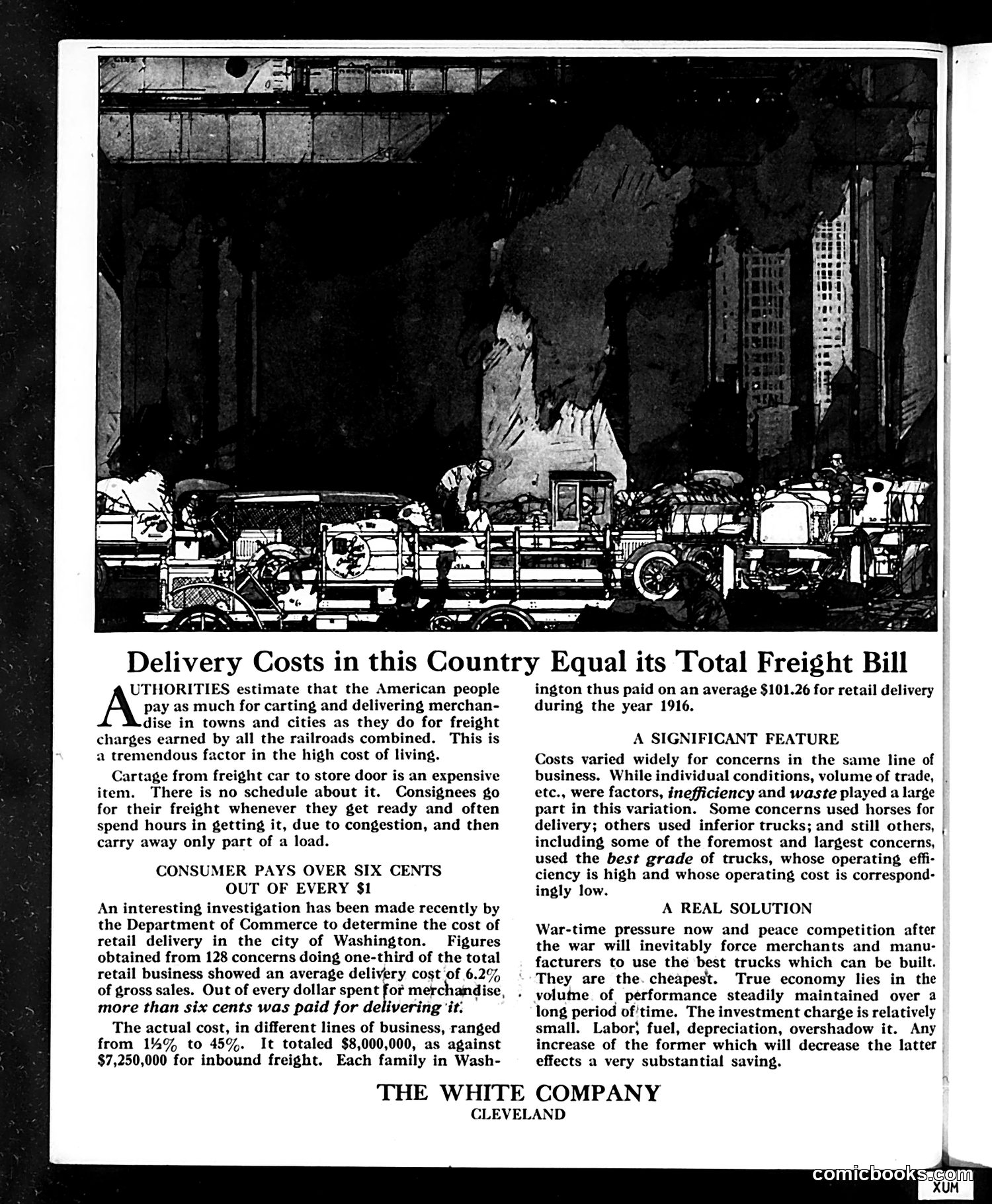
This is **primarily an advertisement**, not satire or political commentary. The White Company of Cleveland is marketing commercial delivery trucks. The top image shows an industrial/warehouse scene with various delivery vehicles and workers, illustrating modern logistics infrastructure. The text argues that delivery costs in America are substantial—consumers pay over six cents per dollar for merchandise delivery. A 1916 Department of Commerce study of Washington, D.C. found delivery costs ($8,000,000) nearly matched inbound freight costs ($7,250,000). The advertisement positions White Company trucks as "a real solution" to inefficient delivery systems, promoting their vehicles as the cheapest and most economical option for merchants. The pitch emphasizes reliability and low operating costs over time. This reflects early-twentieth-century industrial concerns about distribution efficiency.
📄 Transcribed text from this page (OCR, searchable)
Machine-transcribed from the original scan — historical spelling and the odd misread are preserved.
i ee ? Delivery Costs in this Country Equal its Total Freight Bill HORITIES estimate that the American people pay as much for carting and delivering merchan- dise in towns and cities as they do for freight charges earned by all the railroads combined. This is a tremendous factor in the high cost of living. Cartage from freight car to store door xpensive item. There is no schedule about it. Consignees go for their freight whenever they get ready and often spend hours in getting it, due to congestion, and then carry away only part of a load. CONSUMER PAYS OVER SIX CENTS OUT OF EVERY $1 An interesting investigation has been made recently by the Department of Commerce to determine the cost of retail delivery in the city of Washington. Figures obtained from 128 concerns doing one-third of the total retail business showed an average delivery cost ‘of 6.2% of gross sales. Out of every dollar spent for merchandise, more than six cents was paid for delivering ‘it. The actual cost, in different lines of business, ranged from 14% to 45%. It totaled $8,000,000, as against $7,250,000 for inbound freight. Each family in Wash- # ington thus paid on an average $101.26 for retail delivery | during the year 1916. A SIGNIFICANT FEATURE Costs varied widely for concerns the same line of business. While individual conditions, volume of trade, |, etc., were factors, inefficiency and waste played a large part in this variation. Some concerns used horses for delivery; others used inferior trucks; and still others, | including some of the foremost and largest concerns, used the best grade of trucks, whose operating effi- ciency is high and whose operating cost is correspond- ingly low. A REAL SOLUTION War-time pressure now and peace competition after the war will inevitably force merchants and manu- facturers to use the best trucks which can be built. They are the. cheapest. True economy lies in the volutne of performance steadily maintained over a long period of'time. The investment charge is relatively small. Labor, fuel, depreciation, overshadow it. Any increase of the former which will decrease the latter effects a very substantial saving. THE WHITE COMPANY CLEVELAND