
Life, 1918-04-11 · page 21 of 44
Life — April 11, 1918 — page 21: what you’re looking at
What you’re looking at
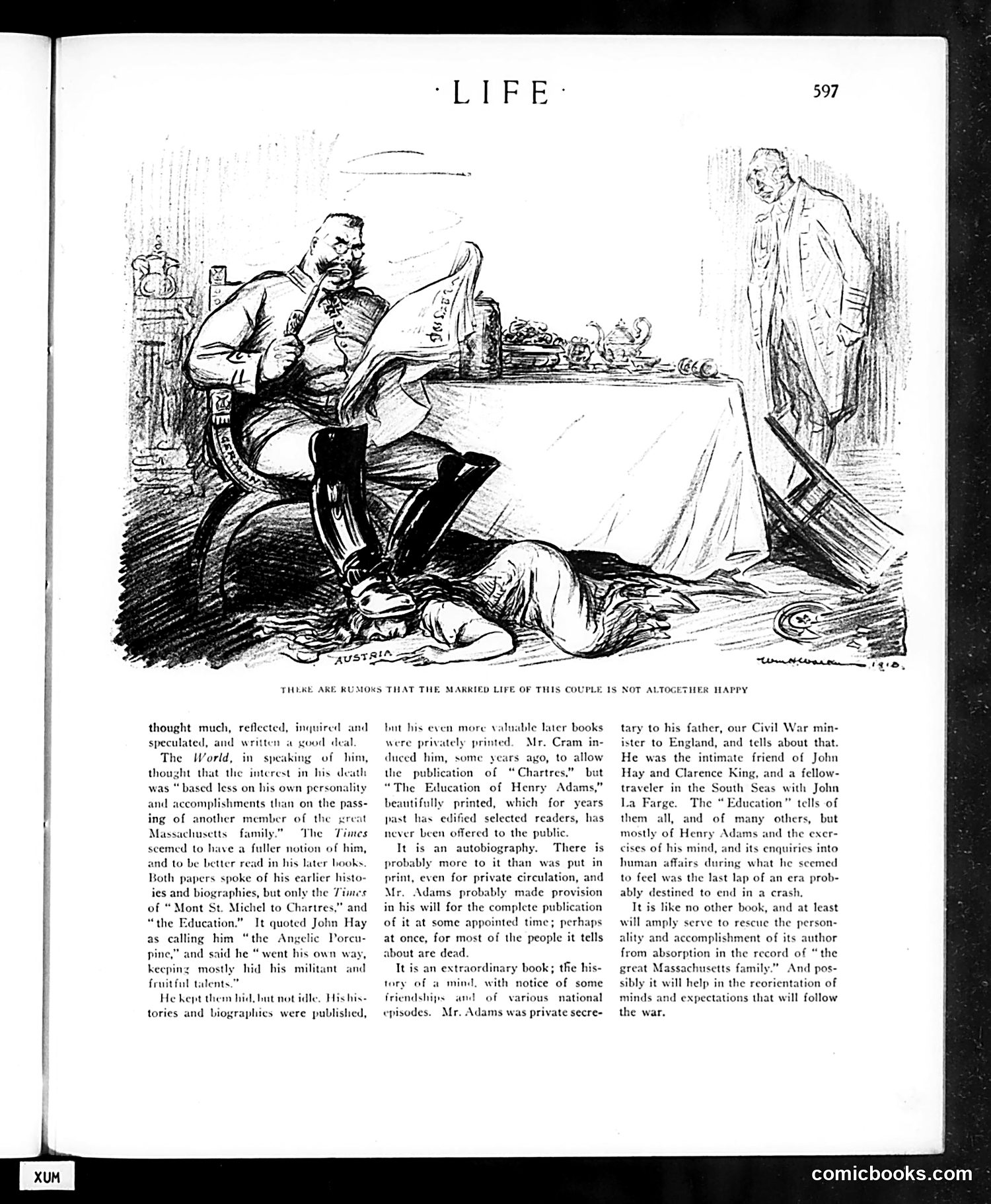
This page from *Life* magazine contains a satirical cartoon about marital discord, paired with text discussing Henry Adams's autobiography "The Education of Henry Adams." **The Cartoon:** The sketch depicts a military officer (likely Austro-Hungarian, suggested by the uniform and imperial décor) seated at a dining table while his wife lies prone on the floor in apparent distress or submission. A servant observes from the doorway. The caption reads: "There are rumors that the married life of this couple is not altogether happy." **The Satire:** The joke relies on obvious understatement—the visual evidence of marital conflict (the woman's prostrate position) starkly contradicts the mild, euphemistic caption claiming merely "rumors" of unhappiness. The humor targets both the absurd gap between observation and language, and likely satirizes Austro-Hungarian court life or military culture as portrayed in contemporary media. **Context:** Without knowing the specific date, this appears to reference European aristocratic or military society, possibly during or around WWI given the historical references in the accompanying text.
📄 Transcribed text from this page (OCR, searchable)
Machine-transcribed from the original scan — historical spelling and the odd misread are preserved.
597 THERE ARE RUMOKS THAT THE MARRIED LIFE OF THIS COUPLE 18 NOT ALTOGETHER HAPPY thought much, reflected, inquired and speculated, and written a good deal The World, in’ speaking of him, thought that the interest in his death based less on his own personality and accomplishments than on the pass- ing of another member of the great Massachusetts family The Times scemed to have a fuller notion of him, and to be better read in his later books, Both papers spoke of his earlier histo- ies and biographies, but only the Times of “Mont St. Michel to Chartres,” and “the Education.” It quoted John Hay as calling him “the Angelic Dorcu- and said he “went his own way, was nz mostly hid his militant and fruitful talents.” He kept them hid, but not idle. His his- tories and biographies were published, but his even more valuable later books were privately printed. Mr. Cram in- duced him, some years ago, to allow the publication of “Chartres,” but “The Education of Henry Adams,” beautifully printed, which for years past has edified selected readers, has never been offered to the public. It is an autobiography. There is probably more to it than was put in print, even for private circulation, and Mr. Adams probably made provision in his will for the complete publication of it at some appointed time; perhaps at once, for most of the people it tells about are dead. It is an extraordinary book; the his- y of a mind, with notice of some “ndships and of various national episodes. Mr. Adams was private secre- tary to his father, our Civil War min- ister to England, and tells about that. He was the inti e friend of John Hay and Clarence King, and a fellow- traveler in the South Seas with John La Farge. The “Education” tells of them all, and of many others, but mostly of Henry Adams and the exer- cises of his mind, and its enquiries into human affairs during what he seemed to feel was the last lap of an era prob- ably destined to end in a crash. It is like no other book, and at least will amply serve to rescue the person- thor ality and accomplishment of its a from absorption in the record of “the great Massachusetts family.” And pos- sibly it will help in the reorientation of minds and expectations that will follow the war. comicbooks.com