
Life, 1918-04-11 · page 27 of 44
Life — April 11, 1918 — page 27: what you’re looking at
What you’re looking at
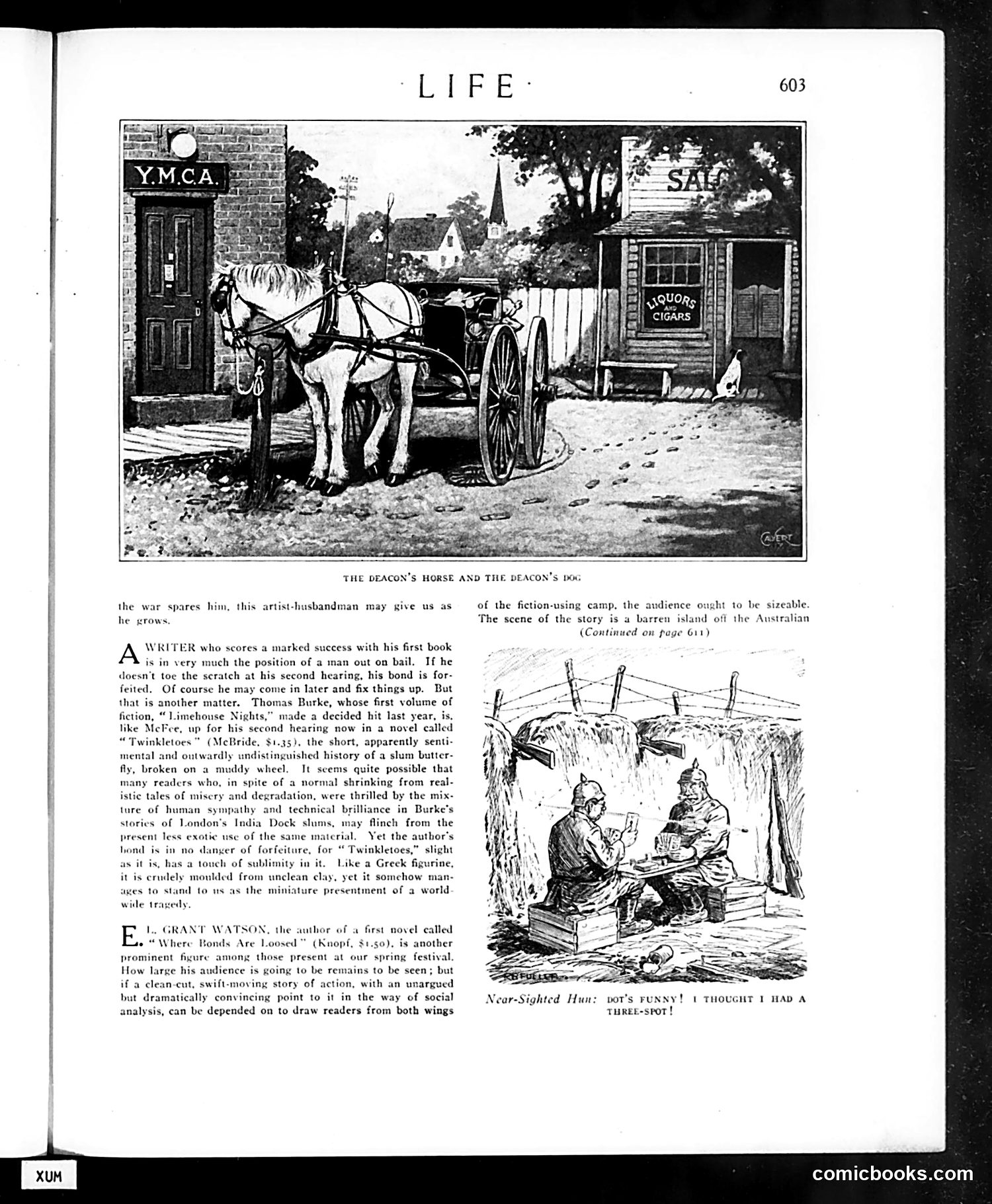
The top illustration, "The Deacon's Horse and the Deacon's Dog," depicts a rural American village scene with a horse-drawn cart outside a YMCA building and a liquor/cigar shop. This appears to be satirizing rural or small-town American life, likely contrasting moral institutions (YMCA) with vice establishments (liquor sales) existing side-by-side. The bottom cartoon, "Near-Sighted Hun," shows two figures in what appears to be a trench or dugout. The caption suggests it's wartime humor: one soldier mistakenly thought he saw three enemy soldiers but only spotted one. "Hun" was American/British WWI slang for German soldiers. The text discusses three contemporary novelists (Thomas Burke, E.L. Grant Watson, and others) and their recent literary successes, analyzing whether they can maintain momentum after debut novels. The page is primarily a book review/literary criticism piece with accompanying illustrations meant to entertain readers alongside the serious literary discussion.
📄 Transcribed text from this page (OCR, searchable)
Machine-transcribed from the original scan — historical spelling and the odd misread are preserved.
THE DEACON’S HORSE AND THE DEACON’S DOG the war spares him, this artist-husbandman may give us as of the fiction-using camp, the audience ought to be sizeable. he grows The scene of the story is a barren island off the Australian (Continued on page 611) WRITER who scores a marked success with his first book is in very much the position of a man out on bail. If he doesn’t toe the scratch at his second hearing, his bond is for- feited. Of course he may come in later and fix things up. But that is another matter. Thomas Burke, whose first volume of fiction, “Limehouse Nights,” made a decided hit last year, is. like McFee, up for his second hearing now in a novel called * (McBride, $1.35). the short, apparently senti- mental and outwardly undistinguished history of a slum butter- broken on a muddy wheel, It scems quite possible that ny readers who, in spite of a normal shrinking from real- istic tales of misery and degradation, were thrilled by the mix- ture of human sympathy and technical brilliance in Burke's stories of London's India Dock shims, may flinch from the present less exotic use of the same material, Yet the author's hond is in no danger of forfeiture, for “ Twinkletoes,” slight Like a Greek figurine, n clay, yet it somehow man- ture presentment of a world as it is, has a touch of sublimity in it is crudely moulded from une! ages to stand to ns as the mii I wide tras E. 1. GRANT WATSON, the author of a first novel called . (Knopf, $1.50), is another prominent figure among those present at our spring festival, How large his at if a clean-cut, swift-moving story of action, with an unargued but dramatically convincing point to it in the way of social Near-Sightéd Hun vov's yuNNy) t-tuoveut? wap A analysis, can be depended on to draw readers from both wings : TUREE-SpOT! Where Bonds Are Loosed jience is going to be remains to be seen; but comicbooks.com