
Life, 1918-04-11 · page 35 of 44
Life — April 11, 1918 — page 35: what you’re looking at
What you’re looking at
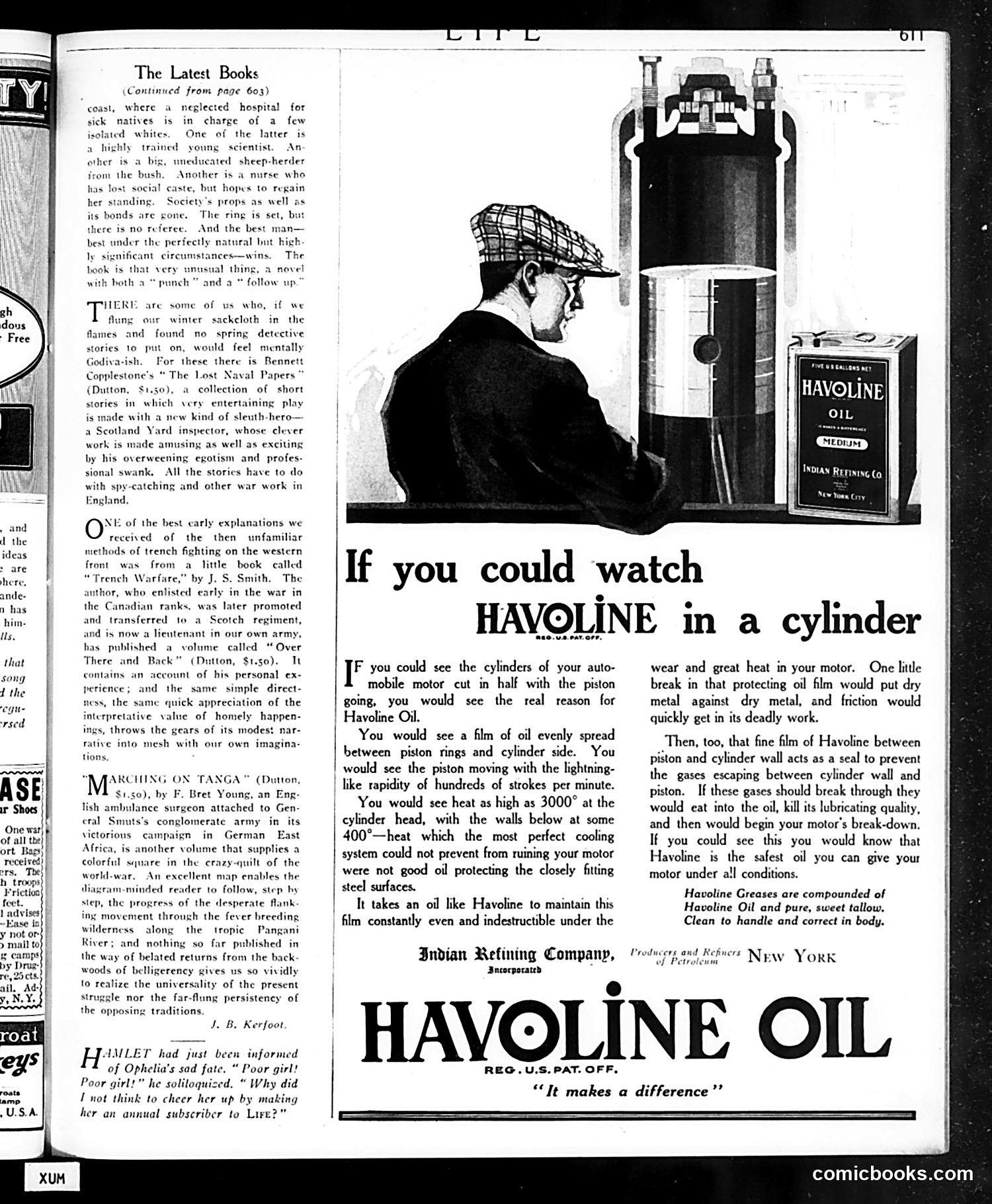
This page combines literary reviews with a full-page **Havoline Oil advertisement**—not political satire. **The Book Reviews Section** ("The Latest Books," continued from page 603) discusses contemporary novels, including war fiction. A brief literary joke at bottom references *Hamlet*: the soliloquy suggests making Ophelia an annual *Life* magazine subscriber would have cheered her—a self-promotional joke typical of the magazine. **The Advertisement** dominates the page. It depicts a man examining an engine cutaway, with accompanying technical copy explaining why Havoline Oil protects motors. The ad uses popular educational rhetoric ("If you could see...") to explain motor mechanics to lay readers. This reflects early-20th-century marketing strategy: explaining product function through pseudo-scientific visualization. **Historical Context**: This appears to be from the World War I era (references to trench warfare, General Smuts's African campaign). The advertisement's emphasis on protective oil film was standard industrial messaging of that period. This is primarily **commercial content**, not satire or political commentary.
📄 Transcribed text from this page (OCR, searchable)
Machine-transcribed from the original scan — historical spelling and the odd misread are preserved.
, and d the ideas > are here, ande- n has him- lls, that song | 1 the r Shoes One war} of all the}] ort Bazs)| received) prs, The}/ h troops} rrcle| fect. Lad’ ~Ease y not or + The Latest Books (Continued from page 603) “coast, where a neglected hospital for sick natives is in charge of a few lated whites, One of the latter is scientist An ed sheep-herder highly trained youn other is a unedue from the bush, Anoth has lost social caste, is a nurse who hopes tor her standing. Society's props as well as The ring is set, re is no referee. And the best best under the perfectly natural but hi ly significant cireun book is that very with both a “ punch its bonds are gone. and a * follow up.” I are some of us who, if we winter sackeloth in the flames and found no spring detective stories 10 put on, would feel mentally Godiva-ish. For these there is Bennett Copplestone’s “The Lost Naval Papers ” (Dutton, $1.50), a collection of short stories in which very entertaining play nung 0 is made with a new kind of sleuth-hero— a Scotland Yard inspector, whose clever work is made amusing as well as exciting by his overweening egotism and profes: sional swank, All the storics have to do with spy-catehing and other war work in England, O E: of the best carly explanati received of the then unfamiliar methods of trench fighting on the western front. was from a little book called “Trench Warfare,” by J. S. Smith. The author, who enlisted early in the war in the Cal 1 ranks, was later promoted and transferred 10 a Scotch regiment, and is now a lieutenant in our own army, has published a volume called “ Over There and Back" (Dutton, $1.50). Tt contains an account of his personal ex- perience; and the same simple direct- ness, the same quick appreciation of the interpretative value of homely happen- ings, throws the gears of its modest nar- rative into mesh with our own imagina- Ss we ARCHING ON TANGA” (Dutton, *, Bret Young, an Eng- lish ambulance surgeon attached to Gen- eral Smuts's conglomerate army in its orious campaign in German East Africa, is another volume that supplies a colorful square in the erazy-quilt of the An excellent map enables the nminded reader to follow, step by world-war. ai sep, the progress of the desperate flank ing movement through the fever breeding wilderness along the tropic Pangani River; and nothing so far published in the way of belated returns from the back woods of belligerency gives us so vividly to realize the universality of the present sle nor the far-flung persistency of the opposing traditions. J. B. Kerfoot AMLET had just been informed of Ophelia’s sad fate. “ Poor girl! Poor girl!” he soliloquized. “ Why did I not think to cheer her up by making her an annual subscriber to Live?” F you could see the cylinders of your auto- mobile motor cut in half with the piston going, you would see the real reason for | Havoline Oil. You would see a film of oil evenly spread between piston rings and cylinder side. You would see the piston moving with the lightning- like rapidity of hundreds of strokes per minute. | You would see heat as high as 3000° at the | cylinder head, with the walls below at some 400°—heat which the most perfect cooling system could not prevent from ruining your motor | were not good oil protecting the closely fitting steel surfaces. | — It takes an oil like Havoline to maintain this film constantly even and indestructible under the | Indian Refining Company, Incorporated ELT z INDIAN Reninine (o New Your Cry If you could watch HAVOLINE in a cylinder wear and great heat in your motor. One little break in that protecting oil film would put dry metal against dry metal, and friction would quickly get in its deadly work. Then, too, that fine film of Havoline between piston and cylinder wall acts as a seal to prevent the gases escaping between cylinder wall and piston. If these gases should break through they would eat into the oil, kill its lubricating quality, and then would begin your motor's break-down. If you could see this you would know that Havoline is the safest oil you can give your motor under all conditions. Havoline Greases are compounded of Havoline Oil and pure, sweet tallow. Clean to handle and correct in body. cfuers New YORK HAVOLINE OIL REG.U.S. PAT. OFF. “It makes a difference’ comicbooks.com