
A complete issue · 40 pages · 1917
Life — September 6, 1917
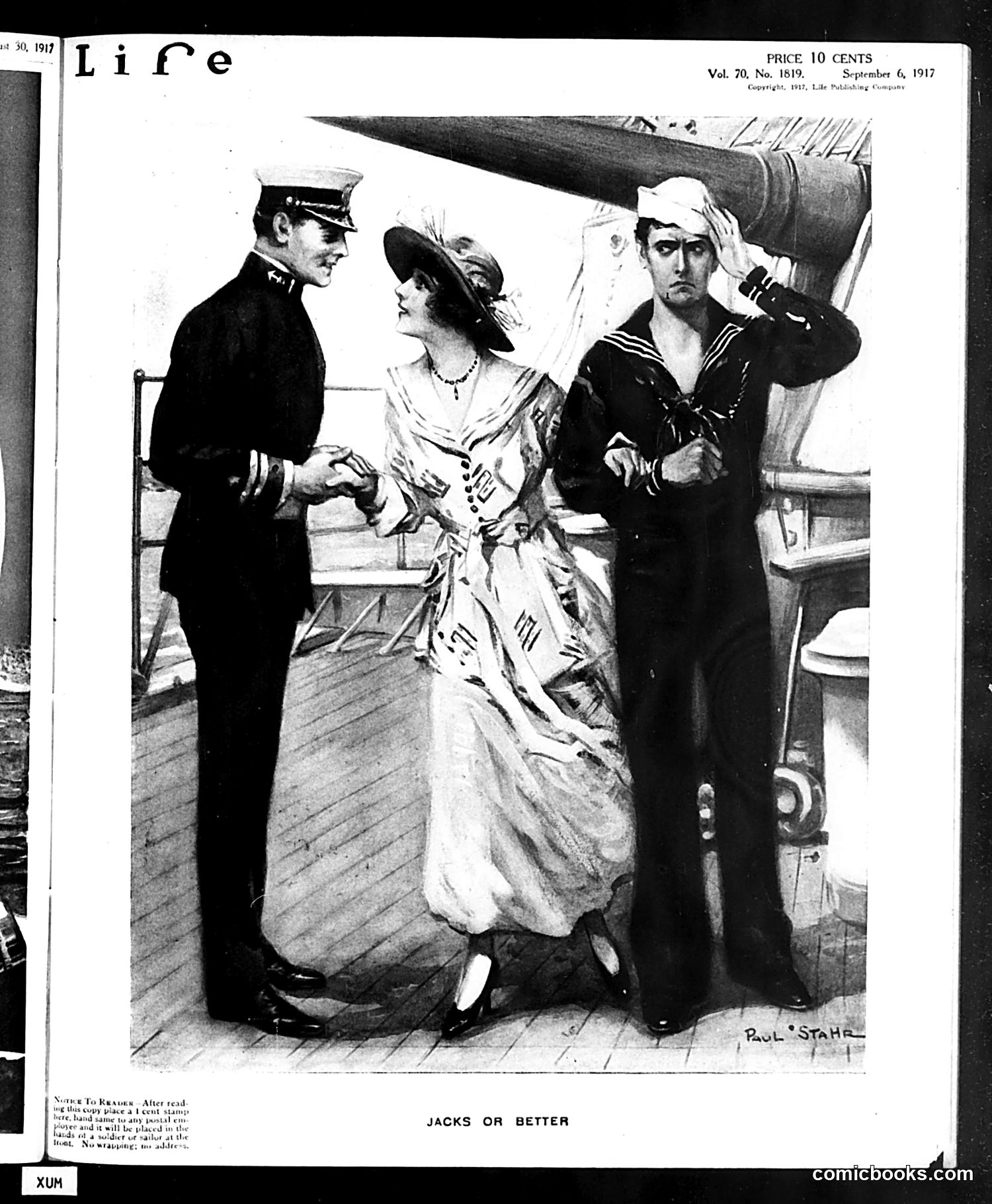
This cartoon depicts three figures aboard what appears to be a naval vessel. The title "Jacks or Better" is a poker term (requiring a pair of jacks minimum to open betting), suggesting a gambling/risk metaphor. The image shows a naval officer on the left conversing with a woman in an elegant dress in the center, while a sailor on the right adjusts his bandage. The cartoon likely satirizes American military personnel during World War I (the U.S. entered in April 1917), possibly commenting on military readiness, shore leave decisions, or romantic entanglements involving servicemen. The specific political or social critique remains unclear without additional context, though the artistic style and composition suggest commentary on military personnel's judgment or priorities during wartime.
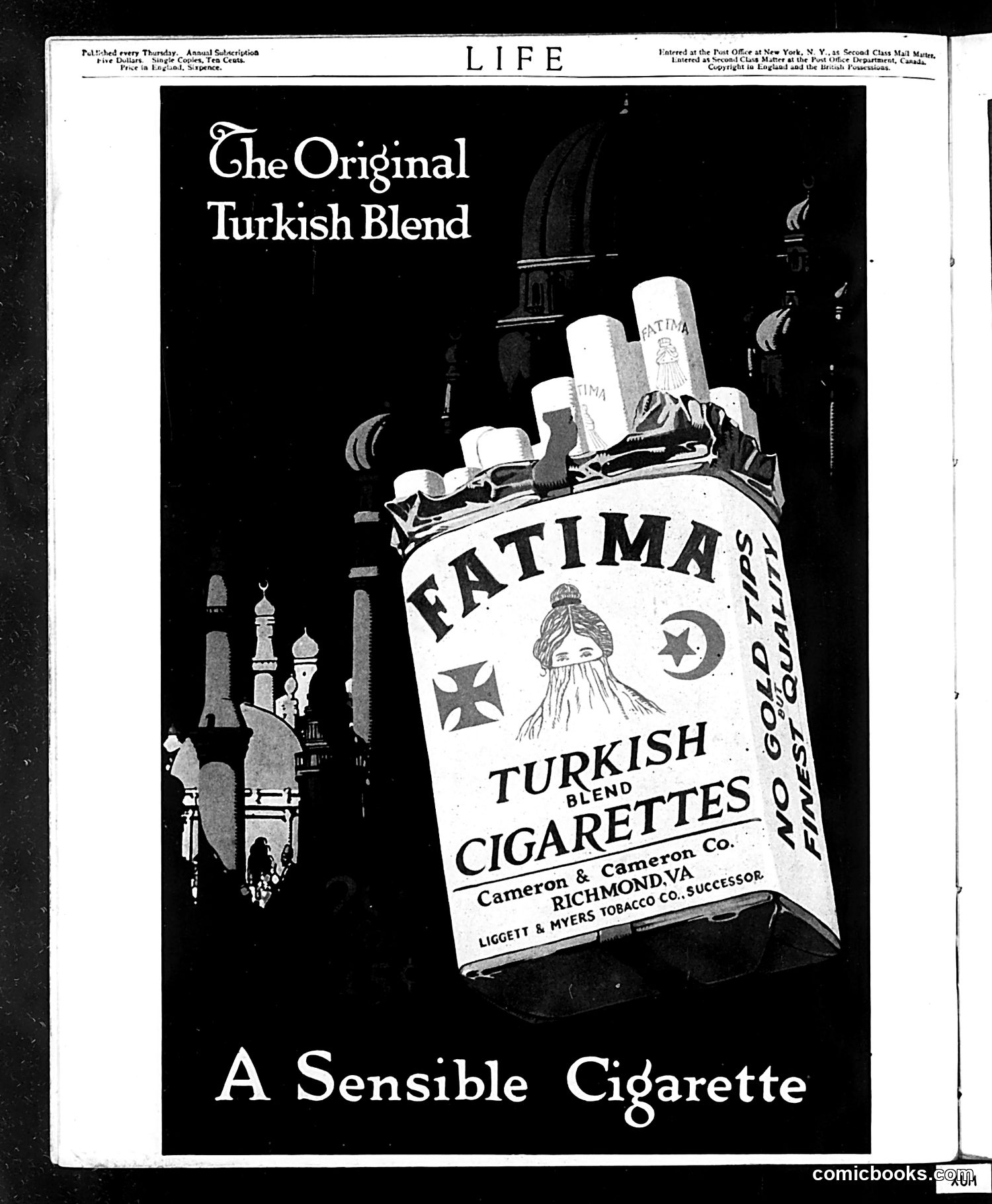
This page is primarily an **advertisement**, not political satire. It promotes Fatima Turkish Blend Cigarettes, manufactured by Cameron & Cameron Co. of Richmond, Virginia (successor to Liggett & Myers Tobacco Co.). The ad uses orientalist imagery—silhouettes of minarets and Ottoman architecture—to evoke Turkey and lend exotic appeal to "the original Turkish blend." The tagline "A Sensible Cigarette" suggests marketing to consumers seeking a quality product. The cigarette package dominates the composition, displaying the Fatima brand name with a bearded Turkish figure and crescent moon symbol—visual markers of Turkish identity used to differentiate the product in early 20th-century American markets. This reflects historical tobacco advertising's reliance on ethnic/colonial imagery to create brand identity and prestige.
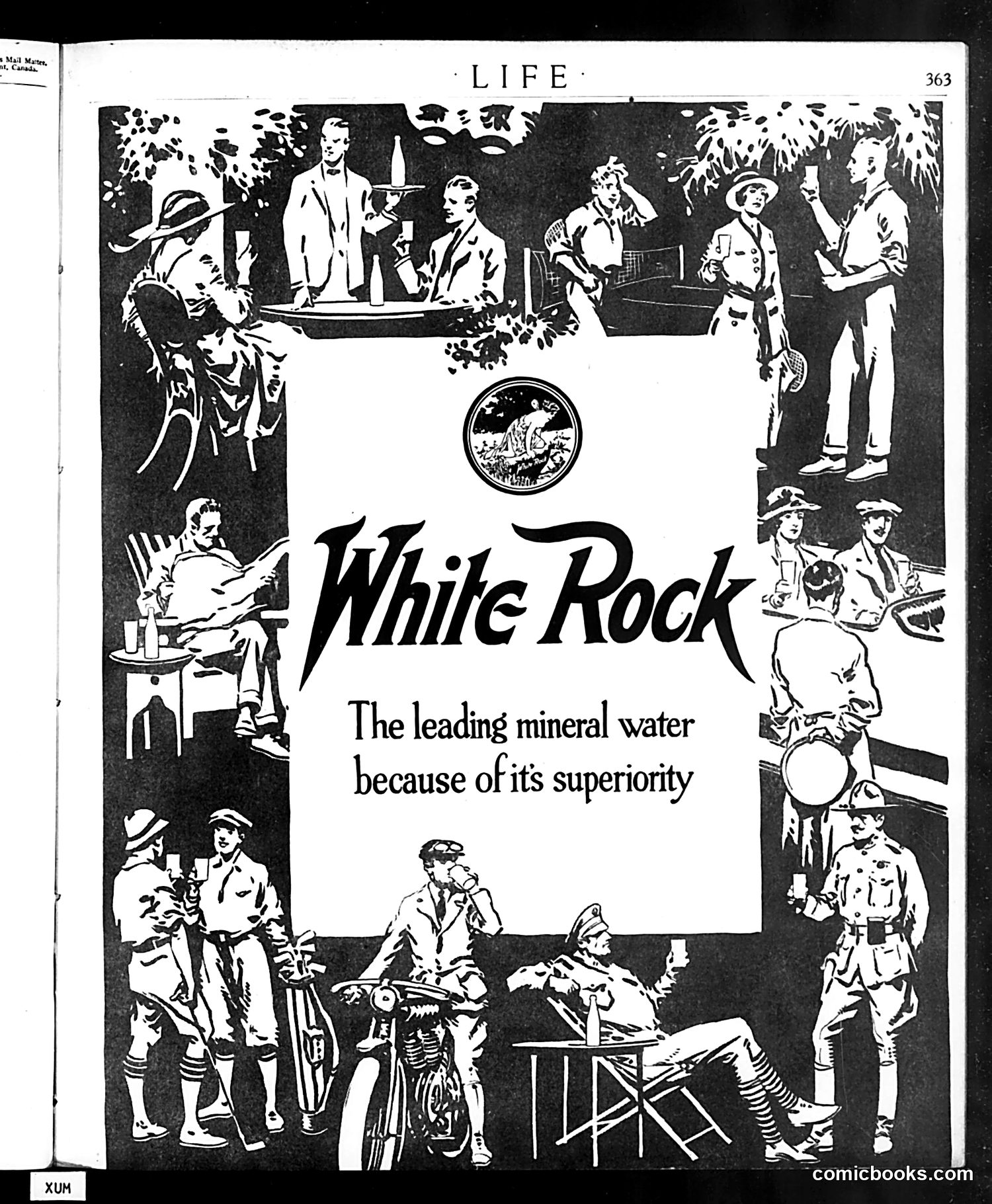
This is a **commercial advertisement**, not political satire. The page promotes White Rock mineral water as "the leading mineral water because of its superiority." The illustration depicts leisure activities across different social classes and settings—a garden party, beach scene, picnic, and outdoor recreation with motorcycles and sports. The diverse figures (men and women in various casual and formal attire) suggest the product appeals to everyone. This reflects early 20th-century marketing strategy: positioning a luxury good as universally desirable by showing it consumed across different contexts and social situations. The aspirational imagery—elegant gatherings, outdoor recreation, leisure time—associates White Rock with a desirable lifestyle rather than merely functional hydration.
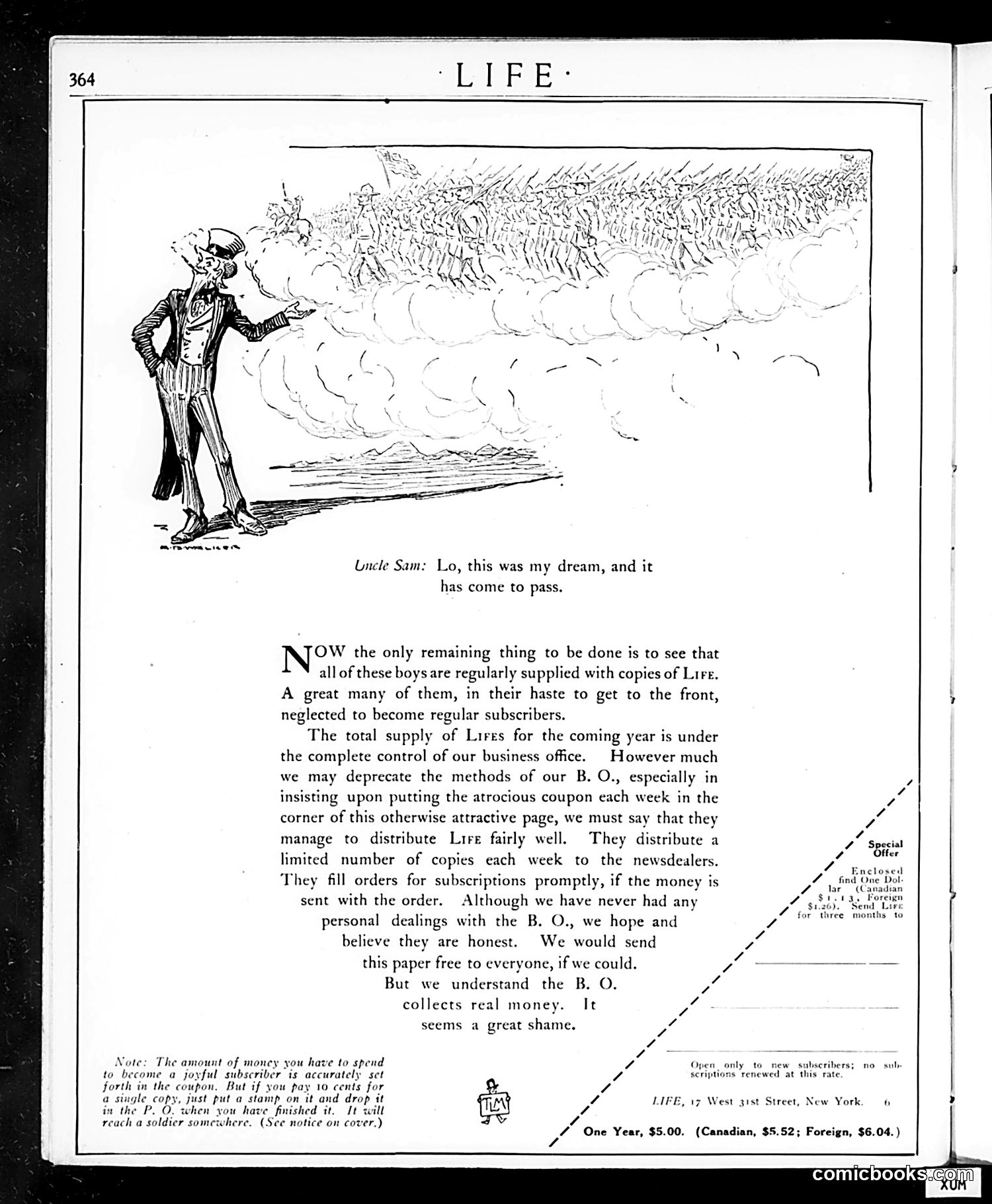
The cartoon depicts **Uncle Sam** (personified America) observing masses of soldiers marching into clouds above, saying "Lo, this was my dream, and it has come to pass." The accompanying text discusses Life magazine's distribution to soldiers at the front, praising their business office's efficiency despite criticizing their coupon subscription methods. The author expresses hope the B.O. (business office) is "honest" while acknowledging they collect "real money." **The satire**: Uncle Sam's dream of military might has materialized as soldiers march forward. The text's backhanded compliments about the B.O.—praising efficiency while doubting integrity—satirize both corporate bureaucracy and wartime profiteering. The passage suggests tension between patriotic sentiment and commercial self-interest during what appears to be a World War I-era publication.
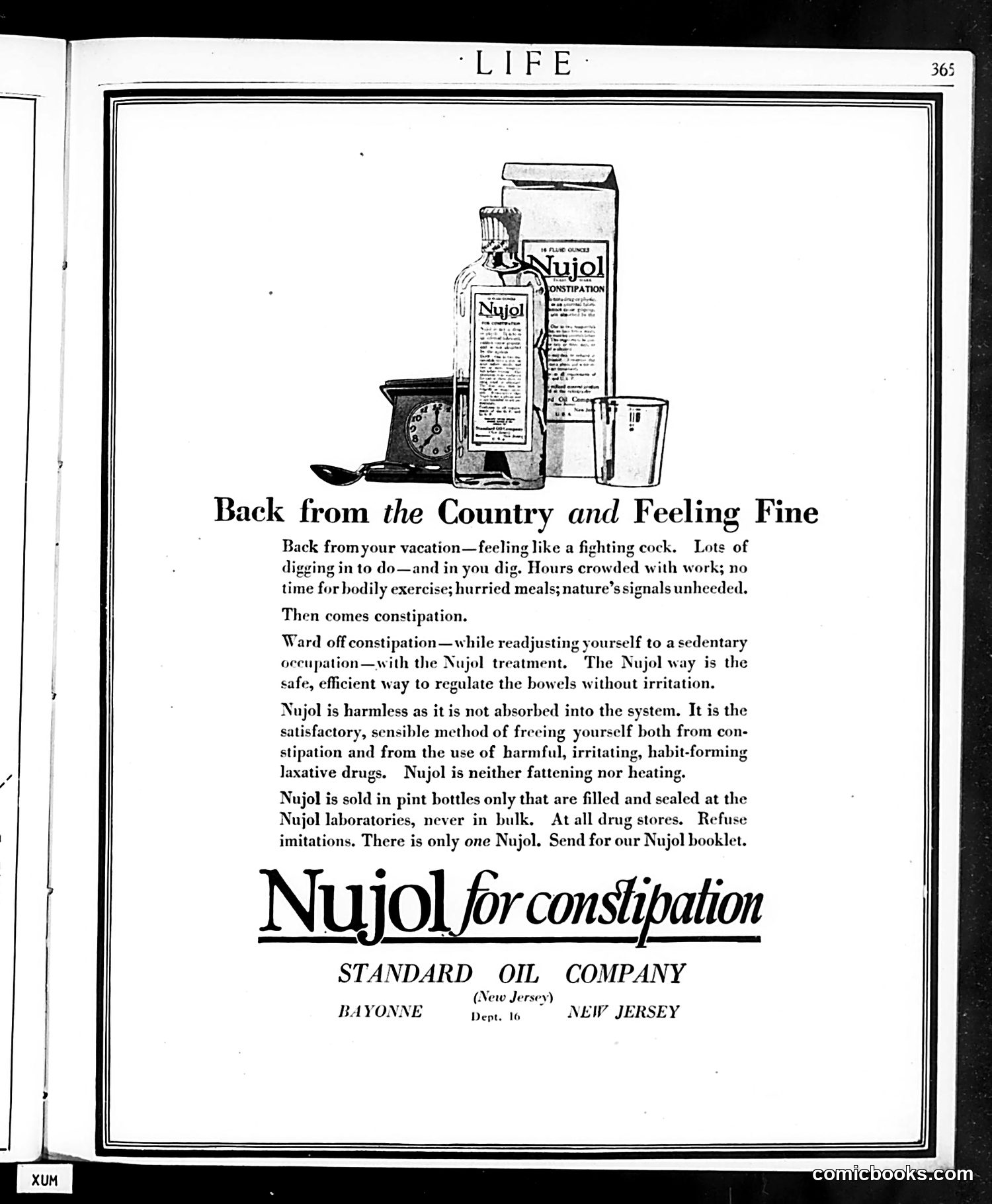
This is a **product advertisement**, not a political cartoon or satirical content. The ad promotes Nujol, a laxative made by Standard Oil Company (New Jersey), based in Bayonne. The headline "Back from the Country and Feeling Fine" uses humor to address a common problem: constipation from sedentary desk work after vacation. The advertisement's appeal is straightforward—it markets Nujol as a gentle, non-irritating solution to constipation caused by lifestyle changes (lack of exercise, irregular meals). The ad emphasizes that Nujol is "harmless," "neither fattening nor heating," and sold only in sealed bottles to prevent imitations. This reflects early 20th-century advertising that openly discussed bodily functions and promoted patent medicines with broad health claims—practices later restricted by FDA regulations.
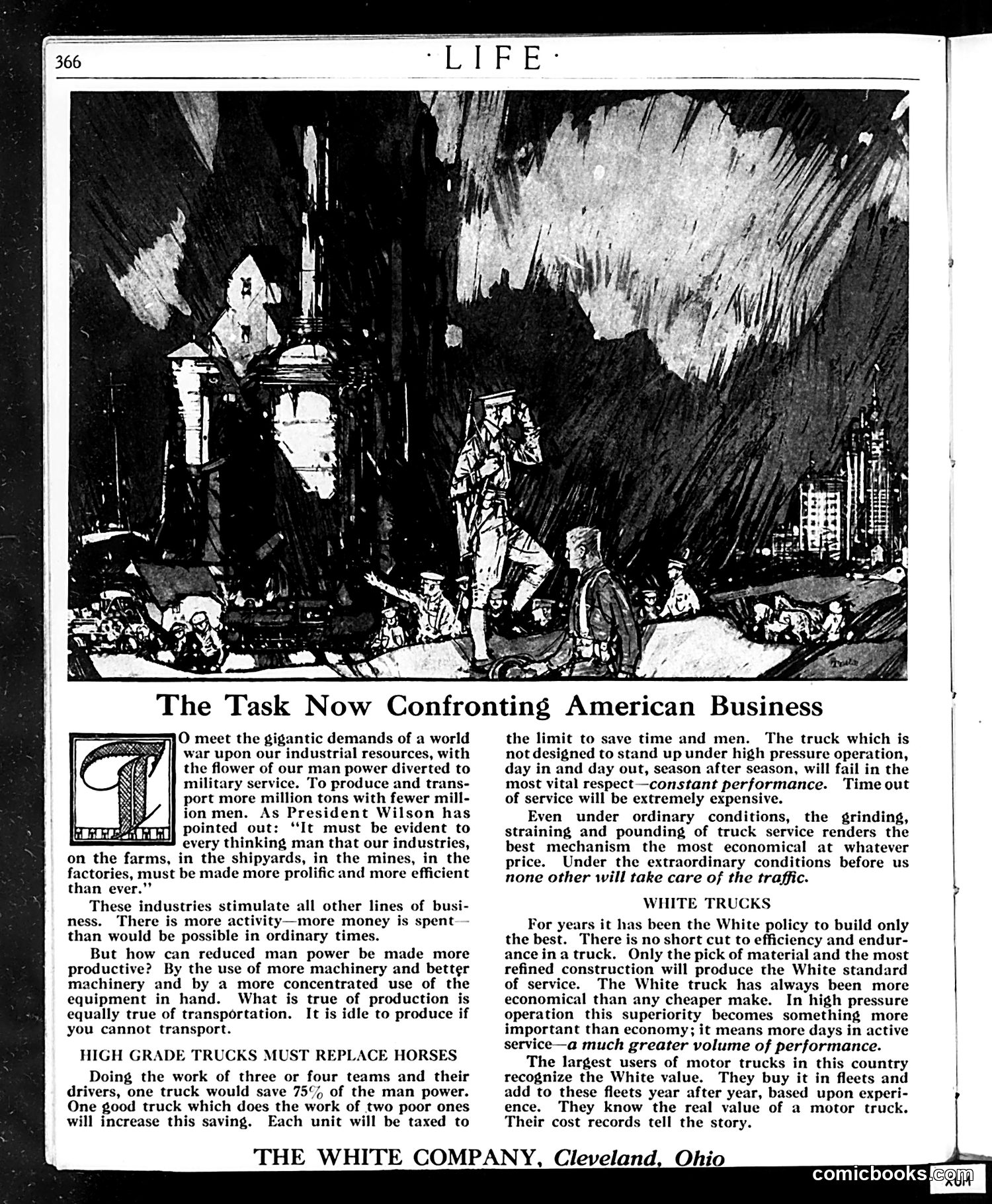
This page is primarily **advertising rather than satire**. It's a White Company truck advertisement from Cleveland, Ohio (page 366 of Life magazine). The illustration depicts an **industrial wartime scene**—factories, construction cranes, and workers amid what appears to be wartime production activity. The text references President Wilson and emphasizes how trucks are essential to American industry during this period, likely WWI. The advertisement argues that White trucks increase productivity by replacing multiple horse teams while requiring fewer workers and less maintenance time. It appeals to patriotic duty ("every thinking man") and economic efficiency. The "satire" element, if any, is subtle—the ad uses hyperbole about trucks' superiority, but this is standard advertising rhetoric rather than political commentary.
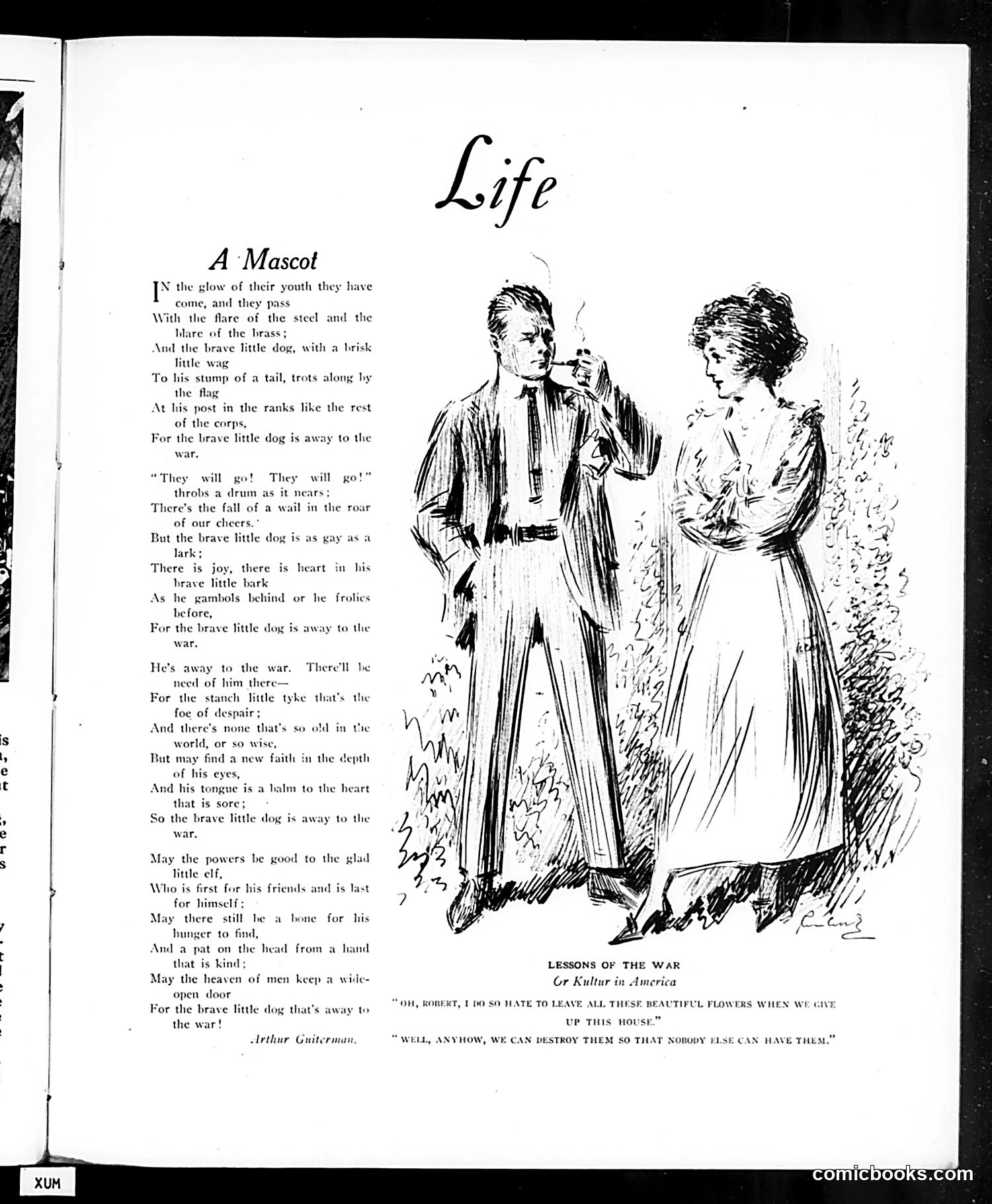
This page contains two elements: **Left side:** A poem titled "A Mascot" by Arthur Guiterman celebrating a small dog departing for war. The poem portrays the dog as brave and spirited, departing with soldiers while bringing comfort ("his tongue is a balm to the heart"). **Right side:** An illustration showing a man and woman in early 1900s dress, with dialogue below labeled "Lessons of the War: Or Kultur in America." The woman says she won't leave flowers when abandoning the house; the man responds they can destroy them so "nobody else can have them." The satire appears to mock German militarism ("Kultur") by suggesting American civilians are adopting destructive, scorched-earth tactics. The contrast between the sentimental dog poem and this cynical dialogue critiques how war attitudes were influencing American civilian behavior.
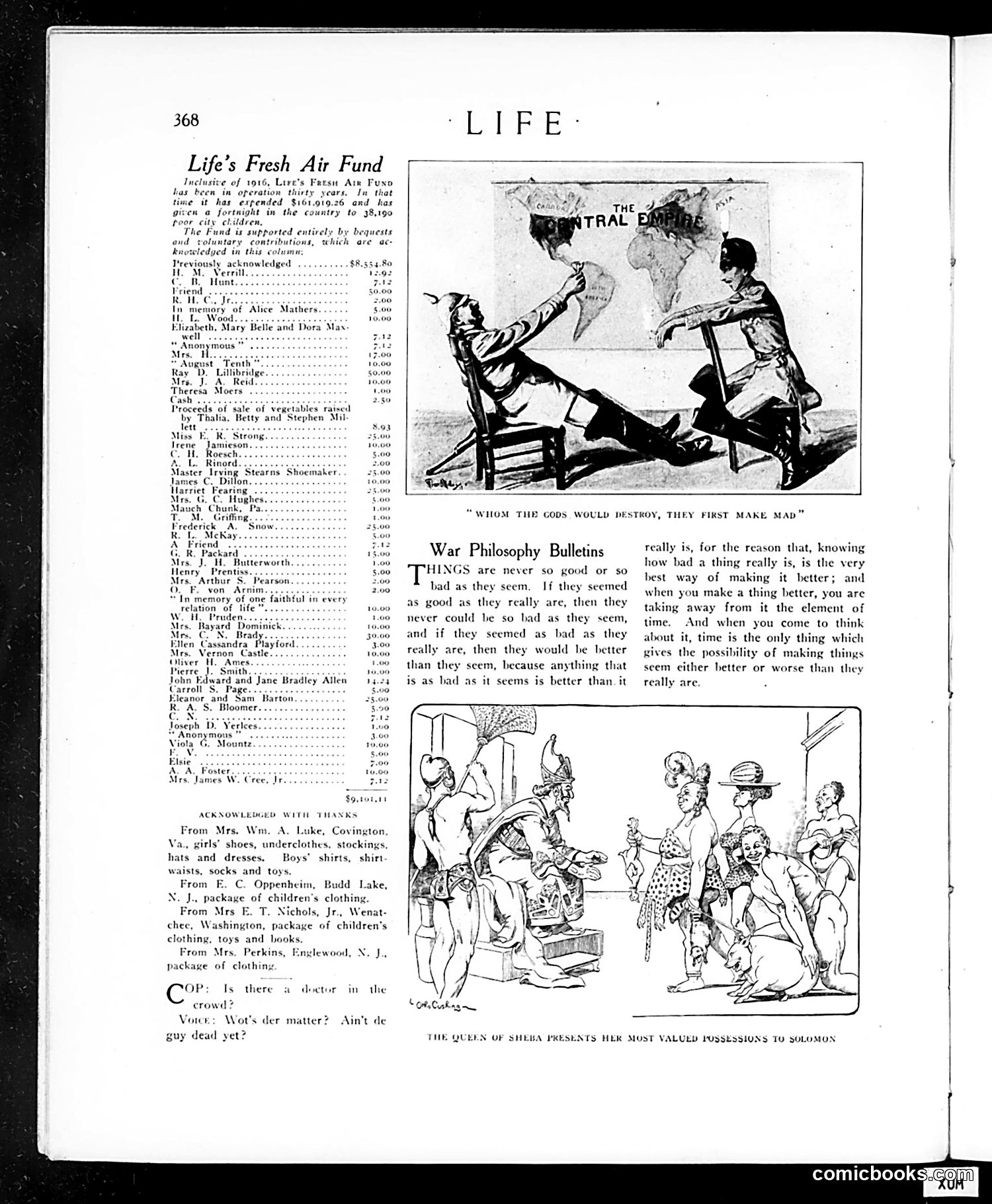
This page contains two distinct cartoons addressing World War I themes: **Top cartoon** ("Whom the Gods Would Destroy, They First Make Mad"): Shows two figures examining a world map labeled "The Central Empire." The satirical point appears to comment on German war ambitions and overconfidence—the classical allusion suggests that excessive pride precedes destruction. **Bottom cartoon** ("The Queen of Sheba Presents Her Most Valued Possessions to Solomon"): Depicts a queen offering treasures to a seated ruler surrounded by children and attendants. This likely satirizes war profiteering or the transfer of wealth/resources during wartime, using biblical reference as a mask for contemporary criticism. The page also lists "Life's Fresh Air Fund" donations and includes a "War Philosophy Bulletins" section offering cynical observations about conflict.
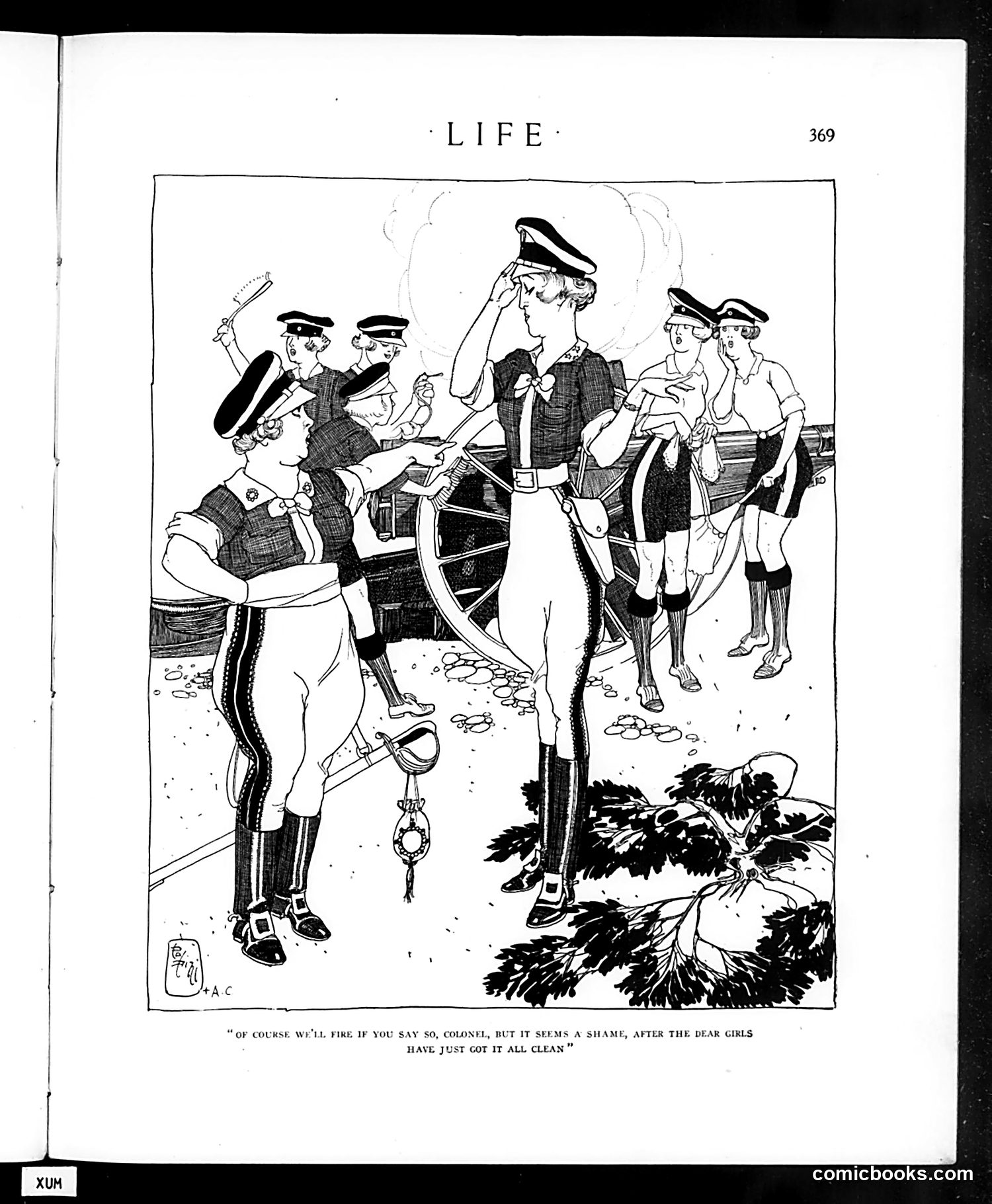
This is a satirical cartoon from Life magazine depicting a military scene. The caption reads: "Of course we'll fire if you say so, Colonel, but it seems a shame, after the bear girls have just got it all clean." The cartoon shows mounted cavalry officers on horses, with what appears to be artillery or cannon equipment. The humor derives from a domestic/cleaning reference ("bear girls...got it all clean") being absurdly applied to military weaponry and combat preparation. The "bear girls" likely refers to a specific contemporary reference—possibly a musical act, sports team, or entertainment group popular at the time—though the exact reference is unclear without additional context. The satire appears to mock the disconnect between military readiness and civilian domestic concerns, or perhaps critiques unnecessary military expenditure or action.
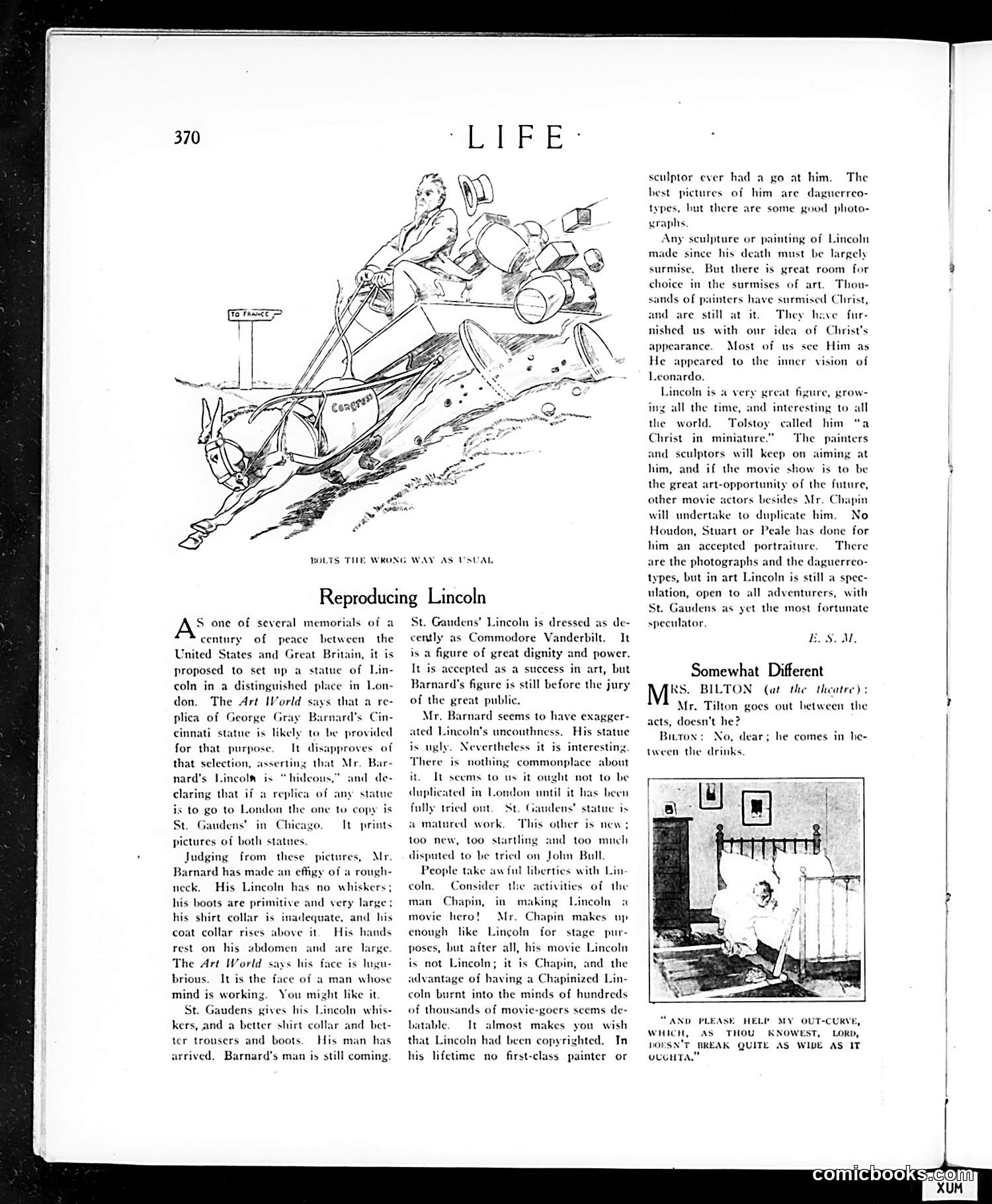
This page satirizes efforts to create statues and artistic representations of Abraham Lincoln. The main cartoon depicts a sculptor laboring chaotically over a Lincoln monument, with materials and tools scattered about—suggesting the difficulty and messiness of capturing Lincoln's likeness. The accompanying article discusses competing Lincoln statues by artists George Barnard and St. Gaudens, critiquing their respective approaches. It also references Charlie Chaplin's planned film portrayal of Lincoln, noting the irony that Chaplin (a famous comedian) would interpret this serious historical figure. The satire centers on how artists across mediums—sculpture, painting, cinema—struggle to authentically "reproduce" Lincoln, with varying degrees of success and appropriateness.
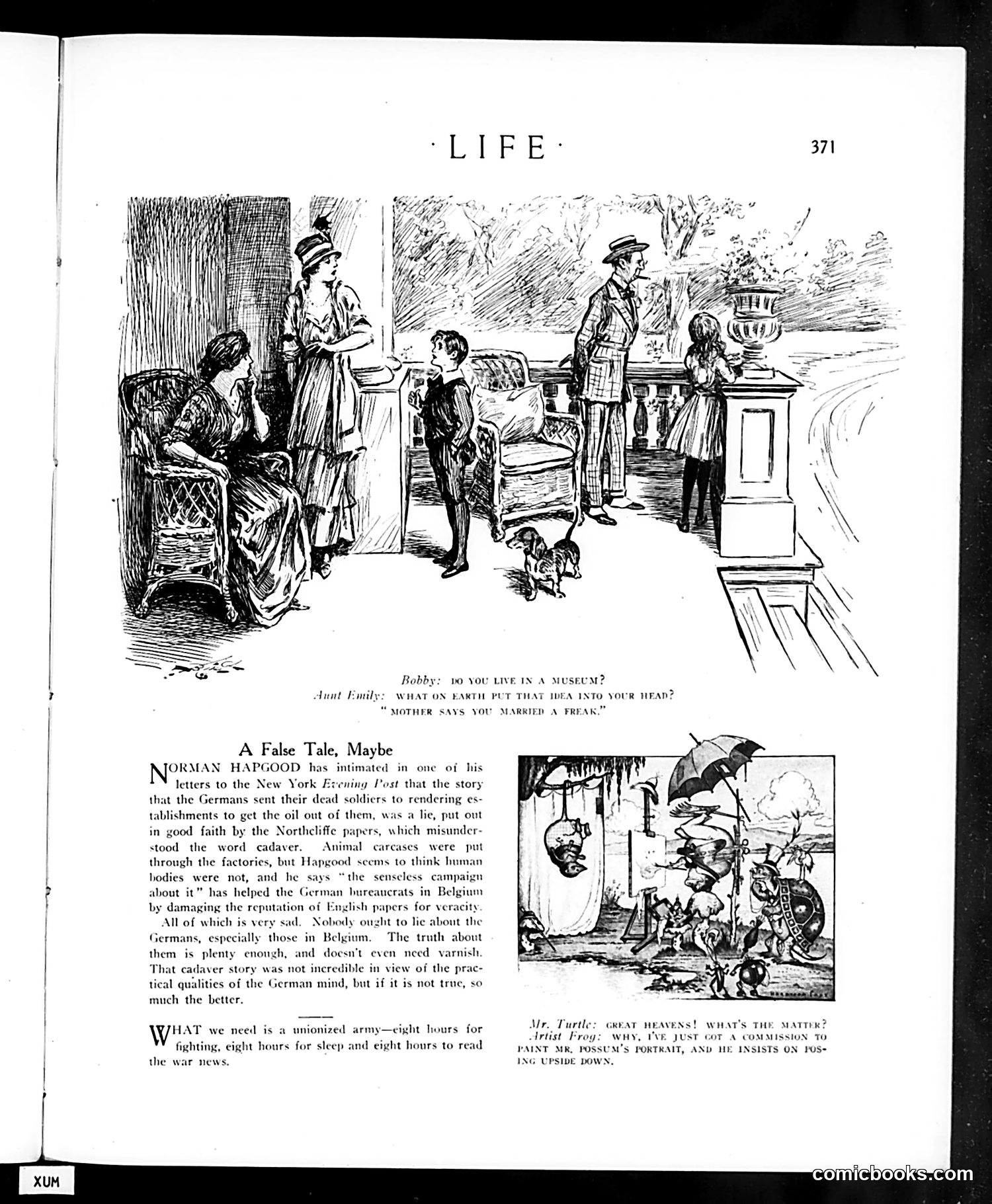
**Top Cartoon**: Shows an upper-class family scene with a boy (Bobby) asking his aunt about a museum artifact. The aunt responds with gossip: "DO YOU LIVE IN A MUSEUM?" and "WHAT ON EARTH PUT THAT IDEA IN YOUR HEAD?" The caption notes "MOTHER SAYS YOU MARRIED A FREAK." **Article Context**: Norman Hapgood, writing to the *New York Evening Post*, disputes German claims that British soldiers mutilated Belgian civilians during WWI. He argues the Germans started this "cadaver" lie, which damaged English newspapers' credibility. He states the truth about German conduct in Belgium is damaging enough without embellishment. **Bottom Cartoon**: Features Mr. Turtle and Artist Frog discussing a portrait commission, with Frog insisting on artistic control. This reflects WWI-era propaganda concerns and media credibility issues.
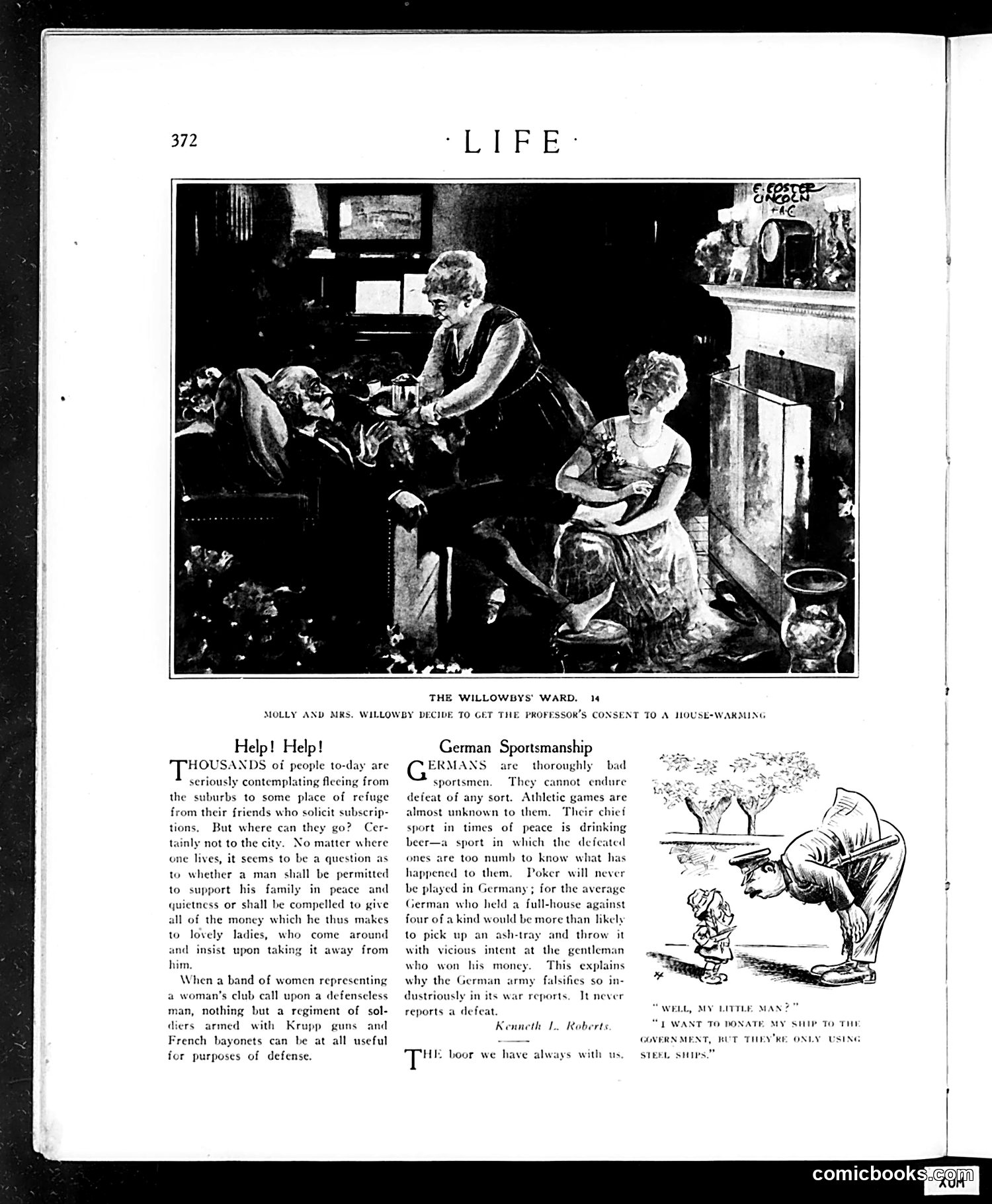
**Main Image:** "The Willowbys' Ward" - a domestic scene showing adults and a child, illustrating a narrative about obtaining a professor's consent for a house-warming party. **Left Article ("Help! Help!"):** Satirizes women's suffrage activism. It mocks the idea that women's clubs might call upon defenseless men to support family interests in peacetime. The piece ridicules the notion of armed conflict between civilians, sarcastically suggesting "French bayonets" could be defensive tools. **Right Article & Cartoon ("German Sportsmanship"):** Critiques German military culture as inherently aggressive and dishonest. The piece argues Germans cannot accept defeat, blaming their war losses on false reporting rather than actual defeats. The cartoon depicts this attitude through an adult-child interaction about donating ships, suggesting German dishonesty toward government. Both sections reflect pre-WWI American anxieties about feminism and German militarism.
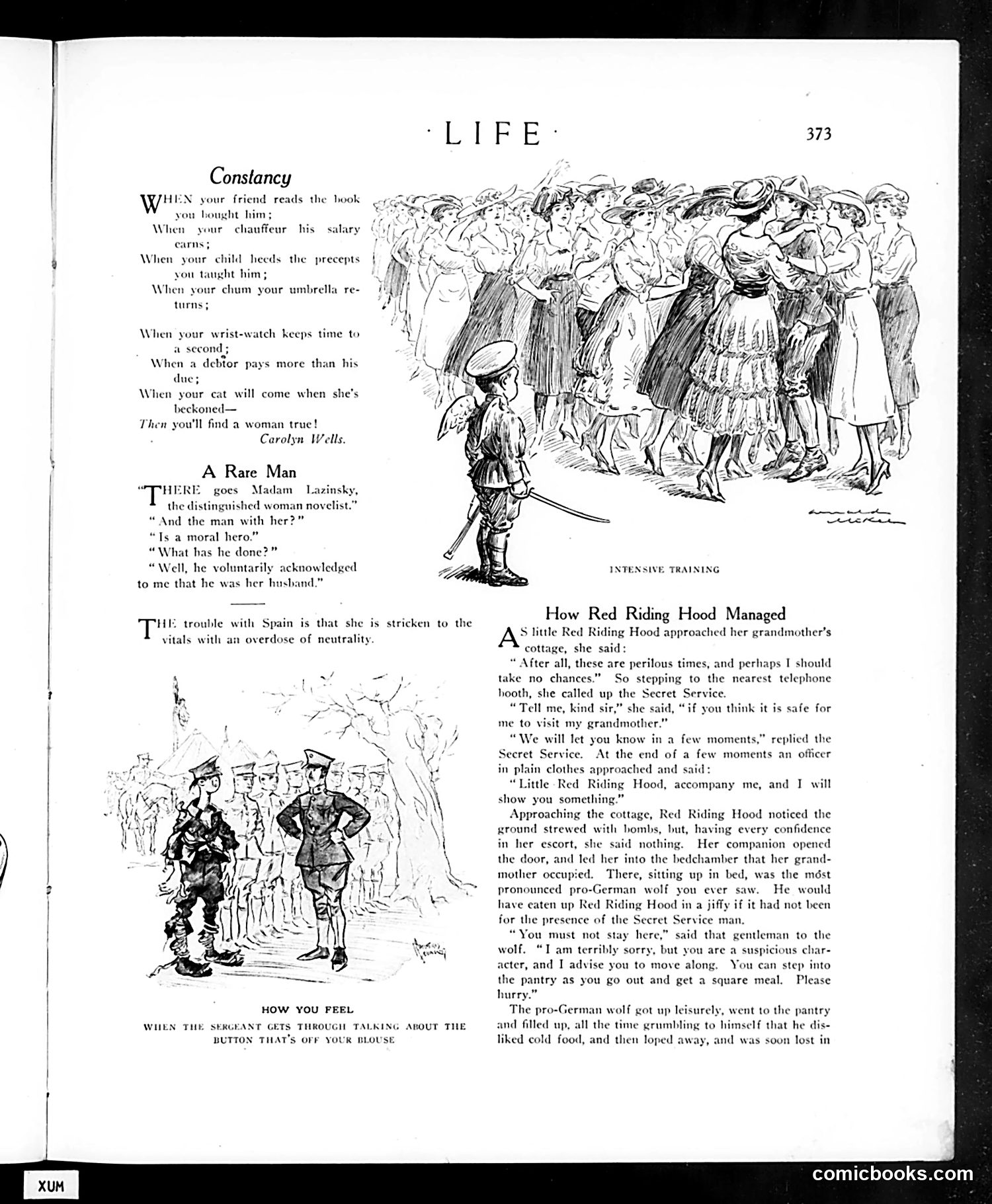
This page contains several satirical pieces typical of early 20th-century Life magazine humor: **"Constancy"** is a poem listing situations when a woman proves her loyalty—when friends borrow books, servants quit, children misbehave, etc.—concluding "Then you'll find a woman true!" **"A Rare Man"** jokes about a "moral hero" who admits to his lover that he was her husband—satirizing male dishonesty. **"How Red Riding Hood Managed"** reimagines the fairy tale with wartime espionage: a Secret Service agent escorts Little Red Riding Hood past a suspicious pro-German wolf, who becomes distracted by food. It's a WWI-era propaganda piece satirizing German spies and wartime precautions. The illustrations show soldiers, crowds, and the wolf encounter, using familiar fairy-tale framing for contemporary security concerns.
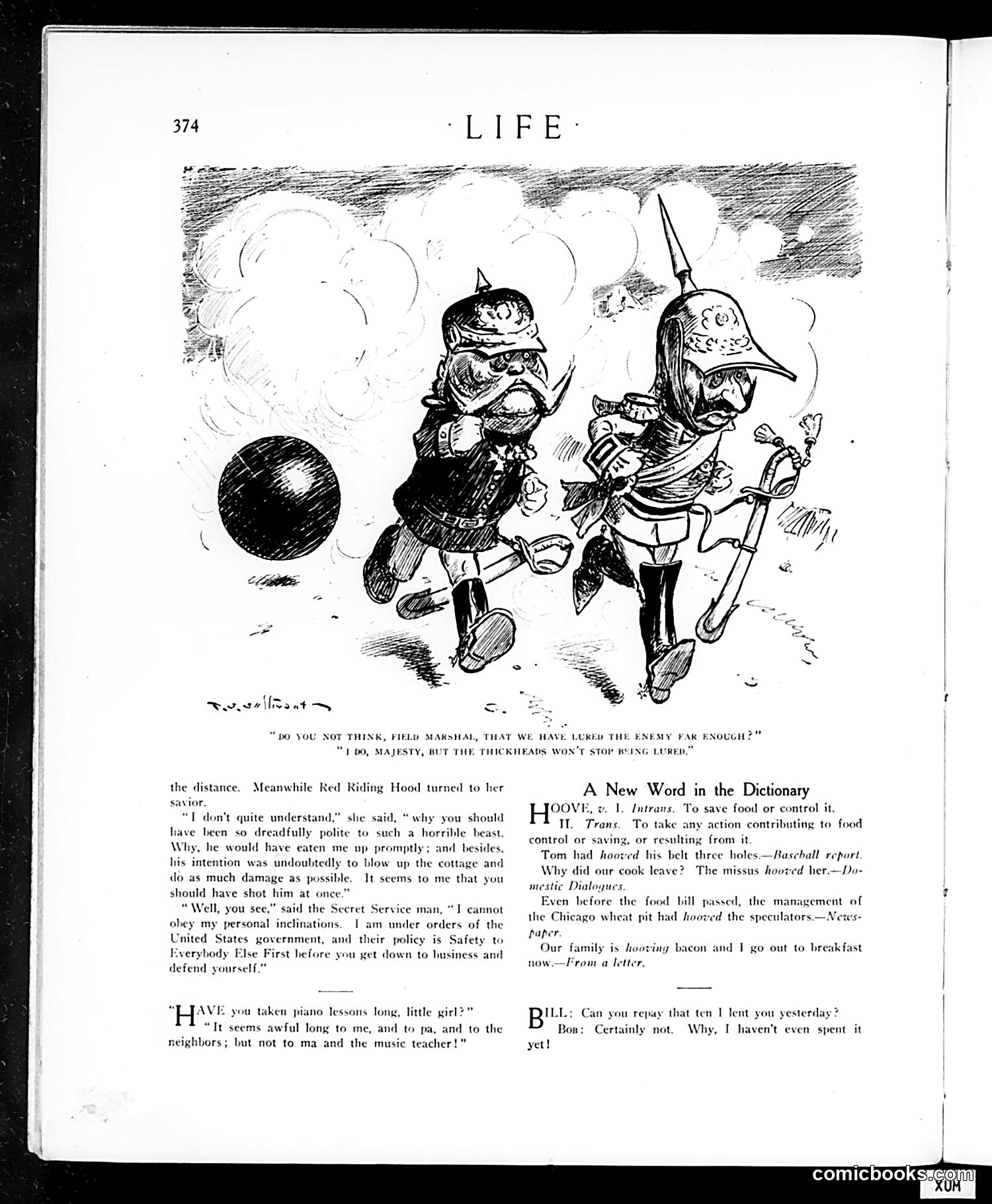
The main cartoon depicts two Prussian/German military officers with spiked helmets ("Pickelhaubes") discussing a large black sphere—likely representing a bomb or explosive device. The caption reads: "Do you not think, Field Marshal, that we have lured the enemy far enough?" / "I do, Majesty, but the thickheads won't stop being lured." This appears to be **World War I-era satire** mocking German military strategy. The cartoon suggests German leaders deliberately baited enemies into unfavorable positions, yet their opponents foolishly kept advancing. The "thickheads" reference implies the enemy commanders were stupid for not recognizing the trap. The crude, exaggerated caricatures of German officers (with their characteristic helmets and facial features) reflect wartime propaganda depicting the enemy as ridiculous and contemptible.
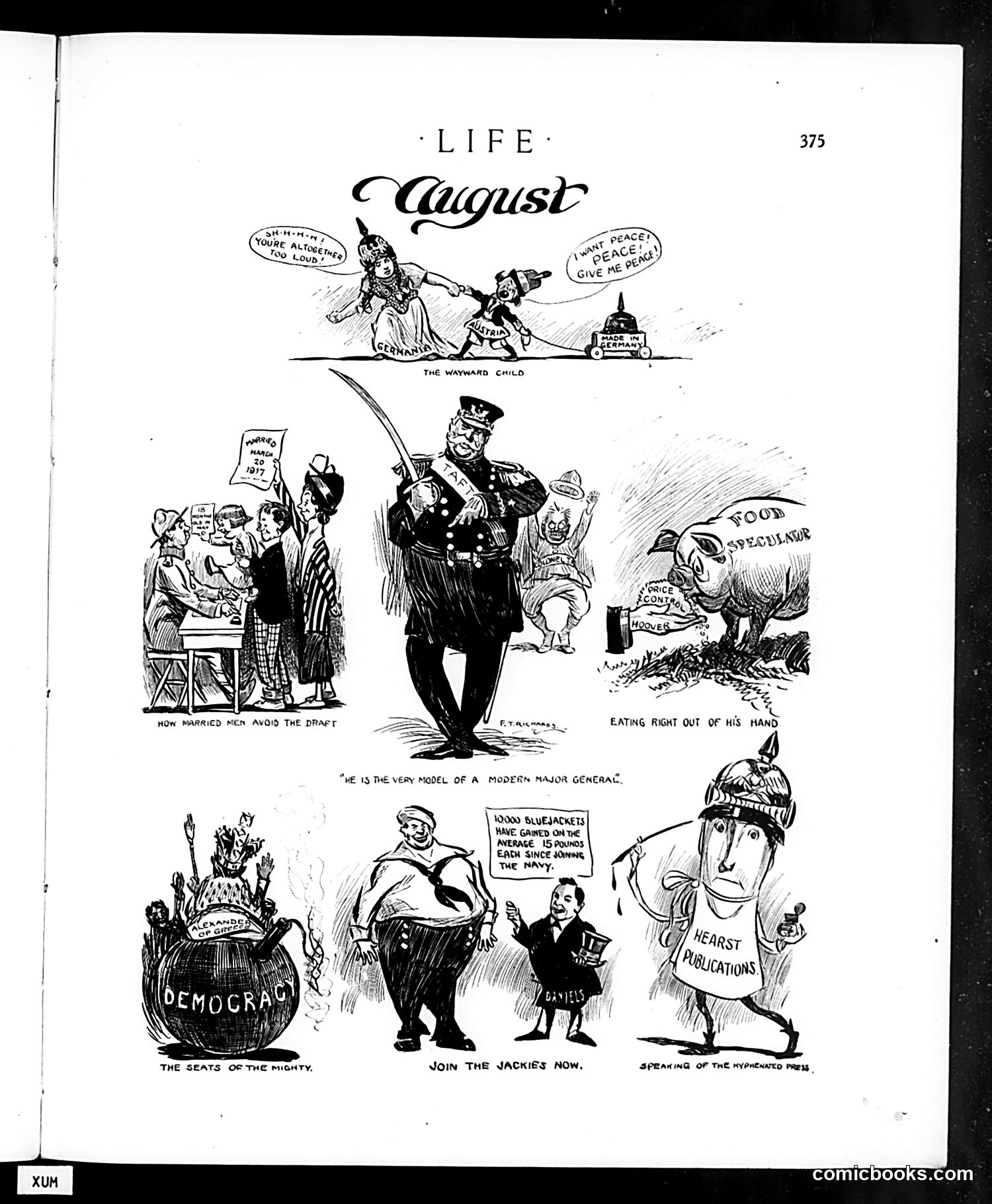
This Life magazine page contains six cartoons satirizing World War I politics and German militarism. "The Wayward Child" shows Germany as a spoiled, aggressive infant demanding "peace" while Britain pacifies it. The central figure labeled "a modern major general" appears to be a bloated German military officer. "The Seats of the Mighty" depicts Democracy as a fragile throne under threat. "Join the Jackies Now" and other panels mock military recruitment and the hypocrisy of wartime leadership. "Speaking of the Hyphenated Press" criticizes German-American publications. The overall message condemns German aggression, militarism's corruption of democratic values, and perceived propaganda from German-sympathetic American media during this period before U.S. entry into WWI.
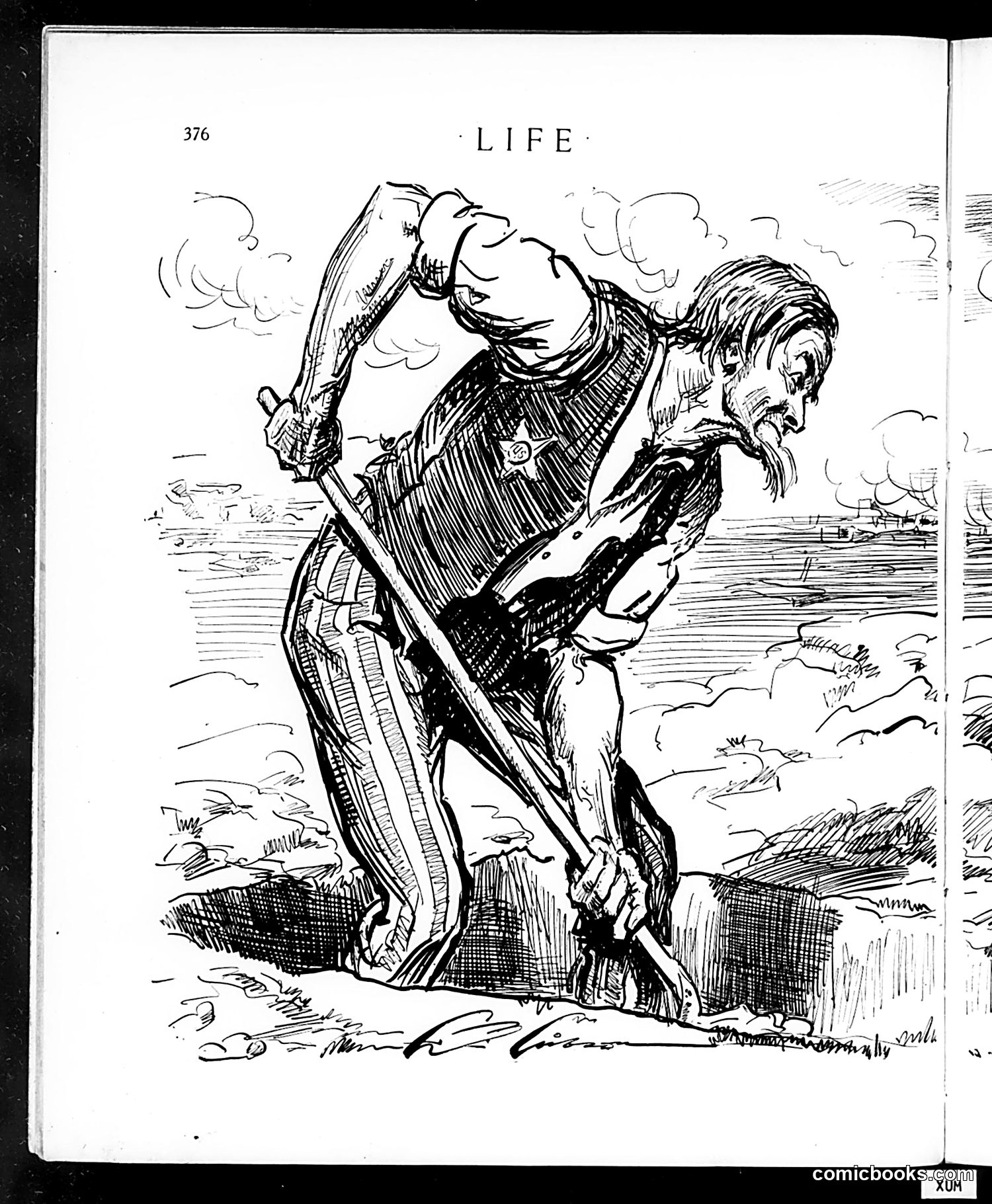
This page from *Life* magazine (page 376) contains a single political cartoon. The image shows a caricatured figure in period clothing wielding a large sword or axe in an aggressive stance, positioned near water with ships visible in the background. Without being able to read the OCR'd text clearly (it appears corrupted as "sayy \ WIE"), I cannot definitively identify the specific figure or political event being satirized. The martial pose and naval setting suggest this may reference a military or naval conflict, possibly from the late 19th or early 20th century when *Life* was actively publishing political satire. The artist's signature appears at the bottom, but I cannot read it with certainty from this image. To accurately explain the satire's specific meaning, I would need either clearer accompanying text or additional context about the publication date.
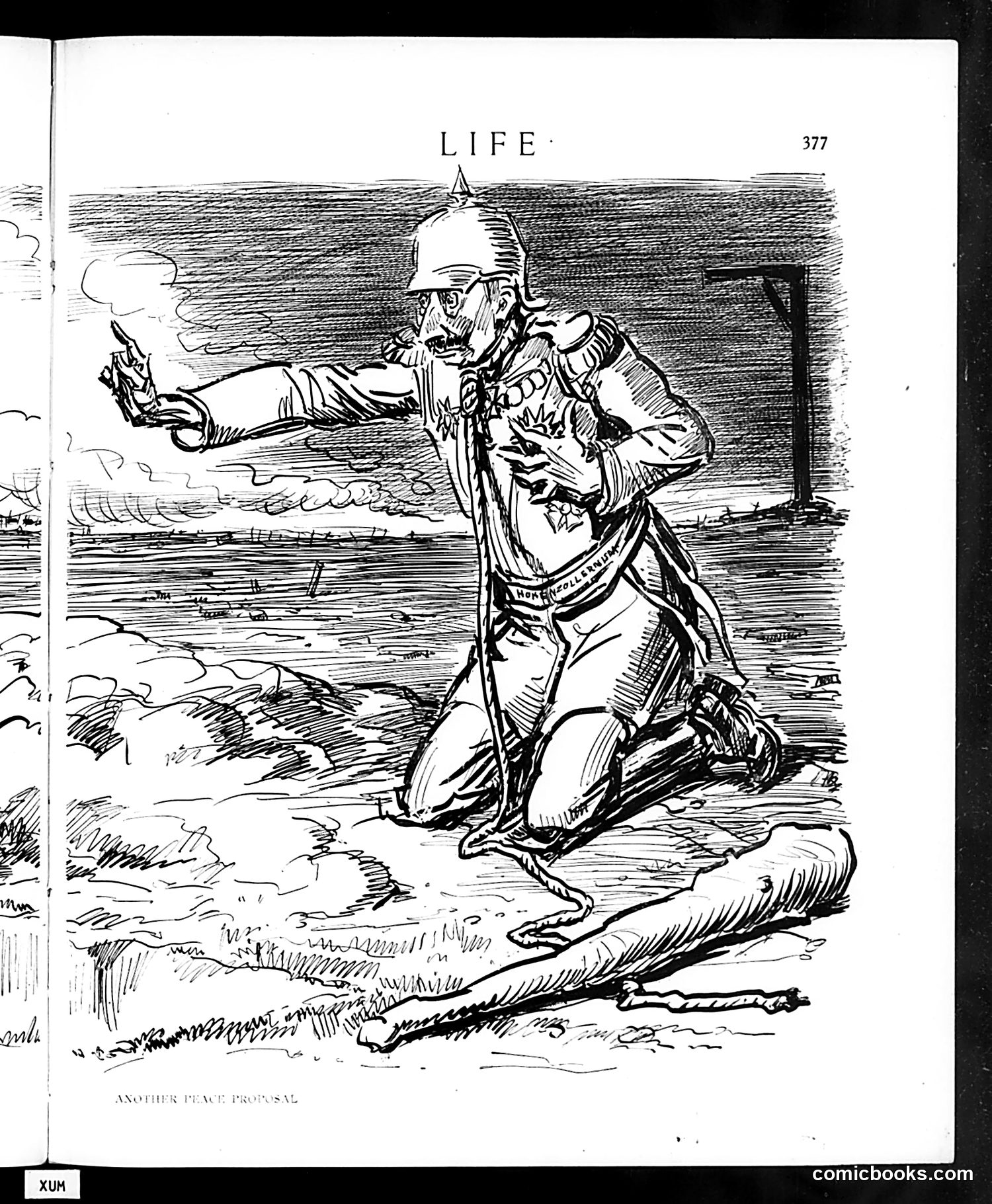
This is a satirical cartoon titled "Another Peace Proposal" from Life magazine (page 377). It depicts a caricatured military figure in a Prussian-style spiked helmet (pickelhaube), kneeling in a submissive pose while extending an olive branch. The exaggerated facial features and military regalia suggest this represents German leadership. The satire appears to mock peace proposals from Germany, likely during World War I, by depicting the military aggressor in a humiliating, forced position of surrender. The cartoon suggests such "peace proposals" are insincere or coerced rather than genuine—the figure maintains military dress and bearing despite the gesture of peace, implying Germany's aggressive nature remains unchanged. The humor derives from the contradiction between aggressive militarism and feigned peaceful intent.
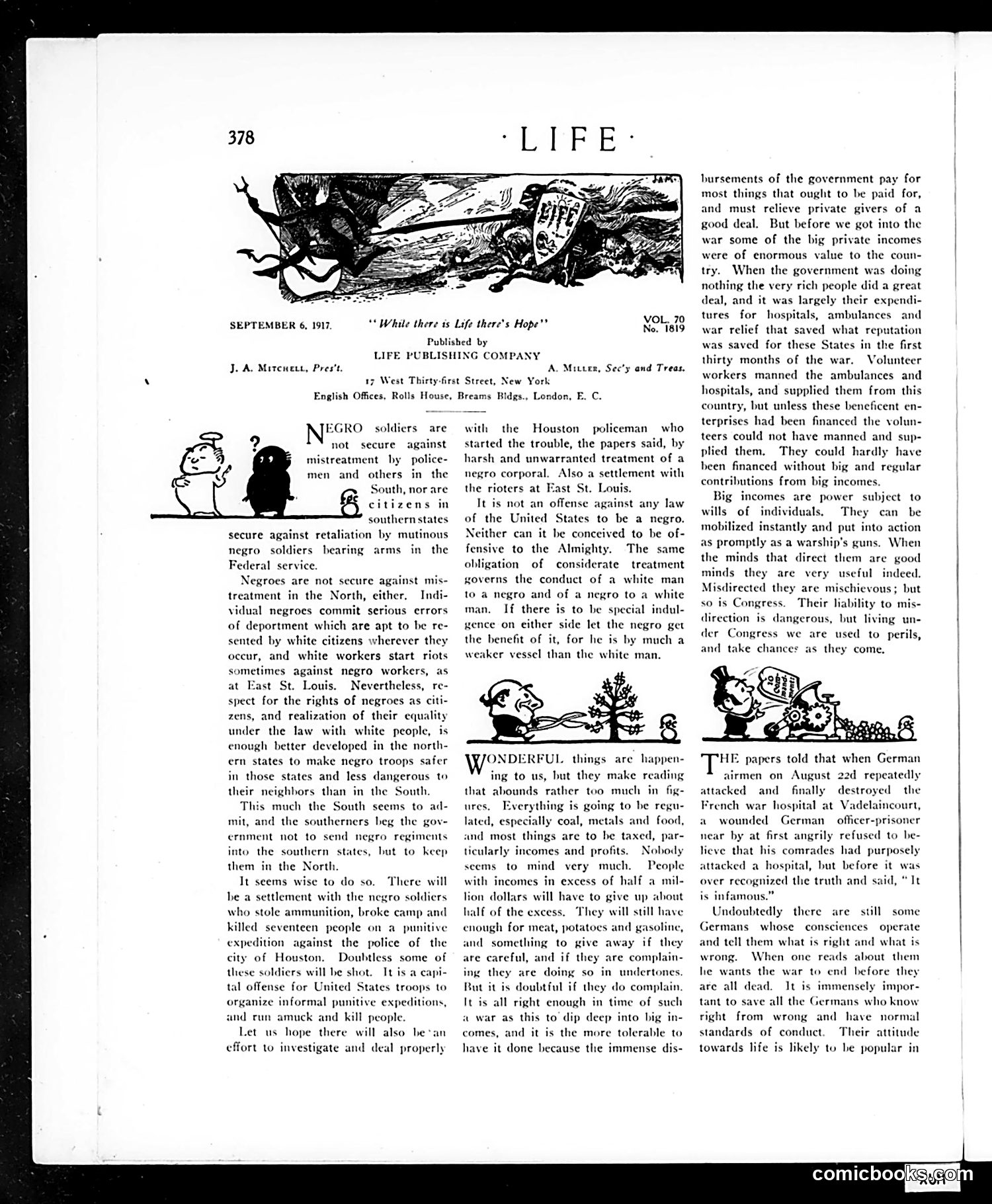
This editorial addresses racial violence and military service during World War I. The page references two specific incidents: the **Houston riot** (1917), where Black soldiers clashed with police, killing seventeen people, and the **East St. Louis riot** (1917), a white mob attack on Black residents. The cartoons (small illustrations accompany the text) appear to depict racial conflict and inequality—showing figures in confrontational or unequal positions, though exact details are difficult to discern. The editorial's argument is notably progressive for 1917: it condemns mistreatment of Black soldiers and civilians, asserts legal equality regardless of race, and advocates investigating white authorities (the Houston police) who provoked the incident. It advocates keeping Black troops in the North where they face "less dangerous" conditions—acknowledging the South's hostility while proposing geographic rather than systemic solutions. The piece frames racial justice as a practical wartime concern and moral obligation, though it stops short of demanding fundamental change in Southern racial structures.
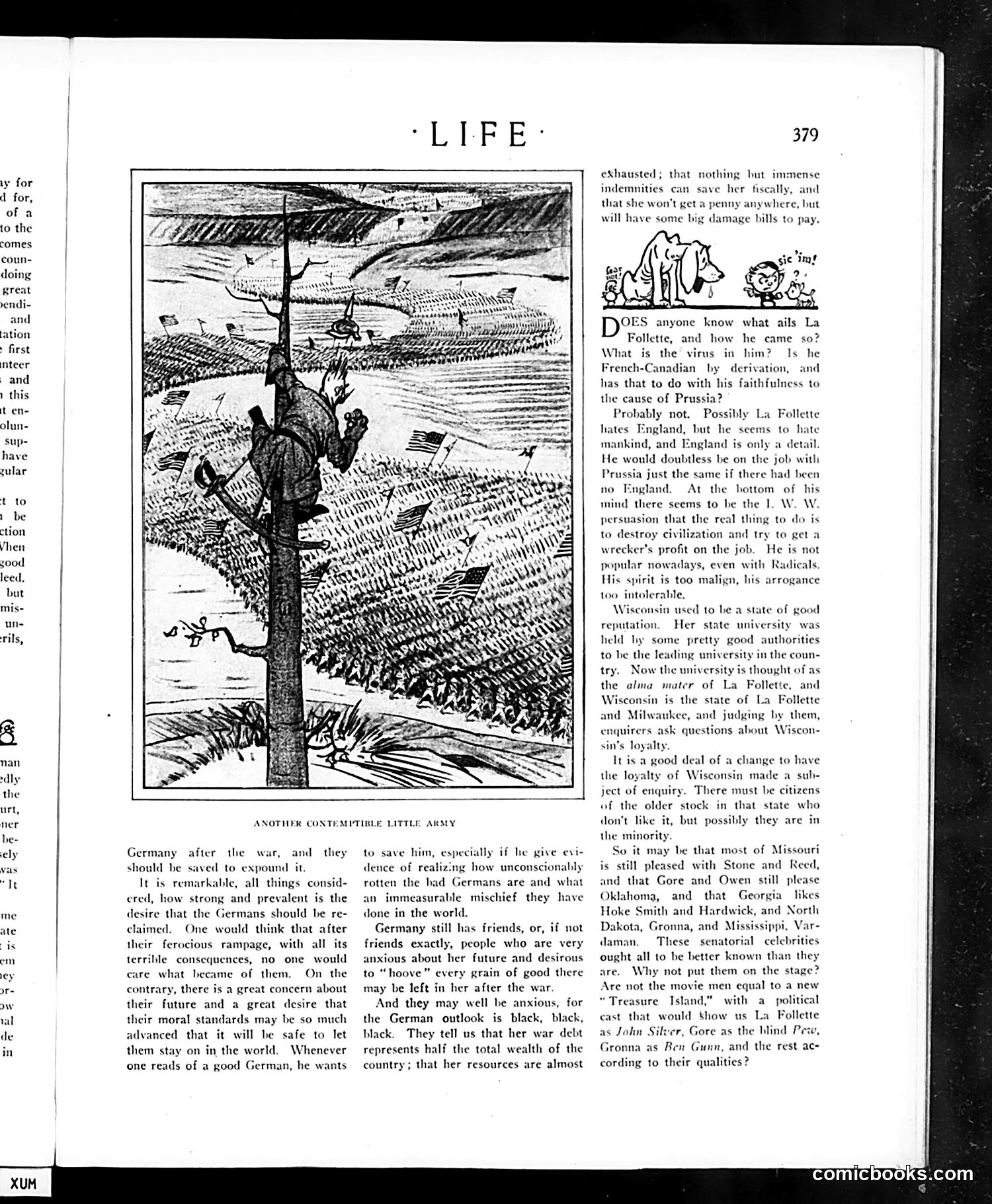
The cartoon depicts a scarecrow-like German soldier standing in a devastated battlefield strewn with bodies and debris. The accompanying text discusses post-WWI Germany's dire situation: massive war debt, resource exhaustion, and moral reckoning. The satire operates on two levels: The image suggests Germany itself has become a hollow, pathetic remnant after the war's devastation. The text then pivots to attacking Senator Robert La Follette of Wisconsin for his perceived sympathy toward Germany and opposition to American interventionism. The author sarcastically questions whether La Follette's loyalty to "the cause of Prussia" stems from his French-Canadian heritage, portraying him as un-American and sympathetic to America's defeated enemy. The piece reflects post-WWI tensions: resentment toward pacifists and isolationists who'd opposed U.S. involvement, while also expressing ambivalent concern for German reconstruction alongside contempt for German militarism.
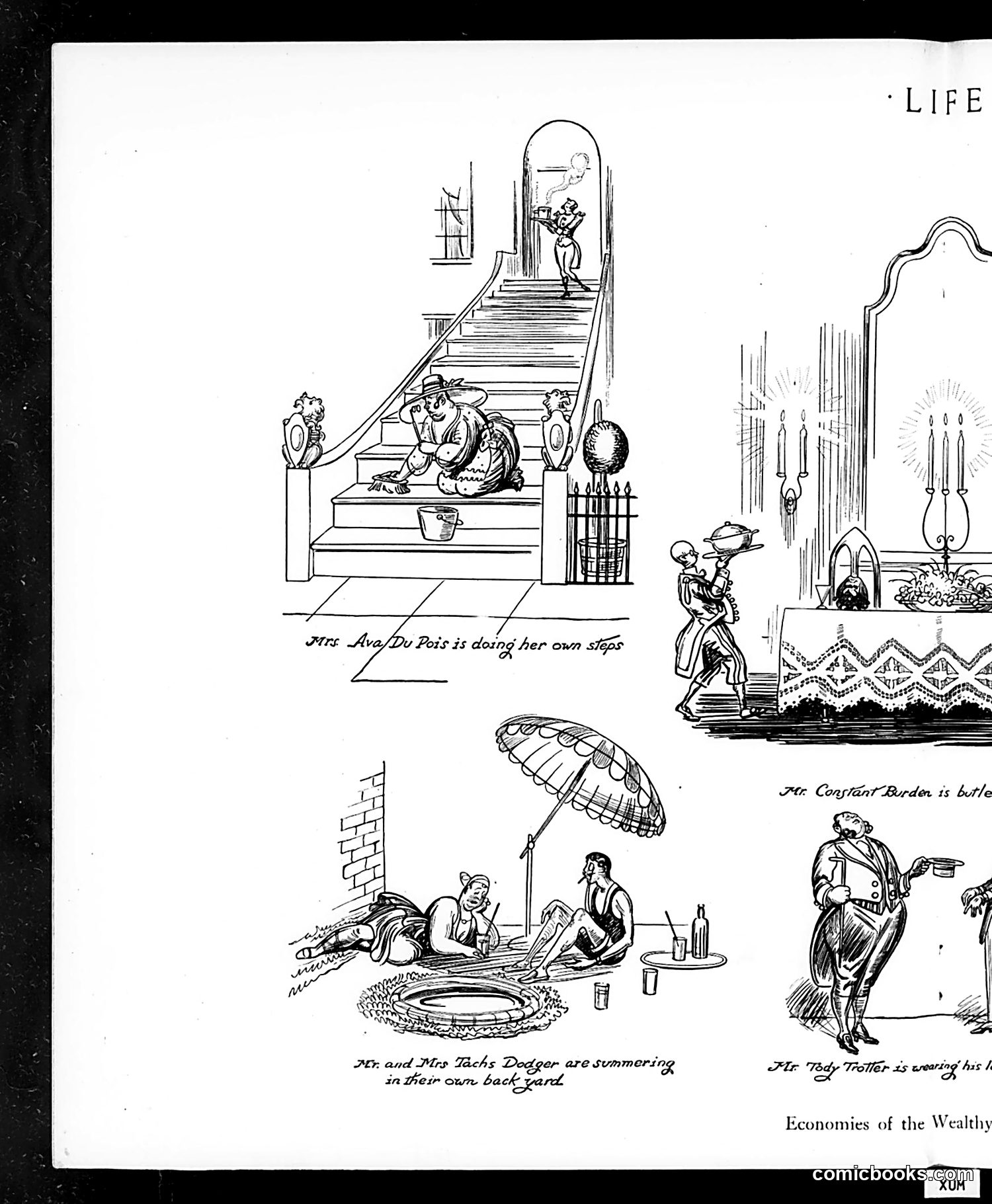
This satirical page mocks wealthy people's pretensions and lifestyle choices. The cartoon depicts various wealthy figures engaging in absurd "economizing" behaviors: - **Mrs. Ava/Du Pois** climbs stairs herself rather than being carried - **Mr. and Mrs. Zachs Dodger** summer in their own backyard instead of traveling - **Mr. Confident Burdon** appears to practice some form of self-sufficiency - **Mr. Toby Trotter** engages in another economical activity The satire's point: despite claiming financial hardship or frugality, the wealthy still maintain their pretentious lifestyles—their "economies" are laughably trivial compared to actual working-class constraints. The humor lies in the gap between their claim to economize and their continued privileged circumstances. This likely reflects post-WWI or Depression-era commentary on wealthy Americans claiming hardship while remaining fundamentally affluent.
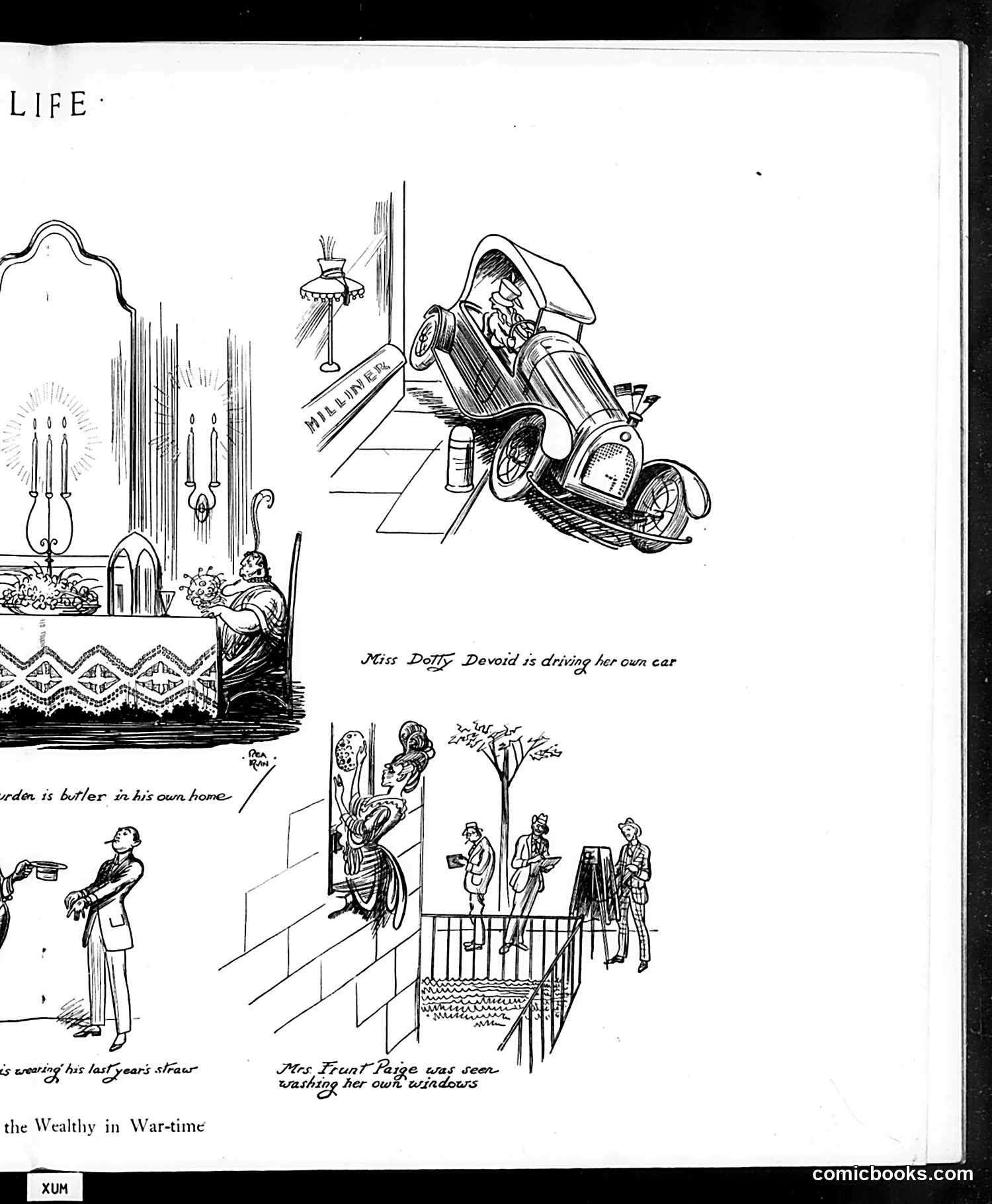
This satirical page mocks how wealthy Americans lived during wartime (likely WWI era). The vignettes show: 1. **"Miss Dolly Devoid is driving her own car"** — A woman driving herself, implying wealthy people had to adapt to labor shortages by doing their own work. 2. **"Mrs. Truxt Paige was seen washing her own windows"** — Another wealthy woman performing domestic labor herself. 3. Additional scenes showing affluent individuals in unusual domestic situations. The satire's point: During wartime, servants and household staff were unavailable (enlisted or working in war industries), forcing the wealthy to perform menial tasks they'd previously avoided. The cartoon ridicules this as a humorous reversal of class privilege—wealthy people experiencing ordinary life for perhaps the first time.
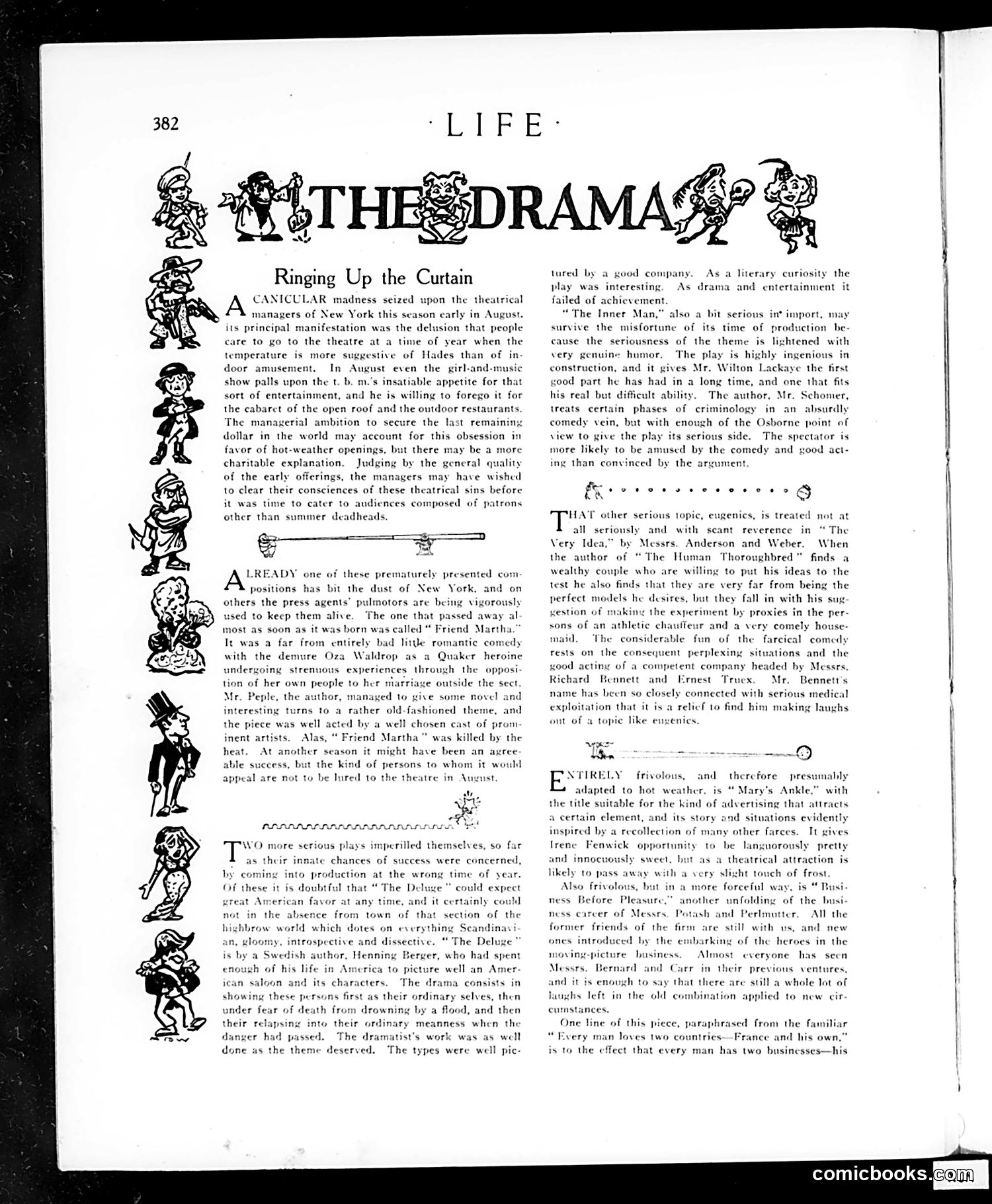
This page reviews several theatrical productions opening in New York during August—a time the critic considers commercially desperate. The author satirizes theater managers for scheduling shows in oppressive heat, attributing this to either financial desperation or desire to clear their consciences of mediocre plays before catering to serious audiences. The review discusses specific plays: "Friend Martha" (which failed despite decent acting), "The Deluge" (a Swedish drama about ordinary people facing flood that succeeded as literary curiosity but failed as entertainment), and mentions "The Inner Man" and "The Very Idea" as more successful serious works. The decorative illustrations along the margin appear to be theatrical character sketches—typical of Life's visual satirical style. The overall tone mocks both theater managers' poor judgment and the quality of summer productions, using humor to critique the theatrical business of the era.
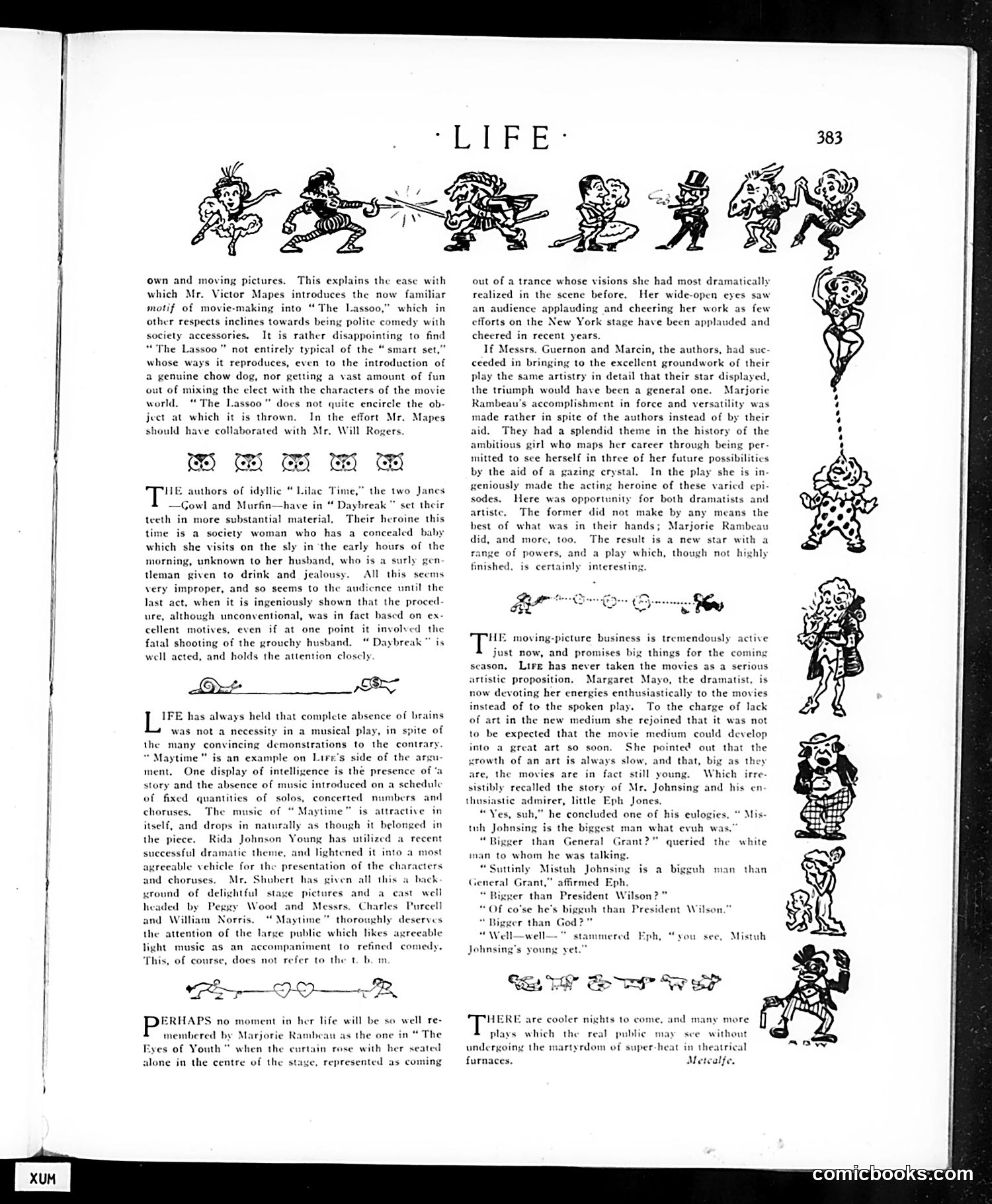
This page reviews several Broadway theatrical productions from the 1910s-1920s era. The satirical cartoons adorning the margins depict exaggerated theatrical characters and performers—likely caricatures of actors or stock theatrical types of the period. The reviews critique plays including "The Lassoo" (which incorporates movie-making elements), "Daybreak" (about a society woman secretly visiting an illegitimate child), and "Maytime" (a musical). The page praises Marjorie Rambeau's performance in "The Eyes of Youth," where she portrays a woman viewing her possible futures through a crystal ball—apparently a striking theatrical moment. The satire centers on theater's relationship with emerging cinema and on the gap between intelligent dramatic writing and mere entertainment spectacle. *Life* argues that musicals needn't be brainless, and that talented actors (like Rambeau) sometimes succeed despite weak material rather than because of it.
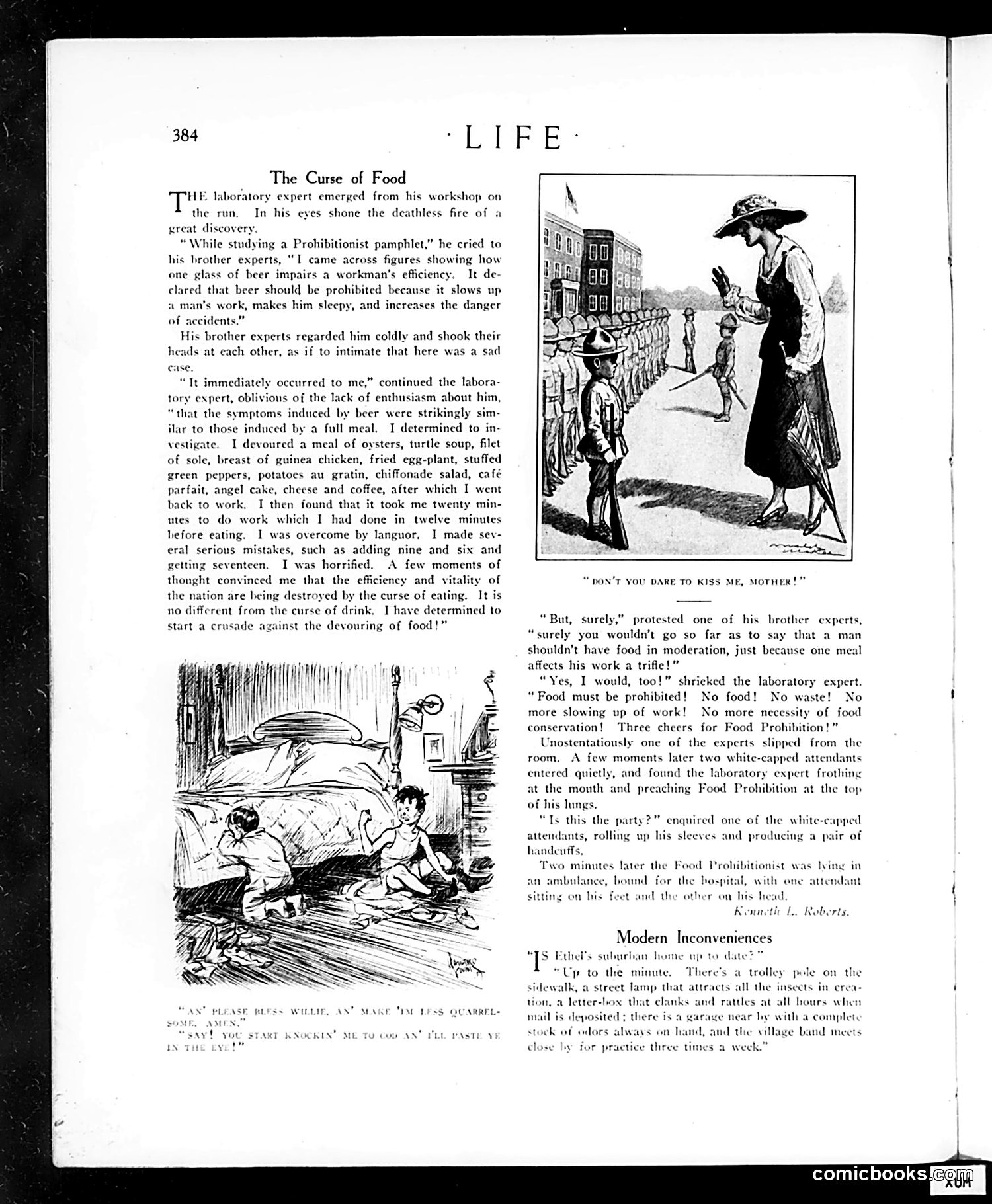
This piece satirizes **Prohibition advocates** by extending their temperance logic absurdly to food. A laboratory expert, having read prohibitionist arguments about alcohol's efficiency-reducing effects, conducts an experiment eating a large meal and finds it similarly impairs his work performance. He therefore advocates "Food Prohibition." **The satire's point**: Prohibitionists' reasoning—that any substance reducing efficiency should be banned—is logically ridiculous when applied to necessary food. The expert's descent into mania (ending hospitalized) mocks the fervor of prohibition crusaders as irrational fanaticism. The accompanying illustrations show the expert's frenzied preaching and his mental collapse. This likely dates to the Prohibition era (1920-1933), when Life magazine regularly lampooned temperance movements through exaggerated humor. The joke assumes readers understand Prohibition was a contentious, often-mocked policy position.
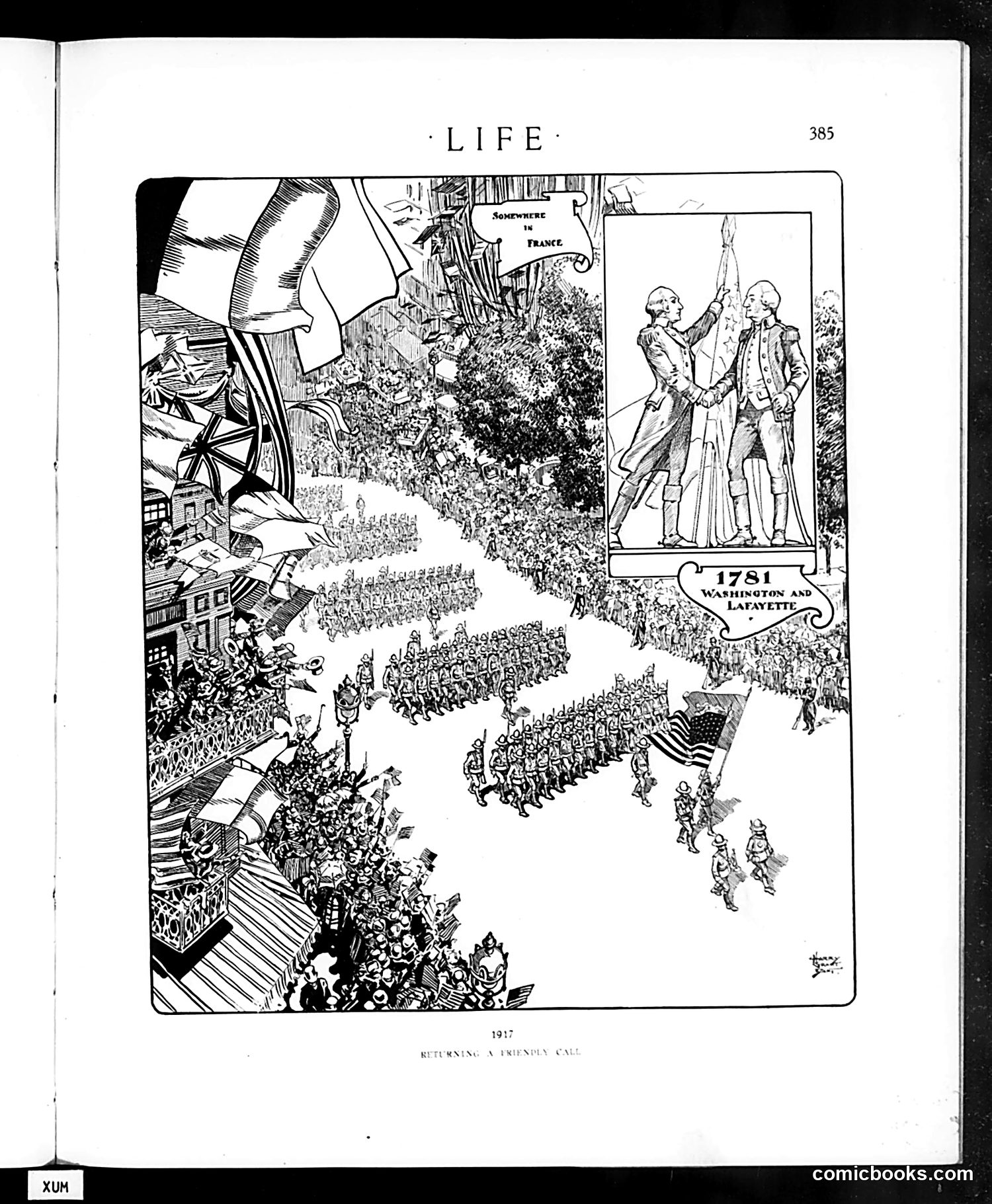
This page contains two historical illustrations. The main image depicts a massive military parade or gathering, labeled "1917 - RETURNING A LUNCHEON CALL" at the bottom. The scene shows organized military formations, crowds, and American flags in what appears to be a European city street. The inset illustration in the upper right, labeled "1781 WASHINGTON AND LAFAYETTE," depicts two uniformed historical figures. The satire appears to compare America's 1917 military involvement (likely America's entry into World War I) with the Revolutionary War alliance between Washington and Lafayette. The "luncheon call" reference likely satirizes formal diplomatic military exchanges, suggesting America is reciprocating earlier French military support by joining the war effort in France.
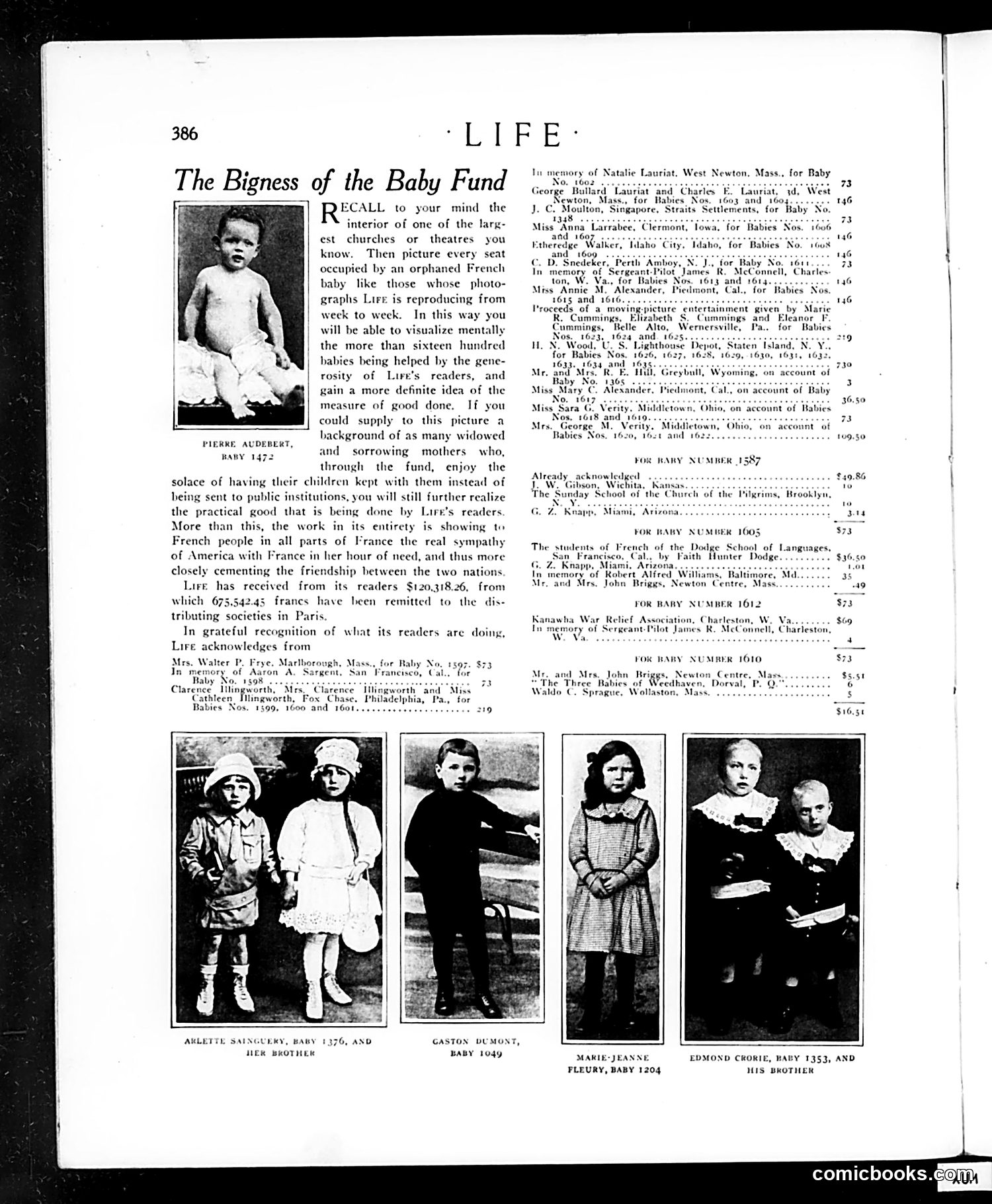
This page documents **Life magazine's charitable campaign to aid French orphans and war widows** following World War I. The article uses a striking visualization technique: imagining 1,600+ French babies filling a large church or theater to help American donors grasp the scale of suffering. The page primarily lists **donors and contributions** to the fund, which has raised $120,318.26 (distributing 675,542.45 francs through Paris societies). Rather than satire, this represents **earnest philanthropy with Cold War messaging**—emphasizing how American charity demonstrates sympathy for France and "cement[s] the friendship between the two nations." The accompanying photographs show **actual beneficiary children** (Pierre Audebert, Gaston Dumont, Marie-Jeanne Fleury, and Edmond Ckorie), personalizing the abstract statistics. This is **not political satire but humanitarian advocacy**, using Life's platform to solicit donations for postwar European relief.
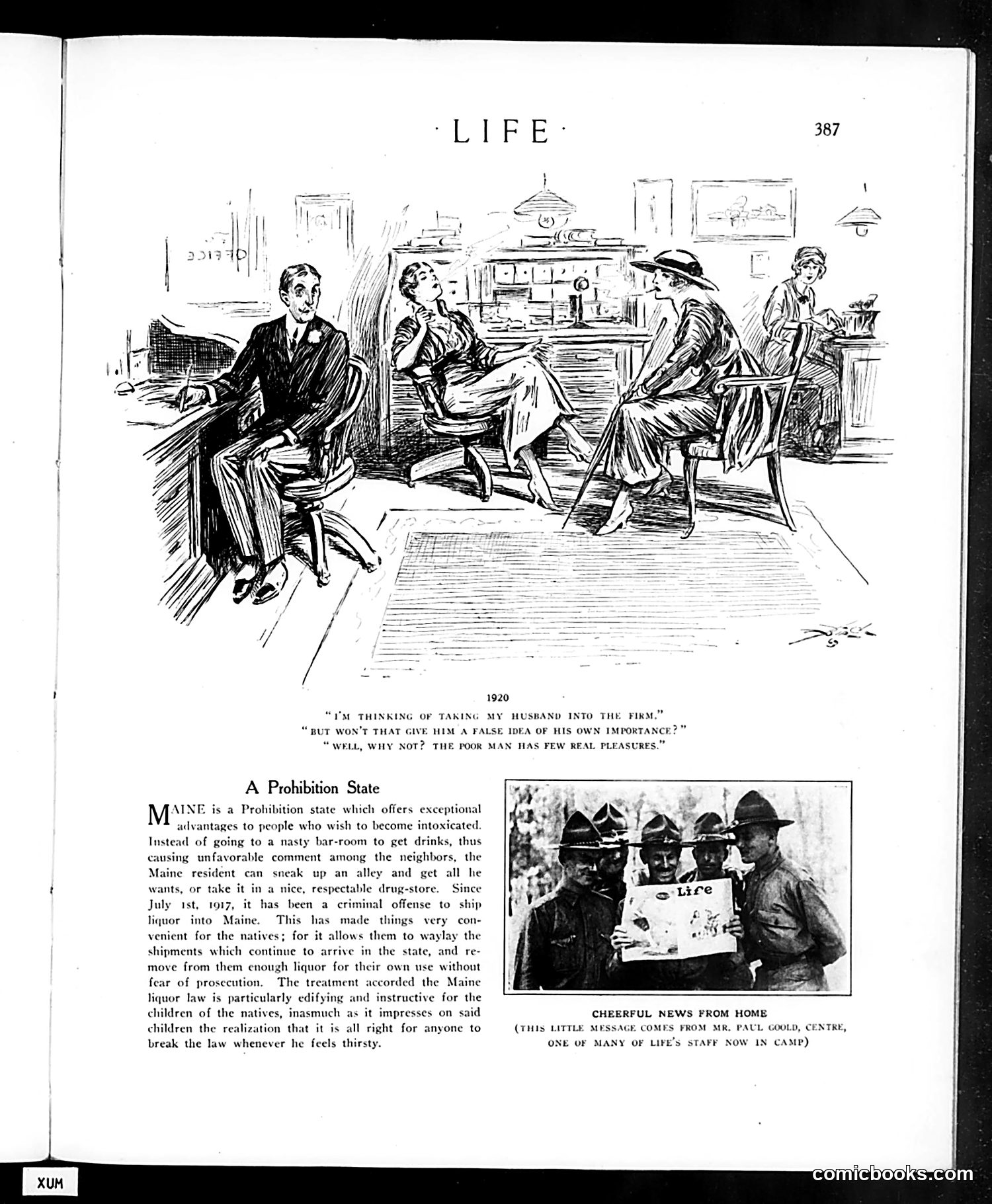
This 1920 *Life* magazine page satirizes **Prohibition's practical failure** in Maine, which banned liquor in 1917. The top cartoon shows an office discussion about hiring someone's husband, joking that giving him a job title provides one of life's few pleasures for working men—bittersweet humor about male dignity. The main article mocks Maine's Prohibition law as counterproductive. It argues that instead of eliminating drinking, the law merely drove it underground: residents now patronize alleys and drugstores rather than public bars. More critically, the satire highlights how Prohibition created **perverse incentives**—it legalized smuggling and black-market distribution while making law-breaking appear acceptable, especially to children witnessing adults openly flouting the law without consequences. The accompanying photograph labeled "Cheerful News from Home" appears to show soldiers in camp—contextualizing how Prohibition affected military life during or after WWI. The satire's point: Prohibition didn't eliminate drinking; it criminalized normal behavior and corrupted public morality.
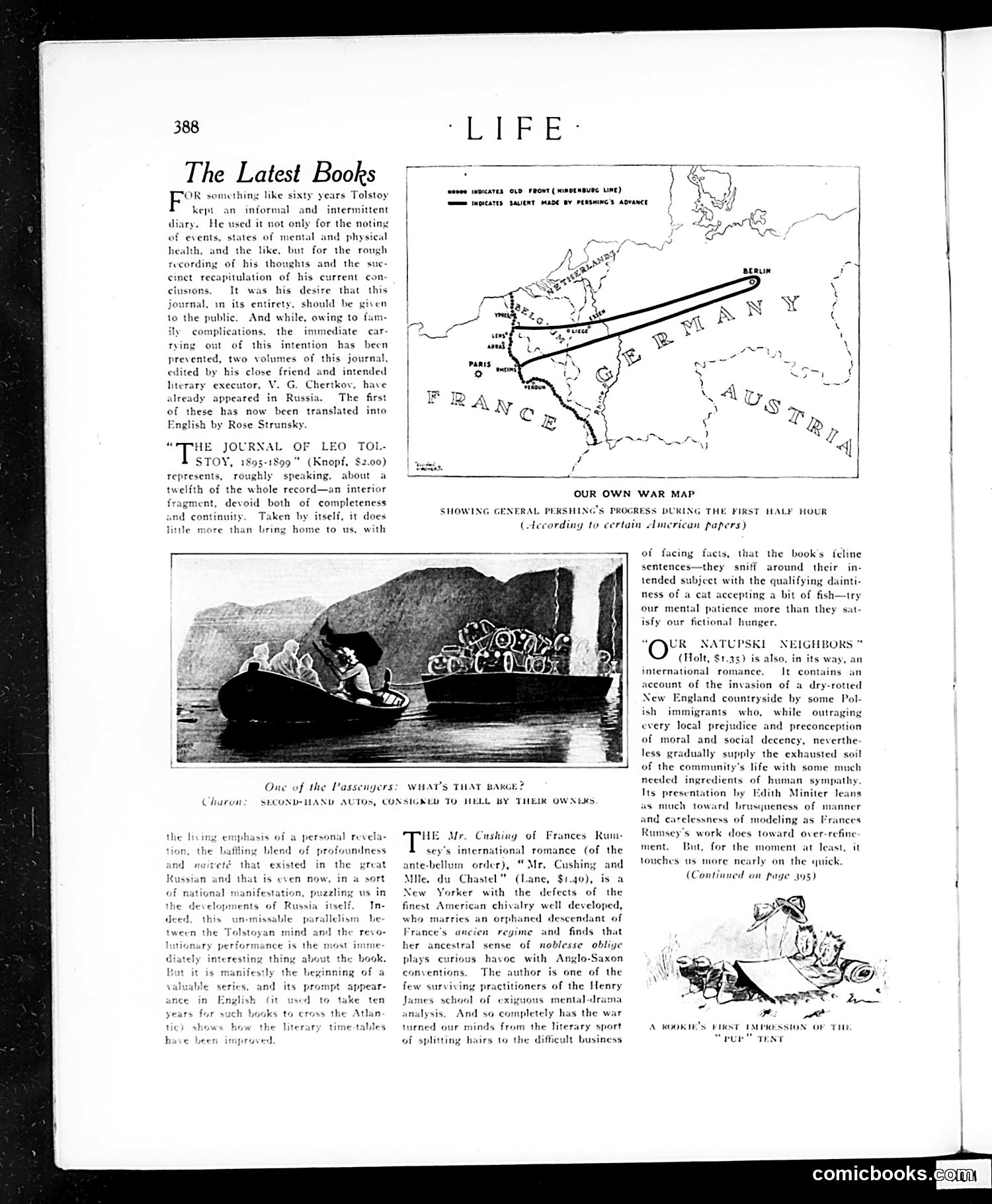
This is a book review section from *Life* magazine. The main satirical content is the war map cartoon titled "OUR OWN WAR MAP," which mocks American newspaper coverage of World War I. The cartoon shows a map with an absurdly large arrow labeled "BERLIN" extending from France—a visual joke about exaggerated American press claims regarding General Pershing's military progress. The subtitle reads "showing General Pershing's progress during the first half hour (according to certain American papers)," sarcastically suggesting newspapers were publishing wildly optimistic, unrealistic accounts of how quickly the U.S. forces were advancing. Below is an unrelated illustration of a riverboat labeled "WHAT'S THAT BARGE? SECOND-HAND AUTOS, CONSIGNED TO HELL BY THEIR OWNERS"—a separate joke about old cars being discarded. The page primarily reviews recent books including Tolstoy's journal and works of international fiction. The satire targets wartime journalistic hyperbole rather than politics directly.
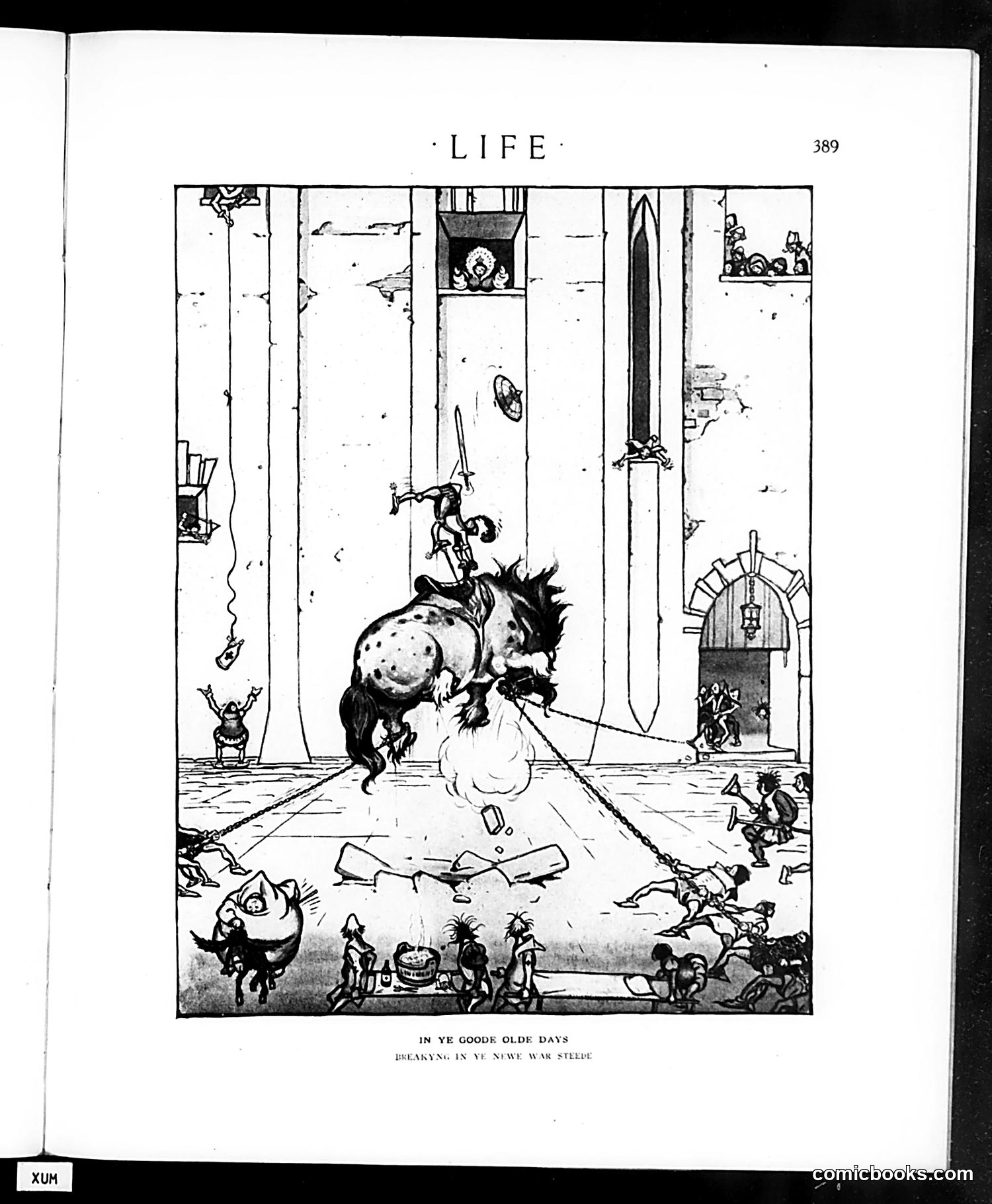
This satirical cartoon uses mock-archaic language ("ye goode olde days") to depict a massive war horse being broken in by tiny figures. The horse represents a new military weapon or technology being introduced to warfare. Observers in towers and windows watch the chaotic scene as the horse bucks violently, throwing riders and causing destruction below. The satire appears to criticize the introduction of new military innovations—likely referencing WWI-era weaponry or tactics—as destructive and uncontrollable. The diminished human figures struggling to manage this "newe war steede" suggest that modern warfare has become monstrous and beyond human control. The whimsical medieval framing underscores the absurdity of treating devastating new weapons as if they were merely novel additions to traditional combat.
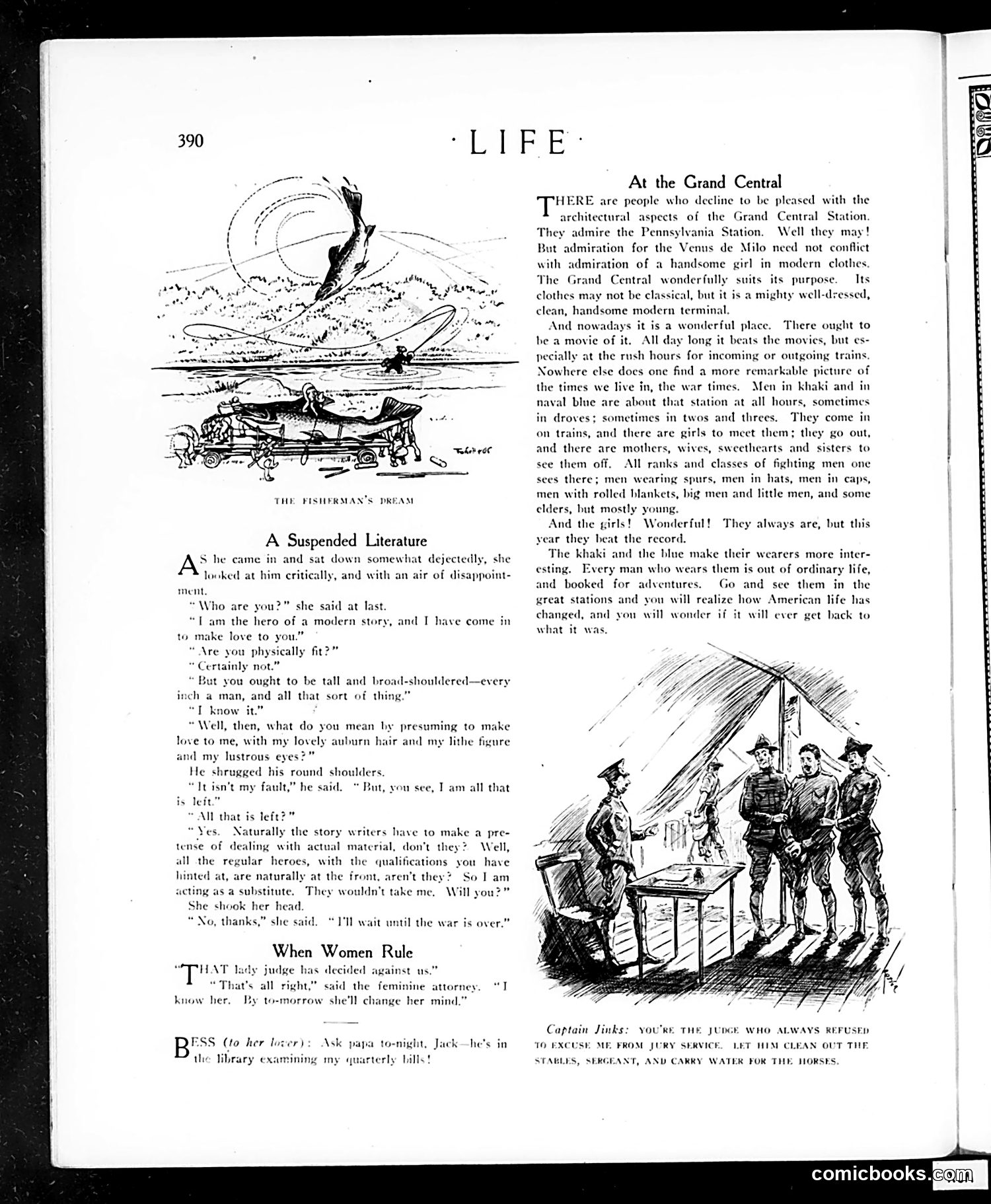
This page contains three distinct satirical pieces from WWI-era Life magazine: **"The Fisherman's Dream"**: A man tries to seduce a woman by claiming he's a modern story hero, but admits he's physically unfit—a substitute because real heroes are at the front fighting. She refuses, preferring to wait for the war's end. The satire mocks both the mediocrity of romance fiction and male inadequacy during wartime. **"A Suspended Literature"**: Similar theme—a woman dismisses a suitor as unqualified, but he argues all suitable men are fighting, so he's the only available option. She rejects him anyway. This satirizes how WWI disrupted normal social/romantic life. **"When Women Rule"** and **"Captain Jinks"**: Brief quips about female authority and military service obligations. **"At the Grand Central"**: Celebrates Grand Central Terminal as a microcosm of wartime America—soldiers, families saying goodbye, the transformation of civilian life by war. The prose is genuinely admiring rather than satirical. The page captures how WWI fundamentally disrupted American society, leaving civilians (especially men) displaced and uncertain.
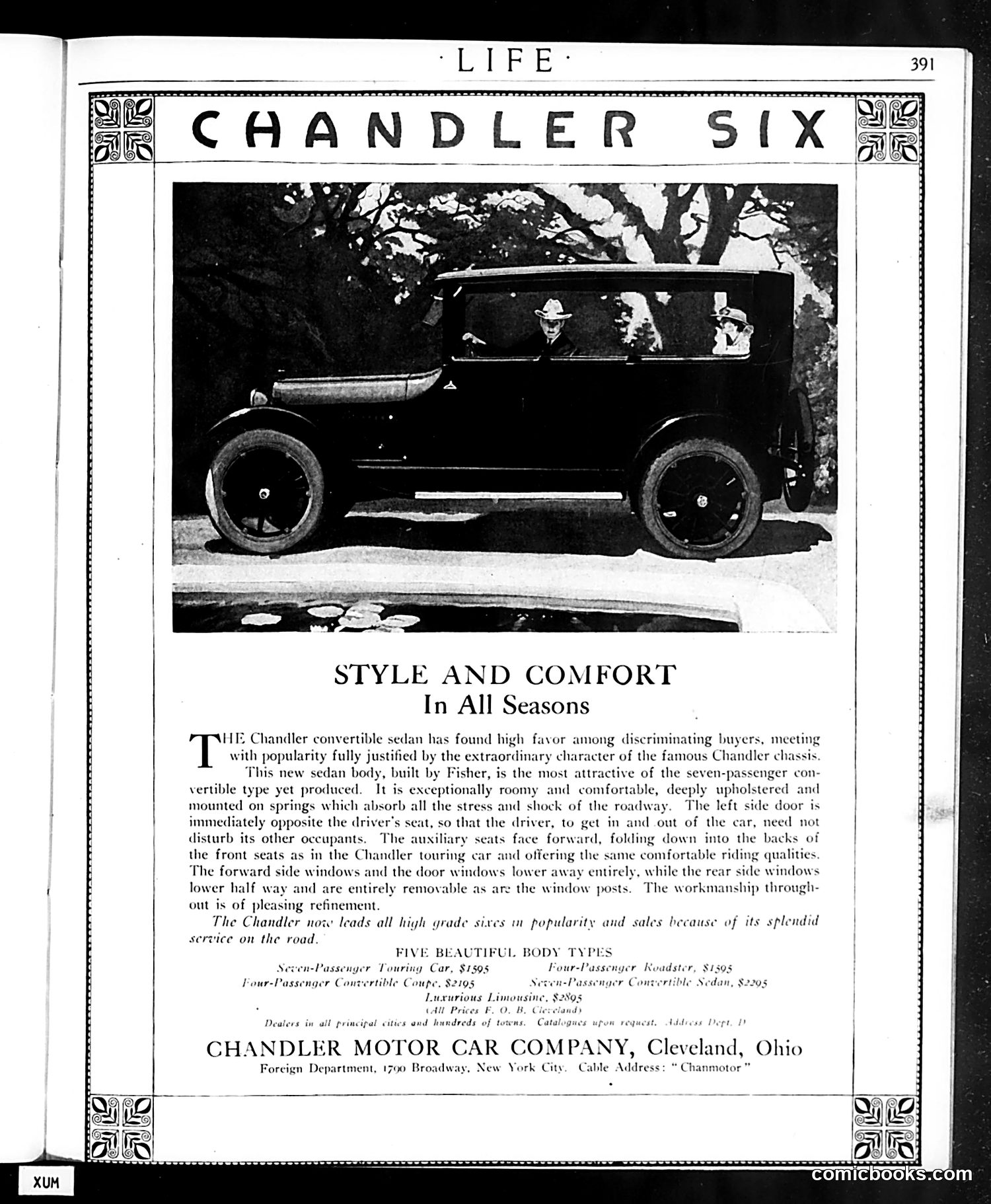
This is **not a cartoon or satire**—it's a straightforward automobile advertisement from *Life* magazine (page 391). The image shows a black Chandler convertible sedan with three men in hats seated inside, photographed against a tree-lined road. The ad promotes the Chandler Motor Car Company's new seven-passenger convertible sedan body, built by Fisher. It emphasizes luxury features: comfort, spacious seating, spring suspension, and practical design elements like side-opening doors and adjustable windows. The text claims the Chandler "leads all high grade sixes in popularity and sales." Five body styles are listed with prices ranging from $1,395 to $2,295. This appears to be from the early 1920s, when such automobiles represented significant luxury purchases for "discriminating buyers." The advertisement is purely commercial—there is no political or satirical content to decode.
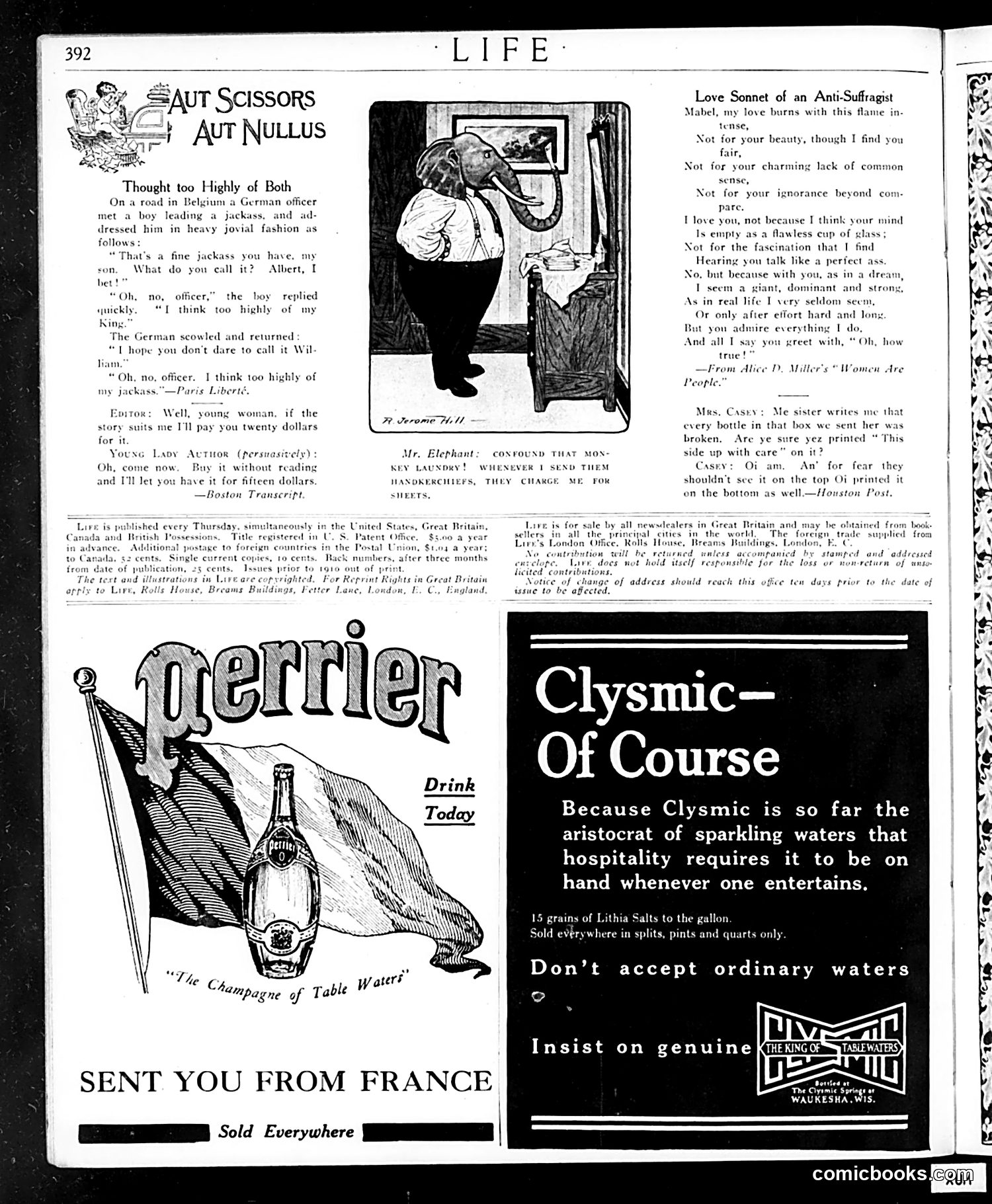
This page contains three distinct humorous pieces: **"Aut Scissors, Aut Nullus"** (top left): A brief anecdote where a German officer compliments a Belgian boy's donkey in "heavy jovial fashion." The boy replies he thinks too highly of his jackass to name it—a joke playing on the officer's condescension and the boy's subtle insult by comparing the officer to the animal. **"Love Sonnet of an Anti-Suffragist"** (right): Satire of anti-women's-suffrage rhetoric. The poem mocks men who claim to love women precisely for their intellectual emptiness and lack of agency—"empty as a lawless cup of glass." This directly ridicules anti-suffragist arguments that women shouldn't vote because they were intellectually inferior. **Lower cartoons**: Brief workplace humor about laundry services and elephant complaints, unrelated to the suffrage content. **Advertisements** occupy significant space (Perrier water, Clysmic sparkling water). The page reflects early 20th-century American debates over women's voting rights, with Life magazine using satire to mock those opposed to suffrage.
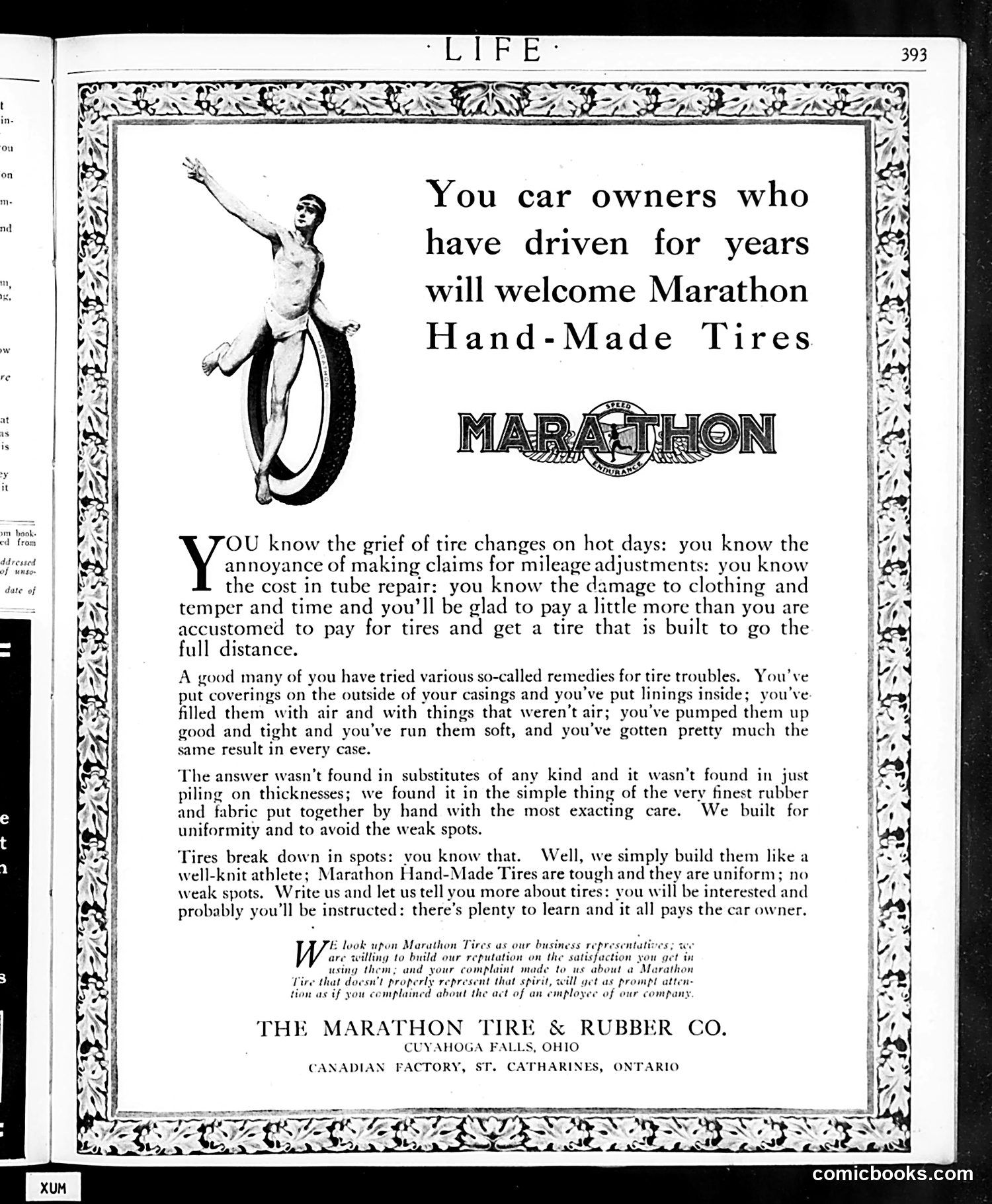
This is a full-page advertisement, not satire or political commentary. It promotes Marathon brand tires to experienced car owners. The illustration shows a man in formal attire triumphantly holding up a tire, celebrating the product. The ad addresses common early-automobile frustrations: tire failures on hot days, expensive repairs, messy patches and patches-on-patches, mileage adjustment claims, and weak spots that develop unpredictably. Marathon's pitch: their tires are hand-made from "the very finest rubber and fabric" with uniform construction throughout—compared metaphorically to a "well-knit athlete" with no weak spots. Rather than gimmicky fixes or added thickness, quality materials and craftsmanship ensure durability. The company (based in Cuyahoga Falls, Ohio, with a Canadian factory) promises customer satisfaction and invites inquiries. This reflects early 1900s advertising targeting affluent car owners frustrated by the mechanical unreliability of automobiles.
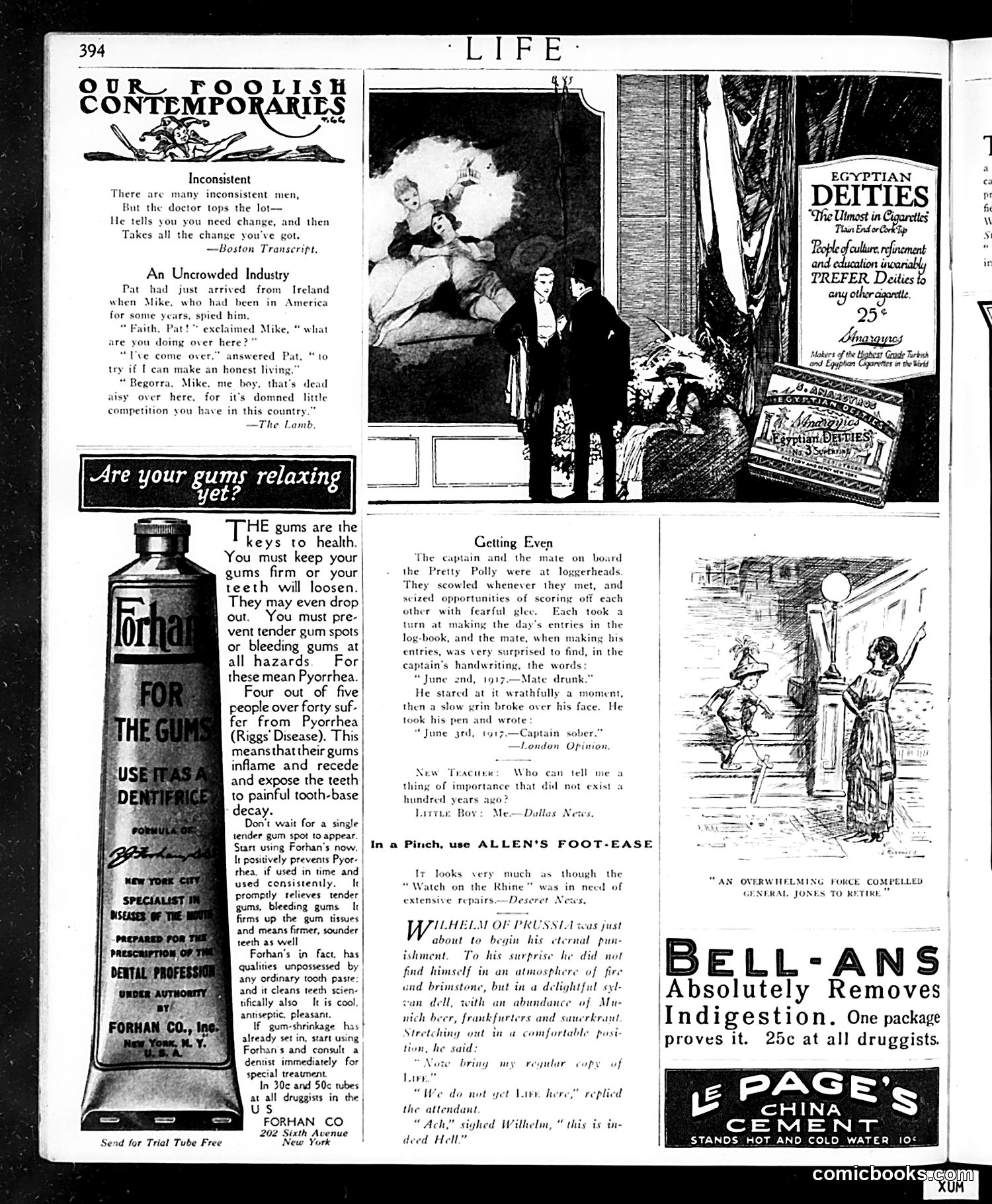
This page from *Life* magazine contains several short satirical pieces typical of the publication's humor section: **"Inconsistent"** jokes that doctors are hypocrites—they advise patients to seek change for their health, then charge them all their money. **"An Uncrowded Industry"** features two Irish immigrants (Pat and Mike), with Mike sarcastically noting that being an honest man in America offers "no competition"—implying dishonesty is rampant. **"Getting Even"** depicts a captain-mate feud aboard ship (*Pretty Polly*). After the captain logs the mate as drunk, the mate retaliates by writing the captain was sober—suggesting the captain's sobriety is so remarkable it's noteworthy. **"Wilhelm of Prussia"** is a post-WWI joke: the Kaiser, facing eternal punishment, finds himself in a pleasant Munich beer hall. When told "Life" magazine isn't available there, he despairs—"this is indeed Hell." The page also contains period advertisements for dental products, foot powder, and digestive aids, reflecting early-20th-century patent medicine marketing.
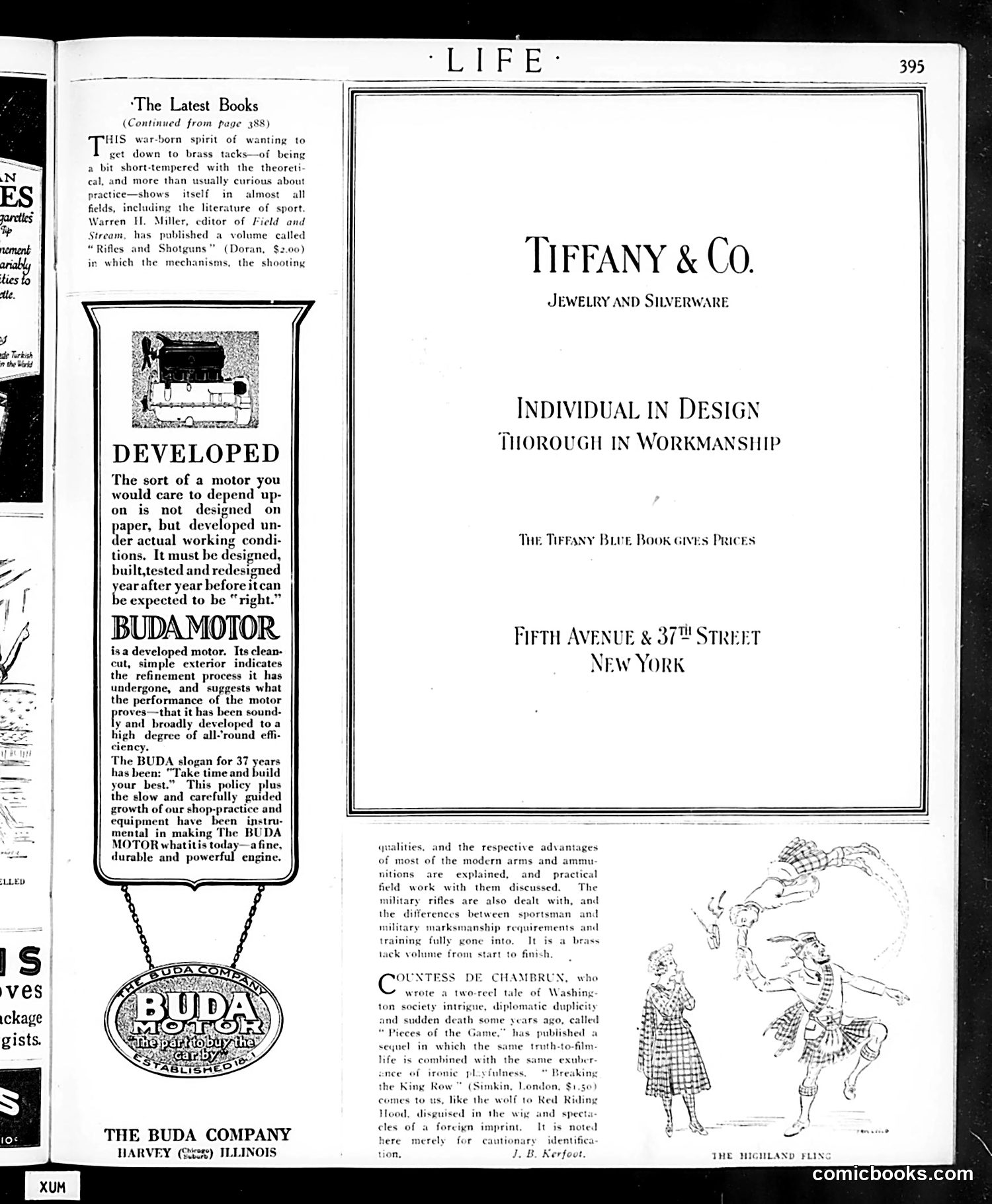
This page is primarily **advertising and promotional content** rather than political satire or comics. The top left contains a **BUDA Motor advertisement** emphasizing the company's 37-year philosophy of careful development ("Take time and build your best"). It's marketing industrial motors through the lens of reliability and workmanship. The right side features a **Tiffany & Co. luxury goods advertisement** for jewelry and silverware at their Fifth Avenue location. Below is a **book review section** discussing sporting literature (rifles and shotguns) and two film references—one about Washington society intrigue. A small illustration labeled "THE HIGHLAND FLING" appears at bottom right, showing what appears to be a Highland dancer, likely accompanying a separate short piece. The page reflects **early 20th-century Life magazine format**: mixing advertisements with literary/entertainment reviews. There is no discernible political cartoon or satirical content on this particular page—it's a typical advertiser-supported publication layout of that era.
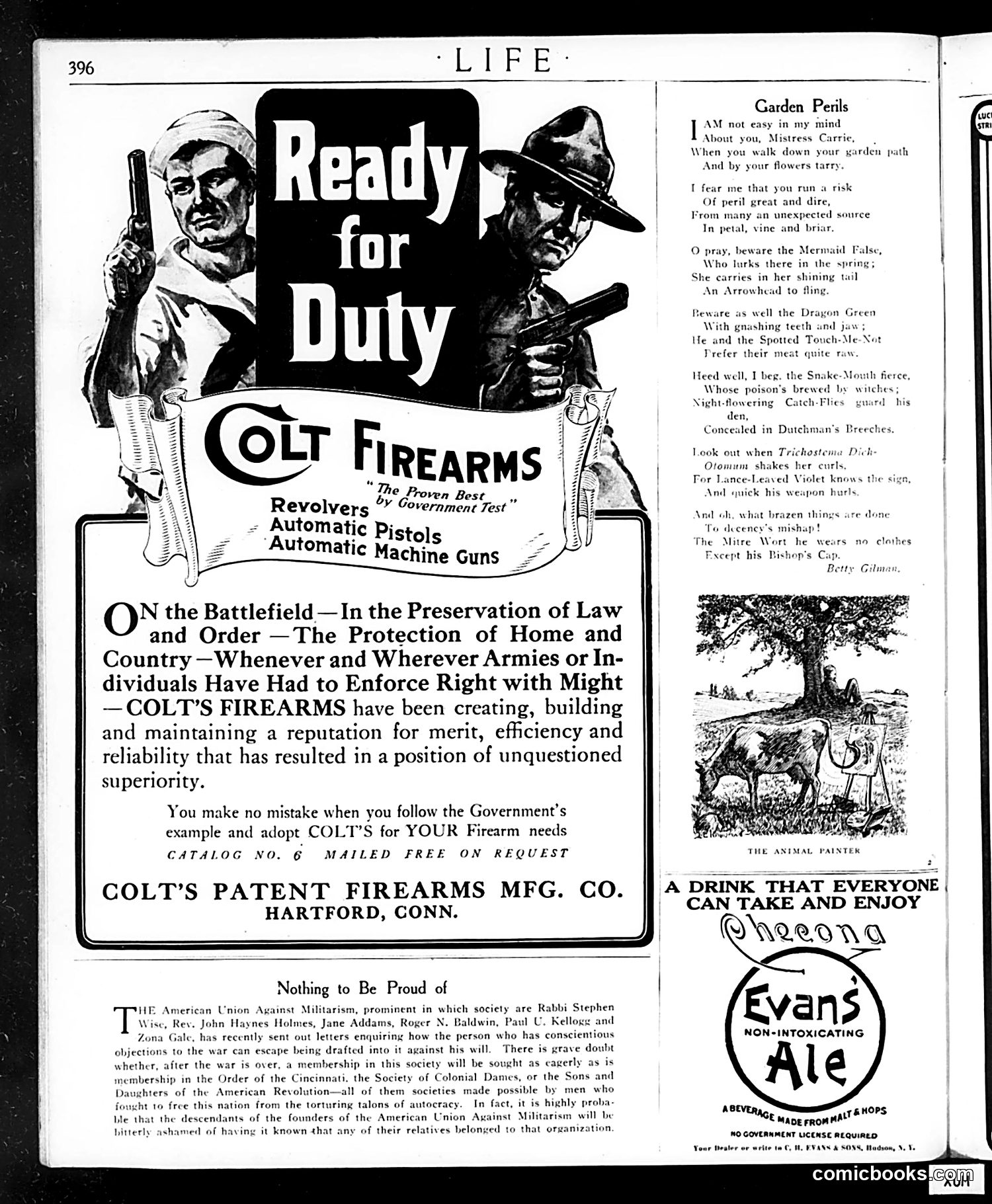
This page combines wartime advertising with satirical commentary on pacifism during World War I. **The Main Advertisement:** A Colt Firearms ad featuring two soldiers uses patriotic language ("Ready for Duty," "Preservation of Law and Order") to market weapons to the government and public. The ad invokes military necessity and national defense. **The Satirical Article ("Nothing to Be Proud of"):** The text criticizes the American Union Against Militarism, a real anti-war organization that helped conscientious objectors avoid the draft. The satire argues that future generations will be ashamed to admit their ancestors belonged to this group—contrasting it unfavorably with prestigious patriotic societies (Sons of the American Revolution, etc.) founded by Revolutionary War fighters. **The Irony:** The page juxtaposes pro-military advertising with criticism of pacifists, reflecting the magazine's position supporting WWI participation. The satire suggests that avoiding military service is dishonorable, even cowardly. **"Garden Perils" poem** (top right) appears to be humorous nature verse, unrelated to the war content.
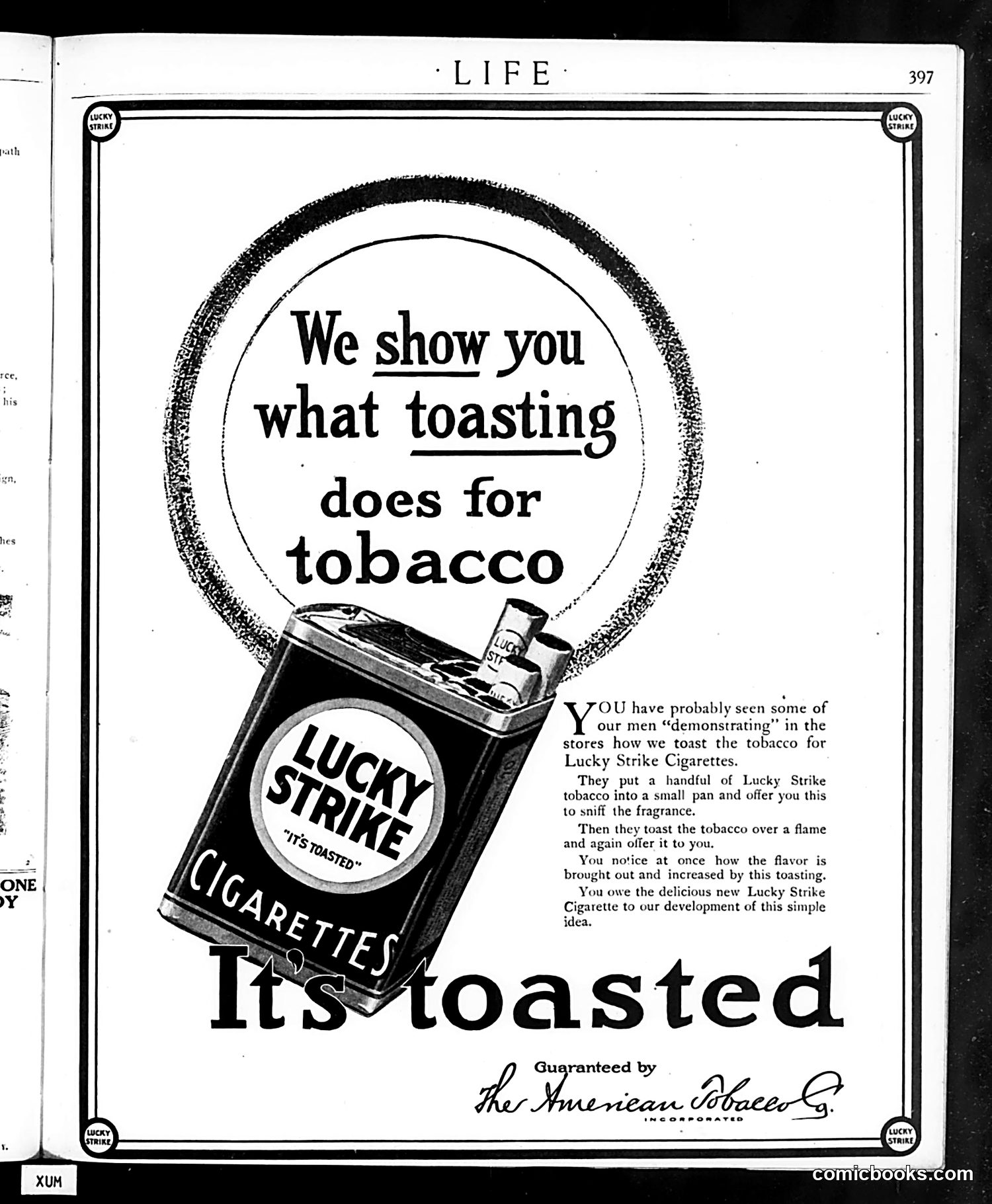
This is a **Lucky Strike cigarette advertisement**, not satire or political commentary. The page shows a vintage tobacco ad from Life magazine (page 397). The ad demonstrates Lucky Strike's marketing claim that toasting tobacco improved flavor. The text describes in-store demonstrations where salesmen would toast tobacco samples over a flame to convince customers that the toasting process enhanced the product's taste and aroma. The large illustration depicts a pack of Lucky Strike cigarettes emerging from a flame, emphasizing this toasting technique as the brand's distinctive feature. The phrase "It's toasted" became Lucky Strike's actual advertising slogan. **For modern readers:** This represents an era when tobacco companies openly advertised cigarettes in mainstream magazines and conducted live product demonstrations in stores—practices now prohibited. The ad makes direct health/quality claims that would be illegal today.
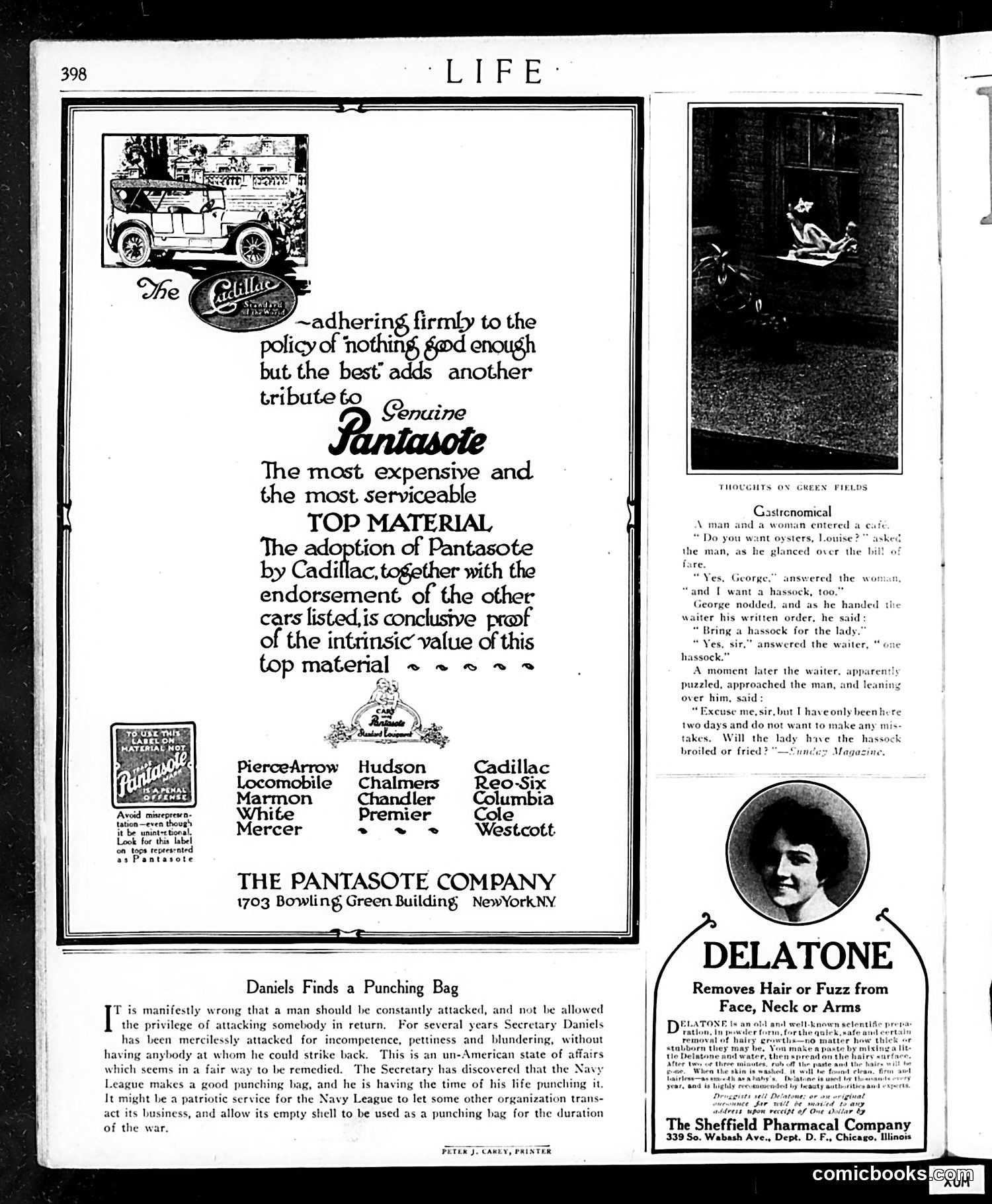
This Life magazine page is primarily **advertisements and commercial content**, not political satire in the traditional sense. The largest item is a Pantasote (automobile upholstery material) advertisement endorsing multiple car brands—Pierce-Arrow, Locomobile, Marmon, Hudson, Chalmers, Cadillac, etc. It claims adopting this material proves its quality. The one editorial piece, titled "Daniels Finds a Punching Bag," comments on Secretary of the Navy Josephus Daniels. The article defends Daniels, arguing he has endured public criticism without recourse—until now. Life suggests the Navy League serves as his convenient "punching bag," allowing him to strike back. The piece ironically proposes letting other organizations run the Navy League's business so Daniels can continue using it as a target for his grievances. The remaining content includes period advertisements (Delatone hair-removal cream) and a brief humorous anecdote about restaurant etiquette ("Thoughts on Green Fields").
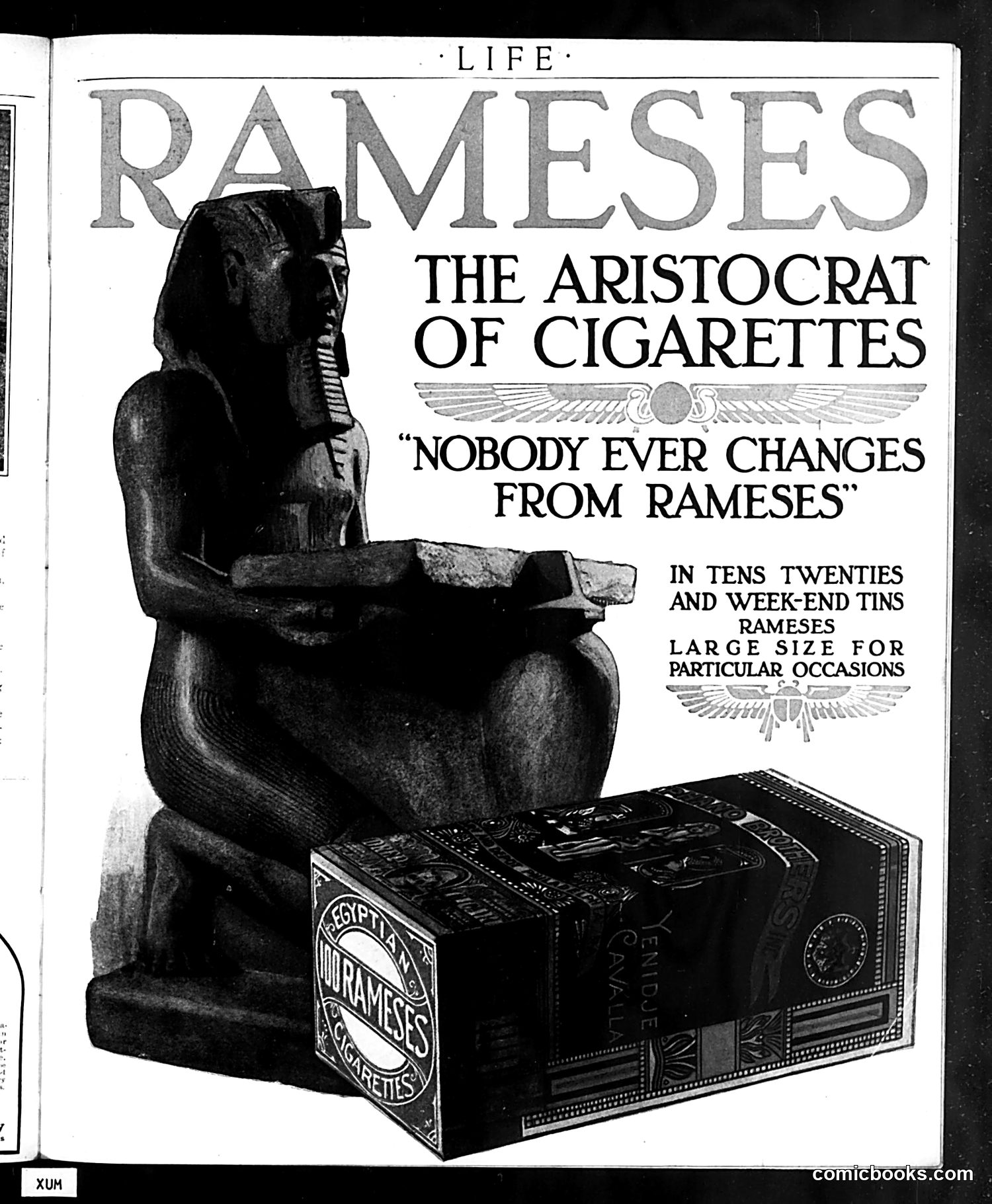
This is a cigarette advertisement, not political satire. It features an Egyptian sphinx statue as the brand's logo, capitalizing on early 20th-century fascination with Egyptian aesthetics and "exotic" imagery. The ad claims Rameses cigarettes are "the aristocrat of cigarettes" and uses the slogan "Nobody ever changes from Rameses"—suggesting customer loyalty. The sphinx conveys sophistication and timelessness, implying the product's unchanging quality and premium status. Packaging options are listed: tens, twenties, week-end tins, and large sizes for special occasions. The Egyptology reference was common in period advertising, using historical grandeur to market consumer goods. This reflects no particular political message, merely commercial appeals to status and tradition typical of vintage tobacco marketing.
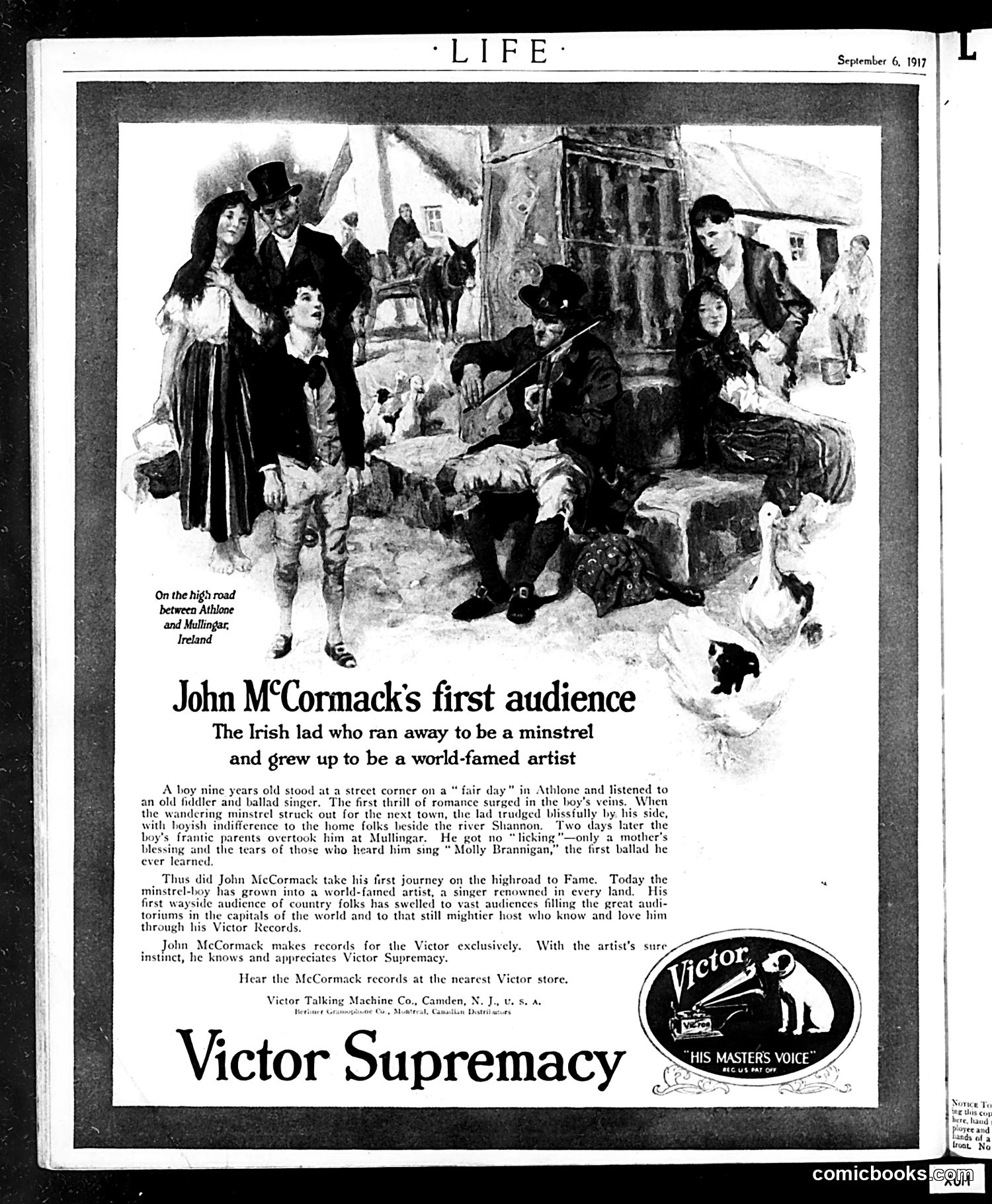
This is primarily a **Victor Records advertisement** from September 1917, not political satire. It promotes Irish tenor John McCormack's phonograph recordings. The page depicts McCormack's origin story: a nine-year-old boy in rural Ireland (Athlone/Mullingar) who heard a wandering minstrel and followed him, inspiring his eventual career as a world-renowned singer. The illustration shows this legendary "first audience"—country people gathered on an Irish road. The advertisement's appeal is **nostalgic and nationalist**: it romanticizes rural Irish culture and positions McCormack as an Irish success story who brought traditional Irish music to global audiences. The narrative emphasizes his humble origins and the blessing of Irish mothers, likely resonating with Irish-American readers during WWI. The sales pitch is straightforward: McCormack records exclusively for Victor, therefore Victor records are superior. Readers should purchase his recordings at Victor dealers. There is **no political cartoon or satire** here—it's a straightforward testimonial advertisement using sentimental storytelling.