
Life, 1917-09-06 · page 23 of 40
Life — September 6, 1917 — page 23: what you’re looking at
What you’re looking at
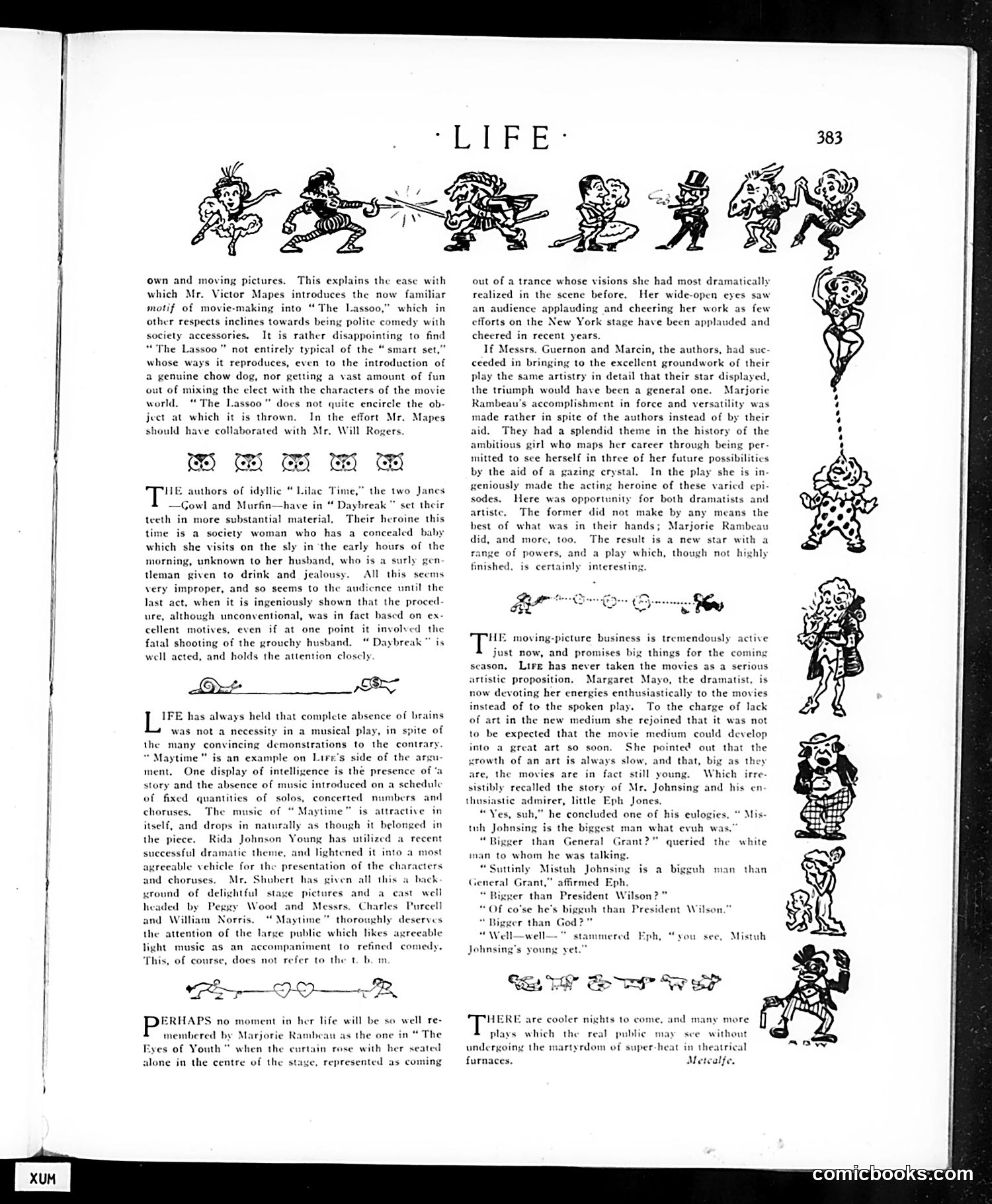
This page reviews several Broadway theatrical productions from the 1910s-1920s era. The satirical cartoons adorning the margins depict exaggerated theatrical characters and performers—likely caricatures of actors or stock theatrical types of the period. The reviews critique plays including "The Lassoo" (which incorporates movie-making elements), "Daybreak" (about a society woman secretly visiting an illegitimate child), and "Maytime" (a musical). The page praises Marjorie Rambeau's performance in "The Eyes of Youth," where she portrays a woman viewing her possible futures through a crystal ball—apparently a striking theatrical moment. The satire centers on theater's relationship with emerging cinema and on the gap between intelligent dramatic writing and mere entertainment spectacle. *Life* argues that musicals needn't be brainless, and that talented actors (like Rambeau) sometimes succeed despite weak material rather than because of it.
📄 Transcribed text from this page (OCR, searchable)
Machine-transcribed from the original scan — historical spelling and the odd misread are preserved.
own and moving pictures. This explains the ease with which Mr. Victor Mapes introduces the now familiar motif of movie-making into “The Lassoo,” which in other respects inclines towards being polite comedy with society accessories. It is rather disappointing to find “The Lassoo” not entirely typical of the “ smart set,” whose ways it reproduces, even to the introduction of a genuine chow dog, nor getting a vast amount of fun out of mixing the clect with the characters of the movie world. “The Lassoo” does not quite encircle the ob- ject at which it is thrown, In the effort Mr. Mapes should have collaborated with Mr. Will Rogers. fe." the two Janes HE authors of idyllic “ Lilac Ti —Gowl and Murfin—have in “ Daybreak” set their 1, Their heroine this 1s a concealed baby teeth in more substantial materia time is a society woman who which she visits on the sly in the early hours of the morning, unknown to her husband, who is a surly gen tleman given to drink and jealousy. All this seems very improper, and so seems to the audience until the last act, when it is ingeniously shown that the proced ure, although unconventional, was in fact based on ex- cellent motives, even if at one point it involved the fatal shooting of the grouchy husband. “ Daybreak " is well acted, and holds the attention closely But Fen IFE has always held that complete absence of brains was not a necessity in a musical play, in spite of the many convincing demonstrations to the contrary. Maytime” is an example on Lire’s side of the argu ment, One display of intelligence is the presence of “ schedule nd story and the absence of music introduced on a f fixed quantities of solos, concerted numbers wsic of “ M is attractive in itself, and drops in naturally din the piece. Rida Johnson Young has utilized a recent successful dramatic theme, and lightened it into a most agreeable vehicle for the presentation of the characters all this a back st welll choruses, The h it belon nd choruses, Mr. Shubert has given ground of delightful staxe pictures and a ca I by Peggy Wood and Messrs. Charles Purcell ves head and William Norris, “ Maytime” thoroughly des the attention of the large public which likes agreeabl light music a ined comedy, ‘This, of course, does not refer to the t bom an accompaniment to re P ZRHAPS no moment in her life will be so well re- membered by Marjorie Rambeau as the one in“ The Eyes of Youth” when the curt. rose with her seated alone in the centre of the st ¢, represented as coming out of a trance whose visions she had most dramatically realized in the scene before. Her wide-open eyes saw an audience applauding and cheering her work as few efforts on the New York stage have been applauded and cheered in recent years. If Messrs. Guernon and Marcin, the authors, had suc- ceeded in bringing to the excellent groundwork of their play the same artistry in detail that their star displayed, the triumph would have been a general one. Marjorie Rambeau’s accomplishment in force and versatility was made rather in spite of the authors instead of by their aid. They had a splendid theme in the history of the ambitious girl who maps her career through being per- mitted to see herself in three of her future possibilities by the aid of a gazing crystal. In the play she is in de the acting heroine of these varied epi- matists and geniously m sodes. Here was opportunity for both di artiste, The former did not make by any means the best of what was in their hands; Marjorie Rambeau did, and more, too, The result is a new star with a range of powers, and a play which, though not highly finished, is cei inly interest HIE, moving-picture business is tremendously active just now, and pron season, Lire has never taken the movies as a serious artistic proposition. Margaret Mayo, tke dramatist, is now devoting her energies enthusiastically to the movies instead of to the spoken play. To the charge of lack of art in the new medium she rejoined that it was not to be expected that the movie medium could develop es big things for the coming into a great art so soon. She pointed out that the xrowth of an art is always slow, and that, big as they are, the movies are in fact still young. Which irre sistibly recalled the story of Mr. Johnsing and his en Eph Jones. “Yes, suh,” he concluded one of his eulogies. “ Mis- Jobnsing is the biggest man what evuh was.” “Bigger than General Grant?” queried the white nto whom he was talking. “Suttinly Mistuh Johnsing is a bigs General Grant,” affirmed Eph. “Bigger than President Wilson?” “ Of co’se he’s bigguh than President Wilson.” “Bigger than God?” Well—well stammered Eph, “you see, Mist Johnsing’s young yet thusiastic admirer, little he HERE are cooler nights to come, and many more plays which the real public may sce without undergoing the martyrdom of super-heat in theatrical furnaces. Metcalfe.