
Life, 1917-09-06 · page 18 of 40
Life — September 6, 1917 — page 18: what you’re looking at
What you’re looking at
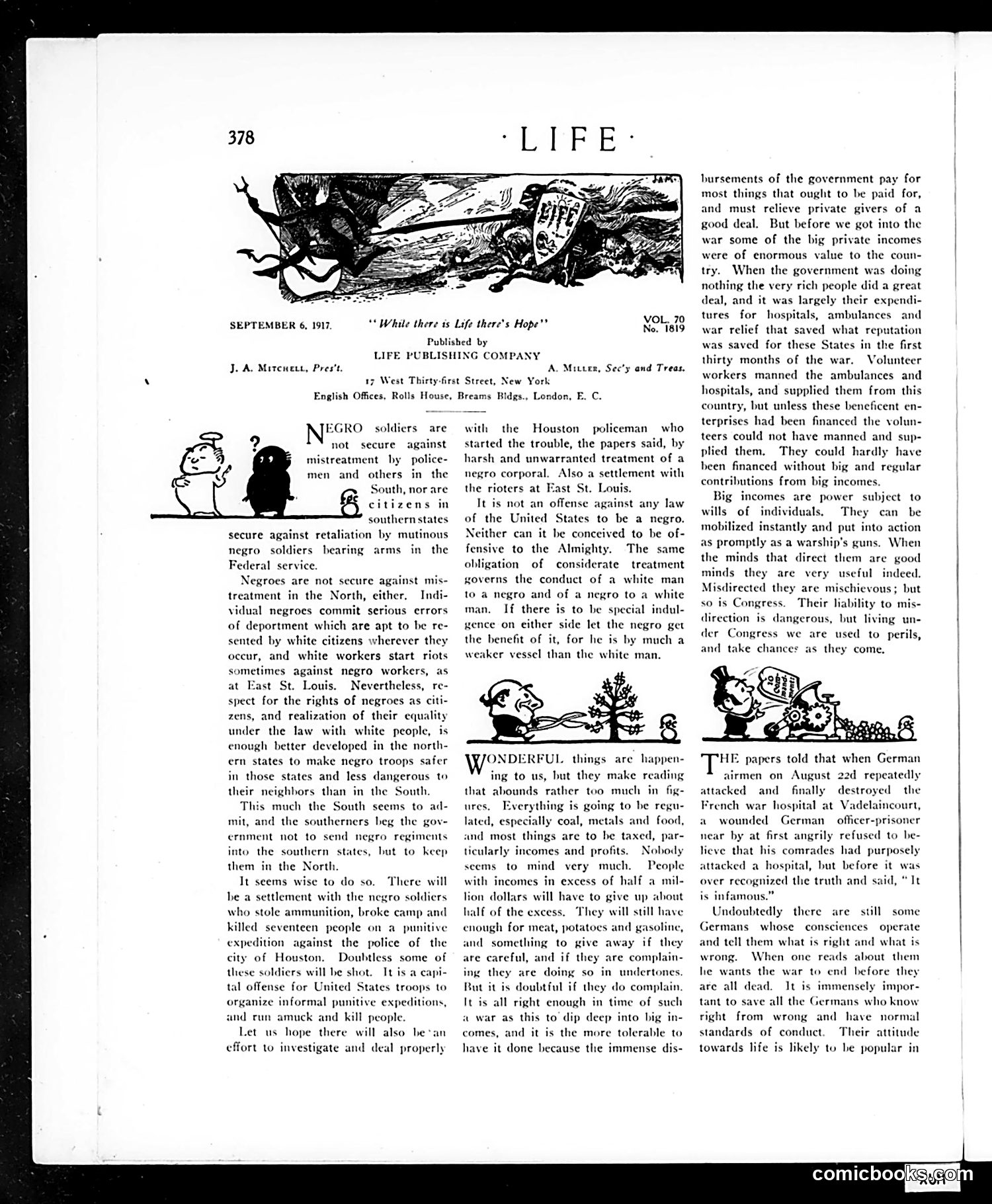
This editorial addresses racial violence and military service during World War I. The page references two specific incidents: the **Houston riot** (1917), where Black soldiers clashed with police, killing seventeen people, and the **East St. Louis riot** (1917), a white mob attack on Black residents. The cartoons (small illustrations accompany the text) appear to depict racial conflict and inequality—showing figures in confrontational or unequal positions, though exact details are difficult to discern. The editorial's argument is notably progressive for 1917: it condemns mistreatment of Black soldiers and civilians, asserts legal equality regardless of race, and advocates investigating white authorities (the Houston police) who provoked the incident. It advocates keeping Black troops in the North where they face "less dangerous" conditions—acknowledging the South's hostility while proposing geographic rather than systemic solutions. The piece frames racial justice as a practical wartime concern and moral obligation, though it stops short of demanding fundamental change in Southern racial structures.
📄 Transcribed text from this page (OCR, searchable)
Machine-transcribed from the original scan — historical spelling and the odd misread are preserved.
SEPTEMBER 6, 1917. “While there is Life there's Hope” VOL. 70 No. 1819 Published by LIFE PI J. A. Mitcnent, Pres’t. BLISHING COMPANY A. Mitten, Sec’y and Treas. 17 West Thirty-first Street, New York English Offices, Rolls House, Breams Bldgs., London, E. C. N [GRO soldiers are not secure inst mistreatment by police- and others in the South, nor are citizens in southern states secure against retaliation by mutinous negro soldiers bearing arms in the Federal service. Negroes are not secure against mis- treatment in the North, either, Indi- vidual negroes commit serious errors of deportment which are apt to be re- sented by white citizens wherever they occur, and white workers start riots sometimes against negro workers, as at East St. Louis. Nevertheless, re- spect for the rights of negroes as citi- zens, and realization of their equality under the law with white people, is enough better developed in the north- ern states to make negro troops safer in those states and less dangerous to men their neighbors than in the South. This much the South seems to ad- mit, and the southerners beg the gov- ernment not to send negro regiments into the southern states, but to keep them in the North. It seems wise to do so. There will be a settlement with the negro soldiers who stole ammunition, broke camp and killed seventeen people on a punitive expedition against the police of the city of Houston. Doubtless some of these soldiers will be shot. It is a capi- tal offense for United States troops to organize informal punitive and run amuck and kill people. expeditions, Let us hope there will also be*an effort to investigate and deal properly with the Houston policeman who started the trouble, the papers said, by harsh and unwarranted treatment of a negro corporal. Also a settlement with the rioters at East St. Louis. It is not an offense against any law of the United States to be a negro. Neither can it be conceived to be of- fensive to the Almighty. The same obligation of considerate treatment governs the conduct of a white man to a negro and of a negro to a white man. If there is to be special indul- gence on either side let the negro get the benefit of it, for he is by much a weaker vessel than the white man. bursements of the government pay for most things that ought to be paid for, and must relieve private givers of a good deal. But before we got into the war some of the big private incomes were of enormous value to the coun- try. When the government was doing nothing the very rich people did a great deal, and it was largely their expendi- tures for hospitals, ambulances and war relief that saved what reputation was saved for these States in the first thirty months of the war. Volunteer workers manned the ambulances and hospitals, and supplied them from this country, but unless these beneficent en- terprises had been financed the volun- teers could not have manned and sup- plied them. They could hardly have been financed without big and regular contributions from big incomes. Big incomes are power subject to wills of individuals, They can be mobilized instantly and put into action as promptly as a warship’s guns. When the minds that direct them are good minds they are very useful indeed. Misdirected they are mischievous; but so is Congress. Their liability to mi direction is dangerous, but living un- der Congress we are used to perils, and take chances as they come, ONDERFUL things are happen- ing to us, but they ma reading that abounds rather too much in fig- ures, Everything is going to be regu- lated, especially coal, metals and food, and most things are to he taxed, par- ticularly incomes and profits. Nobody seems to mind very much, People with incomes in excess of half a mil- lion dollars will have to give up about half of the excess. They will still have cnough for meat, potatoes and gasoline, and something to give away if they ¢ careful, and if they are complain- ing they are doing so in undertones. Rut it is doubtful if they do complain. It is all right enough in time of such a war as this to’ dip deep into big in- comes, and it is the more tolerable to have it done because the immense dis- HE. papers told that when German airmen on August 22d repeatedly attacked and finally destroyed the French war hospital at Vadelaincourt, a wounded German officer-prisoner near by at first angrily refused to be- lieve that his comrades had purposely , but before it was over recognized the truth and said, “It attacked a hospit is infamous, Undoubtedly there are still Germans whose consciences operate and tell them what is right and what is wrong. When one reads about them he wants the war to end before they are all dead. It is immensely impor- tant to save all the Germans who know right from wrong and have norr standards of conduct. Their attitude towards life is likely to be popular in some comicboo;)