
Life, 1917-09-06 · page 19 of 40
Life — September 6, 1917 — page 19: what you’re looking at
What you’re looking at
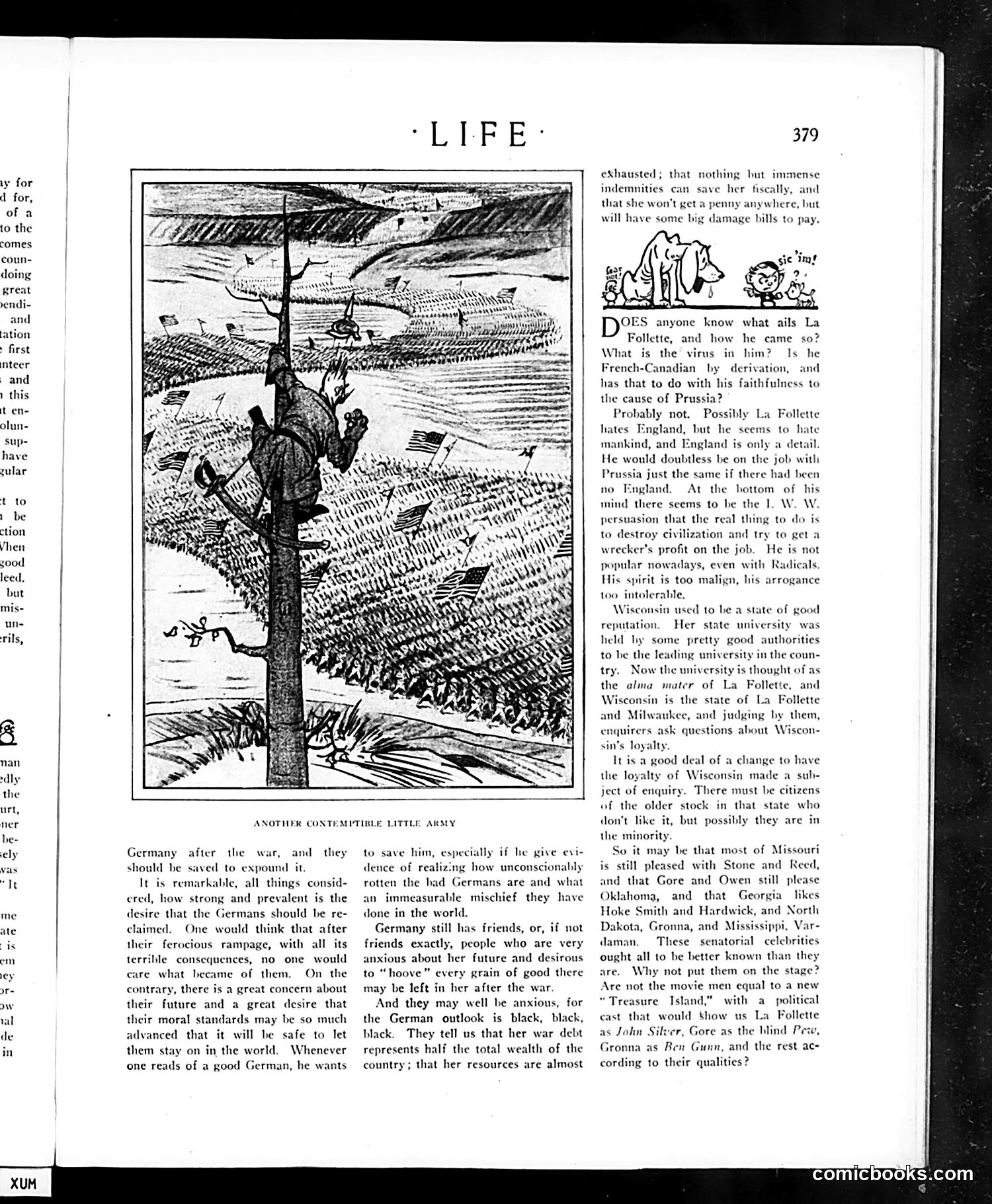
The cartoon depicts a scarecrow-like German soldier standing in a devastated battlefield strewn with bodies and debris. The accompanying text discusses post-WWI Germany's dire situation: massive war debt, resource exhaustion, and moral reckoning. The satire operates on two levels: The image suggests Germany itself has become a hollow, pathetic remnant after the war's devastation. The text then pivots to attacking Senator Robert La Follette of Wisconsin for his perceived sympathy toward Germany and opposition to American interventionism. The author sarcastically questions whether La Follette's loyalty to "the cause of Prussia" stems from his French-Canadian heritage, portraying him as un-American and sympathetic to America's defeated enemy. The piece reflects post-WWI tensions: resentment toward pacifists and isolationists who'd opposed U.S. involvement, while also expressing ambivalent concern for German reconstruction alongside contempt for German militarism.
📄 Transcribed text from this page (OCR, searchable)
Machine-transcribed from the original scan — historical spelling and the odd misread are preserved.
y for d for, of a to the comes coun- doing great rendi- and ation > first nteer and this it en- olun- sup- have zular t to 1 be ction Vhen sood leed. but mis- un= ils, the urt, ner be- ely vas “Tt me ate em. Ney ore ow val de in XUM ANOTHER CONTEMITIBLE LITTLE ARMY Germany after the war, and they should he saved to expound it, It is remarkable, all things consid- cred, how strong and prevalent is the desire that the Germans should be re- claimed. One would think that after their ferocious rampage, with all its terrible consequences, no one would care what became of them. On the contrary, there is a great concern about their future and a great desire that their moral standards may be so much advanced that it will be safe to let them stay on in the world. Whenever one reads of a good German, he wants to save him, especially if he give evi- dence of realizing how unconscionably rotten the had Germans are and what an immeasurable mischief they have done in the world. Germany still friends, or, if not friends exactly, people who are very anxious about her future and desirous to “hoove” every grain of good there may be left in her after the v And they may well be ano the German outlook is black, black, Mack. They tell us that her war debt represents half the total wealth of the country; that her resources are almost ious, for exhausted; that nothing but in indemnities that she won't g will have some big dan n save her fiscal penny anywhere, but bills to pay. OES anyone know what ails La Follette, and how he came so? What is the virus in him? Is he French-Canadian by derivation, and has that to do with his faithfulness to the cause of Prussia? Probably not. Possibly La Follette hates England, but he seems to hate mankind, and England is only a detail. He would doubtless be on the job with Prussia just the same if there had been no England. At the bottom of his mind there seems to he the 1. W. W. persuasion that the real thing to do is to destroy civilization and try to get a wrecker’s profit on the job. He is not popular nowadays, even with Rad His spirit is too malign, his arrogance too intolerable, Wisconsin used to be a state of good reputation, Her state university was held by some pretty good authorities to he the leading university in the coun- thought of as the alma mater of La Follet Wisconsin is the state of L: and Milwaukee, and judging by them, enquirers ask questions about Wiscon- ty. It is a good deal of a change to the loyalty of Wisconsin made a sub- ject of enquiry. There must be citizens of the older stock in that state who don't like it, but possibly they are in the minority. So it m als. try. Now the universi sin’s loya be that most of Missouri is still pleased with Stone and Reed, and that Gore and Owen still please Oklahoma, and that Georgia likes Hoke Smith and Hardwick, and North Dakota, Gronna, and Mississippi, Var- daman. These senatorial celebrities ought all to be better known than they are. Why not put them on the stage? Are not the movie men equal to a new “Treasure Island,” with a_ political t that would Show us La Follette r, Gore as the blind Pew, a as John Gronna as Ben Gunn, and the rest ace cording to their qualities? comicbooks:com