
Life, 1917-09-06 · page 22 of 40
Life — September 6, 1917 — page 22: what you’re looking at
What you’re looking at
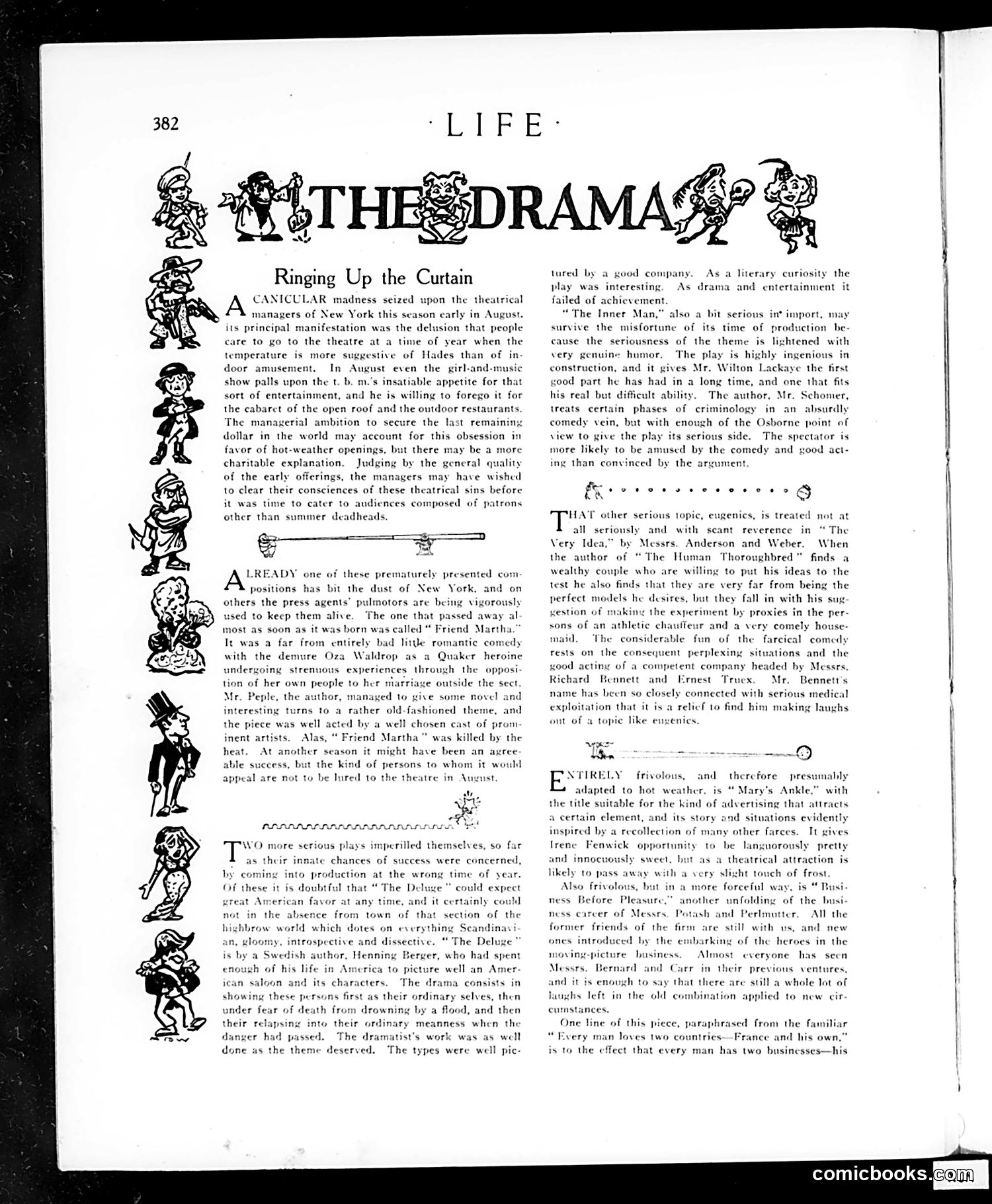
This page reviews several theatrical productions opening in New York during August—a time the critic considers commercially desperate. The author satirizes theater managers for scheduling shows in oppressive heat, attributing this to either financial desperation or desire to clear their consciences of mediocre plays before catering to serious audiences. The review discusses specific plays: "Friend Martha" (which failed despite decent acting), "The Deluge" (a Swedish drama about ordinary people facing flood that succeeded as literary curiosity but failed as entertainment), and mentions "The Inner Man" and "The Very Idea" as more successful serious works. The decorative illustrations along the margin appear to be theatrical character sketches—typical of Life's visual satirical style. The overall tone mocks both theater managers' poor judgment and the quality of summer productions, using humor to critique the theatrical business of the era.
📄 Transcribed text from this page (OCR, searchable)
Machine-transcribed from the original scan — historical spelling and the odd misread are preserved.
Ringing Up the Curtain A CANICULAR madness seized upon th managers of New York this season carly in August. theatrical its principal manifestation was the delusion that people care to go to the theatre at a time of year when the temperature is more suggestive of Hades than of in door amusement, In August even the girl-and- show palls upon the t. b. m.'s insatiable appetite for th sort of entertainment, and he is willing to forego it for the cabaret of the open roof and the outdoor resta The managerial ambition to secure the last remaini dollar in the world may account for this obsession in favor of hot-weather openings, but there m: charitable explanation. Judging by the general quality of the early offerings, the managers may have wished ants y be a more to clear their consciences of these theatrical sins before it was time to cater to audiences composed of patrons other than summer deadheads. LREADY one of these prematurely presented com positions has bit the dust of New York. and on others the press agents’ used to keep them alive. The one that 1s soon as it was born was called “ motors are being vigorously passed away al riend Martha.” It was a far from entirely bad little romantic comedy with the demure Oza Waldrop as a Quaker heroine undergoing. strenuc most s experiences through the opposi le the sect nd and tion of her own people to her marriage outsi Mr. Peple, the ay interesting turns to a thor, manayed to give sor novel rather old the piece was well acted by a well chosen inent artists. Alas, “ Friend Martha” was killed by the heat. At another season it might have been an agree the k 1 peal are not to be lured to hion me, ast of prom able success, b: nd of persons to whom it w he theatre in August ARIANA nny s the © chances of success were concerned, inn; to production at the wrong time of year. Of these it is doubtful that “ The Delu pL more serious plays imperilled themselves, so far ye ing i fe could expect great American favor a dit certainly could any time, n the absence from town of that section of the Scand an, gloomy, introspective and dissective. “ The Deluge" n highbrow world which dotes on everyt in is by a Swedish author, Henning Berger, who had spent enough of his life in America to picture well an Amer- nd its characters. The drama consists in ican saloon showing these persons first as their ordinary selves, then under fear of death from drow ing by a flood, and then their relapsing into their ordin neanness when the ry Tine danger had passed, The dramatist’s work was as well done as the theme deserved. The types were well pic- lured by a good company. As a literary curiosity the play was interesting. As drama and entertainment it failed of achievement. he Inner Man,” also survive the misfortune of its time of production by cause the seriousness of the theme is lightened with very genuine humor. The play is highly ingenious in construction, and it gives Mr. Wilton Lackaye the first good part he has had in a long time, and one that fits his real but difficult ability. The author, Mr. Schomer, treats certain phases of criminology in an absurdly comedy vein, but with enc a bit serious in* import, i h of the Osborne point of view to give the play its serious side. The spectator is more likely to be amused by the comedy and good act- ced by the a ing than con gumen fro c corse ecove oo ran 8 eugenics, is tre T" AT other serious 10pi MH seriously and with scant reverence ted not at in “ The Very Idea,” by Messrs. Anderson and Weber. When the author of “The Huma zhbred " finds a wealthy couple who are willing test he perfect models he desires, but they fall in with his sug to put his ideas to the re very far from bei Iso finds that they s the xestion of making the experiment by proxies in the per- nd a very ‘onsiderable fun of the farcical comedy sons of an athletic chauffeur comely house- maid. ‘The rests on the consequent perplexing situations and the xood actiny of a competent company headed by Messrs. Richard Bennett and Ernest Truex. Mr. Bennett's name has been so closely connected with serious medical exploitation that it isa relief to find him making out of a topic like laughs NTIRELY frivolous, and therefore presumably adapted to hot weather, is “ Mary's Ankle,” with the title suitable for the kind of advertising that attracts a certain clement, and its story and situations evidently inspired by a recollection of many other farces. It gives Irene Fenwick opportunity to be languorously pretty and innoet isly sweet, but as a theatri attraction is likely to pass away with a very slight tonch of frost Also frivolous, but in a more forceful way, is “ Bu ness Before P! asure,” another unfolding of the busi sh and # utter, All the former friends of the firm are still with ness career of Messrs. I rl . and new ones introduced by the embarking of the heroes in the moving-picture business. Almost everyone has. secn Messrs, Bernard and Carr their previous ventures. and it is enough to say that there are still a whole lot of in the old ec laughs Te mbination applied to new cir cum) ances. One line of this piece, paraphrased from the familiar “Every man loves two countries—France and his own,” is to the effect that every man has two businesses—his comicbooks