
Life, 1917-09-06 · page 28 of 40
Life — September 6, 1917 — page 28: what you’re looking at
What you’re looking at
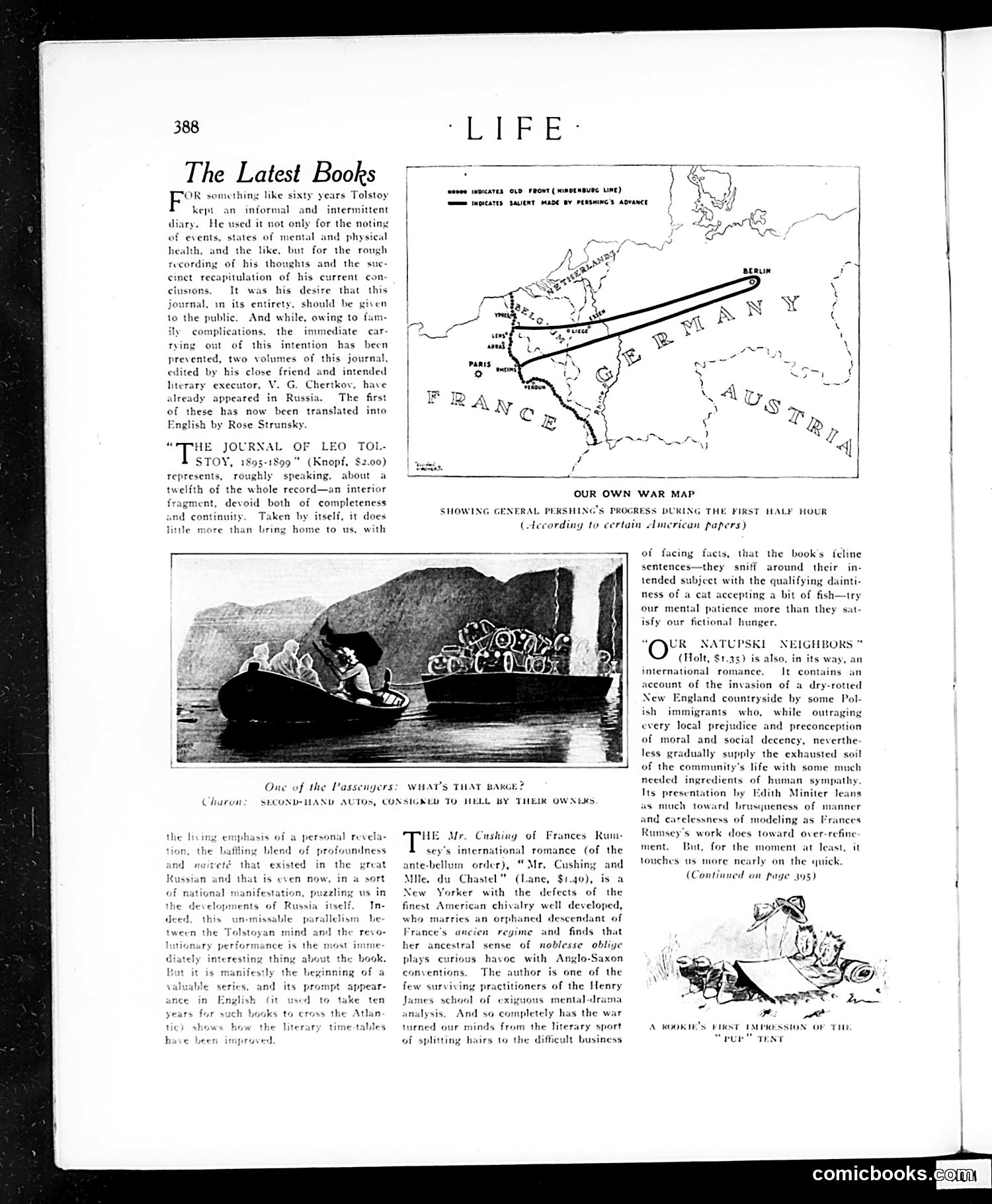
This is a book review section from *Life* magazine. The main satirical content is the war map cartoon titled "OUR OWN WAR MAP," which mocks American newspaper coverage of World War I. The cartoon shows a map with an absurdly large arrow labeled "BERLIN" extending from France—a visual joke about exaggerated American press claims regarding General Pershing's military progress. The subtitle reads "showing General Pershing's progress during the first half hour (according to certain American papers)," sarcastically suggesting newspapers were publishing wildly optimistic, unrealistic accounts of how quickly the U.S. forces were advancing. Below is an unrelated illustration of a riverboat labeled "WHAT'S THAT BARGE? SECOND-HAND AUTOS, CONSIGNED TO HELL BY THEIR OWNERS"—a separate joke about old cars being discarded. The page primarily reviews recent books including Tolstoy's journal and works of international fiction. The satire targets wartime journalistic hyperbole rather than politics directly.
📄 Transcribed text from this page (OCR, searchable)
Machine-transcribed from the original scan — historical spelling and the odd misread are preserved.
388 The Latest Books He wu: of events, 5 hing like sixty years Tolstoy informal and intermittent sed it not only for the noting tes of met health, and the like, but cordi diary. and physical for the rough of his thoughts and the ste ct recapitulation of his current con. e¢ that this should be given ne clusions, It his des’ nal, im its entirety to the public. And while, owing to fi was jo ily complications, the immediate car: rying out of this intention has been prevented, two volumes of this journal. edited by his close friend and intended Iterary executor, V. G. Chertkov, have already appeared in Russia. The first of these has now been translated into English by Rose Strunsky. “CHE JOURNAL OF LEO TOL. STOY, 1893-1899” (Knopf, $2.00) represents, roughly speaking, about a twelfth of the whole record—an interior fragment, devoid both of completeness ity. Ta than bring home to us, with nd co: n by itself, it does little “LIFE: eevee inDKCATES OLD FRONT ( MIRDEMBURG LINE) a picarts SAUENT MADE BY PLESMINC'S ADVANCE arRun OUR OWN WAR MAP SHOWING GENERAL PERSHING'S PROGRESS DURING THE FIRST HALF HOUR (decording to certain American papers) One of the Passengers Charon the I of profoundn nd 4 té th: sted in the eat Kus and that is even now, in a sort national manifestation, puzzling us in ¢ developments of Russia itse’ In- deed, this missable parallelism be tween the Tolstoyan the revo- lutionary perfor ost imme he book. ely interesting it is manifestly sable series, and its prompt appear- nce in English (it used to take ten for such aks to cross the Atla pw the nproved literary time-tables WHAT'S THAT BAKGE? SECOND*HAND AUTOS, CONSIGRED TO HELL BY THEIR OWNEKS. Cushing of Frances Kum: ’ national romance (of the ante-bellum order), “Mr. Cushing and Mile, du Chastel” (Lane, $1.40), is a New Yorker with the defects of the finest American chivalry well developed, descendant of 1 finds that her ancestral noblesse obliye plays curious havoc with Anglo-Saxon conventions. The author is one of the few surviving practitioners of the Henry James school of exig And so co! turned our minds fr ries an orphan France’s ay a regime sense of pus mental-dr: analysis. pletely has the war m the 1 of splitting hairs to the difficult business era y sport the book's around of facing facts, that icline sentences—they sniff their in- tended subject with the qualifying dainti- ness of a cat accepting a bit of fish—try our mental patience more than they sat- isfy fictional hunger. a IR NATUT (Holt, $ imternational ron 1 NEIGHBORS * 5) is also, in its ance. It contains an account of the invasion of a dry-rotted t New England countryside by some Pol- ish immigrants while outraging every local prejudice and preconception of moral and social decency. less gradually supply the ex: of the community who, neverthe. sted soil 's life with some much needed ingredients of human symy Is presentation by Edith as much toward brusquen and ces Rumsey’s work does toward over-refine ment. But, for the moment at least, it touches us more n Miniter leans ess of manner relessness of modeling as F arly on the quick. (Continued on page 395) yr Fi f ST ZS at A KOOKIE'S FIKST IMPRESSION OF “pur” TENT THE comicbooks