
Life, 1917-09-06 · page 30 of 40
Life — September 6, 1917 — page 30: what you’re looking at
What you’re looking at
This page contains three distinct satirical pieces from WWI-era Life magazine: **"The Fisherman's Dream"**: A man tries to seduce a woman by claiming he's a modern story hero, but admits he's physically unfit—a substitute because real heroes are at the front fighting. She refuses, preferring to wait for the war's end. The satire mocks both the mediocrity of romance fiction and male inadequacy during wartime. **"A Suspended Literature"**: Similar theme—a woman dismisses a suitor as unqualified, but he argues all suitable men are fighting, so he's the only available option. She rejects him anyway. This satirizes how WWI disrupted normal social/romantic life. **"When Women Rule"** and **"Captain Jinks"**: Brief quips about female authority and military service obligations. **"At the Grand Central"**: Celebrates Grand Central Terminal as a microcosm of wartime America—soldiers, families saying goodbye, the transformation of civilian life by war. The prose is genuinely admiring rather than satirical. The page captures how WWI fundamentally disrupted American society, leaving civilians (especially men) displaced and uncertain.
📄 Transcribed text from this page (OCR, searchable)
Machine-transcribed from the original scan — historical spelling and the odd misread are preserved.
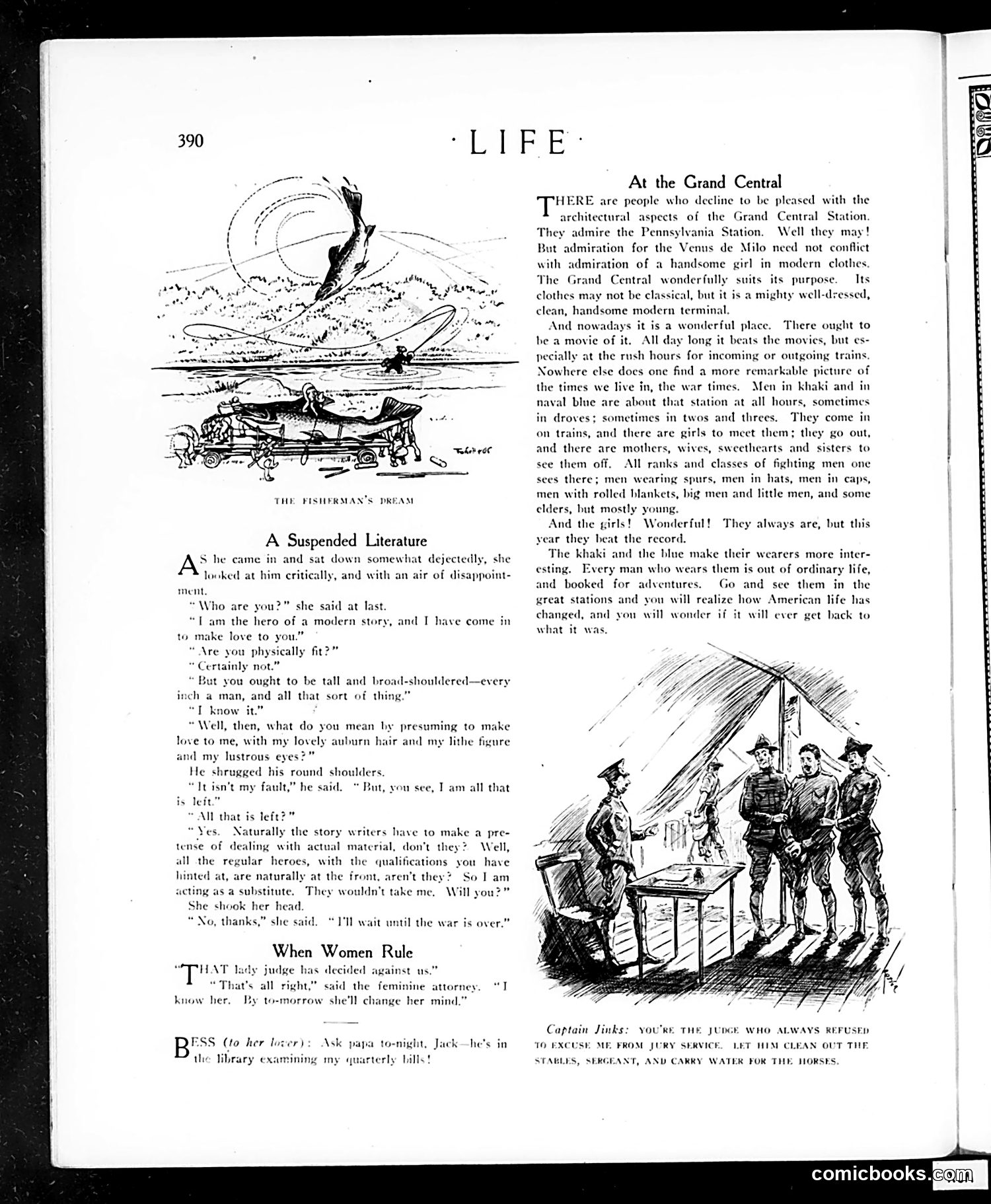
“LEE THE FISHERMAN’S DREAM A Suspended Literature AS he came in and sat down somewhat dejectedly, she ked at him critically, and with an air of disappoint- ment Who are you?” she said at last. “Lam the hero of a modern story, and T have come in to make love to you.” “Are you physically fit ” Certainly not.” “But you ought to be tall and broa inch a man, and all that sort of thing “T know it.” “Well, then, what do you mean by presuming to make love to me, with my lovely auburn hair and my lithe figure 1 my lustrous eyes? He shrugged his round shoulders. “Tt isn't my fault,” he said. is leit.” ~All that is left?” >” shouldered—every “But, you see, Tam all that cs. Naturally the story writers have to make a pre= tense of dealing with actual material, don't they? Well, all the regular heroes, with the qualifications you have hinted at, are naturally at the front, aren’t they? So I am acting as a substitute. They wouldn't take me, Will you? She shook her head. “No, thanks,” she said. “I'M wait until the war is over.” When Women Rule judge has d against us.” “TH NV “That's all right,” said the feminine attorney know her. By to-morrow she'll change her mind.” ESS (to her lover) the library examining my quarterly bills! Ask papa to-night, Jack he's in At the Grand Central HERE are people who decline to be pleased with the architectural aspects of the Grand Central Station. They admire the Pennsylvania Station. Well they may! But admiration for the Venus de Milo need not conflict with admiration of a handsome girl in modern clothes. The Grand Central wonderfully clothes may not be classical, but it is a mighty well-dressed, clean, handsome modern terminal. And nowadays it is a wonderful place. be a movie of it. All day long it beats the movies, but es- pecially at the rush hours for incoming or outgoing trains. Nowhere else does one find a more remarkable picture of the times we live in, the war times. Men in khaki and in naval blue are about that station at all hours, sometimes in droves; sometimes in twos and threes. They come in on trains, and there are girls to meet them; they go out, and there are mothers, wives, sweethearts and sisters to see them off. All ranks and classes of fighting men one sees there; men wearing spurs, men in hats, men in caps, men with rolled blankets, big men and little men, and some elders, but mostly young. And the girls!) Wonderful! r they beat the record. The khaki and the blue make their wearers more inter- esting, Every man who wears them is out of ordinary life, and booked for adventures. Go and see them in the great stations and you will realize how American life has changed, and you will wonder if it will ever get back to what it was. suits its purpose. — Its There ought to They always are, but this Captain Jinks: you're THE JUDGE WHO ALWAYS REFUSED TO EXCUSE ME FROM JURY SERVICE. LET HIM CLEAN OUT THE STALES, SERGEANT, AND CARRY WATER FOR THE HORSES comicbooks