
Life, 1917-09-06 · page 10 of 40
Life — September 6, 1917 — page 10: what you’re looking at
What you’re looking at
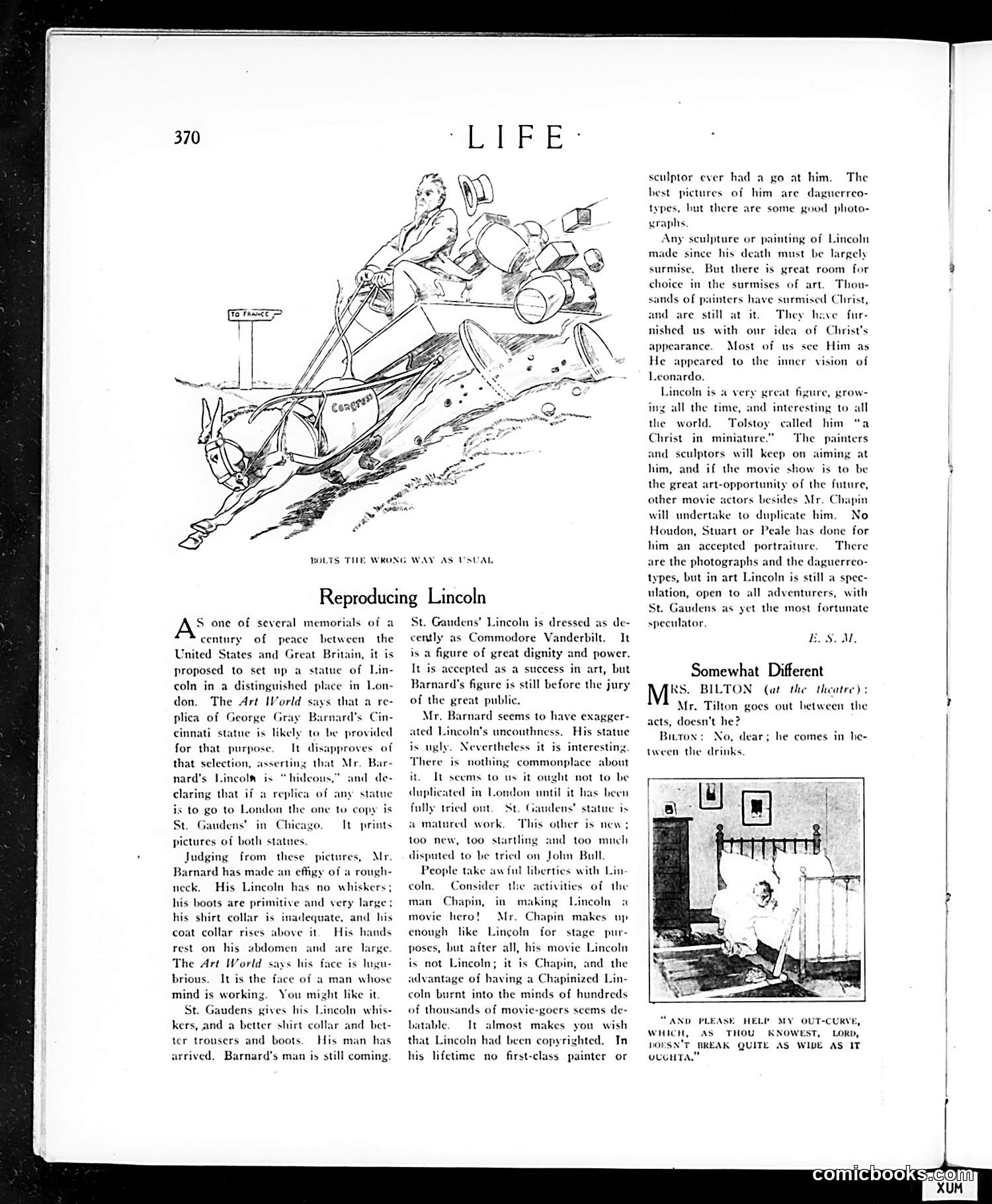
This page satirizes efforts to create statues and artistic representations of Abraham Lincoln. The main cartoon depicts a sculptor laboring chaotically over a Lincoln monument, with materials and tools scattered about—suggesting the difficulty and messiness of capturing Lincoln's likeness. The accompanying article discusses competing Lincoln statues by artists George Barnard and St. Gaudens, critiquing their respective approaches. It also references Charlie Chaplin's planned film portrayal of Lincoln, noting the irony that Chaplin (a famous comedian) would interpret this serious historical figure. The satire centers on how artists across mediums—sculpture, painting, cinema—struggle to authentically "reproduce" Lincoln, with varying degrees of success and appropriateness.
📄 Transcribed text from this page (OCR, searchable)
Machine-transcribed from the original scan — historical spelling and the odd misread are preserved.
BOLTS THE WRONG WAY AS USUAL Reproducing Lincoln S one of several memorials of a century of peace between the United States and Great Britain, it is proposed to set up a statue of Lin- coln in a distinguished place in Lon- don. The Art World says that a re- plica of € i Barnard’s Cin- cinnati statue is likely to be provided for that purpose. It disapproves of that selection, asserting that Mr. Bar- nard’s Lincolm is “hideous,” and de- of ue claring that if a repli ay is to go to London the one to copy is St. Gandens’ in Chicago. — It prints pictures of both statues. Judging from these Barnard has made an effigy of a rough- neck. His Lincoln has no whiskers; his boots are primitive his shirt collar is inadequate, and his coat collar rises above it. His hands rest on his abdomen and are large The Art World says his face is lu brious. It is the face of a man whose mind is working. You might like it St. Gaudens gives his Lincoln whis- kers, and a better shirt collar and bet- ter trousers and boots. His man has arrived. Barnard’s man is still coming. jictures, Mr. nd very large; St. Gaudens’ Lincoln is dressed as de- cently as Commodore Vanderbilt. It is a figure of great dignity and power. It is accepted as a success in art, but Barnard’s figure is still before the jury of the great public. Mr. Barnard seems to have exagger- ated Lincoln’s uncouthness, His statue is ugly. Nevertheless it is interesting There is nothing commonplace about it, It seems to us it ought not to be duplicated in London until it has been fully tried ont. St. G: a matured work. ‘This other is new; idens’ ue is too new, too startling and too much disputed to be tried on John Bull People take aw ful liberties with Lin coln. Consider the man Chapin, in) making Lincoln a movie hero! Mr. Chapin makes up enough like Lincoln for stage pur- activities of the poses, but after all, his movie Lincoln is not Lincoln; it is Chapin, and the advantage of having a Chapinized 1 coln burnt into the minds of hundreds of thousands of movi ble. It almost makes you wish that Lincoln had been copyrighted. In his lifetime no first-class painter or oers scems de- sculptor ever had a go at him. The hest pictures of him are daguerreo- types, hut there are some good photo- graphs. Any sculpture or painting of Lincoln made since his death must be largely surmise, But there is great room for choice in the surmises of art. Thou- sands of painters have surmised Christ, They have fur- and are still at it shed us with our idea of Christ's app He appeared to the inner vision of ance. Most of us see Him as Leonardo. Lincoln is a very great figure, grow- ing all the time, and interesting to all the world, Tolstoy called him “a Christ in miniature.” The painters. and sculptors will keep on aiming at him, and if the movie show is to be the great art-opportunity of the future, other movie actors besides Mr. Chapin will undertake to duplicate him, No Houdon, Stuart or Peale has done for him an accepted portraiture. There are the photographs and the daguerreo- types, but in art Lincoln is still a spec- ulation, open to all adventurers, with St. speculator, jaudens as yet the most fortunate Somewhat Different M! 5. BILTON (at the theatre): Mr. Tilton goes out between the acts, doesn’t he? Bitton : . dear; he comes in he- tween the drinks. “AND PLEASE HELP MY OUT~ CURVE, WHICH, AS THOU KNOWEST, LORD, VOESN'T BREAK QUITE AS WIDE AS IT OUGHTA,” ——w