
A complete issue · 40 pages · 1917
Life — July 12, 1917
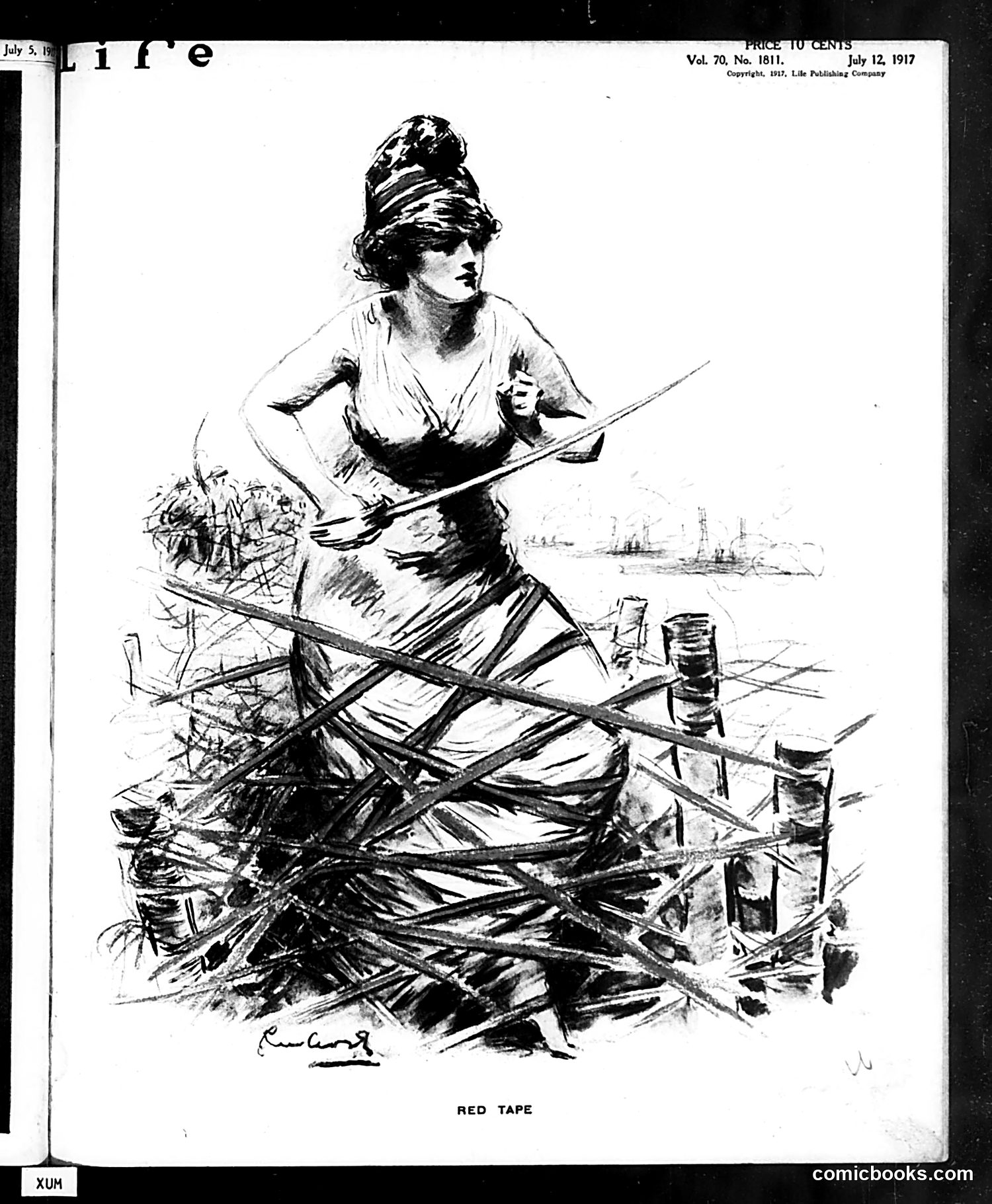
This political cartoon satirizes governmental bureaucracy during World War I. A woman representing America or Liberty is entangled and nearly suffocated by red tape—literal coils of ribbon labeled "red tape," a period idiom for excessive bureaucratic procedures and paperwork. In the background, military ships are visible, suggesting the context of America's involvement in the war (the U.S. entered in April 1917). The cartoon critiques how administrative red tape and government inefficiency were hampering the war effort and national mobilization. The woman's determined pose with a sword suggests she wants to take action but is constrained by bureaucratic obstacles. The artist signed the work at bottom left.
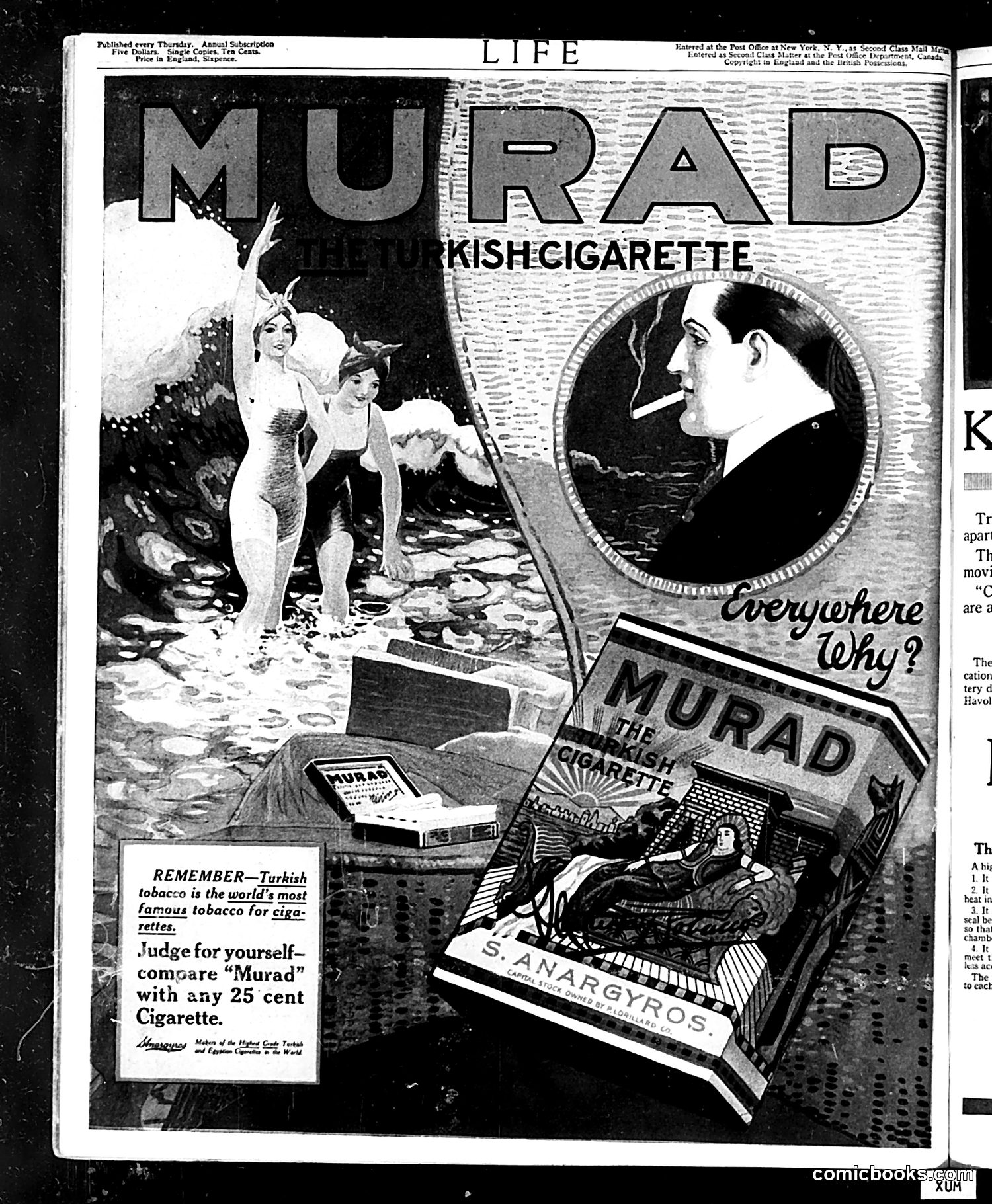
This page is primarily a **Murad Turkish cigarette advertisement**, not political satire. The ad uses orientalist imagery common to early 20th-century marketing: women in exotic/revealing attire in a harem-like setting, with a turbaned man smoking in a circular portrait. The accompanying text appeals to consumers to "Judge for yourself—compare 'Murad' with any 25 cent Cigarette," emphasizing that Turkish tobacco is "the world's most famous tobacco for cigarettes." The phrase "Everywhere Why?" appears to reference the product's widespread availability. This reflects period marketing strategies that exoticized non-Western cultures to sell luxury goods to American consumers. The imagery perpetuates orientalist stereotypes rather than conveying political commentary.
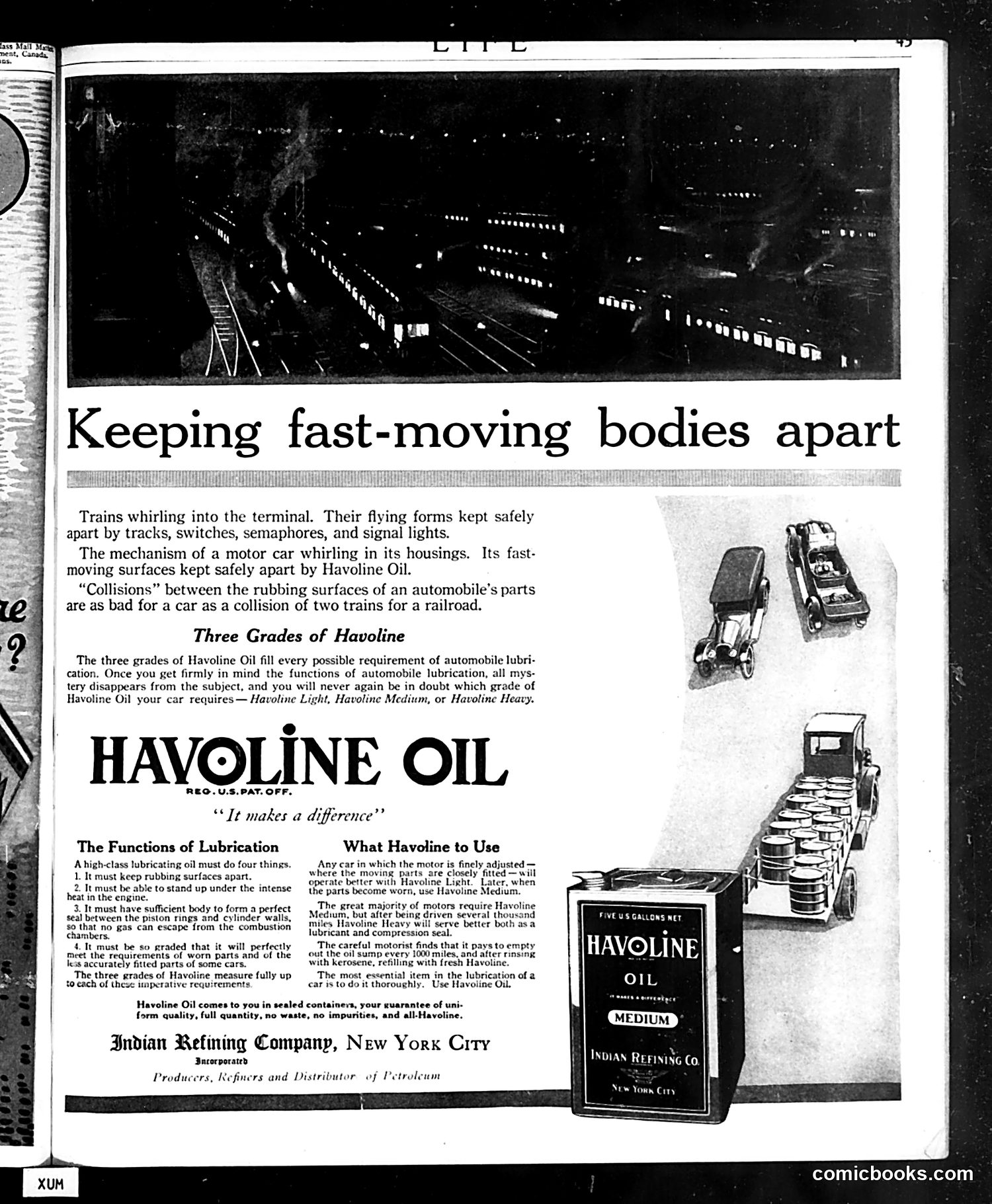
This is primarily **an advertisement, not satirical content**. It's a full-page ad for Havoline Oil from the Indian Refining Company (New York City). The top photograph shows trains at night in a terminal with illuminated windows. The ad uses this image metaphorically: just as railway switches and signals keep fast-moving trains safely separated on different tracks, Havoline Oil keeps moving engine parts separated through lubrication, preventing damaging collisions between metal surfaces. The ad emphasizes three grades of oil (Light, Medium, Heavy) and lists lubrication's functions: keeping surfaces apart, reducing friction, and preventing wear. Small illustrations show oil containers and engine components. The tagline is "It makes a difference." This is straightforward early automotive advertising using an industrial metaphor.
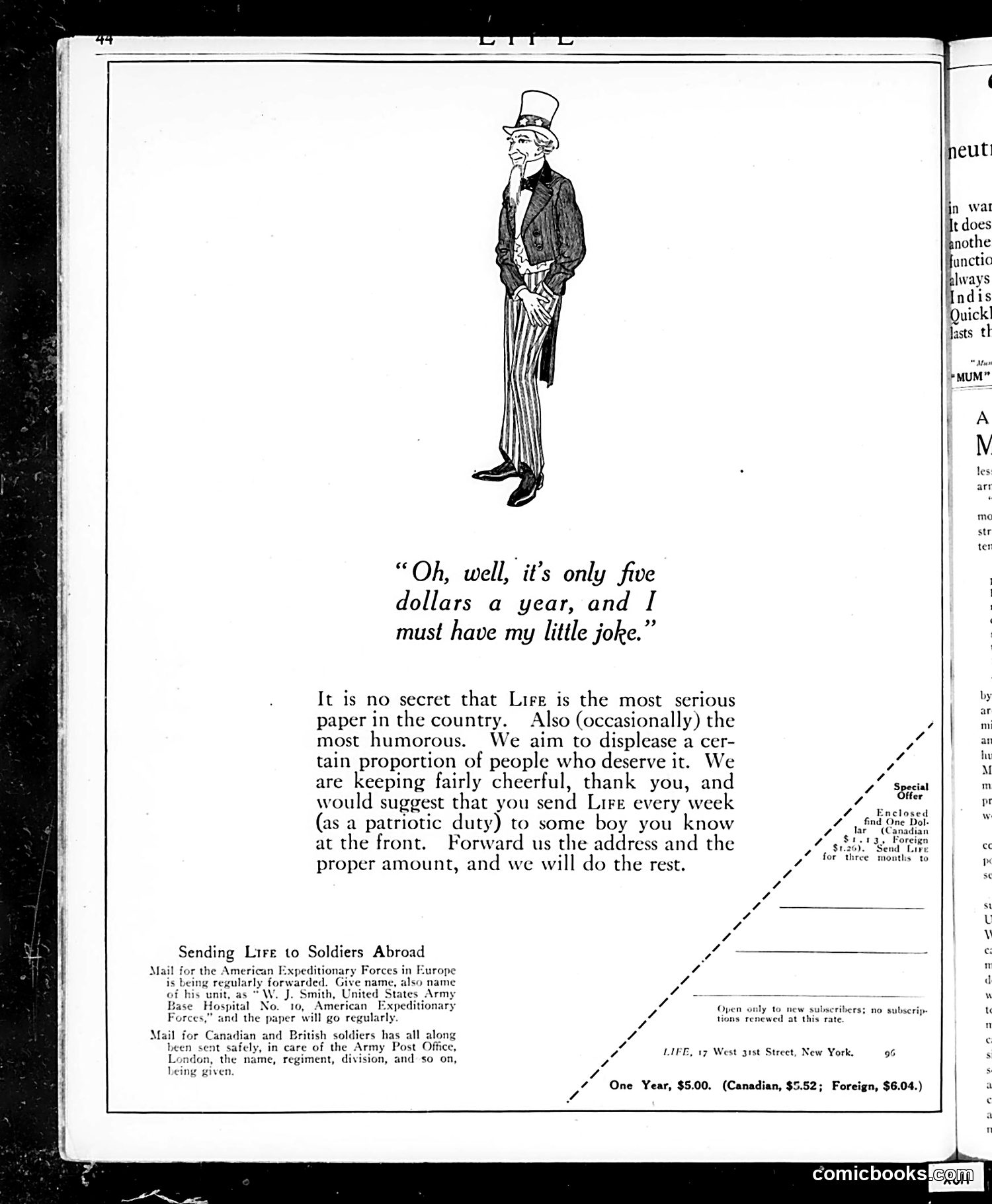
The cartoon shows a well-dressed man in a top hat making a self-deprecating joke about Life magazine's subscription cost: "Oh, well, it's only five dollars a year, and I must have my little joke." The accompanying text acknowledges Life's dual identity as both a serious and humorous publication, then pivots to a patriotic appeal. During what appears to be World War I (based on references to "Soldiers Abroad" and "American Expeditionary Forces in Europe"), Life solicited subscriptions as a charitable act—readers should send the magazine to soldiers at the front as "a patriotic duty." The satire is gentle: Life positions itself as essential reading for troops while simultaneously asking civilians to fund this patriotic gesture through subscriptions. It's simultaneously self-promotional and patriotic messaging.
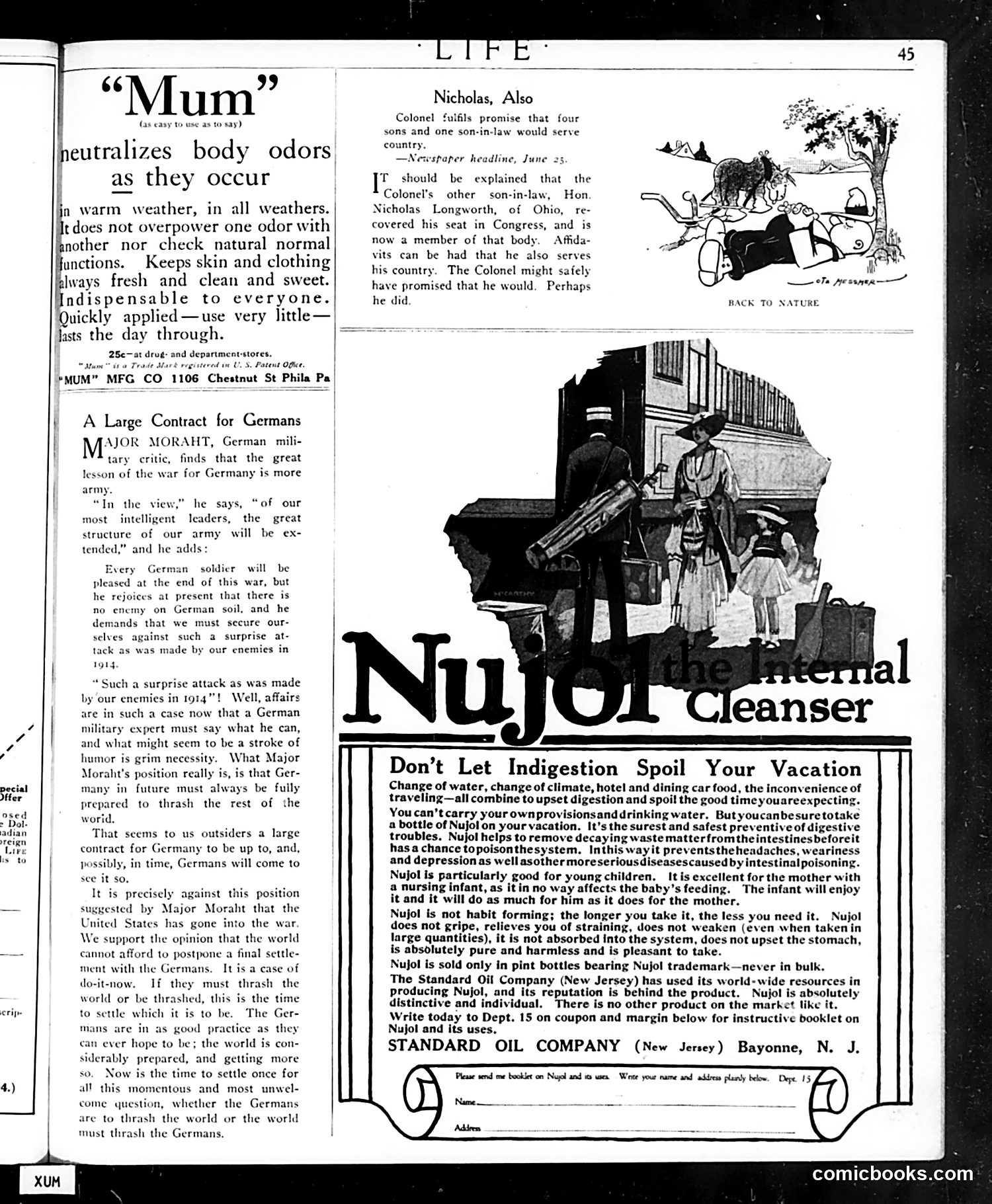
This page is primarily **advertising and political commentary**, not satirical cartoons. The top cartoon "Back to Nature" depicts a couple relaxing outdoors—likely satirizing the leisure class or vacation culture. The main content is a **political article about Germany** following WWI. Major Morath, a German military critic, argues Germany's lesson from the war is to build a stronger army. The piece presents his argument that Germans should prepare militarily for future conflict, suggesting the world must choose between "thrash[ing] the world or be thrashed." The bulk of the page is a **Nujol digestive aid advertisement** targeting vacation travelers, claiming the product prevents digestive problems from travel stress and dietary changes. The political commentary reflects post-WWI anxiety about German militarism and rebuilding—concerns that would prove prescient regarding 1930s-40s developments.
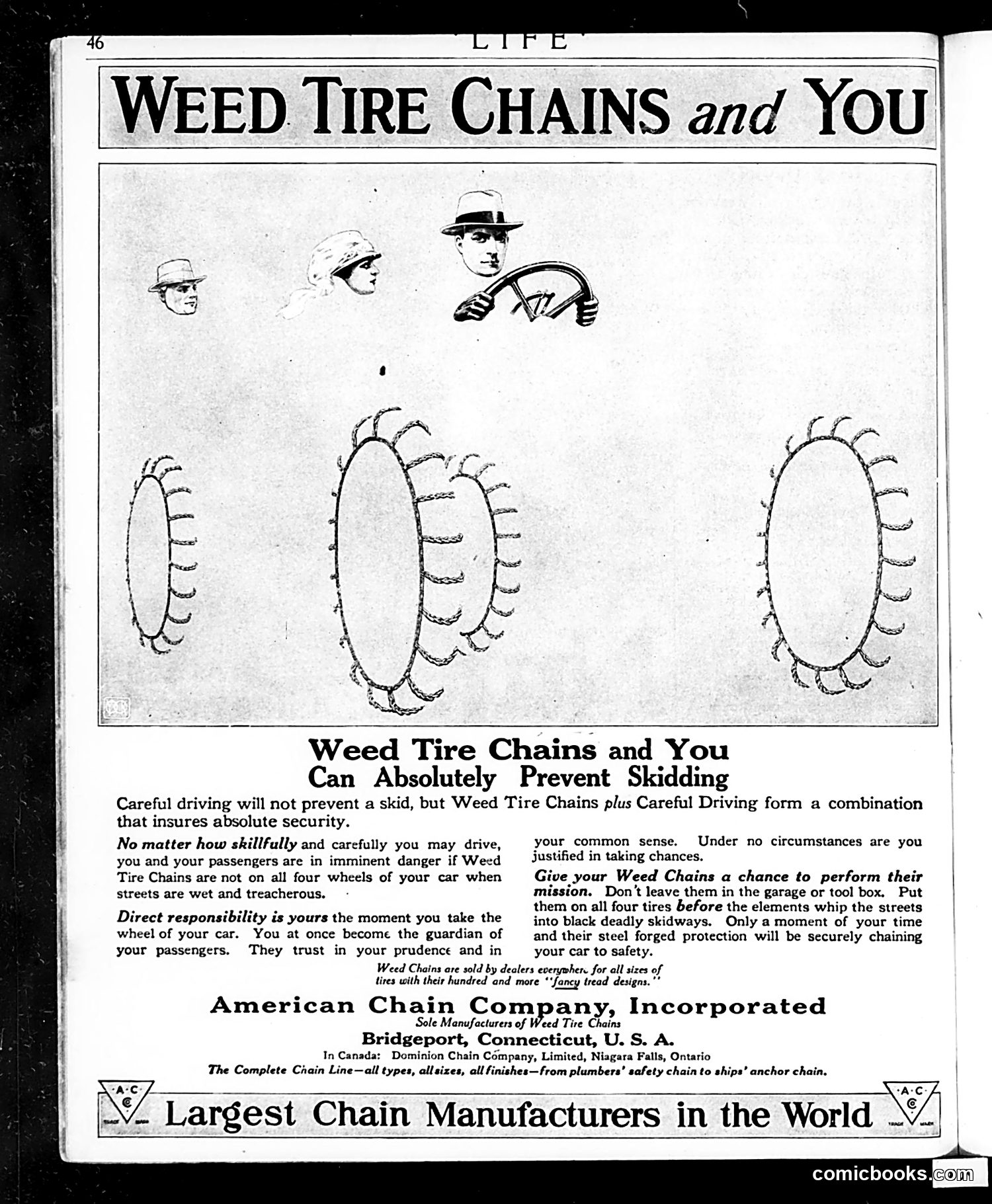
This is a **product advertisement**, not political satire. The page promotes Weed Tire Chains, devices that attach to car tires to prevent skidding on wet or icy roads. The visual shows three illustrated men of progressively smaller size, followed by diagrams of tires with and without chains attached. The progression appears to represent the "shrinking" confidence or safety of drivers without proper tire chains. The advertisement's message is straightforward: careful driving alone cannot guarantee safety in dangerous road conditions. Drivers have a responsibility to their passengers to equip their vehicles with Weed Tire Chains before weather makes streets treacherous. The ad emphasizes this is a safety responsibility, not optional. American Chain Company manufactured these chains and positioned themselves as the largest chain manufacturer globally.
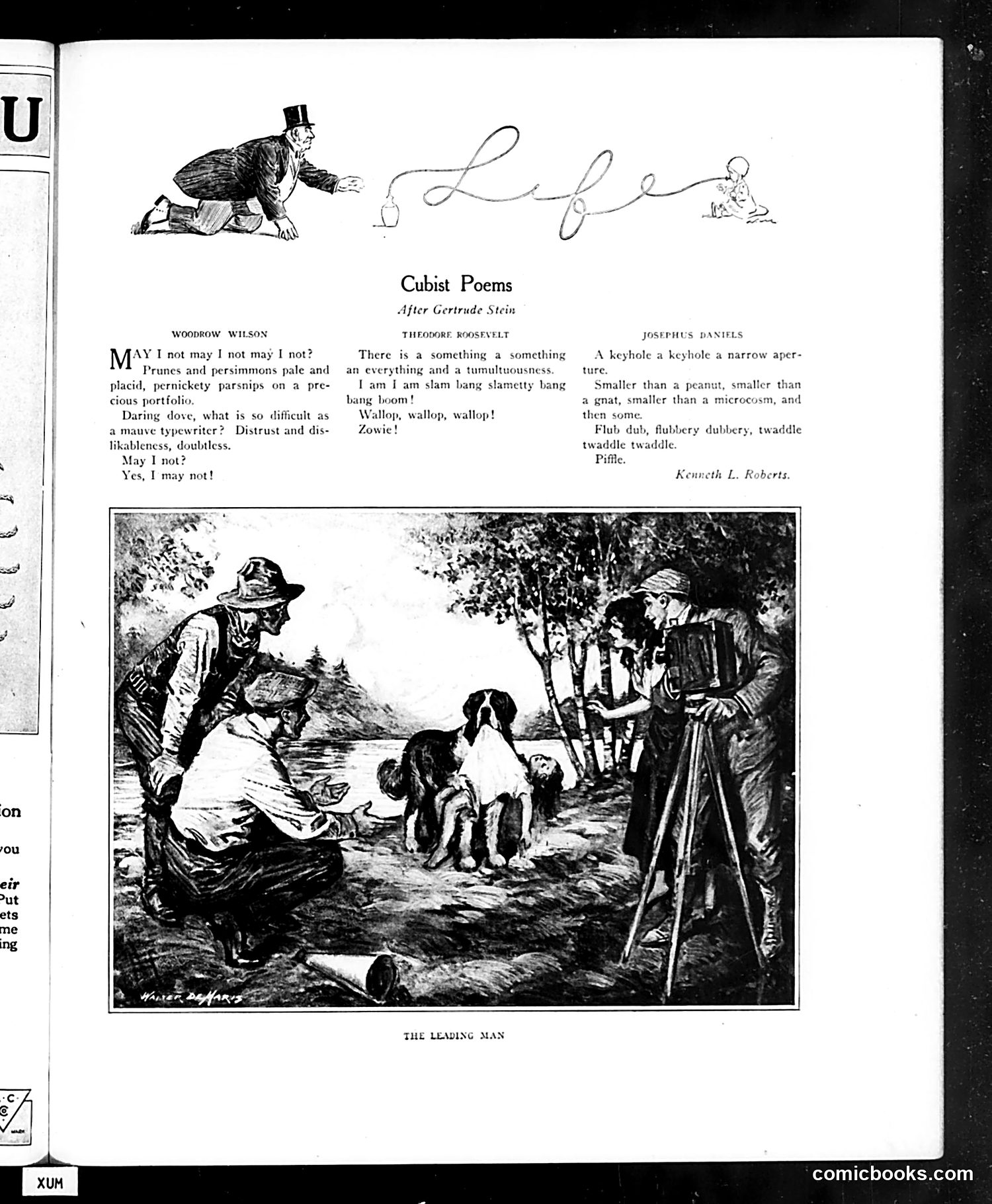
This page presents "Cubist Poems After Gertrude Stein"—a satirical take on modernist literary experimentation. The three short poems parody the abstract, fragmented style of Gertrude Stein's experimental writing. The illustration titled "The Leading Man" depicts outdoorsmen or surveyors with dogs in a landscape, likely mocking how Cubist and modernist art prioritized abstract form over clear narrative or subject matter. The satire targets early 20th-century avant-garde literature and art movements. By pairing nonsensical poems (featuring words like "Wallop, wallop!" and "Flub dub, flubbery dubbery") with a conventionally realistic illustration, Life magazine ridicules the gap between modernists' claims of sophistication and what ordinary readers perceive as meaningless gibberish. The joke: if you strip away modernist pretension, you're left with nothing.
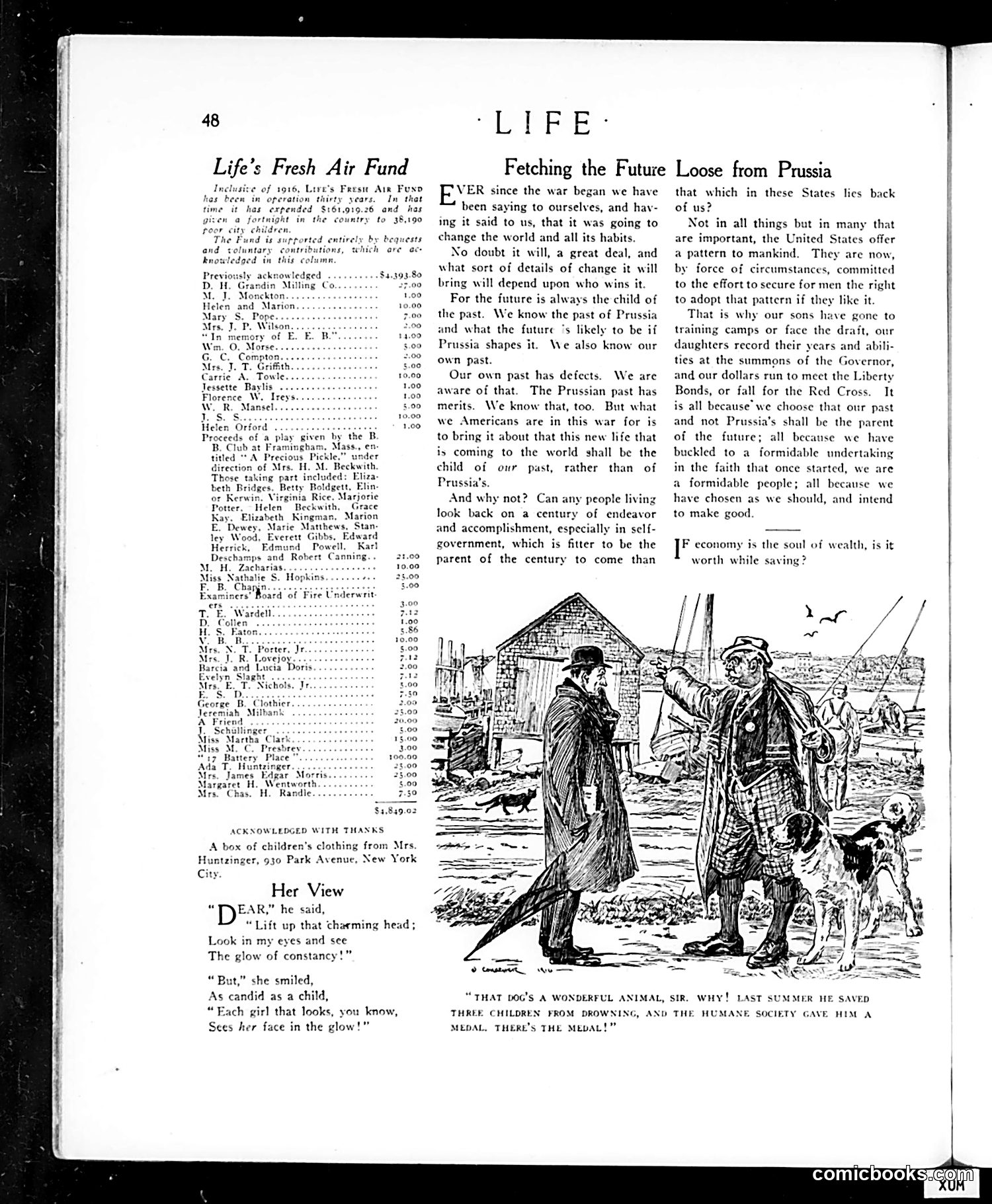
This page contains two distinct pieces: **Left side:** "Life's Fresh Air Fund" - a fundraising list acknowledging donors who contributed to a children's charity providing fresh air/outdoor experiences for poor urban children. The amounts donated range from small sums to over $1,000. **Right side:** An article titled "Fetching the Future Loose from Prussia" discusses post-WWI American attitudes toward reshaping Europe, arguing Americans should focus on improving their own society rather than serving as Europe's moral parent. **Main illustration:** A sketch showing two adults and children at what appears to be a seaside location. The caption praises a dog that saved three drowning children, with the Humane Society awarding it a medal—a sentimental story contrasting with the serious geopolitical article above it.
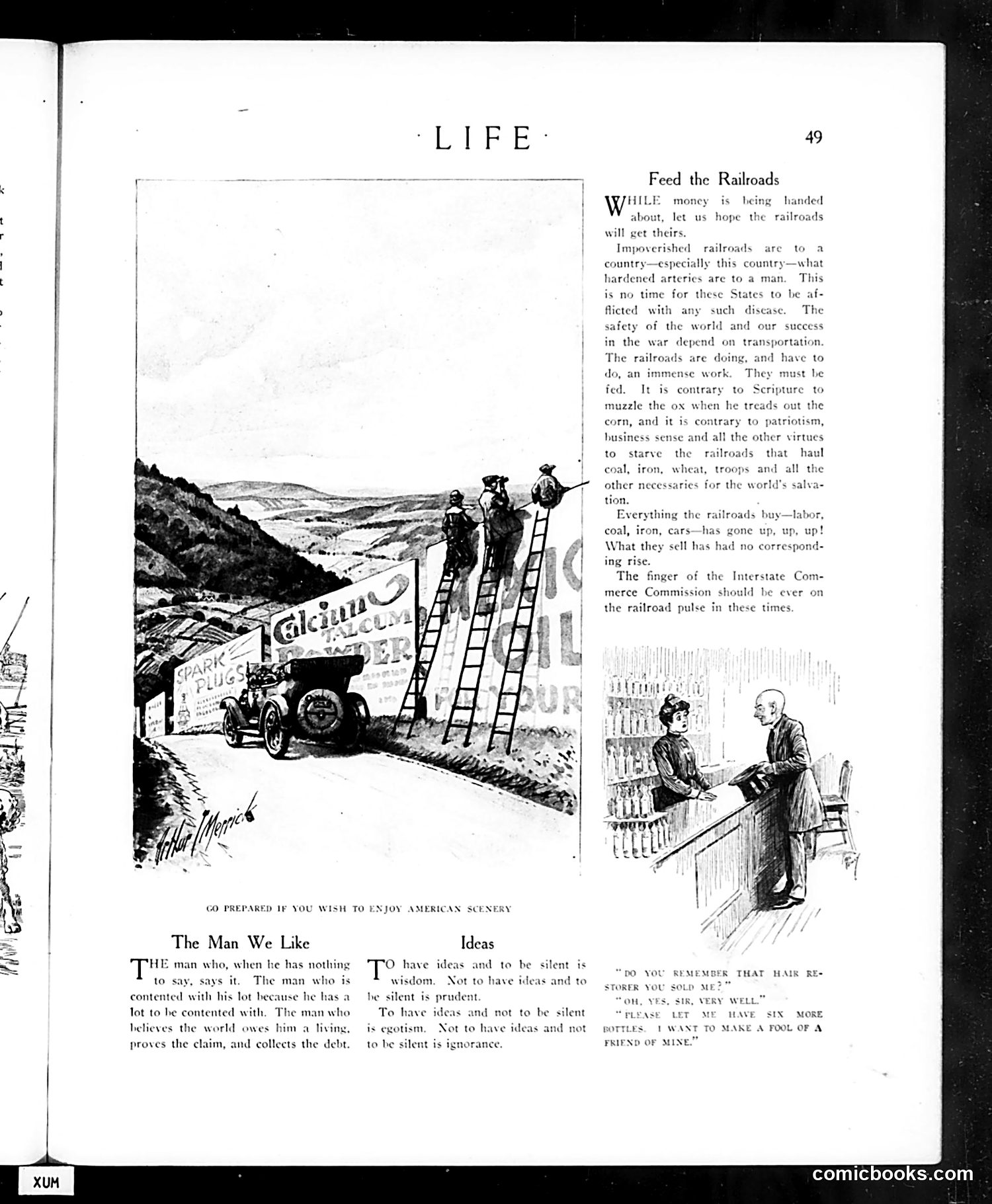
This page contains three distinct pieces of content: **"Feed the Railroads"** (main article): A wartime advocacy piece arguing that railroads require financial support to transport war materials and troops. It criticizes those who would "starve" railroads while profiting from war, appealing to patriotic duty and the Interstate Commerce Commission to maintain rail infrastructure. **"The Man We Like"** (left column): A brief philosophical piece praising people with ideas who are willing to share them, contrasting this with silent wisdom and ignorance. **"Ideas"** (right): A cartoon showing two men discussing business proposals, with the punchline about wanting six more bottles to make "a fool of a friend of mine"—a joke about frivolous spending disguised as friendship. The illustrations are unsigned character sketches typical of Life's satirical style from this era.
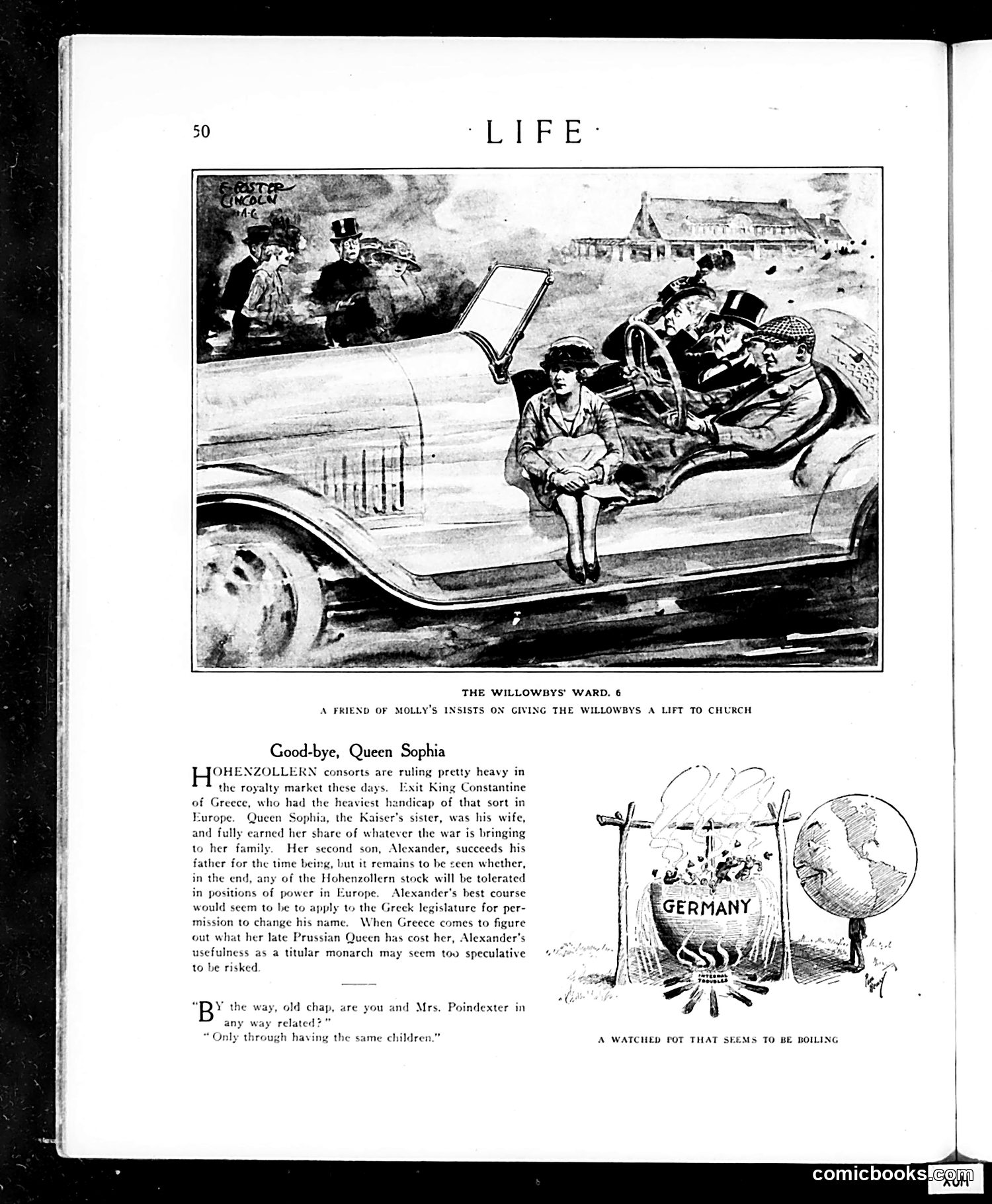
This page satirizes post-World War I European royalty. The article discusses Queen Sophia of Greece, sister to the deposed German Kaiser (Emperor Wilhelm II), examining whether her family's royal lineage will survive the war's aftermath and the fall of European monarchies. The main cartoon shows a woman being given a car ride to church—a mundane modern scene contrasting with royal dignity. The accompanying sketch depicts Germany as a boiling pot, visually pun on the phrase "A watched pot that seems to be boiling." The satire targets how European royalty, once powerful, now faces uncertain futures. The juxtaposition of Queen Sophia with ordinary charitable acts and the "boiling" Germany imagery emphasizes the political upheaval destabilizing the old aristocratic order.
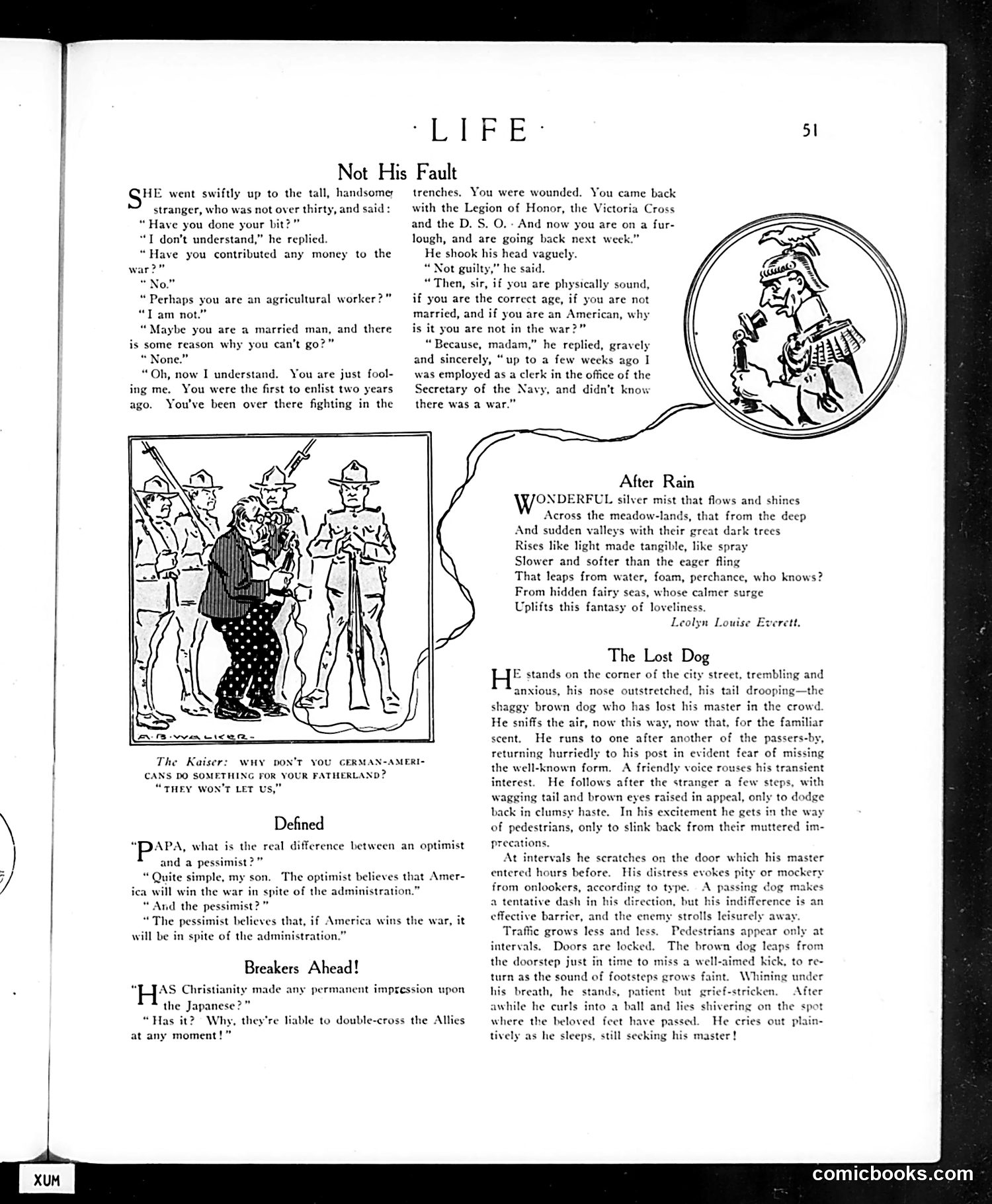
The cartoon titled "The Kaiser" depicts a German-American man being interrogated by three military officers. The caption reads: "WHY DON'T YOU GERMAN-AMERICANS GO SOME PATRIOTIC AND 'THEY WON'T LIST US.'" This satirizes suspicion of German-Americans during World War I. The joke suggests that German-Americans faced accusations of disloyalty, with the implication that enlisting would prove their patriotism and avoid discrimination. The cartoon critiques both the prejudice against German-Americans and their perceived desperation to demonstrate loyalty. The other content on the page—"Not His Fault," "Defined," and "Breakers Ahead!"—contains dialogue-based humor about WWI themes: military service, optimism versus pessimism about American victory, and Christianity's influence on the Japanese.
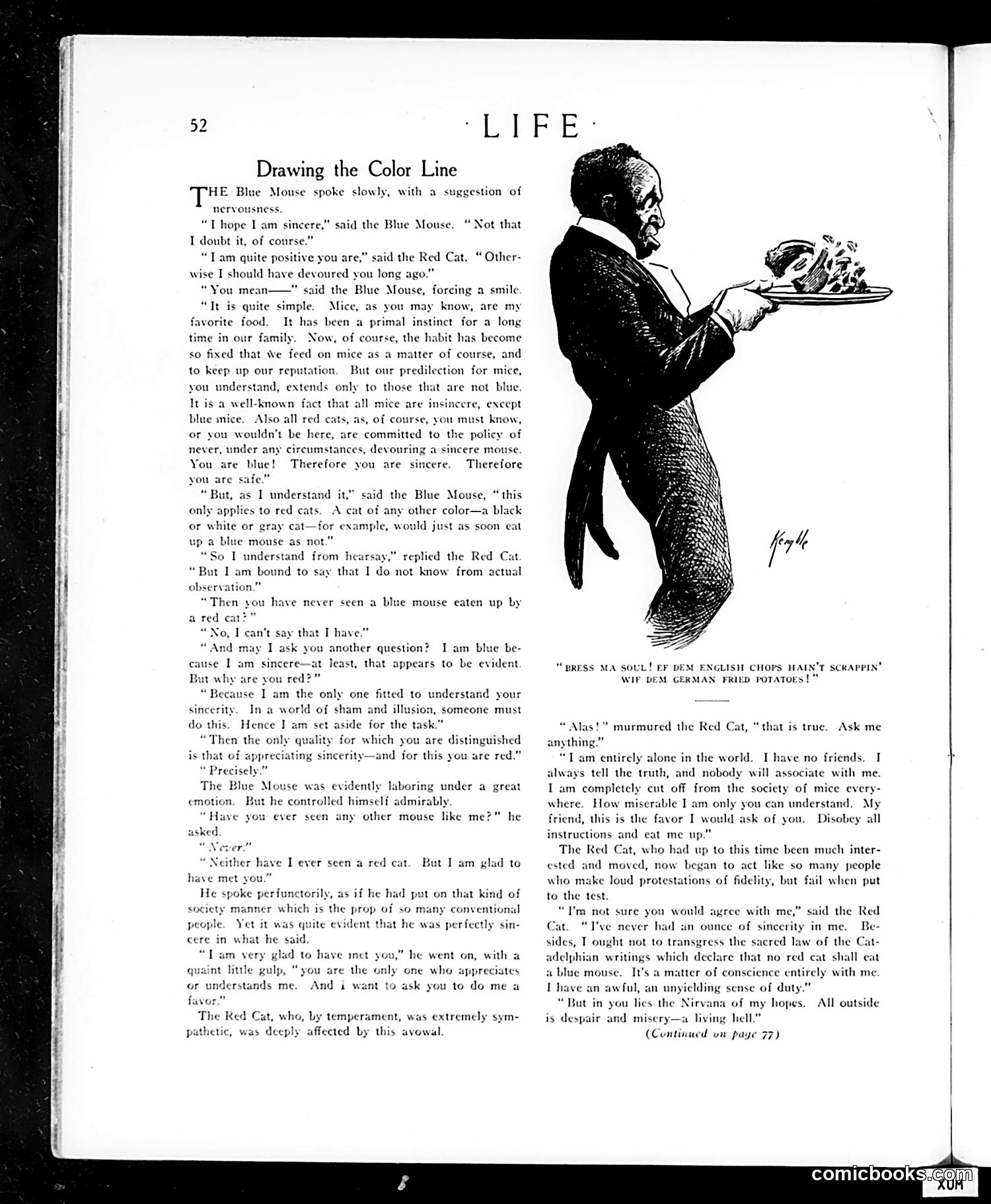
This satirical story uses animal characters to debate racial politics. A Blue Mouse argues he's inherently sincere and therefore safe from a Red Cat—because the cat's code forbids eating sincere mice. The Red Cat counters that only *blue* mice receive this protection; other colored mice face no such safeguard. The allegory critiques racial hierarchies and selective moral protections. The story suggests society grants certain groups (represented by "blue") special status or safety, while denying it to others based on arbitrary distinctions. The Red Cat's admission of prejudice against non-blue mice illustrates how discrimination operates through coded justifications. The caption below the illustration references English chops and German fried potatoes—likely a WWI-era jab at European powers.
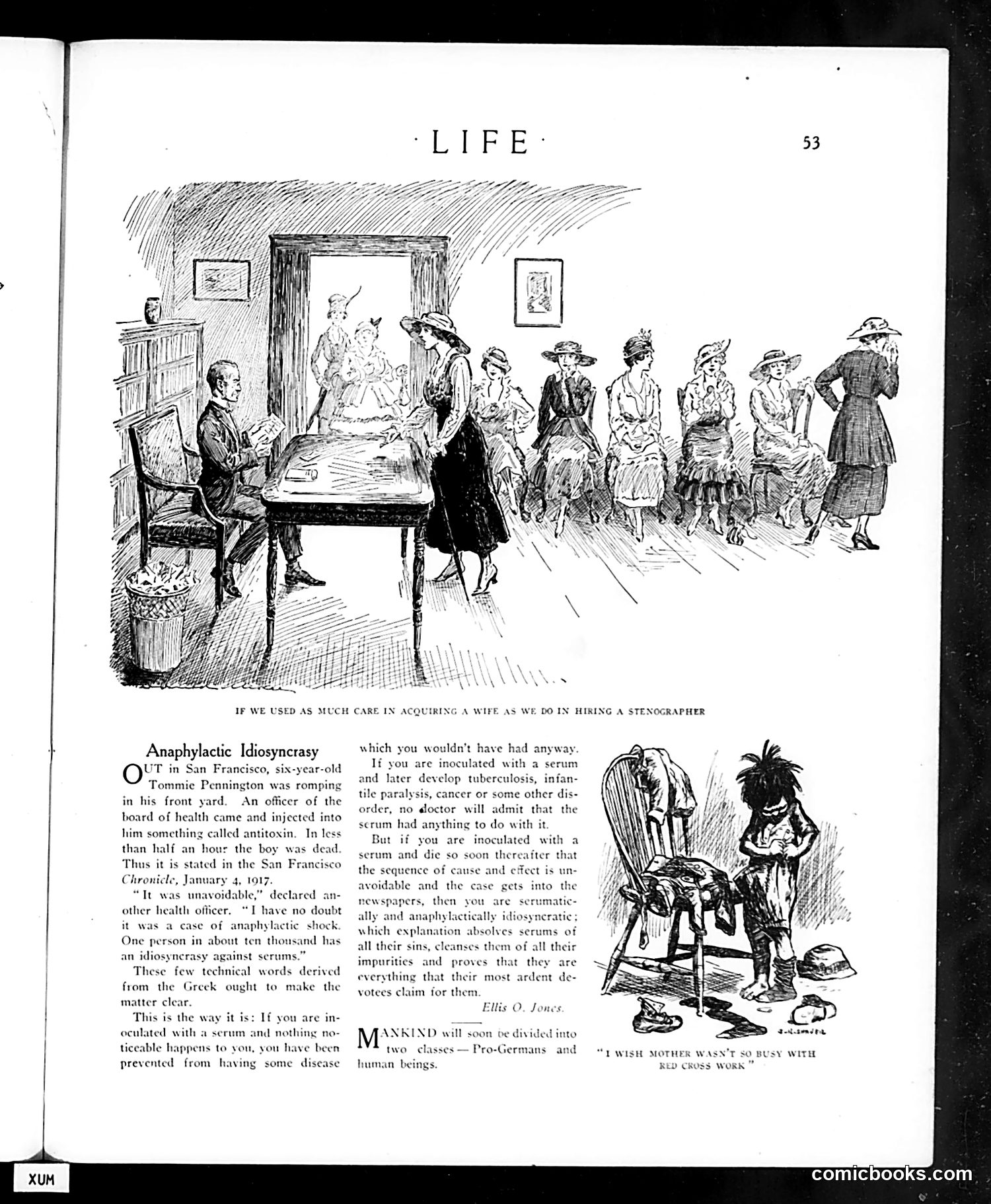
**Top Cartoon:** Shows a man at a desk interviewing a line of women applicants, captioned "IF WE USED AS MUCH CARE IN ACQUIRING A WIFE AS WE DO IN HIRING A STENOGRAPHER." This satirizes how men applied rigorous hiring standards to employees while choosing wives carelessly, implying marriage decisions lacked the same scrutiny as business practices. It mocks both male presumption and the casual attitude toward matrimony. **Main Article:** Discusses "anaphylactic idiosyncrasy"—an allergic reaction that killed a San Francisco boy. The text uses this medical case to satirize pseudoscientific thinking and how people blamed serums for diseases they already had, rather than acknowledging actual causation. **Bottom Cartoon:** A child tells his mother "I WISH MOTHERS WASN'T SO BUSY WITH RED CROSS WORK," referencing women's wartime charitable activities during WWI.
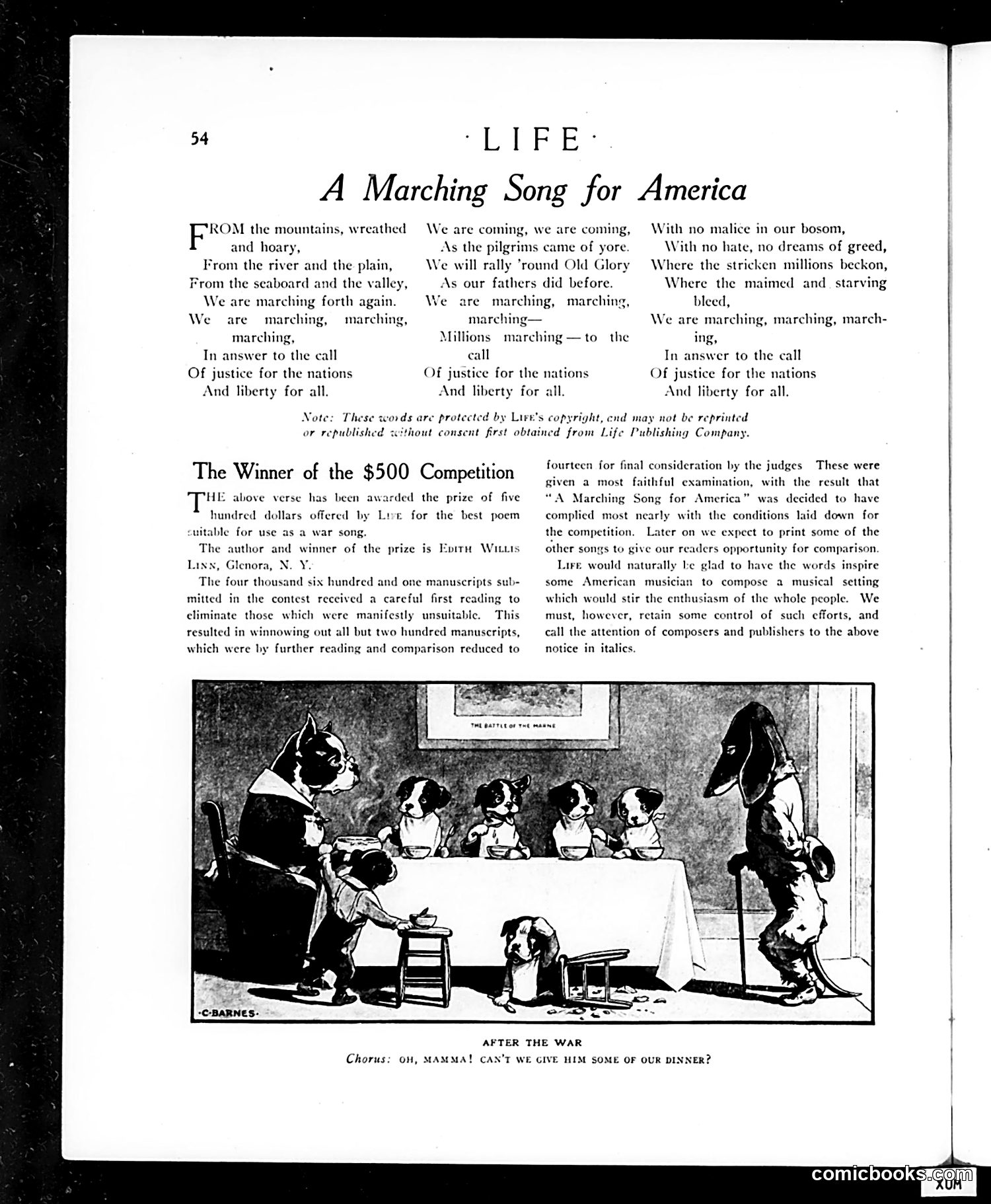
This page presents "A Marching Song for America," a patriotic poem that won Life's $500 wartime poetry competition. The winning author is Edith Willis Linn of Glenora, New York. The cartoon below, titled "After the War," depicts anthropomorphic animals (appearing to be dogs or similar creatures) seated at a dinner table with human children, while two larger animal figures stand as servers. The caption reads: "OH, MAMMA! CAN'T WE GIVE HIM SOME OF OUR DINNER?" This satirizes post-war food scarcity and rationing. The joke inverts normal hierarchy—animals are now served alongside humans—suggesting wartime deprivation is so severe that even pets compete for scarce food resources. The children's innocent request highlights the hardship American families faced during or after the conflict.
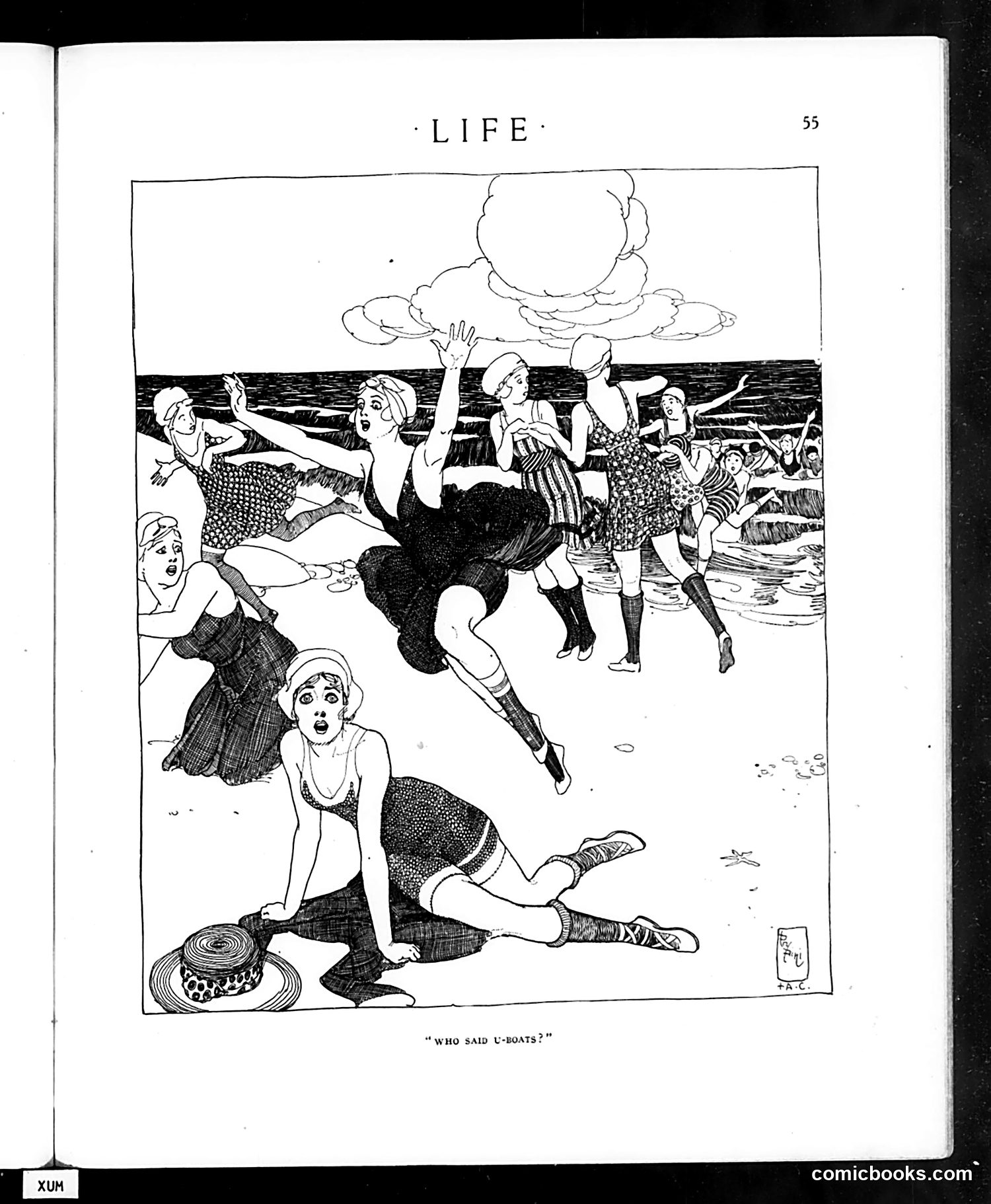
This cartoon depicts a beach scene with women in 1920s bathing attire engaged in exuberant, joyful activity—jumping, dancing, and celebrating. The caption "Who said U-Boats?" is the key to understanding the satire. During World War I, German U-boats (submarines) posed a serious threat to American coastal shipping and represented public anxiety about enemy presence near U.S. shores. By the 1920s, with the war concluded, this threat had vanished. The cartoon satirizes the carefree post-war mood and the return to leisure activities. The women's uninhibited beach behavior suggests relief and liberation from wartime fears. The caption humorously dismisses lingering war anxieties—implying that public concerns about U-boats seem absurdly outdated given the current peaceful prosperity and freedom to enjoy life.
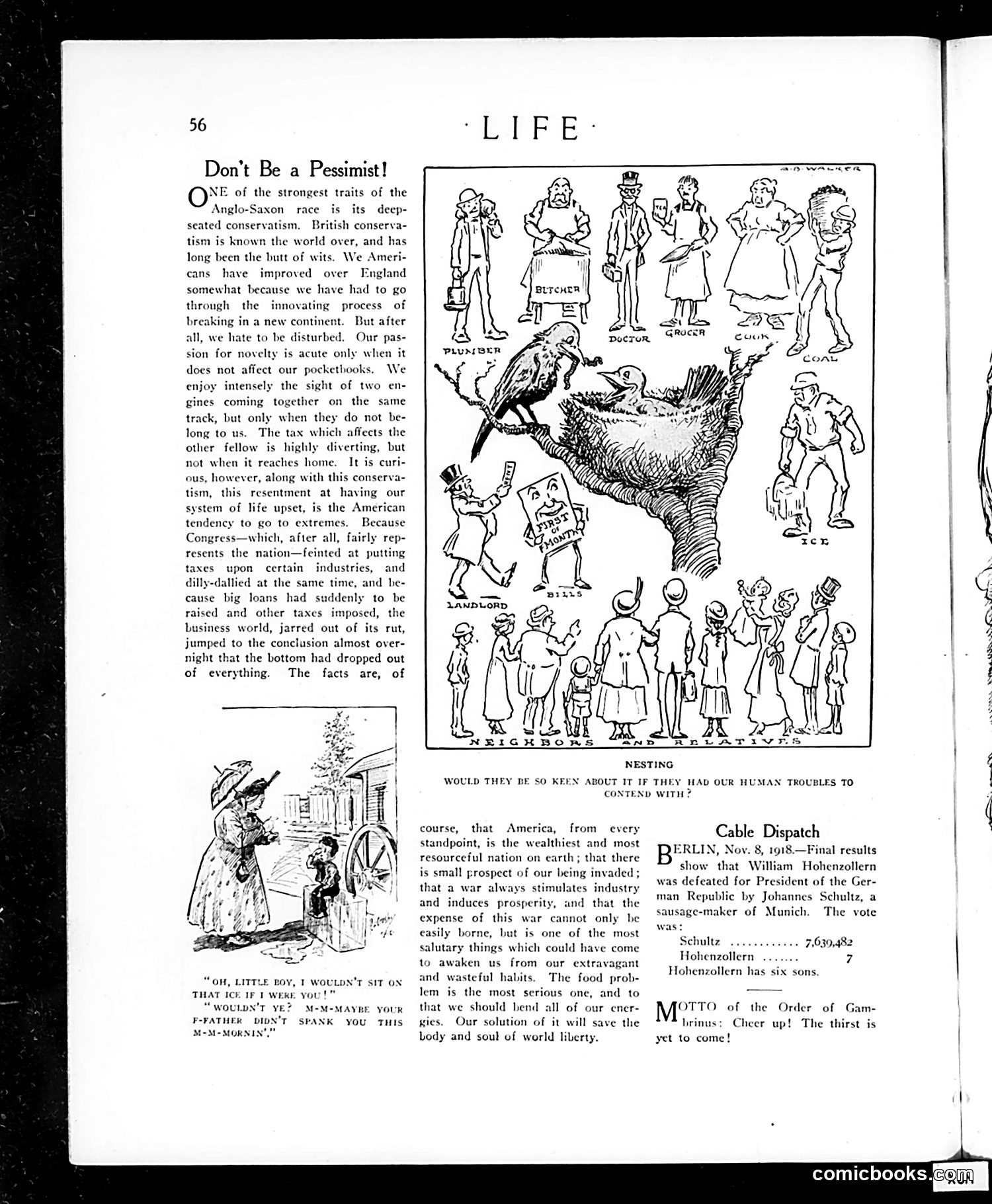
This page from Life (dated November 1918, near WWI's end) contains two satirical pieces: **Main Article "Don't Be a Pessimist!"** argues Americans shouldn't panic about wartime economic disruption. It mocks American conservatism and tendency toward extremes—we enjoy spectacles (like train collisions) but fear personal loss. The piece reassures readers that America's wealth and resources can sustain the war effort, and that solving food shortages will preserve "world liberty." **The cartoon "Nesting"** depicts birds seemingly unconcerned while human figures below appear anxious about various troubles (labeled figures include "Plumber," "Doctor," "Grocer," etc.). The caption sardonically questions whether birds would be so content "if they had our human troubles to contend with"—contrasting avian indifference with human wartime anxieties. **The "Cable Dispatch"** is mock-serious satire: it absurdly reports Kaiser Wilhelm II (Hohenzollern) lost a German presidential election to an unknown sausage-maker, receiving only 7 votes. This mocks Germany's actual recent armistice and impending regime change, presenting it as comically decisive defeat.
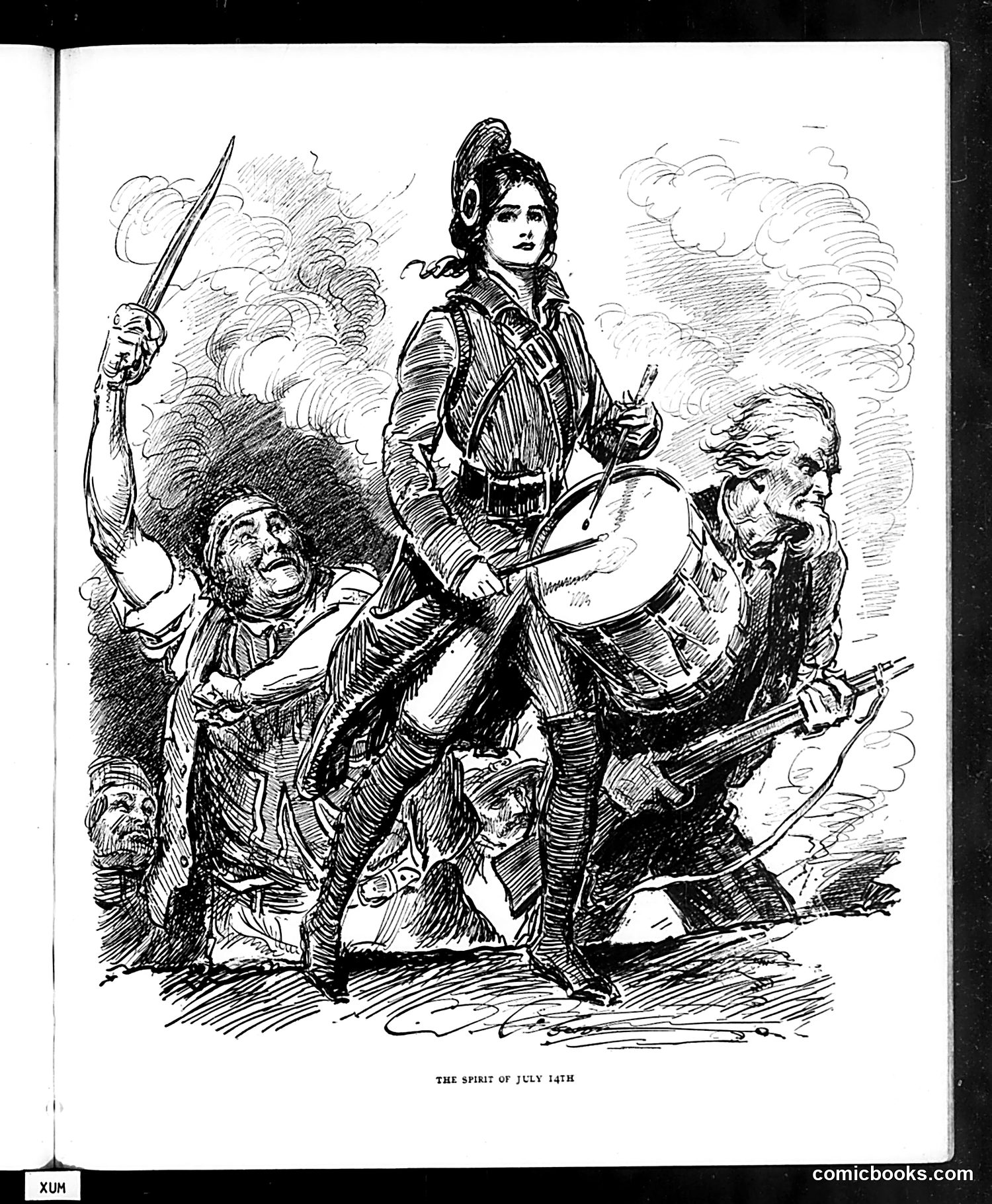
This engraving satirizes the French Revolution's ideals through allegorical figures. A female personification of Liberty stands centrally, wearing military attire and a feathered headdress, embodying revolutionary fervor. She's surrounded by armed male figures—soldiers or revolutionaries wielding weapons (sword, drums, rifle)—depicted with exaggerated, somewhat grotesque features characteristic of 19th-century caricature. The title references July 14th (Bastille Day), the French Revolution's pivotal date. The satire likely critiques how revolutionary ideals of liberty were enacted through violence and chaos, or commentary on revolutionary fervor spreading through Europe. The crude depictions of the common soldiers suggest satirical commentary on mob rule versus idealized liberty. Without more context about *Life* magazine's date and perspective, the specific target remains unclear.
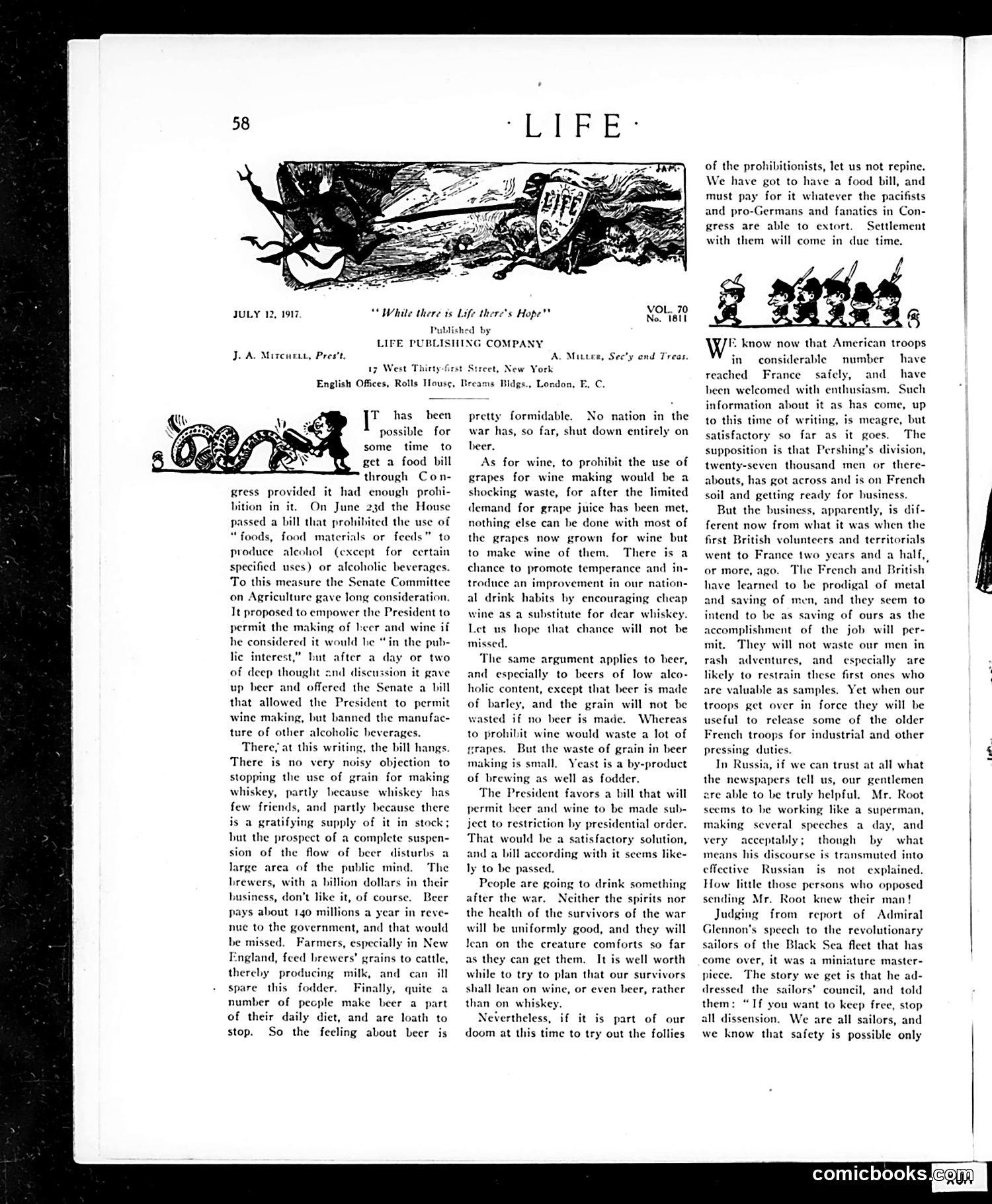
This editorial discusses a food bill before Congress that would prohibit using grain for alcohol production during World War I. The cartoons at the top show distressed figures (likely representing brewers or beer interests) facing prohibition. The piece debates whether to ban beer, wine, or both. The author argues that while prohibiting whiskey faces little resistance, banning beer troubles many: brewers have substantial financial interests, farmers rely on brewers' grain as cattle feed, and many citizens consume beer daily. The editorial favors the President's compromise position—permitting beer and wine under presidential restriction—as preferable to complete prohibition. The rhetoric frames prohibition as pushed by "fanatics" and "pro-Germans," suggesting opposition to alcohol restrictions as patriotic necessity during wartime. The cartoons satirize those opposing the food bill's alcohol restrictions as out of touch with wartime sacrifices.
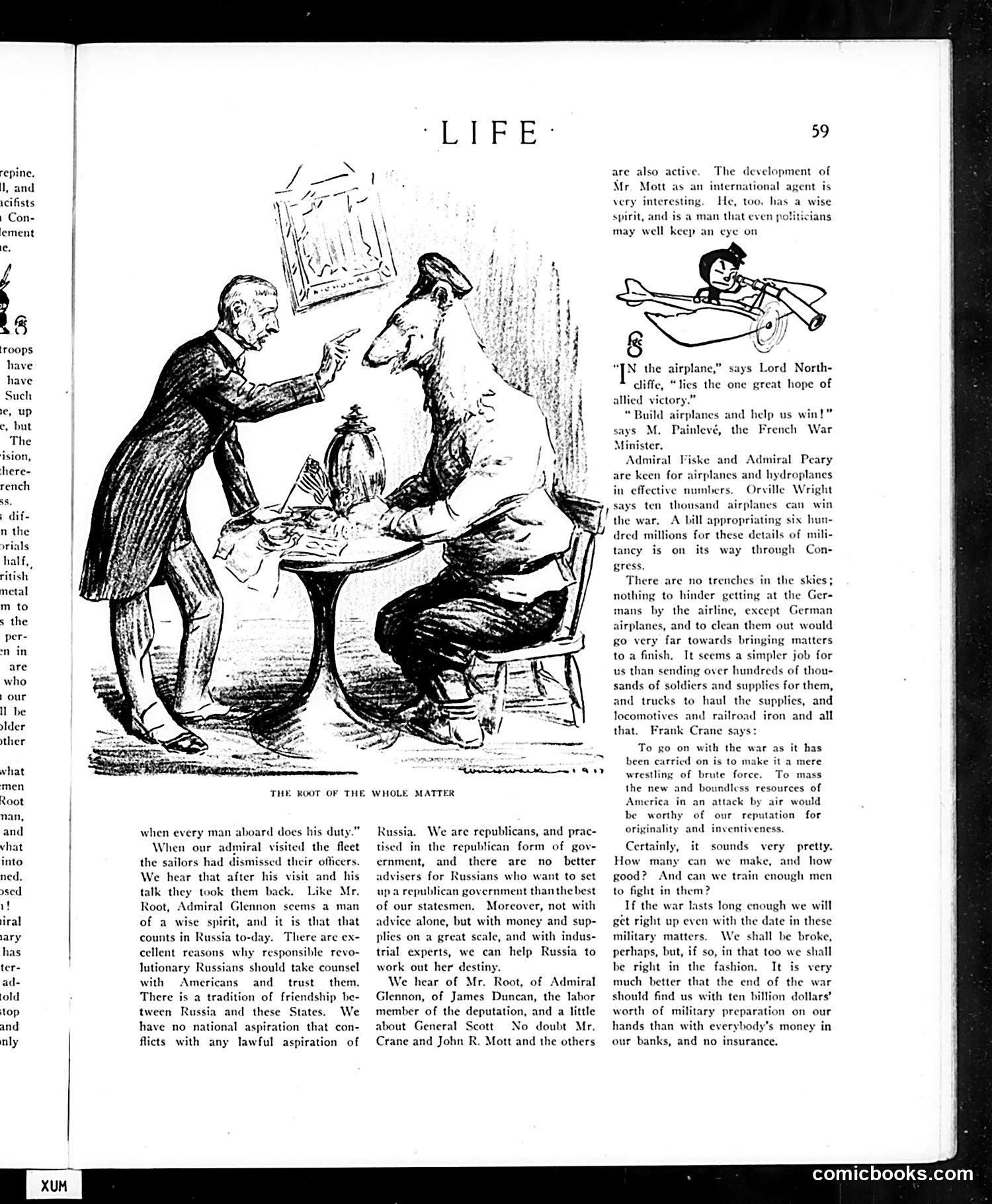
The main cartoon depicts a well-dressed older man (identified in caption as representing American interests) instructing a barefoot Russian sailor or worker. This illustrates the page's theme: American advisors—including Elihu Root, Admiral Glennon, and others—visiting Russia (then in revolutionary upheaval post-1917) to guide its political development toward republicanism. The satire suggests Americans believe they can simply teach Russians democracy through visits and advice, treating it almost as a simple matter of instruction rather than acknowledging Russia's complex internal struggles. The surrounding text discusses how America could better aid the Allies through aircraft production rather than shipping supplies—advocating for industrial/technological solutions over traditional military logistics. The overall message is satirical commentary on American confidence in exporting political ideology while debating war strategy.
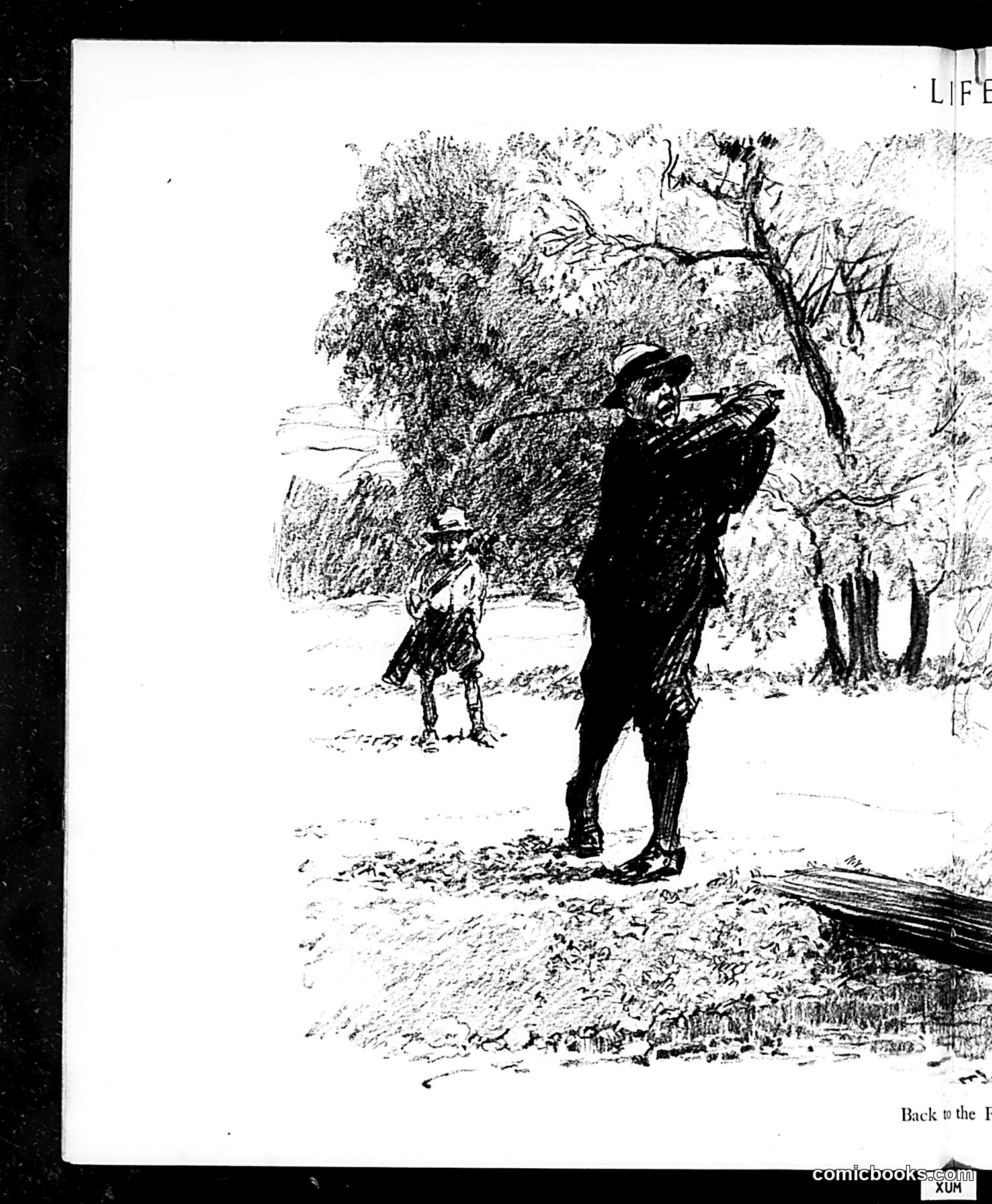
This appears to be an illustration from *Life* magazine showing two figures in an outdoor, wooded setting. A man in dark clothing and a hat stands prominently in the foreground, appearing to aim or hold a rifle upward. A smaller figure (possibly a child or youth) stands to the left in the background. The partial text visible reads "Back o the F" at the bottom, which likely continues beyond the visible page. Without additional context or complete text, I cannot definitively identify the specific political figures or satire being depicted. The hunting or shooting scene may reference a political cartoon about frontier policy, conservation, or military matters, but the exact meaning requires more information than this image alone provides.
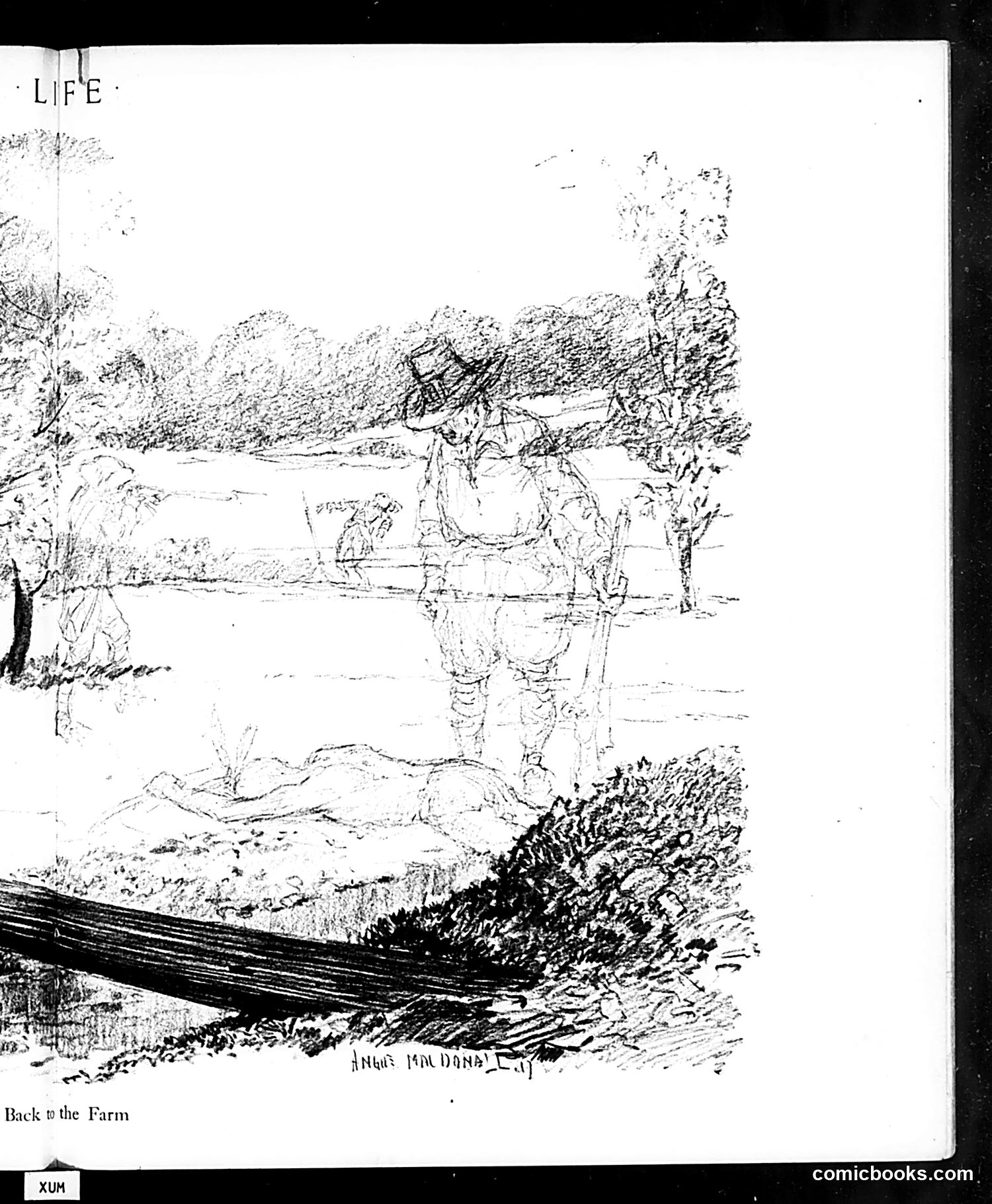
This sketch depicts a farmer in overalls and hat standing in a rural landscape with a plow horse, wooden fence, and cultivated fields. The title "Back to the Farm" suggests commentary on returning to agricultural life. The satire likely references early 20th-century urban-to-rural migration trends or idealization of farm life by city dwellers. Life magazine frequently mocked such romantic notions of pastoral simplicity, contrasting idealized visions with the actual hardship of farming. The sketch's rough, loose style emphasizes the crude reality of farm work rather than any picturesque charm. Without additional context about the specific publication date, the precise social or political target remains unclear, though the tone appears to be gentle mockery of back-to-the-land sentiment.
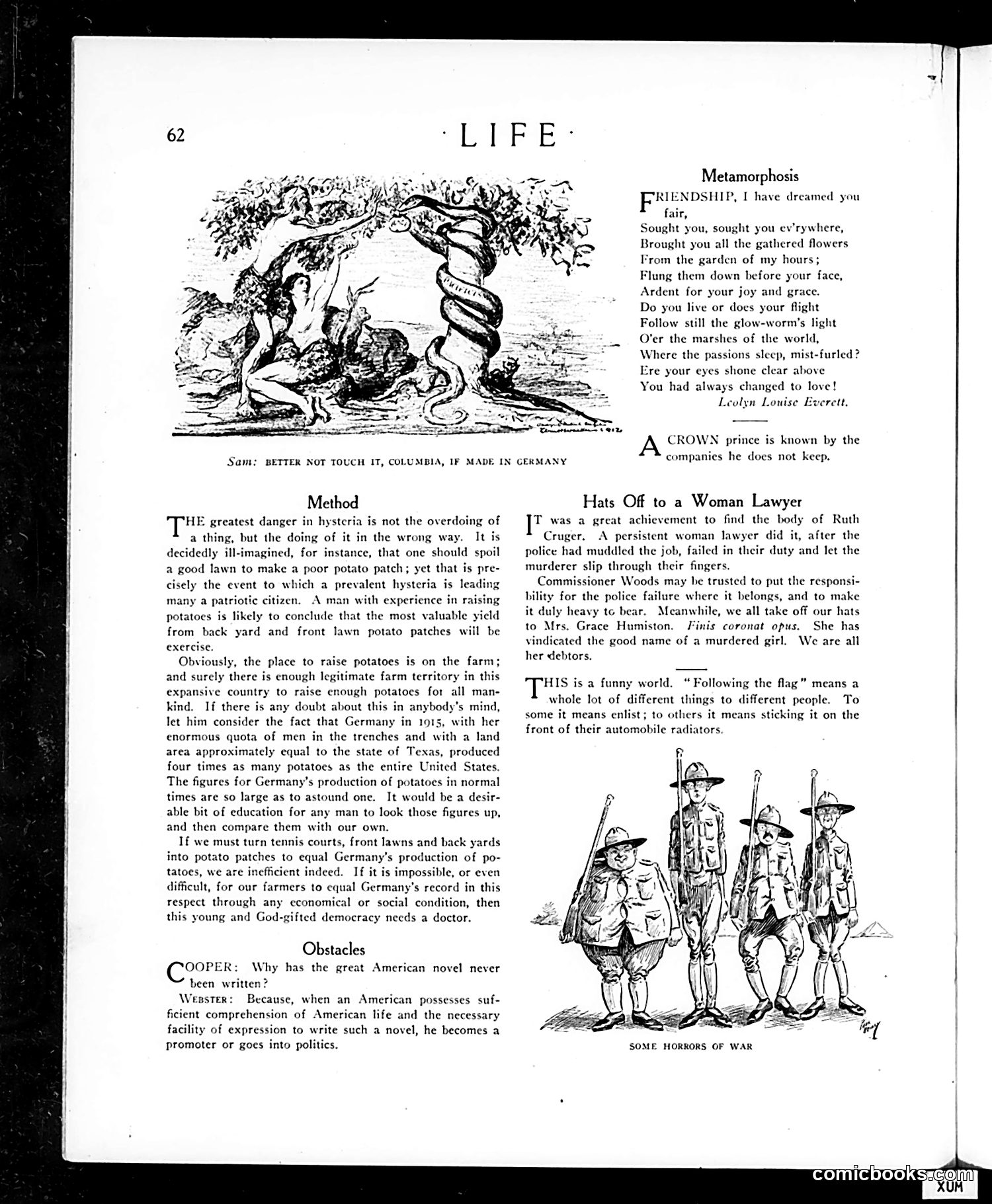
This page contains several distinct pieces of wartime satire (appearing to be WWI-era, referencing 1915 Germany). **Top cartoon**: "Sam: Better Not Touch It, Columbia, If Made in Germany" warns against purchasing German-made goods, using the female figure Columbia (symbol of America) as the cautionary subject. **"Method" article**: Critiques American war hysteria, specifically the trend of converting lawns into vegetable gardens. It argues this is inefficient compared to Germany's agricultural output and suggests Americans should use proper farmland instead—implying panic-driven gardening won't solve food production problems. **"Obstacles" joke**: Satirizes American talent drain, suggesting capable writers abandon literature for business or politics rather than producing great novels. **"Hats Off to a Woman Lawyer"**: Praises Mrs. Grace Humiston for solving the Ruth Cruger murder case after police failed, celebrating her investigative success. **Bottom cartoon "Some Horrors of War"**: Depicts armed soldiers, likely commenting on wartime consequences. The overall tone criticizes both German efficiency and American inefficiency, hysteria, and institutional failure.
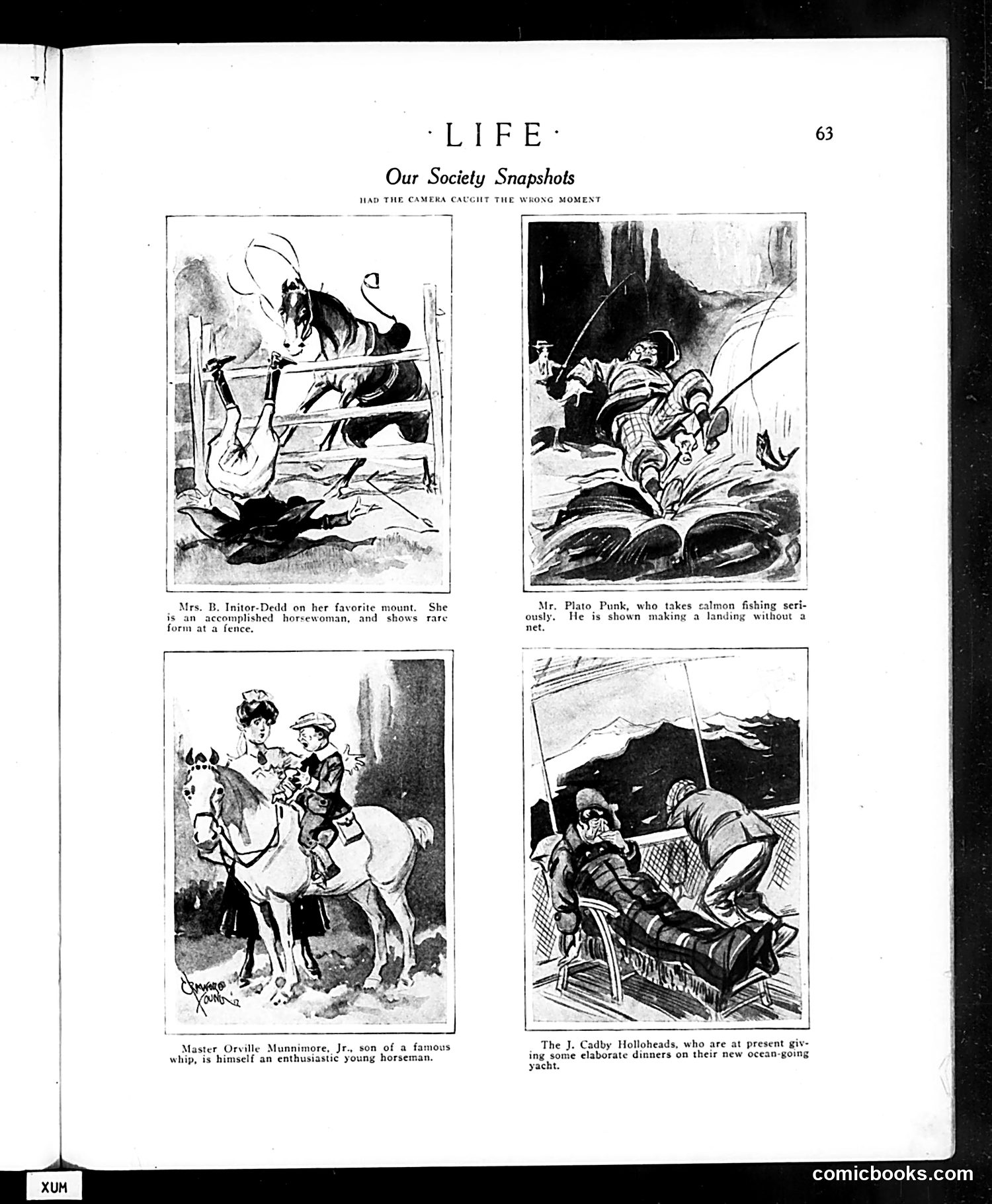
This page satirizes high-society figures by depicting them in embarrassing moments caught by the camera. The humor relies on contrasting their pretensions with humiliating reality: - **Mrs. B. Initor-Dedd**: Despite being "an accomplished horsewoman," she's shown unseated or falling from her horse at a fence - **Mr. Plato Punk**: A serious salmon fisherman shown failing spectacularly—making "a landing without a net" (implying he's losing his catch) - **Master Orville Munnimore Jr.**: Son of a renowned "whip" (horseman), yet depicted in an awkward riding situation - **The J. Cadby Holloheads**: Wealthy enough for elaborate yacht dinners, but caught in an undignified moment aboard ship The satire targets wealthy individuals' self-importance by revealing their incompetence and mishaps. The subtitle "Had the Camera Caught the Wrong Moment" is ironic—these *are* the "wrong moments," exposing the gap between society's polished self-image and reality. This reflects Life magazine's tradition of mocking American aristocratic pretension.
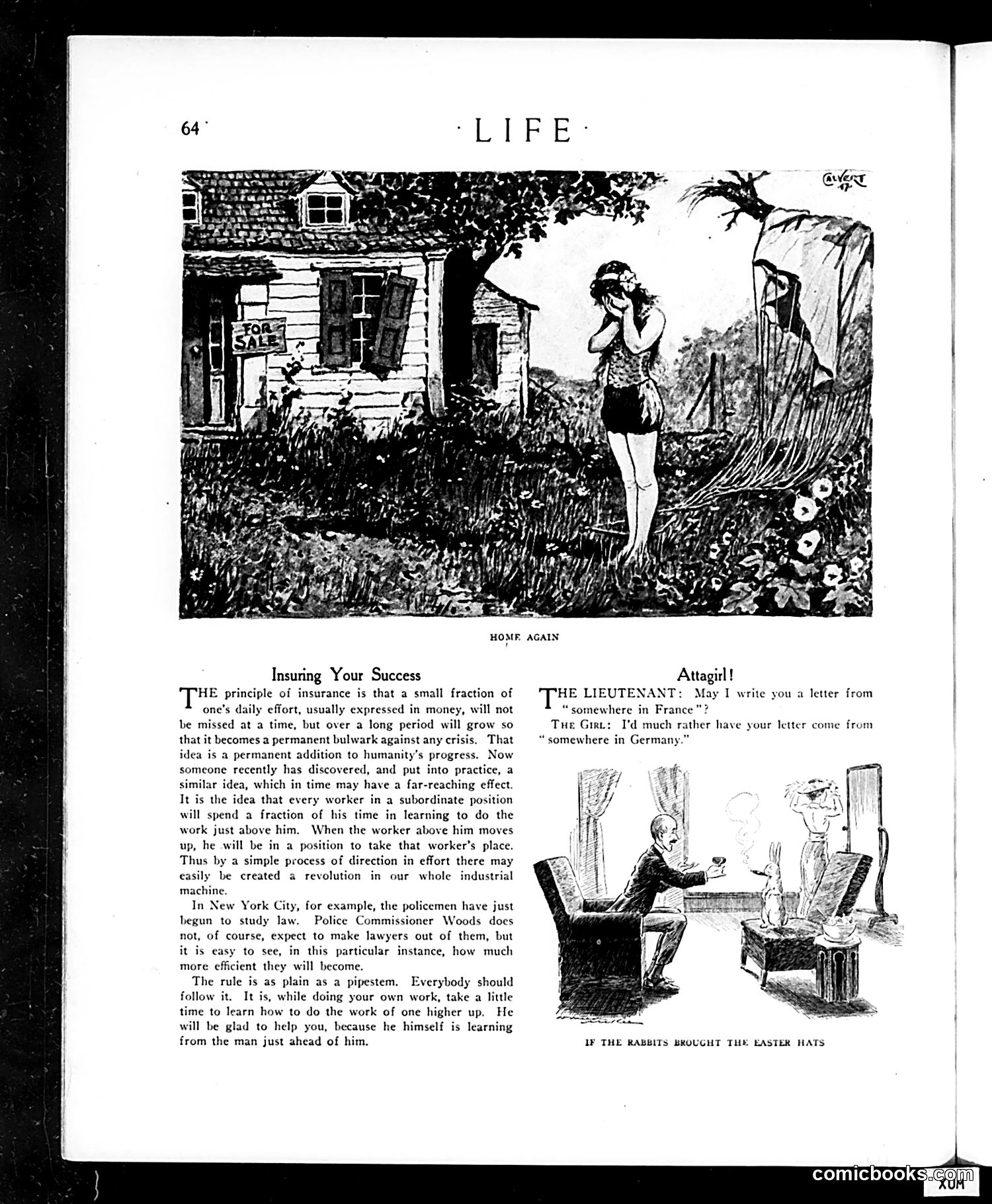
This page contains two distinct pieces of satirical content: **"Insuring Your Success"** (left): An editorial arguing for worker cross-training—employees should spend time learning their supervisor's job so they're ready for advancement. It cites New York City police studying law as a practical example. The satire is subtle: the piece presents this as revolutionary workplace wisdom, though the idea is straightforward. The accompanying illustration shows a woman surveying a modest house marked "FOR SALE," suggesting the promised upward mobility. **"Attagirl!"** (right): A wartime joke (likely WWI-era, given "France" and "Germany" references). A young woman tells a soldier she'd prefer his letters come from Germany rather than France—implying she wants him fighting deeper in enemy territory, suggesting either patriotic zeal or darkly comic indifference to his safety. The bottom caption references Easter hats from rabbits, appearing to be a separate, unrelated cartoon. The page reflects early 20th-century American attitudes toward industrial efficiency, class mobility, and wartime patriotism.
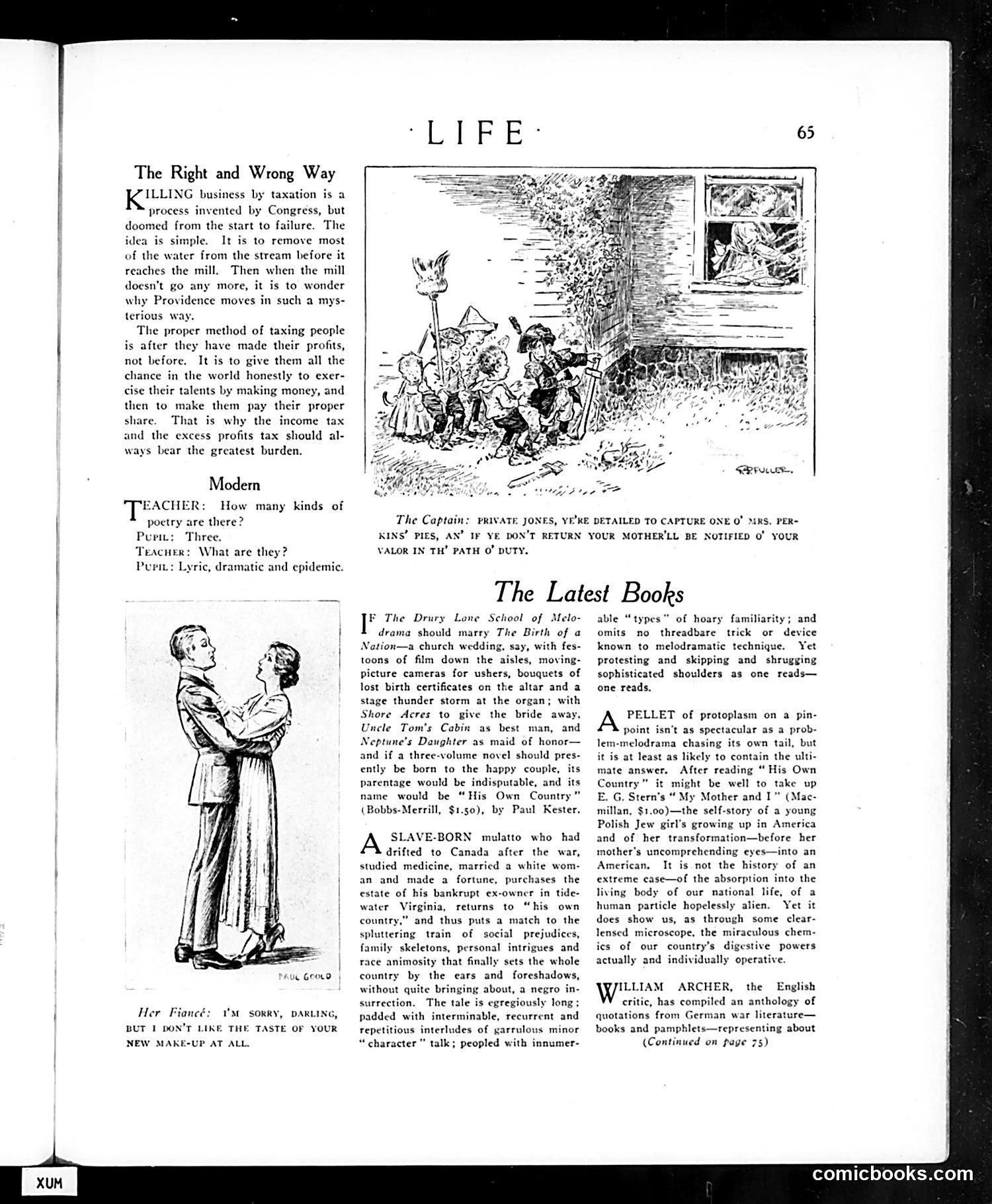
This page contains three separate satirical pieces: **"The Right and Wrong Way"** (top): An editorial arguing against taxation *before* business profits are made, comparing it to removing water from a stream before it reaches a mill. It advocates for income and excess profits taxes *after* earnings occur—a progressive tax argument likely responding to contemporary Congressional tax policy debates. **"Modern" (middle)**: A classroom joke where a pupil defines the three types of poetry as "lyric, dramatic and epidemic"—a pun suggesting that poetry, like disease, spreads widely. Simple wordplay humor. **Lower cartoons**: Two domestic humor sketches—one showing a fiancé complaining about his partner's makeup taste, another depicting a military captain threatening a private with a humorous Scottish accent. **"The Latest Books"** (lower half): Book reviews mockingly describing melodramatic plots, including "His Own Country" (about a freed Black man purchasing his former owner's estate) and immigrant assimilation narratives. The reviews employ sarcasm to critique overwrought storytelling conventions. The page mixes political commentary with light domestic humor typical of Life's satirical approach.
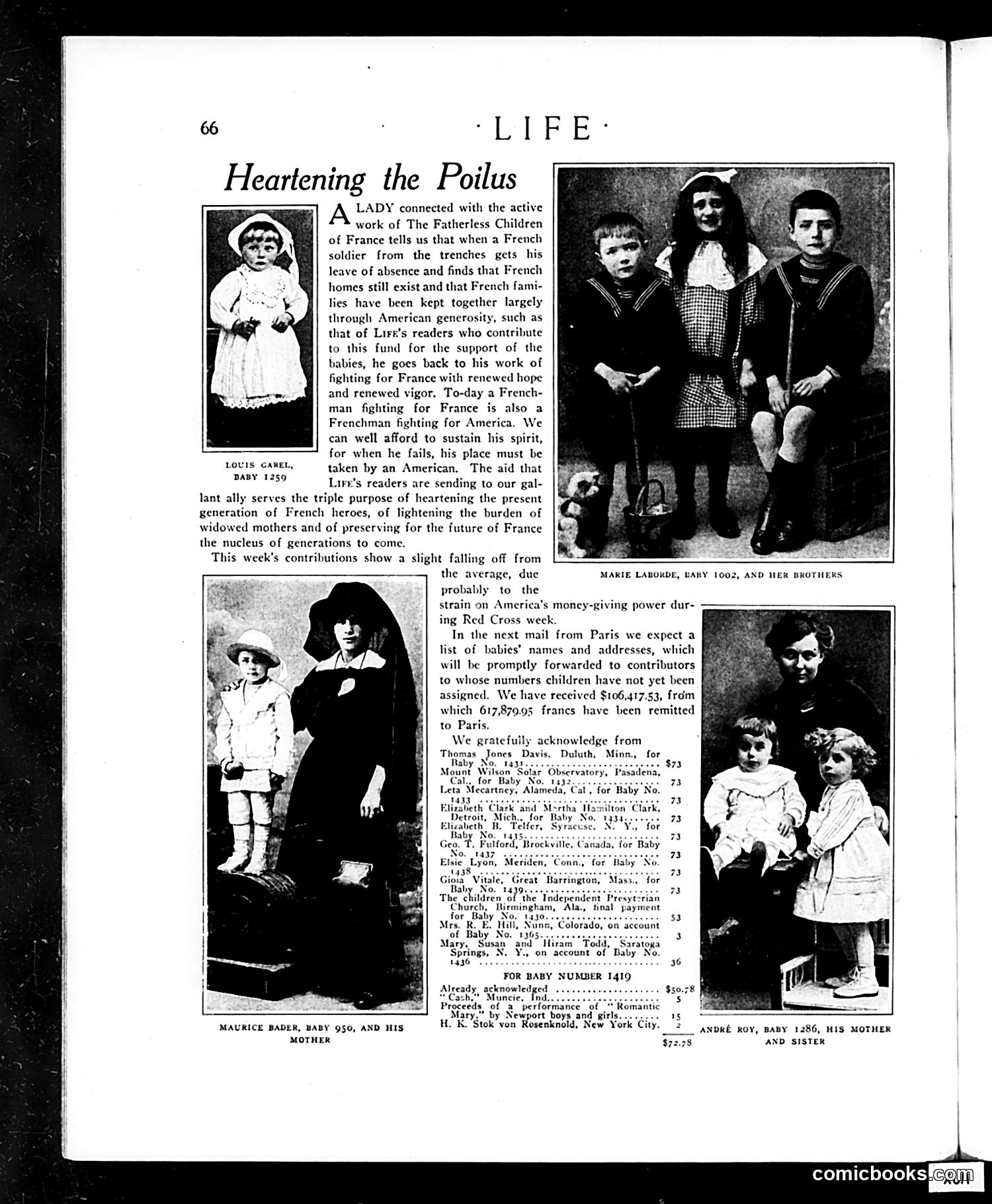
This is not a cartoon but a charity fundraising article. "Poilus" refers to French soldiers (slang for WWI infantrymen). The page documents *The Fatherless Children of France*, an American relief fund supporting French war orphans and widowed mothers. The argument is straightforward: American donations sustain French soldiers' morale by proving their families survive through U.S. generosity. A French soldier on leave sees his home intact and returns to fighting with "renewed hope and vigor"—fighting for both France *and* America. The implicit logic: supporting French civilians is investing in American security. The photographs show sponsored children—babies and young siblings assigned numbers. The financial accounting lists donors and amounts remitted to Paris ($617,879.95 francs). The article notes a slight fundraising dip, attributed to competing Red Cross appeals. This reflects WWI-era American interventionism: civilian support networks justified U.S. involvement by framing aid as mutual survival.
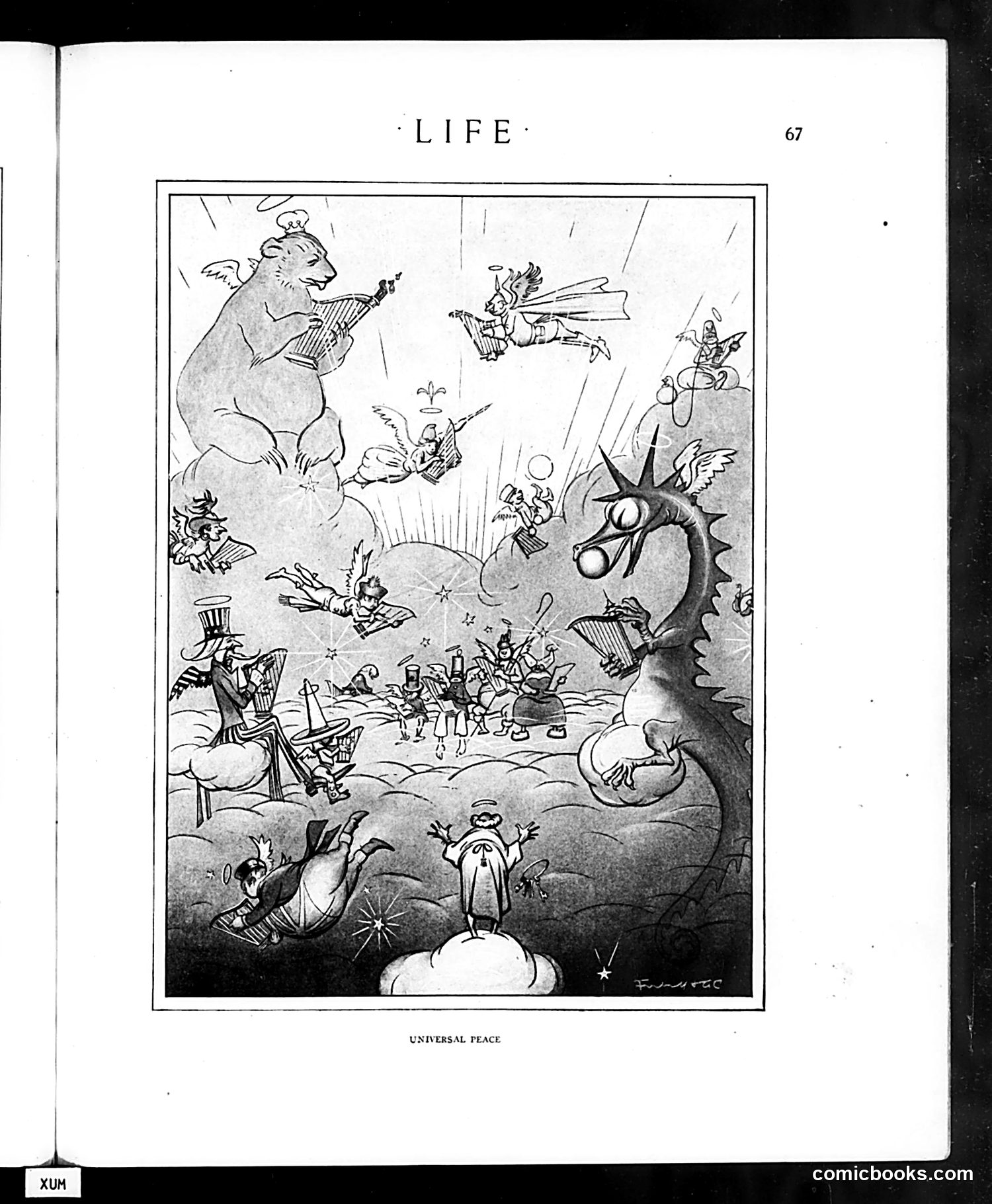
This satirical cartoon depicts an idealistic vision of "Universal Peace" turned absurd. A peaceful figure stands on a cloud at the bottom, arms raised hopefully toward heaven. Above, however, chaos reigns: giant menacing creatures (appearing demonic or war-like) loom on either side, while angels and cherubs frantically fly about playing instruments and waving banners. A large bear-like figure on the left plays a violin; winged beings scatter in all directions above. The satire suggests that achieving true universal peace is a naive fantasy—while humans dream of harmony, powerful destructive forces and cosmic chaos make such peace impossible. The contrast between the serene dreamer below and the frantic, threatening activity above mocks pacifist or idealistic peace movements as disconnected from reality.
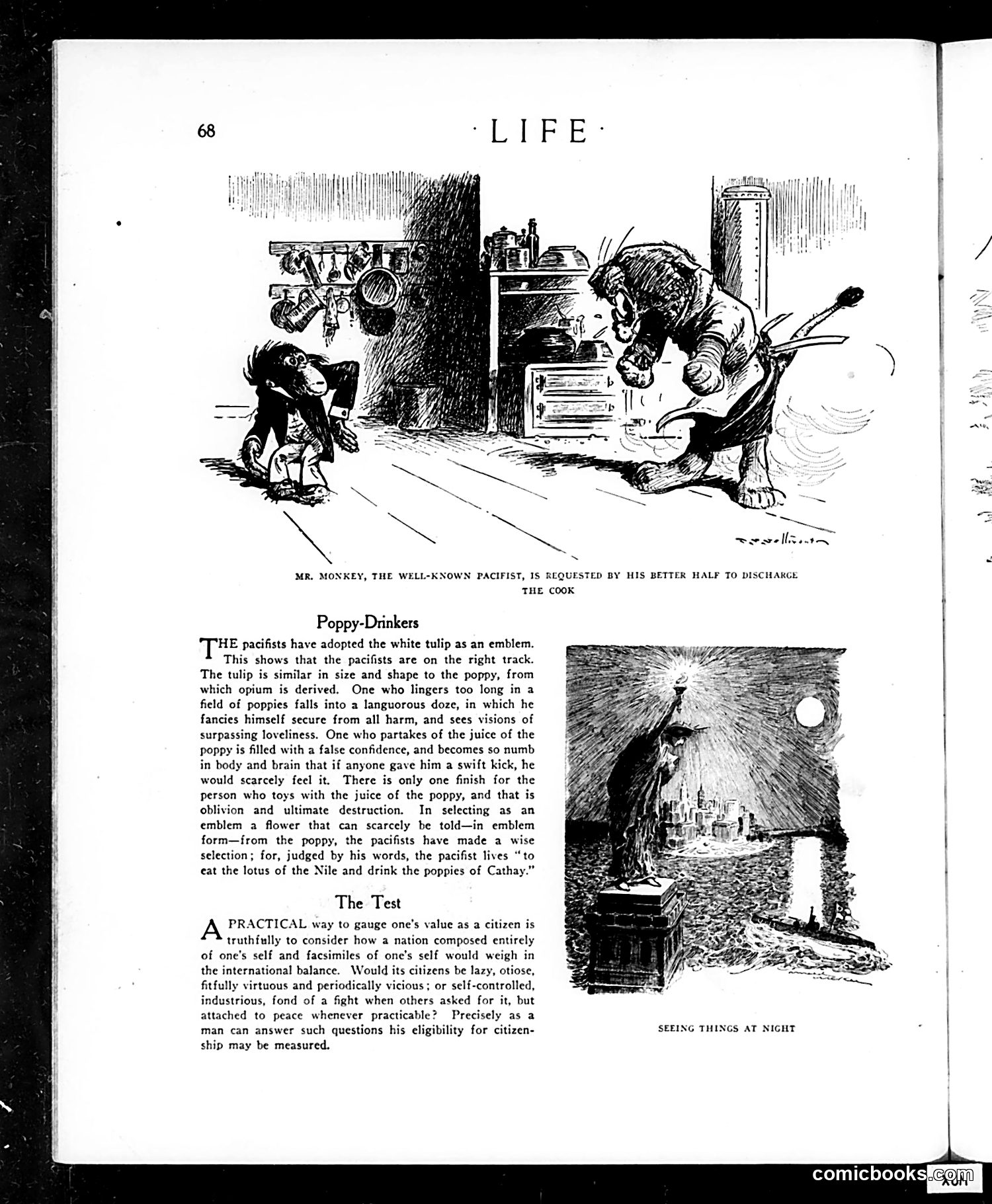
**Top Cartoon:** Shows two monkeys in a domestic scene. The caption describes "Mr. Monkey, the well-known pacifist" being asked by his wife to fire the cook. The satire equates pacifism with weakness and inability to take decisive action—even in a simple household matter. The monkey's pacifism is mocked as impractical. **"Poppy-Drinkers" Section:** A scathing critique of pacifists, comparing their movement to opium addiction. The text argues that pacifists have adopted the white tulip as their emblem, but it resembles a poppy—symbol of drug-induced delusion and false security. The satire suggests pacifists are deluded into believing they're safe from harm, and that pacifism leads to "oblivion and ultimate destruction." **"The Test" Section:** A philosophical argument about citizenship, suggesting a person's worth should be measured by whether a nation of clones like them would be strong and capable of fighting when necessary, while preferring peace when practical. **Context:** These pieces reflect early 20th-century anti-pacifist sentiment, likely connected to debates over American military preparedness or intervention before/during World War I.
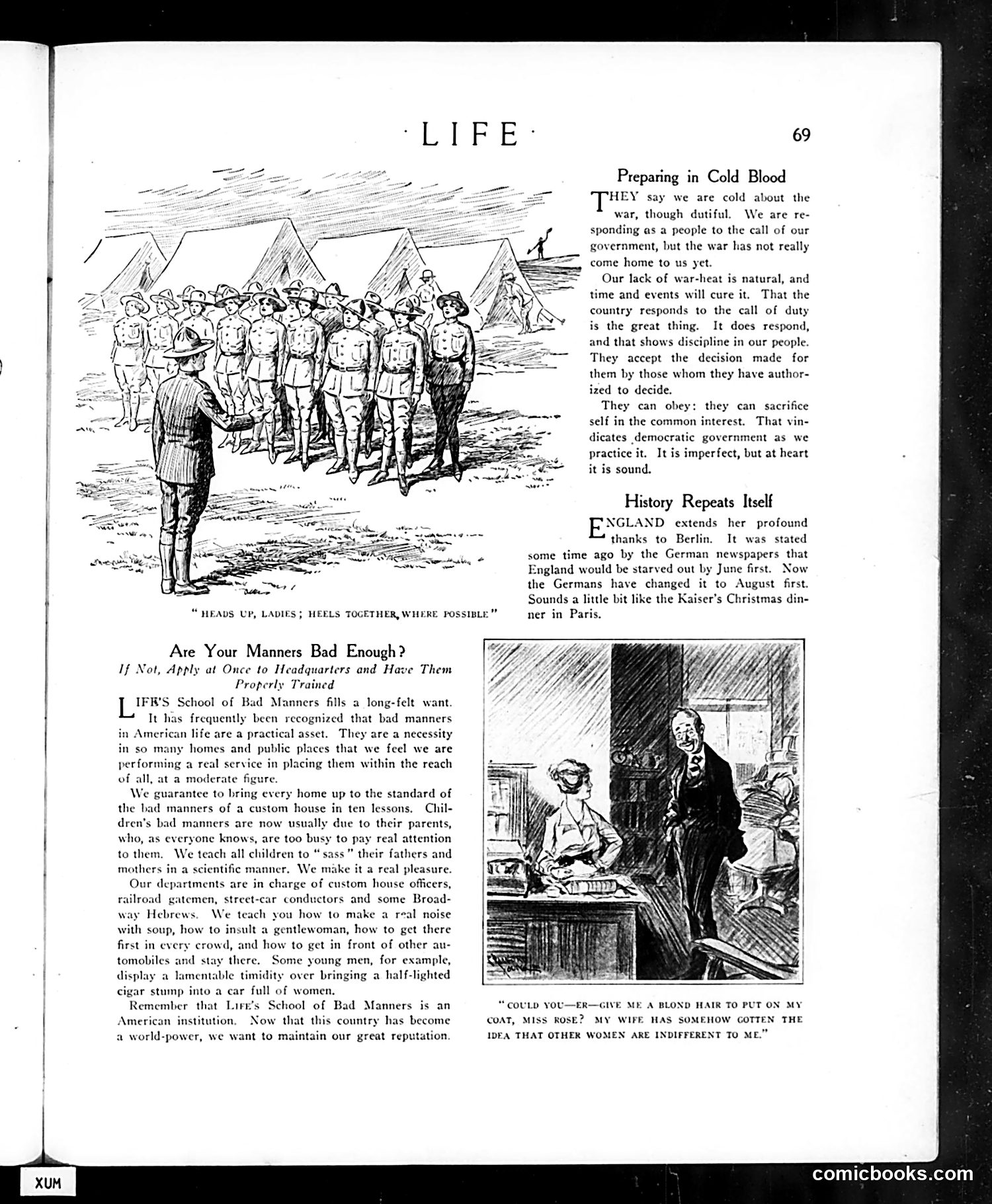
This page contains three separate satirical pieces from Life magazine during World War I: **"School of Bad Manners"** mocks American rudeness as a national trait, sarcastically proposing formal training in discourtesy. It criticizes specific behaviors—loud soup-eating, insulting women, cigar smoking in crowded cars, aggressive driving—suggesting these represent American vulgarity. The joke targets both ordinary citizens and authority figures (customs officers, conductors) as sources of incivility. **"Preparing in Cold Blood"** defends American restraint about the war as disciplined rather than apathetic, arguing that orderly obedience demonstrates democratic values. **"History Repeats Itself"** mocks German military predictions about starving Britain, noting they've already revised their timeline from June to August. The Kaiser's "Christmas dinner in Paris" reference suggests Germans initially expected rapid conquest of France. The accompanying cartoon shows a man asking a woman for a blonde hair to place on his coat, implying infidelity—illustrating the manners theme through domestic deception.
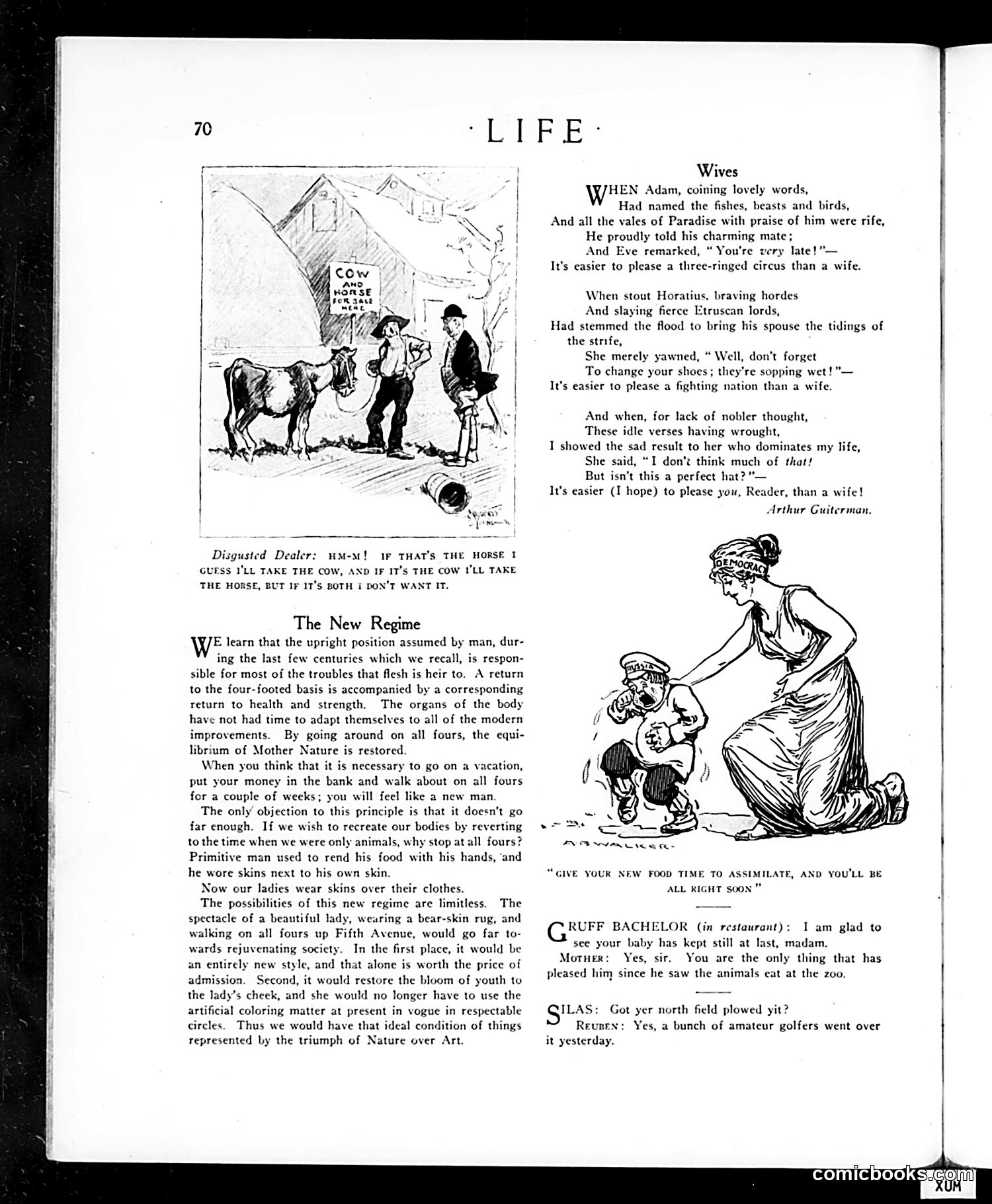
This page contains three satirical pieces mocking contemporary trends and gender relations: **"The New Regime"** ridicules the "back-to-nature" health fad popular in early 20th-century America. It sarcastically proposes that humans should walk on all fours to restore health, escalating absurdly to suggest ladies wearing bear-skin rugs and crawling up Fifth Avenue. The satire targets both the pseudo-scientific wellness movements of the era and fashionable society's contradictions—women wearing animal skins "over their clothes" while rejecting natural living. **"Wives"** (by Arthur Guiterman) uses historical examples—Adam, Horatius—to joke that wives are impossible to please. The refrain suggests women care only about trivial matters (lateness, wet shoes, hats) regardless of male accomplishment, playing on common misogynistic stereotypes about female superficiality. **The dealer cartoon** and brief jokes ("Ruff Bachelor," "Silas") continue light domestic humor typical of the magazine's content. Overall, the page reflects early-1900s satirical attitudes toward health fads, fashion, and domestic gender dynamics.
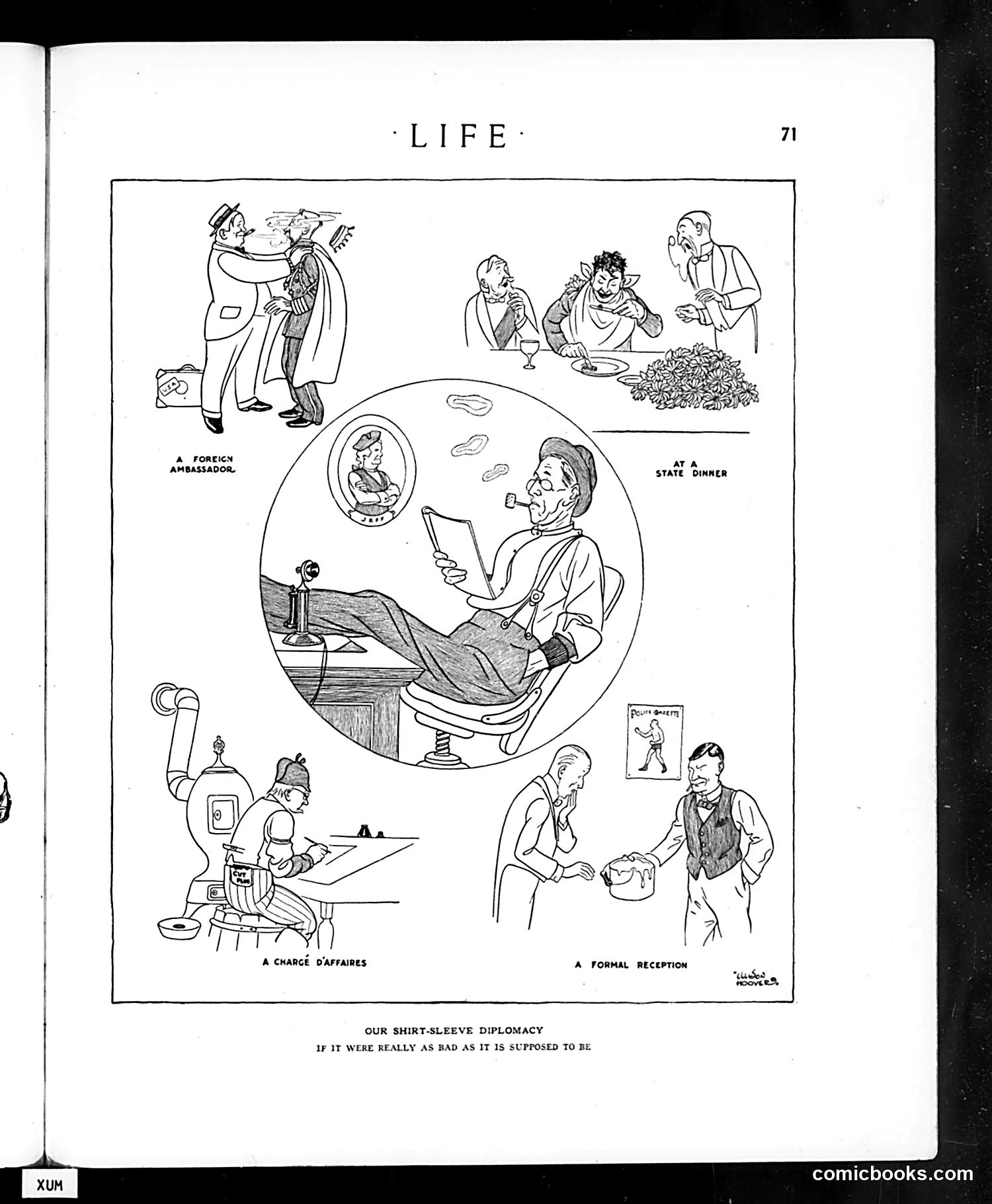
This satirical cartoon critiques American diplomatic practices through six scenes depicting informal, casual approaches to international relations. The central image shows a man in shirtsleeves (literally rolled-up sleeves, suggesting casual or rough handling) conducting diplomacy while reading documents. The surrounding vignettes mock different diplomatic scenarios: "A Foreign Ambassador" (formal greeting gone wrong), "A State Dinner" (chaotic meal), "A Charge d'Affaires" (man working at desk amid plumbing), and "A Formal Reception" (awkward social interaction). The title suggests that American "shirt-sleeve diplomacy"—informal, direct negotiation style—is being satirized as crude or undignified compared to traditional formal diplomatic protocol. The cartoon implies American diplomatic methods are inappropriately casual for serious international affairs, treating weighty negotiations with insufficient formality or respect.
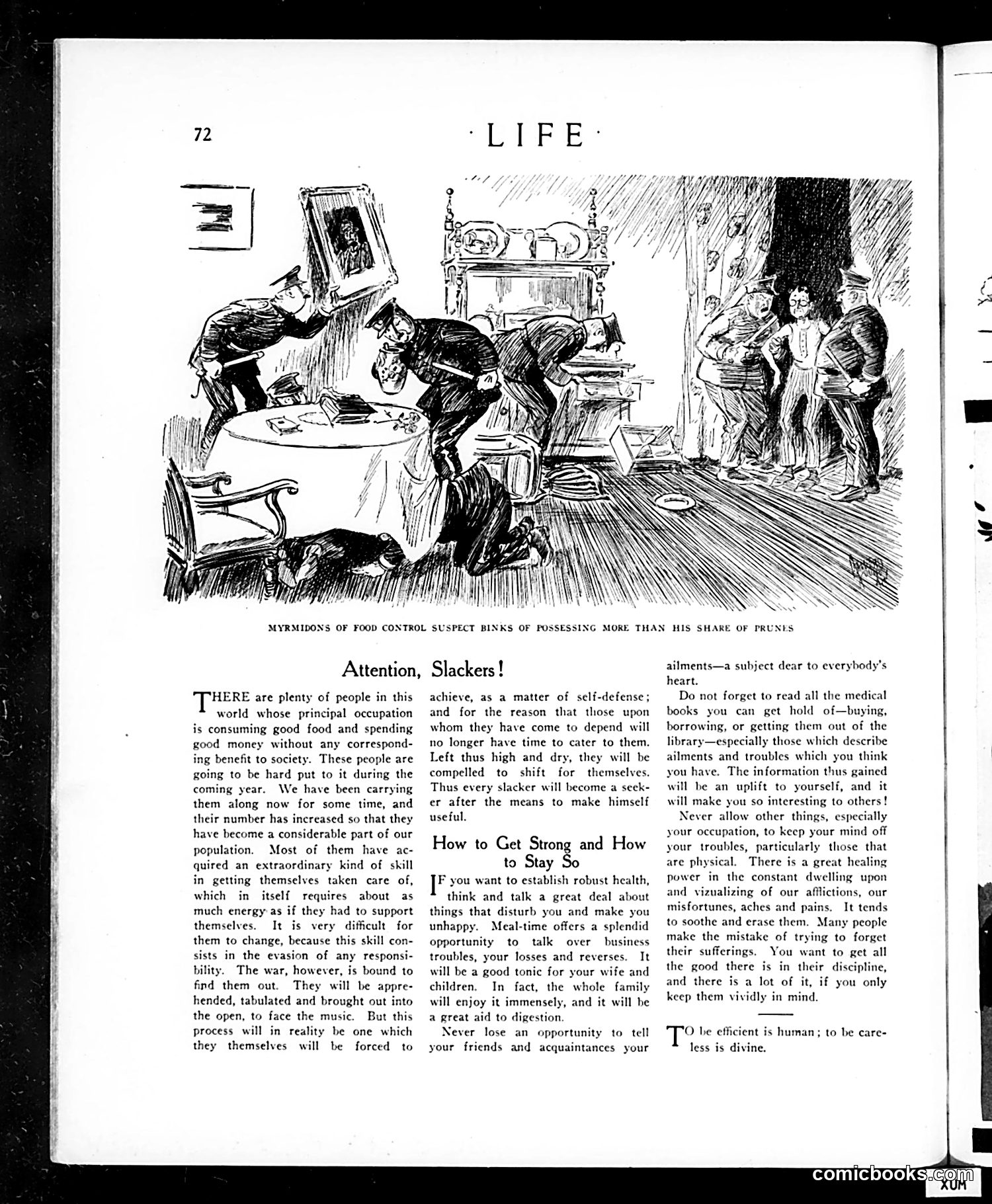
This page targets wartime "slackers"—those evading civic duty during WWI. The cartoon depicts food control officials investigating a suspect ("Binks") for hoarding rationed goods like prunes, a scarce commodity under wartime rationing. The main article shames able-bodied people who consume resources without contributing to society, warning they'll be "found out" during wartime when their dependents can no longer support them. It frames shirking responsibility as unsustainable. The second section, "How to Get Strong," uses heavy sarcasm—advising readers to obsess over ailments and troubles during meals—to ridicule hypochondriacs and whiners. The final maxim ("To be efficient is human; to be careless is divine") drips with irony, implying carelessness is actually foolish. Overall, the page promotes patriotic self-reliance and productive citizenship while mocking those deemed parasitic or self-pitying.
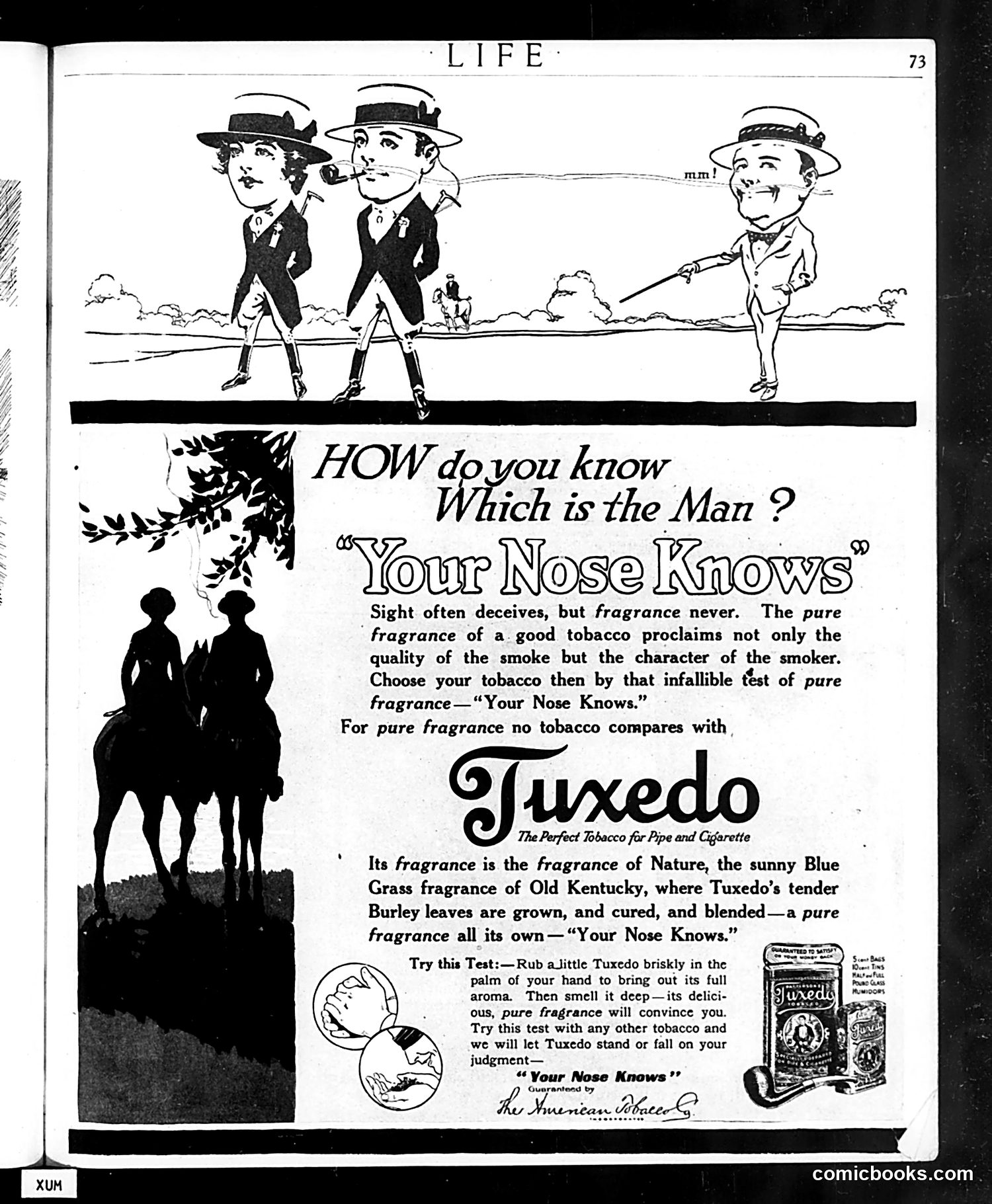
This is primarily a **tobacco advertisement** for Tuxedo brand, not political satire. The top cartoon is a visual joke: three men in formal attire and bowler hats stand in a line, with the caption asking "How do you know Which is the Man?" The implication appears to be that they look identical—suggesting that Tuxedo tobacco's quality and "fragrance" reveals true character and distinguishes a man's worth. The ad's central claim—"Your Nose Knows"—positions fragrance as an infallible test of both tobacco quality and the smoker's character. This reflects early 20th-century advertising rhetoric conflating consumer choice with personal virtue. The lower section includes silhouettes of two figures on horseback and instructional diagrams showing how to test tobacco's aroma by rubbing it in one's palm, positioning sensory evaluation as scientific proof of superiority. The entire page is marketing copy rather than satirical commentary on contemporary events or figures.
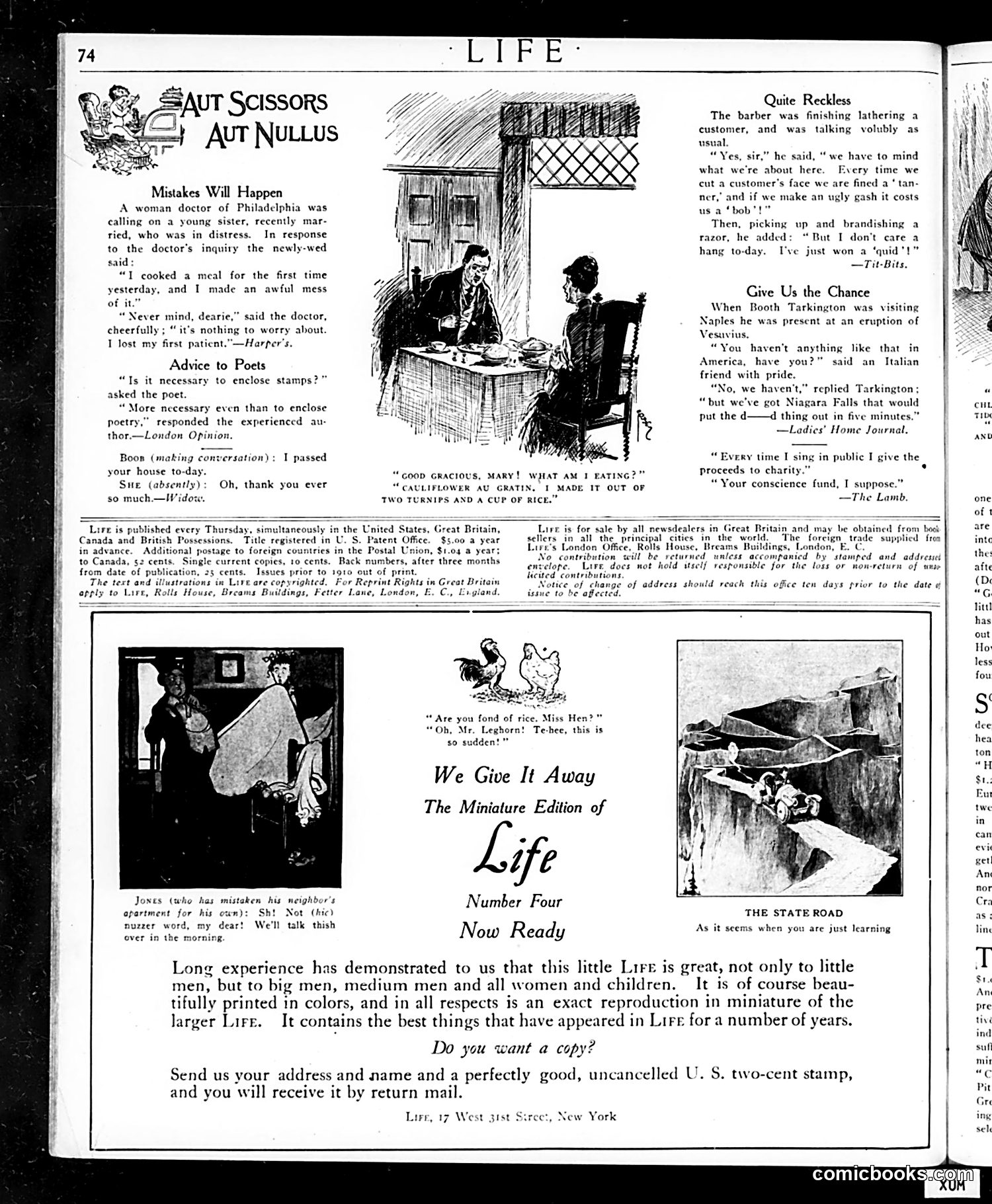
This page from *Life* magazine (a satirical publication, not the photojournalism magazine) contains several brief comedic anecdotes and advertisements typical of early 20th-century humor writing. The cartoons and jokes mock everyday situations: a reckless barber who's won money and doesn't fear fines for nicking customers; a newlywed woman who admits to her doctor she ruined her first meal; a woman claiming her singing proceeds go to charity (sarcastically called a "conscience fund"); and wordplay involving confused neighbors and mistaken identities. The humor reflects period-specific details—British currency ("quid," "bob," "tanner"), references to Booth Tarkington and Vesuvius, and domestic scenarios. The "Quite Reckless" cartoon's joke about fines for barber mistakes assumes readers understand working-class occupational hazards and gambling. Much of the page advertises a "Miniature Edition of Life" available for a two-cent stamp, suggesting the magazine's self-promotional strategy alongside entertainment content.
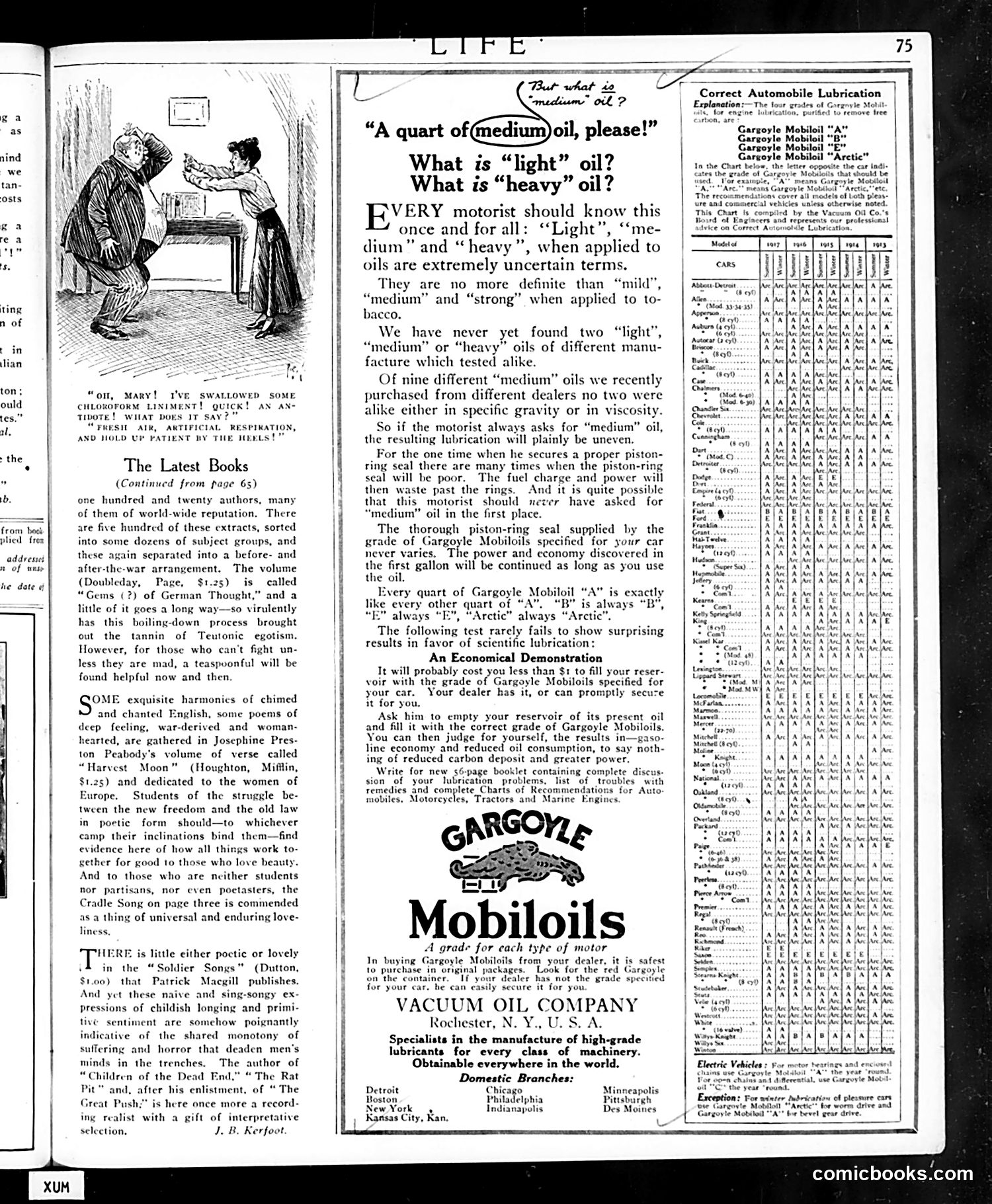
**The Cartoon:** The small sketch at top left depicts a domestic emergency—a person has accidentally swallowed chloroform liniment and urgently asks their spouse what the label says, requesting an antidote. The humor lies in the absurd situation: they're asking someone to read the very label they should have read *before* drinking it. **The Advertisement:** The bulk of the page promotes Gargoyle Mobiloils motor oil. The satirical point mirrors the cartoon's theme: motorists carelessly ask gas station attendants for "medium" or "heavy" oil without realizing these terms are meaningless and inconsistent across manufacturers. The ad argues that just as one shouldn't blindly follow vague instructions (like our liniment drinker), drivers should specify the *exact grade* of Gargoyle oil suited to their specific car model, not generic descriptors. The humor is the implicit comparison: both situations involve people needing specific information but accepting dangerously vague answers instead.
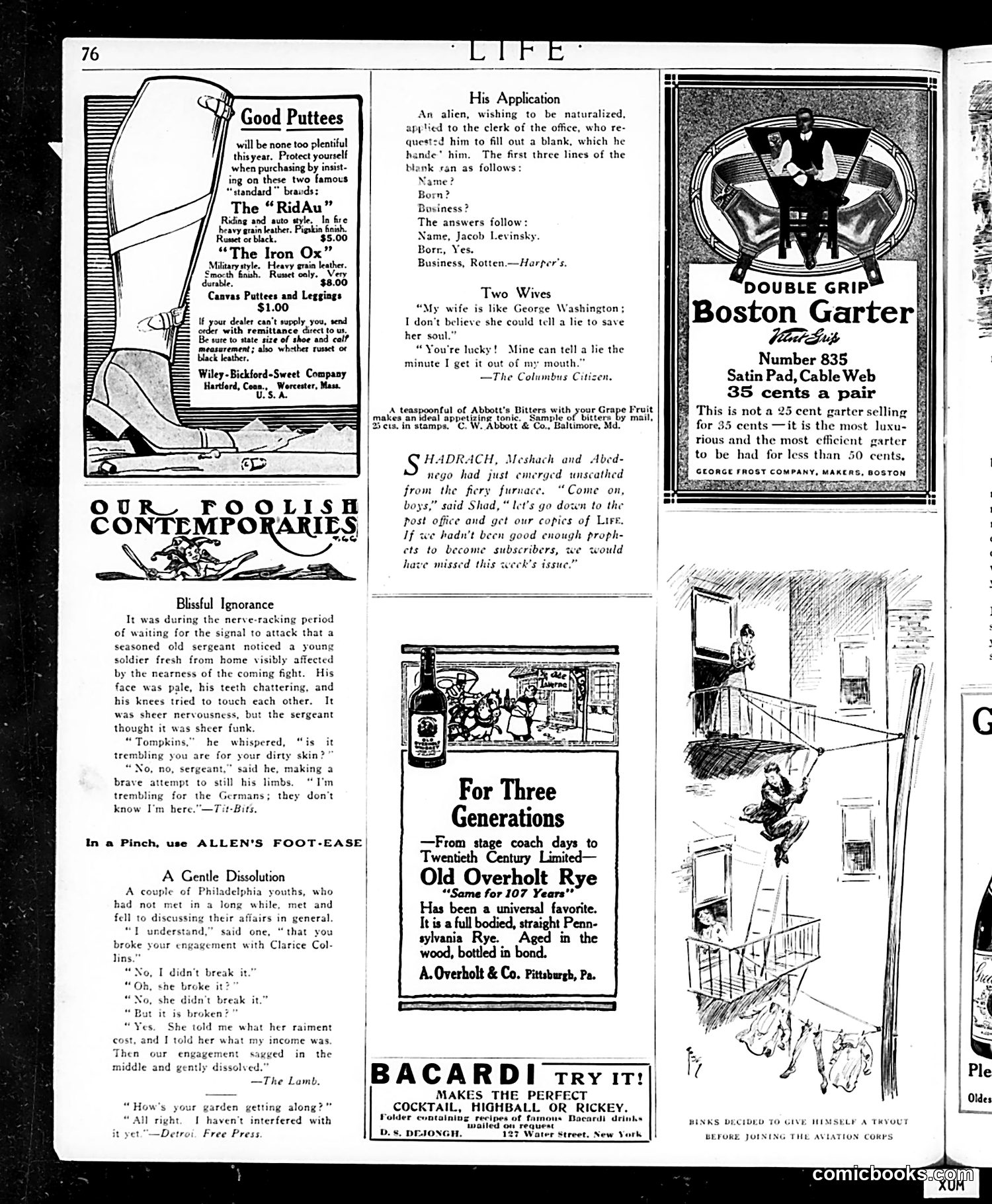
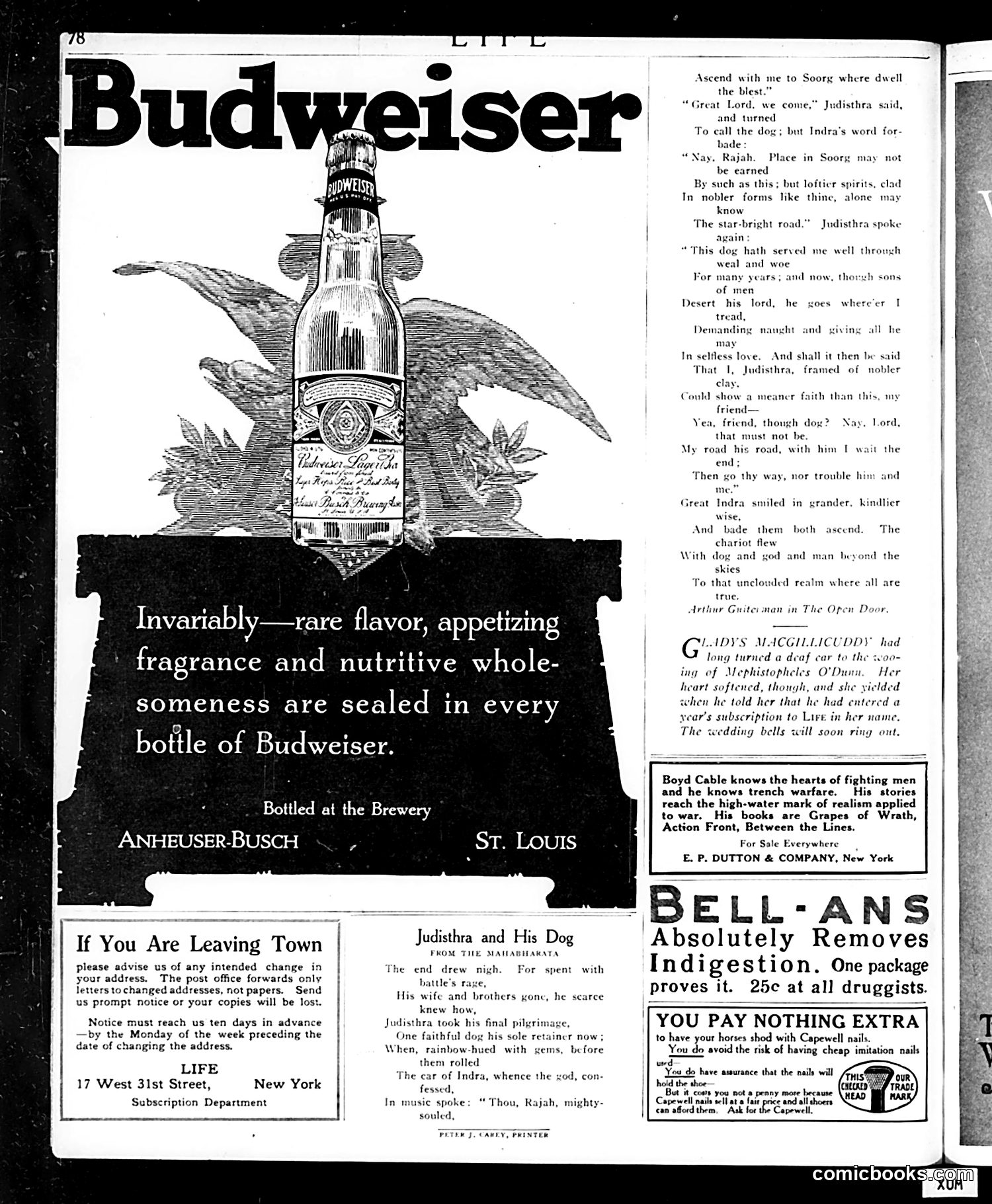
This page from *Life* magazine contains several humorous anecdotes and advertisements typical of early 20th-century American satire. **"His Application"** jokes about naturalization procedures, featuring a Jewish immigrant named Jacob Levinsky whose occupation is listed as "Rotten"—likely mocking both bureaucratic absurdity and ethnic stereotypes common to the era. **"Two Wives"** contrasts marital philosophies: one wife is praised for honesty (like George Washington), while the other is mocked for constant lying—a standard domestic humor trope. **"Our Foolish Contemporaries"** satirizes blind patriotism through a biblical reference (Shadrach, Meshach, and Abednego emerging from fire), with characters suggesting they'd miss *Life* magazine if they weren't subscribers—self-promotional humor. **"Blissful Ignorance"** presents a young soldier's bravery: his trembling isn't fear but concern for Germans who don't know he's there—patriotic humor playing on overconfidence. The remainder comprises period advertisements for puttees, garters, rye whiskey, and foot powder—standard magazine filler.
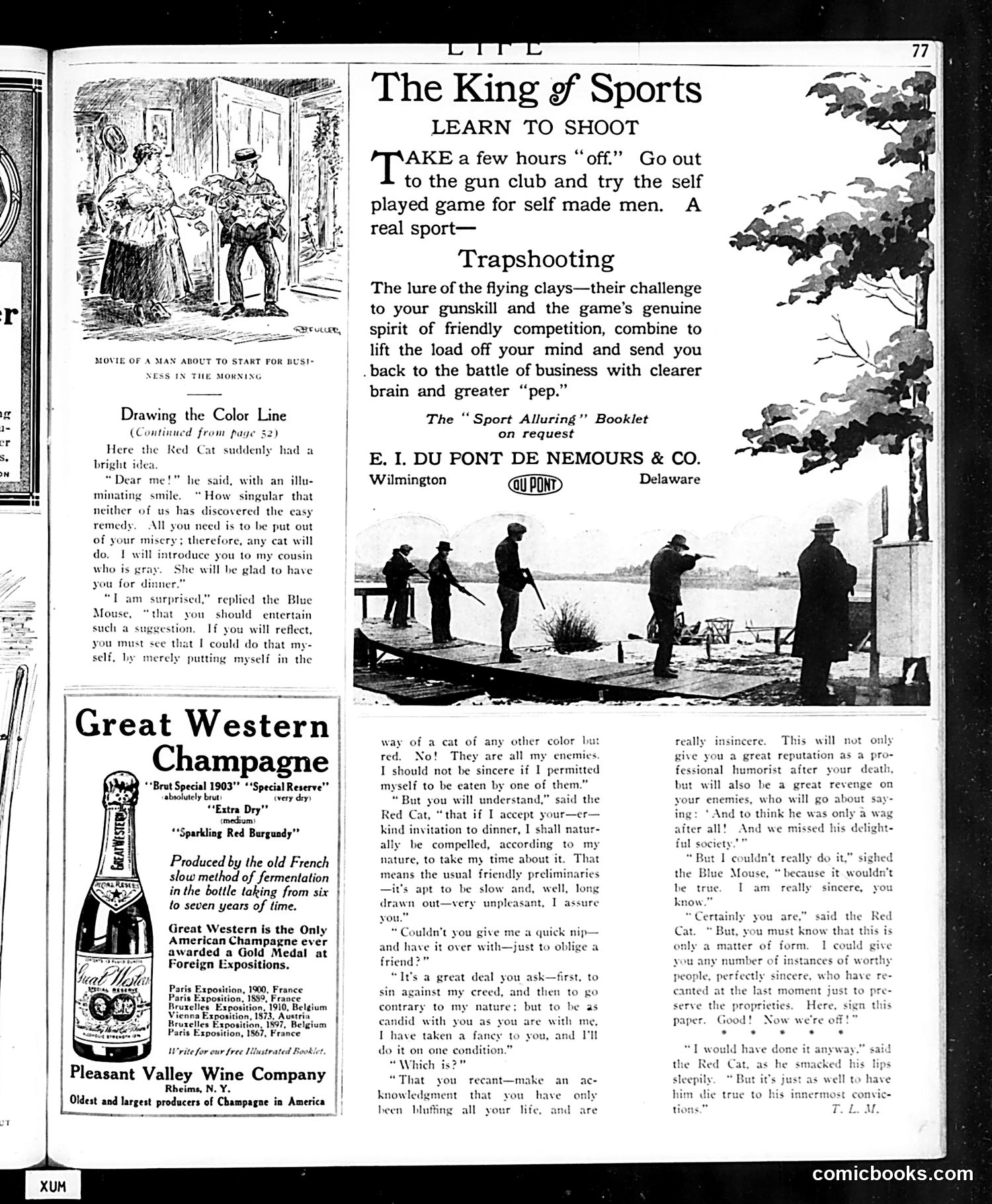
This page contains a serialized fable titled "Drawing the Color Line" (continued from page 52), featuring anthropomorphic animals—a Red Cat and Blue Mouse—in philosophical dialogue about mortality and sincerity. The narrative depicts the Red Cat offering to eat the Blue Mouse to relieve his suffering, but imposing a condition: the Mouse must publicly recant that he's been "bluffing all your life" and admit he was never truly sincere. The Mouse initially refuses, then reluctantly accepts. **The satire's meaning**: This appears to be an allegory about social hypocrisy and the human tendency to maintain facades. The "color line" reference (title) likely alludes to racial or class divisions, with the fable suggesting that people maintain false personas throughout life, and only face truth when confronting mortality. The page also includes advertisements for Du Pont's trapshooting promotion and Great Western Champagne, typical of Life's era.
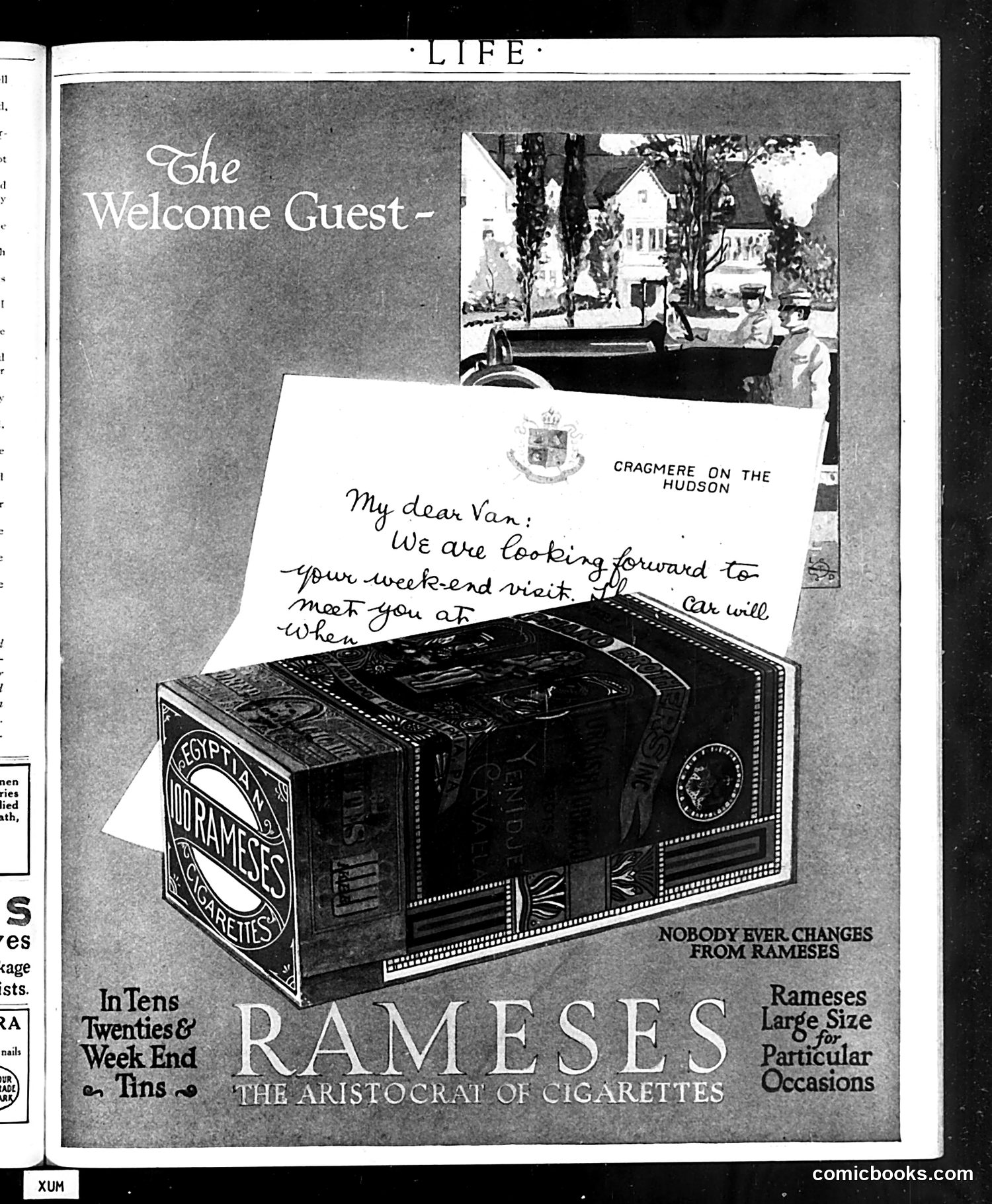
This is primarily a **cigarette advertisement**, not political satire. The page shows a Rameses cigarette box styled as a decorative gift trunk, accompanied by a handwritten letter from "Cragmere on the Hudson" (a Hudson River estate) inviting a guest named Van for a weekend visit. The advertisement's humor relies on positioning Rameses cigarettes as an appropriately luxurious gift for wealthy social occasions. The tagline "The Aristocrat of Cigarettes" and "Nobody Ever Changes from Rameses" emphasize brand prestige and loyalty among the upper class. The "Welcome Guest" heading and personal letter create an intimate, aspirational sales pitch—suggesting that serving Rameses signals refined hospitality and social status. This reflects 1920s marketing strategies targeting affluent consumers through lifestyle association rather than product functionality.
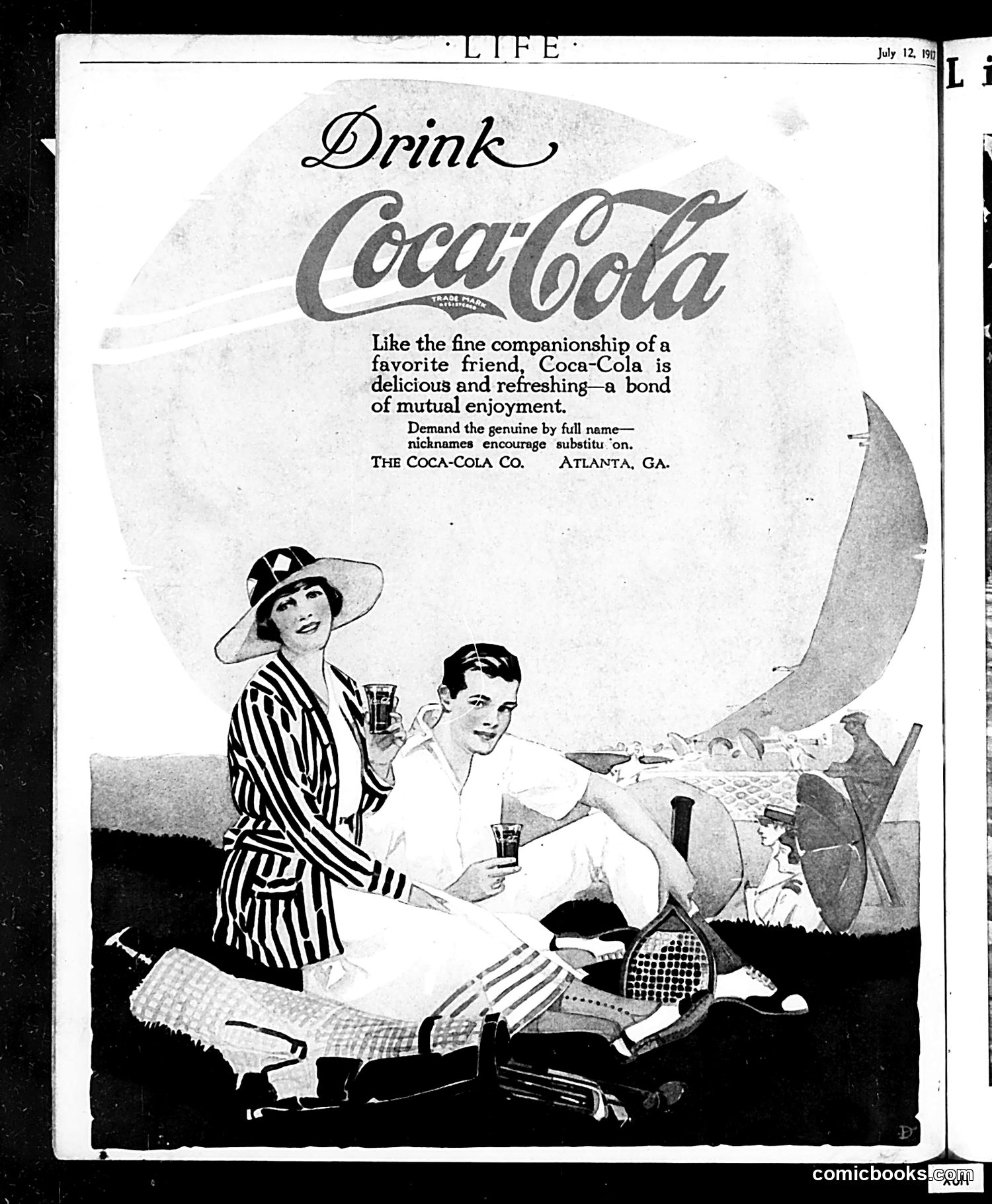
This is a **Coca-Cola advertisement**, not political satire. The page depicts a stylish couple enjoying Coca-Cola during a seaside leisure activity (sailing or beach picnic), likely set in the 1920s based on the fashion—the woman wears a striped jacket and wide-brimmed hat; the man sports casual attire. The ad's messaging emphasizes: - Coca-Cola as a social beverage enhancing companionship - The importance of buying the "genuine" product by full name rather than accepting substitutes or "nicknames" This reflects early 20th-century concerns about **brand protection and counterfeit products**. The aspirational imagery (fashionable people, leisure activities) was typical advertising strategy to associate the drink with desirable lifestyles and social status.