
Life, 1917-07-12 · page 18 of 40
Life — July 12, 1917 — page 18: what you’re looking at
What you’re looking at
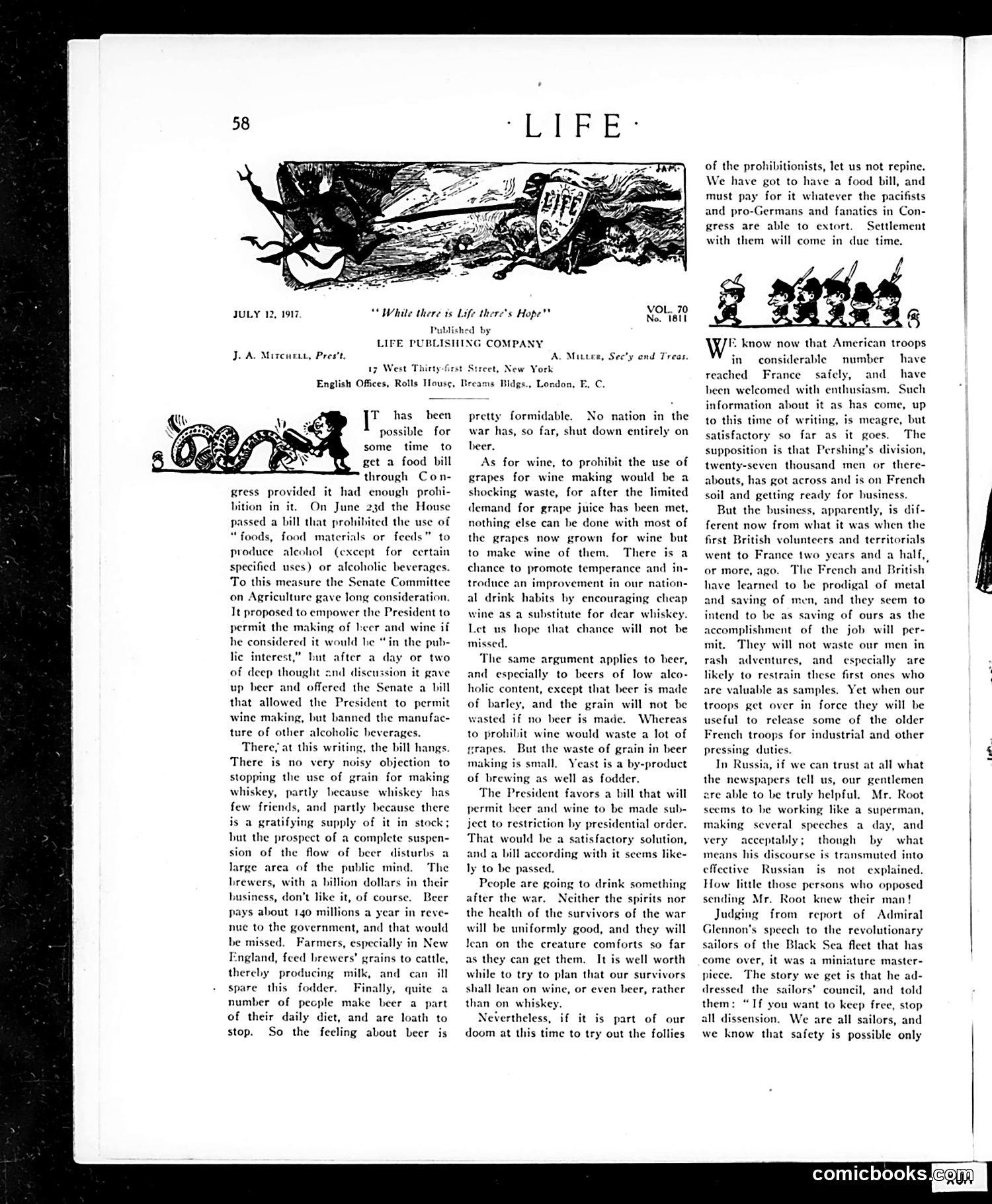
This editorial discusses a food bill before Congress that would prohibit using grain for alcohol production during World War I. The cartoons at the top show distressed figures (likely representing brewers or beer interests) facing prohibition. The piece debates whether to ban beer, wine, or both. The author argues that while prohibiting whiskey faces little resistance, banning beer troubles many: brewers have substantial financial interests, farmers rely on brewers' grain as cattle feed, and many citizens consume beer daily. The editorial favors the President's compromise position—permitting beer and wine under presidential restriction—as preferable to complete prohibition. The rhetoric frames prohibition as pushed by "fanatics" and "pro-Germans," suggesting opposition to alcohol restrictions as patriotic necessity during wartime. The cartoons satirize those opposing the food bill's alcohol restrictions as out of touch with wartime sacrifices.
📄 Transcribed text from this page (OCR, searchable)
Machine-transcribed from the original scan — historical spelling and the odd misread are preserved.
JULY 12, 1917. White there is Life there's Hope VOL. 70 No. 1811 Published by LIFE PUBLISHIN J. A. Mircnent, Pres’t. tz West Thirty-frst St English Offices, Rolls Housg, Brea: lr has been possible for some time to get a food bill through Con- gress provided it had enough prohi- bition in it. On June 23d the House passed a bill t! prohibited the use of “foods, food materials or feeds” to produce alcohol (except for certain specified uses) or alcoholic beverages. To this measure the Senate Committee on Agriculture gave long consideration. It proposed to empower the President to permit the making of leer and wine if he considered it would he “in the pub- lic interest,” but after a day or two of deep thought and discussion it gave up beer and offered the Senate a bill that allowed the President to permit wine making, but banned the manufac- ture of other alcoholic heverages. There, at this writing, the bill hangs. There is no very noisy objection to stopping the use of grain for making whiskey, partly because whiskey has few friends, and partly because there is a gratifying supply of it in stock; but the prospect of a complete suspen- sion of the flow of beer disturbs a large area of the public mind. The brewers, with a billion dollars in their business, don’t like it, of course. Beer pays about 140 millions a year in reve- nue to the government, and that would be missed. Farmers, especially in New England, feed brewers’ grains to cattle, thereby producing milk, and can ill spare this fodder. Finally, quite a number of people make beer a part of their daily diet, and are loath to stop. So the feeling about beer is 3 COMPANY A. Mutter, Sec’y ond Treas. cet, New York s Bidgs., London, F, C. pretty formidable. No nation in the war has, so far, shut down entirely on beer. As for wine, to prohibit the use of grapes for wine making would be a shocking waste, for after the limited demand for grape juice has been met, nothing else can be done with most of the g grown for wine but to 1 wine of them. There is a chance to promote temperance and in- troduce an improvement in our nation- al drink habits hy encouraging cheap wine as a substitute for dear whiskey. Let us hope that chance will not be missed. The same argument applies to beer, and especially to beers of low alco- holic content, except t beer is made of barley, and the grain will not be wasted if no beer is made. Whereas to prohibit wine would waste a lot of grapes. But the waste of grain in beer making is small. Yeast is a by-product of brewing as well as fodder. The President favors a bill that will permit beer and wine to be made sub- ject to restriction by presidential order. That would be a satisfactory solution, and a bill according with it seems like- ly to be passed. People are going to drink something after the war. Neither the spirits nor the health of the survivors of the war will be uniformly good, and they will lean on the creature comforts so far as they can get them. It is well worth while to try to plan that our survivors. shall lean on wine, or even beer, rather than on whiskey. Neverthel if it is part of our doom at this time to try out the follies pes now of the prohibitionists, let us not repine. We have got to have a food bill, and must pay for it whatever the pacifists and pro-Germans and fanatics in Con- gress are able to extort. Settlement with them will come in due time. know now that American troops in considerable number have reached France safely, and have heen welcomed with enthusiasm. Such information about it as has come, up to this time of writing, is meagre, but satisfactory so far as it goes. The supposition is that Pershing’s division, twenty-seven thousand men or there- abouts, has got across and is on French soil and getting ready for business. But the business, apparently, is dif- ferent now from what it was when the first British volunteers and territorials went to France two years and a half,, or more, ago. The French and British have learned to be prodigal of metal and saving of men, and they seem to intend to be as saving of ours as the accomplishment of the job will per- mit. They will not waste our men in rash adventures, and especially are likely to restrain these first ones who are valuable as samples. Yet when our troops get over in force they will be useful to release some of the older French troops for industrial and other pressing dutie: In Russia, if we can trust at all what the newspapers tell us, our gentlemen are able to be truly helpful. Mr. Root seems to be working like a superman, making several speeches a day, and very acceptably; though by what means his discourse is transmuted into effective Russian is not explained. How little those persons who opposed sending Mr. Root knew their man! Judging from of Admiral Glennon’s speech to the revolutionary sailors of the Black Sea fleet that has come over, it was a miniature master- piece. The story we get is that he ad- dressed the sailors’ council, and told them: “If you want to keep free, stop all dissension. We are all sailors, and we know that safety is possible only report comicbooks|! 4 Com