
Life, 1917-07-12 · page 12 of 40
Life — July 12, 1917 — page 12: what you’re looking at
What you’re looking at
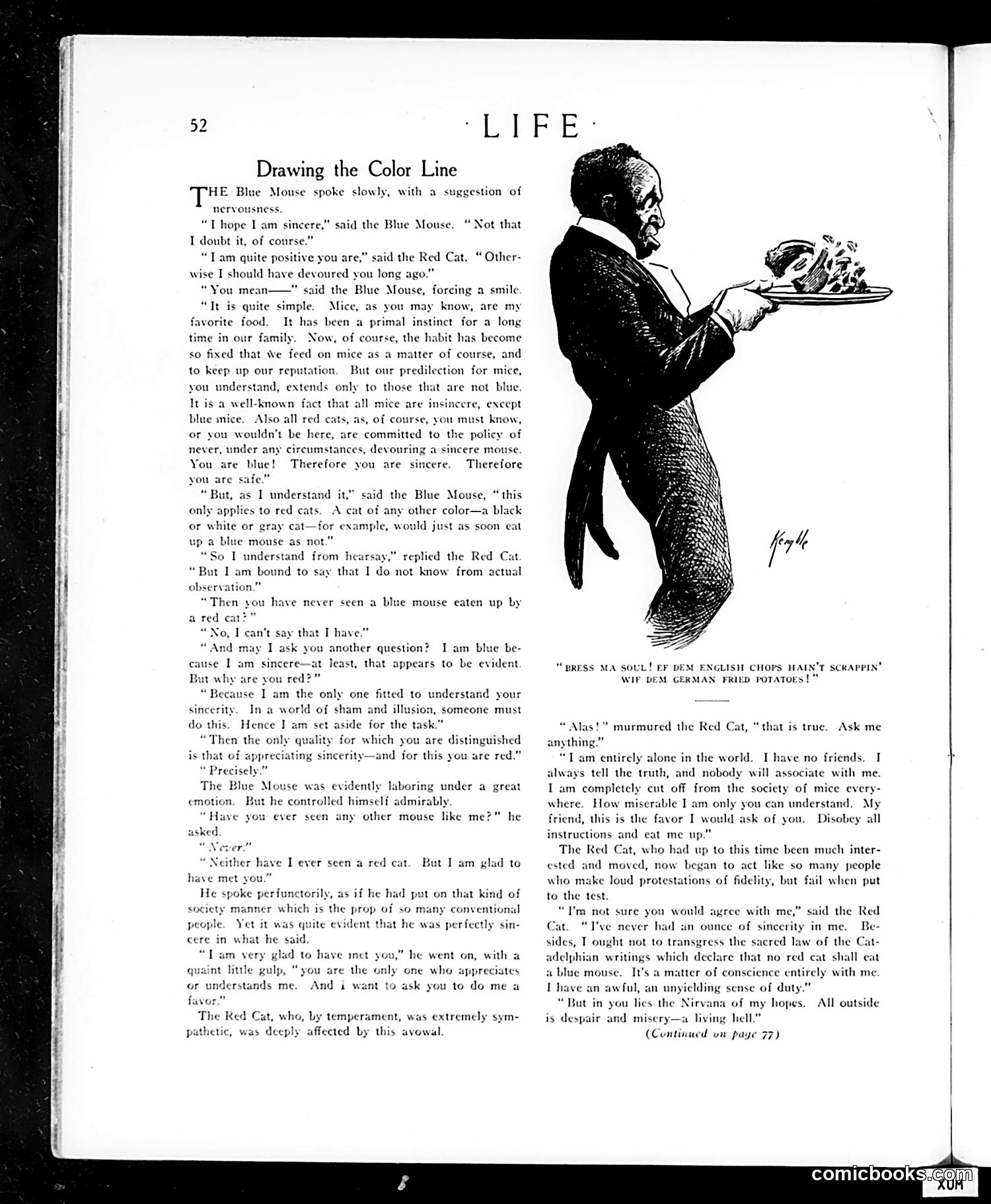
This satirical story uses animal characters to debate racial politics. A Blue Mouse argues he's inherently sincere and therefore safe from a Red Cat—because the cat's code forbids eating sincere mice. The Red Cat counters that only *blue* mice receive this protection; other colored mice face no such safeguard. The allegory critiques racial hierarchies and selective moral protections. The story suggests society grants certain groups (represented by "blue") special status or safety, while denying it to others based on arbitrary distinctions. The Red Cat's admission of prejudice against non-blue mice illustrates how discrimination operates through coded justifications. The caption below the illustration references English chops and German fried potatoes—likely a WWI-era jab at European powers.
📄 Transcribed text from this page (OCR, searchable)
Machine-transcribed from the original scan — historical spelling and the odd misread are preserved.
Drawing the Color Line HE Blue Mouse spoke slow nervousness. “T hope I am sincere,” said the Blue Mouse. “ Not that with a suggestion of I doubt it, of course.” “Tam quite positive you are,” said the Red Cat. “ Other- wise I should have devoured you long ago.” said the Blue Mouse, forcing a smile You mean “Tt is quite simple. Mice, as you may know, are my favorite food. It has been a primal instinct for a long time in our family. Now, of course, the habit has become so fixed that We feed on mice as a matter of course, and to keep up our reputation. But our predilection for mice, you understand, extends only to those that are not blue. It is a well-known fact that all mice are insincere, except blue mice. Also all red cats, as, of course, you must know, of or you wouldn't be here, are committed to the policy never, under any circumstances, devouring a sincere mouse You are blue! Therefore you are sincere. Therefore you are safe.” “But, as I understand it,” said the Blue Mouse, “this only applies to red cats, A cat of any other color—a black or white or gray cat—for example, would just as soon eat up a blue mouse as not.” “So I understand from hearsay,” replied the Red Cat “But Iam bound to say that I do not know from actual observation.” “Then you have never seen a blue mouse eaten up by a red “No, I can't say that I have.” “And may I ask you another question? I am blue be- cause I am sincere—at least, that appears to be evident But why are you red?” “Because I am the only one fitted to understand your ity. Ina world of sham and illusion, someone must do this. Hence I am set aside for the task.” “Then the only quality for which you are distinguished is that of appreciating sincerity—and for this you are red.” since: “ Precisely The Blue Mouse was evidently laboring under a great emotion. But he controlled himself admirably “Have you ever scen any other mouse like me?” he asked er” “ Neither have I ever seen a red cat. But Iam glad to have met you.” He spoke perfunctorily, as if he had put on that kind of society manner which is the prop of so many conventional sin- peor Yet it was quite evident t he was perfectly cere in what he said “Tam very glad to have inet you,” he went on, with a quaint little gulp, “you are the only one who appreciates or understands me. And i want to ask you to do me a favor.” The Ked Cat, who, by temperament, was extremely sym- thetic, was deeply affected by this avowal. “BRESS MA SOUL! EF DEM ENGLISH CHOPS HAIN'T SCKAPPIN’ WIF DEM GERMAN FRIED POTATOES!" Alas!" murmured the Red C “that is true. Ask me anything. “Tam entirely alone in the world. I have no friends. I always tell the truth, and nobody will associate with me. I am completely cut off from the society of mice every- where. How miserable Iam only you can understand, My at, friend, this is the favor I would ask of you. Disobey instructions and eat me up.” The Red Cat, who had up to this time been much inter- ested and moved, now began to act like so many people who make loud protestations of fidelity, but fail when put to the test. “I'm not sure you would agree with me,” said the Red Cat. “I've never had an ounce of sincerity in me. Be- sides, I ought not to transgress the sacred law of the Cat- adelphian writings which declare that no red cat shall eat a blue mouse. It's a matter of conscience entirely with me. T have an awful, an unyielding sense of duty. “ But in you lics the Nirvana of my hopes. All outside is despair and misery—a living hell.” (Continued on page 77) comicbook ‘<a