
Life, 1917-07-12 · page 25 of 40
Life — July 12, 1917 — page 25: what you’re looking at
What you’re looking at
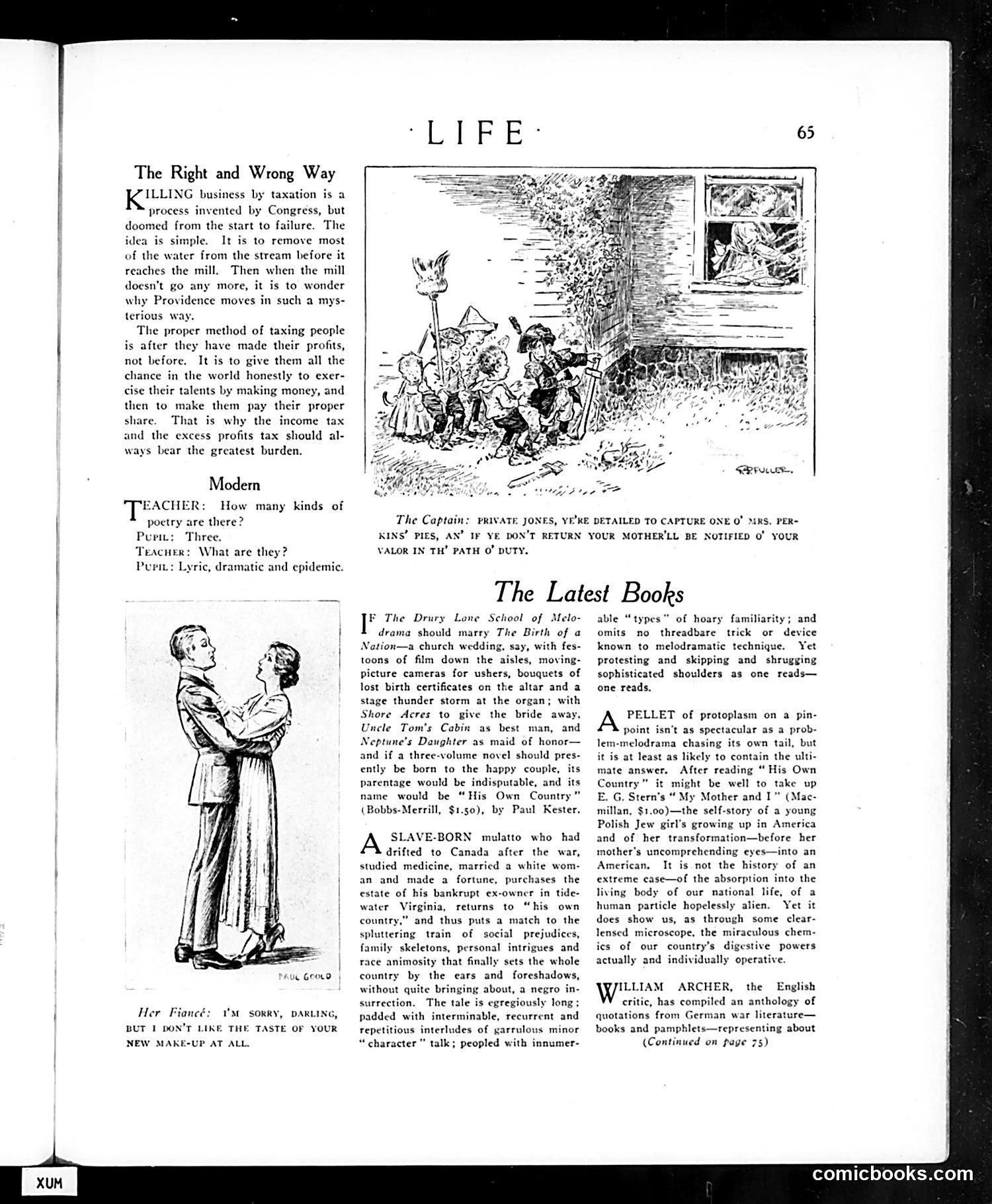
This page contains three separate satirical pieces: **"The Right and Wrong Way"** (top): An editorial arguing against taxation *before* business profits are made, comparing it to removing water from a stream before it reaches a mill. It advocates for income and excess profits taxes *after* earnings occur—a progressive tax argument likely responding to contemporary Congressional tax policy debates. **"Modern" (middle)**: A classroom joke where a pupil defines the three types of poetry as "lyric, dramatic and epidemic"—a pun suggesting that poetry, like disease, spreads widely. Simple wordplay humor. **Lower cartoons**: Two domestic humor sketches—one showing a fiancé complaining about his partner's makeup taste, another depicting a military captain threatening a private with a humorous Scottish accent. **"The Latest Books"** (lower half): Book reviews mockingly describing melodramatic plots, including "His Own Country" (about a freed Black man purchasing his former owner's estate) and immigrant assimilation narratives. The reviews employ sarcasm to critique overwrought storytelling conventions. The page mixes political commentary with light domestic humor typical of Life's satirical approach.
📄 Transcribed text from this page (OCR, searchable)
Machine-transcribed from the original scan — historical spelling and the odd misread are preserved.
The Right and Wrong Way ILLING business by taxation is a process invented by Congress, but doomed from the start to failure. The idea is simple. It is to remove most of the water from the stream before it reaches the mill, Then when the mill doesn’t go any more, it is to wonder why Providence moves in such a mys- terious way. The proper method of taxing people is after they have made their profits, not before. It is to give them all the chance in the world honestly to exer- cise their talents by making money, and then to make them pay their proper share. That is why the income tax and the excess profits tax should al- ways bear the greatest burden. Modern How many kinds of T CHER: poetry are there? Purit: Three. Teacner: What are they? Perit: Lyric, dramatic and epidemic. | Aue Goo Her Fiancé: \'s sorry, DARLING, BUT 1 DON’T LIKE THE TASTE OF YOUR NEW MAKE-UP AT ALL. The Captain: private JONE KINS’ PIES, AD YE DON’T RETUR? VALOR IN TH’ PATH 0° DUTY, , YE'RE DETAILED TO CAPTURE 0: YOUR MOTHER'LL BE NOTIFIED 0° YOUR O" MRS. PER- The Latest Books ] The Drury Lane School of Melo- drama should marry The Birth of a Nation—a church wedding, say, with fes- toons of film down the aisles, moving- picture cameras for ushers, bouquets of lost birth certificates on the altar and a stage thunder storm at the organ; with Shore Acres to give the bride away, Uncle Tom's Cabin as best man, and Neptune's Daughter as maid of honor— and if a three-volume novel should pres- ently be born to the happy couple, its parentage would be indisputable, and its name would be “His Own Country” (Bobbs-Merrill, $1.30), by Paul Kester. SLAVE-BORN mulatto who had drifted to Canada after the war, studied medicine, married a white wom- an and made a fortune, purchases the estate of his bankrupt ex-owner in tide- water Virginia, returns to “his own country,” and thus puts a match to the spluttering train of social prejudices, family skeletons, personal intrigues and race animosity that finally sets the whole country by the ears and foreshadows, without quite bringing about, a negro in- surrection. The tale is egregiously long; padded with interminable, recurrent and repetitious interludes of xarrulous minor “ character” talk; peopled with innumer- able “types” of hoary familiarity; and omits no threadbare trick or device known to melodramatic technique, Yet protesting and skipping and shrugging sophisticated shoulders as one reads— one reads. PELLET of protoplasm on a pin- point isn’t as spectacular as a prob- lem-melodrama chasing its own tail, but it is at least as likely to contain the ulti- mate answer. After reading “ His Own Country” it might be well to take up E. G. Stern’s “ My Mother and I" (Mac- millan, $1.00)—the self-story of a young Polish Jew girl's growing up in America and of her transformation—before her mother’s uncomprehending eyes—into an American, It is not the history of an extreme case—of the absorption into the living body of our national life, of a human particle hopelessly alien. Yet it does show us, as through some clear- lensed microscope, the miraculous chem- ies of our country’s digestive powers actually and individually operative. ILLIAM ARCHER, the English critic, has compiled an anthology of quotations from German war literature— books and pamphlets—representing about (Continued on page 75) comicbooks.com