
Life, 1917-07-12 · page 19 of 40
Life — July 12, 1917 — page 19: what you’re looking at
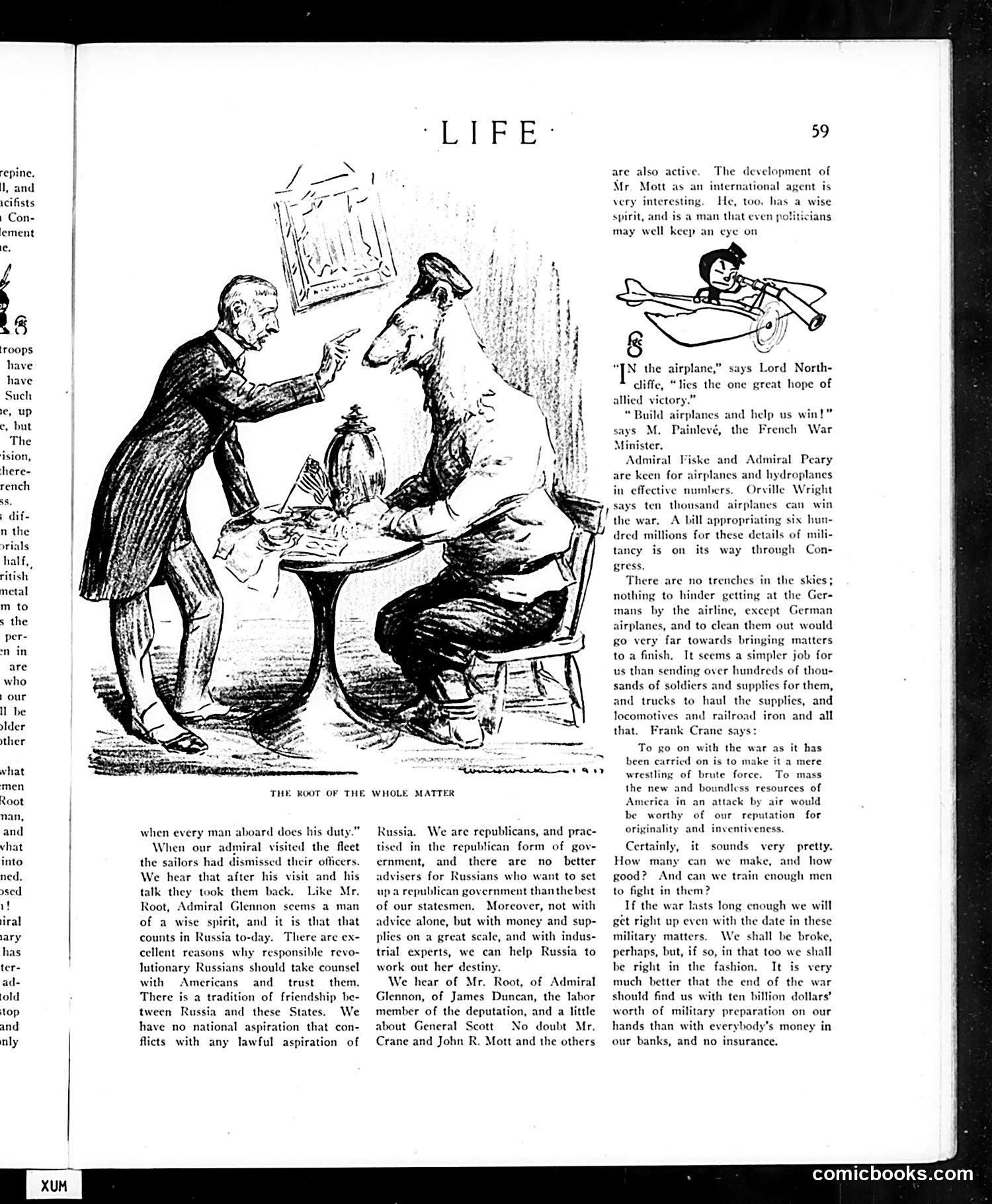
What you’re looking at
The main cartoon depicts a well-dressed older man (identified in caption as representing American interests) instructing a barefoot Russian sailor or worker. This illustrates the page's theme: American advisors—including Elihu Root, Admiral Glennon, and others—visiting Russia (then in revolutionary upheaval post-1917) to guide its political development toward republicanism. The satire suggests Americans believe they can simply teach Russians democracy through visits and advice, treating it almost as a simple matter of instruction rather than acknowledging Russia's complex internal struggles. The surrounding text discusses how America could better aid the Allies through aircraft production rather than shipping supplies—advocating for industrial/technological solutions over traditional military logistics. The overall message is satirical commentary on American confidence in exporting political ideology while debating war strategy.
📄 Transcribed text from this page (OCR, searchable)
Machine-transcribed from the original scan — historical spelling and the odd misread are preserved.
repine. I, and cifists, ) Con- lement ic. 8 Oops have have Such Ie, up e, but The ‘sion, here- rench $8. » dif- n the rials half, ritish metal m to s the per- ‘nin are who Sour be Ider ther what men Root nan, and vhat into ned. sed XUM “LIFE: THE ROOT OF THE WHOLE MATTER when every man aboard does his duty.” When our admiral visited the fleet the sailors had dismissed their officers. We hear that after his visit and his talk they took them back, Like Mr. Root, Admiral Glennon scems a man of a wise spirit, and it is that that counts in Russia to- cellent reasons why responsible revo- lutionary Russians should take counsel with Americans and trust them, There is a tradition of friendship be- tween Russia and these States. We have no national aspiration that con- flicts with any lawful aspiration of Russia. We are republicans, and prac- tised in the republican form of gov- ernment, and there are no_ better advisers for Russians who want to set up a republican government than the best of our statesmen. Moreover, not with advice alone, but with money and sup- plies on a great scale, and with indus- trial experts, we can help Russia to work out her destiny. We hear of Mr. Root, of Admiral Glennon, of James Duncan, the labor member of the deputation, and a little about General Scott No doubt Mr. Crane and John R. Mott and the others 59 are also active, The development of Mr Mott as an international agent is interesting. He, too, has a wise spirit, and is a man that even po! may well keep an eye on N the airplane,” says Lord North- cliffe, “lies the one great hope of allied victory “Build airplanes and help us win!" says M. Painlevé, the French War Minister. Admiral Fiske and Admiral Peary are keen for airplanes and hydroplanes in effective numbers. Orville Wright ten thousand airplanes can win the war. A bill appropriating six hun- dred millions for these details of mili- tancy is on its way through Con- gress. There are no trenches in the skies; nothing to hinder getting the Ger- mans by the airline, except German airplanes, and to clean them out would go very far towards bringing matters toa finish. It seems a simpler job for us than sending over hundreds of thou- sands of soldiers and supplies for them, and trucks to haul the supplies, and locomotives and railroad iron and all that. Frank Crane says: To go on with the war as it has been carricd on is to make it a mere wrestling of brute force. To mass the new and boundless resources of America in an attack by air would be worthy of our reputation for inality and inventiveness. Certainly, it sounds very pretty. How many can we make, and how good? And can we train enough men to fight in them? If the war lasts long enough we will get right up even with the date in these military matters. We shall be broke, perhaps, but, if so, in that too we shall be right in the fashion. It is very much better that the end of the war should find us with ten billion dollars’ worth of military preparation on our hands than with everybody’s money in our banks, and no insurance. : comicbooks.com