A complete issue · 38 pages · 1917
Life — June 14, 1917
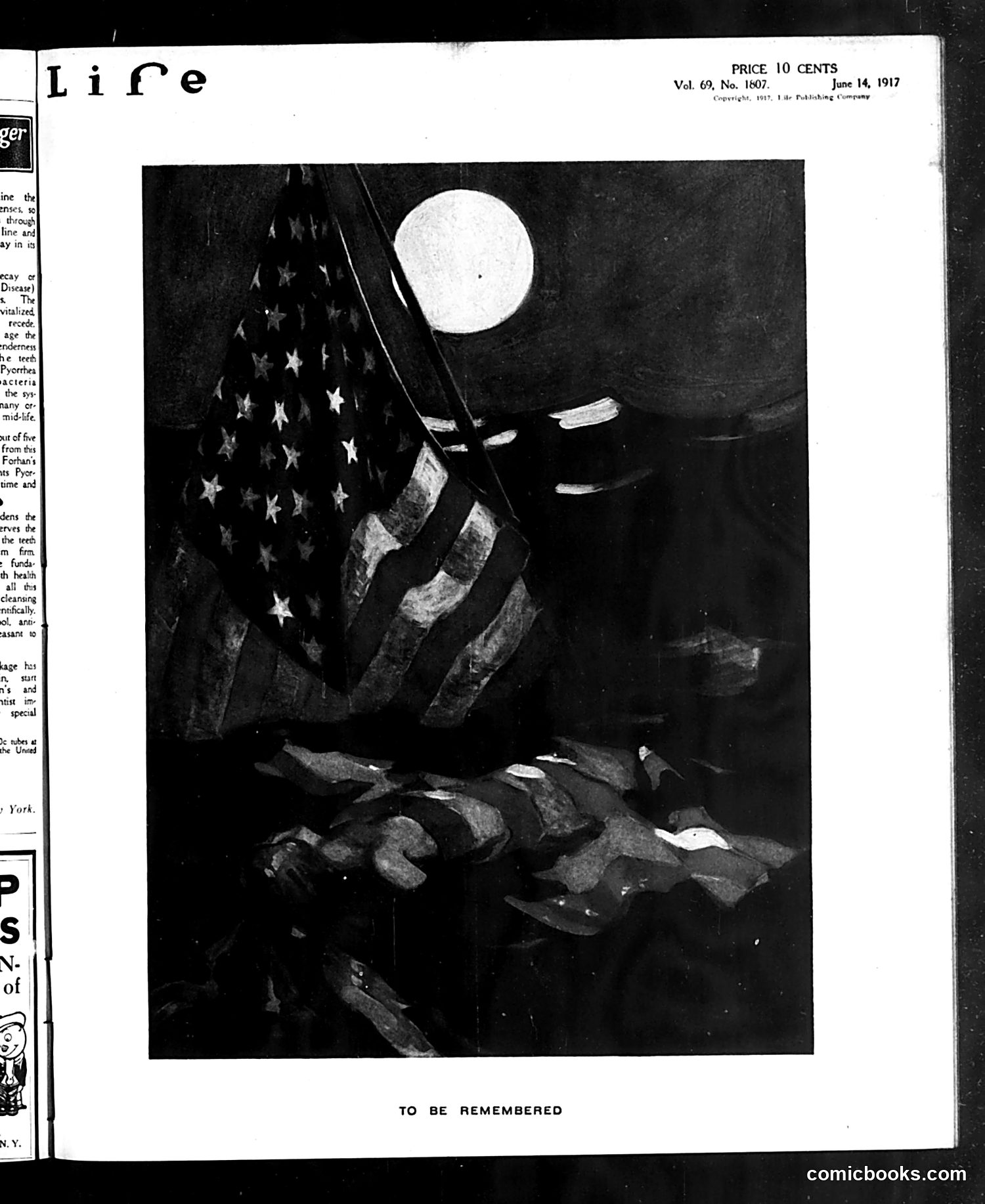
This June 1917 *Life* magazine illustration appears to be WWI-related propaganda or commentary. The image shows an American flag draped over a fallen soldier silhouetted against a full moon, with what appears to be casualties or bodies in the foreground. Published when the U.S. had recently entered World War I (April 1917), the caption "To Be Remembered" likely serves as a solemn memorial to American war dead. The dramatic nighttime composition—flag, moon, and fallen soldiers—creates a poignant message about sacrifice. The image functions as patriotic messaging typical of wartime publications, honoring soldiers' deaths rather than satirizing as *Life* often did. Without additional context from surrounding articles, the specific intended meaning remains unclear, but the overall tone emphasizes remembrance and sacrifice.
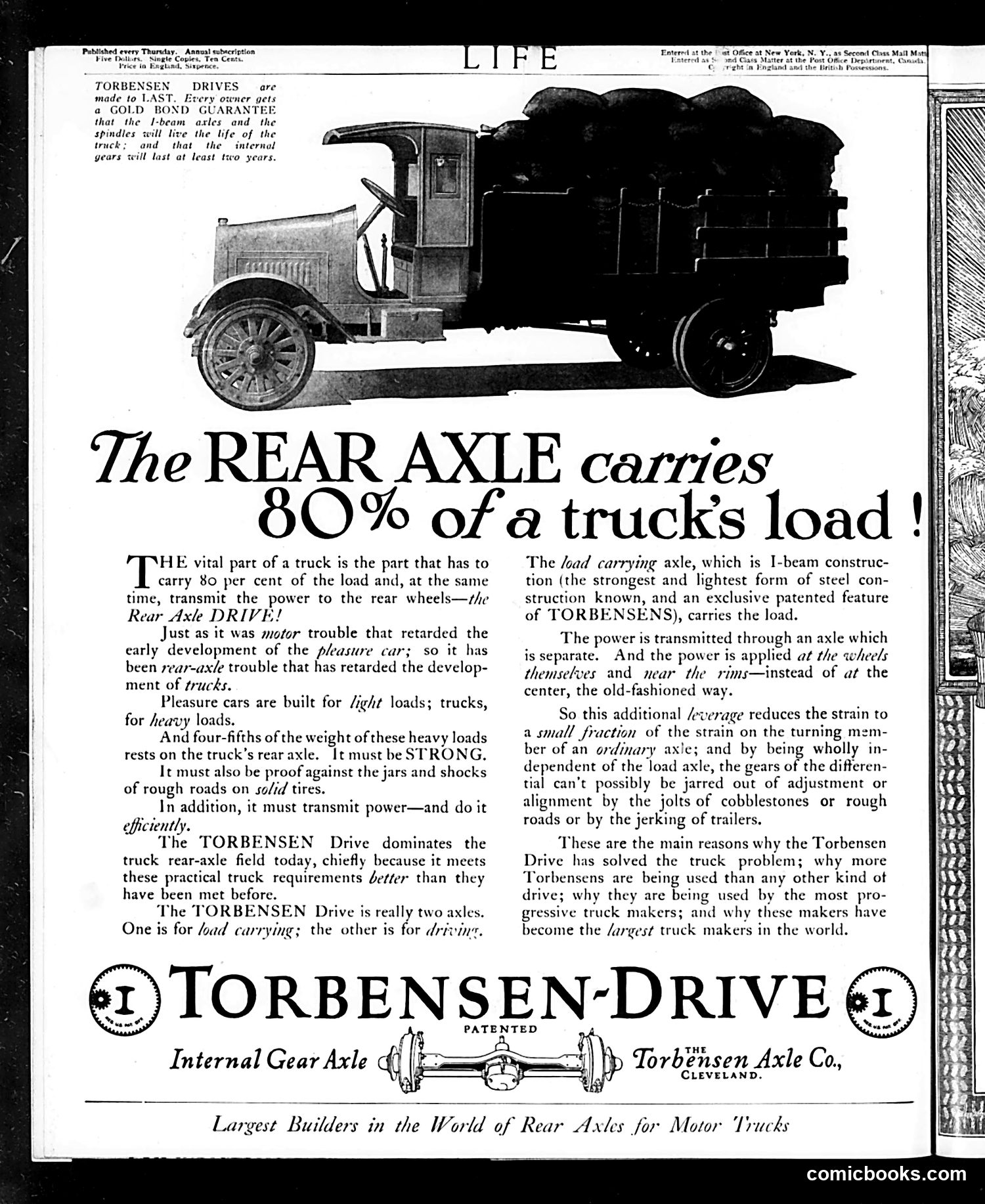
This is **not a political cartoon or satire**—it's a straightforward **product advertisement** for the Torbensen Drive, a truck rear axle manufactured by The Torbensen Axle Co. of Cleveland. The page explains the engineering innovation: the rear axle carries 80% of a truck's load and must be exceptionally strong. The Torbensen Drive uses a patented I-beam construction and separates the load-carrying axle from the driving axle, reducing strain on turning mechanisms. The text emphasizes durability for "heavy loads" and "rough roads," positioning Torbensen as superior to competitors. The page concludes by claiming these axles made Torbensen "the largest truck makers in the world." This is period industrial advertising, not editorial commentary.
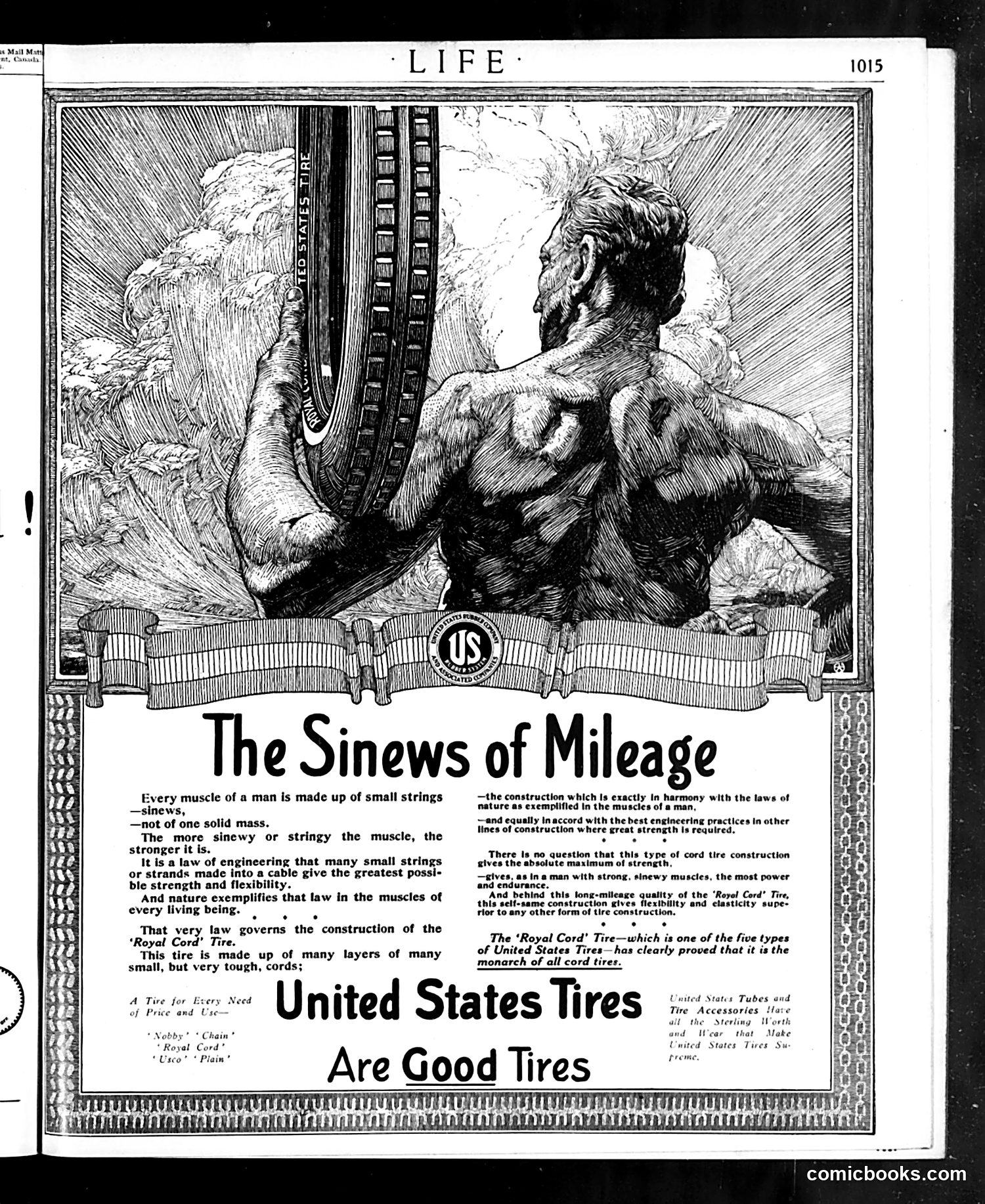
This is primarily a **United States Tires advertisement**, not political satire. The page uses an anatomical metaphor to market tires. The illustration shows a muscular male figure examining a large tire, with text comparing muscle construction to tire construction. The ad argues that just as human muscles contain "sinews"—small fibers bundled together for strength—United States Tires are constructed from many layered cords that provide strength and durability. The advertisement specifically promotes the "Royal Cord" tire, claiming it represents the pinnacle of tire construction and offers "absolute maximum of strength" and flexibility. The anatomical comparison is a rhetorical device meant to make tire engineering seem natural and scientifically sound to consumers. This is product advertising rather than political commentary.
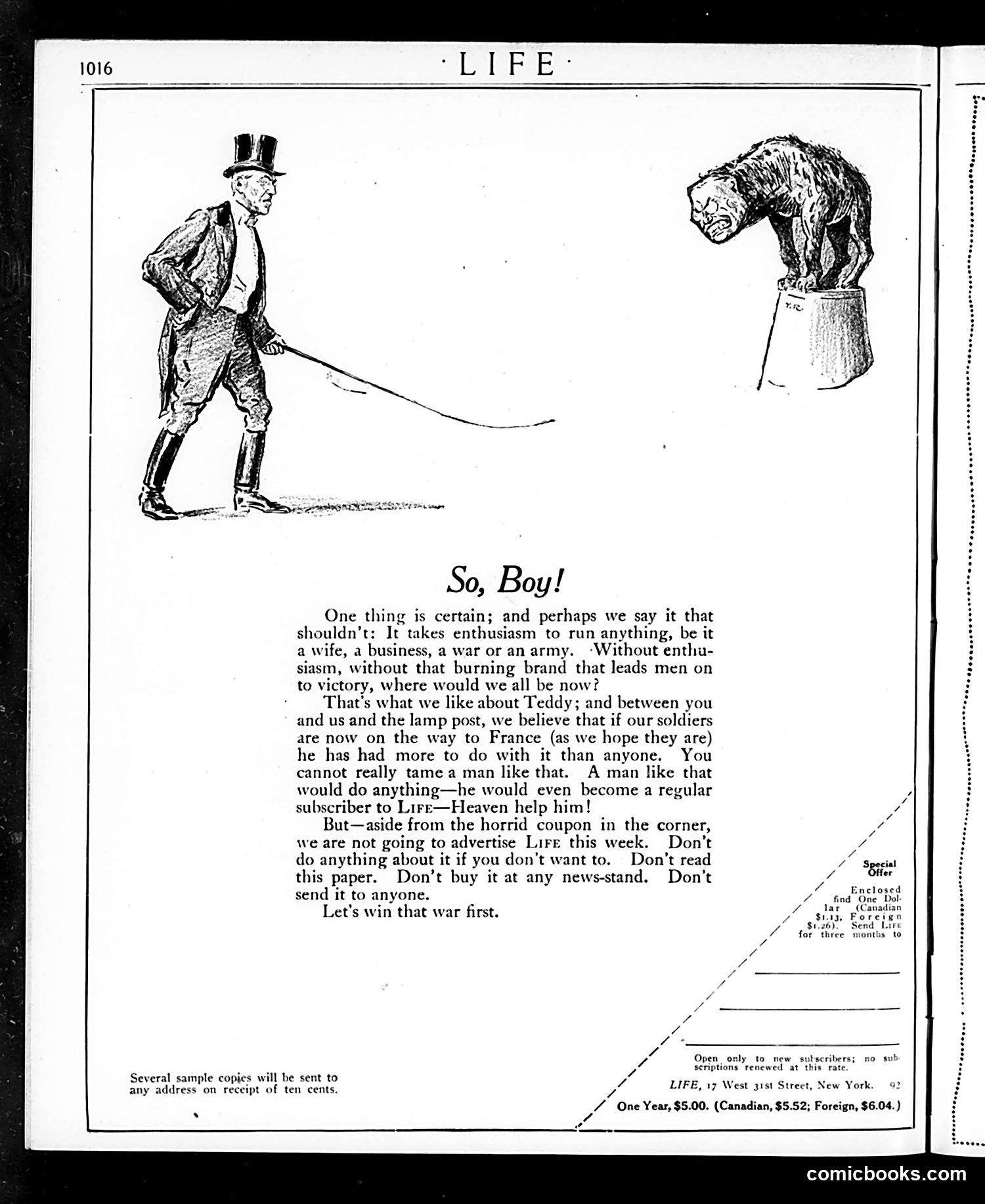
This is a WWI-era recruitment advertisement masquerading as editorial content. The cartoon shows a well-dressed man with a top hat holding a whip, controlling a bear (labeled, appearing to represent Germany or enemy forces) perched on a pedestal. The text references "Teddy"—likely Theodore Roosevelt, known for enthusiastic nationalism and the phrase "speak softly and carry a big stick." The article argues that enthusiasm and leadership win wars, crediting such qualities with American military success in France. The publication then makes an unusual request: readers should *not* promote Life magazine this week to support the war effort instead. This patriotic self-sacrifice was a common WWI propaganda tactic, positioning non-promotion as a civic duty toward winning "that war first."
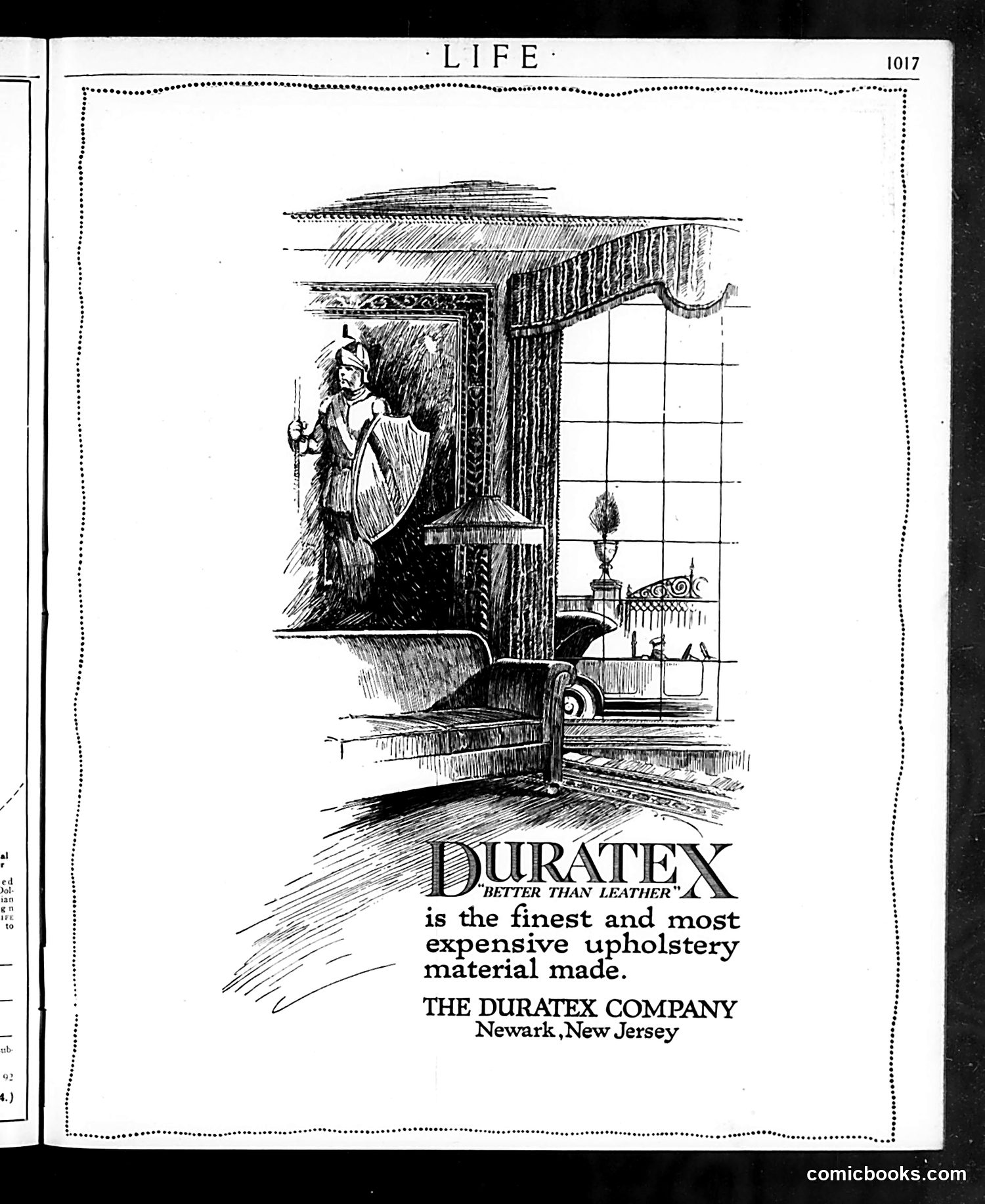
This page is **primarily an advertisement**, not political satire. It promotes Duratex, an upholstery material made by The Duratex Company of Newark, New Jersey. The illustration depicts a medieval or classical figure (possibly a knight or nobleman based on the shield and formal dress) standing in an ornate interior with large windows. The figure's elaborate costume and heraldic shield serve as decorative branding rather than satirical commentary. The advertising claim—"is the finest and most expensive upholstery material made"—uses the figure's noble appearance to suggest luxury and quality. This is typical early-20th-century advertising strategy: associating a product with refinement and high status through classical or aristocratic imagery. There is no political cartoon or satire present on this page.
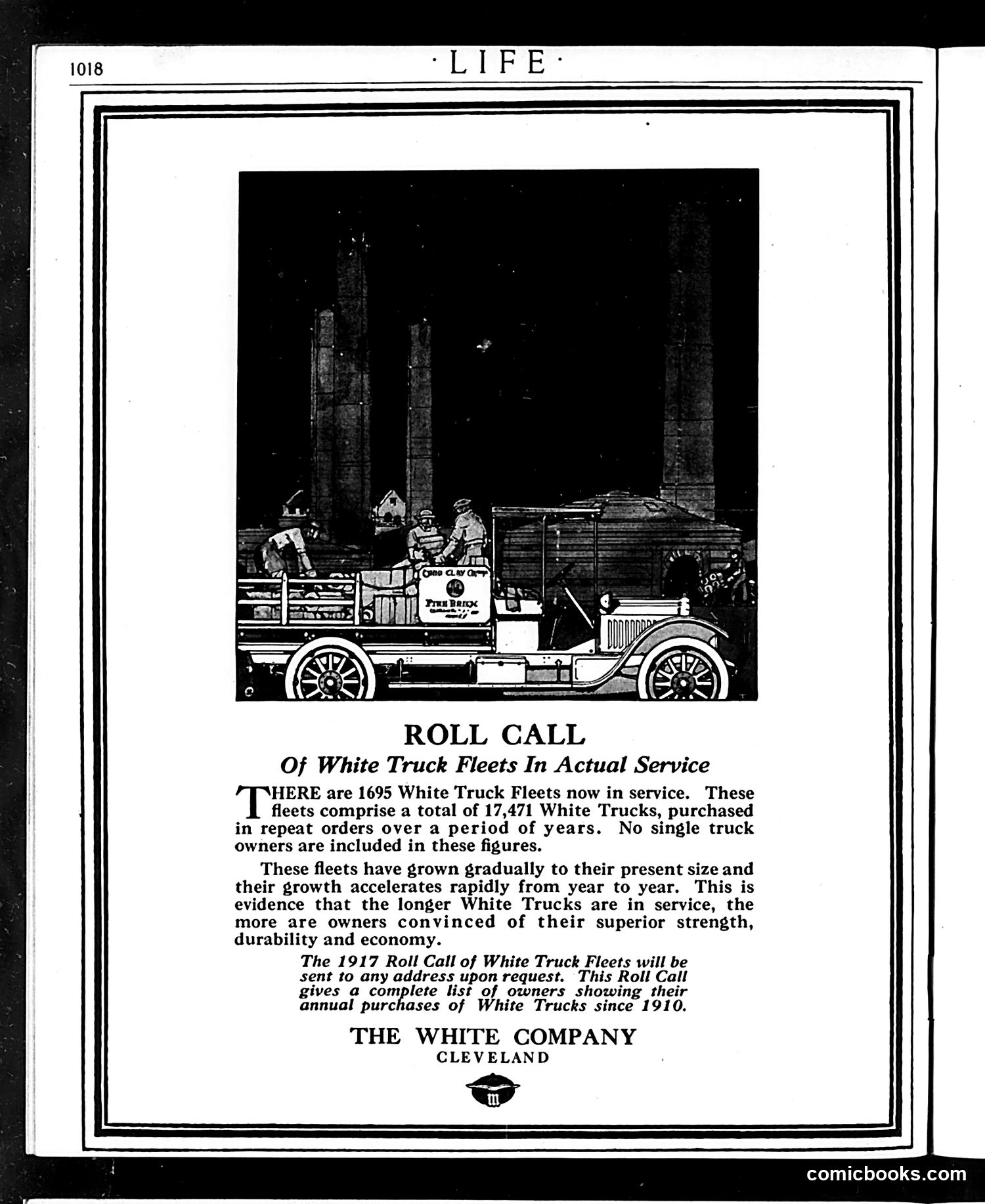
This page is **not a political cartoon or satire**—it's a straightforward **advertisement** for the White Company, a truck manufacturer based in Cleveland. The content promotes White Trucks' commercial success by citing statistics: 1,695 active truck fleets comprising 17,471 total vehicles purchased through repeat orders since 1910. The ad argues this growth demonstrates the trucks' "superior strength, durability and economy." The illustration shows a loaded White delivery truck with workers, representing practical commercial use. The text promises an upcoming "1917 Roll Call" listing fleet owners and their purchasing history. This represents early automotive industry marketing aimed at business buyers, emphasizing reliability and market adoption as proof of product quality—standard advertising strategy rather than satirical commentary.
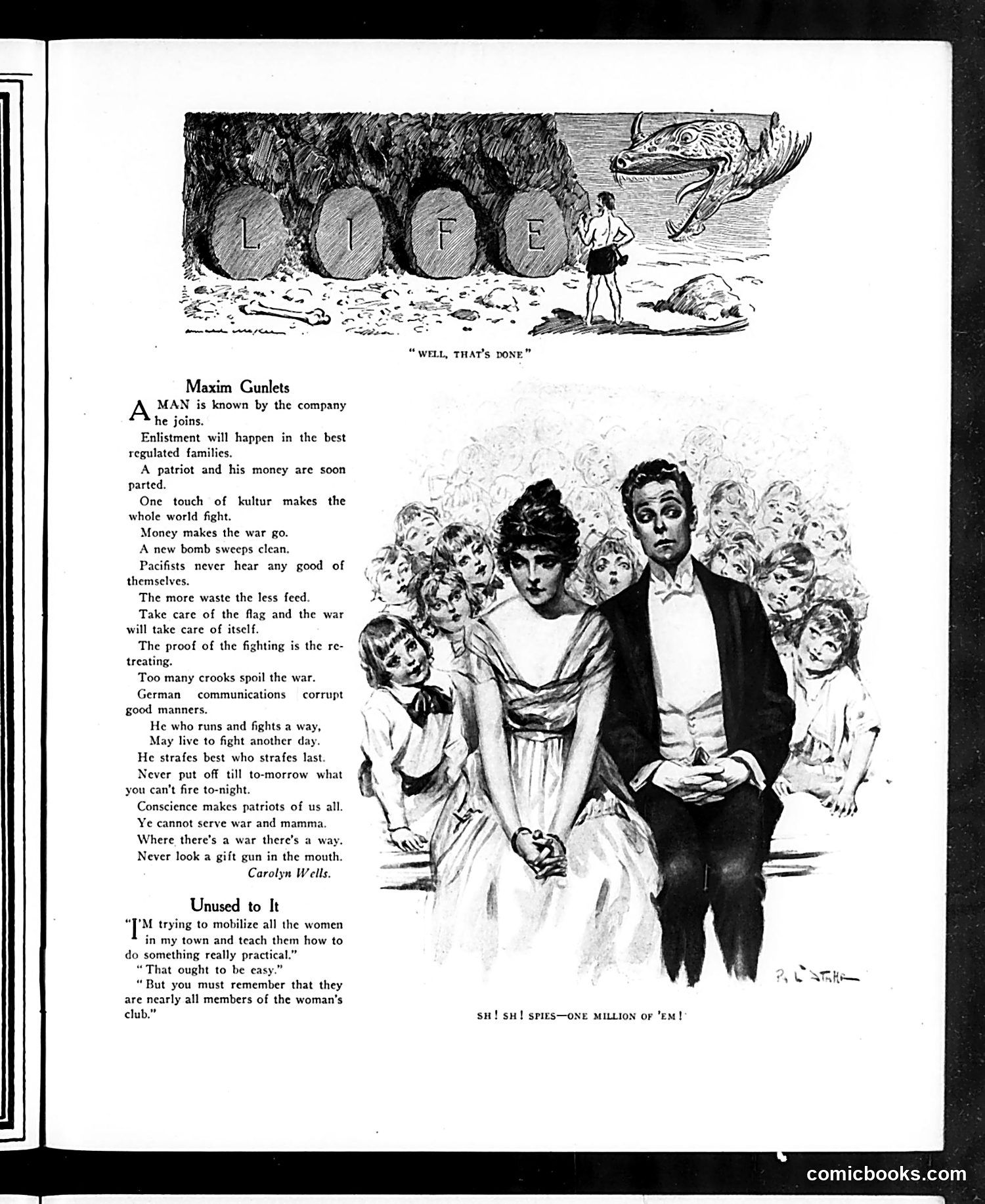
The top cartoon shows a person spelling "LIFE" using four large letters/barrels, with a sea creature emerging from water. The caption "Well, that's done" suggests completing or launching something—likely a satirical reference to the magazine itself or a wartime production effort. The lower section, titled "Maxim Gunlets," presents cynical aphorisms about war, patriotism, and social behavior (attributed to Carolyn Wells). These mock jingoistic slogans and expose hypocrisy—for example, "Pacifists never hear any good of themselves" and "Money makes the war go." The illustration below shows an anxious couple surrounded by numerous children, captioned "Sh! Sh! Spies—one million of 'em!" This satirizes wartime paranoia about enemy spies while also commenting on domestic concerns about population and child-rearing during conflict.
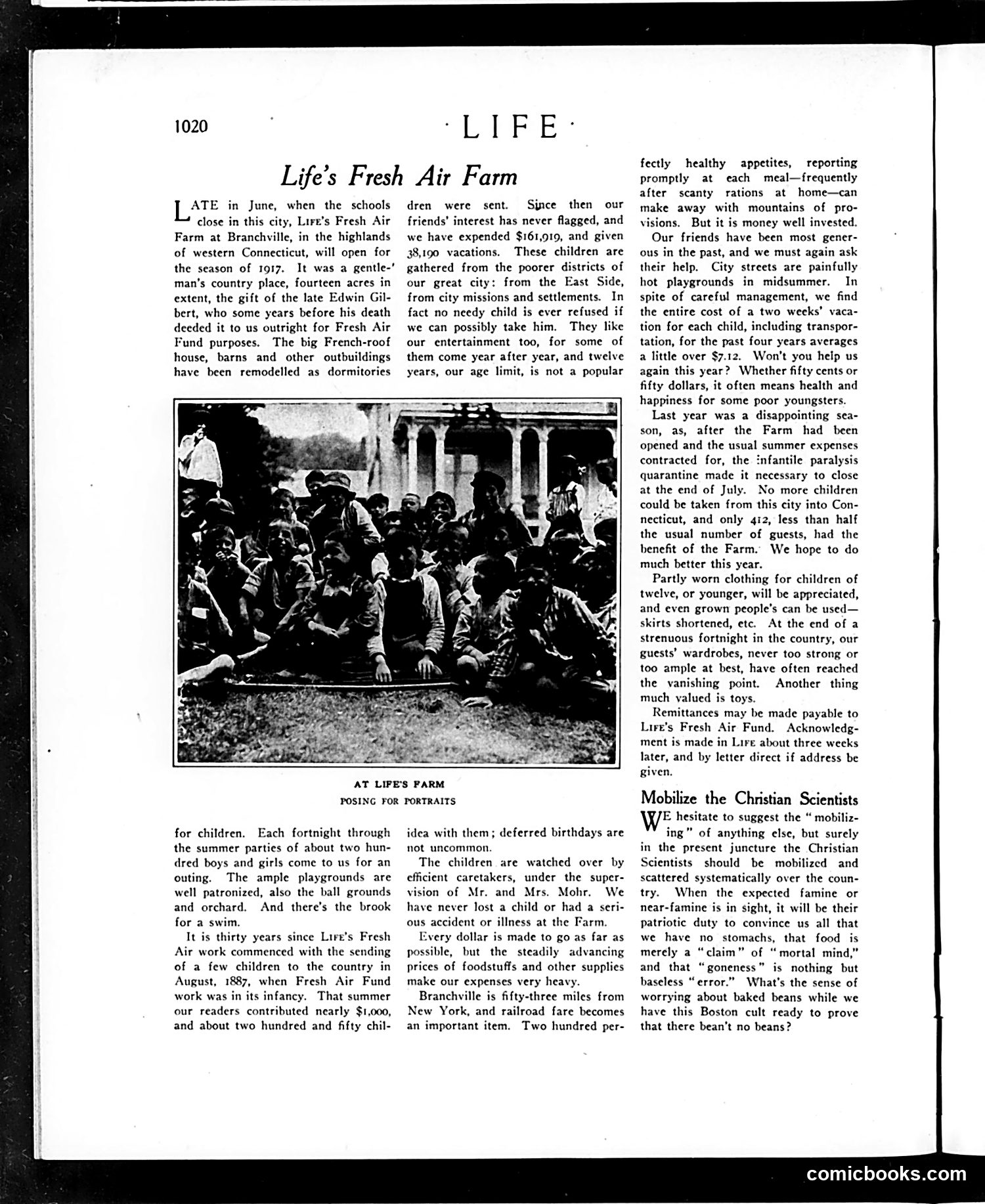
This page contains two distinct articles rather than political cartoons. **"Life's Fresh Air Farm"** describes a charitable children's vacation program in Branchville, Connecticut. The accompanying photograph shows a large group of poor urban children gathered on a porch, illustrating the Farm's mission to provide country experiences for city children from impoverished neighborhoods. The article discusses fundraising ($1,000 contributed that summer in 1889), operational challenges, and solicits donations of clothing and toys for the underprivileged children served. **"Mobilize the Christian Scientists"** is an opinion piece advocating that Christian Scientists use their influence to address social problems like famine and disease, framing it as patriotic duty rather than mere religious practice. Both articles reflect Progressive Era charitable concerns about urban poverty and child welfare.
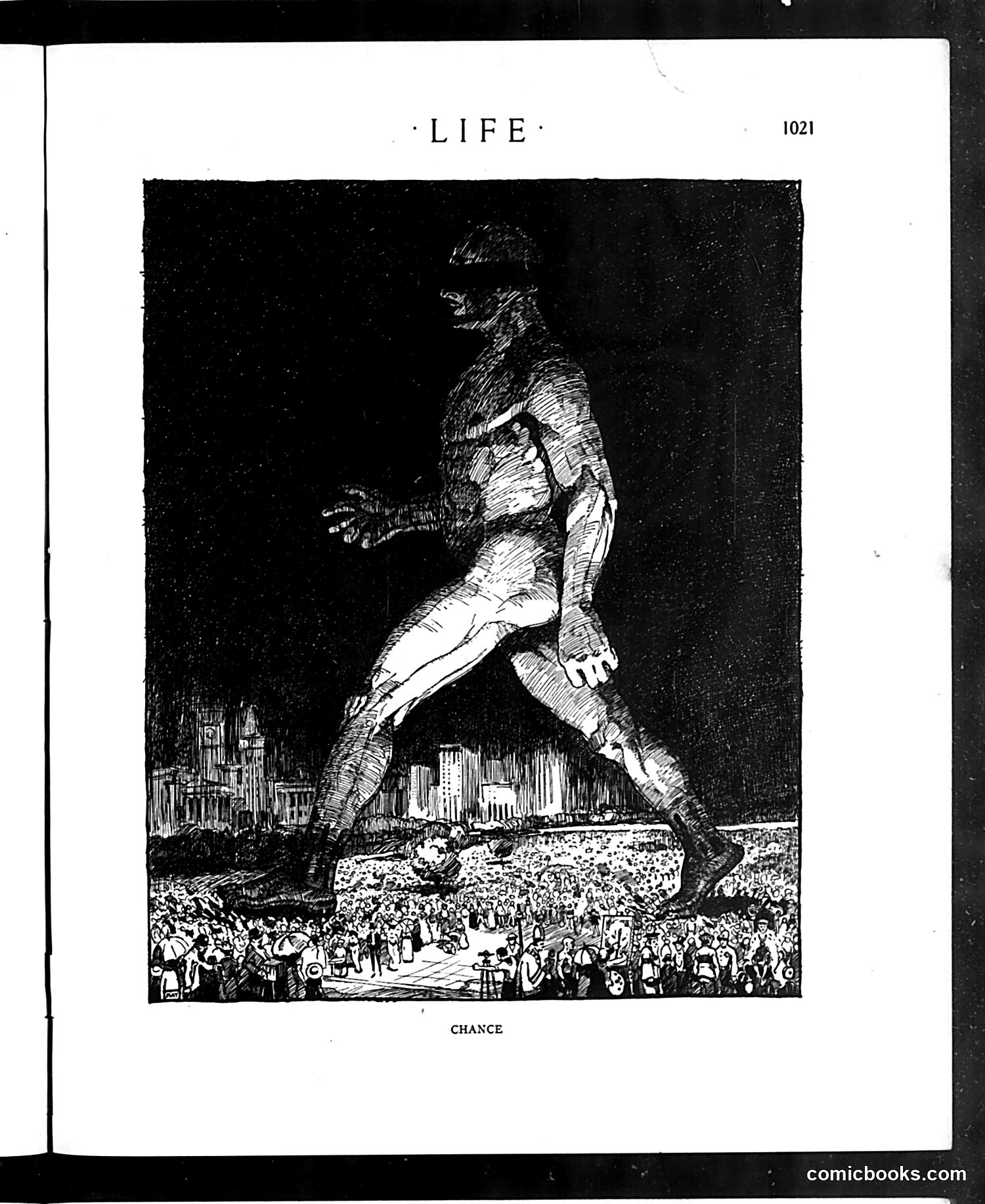
This striking woodcut-style illustration depicts a colossal figure straddling a cityscape, towering over a crowd of tiny people below. The title "CHANCE" suggests the artwork addresses fortune, fate, or randomness in human affairs. The giant represents an abstract, powerful force—likely depicting how chance or fortune operates as an overwhelming, unpredictable power over ordinary people's lives. The crowd's minuscule scale emphasizes human vulnerability to forces beyond individual control. Published in *Life* magazine (page 1021), this appears to be satirical commentary on how chance governs human destiny, particularly relevant to early-to-mid 20th-century anxieties about economic uncertainty, war, or social upheaval. The stark black-and-white technique amplifies the dramatic, ominous tone of the piece.
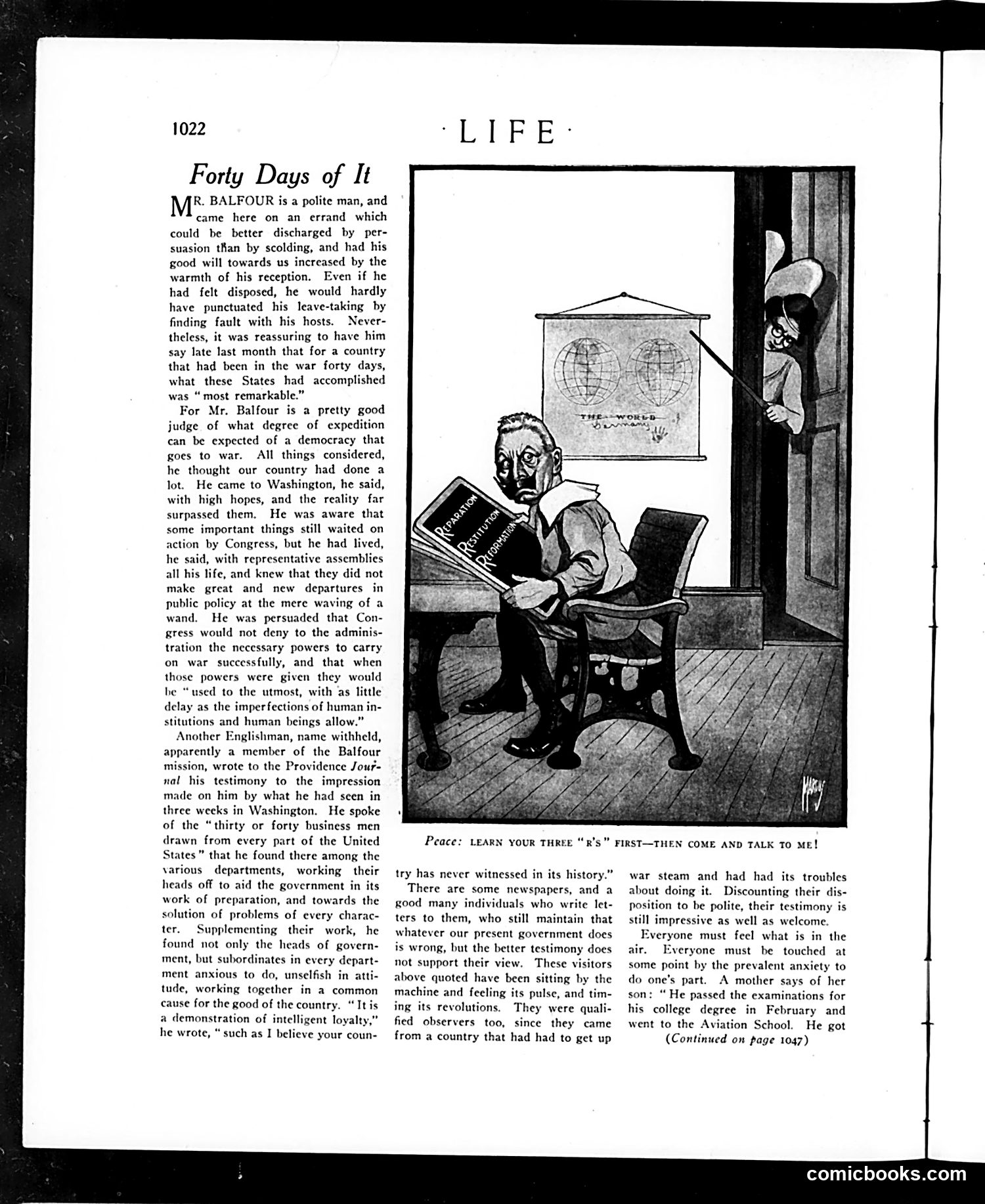
This Life magazine page satirizes diplomatic visits to Washington during WWI. The main illustration shows a man (likely a foreign dignitary) studying a globe while another figure peers in from a doorway—suggesting observation of political intrigue. The accompanying text discusses Mr. Balfour's visit to America, praising efficient wartime mobilization. It mentions various English and American visitors observing Congress and government departments, working toward war preparation. The cartoon's caption reads: "Peace: Learn your three 'R's' first—then come and talk to me!" This appears to mock diplomatic visitors who lack understanding of American readiness, suggesting they should educate themselves before negotiating. The satirical point: American confidence in its war capabilities exceeded foreign observers' assessments of national preparedness.
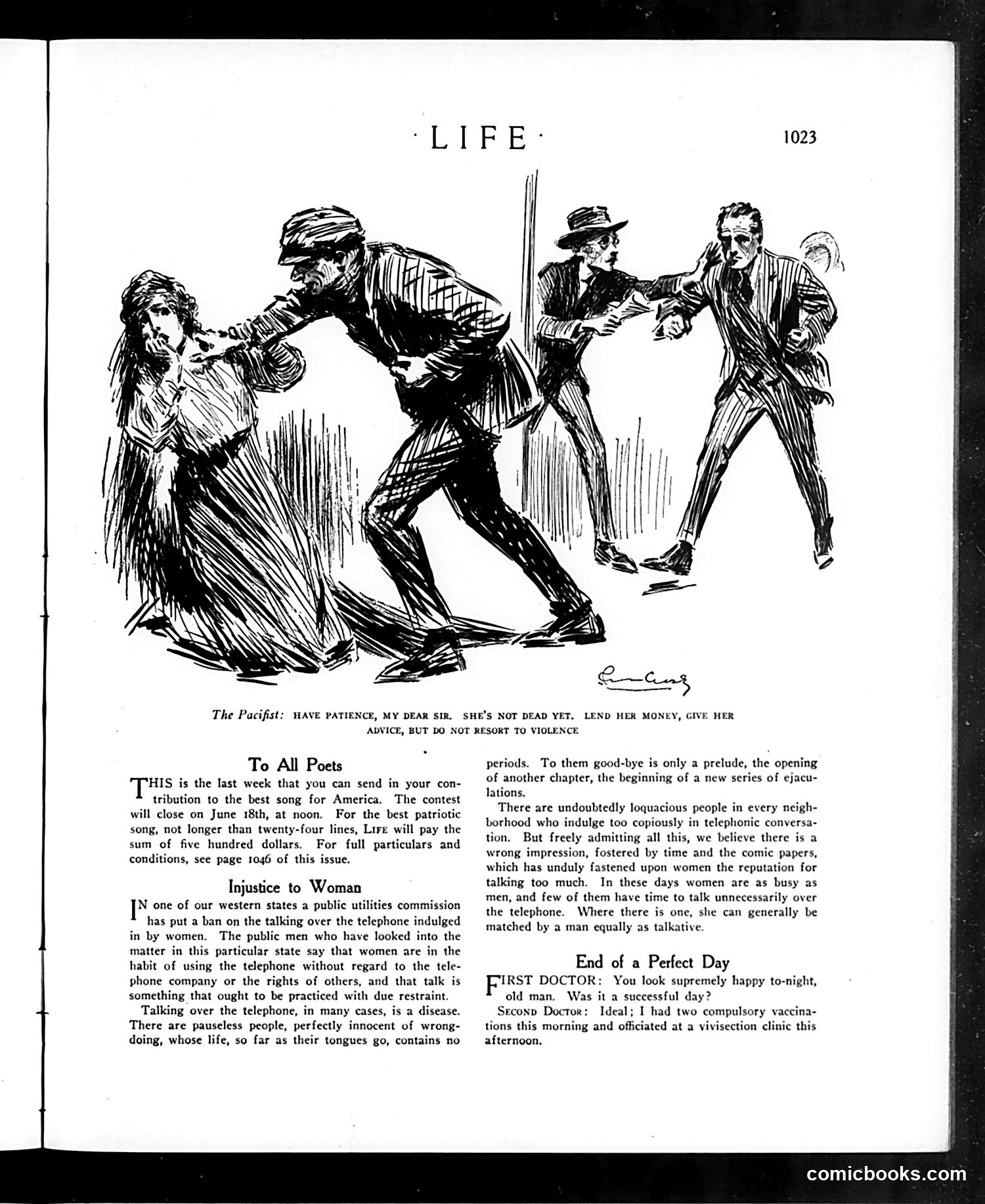
The main cartoon depicts a domestic dispute where a pacifist (labeled "The Pacifist") restrains a woman from violent retaliation, advising "patience" and non-violence instead of resort to force. The men in suits appear to be observers or mediators. The surrounding text critiques excessive telephone use by women. "Injustice to Woman" argues that women monopolize telephones without regard for others' rights, calling it a "disease." The piece suggests women talk too much on the phone compared to men, framing this as a social problem requiring restraint. "End of a Perfect Day" is a humorous exchange between two doctors about their busy day performing vaccinations. The page satirizes early 20th-century gender anxieties—women's increasing independence (phone access, assertiveness) presented as problems requiring male correction or restraint.
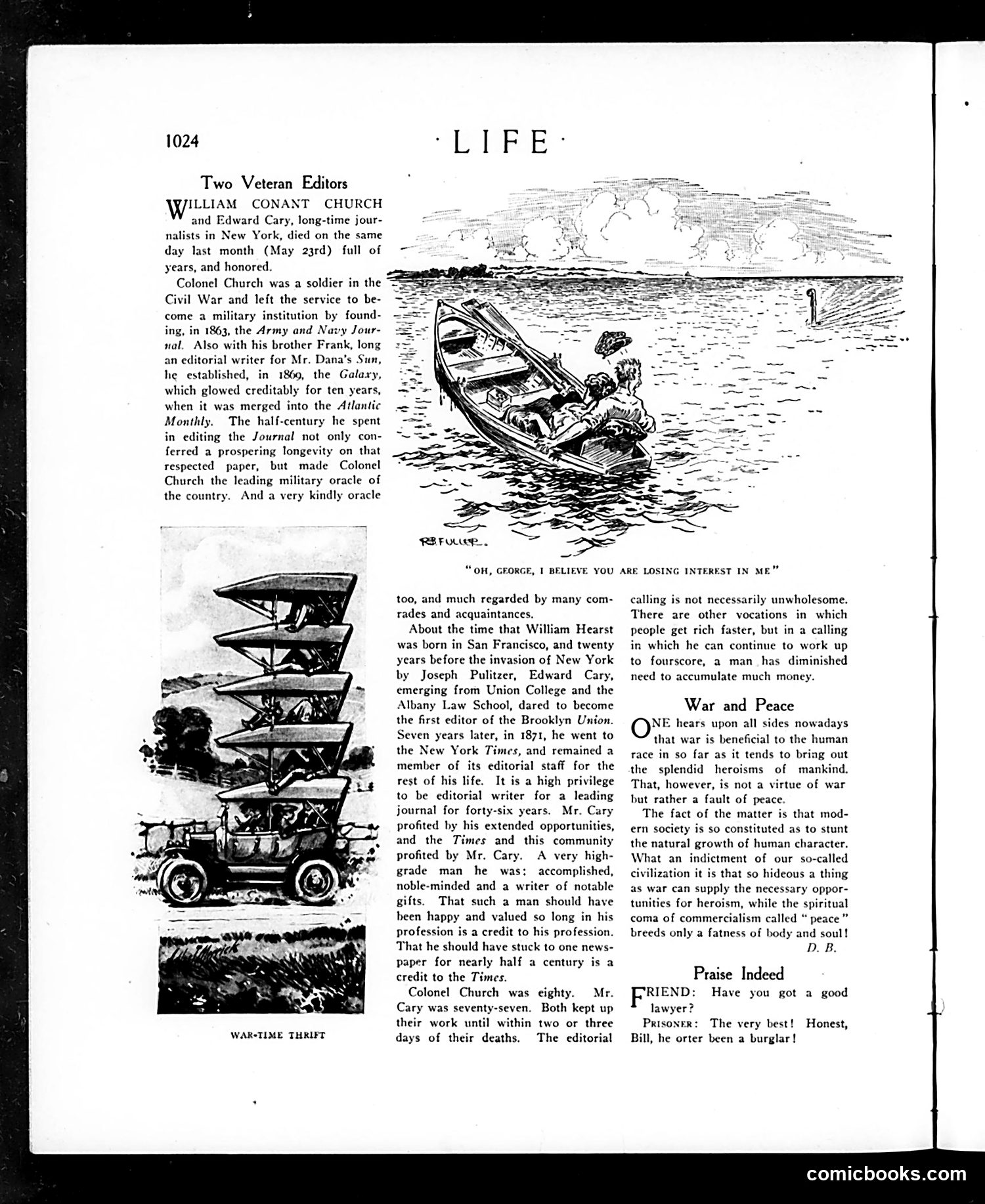
This page commemorates **William Conant Church**, a Civil War veteran and pioneering military journalist who died May 23rd at an advanced age. Church co-founded the *Galaxy* magazine (1860s) and later became the leading editor of the *Army and Navy Journal*, establishing himself as "the leading military oracle of the country." The cartoons appear to be unrelated satirical pieces: one depicting a precarious "War-Time Thrift" stack (suggesting wartime scarcity), and another showing a boat scene titled "Oh, George, I Believe You Are Losing Interest in Me"—likely domestic humor about romance during economic hardship. The page also includes a brief joke about a prisoner claiming an honest burglar makes a better lawyer than his current one—typical period satire about the legal profession.
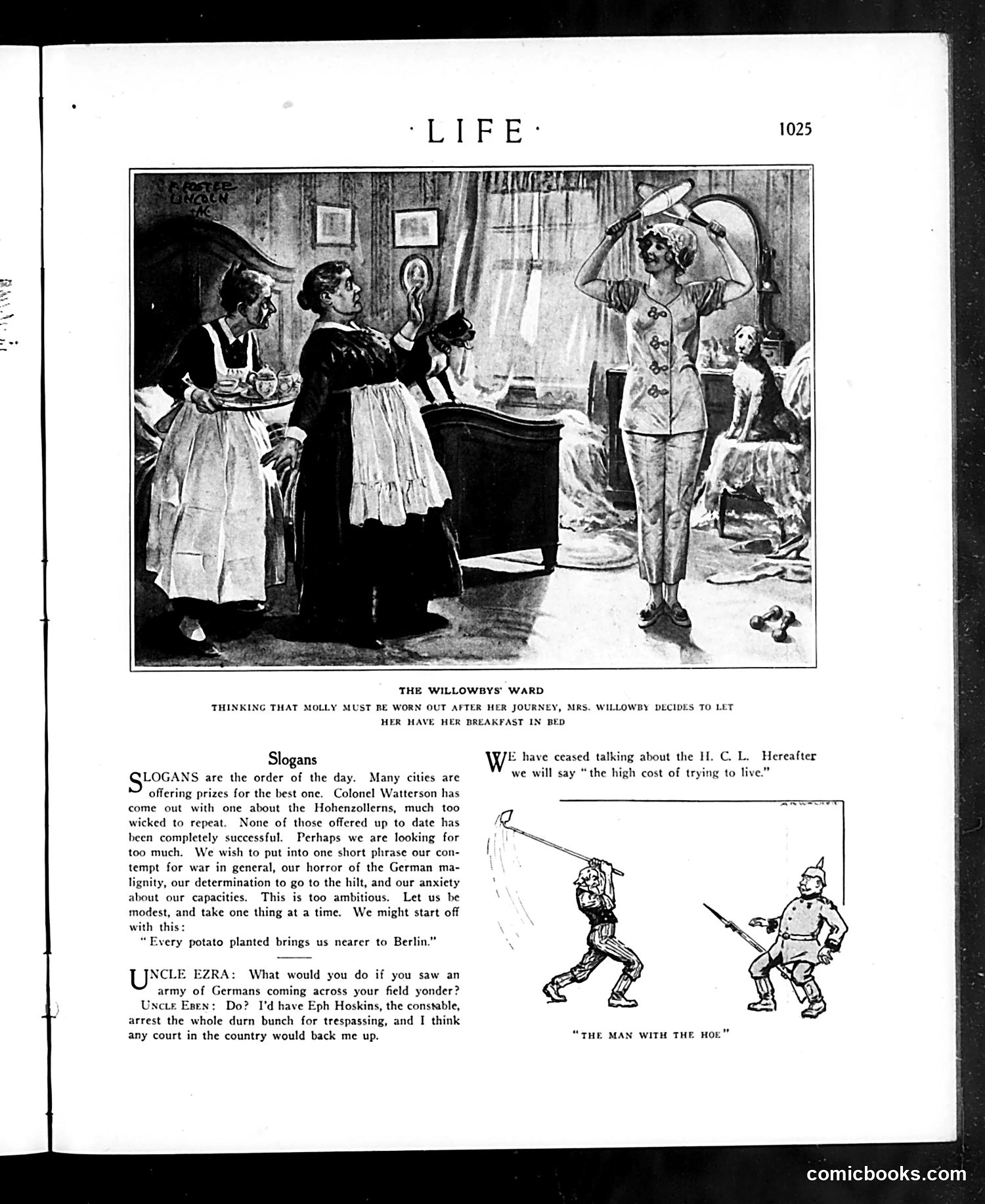
This page contains early 20th-century satirical content. The top illustration, "The Willowbys' Ward," depicts a domestic scene where Mrs. Willowby allows a tired servant ("Molly") to have breakfast in bed after a journey. Below, a "Slogans" section critiques wartime rhetoric. Colonel Watterson apparently proposed slogans for the war effort, but none succeeded. The text advocates modest, practical thinking rather than grandiose war aims. The "Uncle Ezra" dialogue jokes about rural American responses to German invasion—invoking a local constable (Eph Hoskins) to arrest "the whole durn bunch for trespassing." The small cartoon "The Man with the Hoe" shows children playing with a farming tool, likely alluding to Millet's famous painting and rural American life. The overall tone mixes domestic humor with gentle wartime commentary.
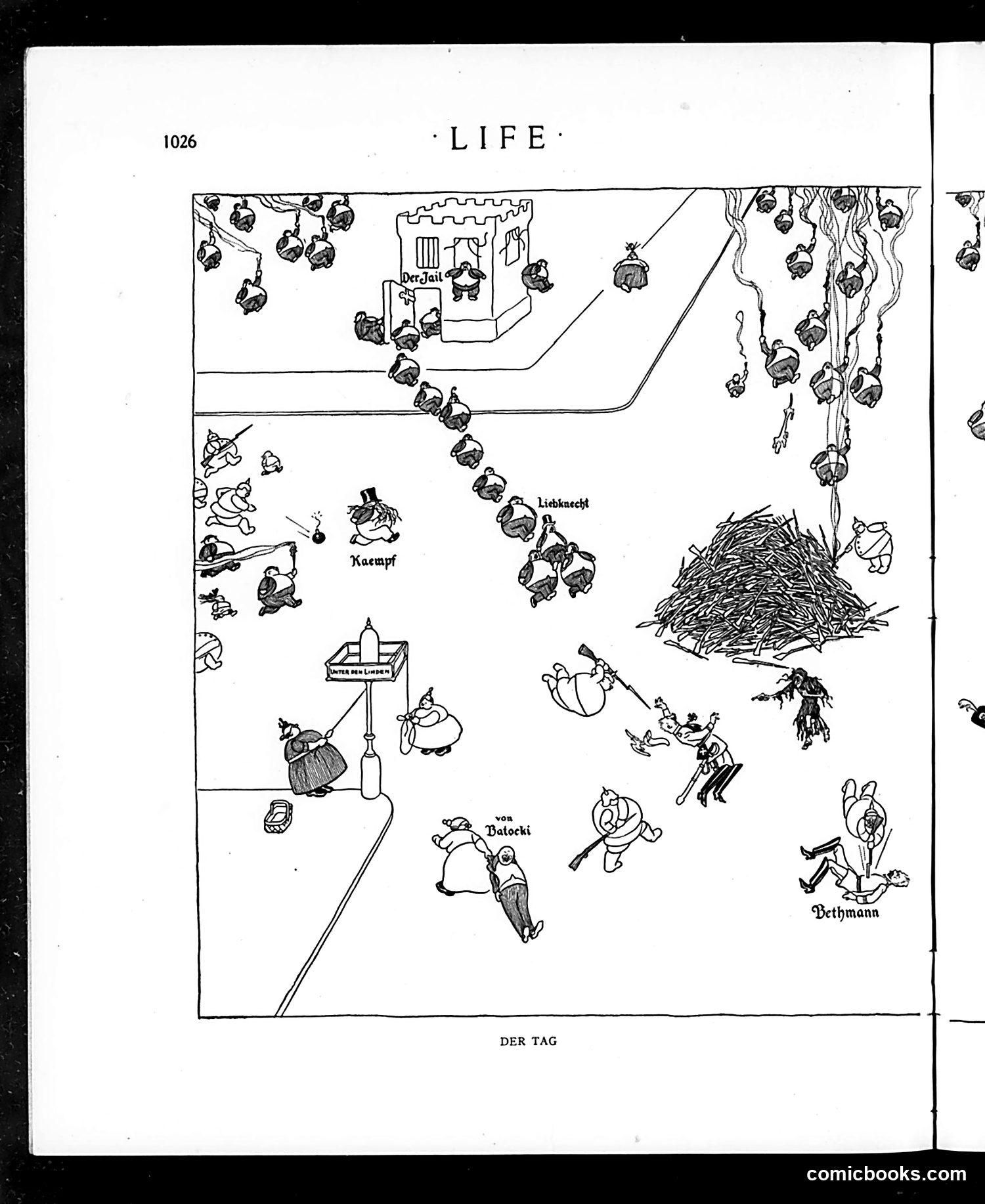
This is a German-language satirical cartoon titled "Der Tag" (The Day), featuring various caricatured figures engaged in activities. The visible labels identify several artists or figures: "Kaempf," "Liebknecht," "von Dalocki," and "Bethmann." The cartoon appears to depict a chaotic scene with multiple characters in exaggerated poses—some falling, jumping, or gesturing dramatically. There's a fortified structure at the top and a large pile or mound on the right side. The overall composition suggests satirical commentary on German political or social turmoil, likely from the early 20th century given the German references and Life magazine's publication period. Without clearer context about the specific historical moment, the precise political commentary remains somewhat unclear, though the chaotic composition suggests mockery of political instability or conflict.
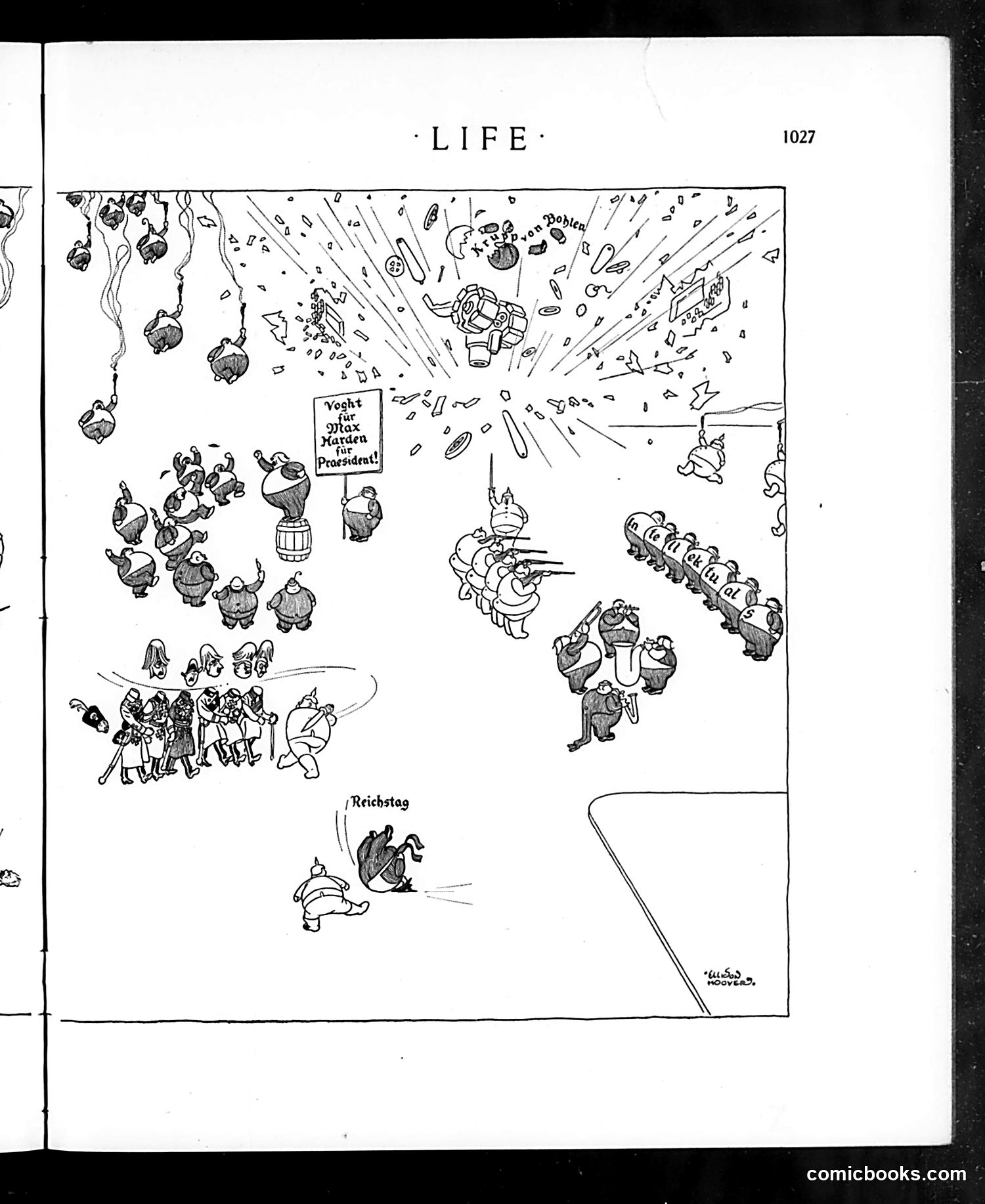
This page from *Life* magazine (page 1027) presents a satirical cartoon by Cesare Mazzoni depicting what appears to be German militarism and rearmament. The central image shows military weaponry and machinery exploding outward in all directions—tanks, cannons, aircraft, and bombs—suggesting aggressive military buildup or proliferation. The sign reading "Yacht + Arlax Garten for President!" appears to be satirizing German political figures or proposals. At the bottom, "Reichstag" is labeled, referencing the German parliament, with a figure riding what looks like a military device. The cartoon's meaning likely critiques German rearmament policies and military expansion in the interwar or early WWII period. The chaotic explosion of weapons symbolizes the danger and destabilization caused by militaristic government policies, presented as absurd and dangerous.
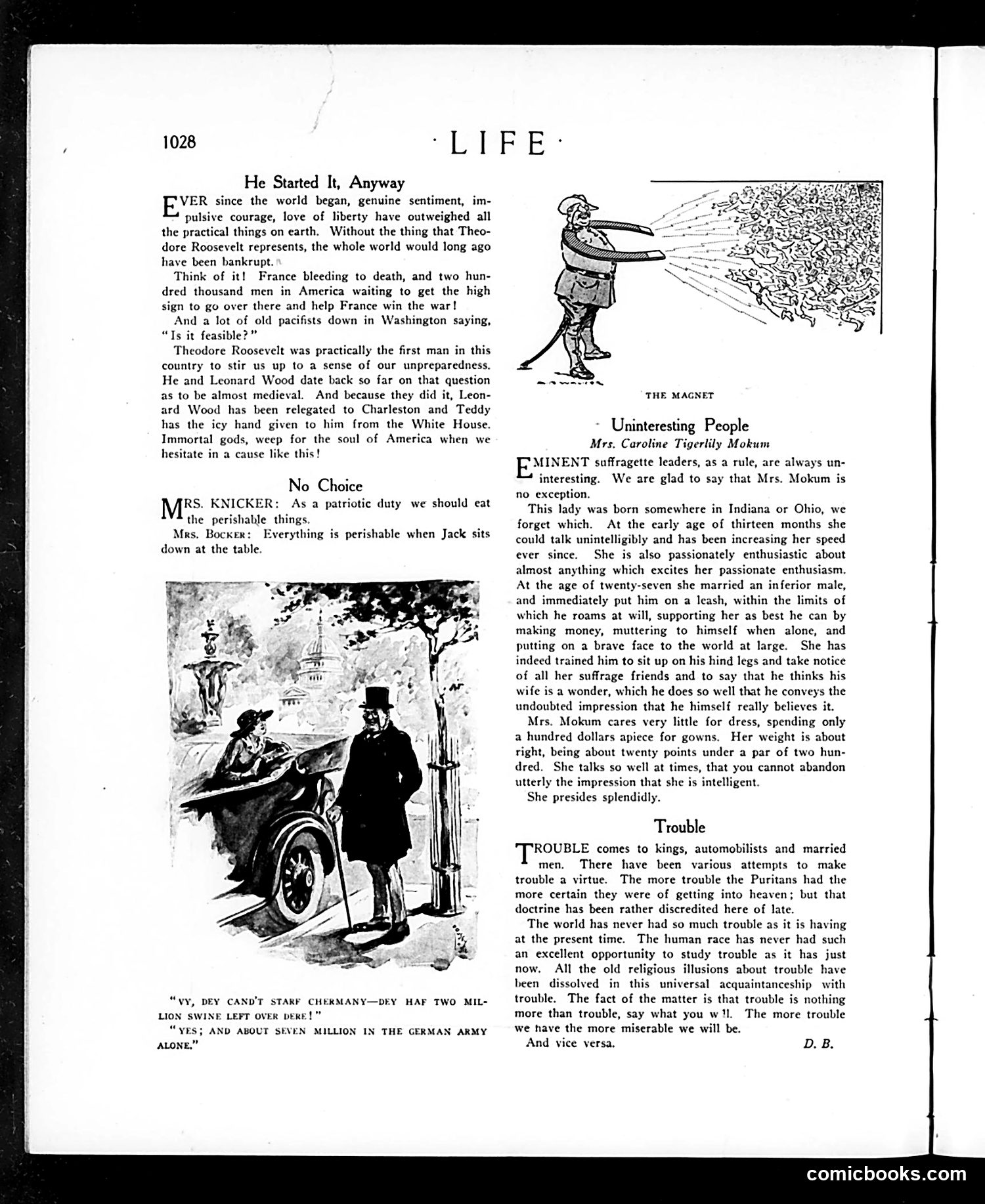
This WWI-era Life page contains three satirical pieces reflecting American debates about entering World War I: **"He Started It, Anyway"** praises Theodore Roosevelt and Leonard Wood for early advocacy of military preparedness, contrasting their activism against pacifists in Washington who questioned involvement. The text criticizes the Wilson administration (implied by "icy hand from the White House") for sidelining these interventionists. **"No Choice"** is a domestic humor piece about a gluttonous husband ("Jack") who consumes all food, with a crude dialect joke about Germany's manpower, likely mocking German soldiers. **"Uninteresting People"** satirizes Mrs. Caroline Mokum, a suffragette leader depicted as verbose, controlling (keeping her husband "on a leash"), and shallow despite her activism. The portrait mocks women's suffrage advocates as self-important and intellectually mediocre. The cartoon illustration shows a couple with an automobile, captioning a German food shortage joke. Overall, the page reflects Life's pro-intervention stance and mockery of both pacifists and progressive activists.
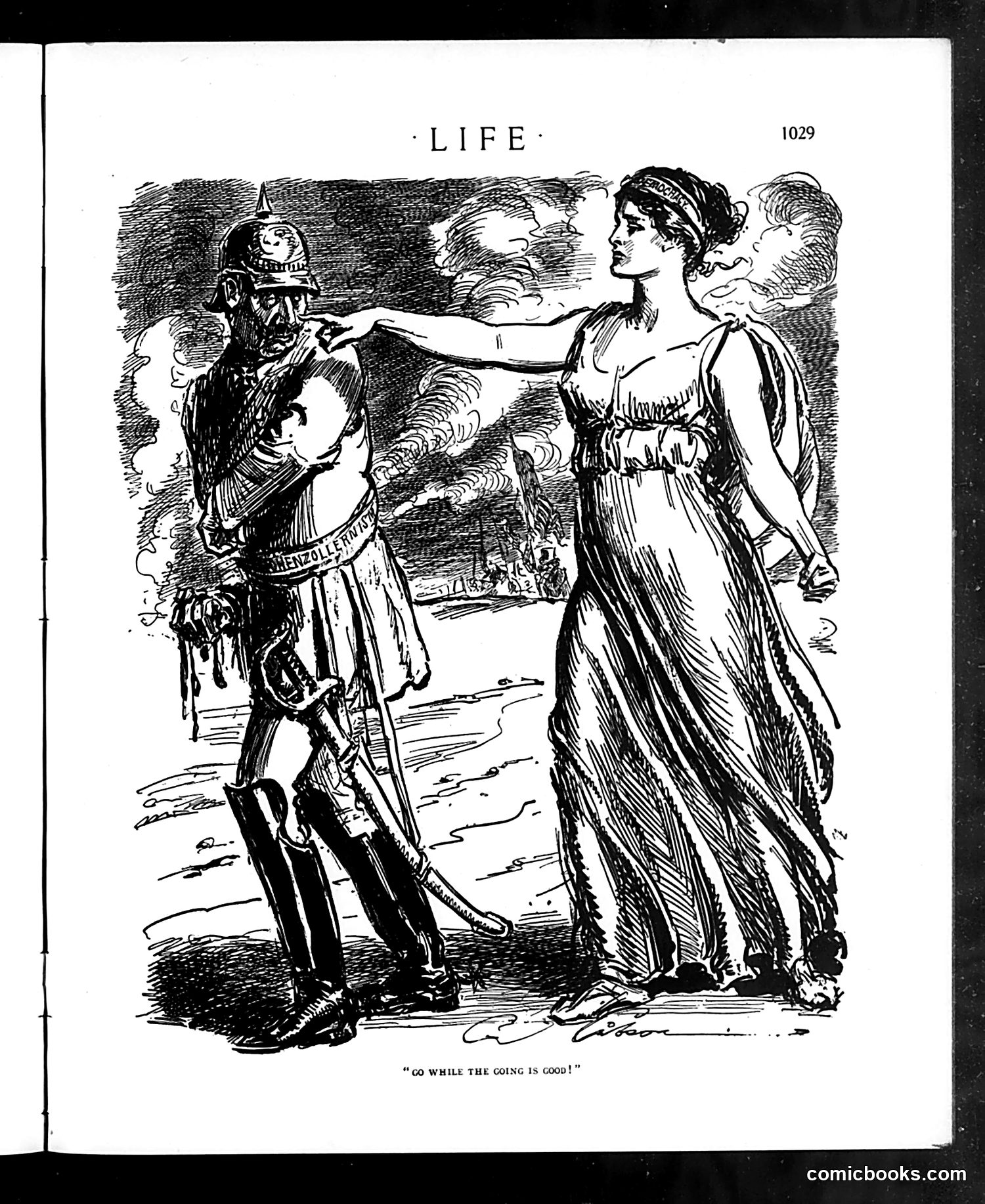
This appears to be a satirical cartoon from Life magazine (page 1029) depicting a military officer in formal dress uniform encountering two women. The caption reads "Go While the Going is Good!" The humor likely plays on romantic or social entanglement—the officer seems caught between or confronted by the women. The phrase "while the going is good" suggests he should leave before complications arise, implying either romantic involvement or social scandal. The style and uniforms suggest early 20th-century context. The cartoon satirizes military or social propriety, possibly commenting on wartime or peacetime social dynamics. However, without additional context about specific historical events or public figures referenced, the precise political or social target remains unclear. The satire appears directed at the intersection of military life and romantic complications.
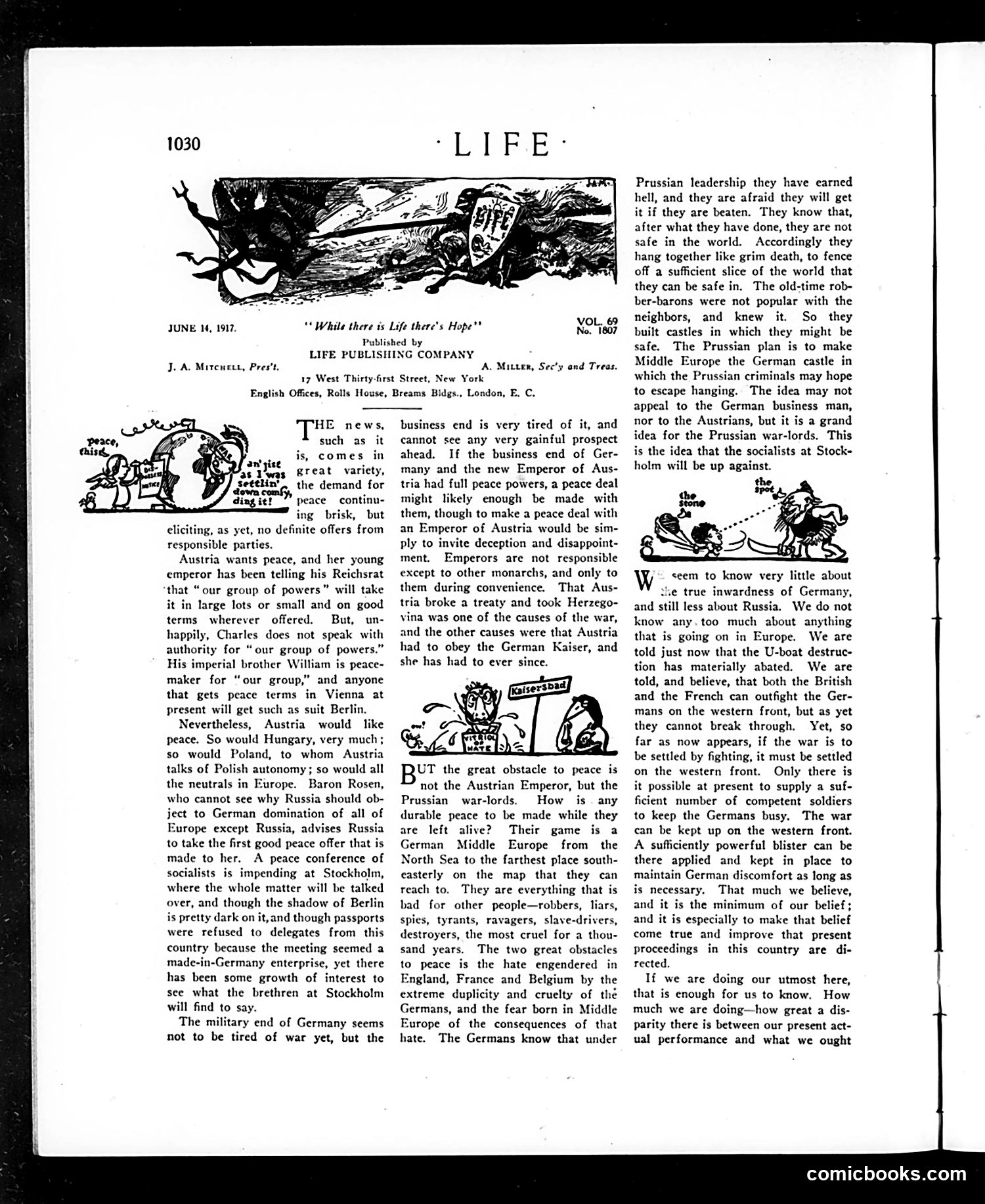
This editorial page satirizes peace negotiations during World War I. The headline's ironic phrase suggests hope persists despite grim reality. **Key targets:** - **Austria's young Emperor Charles** is mocked as powerless—his peace overtures mean nothing because his "imperial brother William" (Germany's Kaiser) actually controls their "group of powers." - **Prussian war-lords** are the real obstacle to peace, depicted as modern robber-barons driven by fear. Having committed atrocities, they know they face justice if defeated, so they cling to power desperately. - **Peace conferences** (like the impending Stockholm socialist gathering) are dismissed as German manipulation attempts. **The satire's point:** Austria wants peace but lacks authority; Germany's military leadership won't allow it because they fear hanging for war crimes. The piece argues lasting peace is impossible while Prussian leadership survives, comparing them to medieval robber-barons building castles for safety—now seeking to dominate all Middle Europe as their fortress. The cartoons (partly illegible here) likely visualize these power dynamics satirically.
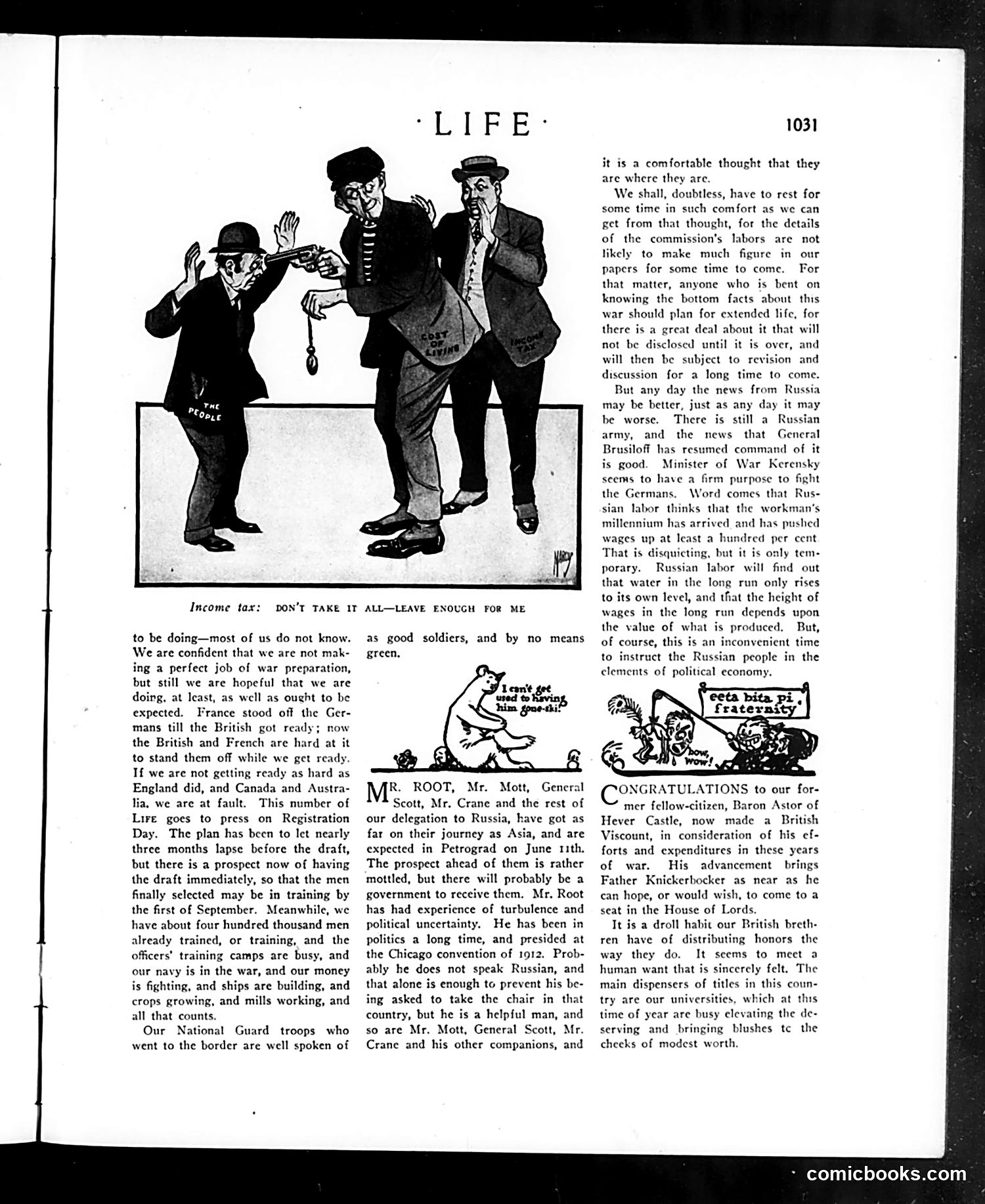
The main cartoon depicts three well-dressed men (likely wealthy businessmen or politicians) confronting a small, working-class figure labeled "The People." One man dangles a pocket watch, suggesting they're extracting wealth. The caption's joke is cynical: the rich are taking income tax but leaving "enough" for ordinary citizens to survive on—implying the burden falls disproportionately on workers. This satirizes **1917 wartime taxation policy**. The U.S. was preparing for potential entry into World War I (the text references "war preparation" and Russian delegation), which required massive revenues. The cartoon mocks how the wealthy and powerful extract taxes while claiming generosity, and how ordinary people bear the financial weight of war preparation. The caricatured figures represent the political/financial establishment making these decisions without genuine consultation of "the people."
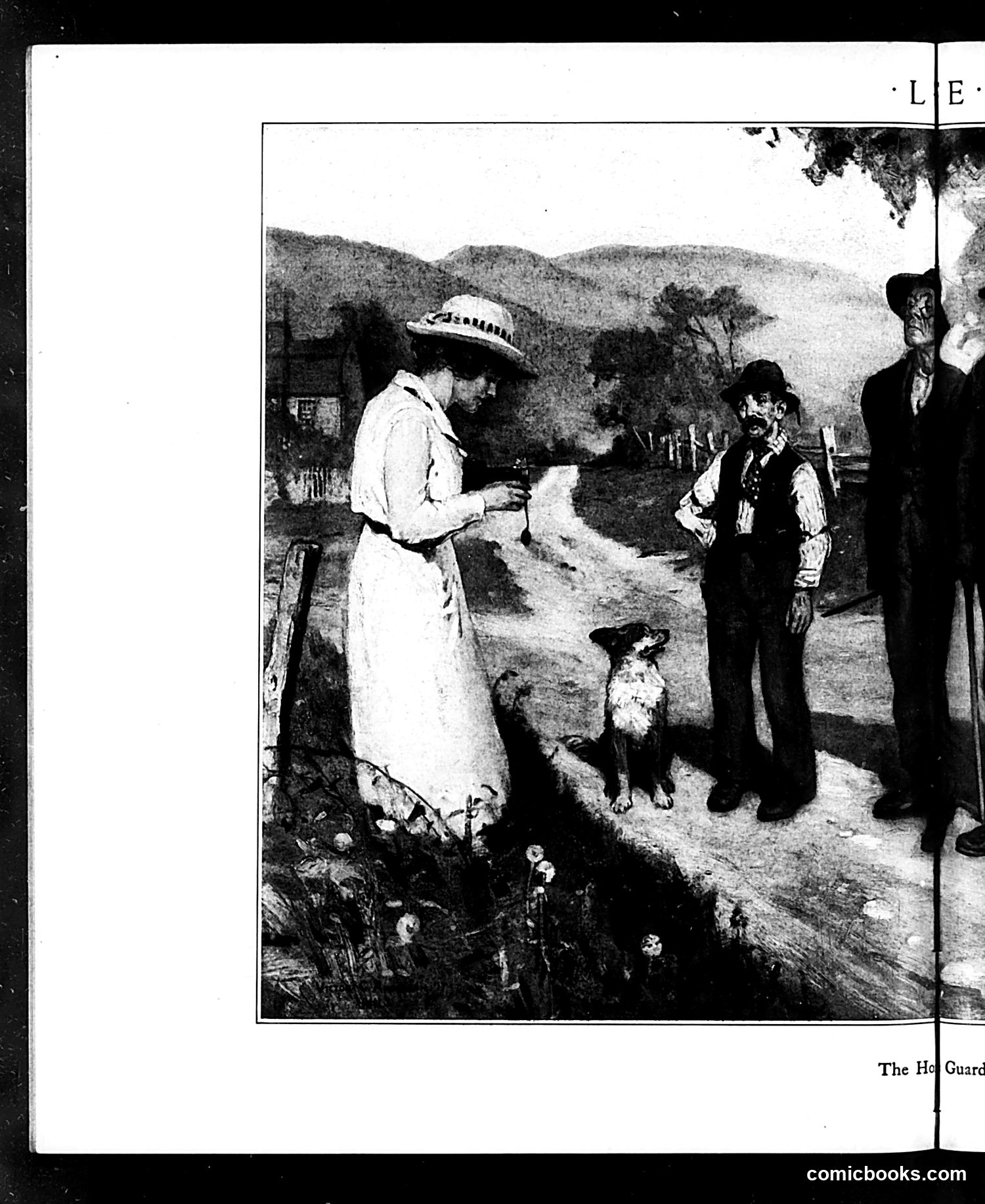
This page appears to be from an early 20th-century *Life* magazine issue. The photograph shows "The Home Guard" (visible in the caption), depicting what appears to be a satirical scene of rural or small-town life. A woman in a long white dress and hat stands examining something (possibly a document or notice), while a small dog sits nearby. Several men in period clothing observe—one in a vest and hat, another in formal attire on the right. Hills and modest buildings are visible in the background. Without clearer OCR text or additional context, the specific satirical point remains unclear. The scene likely comments on rural American life, civic participation, or small-town dynamics of the era, but the exact target of the humor—whether it's about local governance, militia organization, or social pretension—cannot be determined from the image alone.
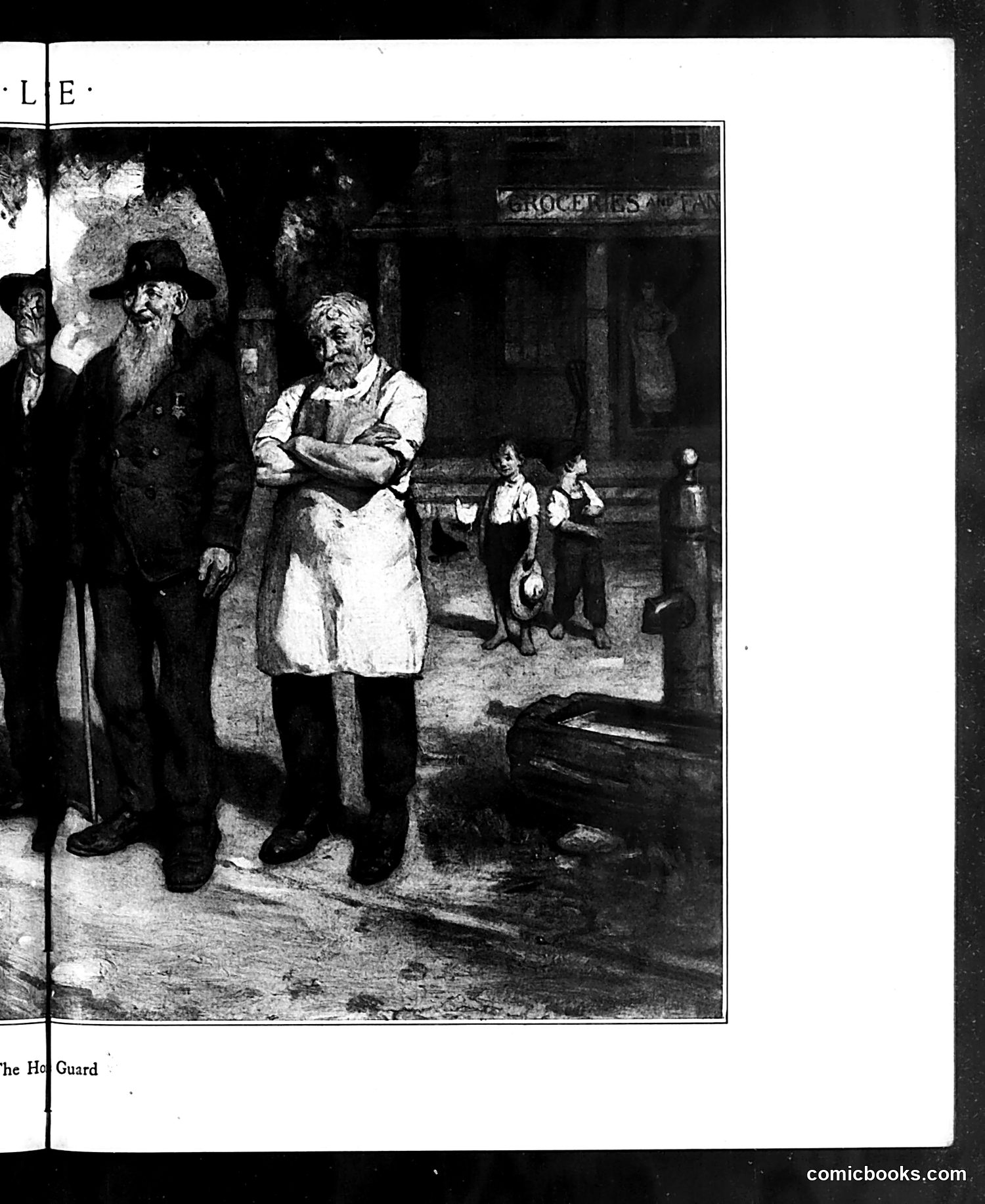
This appears to be a satirical illustration titled "The Holy Guard" depicting a street scene outside what looks like a grocery store (partially visible signage). The central figure is a bearded man in an apron with arms crossed, seemingly a shopkeeper or tradesman. He's surrounded by well-dressed men in coats and hats—likely representing authority figures or officials—and street children or urchins nearby. The satire likely critiques either labor conditions, child welfare, or the relationship between working-class merchants and urban authorities. The "holy guard" title suggests irony—perhaps mocking ineffectual protection of vulnerable populations or the pretense of moral guardianship by those in power while street children remain visible and neglected. The exact historical context remains unclear without additional publication details.
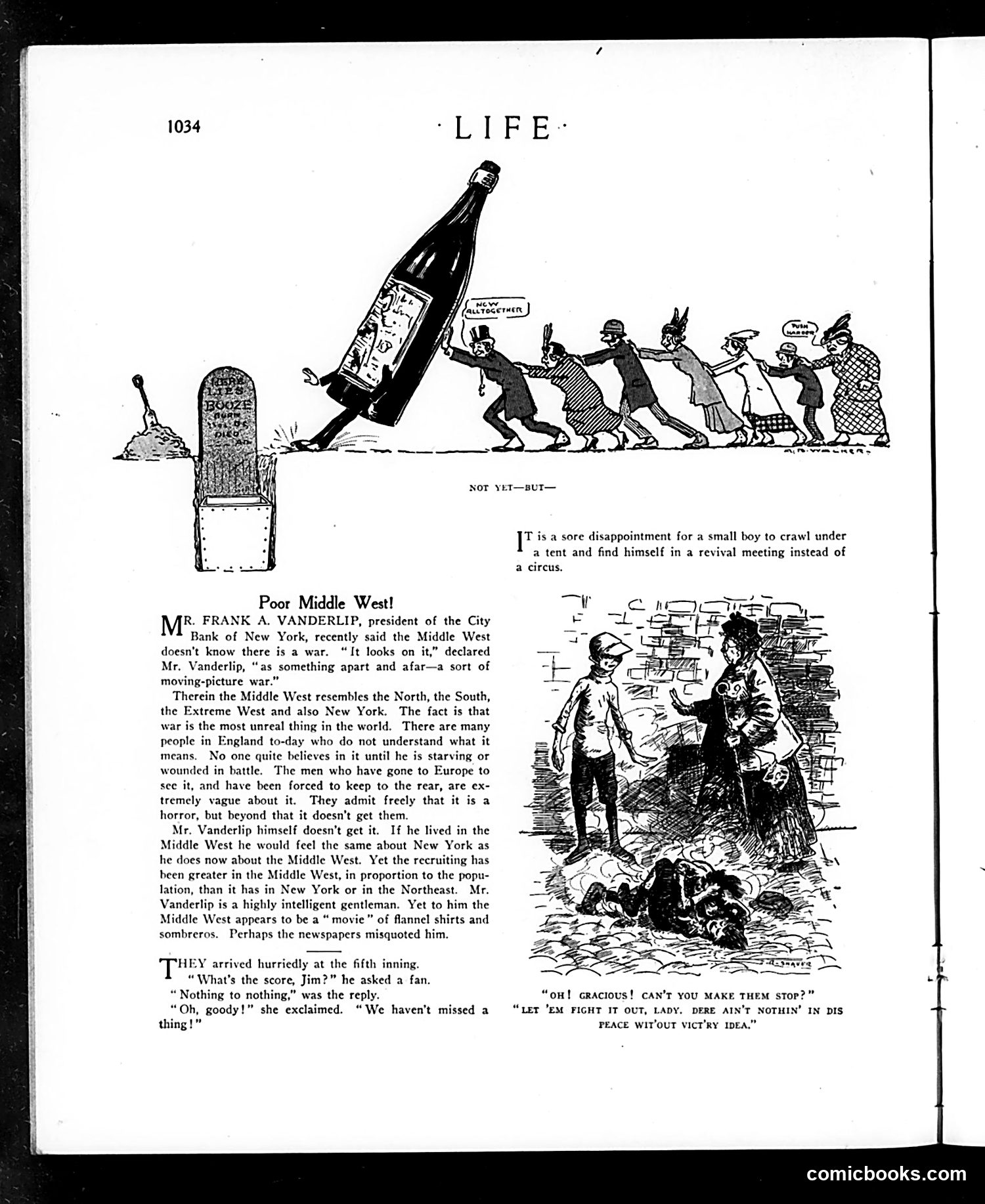
This Life magazine page satirizes American attitudes toward World War I (appears to be 1917-1918, before U.S. entry or early in involvement). **Top cartoon**: A giant champagne bottle tips over a line of people labeled "New Prohibition"—mocking the disconnect between celebrating with alcohol while pushing prohibition policies. **"Poor Middle West" article**: Critiques Frank A. Vanderlip (actual NYC banker) for dismissing the Midwest as viewing war as distant entertainment ("moving-picture war"). The satire inverts his bias: he's equally disconnected from reality. Despite his condescension, Midwest recruitment actually exceeded northeastern rates. **Bottom cartoon**: A woman at a baseball game asks why players can't "stop" fighting at 0-0. A fan replies with working-class dialect that peace without victory is meaningless—a dig at pacifist sentiment and those viewing war as entertainment rather than serious conflict. **Overall point**: Americans, particularly elites, treat the war as abstract spectacle rather than grim reality, whether dismissing distant regions or attending sports games indifferently.
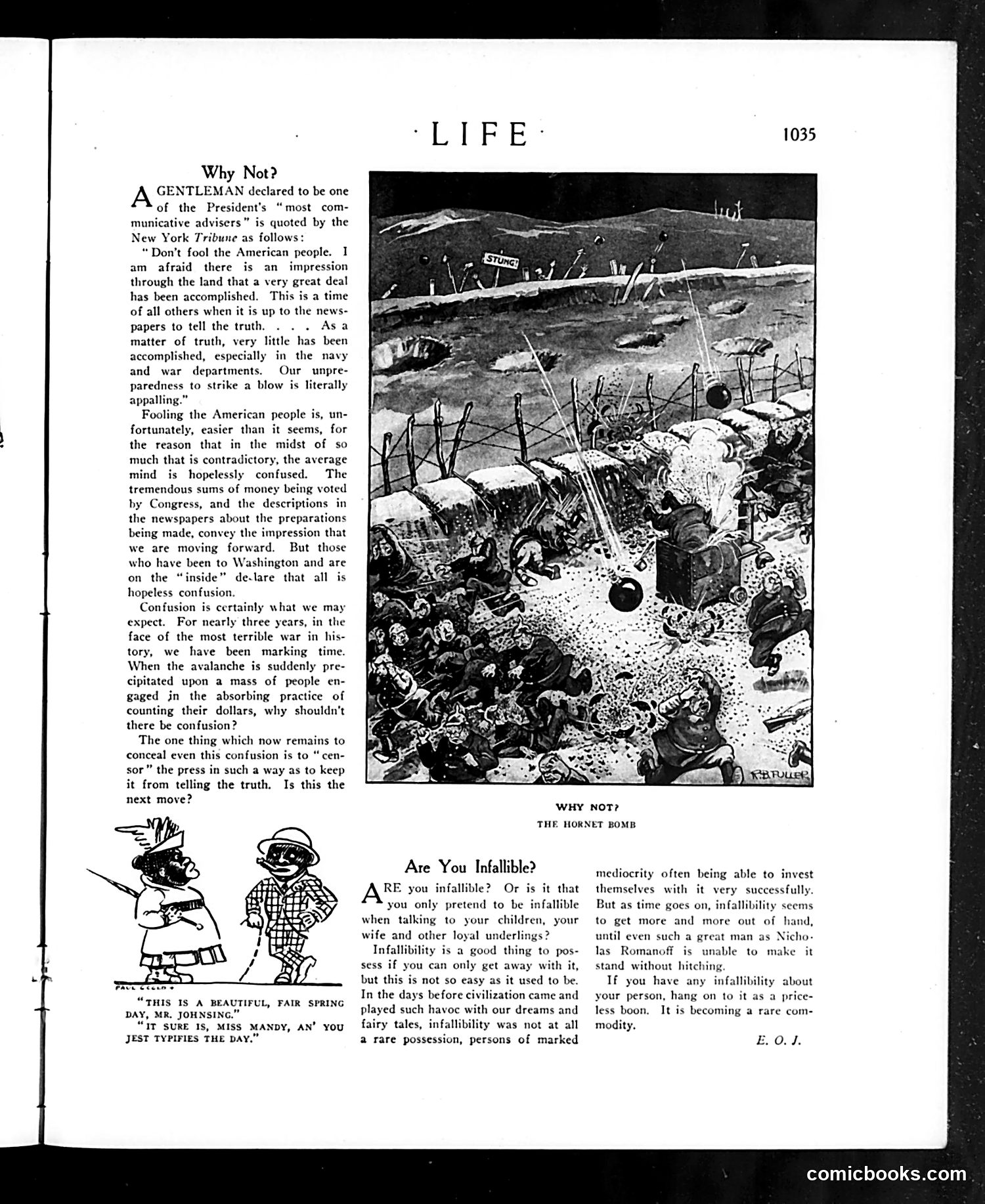
This 1917 *Life* page critiques U.S. military unpreparedness during World War I. The lead article "Why Not?" quotes an unnamed presidential adviser admitting the government has accomplished little in defense preparations, especially in the navy and war departments, despite public perception otherwise. The piece argues Congress votes huge sums while newspapers create false impressions of progress, when in reality confusion reigns. The author warns that censoring the press may be the next step to hide this chaos. The photograph shows the "Hornet Bomb"—likely depicting trench warfare or bomb damage from the European conflict. The secondary piece "Are You Infallible?" is satirical commentary on authority figures (husbands, fathers) claiming infallibility at home while losing credibility publicly—referencing Tsar Nicholas II's failing authority in Russia as an example of collapsed infallibility. The cartoon at bottom is a racist dialect joke between stereotyped Black characters, typical of the era's unfortunately common caricatures in mainstream publications.
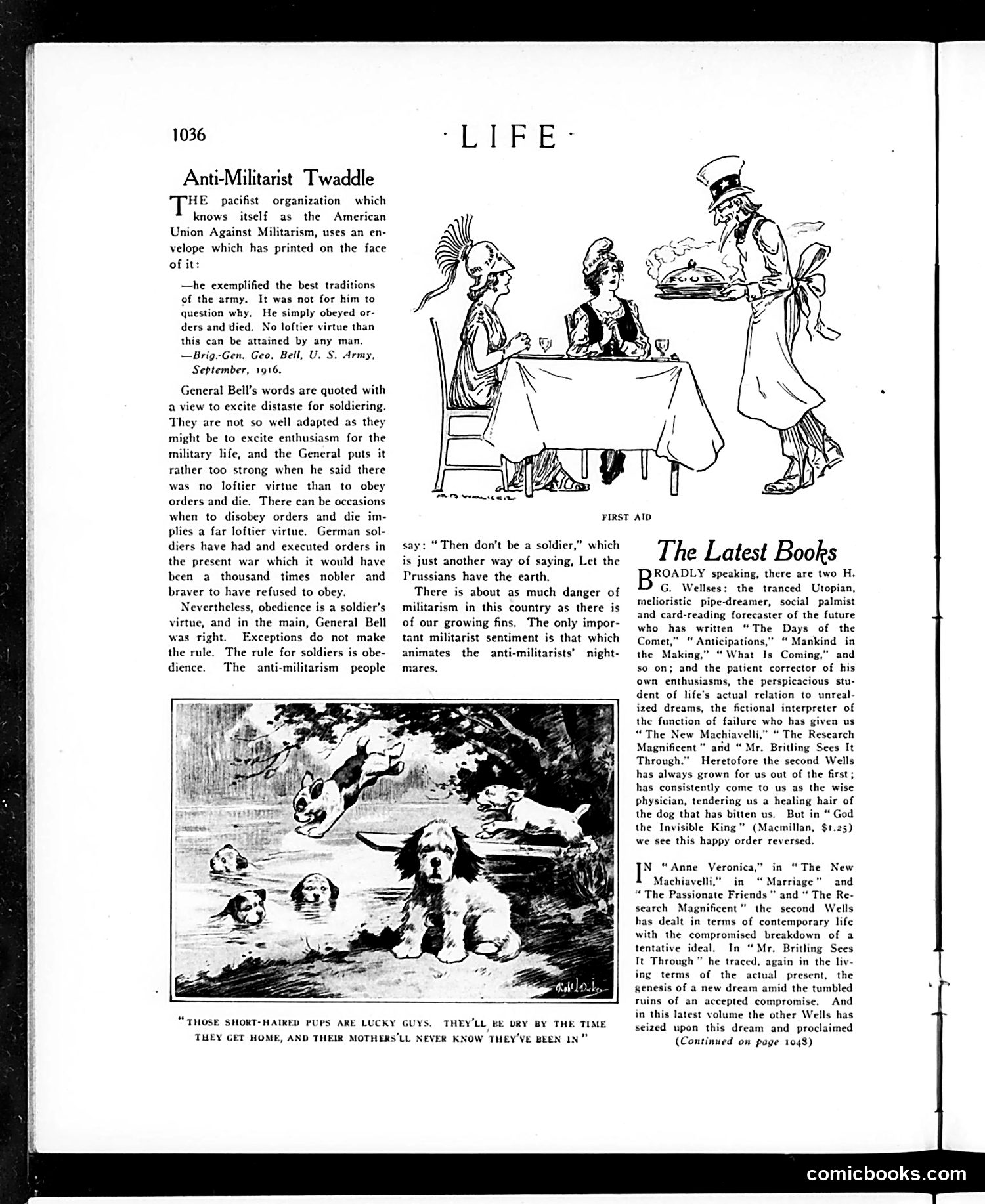
This page attacks American pacifists—specifically the American Union Against Militarism—for discouraging military service. The article quotes Brigadier General George Bell's statement that soldiers should obey orders without question, then uses it against pacifists' recruitment messaging. **The satire's argument:** Pacifists circulate Bell's quote to discourage enlistment by framing obedience as mindless. Life's writer counters that while obedience is indeed a soldier's virtue, pacifists are naive—claiming there's no real militarism threat in America (comparing it to "growing fins"). The writer suggests pacifists essentially invite Prussian domination by discouraging enlistment during World War I. **The cartoon below** depicts puppies swimming, with the caption joking their mothers won't know they got wet—likely mocking pacifists as naive "pups" who underestimate the consequences of unpreparedness for war. The piece reflects 1916 pro-war sentiment against American isolationists/pacifists.
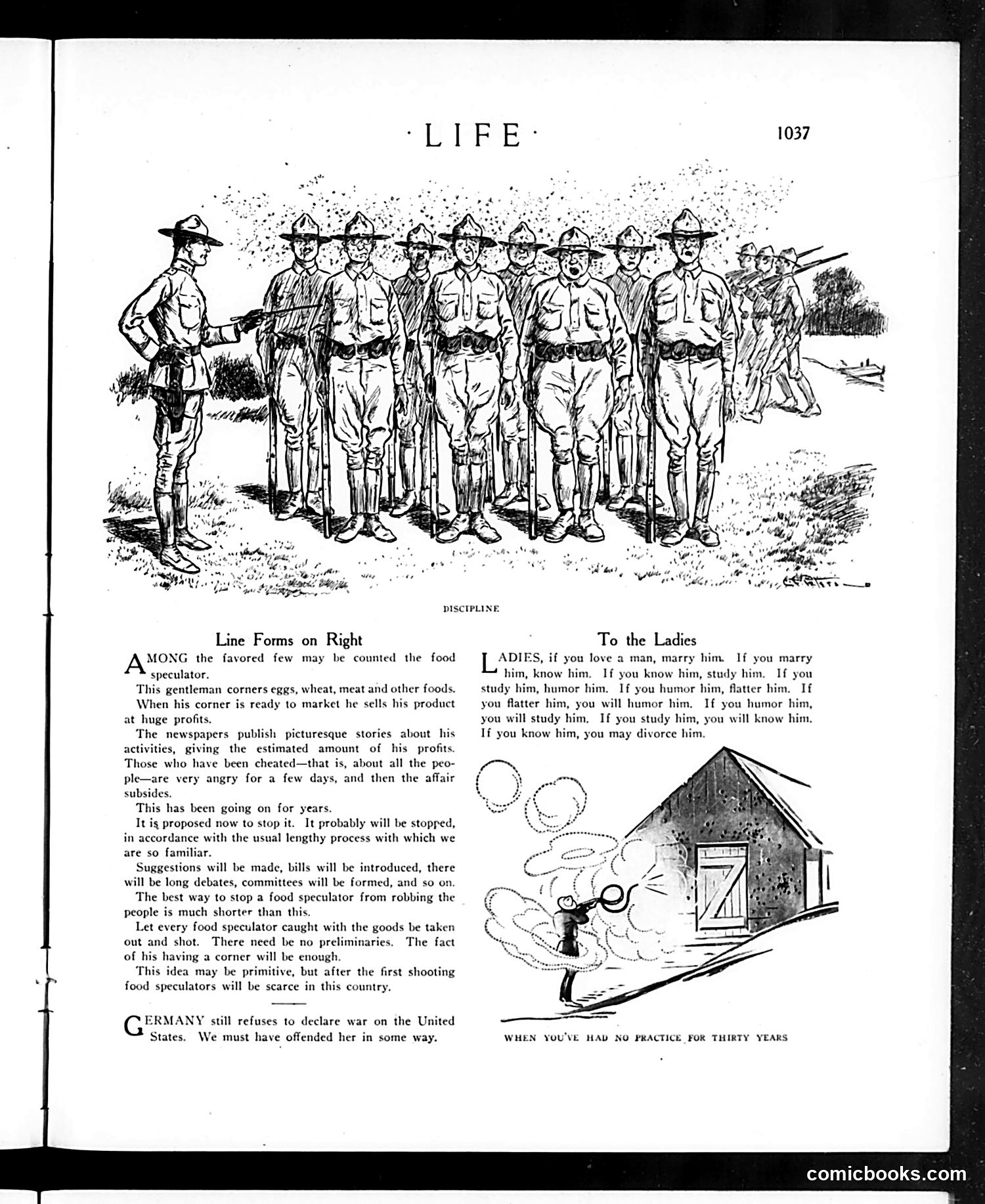
**Top Illustration ("Discipline"):** Shows military recruits in formation being inspected by a sergeant—standard military discipline imagery. **Main Article:** This is serious satire about **food speculators** during what appears to be WWI-era food shortages. The piece argues that profiteers who corner markets on eggs, wheat, and meat exploit the public, generate brief outrage, then face no real consequences. The author sarcastically proposes the "best way" to stop them: execute speculators caught hoarding. The satire's dark humor lies in advocating summary execution as more efficient than the government's slow legislative process. **"To the Ladies" Cartoon:** Appears to be unrelated domestic humor about marriage, using circular logic to suggest wives should ultimately divorce their husbands—mocking both marriage advice columns and gender relations of the era. **Germany Reference:** A brief editorial quip about Germany not declaring war on the US, likely from the pre-1917 period. The page mixes wartime economic frustration with lighthearted domestic humor.
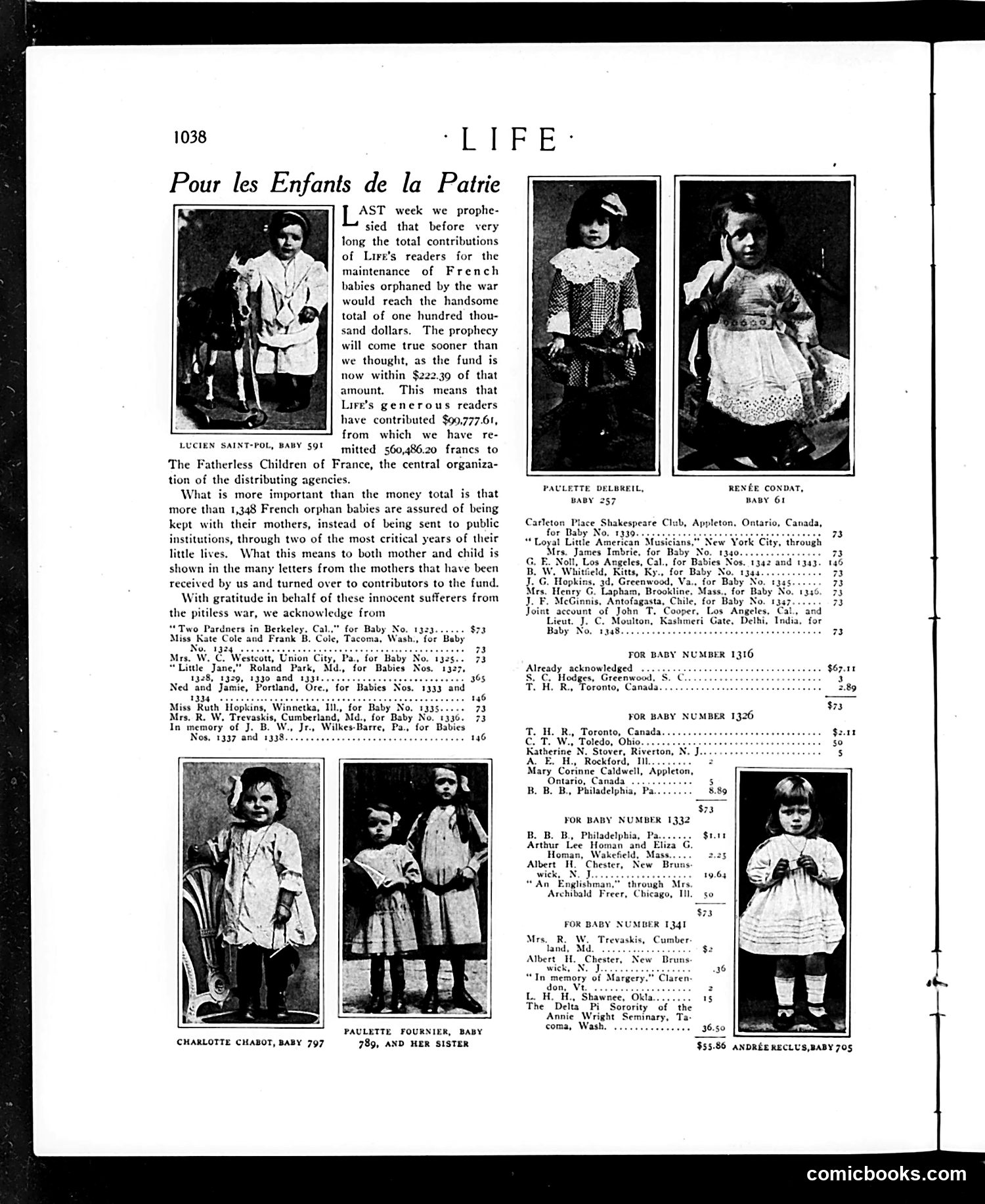
This is not a cartoon but a fundraising appeal from *Life* magazine documenting donations to support French orphans during World War I. The page celebrates that readers have nearly reached a $100,000 goal to maintain over 1,348 French war orphans with their mothers rather than in institutions. The photographs show beneficiary children (identified by name and number) whose care is being funded through reader contributions. The detailed donor listings acknowledge individual and group contributors—many identified only by pseudonym ("Two Pardners in Berkeley") or location—who adopted specific babies financially. The appeal emphasizes the humanitarian impact: keeping mothers and children together "through two of the most critical years of their little lives." This reflects American wartime charitable mobilization and the specific vulnerability of French civilian populations affected by WWI.
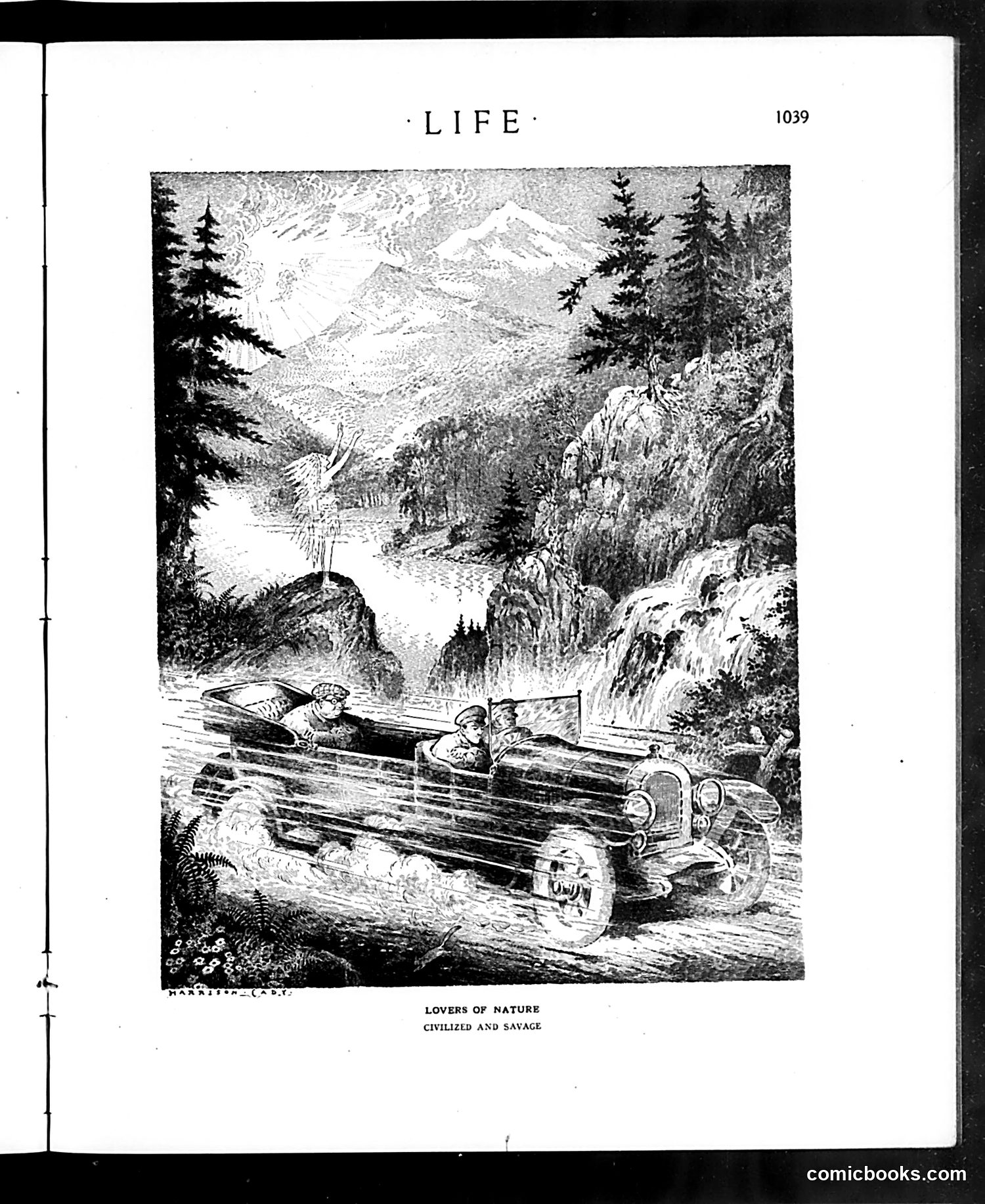
This satirical cartoon contrasts two approaches to nature appreciation. On the left, a person in a small boat peacefully enjoys a mountain lake landscape. On the right, another figure operates what appears to be an early automobile or motorized vehicle, seemingly disrupting the same natural environment with noise and mechanical intrusion. The caption's juxtaposition—"Civilized and Savage"—suggests ironic commentary: the "civilized" person with modern machinery is actually behaving savagely toward nature, while the simple boatman represents a more refined, respectful engagement with the natural world. This likely critiques early 20th-century industrial society's destructive relationship with wilderness, a concern growing during that era of rapid technological expansion.
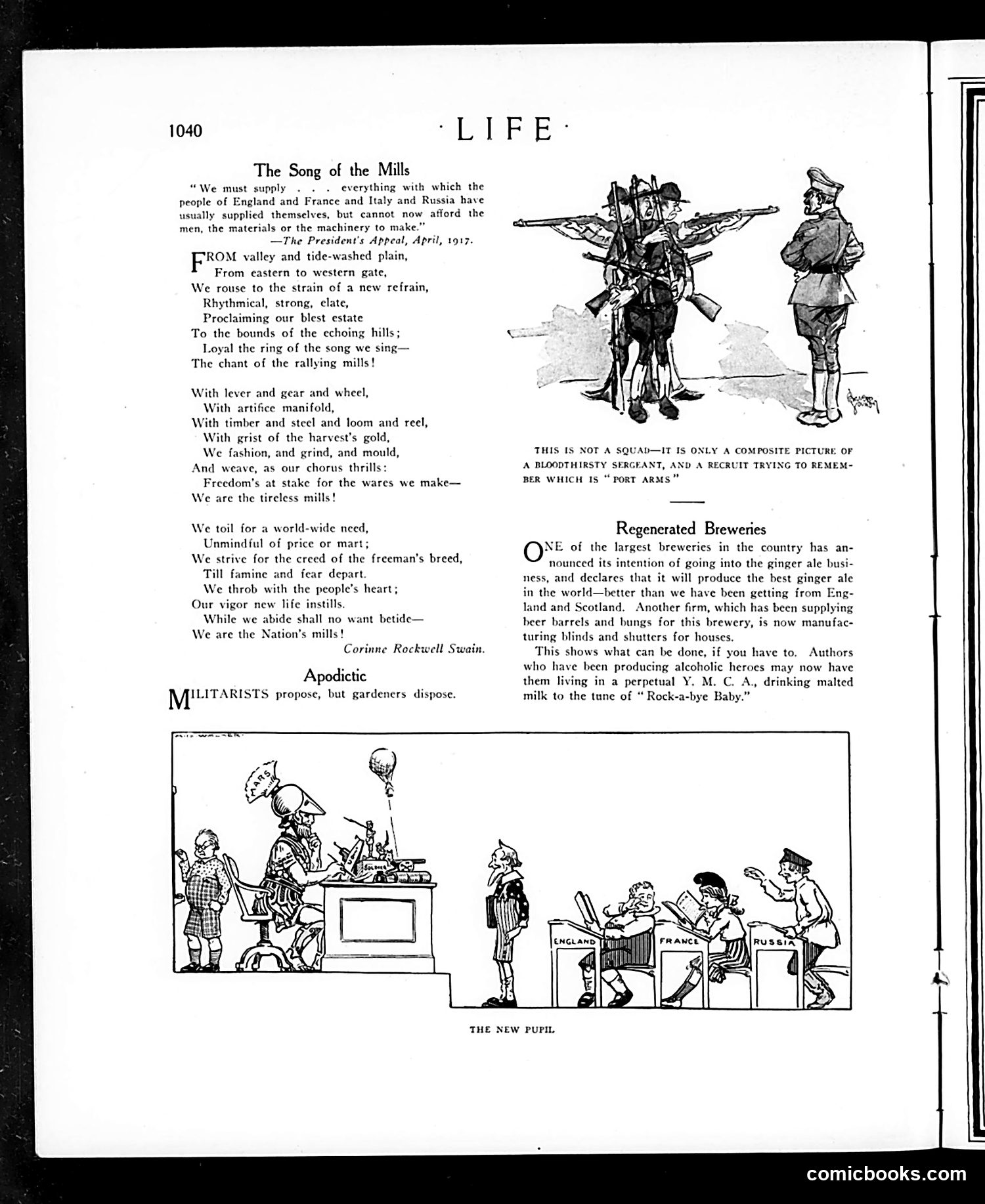
This Life magazine page from 1917 contains WWI-era American propaganda and satire: **"The Song of the Mills"** is a patriotic poem celebrating American industrial production to supply the Allies (England, France, Italy, Russia) who lack manufacturing capacity during wartime. It frames factories as patriotic institutions fighting for freedom. **"The New Pupil"** cartoon satirizes military discipline: a stern drill sergeant instructs young recruits representing Allied nations (labeled England, France, Russia), depicting them as schoolchildren learning from American military expertise. **"Regenerated Breweries"** mocks Prohibition sentiment by celebrating breweries converting to non-alcoholic products (ginger ale, shutters) instead of beer. It sarcastically suggests authors must now write sober characters drinking malted milk rather than alcohol—reflecting America's shifting moral values during wartime. The page overall promotes American industrial might and moral superiority while the nation mobilized for war.
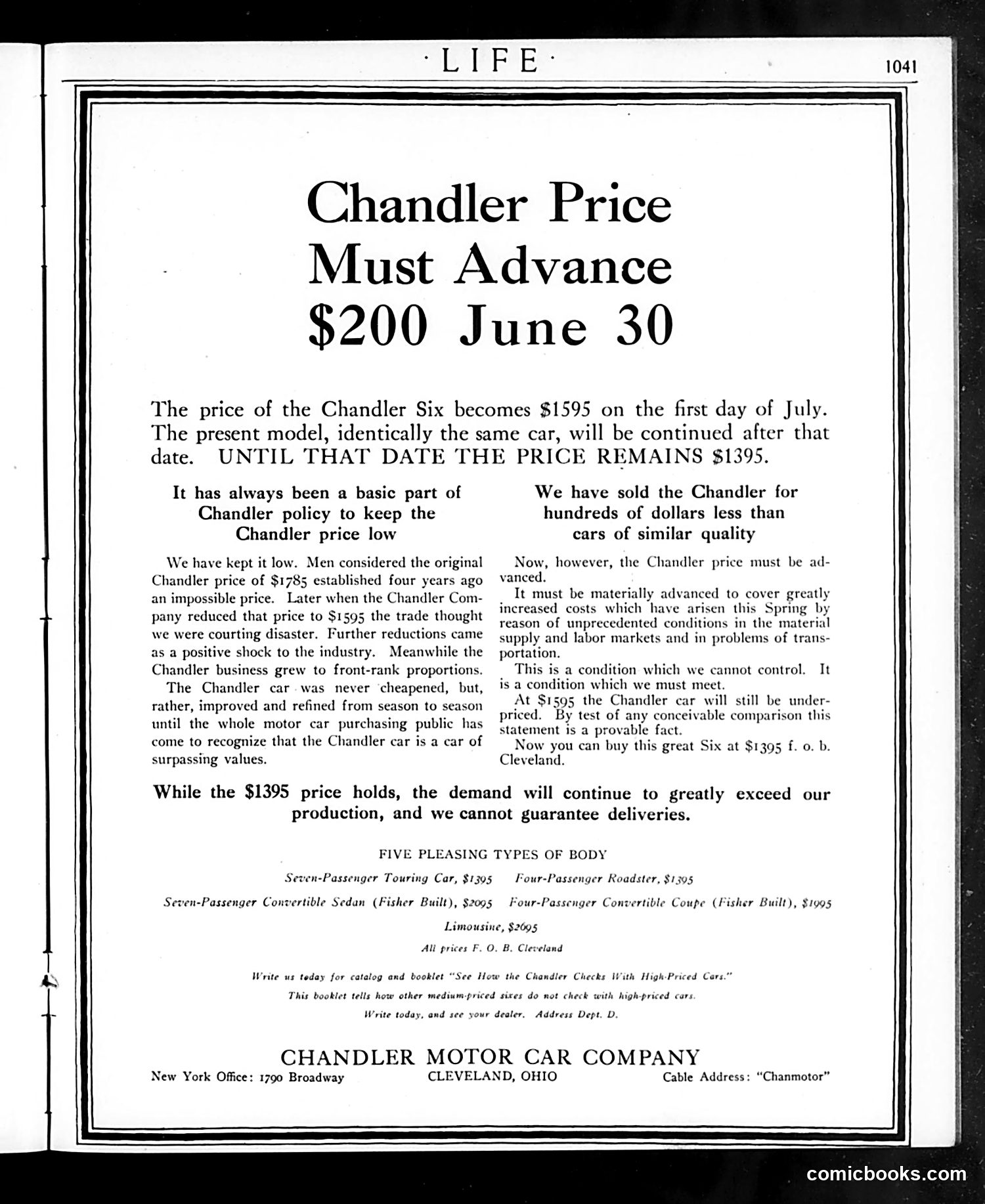
This is a full-page automobile advertisement, not a political cartoon. The Chandler Motor Car Company announces a price increase of $200, effective July 1st, raising the base model from $1395 to $1595. The ad attempts to frame this increase positively, claiming the company has historically kept prices low while improving quality. It attributes the price rise to uncontrollable external factors: increased material costs, labor market conditions, and transportation problems—likely referencing post-World War I economic inflation and supply chain disruptions. The company emphasizes that even at the higher price, Chandlers remain underpriced compared to similar-quality vehicles, and urges readers to purchase before the deadline to lock in the lower price. The ad lists five body styles available at various price points.
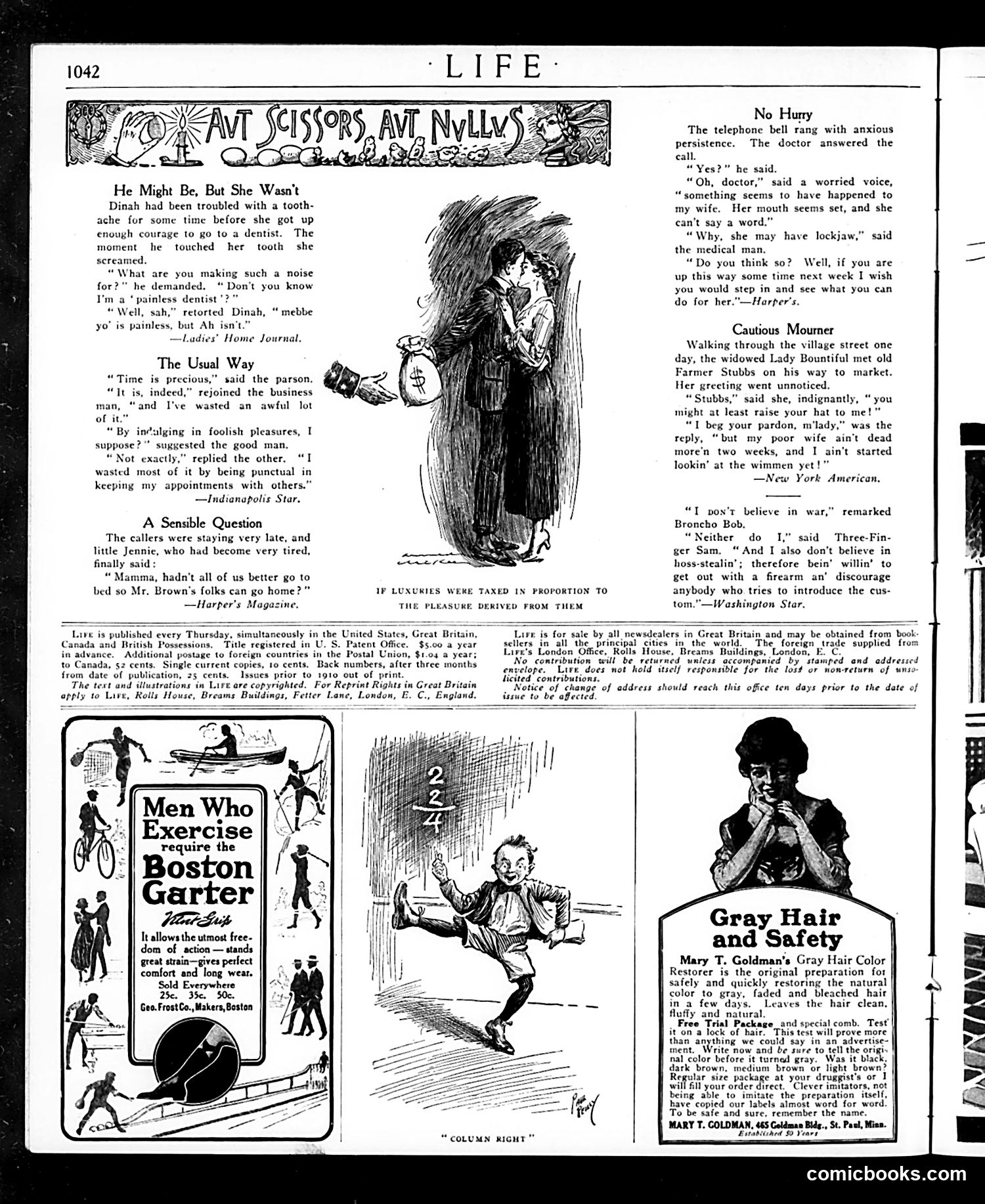
This page contains several short humorous anecdotes typical of Life's satirical style, plus advertisements. **The cartoons/jokes satirize:** - **"He Might Be, But She Wasn't"**: A Black woman (Dinah) visits a "painless dentist" but screams in pain anyway—she retorts that while the dentist may be painless, *she* isn't. The humor relies on racial dialect and a simple pun. - **"Cautious Mourner"**: A widow rebuffs a farmer for not tipping his hat. He explains he won't tip his hat to women until his wife has been dead longer than two weeks—satirizing both excessive mourning customs and the farmer's crude practicality. - **"A Sensible Question"**: A child asks guests why they don't go to bed so the hosts can leave—mocking adult social conventions through innocent logic. The central cartoon (unmarked) shows a child slipping on ice, illustrating the caption about taxing luxuries proportionally to pleasure derived—social commentary on taxation policy. **Advertisements** for Boston Garter suspenders and Gray Hair Restorer fill the lower portion, typical of period magazine monetization.
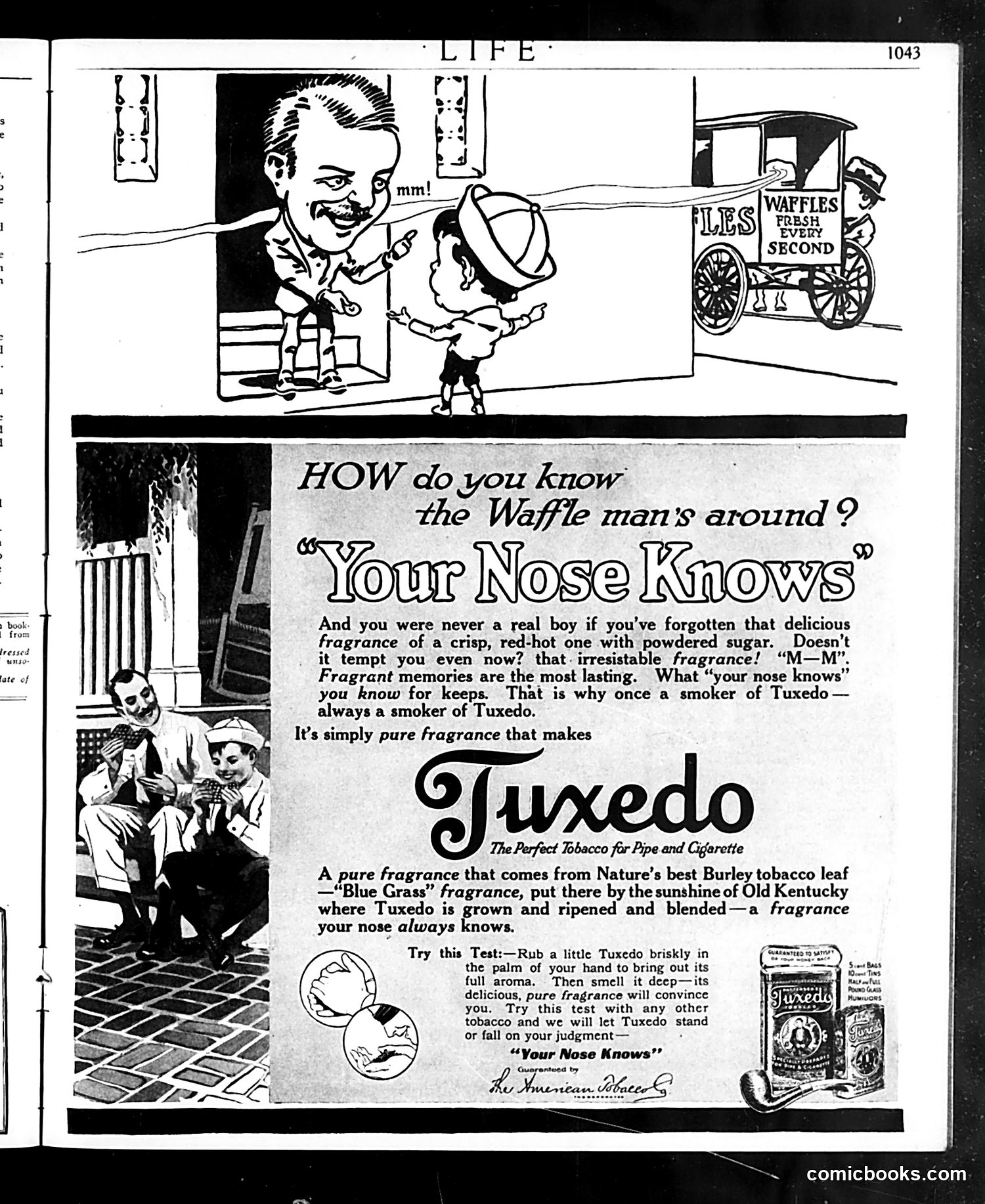
This page is primarily a **Tuxedo tobacco advertisement**, not political satire. The top cartoon shows a small boy recognizing a "waffle man" (street vendor) by smell alone—a whimsical setup for the ad's central claim: "Your Nose Knows." The advertisement exploits **nostalgic sensory memory**, comparing the distinctive fragrance of Tuxedo tobacco to childhood memories of hot waffles with powdered sugar. The tagline suggests that once someone smells Tuxedo's "pure fragrance," they'll become a lifelong customer because olfactory memories are powerful and lasting. The copy emphasizes Tuxedo's "Blue Grass fragrance" from Kentucky burley tobacco and includes a "smell test" challenge—claiming Tuxedo's aroma will outcompete any competitor. **Context for modern readers**: This reflects early 20th-century advertising that normalized tobacco marketing, used emotional/sensory appeals rather than health claims, and targeted broader audiences including implicit associations with boyhood and American innocence. No political figures or satire are present—this is straightforward commercial promotion.
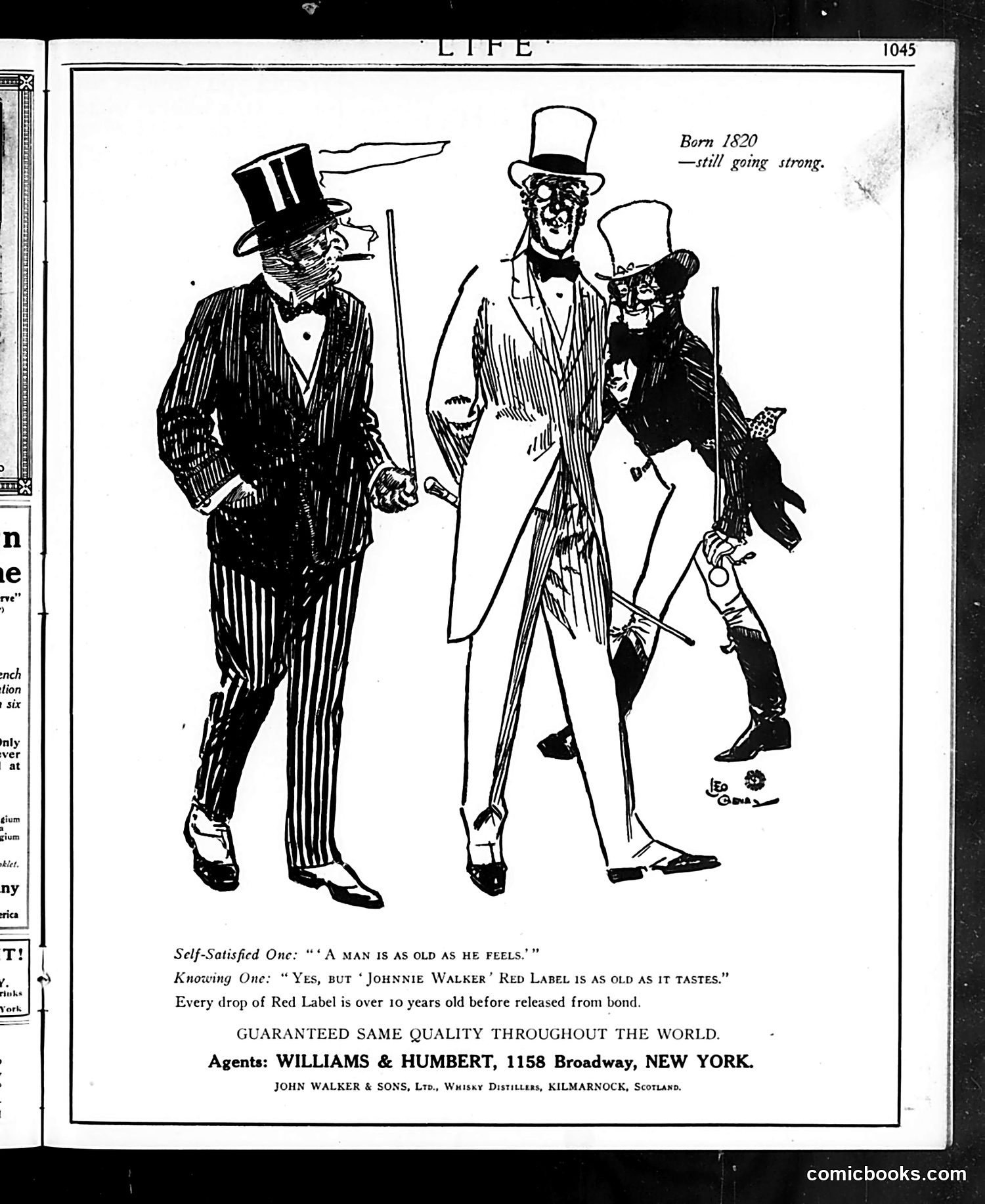
This is a Johnnie Walker whisky advertisement disguised as satirical commentary. Two well-dressed gentlemen in top hats debate aging: one claims "a man is as old as he feels," while the other counters that Johnnie Walker Red Label is "as old as it tastes"—emphasizing the whisky's 10+ years of aging before release. The joke hinges on conflating human vitality with whisky quality. The bottle itself, "Born 1820," suggests longevity and reliability. The cartoon uses genteel characters and witty banter to position the product as a mark of sophistication and good judgment. This reflects early-20th-century advertising strategy: placing commercial messages within humorous content to appear organic rather than purely promotional. The phrase "still going strong" reinforces both the brand's longevity and implied benefits to the consumer.
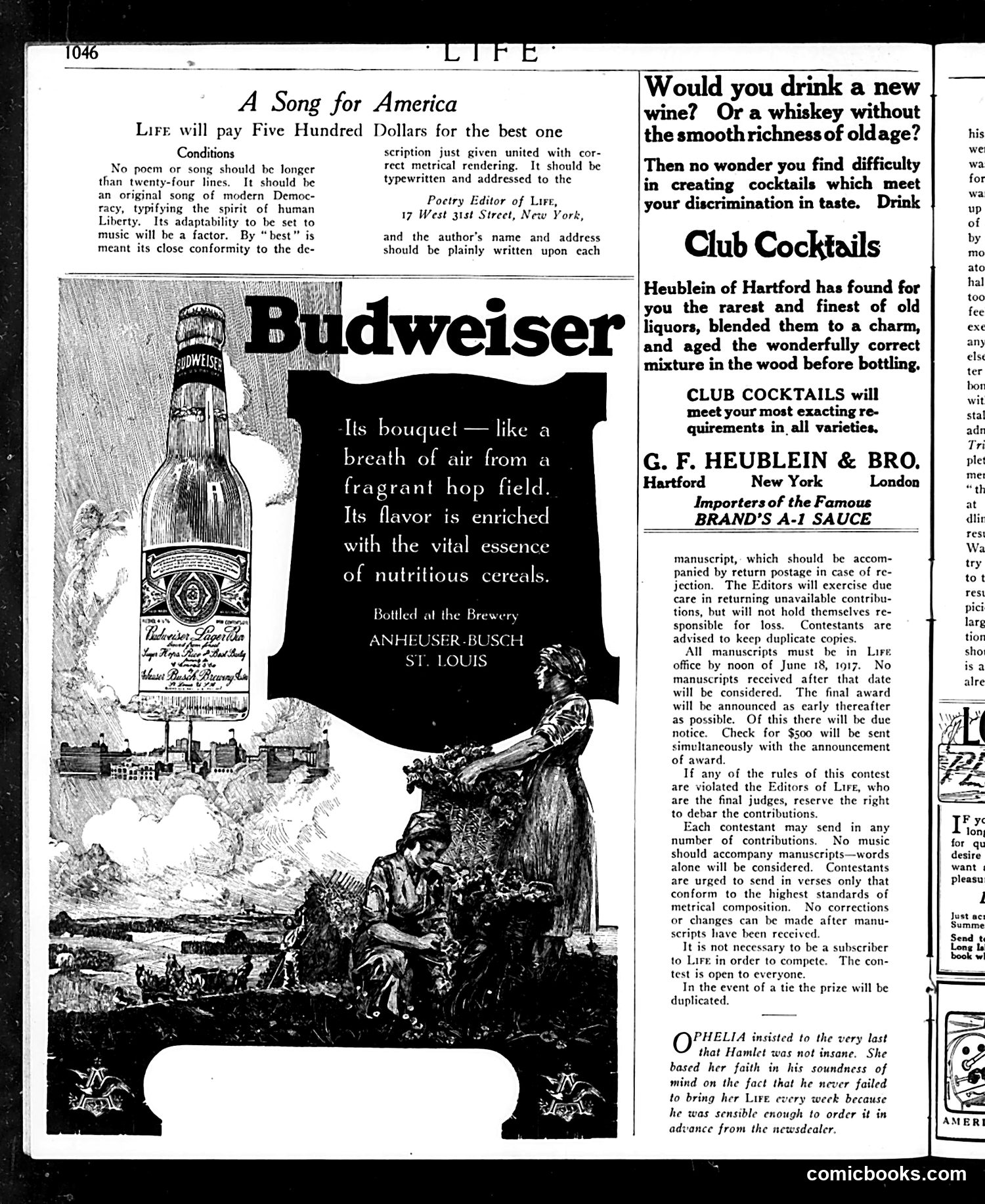
This page primarily features **advertising and a poetry contest**, not political satire. **Main Content:** - **"A Song for America" contest**: Life magazine solicits patriotic poems celebrating "modern Democracy" and "human Liberty," offering $500 for the best 24-line submission. The June 18, 1917 deadline suggests this coincides with America's WWI involvement, making this a nationalistic appeal. **Advertisements:** - **Budweiser beer** ad emphasizes quality and heritage ("Anheuser Busch, St. Louis") - **Club Cocktails** by Heublein & Bros. targets sophisticated drinkers seeking pre-mixed drinks - A humorous **Hamlet reference** at bottom jokes that Ophelia trusts Hamlet's sanity because he reliably orders Life magazine in advance—advertising Life's own subscription reliability The page reflects 1917 consumer culture: patriotic fervor, prohibition-era cocktail culture, and mass-market magazine advertising. No specific political figures or satirical cartoons appear—this is primarily commercial content wrapped in patriotic framing.
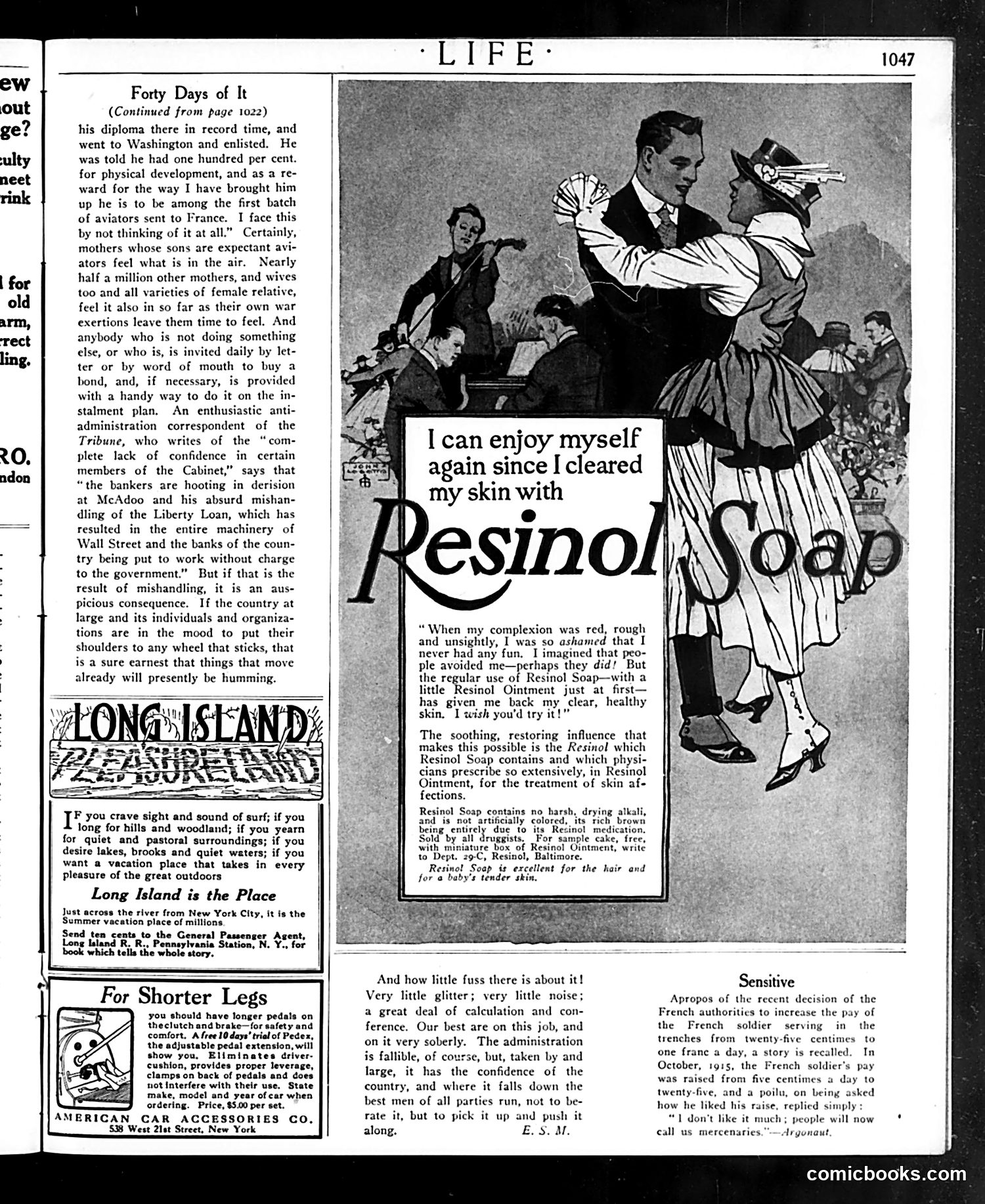
This page blends war-era editorial content with advertising, reflecting America's WWI mobilization period. **Main Editorial ("Forty Days of It"):** The text discusses mothers' anxieties about sons serving as aviators in France, connecting personal sacrifice to broader war efforts. It defends the Wilson administration's handling of Liberty Loans despite banker criticism, arguing their unpaid cooperation demonstrates national unity. **Central Advertisement:** A Resinol Soap/Ointment ad features a young woman describing social shame from skin problems that disappeared after using the product. This represents typical early-20th-century medical advertising exploiting social insecurity—particularly gendered anxiety about appearance. **Supporting Ads:** Include Long Island tourism and automobile pedal extensions. **Historical Context:** The page reflects 1918 anxieties: mothers worried about aviator sons, pressure to purchase war bonds, and trust (or lack thereof) in government. The jarring juxtaposition of wartime sacrifice discussions with vanity advertising was typical of the era's magazines, which made no distinction between serious content and commercialism.
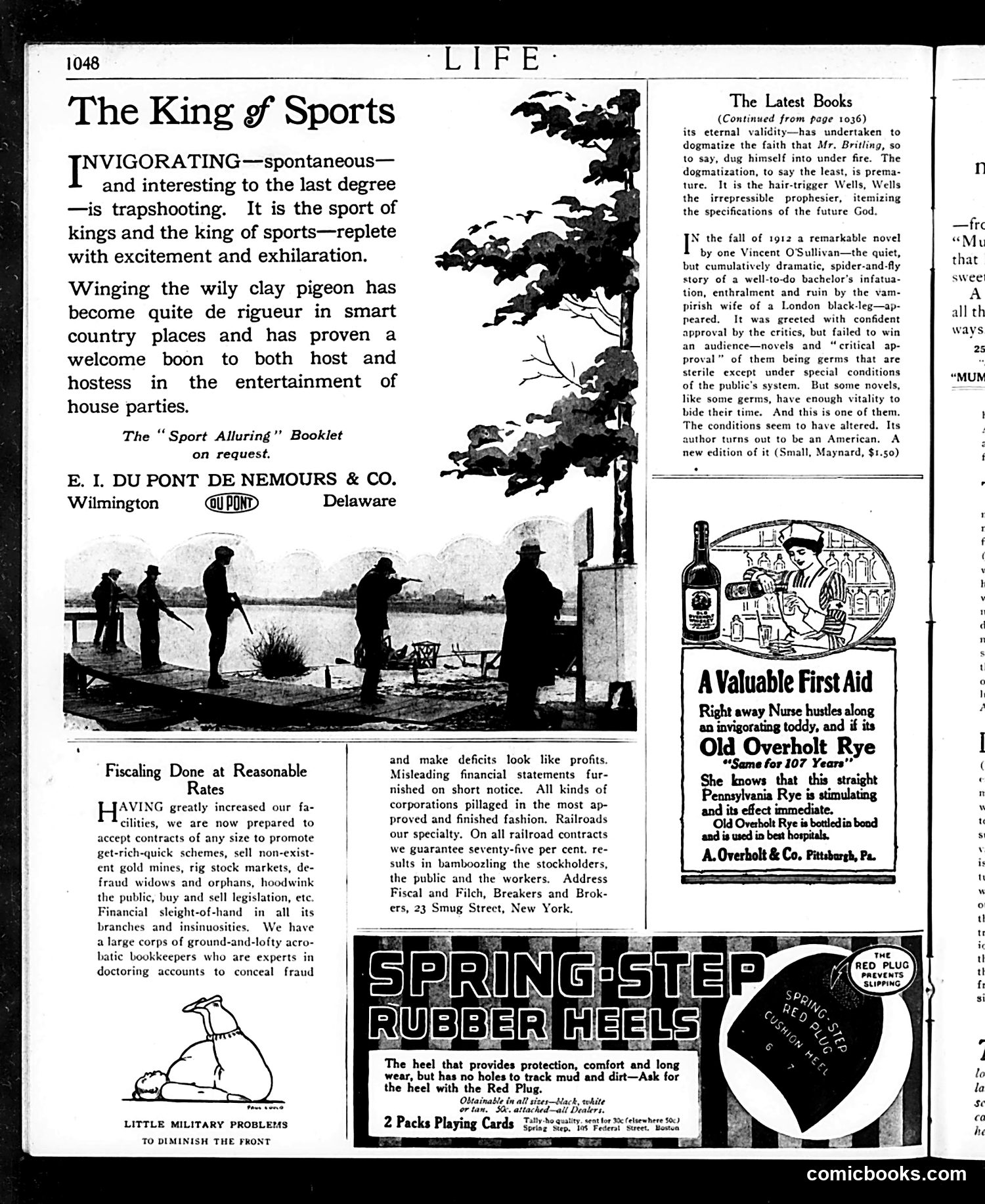
This page contains primarily **advertisements and satirical business parody**, not political cartoons requiring historical context. The main satirical content is the "Fiscaling Done at Reasonable Rates" advertisement, which **mocks financial fraud and corporate corruption**. It humorously offers services like rigging stock markets, defrauding widows and orphans, bamboozling stockholders, and "doctoring accounts to conceal fraud"—presenting these crimes as legitimate business services. This satire reflects early 20th-century public concern about unchecked corporate malfeasance and financial scandals. The small cartoon "Little Military Problems to Diminish the Front" is too small to decipher clearly but appears to be WWI-related, showing a figure attempting to reduce military casualties or troop numbers. The remaining content comprises legitimate advertisements (DuPont trapshooting, Old Overholt whiskey, rubber heels, playing cards) and book reviews. The page is essentially a mix of advertising and satirical commentary on contemporary business practices.
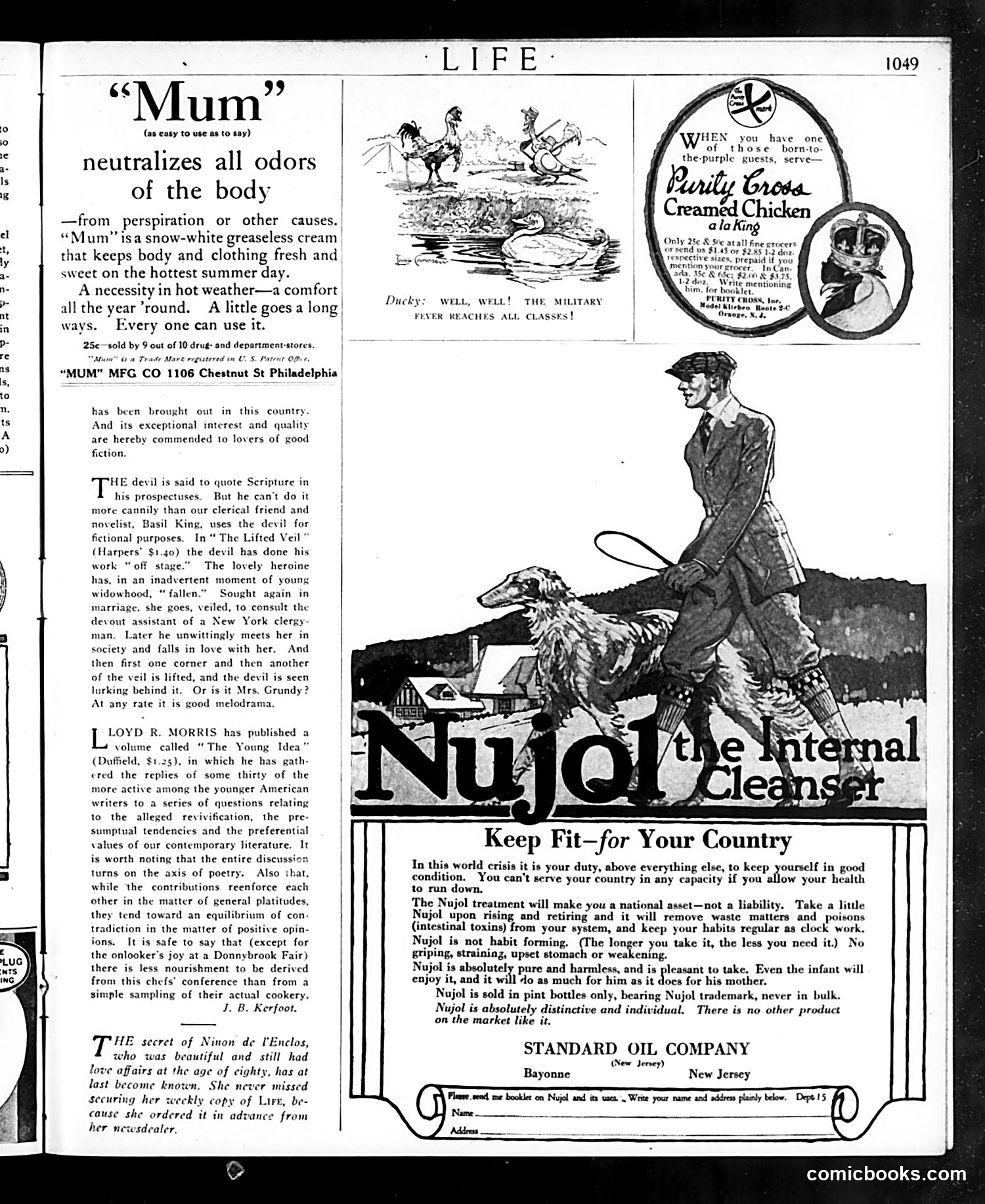
This page from *Life* magazine mixes literary criticism with period advertising, reflecting early 20th-century concerns. **The cartoon** (top center) shows a military aviator reaching "all classes"—a topical reference to WWI-era military recruitment and the novelty of aviation. The caption "The military fever reaches all classes" jokes about how war enthusiasm has spread across society. **The literary section** discusses Basil King's novel *The Lifted Veil*, using the metaphor of the devil and social hypocrisy to critique melodrama. The reviewer notes how the story plays on Victorian morality (invoking "Mrs. Grundy," a symbol of prudish social judgment). **The advertisements** reveal period anxieties: "Mum" deodorant addresses body odor concerns; Nujol (a laxative) frames bowel regularity as patriotic duty during wartime ("Keep Fit—for Your Country"). The Ninon de l'Enclos reference humorously suggests that subscribing to *Life* magazine preserves youth and vitality. Together, the page satirizes contemporary pretensions while selling solutions to everyday embarrassments.