
Life, 1917-06-14 · page 12 of 38
Life — June 14, 1917 — page 12: what you’re looking at
What you’re looking at
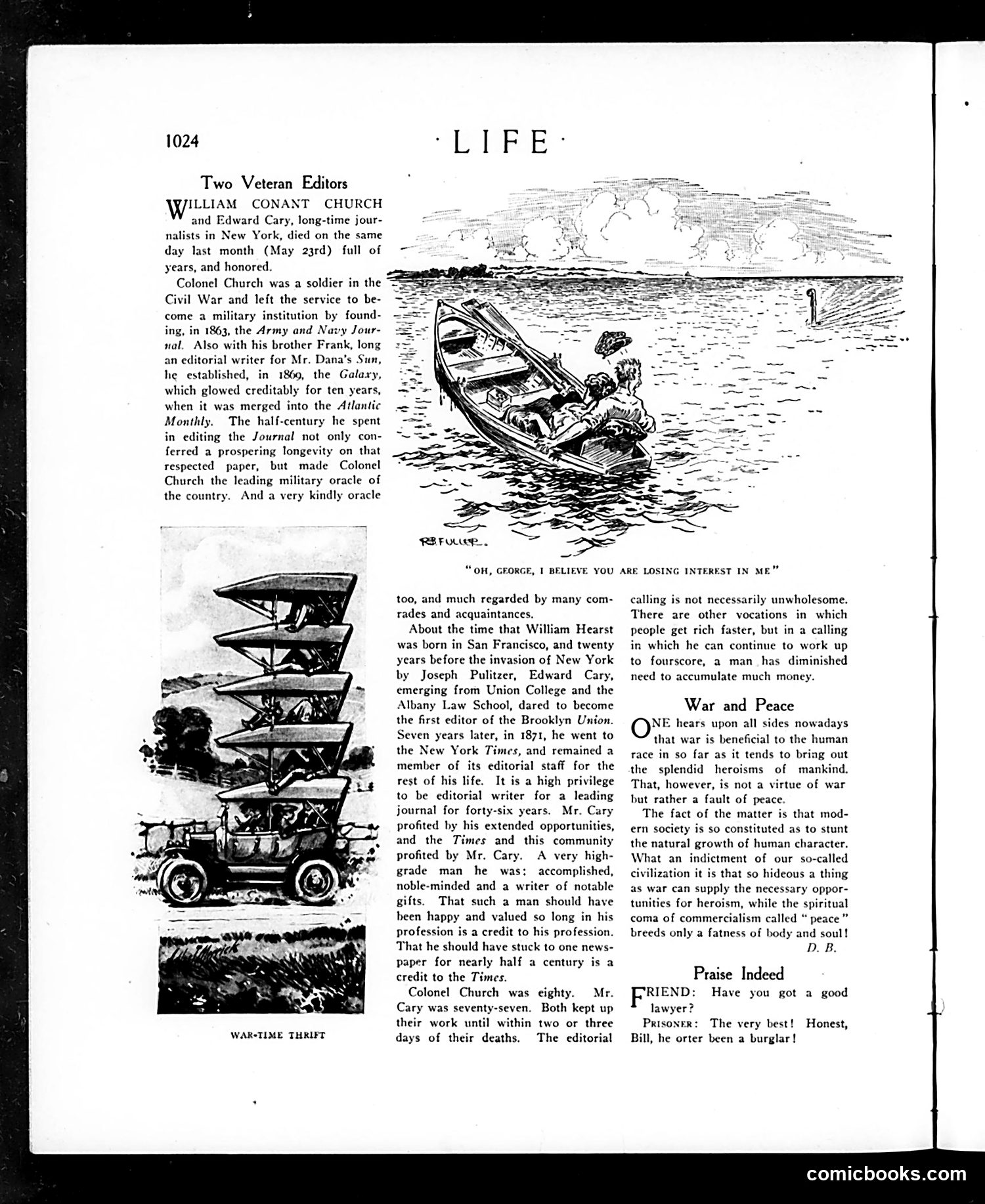
This page commemorates **William Conant Church**, a Civil War veteran and pioneering military journalist who died May 23rd at an advanced age. Church co-founded the *Galaxy* magazine (1860s) and later became the leading editor of the *Army and Navy Journal*, establishing himself as "the leading military oracle of the country." The cartoons appear to be unrelated satirical pieces: one depicting a precarious "War-Time Thrift" stack (suggesting wartime scarcity), and another showing a boat scene titled "Oh, George, I Believe You Are Losing Interest in Me"—likely domestic humor about romance during economic hardship. The page also includes a brief joke about a prisoner claiming an honest burglar makes a better lawyer than his current one—typical period satire about the legal profession.
📄 Transcribed text from this page (OCR, searchable)
Machine-transcribed from the original scan — historical spelling and the odd misread are preserved.
1024 Two Veteran Editors ILLIAM CONANT CHURCH nd Edward Cary, long-time jour- nalists in New York, died on the same day last month (May 23rd) full of years, and honored. Colonel Church was a soldier in the Civil War and left the service to be- come a military institution by found- ing, in 1863, the Army and Navy Jour- nal. Also with his brother Frank, long an editorial writer for Mr. Dana’s Sun, he established, in 1869, the Galaxy, which glowed creditably for ten years, when it was merged into the Atlantic Monthly, The half-century he spent in editing the Journal not only con- ferred a prospering longevity on that respected paper, but made Colonel Church the leading military oracle of the country. And a very kindly oracle WAR-TIME THRIFT RS FoUP. “OH, GEORGE, 1 BELIEVE YOU ARE LOSING INTEREST IN ME” too, and much regarded by many com- rades and acquaintances. About the time that William Hearst was born in San Francisco, and twenty years before the invasion of New York by Joseph Pulitzer, Edward Cary, emerging from Union College and the Albany Law School, dared to become the first editor of the Brooklyn Union. Seven years later, in 1871, he went to the New York Times, and remained a member of its editorial staff for the rest of his life. It is a high privilege to be editorial writer for a leading journal for forty-six years. Mr. Cary profited by his extended opportunities, and the Times and this community profited by Mr. Cary. A very high- grade man he was: accomplished, noble-minded and a writer of notable gifts. That such a man should have been happy and valued so long in his profession is a credit to his profession. That he should have stuck to one news- paper for nearly half a century is a credit to the Times. Colonel Church was eighty. Mr. Both kept up their work until within two or three days of their deaths, The editorial calling is not necessarily unwholesome. There are other vocations in which people get rich faster, but in a calling in which he can continue to work up to fourscore, a man has diminished need to accumulate much money. War and Peace NE hears upon all sides nowadays that war is beneficial to the human race in so far as it tends to bring out the splendid heroisms of mankind. That, however, is not a virtue of war but rather a fault of peace. The fact of the matter is that mod- ern society is so constituted as to stunt the natural growth of human character. What an indictment of our so-called civilization it is that so hideous a thing as war can supply the necessary oppor- tunities for heroism, while the spiritual coma of commercialism called “ peace” breeds only a fatness of body and soul! D. B. Pr: ie Indeed RIEND: Have you got a good lawyer? Prisoner: The very best! Bill, he orter been a burglar! Honest, comicbooks.com