
Life, 1917-06-14 · page 24 of 38
Life — June 14, 1917 — page 24: what you’re looking at
What you’re looking at
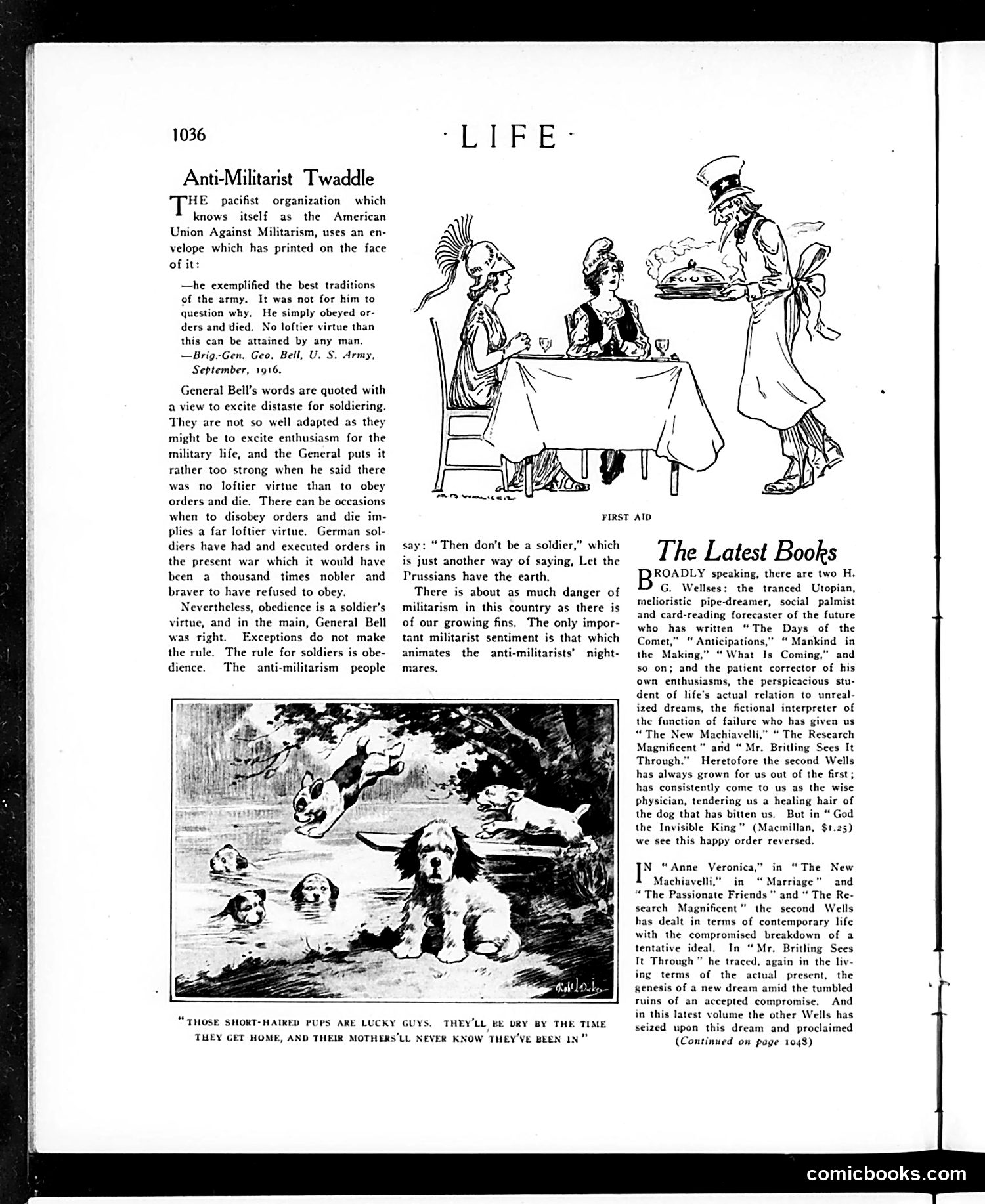
This page attacks American pacifists—specifically the American Union Against Militarism—for discouraging military service. The article quotes Brigadier General George Bell's statement that soldiers should obey orders without question, then uses it against pacifists' recruitment messaging. **The satire's argument:** Pacifists circulate Bell's quote to discourage enlistment by framing obedience as mindless. Life's writer counters that while obedience is indeed a soldier's virtue, pacifists are naive—claiming there's no real militarism threat in America (comparing it to "growing fins"). The writer suggests pacifists essentially invite Prussian domination by discouraging enlistment during World War I. **The cartoon below** depicts puppies swimming, with the caption joking their mothers won't know they got wet—likely mocking pacifists as naive "pups" who underestimate the consequences of unpreparedness for war. The piece reflects 1916 pro-war sentiment against American isolationists/pacifists.
📄 Transcribed text from this page (OCR, searchable)
Machine-transcribed from the original scan — historical spelling and the odd misread are preserved.
1036 Anti-Militarist. Twaddle HE pacifist organization which knows itself as the American Union Against Militarism, uses an en- velope which has printed on the face of it: —he exemplified the best traditions of the army, It was not for him to question why. He simply obeyed or- ders and died. No loftier virtue than this can be attained by any man. —Brig-Gen. Geo. Bell, U. S. Army, September, 1916. General Bell’s words are quoted with a view to excite distaste for soldiering. They are not so well adapted as they might be to excite enthusiasm for the military life, and the General puts it rather too strong when he said there was no loftier virtue than to ob orders and die. There can be occasions when to disobey orders and die im- plies a far loftier virtue. German sol- diers have had and executed orders in the present war which it would have been a thousand times nobler and braver to have refused to obey. Nevertheless, obedience is a soldier's virtue, and in the main, General Bell was right. Exceptions do not make the rule. The rule for soldiers is obe- dience. The anti-militarism people FIRST say: “Then don’t be a soldier,” which is just another way of saying, Let the Prussians have the earth. There is about as much danger of militarism in this country as there is of our growing fins. The only impor- tant militarist sentiment is that which animates the anti-militarists’ night- “THOSE SHORT-HAIRED PUPS ARE LUCKY GUYS. THEY'LL BE DRY BY THE TIME THEY GET HOME, AND THEIR MOTHERS'LL NEVER KNOW THEY'VE BEEN IN Alb The Latest Books ROADLY speaking, there are two H. Wellses: the tranced Utopian, melioristic pipe-dreamer, social palmist and card-reading forecaster of the future who has written “The Days of the Comet,” “ Anticipations,” “ Mankind in the Making,” “What Is Coming,” and so on; and the patient corrector of his own enthusiasms, the perspicacious stu- dent of life's actual relation to unreal- ized dreams, the fictional interpreter of the function of failure who has given us “The New Machiavelli, The Research Magnificent" and “Mr. Britling Sees It Through.” Heretofore the second Wells has always grown for us out of the first; has consistently come to us as the wise physician, tendering us a healing hair of the dog that has bitten us, But in “ God the Invisible King” (Macmillan, $1.25) we see this happy order reversed. IX “Anne Veronica,” in “The New Machiavelli,” in “ Marriage” and “ The Passionate Friends” and“ The Re- search Magnificent” the second Wells has dealt in terms of contemporary life with the compromised breakdown of a tentative ideal. In “Mr. Britling Sees It Through” he traced, again in the liv- ing terms of the actual present, the genesis of a new dream amid the tumbled ruins of an accepted compromise. And in this latest volume the other Wells has seized upon this dream and proclaimed (Continued on page 1048) comicbooks.com