
Life, 1917-06-14 · page 18 of 38
Life — June 14, 1917 — page 18: what you’re looking at
What you’re looking at
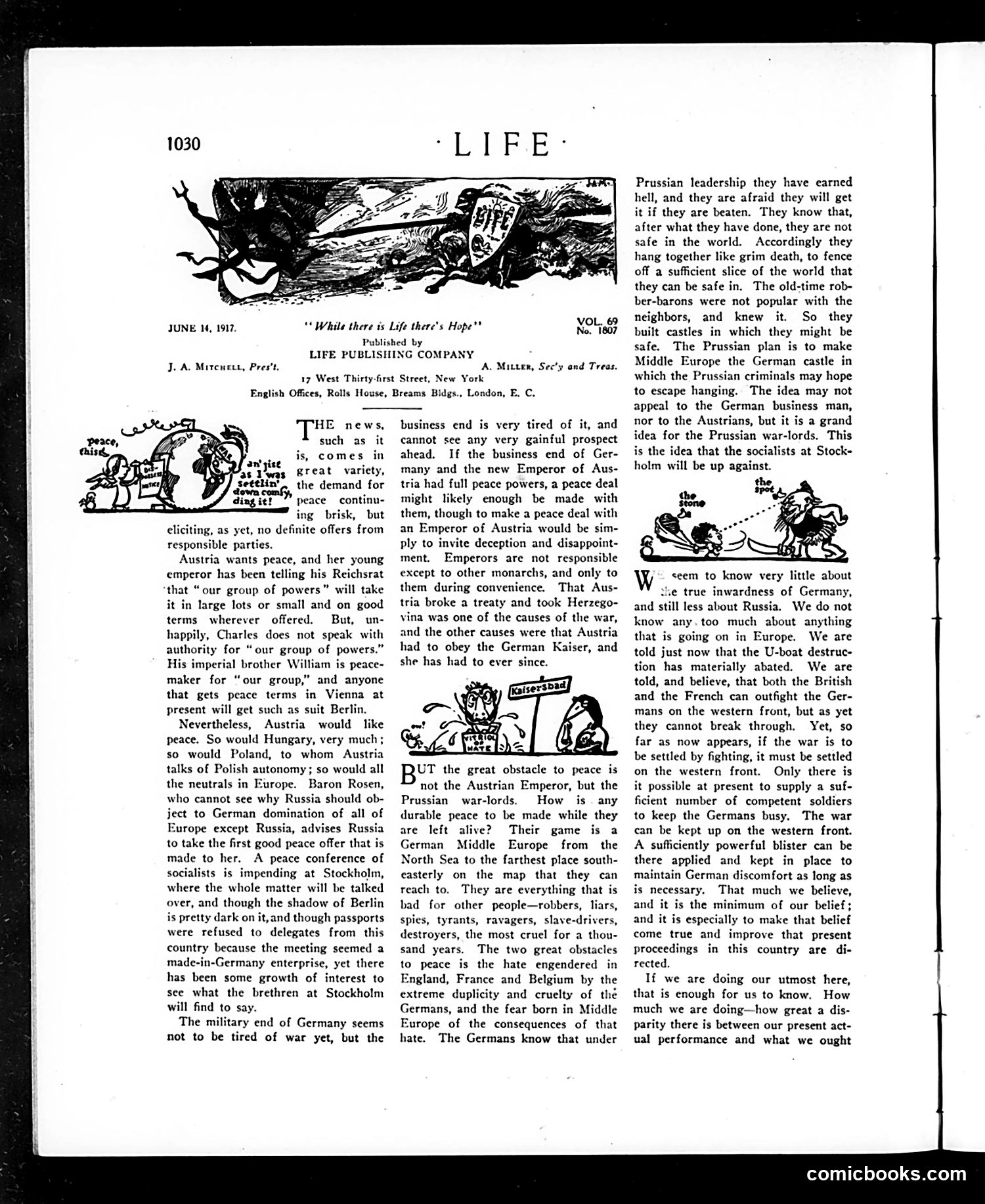
This editorial page satirizes peace negotiations during World War I. The headline's ironic phrase suggests hope persists despite grim reality. **Key targets:** - **Austria's young Emperor Charles** is mocked as powerless—his peace overtures mean nothing because his "imperial brother William" (Germany's Kaiser) actually controls their "group of powers." - **Prussian war-lords** are the real obstacle to peace, depicted as modern robber-barons driven by fear. Having committed atrocities, they know they face justice if defeated, so they cling to power desperately. - **Peace conferences** (like the impending Stockholm socialist gathering) are dismissed as German manipulation attempts. **The satire's point:** Austria wants peace but lacks authority; Germany's military leadership won't allow it because they fear hanging for war crimes. The piece argues lasting peace is impossible while Prussian leadership survives, comparing them to medieval robber-barons building castles for safety—now seeking to dominate all Middle Europe as their fortress. The cartoons (partly illegible here) likely visualize these power dynamics satirically.
📄 Transcribed text from this page (OCR, searchable)
Machine-transcribed from the original scan — historical spelling and the odd misread are preserved.
JUNE M, 1917. ‘While there is Life there's Hope" No, 1807 Published by LIFE PUBLISHING COMPANY J. A. Miteneet, Pres't, HE news, such as it is, comes in great variety, the demand for peace continu- ing brisk, but ing, as yet, no definite offers from responsible parties. Austria wants peace, and her young emperor has been telling his Reichsrat ‘that “our group of powers” will take it in large lots or small and on good terms wherever offered. But, un- happily, Charles does not speak with authority for “our group of powers.” His imperial brother William is peace- maker for “our group,” and anyone that gets peace terms in Vienna at present will get such as suit Berlin. Nevertheless, Austria would like peace. So would Hungary, very much; so would Poland, to whom Austria talks of Polish autonomy ; so would all the neutrals in Europe. Baron Rosen, who cannot see why Russia should ob- ject to German domination of all of Europe except Russia, advises Russia to take the first good peace offer that is made to her. A peace conference of socialists is impending at Stockholm, where the whole matter will be talked over, and though the shadow of Berlin is pretty dark on it,and though passports were refused to delegates from this country because the meeting seemed a made-in-Germany enterprise, yet there has been some growth of interest to see what the brethren at Stockholm will find to say. The military end of Germany seems not to be tired of war yet, but the ani yise 38 L was settlin’ down, ding it! A. Mitten, Sec’y and Treas. 17 West Thirty-first Street, New York English Offices, Rolls House, Breams Bidgs., London, E. C. business end is very tired of it, and cannot see any very gainful prospect ahead. If the business end of Ger- many and the new Emperor of Aus- tria had full peace powers, a peace deal might likely enough be made with them, though to make a peace deal with an Emperor of Austria would be sim- ply to invite deception and disappoint- ment. Emperors are not responsible except to other monarchs, and only to them during convenience. That Aus- tria broke a treaty and took Herzego- vina was one of the causes of the war, and the other causes were that Austria had to obey the German Kaiser, and she has had to ever since. UT the great obstacle to peace is not the Austrian Emperor, but the Prussian war-lords. How is. any durable peace to be made while they are left alive? Their game is a German Middle Europe from the North Sea to the farthest place south- easterly on the map that they can reach to, They are everything that is bad for other people—robbers, liars, spies, tyrants, ravagers, slave-dri destroyers, the most cruel for a thou- sand years. The two great obstacles to peace is the hate engendered in England, France and Belgium by the extreme duplicity and cruelty of the Germans, and the fear born in Middle Europe of the consequences of that hate. The Germans know that under Prussian leadership they have earned hell, and they are afraid they will get it if they are beaten. They know that, after what they have done, they are not safe in the world. Accordingly they hang together like grim death, to fence off a sufficient slice of the world that they can be safe in. The old-time rob- ber-barons were not popular with the neighbors, and knew it. So they built castles in which they might be safe. The Prussian plan is to make Middle Europe the German castle in which the Prussian criminals may hope to escape hanging. The idea may not appeal to the German business man, nor to the Austrians, but it is a grand idea for the Prussian war-lords. This is the idea that the socialists at Stock- holm will be up against. seem to know very little about ¢ true inwardness of Germany, and still less about Russia, We do not know any.too much about anything that is going on in Europe. We are told just now that the U-boat destruc- tion has materially abated. We are told, and believe, that both the British and the French can outfight the Ger- mans on the western front, but as yet they cannot break through. Yet, so far as now appears, if the war is to be settled by fighting, it must be settled on the western front. Only there is it possible at present to supply a suf- ficient number of competent soldiers to keep the Germans busy. The war can be kept up on the western front. A sufficiently powerful blister can be there applied and kept in place to maintain German discomfort as long as is necessary. That much we believe, and it is the minimum of our belief; and it is especially to make that belief come true and improve that present proceedings in this country are di- rected. If we are doing our utmost here, that is enough for us to know. How much we are doing—how great a dis- parity there is between our present act- ual performance and what we ought comicbooks.com