
Life, 1917-06-14 · page 22 of 38
Life — June 14, 1917 — page 22: what you’re looking at
What you’re looking at
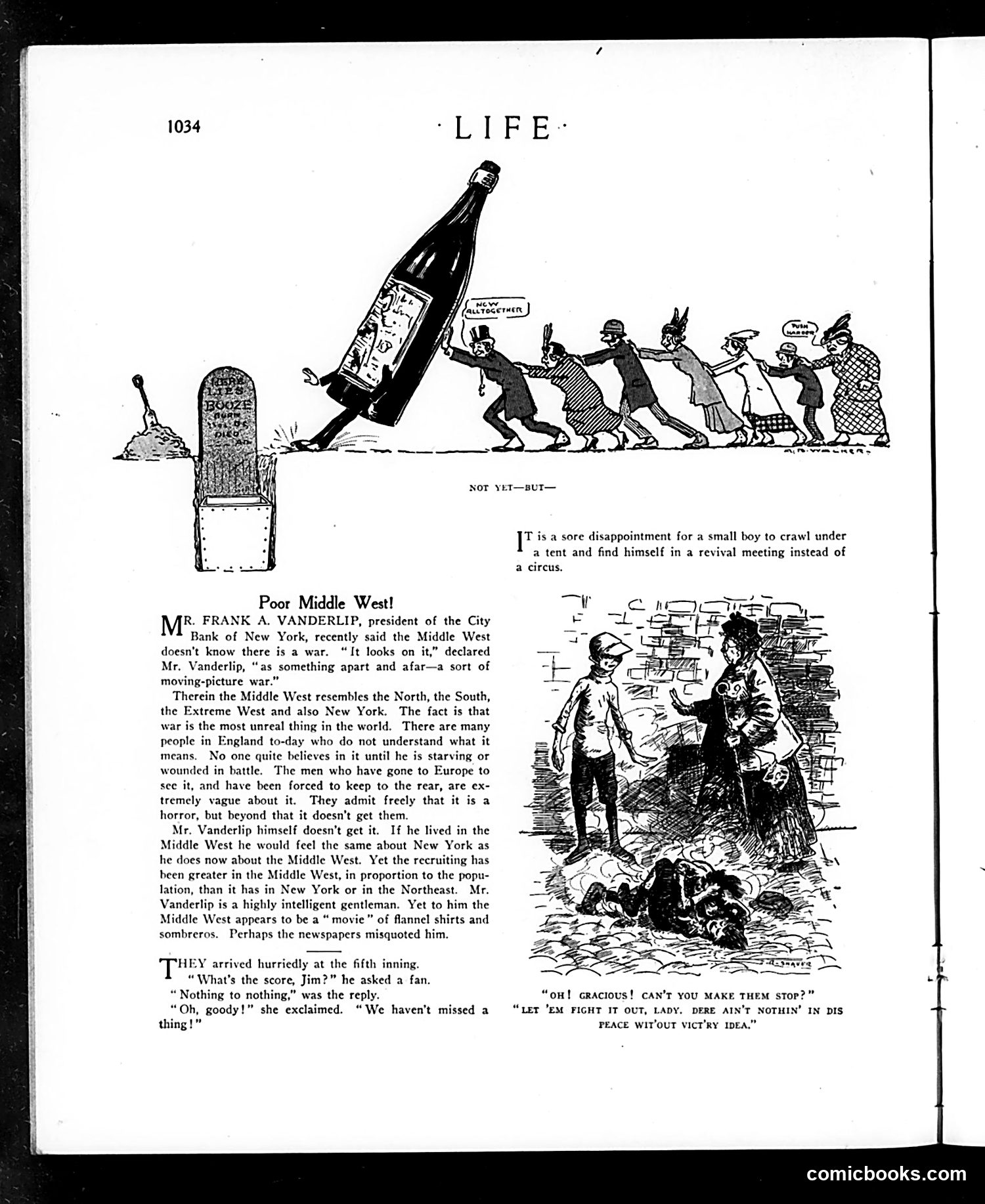
This Life magazine page satirizes American attitudes toward World War I (appears to be 1917-1918, before U.S. entry or early in involvement). **Top cartoon**: A giant champagne bottle tips over a line of people labeled "New Prohibition"—mocking the disconnect between celebrating with alcohol while pushing prohibition policies. **"Poor Middle West" article**: Critiques Frank A. Vanderlip (actual NYC banker) for dismissing the Midwest as viewing war as distant entertainment ("moving-picture war"). The satire inverts his bias: he's equally disconnected from reality. Despite his condescension, Midwest recruitment actually exceeded northeastern rates. **Bottom cartoon**: A woman at a baseball game asks why players can't "stop" fighting at 0-0. A fan replies with working-class dialect that peace without victory is meaningless—a dig at pacifist sentiment and those viewing war as entertainment rather than serious conflict. **Overall point**: Americans, particularly elites, treat the war as abstract spectacle rather than grim reality, whether dismissing distant regions or attending sports games indifferently.
📄 Transcribed text from this page (OCR, searchable)
Machine-transcribed from the original scan — historical spelling and the odd misread are preserved.
yeT—suT— T is a sore disappointment for a small boy to crawl under a tent and find himself in a revival meeting instead of a circus, Poor Middle West! R. FRANK A. VANDERLIP, president of the City Bank of New York, recently said the Middle West doesn't know there is a war. “It looks on it,” declared Mr. Vanderlip, “as something apart and afar—a sort of moving-picture war.” Therein the Middle West resembles the North, the South, the Extreme West and also New York. The fact is that war is the most unreal thing in the world. There are many people in England to-day who do not understand what it means. No one quite believes in it until he is starving or wounded in battle. The men who have gone to Europe to see it, and have been forced to keep to the rear, are ex- tremely vague about it. They admit freely that it is a horror, but beyond that it doesn’t get them. Mr. Vanderlip himself doesn’t get it. If he lived in the Middle West he would feel the same about New York as he does now about the Middle West. Yet the recruiting has been greater in the Middle West, in proportion to the popu- lation, than it has in New York or in the Northeast. Mr. Vanderlip is a highly intelligent gentleman. Yet to him the Middle West appears to be a “ movie” of flannel shirts and sombreros. Perhaps the newspapers misquoted him. HEY arrived hurriedly at the fifth inning. “What's the score, Jim?” he asked a fan. “Nothing to nothing,” was the reply. “ou! Gracious! CAN’T YOU MAKE THEM stor?” “Oh, goody!” she exclaimed. “We haven't missed a “LET 'EM FIGHT IT OUT, LADY. DERE AIN'T NOTHIN’ IN DIS thing!” PEACE WIT'OUT VICT'RY IDEA.” comicbooks.com