
A complete issue · 42 pages · 1917
Life — June 7, 1917
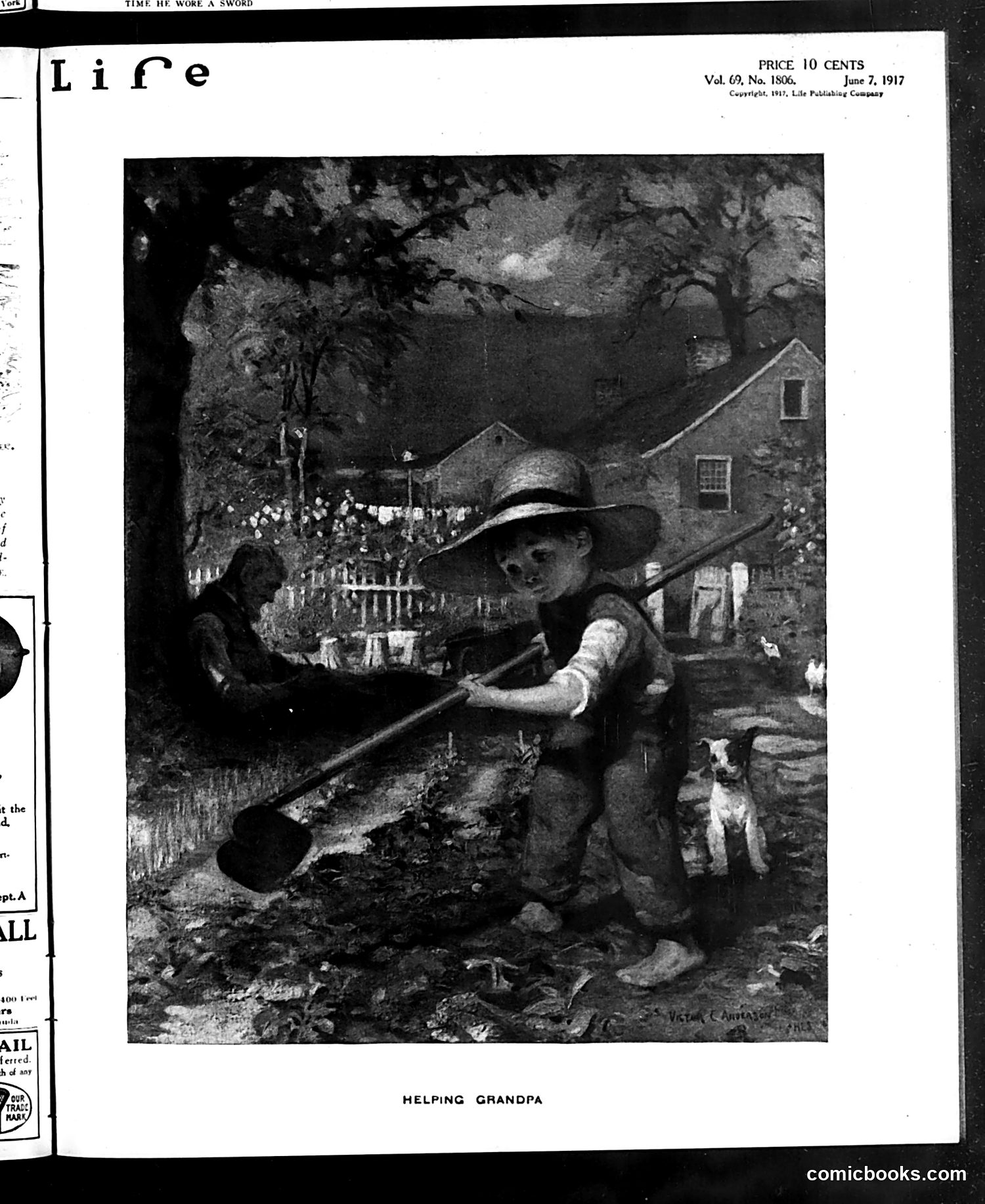
This image from *Life* magazine (June 7, 1912) depicts a young boy in a hat assisting an elderly man with a large shovel or spade in a rural garden setting. A small dog watches nearby as they work in front of a cottage. The caption's title—"Helping Grandpa"—presents this as a wholesome domestic scene of intergenerational cooperation. However, without additional context from the magazine's surrounding content, the specific satirical point remains unclear. It may be commenting on rural life, childhood responsibility, or family dynamics of the Edwardian era, but the exact social or political commentary the cartoonist intended is not evident from the image alone.
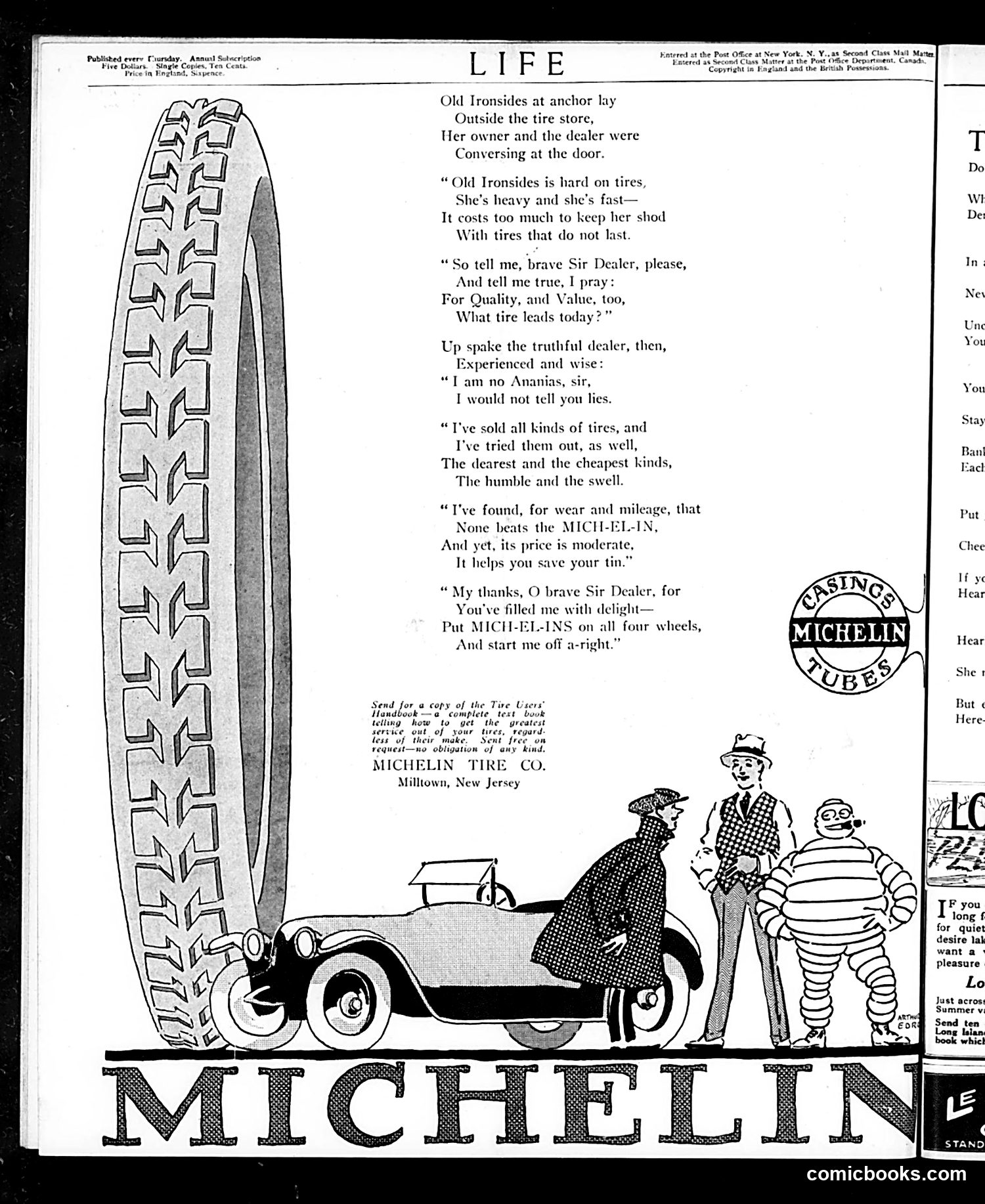
This page is primarily a **Michelin Tire advertisement**, not political satire. The content features a poem about "Old Ironsides" (a ship) encountering tire dealers. The narrative uses the conceit of the ship's owner seeking tire recommendations. A truthful dealer endorses Michelin's "Mich-El-In" brand, praising its durability and value. The advertisement includes: - A large detailed illustration of a Michelin tire on the left - The company's mascot (Bibendum, the "Michelin Man") depicted as a rotund figure made of tire treads, shown on the right with a vintage automobile and two men in period dress - The Michelin Casings & Tubes logo This is **commercial advertising** rather than satirical commentary, using verse and characters to promote tire quality and affordability to early 20th-century automobile owners.
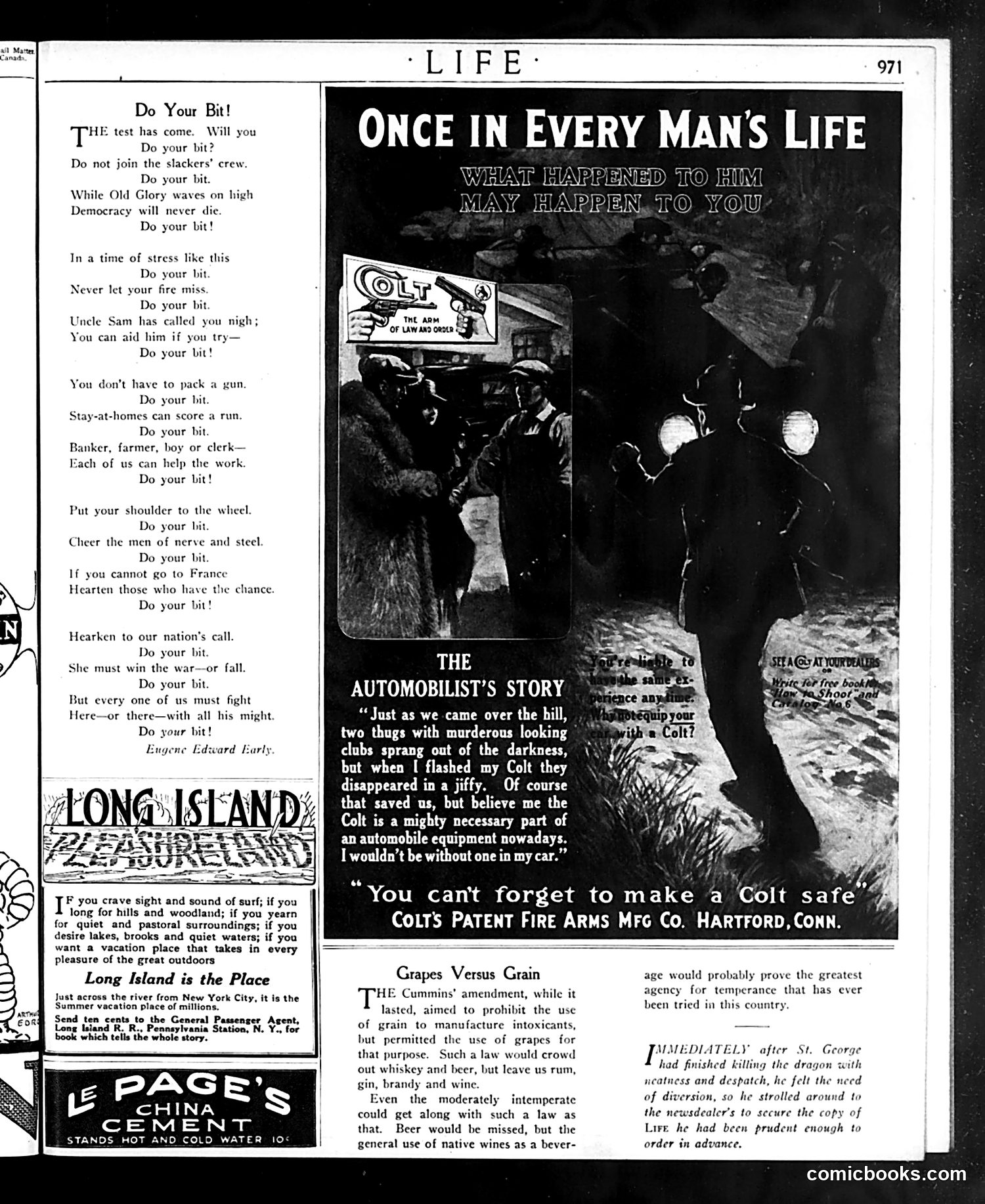
This page combines patriotic messaging with advertising. On the left, the poem "Do Your Bit!" exhorts Americans to support the war effort through various means—financial contribution, home front work, and morale-boosting. References to "Uncle Sam," "France," and "nerve and steel" indicate this is WWI-era content. The main advertisement features "The Automobilist's Story," wherein a driver credits his Colt revolver with saving him from armed attackers. The ad promotes Colt's Patent Fire Arms as essential self-defense equipment. The bottom section discusses the "Cummin's amendment" regarding grain prohibition, suggesting alcohol-regulation debates during Prohibition era. The patriotic and safety themes reflect early 20th-century American anxieties about preparedness and protection.
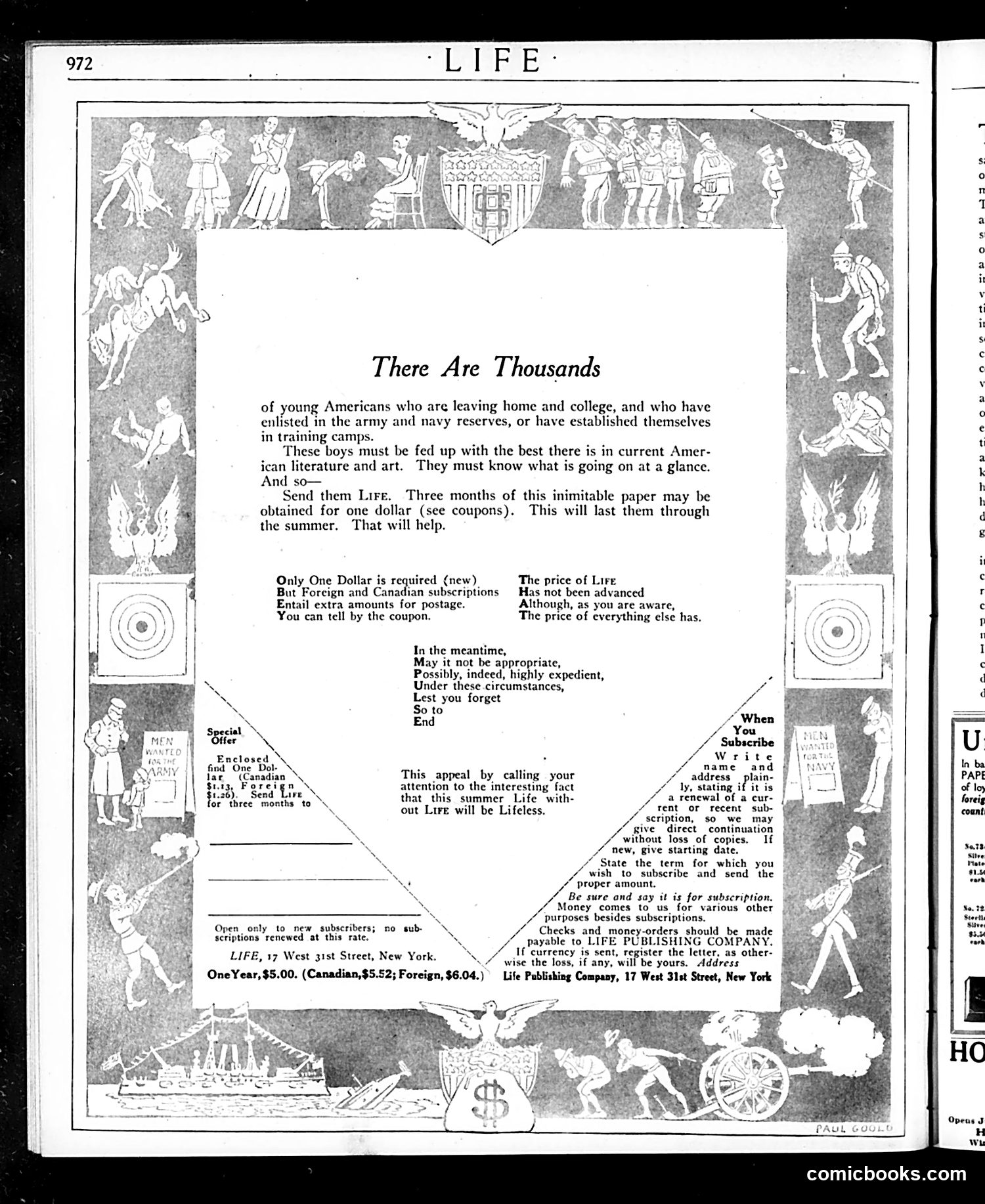
This page is primarily a **subscription advertisement** for *Life* magazine, not a political cartoon. The decorative border illustrates various leisure and patriotic activities—sports, military service, cultural pursuits—reflecting American life circa 1918 (based on references to "army and navy reserves"). The pitch targets young Americans enlisting or in training camps, offering three months of *Life* for one dollar to keep them entertained during summer service. The ad emphasizes that while prices have risen for most goods, *Life*'s price remains unchanged—a rhetorical appeal during wartime inflation. The elaborate illustrated border celebrating American activities serves as visual propaganda supporting military service and national duty, consistent with WWI-era messaging.
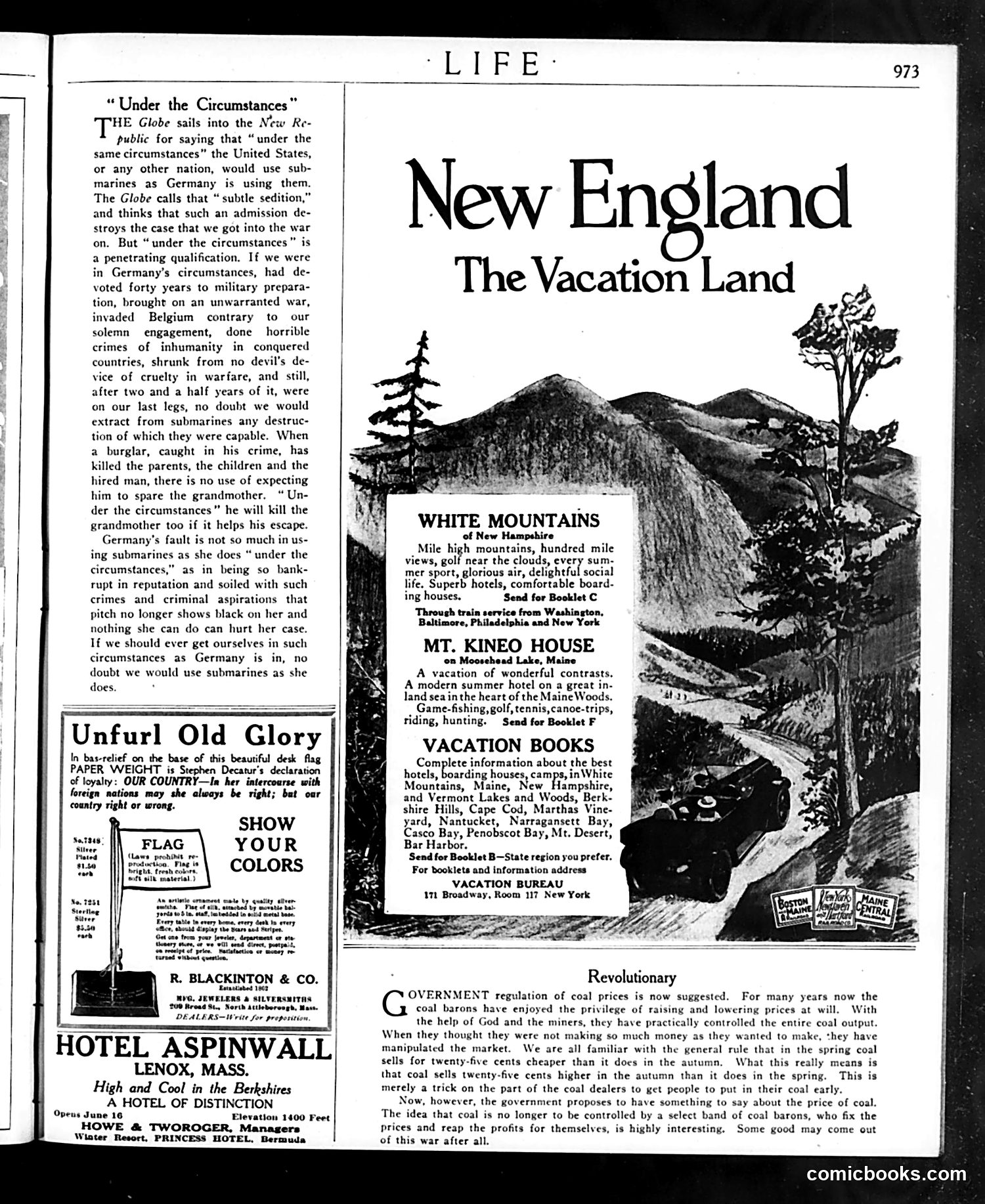
This page is primarily **advertising**, featuring vacation promotions for New England destinations (White Mountains, Mt. Kineo House) and a hotel in Lenox, Massachusetts. The editorial content addresses **submarine warfare ethics**. The left column critiques *The Globe* newspaper's argument that using submarines "under the circumstances" is justified. The author argues that Germany's extensive pre-war military preparation doesn't excuse violating engagement rules, comparing it to a burglar killing a family to escape—circumstances don't justify the crime. The piece advocates for strict adherence to warfare conventions regardless of context. The bottom section discusses **government coal price regulation**, suggesting new controls on coal prices and profits to prevent exploitation. These pieces reflect WWI-era debates about military conduct and wartime economic policy.
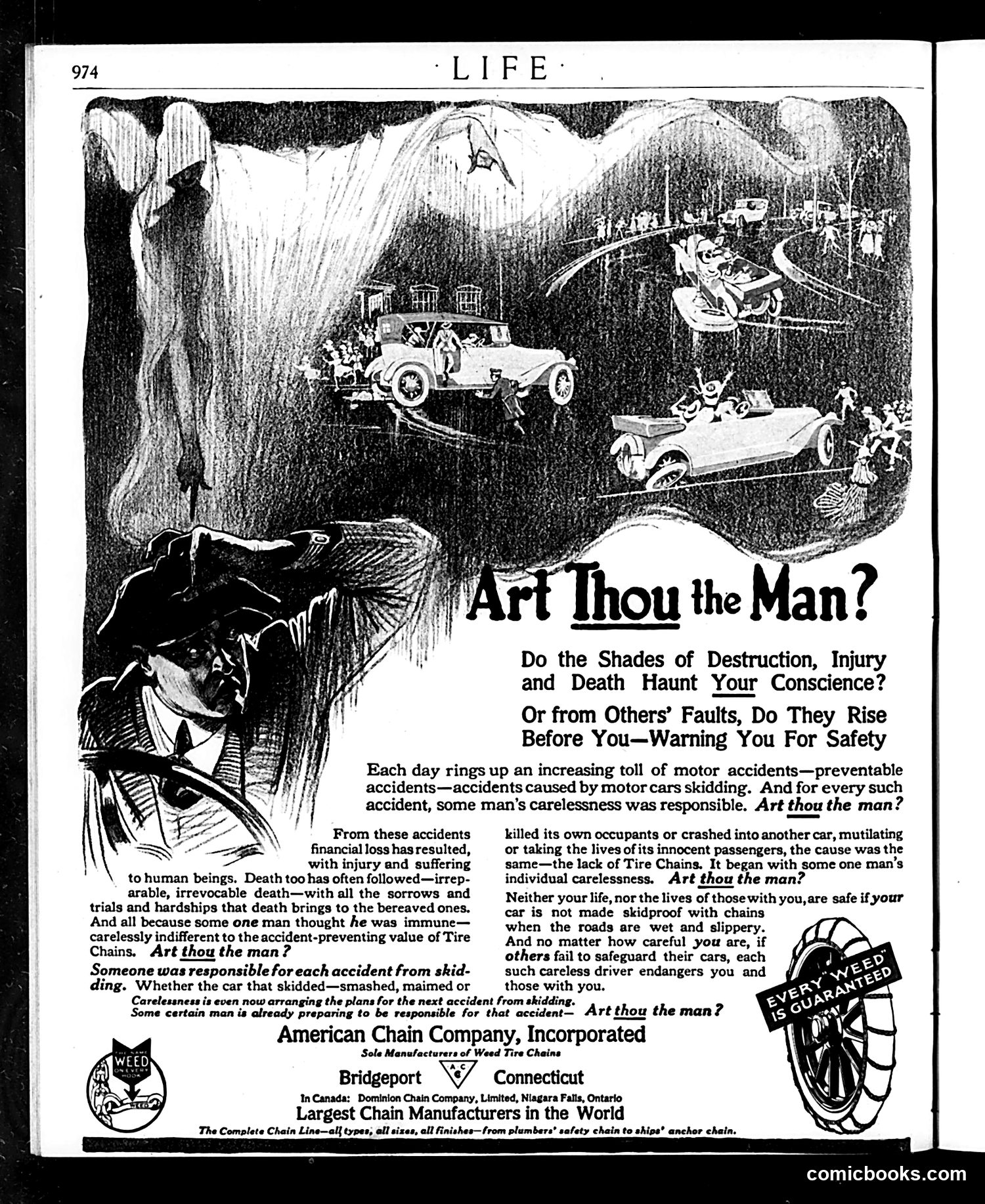
This is primarily a **safety advertisement** for Weed tire chains, not satire or political commentary. The ad uses moral persuasion to promote tire chains as safety devices for wet/slippery roads. The visual shows a ghostly figure (representing death/consequences) overlooking scenes of 1920s automobiles and recreational activities. The repeated question "Art thou the man?" directly addresses readers' consciences about preventable motor accidents. The core message: motor accidents causing injury and death are often preventable through simple precautions like tire chains. The ad suggests drivers bear moral responsibility for accidents caused by their carelessness—a guilt-based sales approach appealing to readers' sense of safety responsibility for themselves and passengers. This reflects 1920s automotive safety concerns and advertising strategies.
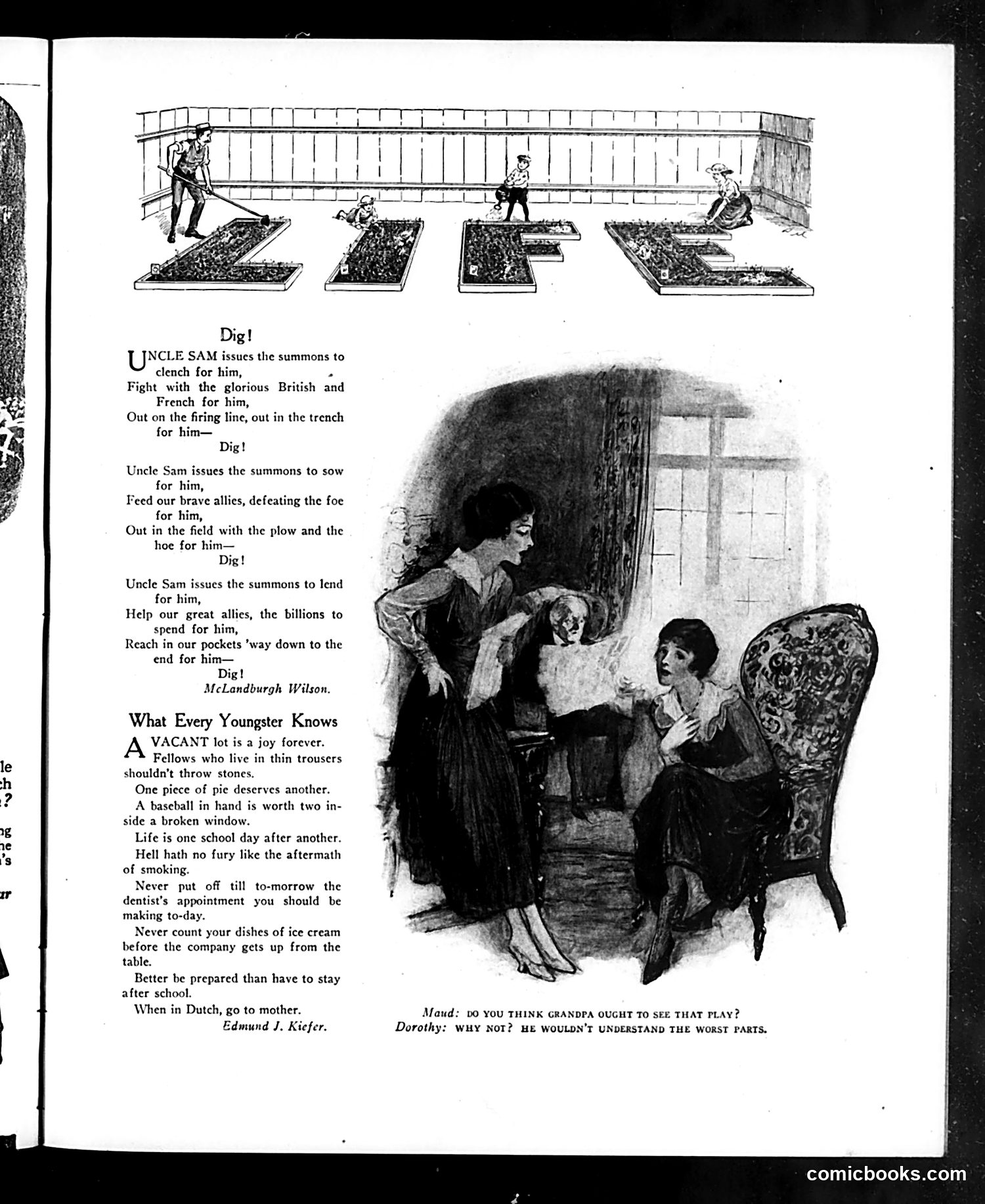
**Top Illustration ("Dig!")**: This patriotic wartime propaganda cartoon depicts workers laying out large letters spelling "LIFE" in what appears to be a trench or fortified position. The poem by McLandburgh Wilson uses repeated calls to "Uncle Sam" (personifying America) to mobilize citizens—summoning them to "clench," fight allies' enemies, sow crops, and lend money to support the war effort. The visual metaphor suggests Americans collectively building patriotic support through coordinated labor. **Bottom Section**: "What Every Youngster Knows" is a humorous advice column by Edmund J. Kiefer offering cynical wisdom to youth—vacant lots are joyful, broken windows matter less than pie, and one should always keep dentist appointments. The accompanying sketch shows a grandmother and children, with dialogue suggesting grandparents shouldn't attend adult theatrical productions. This appears to be WWI-era content mixing serious patriotic messaging with lighthearted domestic humor.
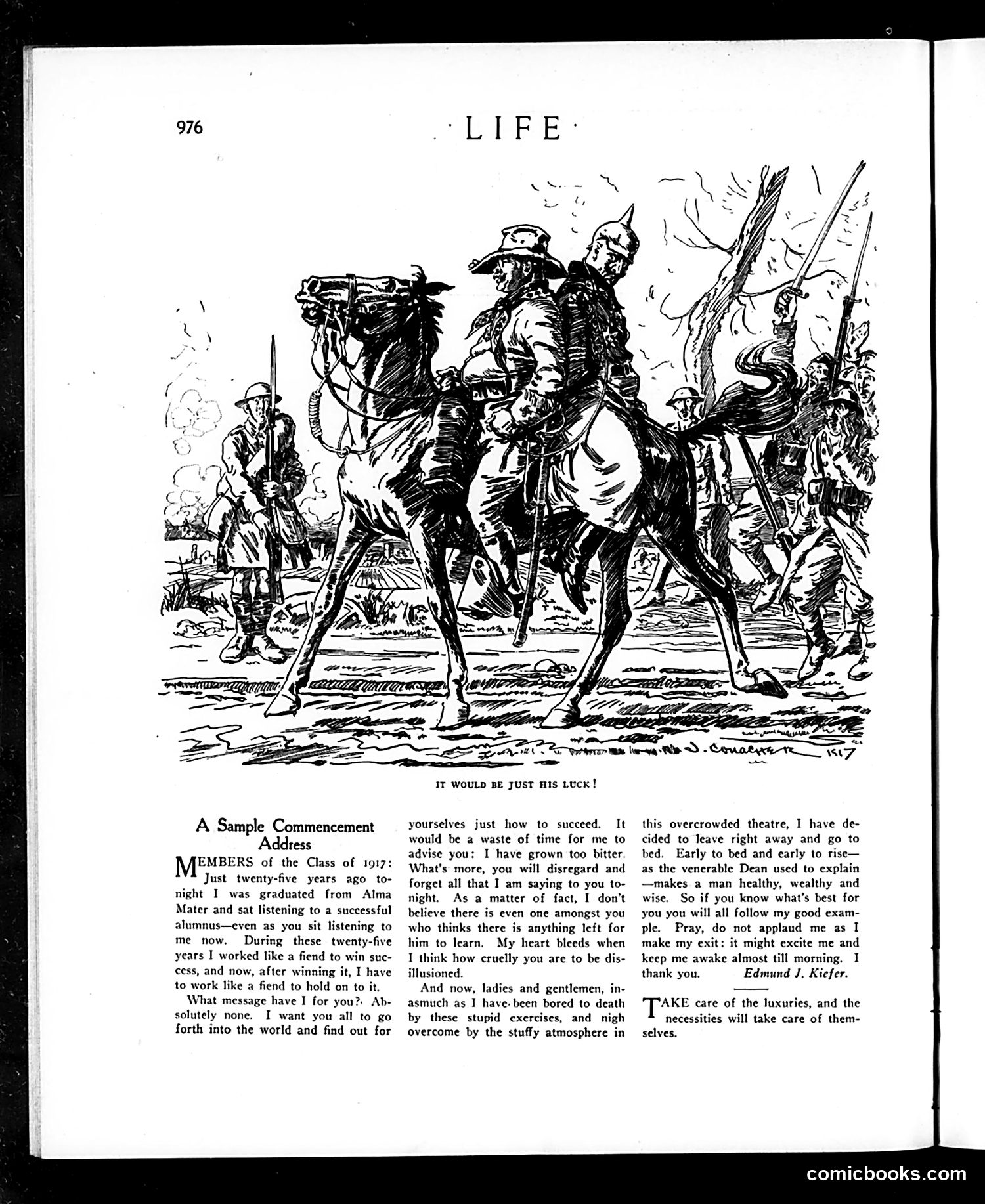
This page contains a commencement speech excerpt paired with a military illustration captioned "IT WOULD BE JUST HIS LUCK!" The illustration shows soldiers on horseback and on foot, appearing to be from a military campaign or battle scene. The speaker, identified as "Edmund J. Kiefer," addresses the Class of 1917, sarcastically telling graduates that hard work and persistence are pointless. He suggests they're naive to expect success and mockingly advises them to enjoy luxuries instead, concluding that "the luxuries, and the necessities will take care of themselves." The satire appears to reference the context of 1917—likely reflecting anxieties about WWI and suggesting that graduates' futures are uncertain or predetermined by circumstances beyond their control, making earnest commencement platitudes seem hollow or absurd.
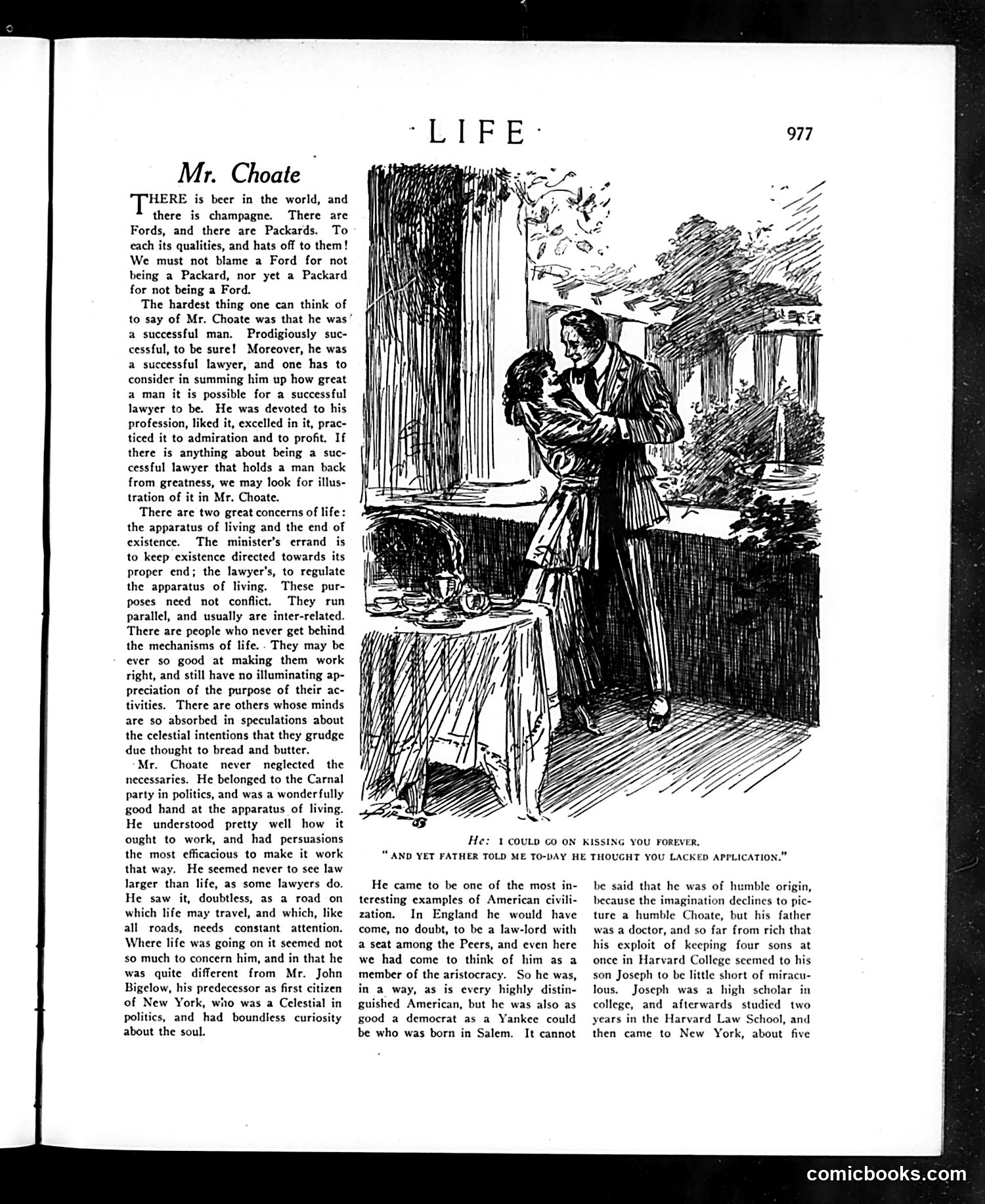
This page features an article about Mr. Choate, described as a successful lawyer and prominent American figure. The illustration shows a woman in Victorian dress leaning toward a man, with a caption reading "And yet father told me to-day he thought you lacked application." The satire appears to target Choate's reputation and social standing. The text discusses how his success in law contrasts with broader philosophical questions about life's purpose—distinguishing between maintaining existence and understanding it. The woman's comment about "lacking application" creates ironic humor, given Choate's documented professional success. The piece uses Choate as a vehicle to explore class distinctions, American democracy versus European aristocracy, and whether professional achievement alone constitutes a complete life.
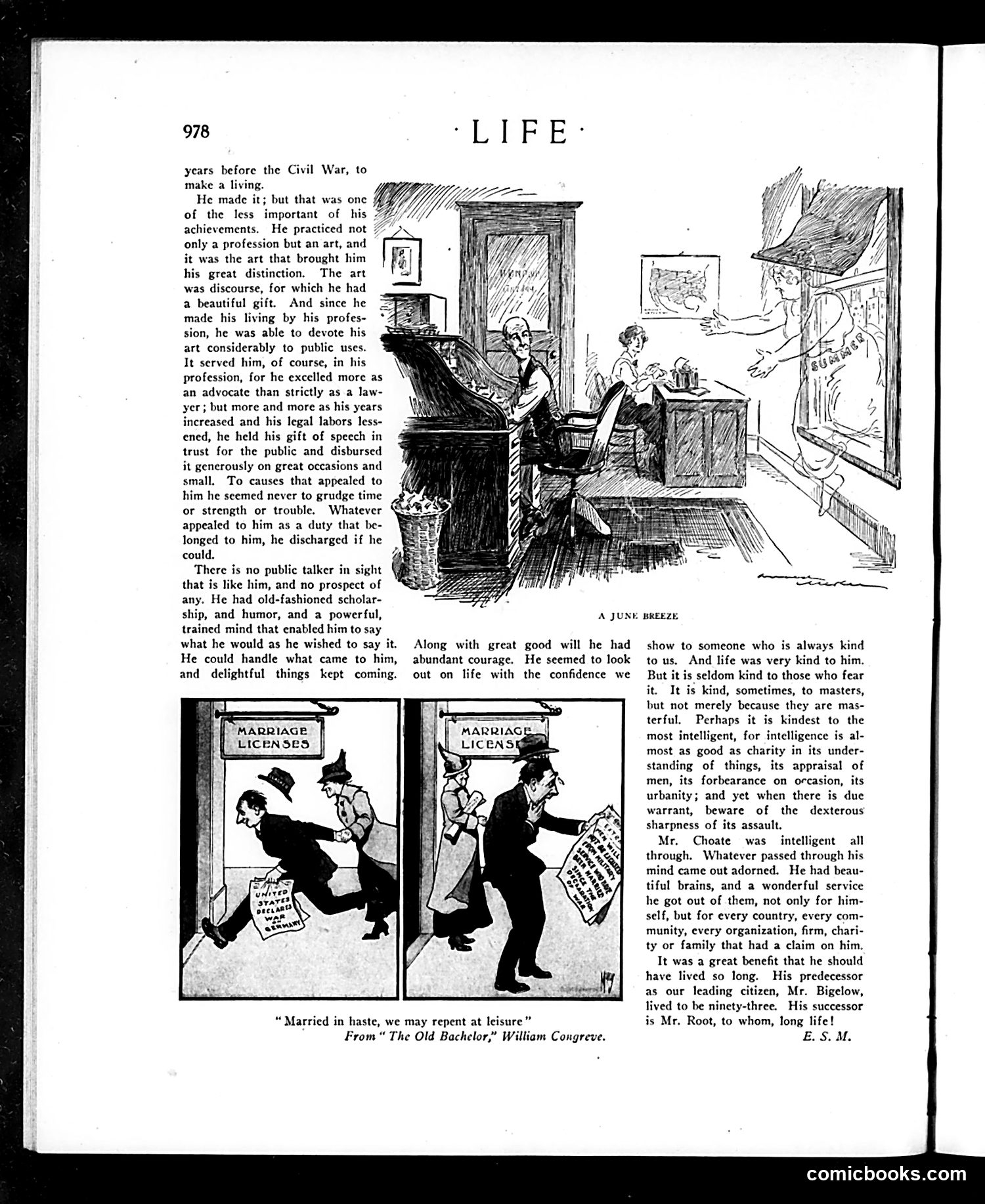
This page features a biographical article about an unnamed public figure (likely a lawyer or advocate based on the text) alongside two cartoon panels satirizing hasty marriages. The two-panel cartoon, credited to William Congreve's "The Old Bachelor," shows a man rushing to a "Marriage Licenses" office, then frantically departing with documents. The caption reads "Married in haste, we may repent at leisure"—a classic warning about impulsive matrimony. The upper illustration depicts people in an office or study setting, appearing to illustrate the biographical subject's professional life. The satire targets impetuous marriage decisions, using the frantic imagery to mock those who rush into wedlock without proper consideration, a common theme in early 20th-century American humor about courtship and domestic life.
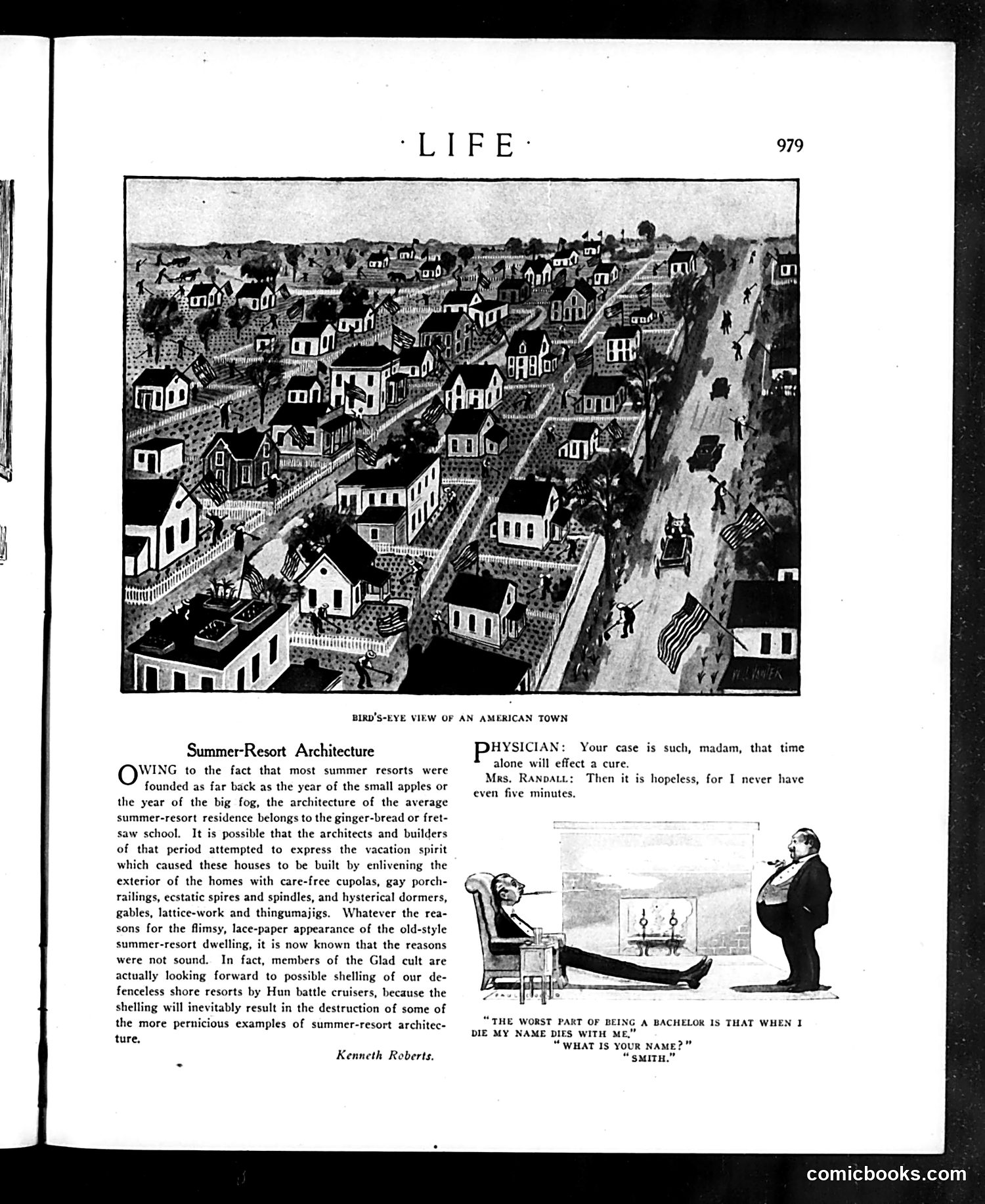
This page contains two separate pieces: **Top:** A bird's-eye illustration of an American town with orderly grid streets, houses, and residents. This appears to be a generic "American town" depiction rather than satire of a specific place. **Bottom Left:** An article titled "Summer-Resort Architecture" by Kenneth Roberts. It critiques the architectural style of old summer resort homes—describing their "ginger-bread" aesthetic with "care-free cupolas, gay porch railings, ecstatic spires" as frivolous. Roberts argues these structures are unsound and will be destroyed, warning that "Hun battle cruisers" will inevitably shell them, destroying "pernicious examples of summer-resort architecture." **Bottom Right:** An unrelated cartoon showing a doctor and patient, with dialogue about a bachelor's misfortune when dying—his name dies with him. The summer-resort critique reflects period anxieties about World War I and architectural taste, mocking Victorian excess.
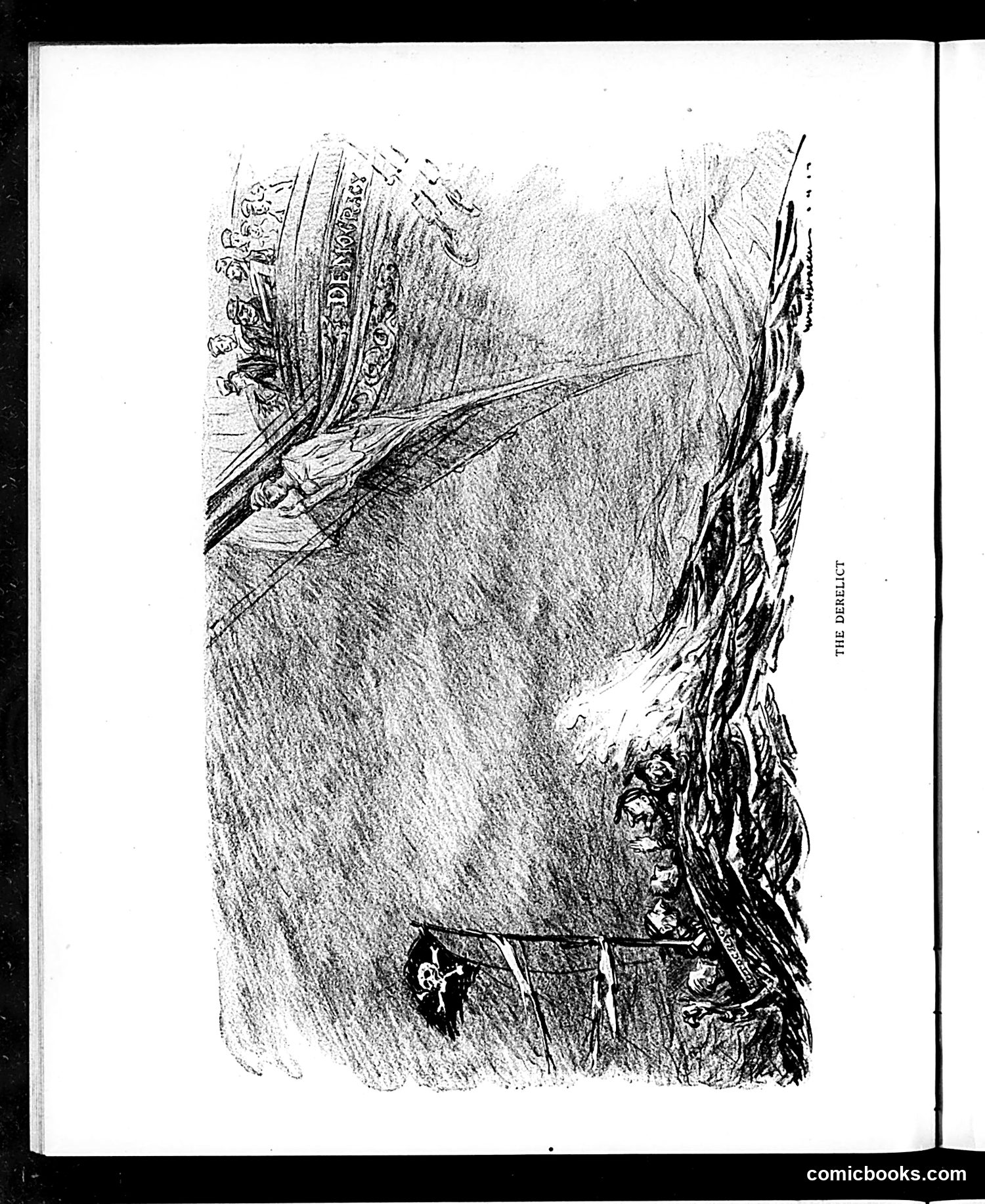
This appears to be a satirical sketch from Life magazine, drawn in a detailed cross-hatched style typical of late 19th or early 20th-century American editorial illustration. The image shows what appears to be a military or institutional scene with uniformed figures and hierarchical dynamics. The title "The Demerit" suggests commentary on punishment or disciplinary systems within rigid institutional structures—possibly military, naval, or academic. The composition emphasizes power dynamics, with authority figures positioned above and subordinates below. The detailed rendering of uniforms and formal setting indicates this likely critiques institutional authority or the consequences of rule-breaking within hierarchical systems. Without additional context or visible text identifying specific individuals or incidents, the precise satirical target remains unclear, though the theme appears to be institutional discipline and its consequences.
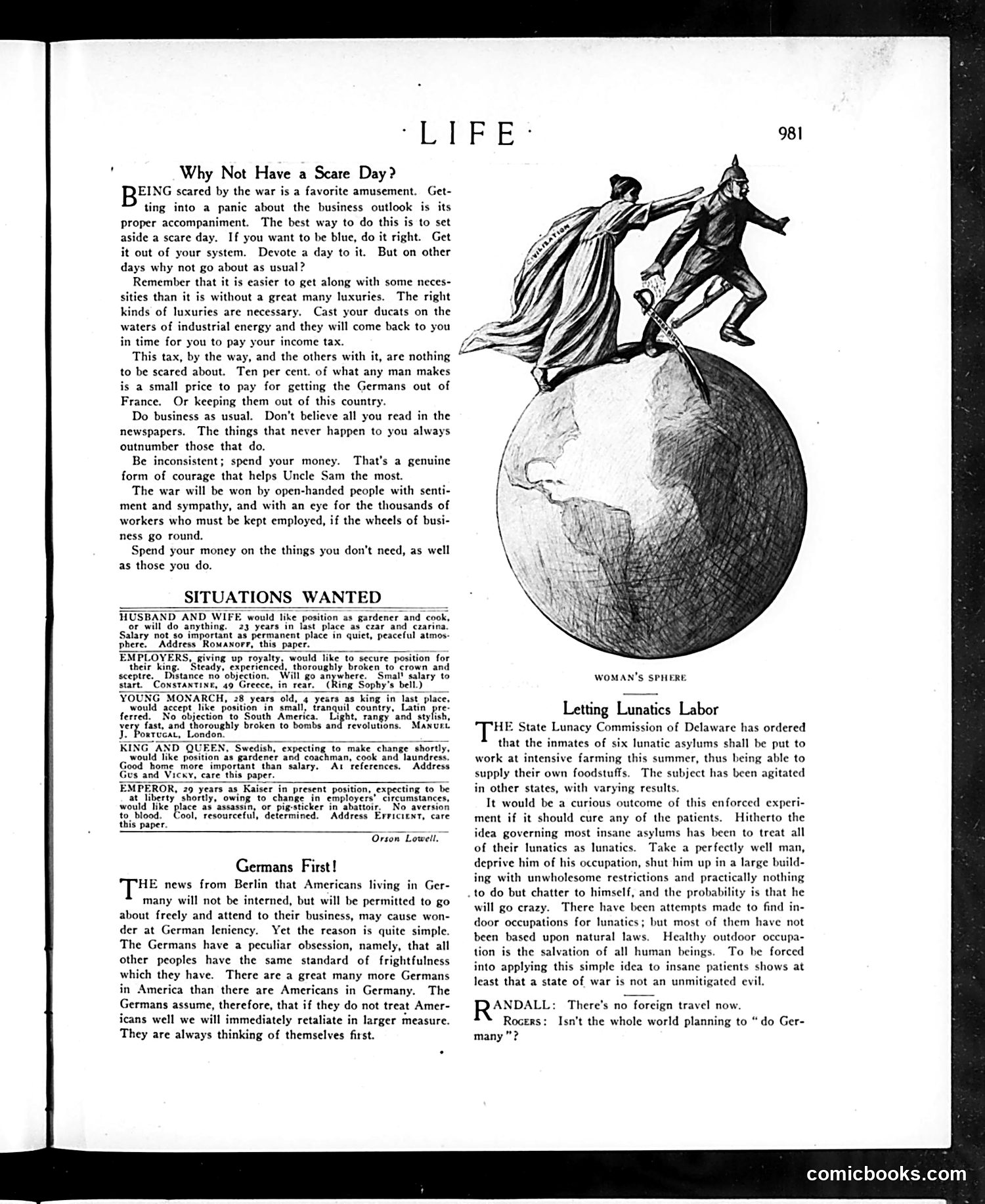
The main illustration, titled "Woman's Sphere," depicts a woman balanced precariously atop a globe while juggling or managing what appears to be fabric or domestic responsibilities. This satirizes women's traditional domestic role during WWI era, suggesting the burden of managing a household while the world is in chaos. The accompanying articles address practical wartime concerns: "Why Not Have a Scare Day?" advises managing economic anxiety through budgeting; "Letting Lunatics Labor" discusses using asylum patients for farm work to address labor shortages; and "Germans First!" cautions Americans against trusting Germans due to assumed ethnic loyalty conflicts. The satire reflects anxieties about loyalty, economic disruption, and social disruption during the First World War period.
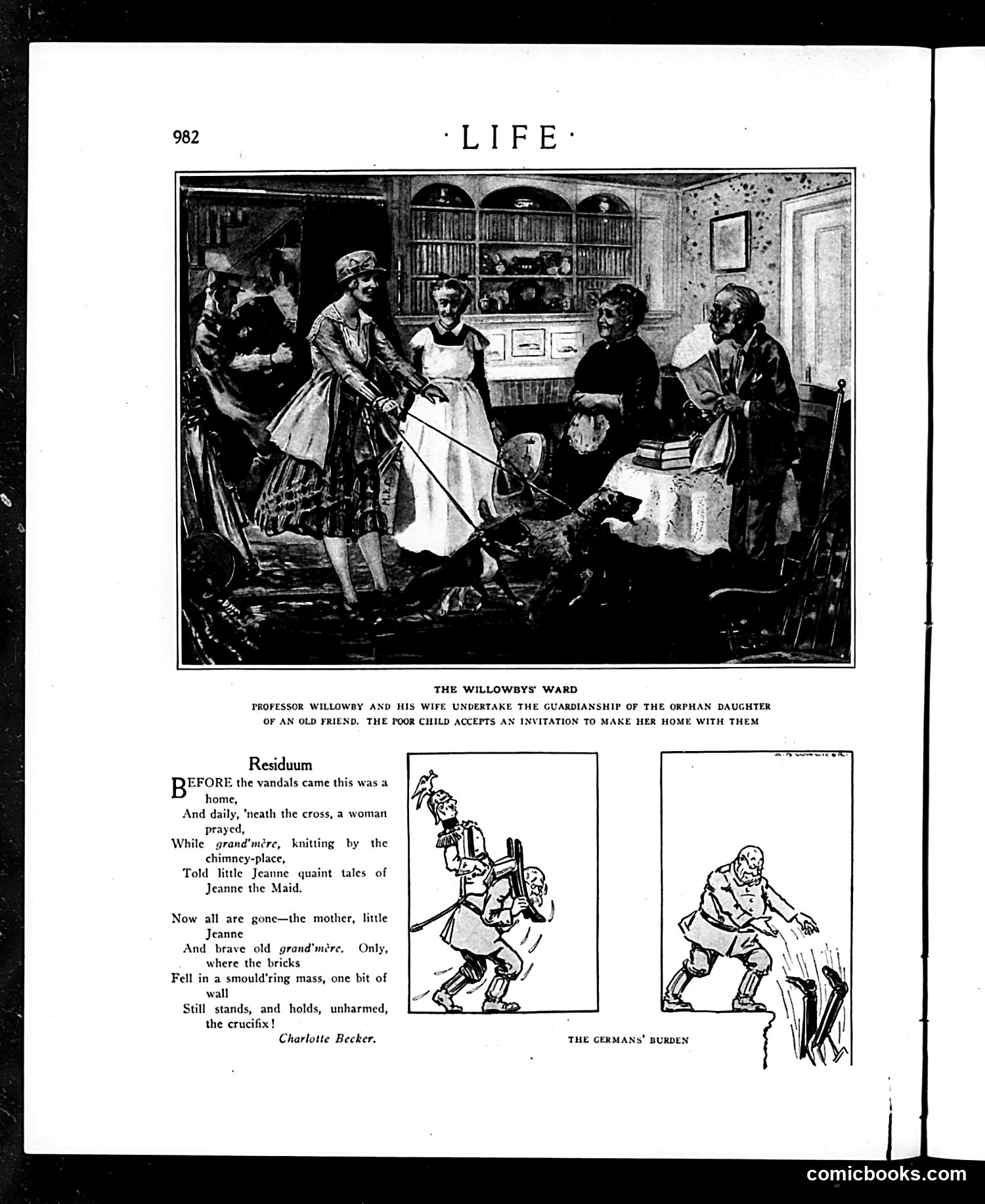
**Main Image**: A domestic scene showing Professor Willowby and his wife taking in an orphan girl. The caption explains they're becoming guardians to "the poor child." **"Residuum" Poem by Charlotte Becker**: This is a commentary on urban poverty and loss. It describes a tenement home where a grandmother once told stories to a child named Jeanne. Now "all are gone"—the mother and grandmother have died—and only the ruins of the building remain, with a crucifix still standing among the wreckage. **Two Smaller Cartoons**: "The Germans' Burden" (right) shows a figure struggling under weight, likely satirizing Germany's imperial ambitions or war responsibilities. The page contrasts charity (the Willowbys taking in an orphan) with the darker reality of widespread poverty and loss depicted in Becker's poem—a common Life magazine theme addressing social inequality.
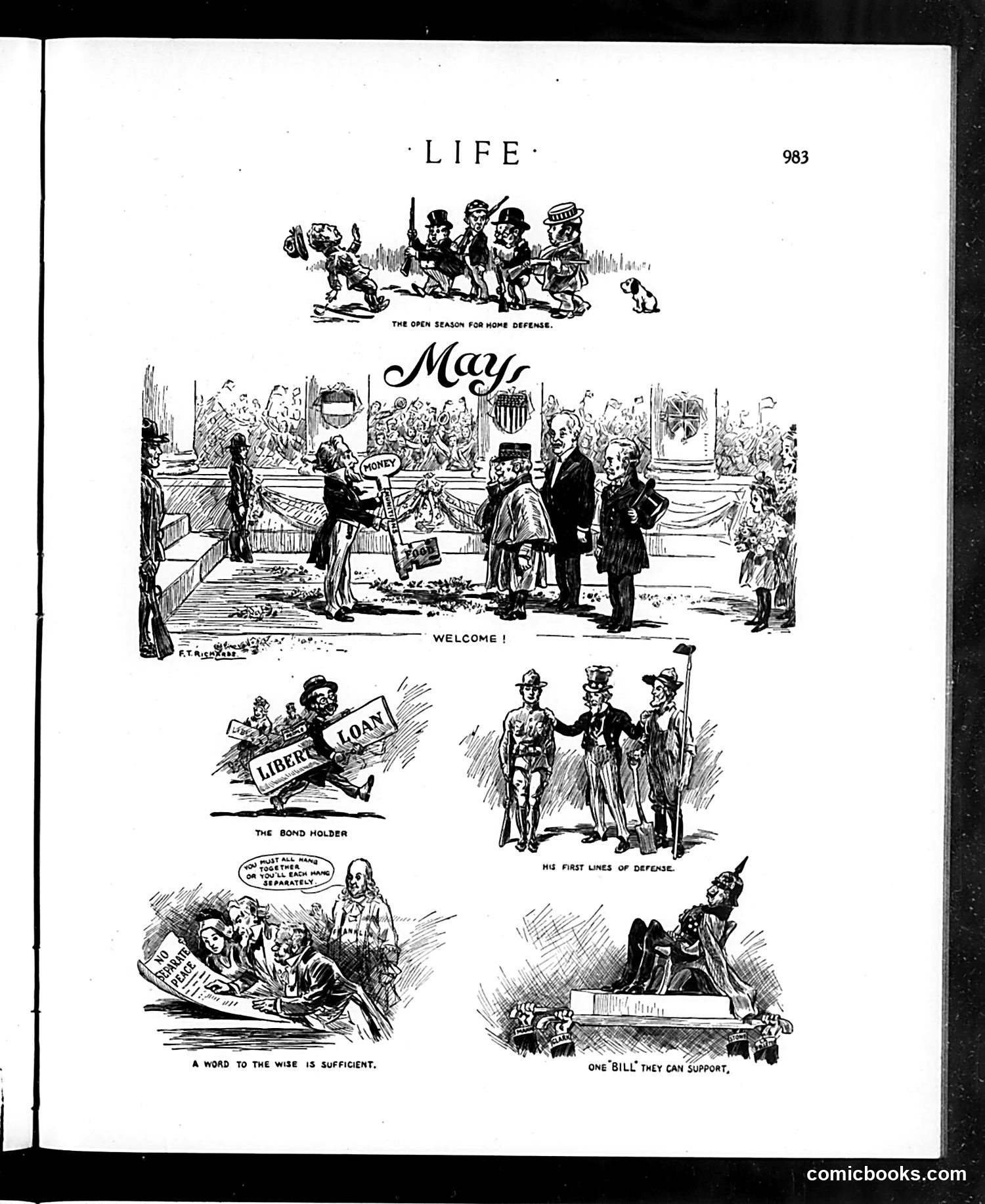
This page contains May-themed political satire about American home defense, likely from WWI era based on references to "Liberty Loan" bonds and military preparedness. The cartoons mock citizens' responses to war financing: - **"The Bond Holder"**: Shows someone struggling under a "Liberty Loan" banner, satirizing the burden of purchasing war bonds. - **"Welcome!"**: Depicts officials greeting what appears to be a wealthy or important figure at a formal event, likely critiquing preferential treatment. - **"His First Lines of Defense"**: Shows military/civilian figures, referencing home defense preparations. - **"A Word to the Wise is Sufficient"** and **"One 'Bill' They Can Support"**: Suggest commentary on financial obligations and civic duty during wartime. The overall theme critiques how ordinary citizens bear financial and social burdens of war while elites profit or avoid sacrifice.
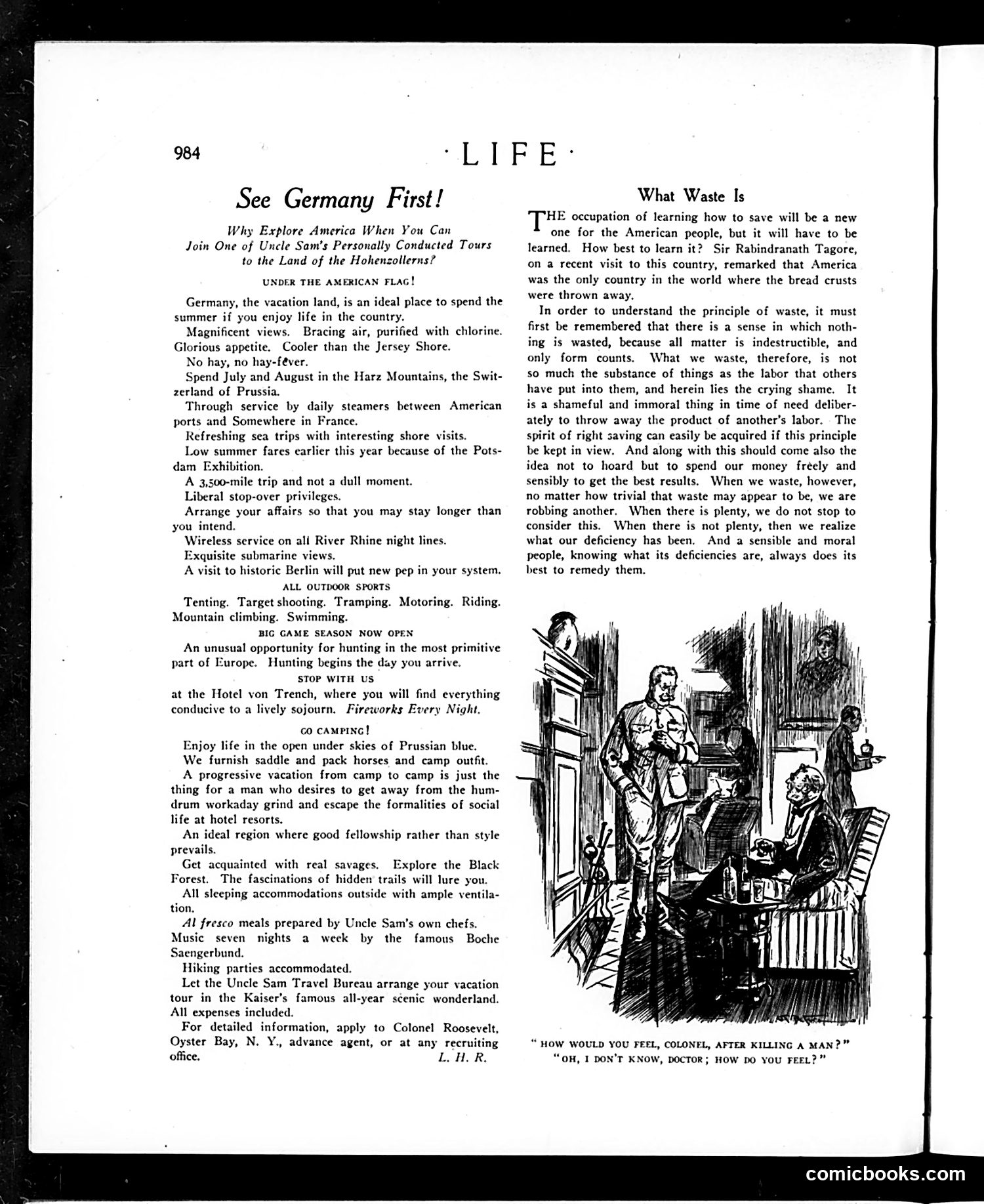
This page contains **satirical war propaganda** from World War I. The left column mocks American pacifism by parodying a travel advertisement for Germany—presenting it as a vacation destination while obliquely referencing warfare ("big game season now open," "hunting begins the day you arrive"). It mentions Colonel Roosevelt as a recruiting agent, likely Theodore Roosevelt, who advocated American entry into WWI. The cartoon shows soldiers or military men in what appears to be casual conversation, with the caption asking how one feels after killing. This darkly satirizes the reality of combat versus sanitized recruitment rhetoric. The right column, "What Waste Is," pivots to serious moralizing about conservation during wartime, citing Indian poet Rabindranath Tagore's criticism of American wastefulness. It frames frugality as patriotic duty—not hoarding but spending wisely during national need. Together, the page juxtaposes bitter satire about enlisting with earnest calls for home-front sacrifice.
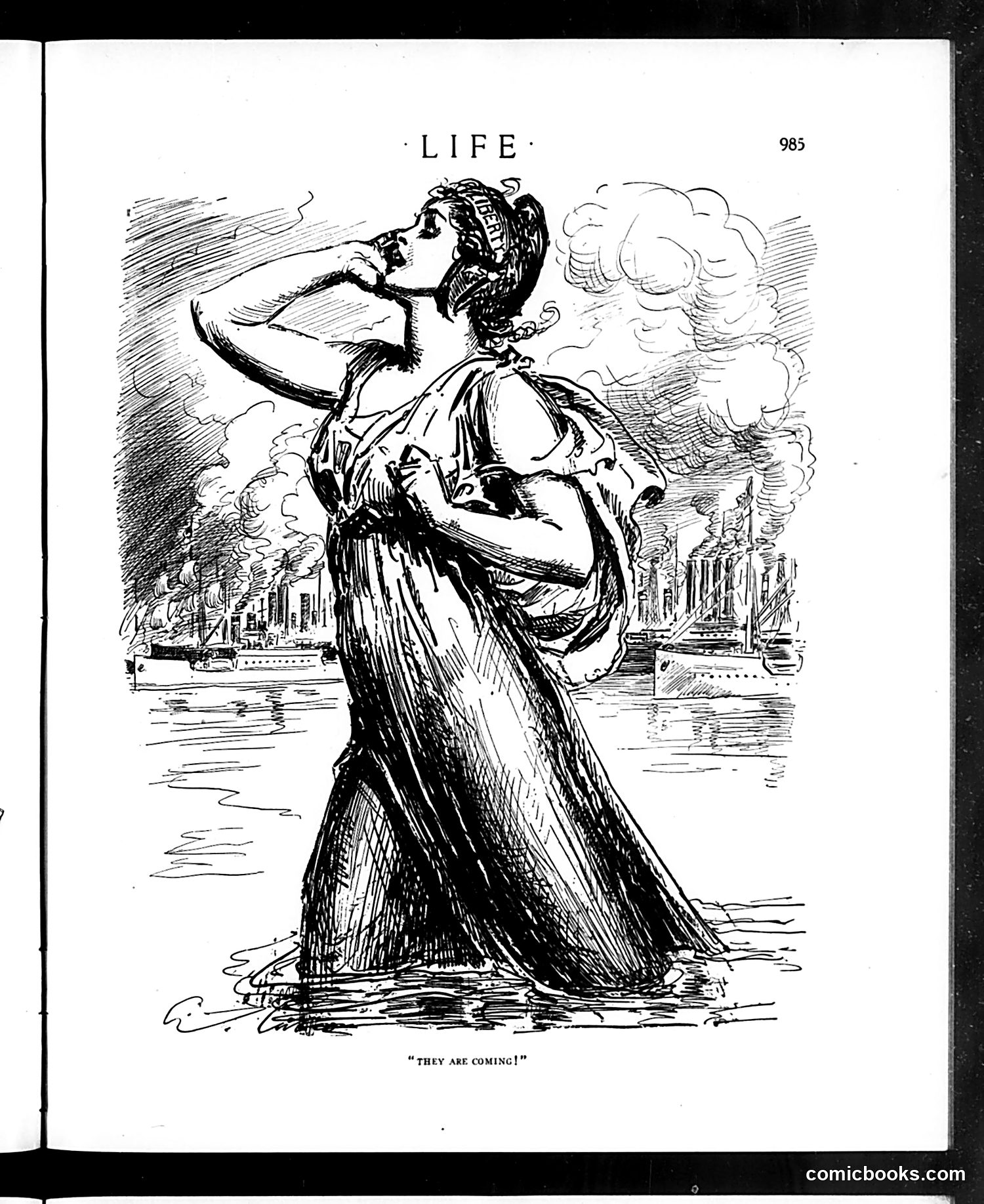
This Life magazine illustration (page 985) depicts a woman in classical dress standing in water, shading her eyes as she gazes toward a distant cityscape with industrial smokestacks. The caption "THEY ARE COMING!" suggests anticipation or alarm. The image appears to be satirical commentary on industrialization and urban growth. The classical female figure—possibly representing tradition, nature, or an idealized past—contrasts sharply with the modern industrial city looming behind her. Her posture conveys concern or vigilance about approaching change. Without additional context about Life's publication date, the specific historical moment remains unclear, but the cartoon likely critiques rapid industrialization's encroachment on established ways of life or natural landscapes, a common satirical theme in early-to-mid 20th century American commentary.
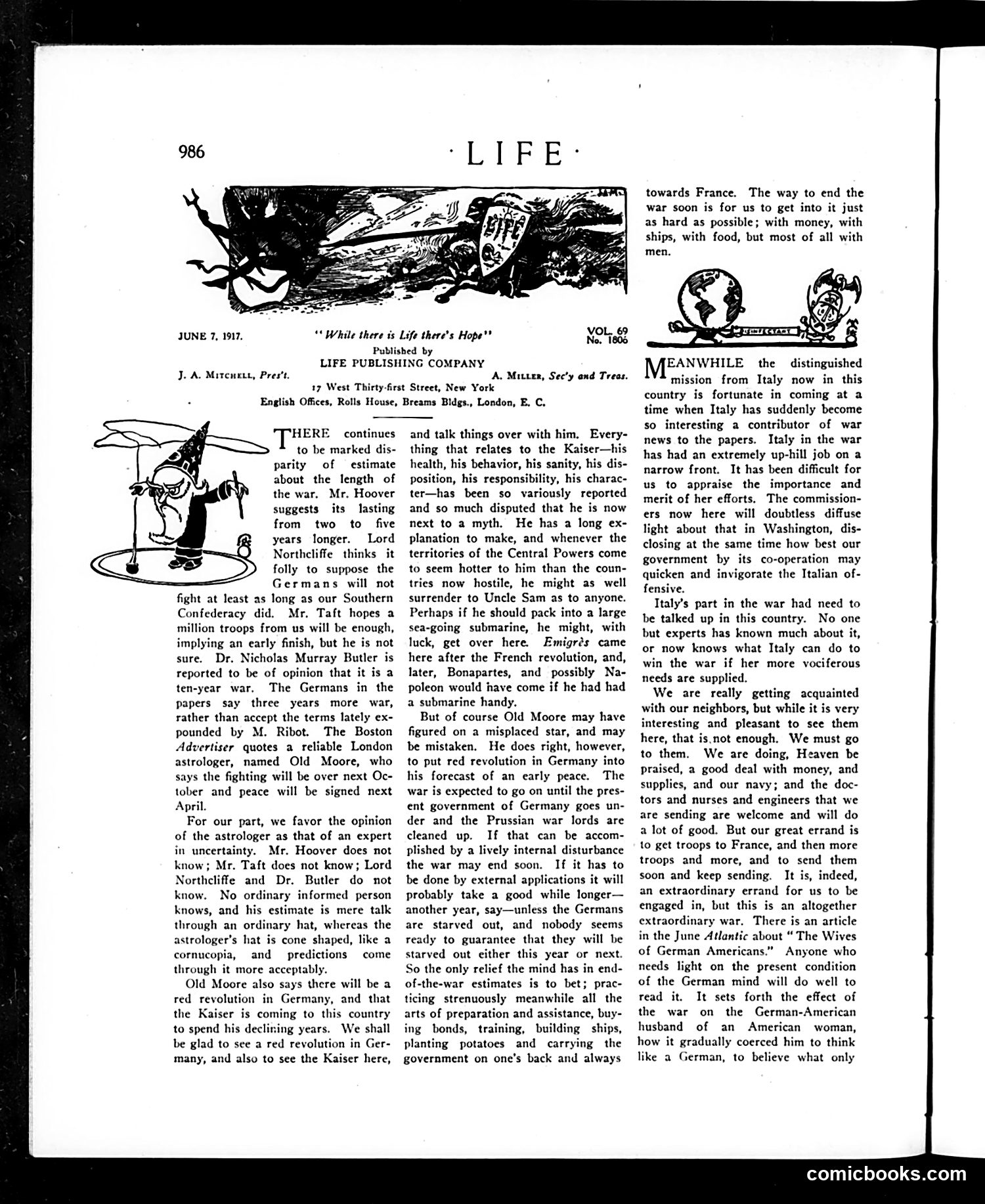
This page contains satirical commentary on World War I, published shortly after the U.S. entered the conflict (April 1917). **Main Cartoon/Editorial Focus:** The article mocks conflicting predictions about the war's duration. Various authorities—Herbert Hoover, Lord Northcliffe, William Howard Taft, and Nicholas Murray Butler—offer vastly different estimates (2-10 years). Life satirically endorses "Old Moore," a London astrologer, whose predictions seem as valid as anyone else's given the uncertainty. **The Satire:** The piece ridicules experts' inability to predict outcomes while praising the astrologer's "cone-shaped" hat (cornucopia) as appropriately shaped for dispensing predictions. Life then humorously suggests the Kaiser might flee to America via submarine, like French émigrés after their revolution, implying Germany's imminent internal collapse. **Context:** The astrologer figure represents wartime desperation—when genuine experts fail, even superstition seems reasonable. The piece advocates aggressive American war effort (money, ships, food, troops) as the fastest path to victory. **Italian Mission Reference:** The closing paragraph shifts to Italy's newly heightened importance as a war contributor.
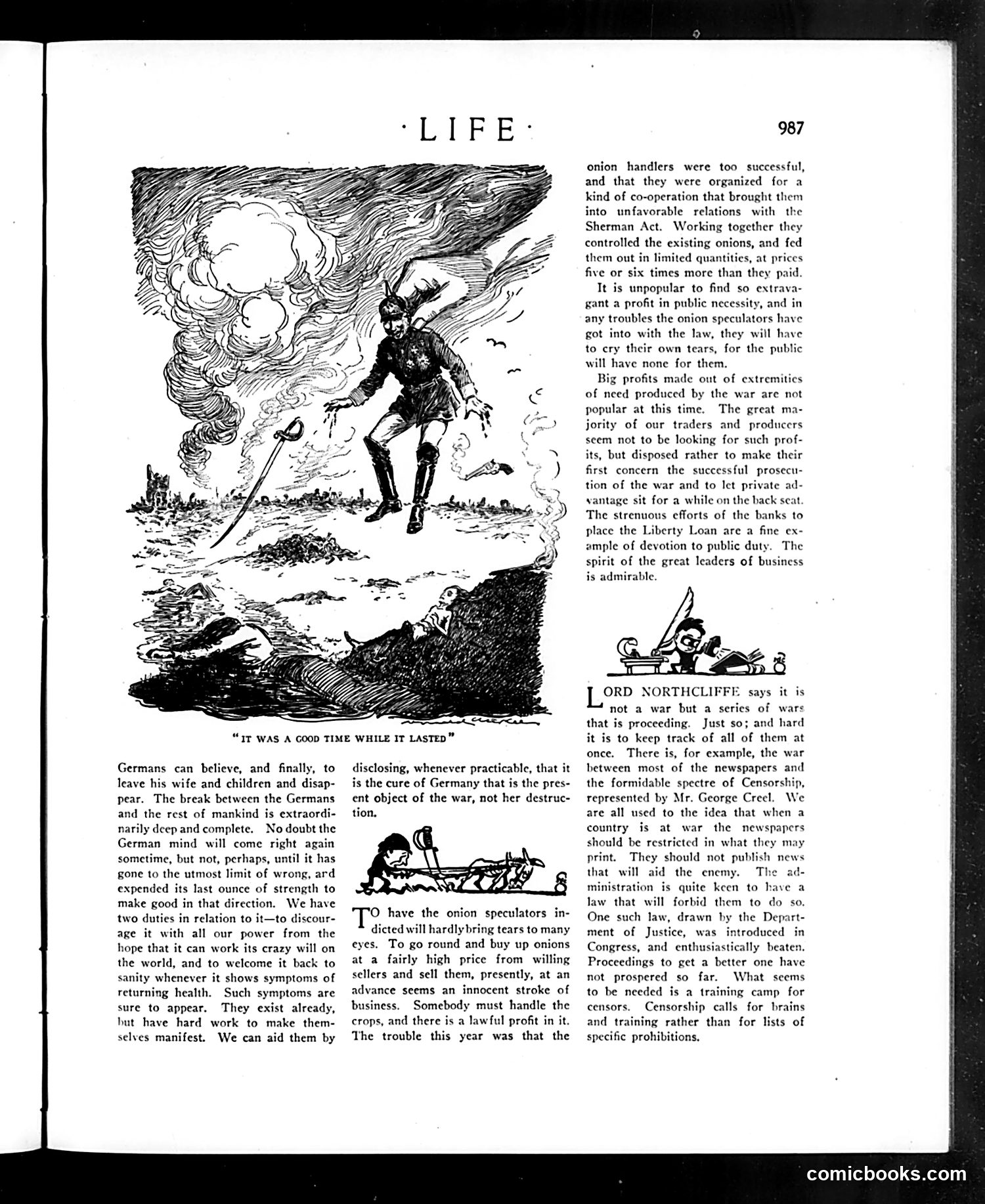
This WWI-era *Life* magazine page (page 987) contains two satirical pieces: **The Main Cartoon** ("It Was a Good Time While It Lasted"): A demonic figure—representing Germany—exhales destruction and flame over a devastated landscape. The satire mocks German militarism and warns that Germany's aggressive ambitions will ultimately fail, though the author argues Germany's "mind" can eventually recover if given proper redirection. **The Onion Speculation Piece**: This critiques domestic war profiteering. Speculators monopolized onions and sold them at 5-6 times their purchase price, exploiting wartime scarcity. The piece condemns such greed as unpopular during national emergency, contrasting it favorably with banks' patriotic efforts on the Liberty Loan (government war bonds). **The Censorship Note**: References Lord Northcliffe and George Creel (head of the Committee on Public Information), discussing tension between press freedom and military security. The author argues censors need training and judgment, not just prohibition lists. The overall theme: patriotic duty should trump private profit during wartime.
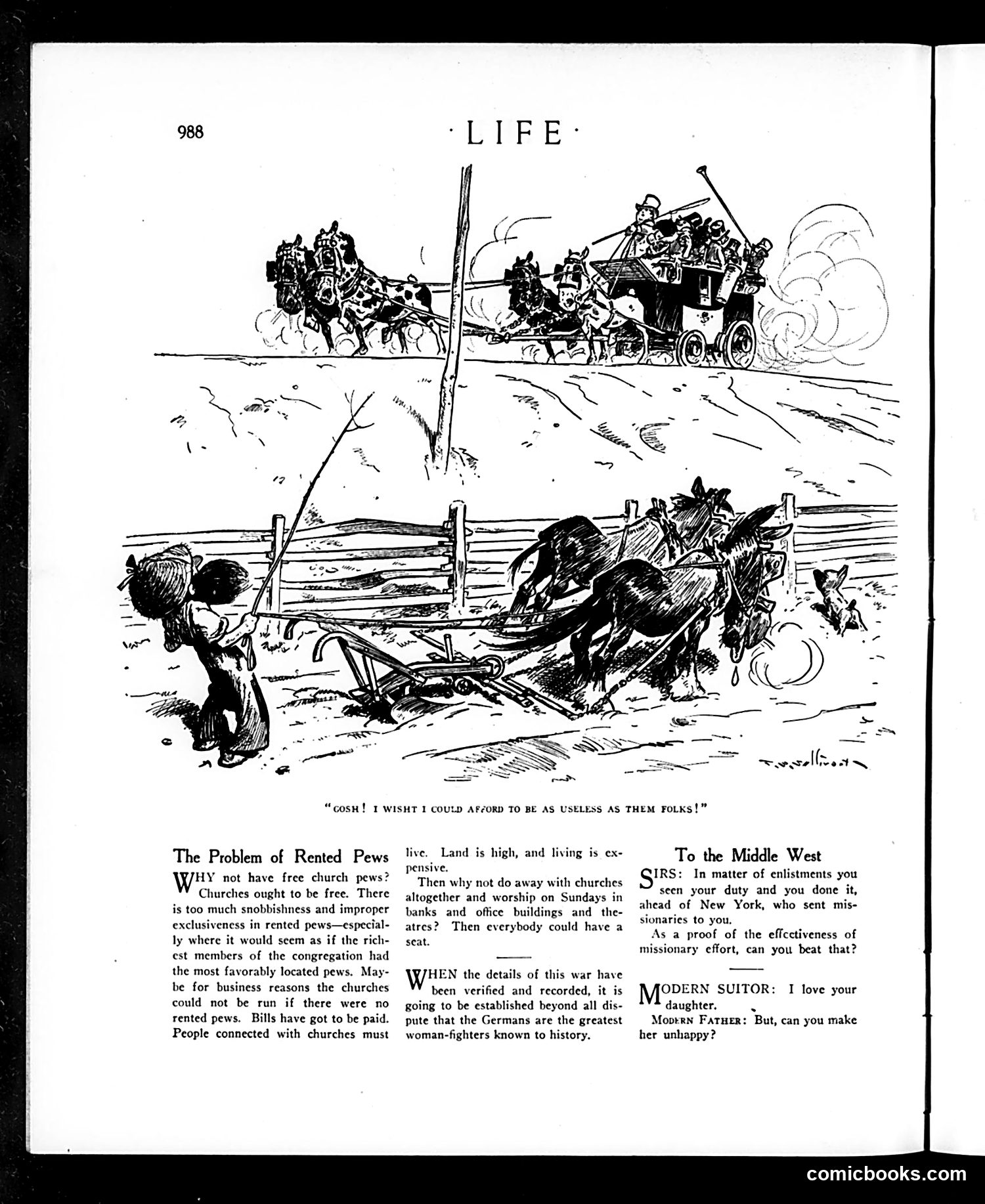
This page contains three separate satirical pieces from Life magazine (likely WWI-era): **Main Cartoon**: A poorly-dressed man with a broken plow watches wealthy people pass in a fancy carriage, saying he wishes he could "afford to be as useless as them folks." This satirizes class inequality and idleness among the wealthy. **"Problem of Rented Pews"**: Critiques churches charging for seating, which created class segregation—wealthy members got prime pews. The piece sarcastically suggests removing churches entirely if they won't offer free access. **"To the Middle West"**: Appears to mock rivalry between regions regarding WWI enlistments, suggesting the Midwest enlisted more than New York (which sent missionaries instead). **"Modern Suitor"**: A brief comedic exchange where a suitor asks a father for his daughter's hand; the father's response—"can you make her unhappy?"—jokes cynically about marriage expectations, inverting the romantic ideal. All pieces employ satirical humor to critique social issues: class pretension, religious hypocrisy, regional pride, and matrimonial pessimism.
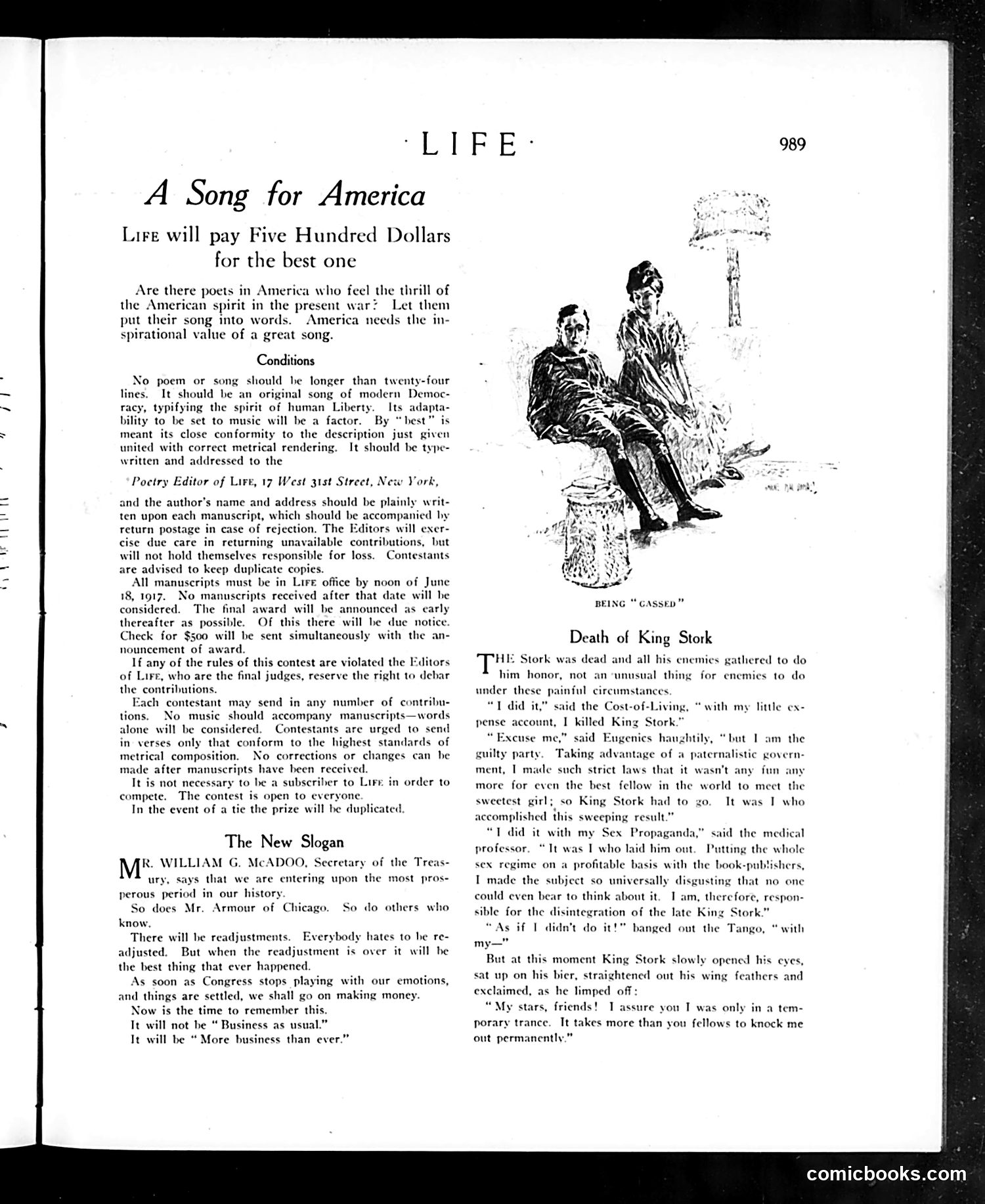
**"A Song for America"** is a patriotic contest soliciting poetry celebrating American democracy and liberty during WWI (the June 18, 1917 deadline places this during U.S. involvement). The $500 prize reflects Life's attempt to inspire nationalist sentiment through art. **"The New Slogan"** satirizes economic optimism from Treasury Secretary William G. McAdoo and Chicago industrialist Philip Armour, who claim postwar prosperity awaits. The satire mocks their insistence that hardship ("readjustment") will yield profits—essentially prioritizing "More business than ever" over workers' welfare. **"Death of King Stork"** (partially visible) appears to be an allegorical tale where various social forces—Cost-of-Living, Eugenics movement, Sex Propaganda, and the Tango dance craze—claim credit for King Stork's demise. This likely satirizes how progressivist social engineering and cultural changes were blamed for declining birth rates during this era.
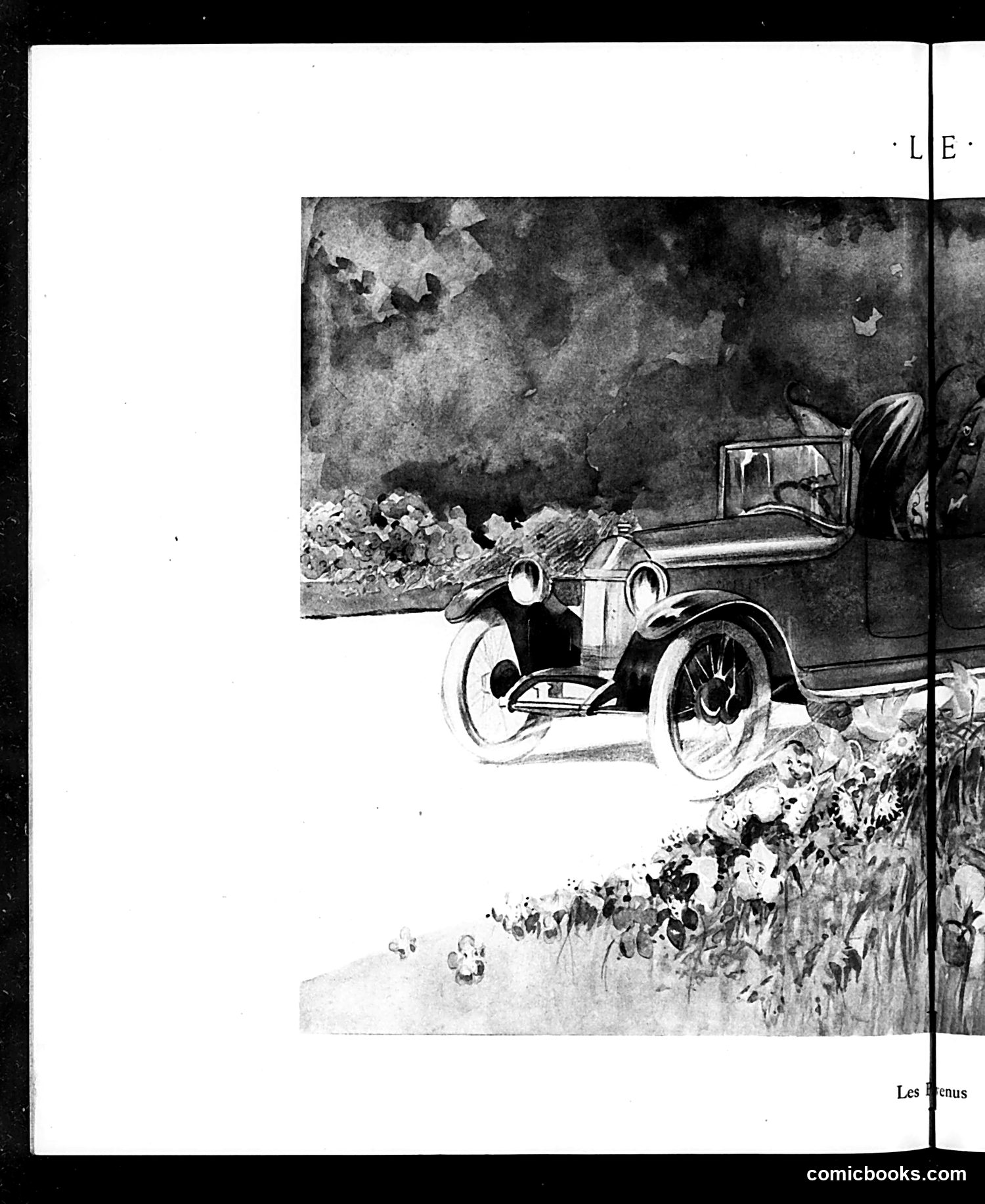
This page contains a single illustration showing an early automobile (appears to be from the 1910s-1920s era based on the vehicle's design) parked near a stone wall with flowering plants in the foreground. The image itself doesn't appear to be overtly political satire. Rather, it seems to be an advertisement or lifestyle illustration promoting automobiles—likely celebrating the novelty and appeal of motor vehicles as status symbols or leisure pursuits of the era. The romantic, pastoral setting with flowers suggests marketing the automobile as enabling pleasant, refined outings. Without clearer OCR text or additional context from surrounding pages, the specific satirical point—if any—remains unclear. The illustration may simply represent aspirational consumer culture of the period.
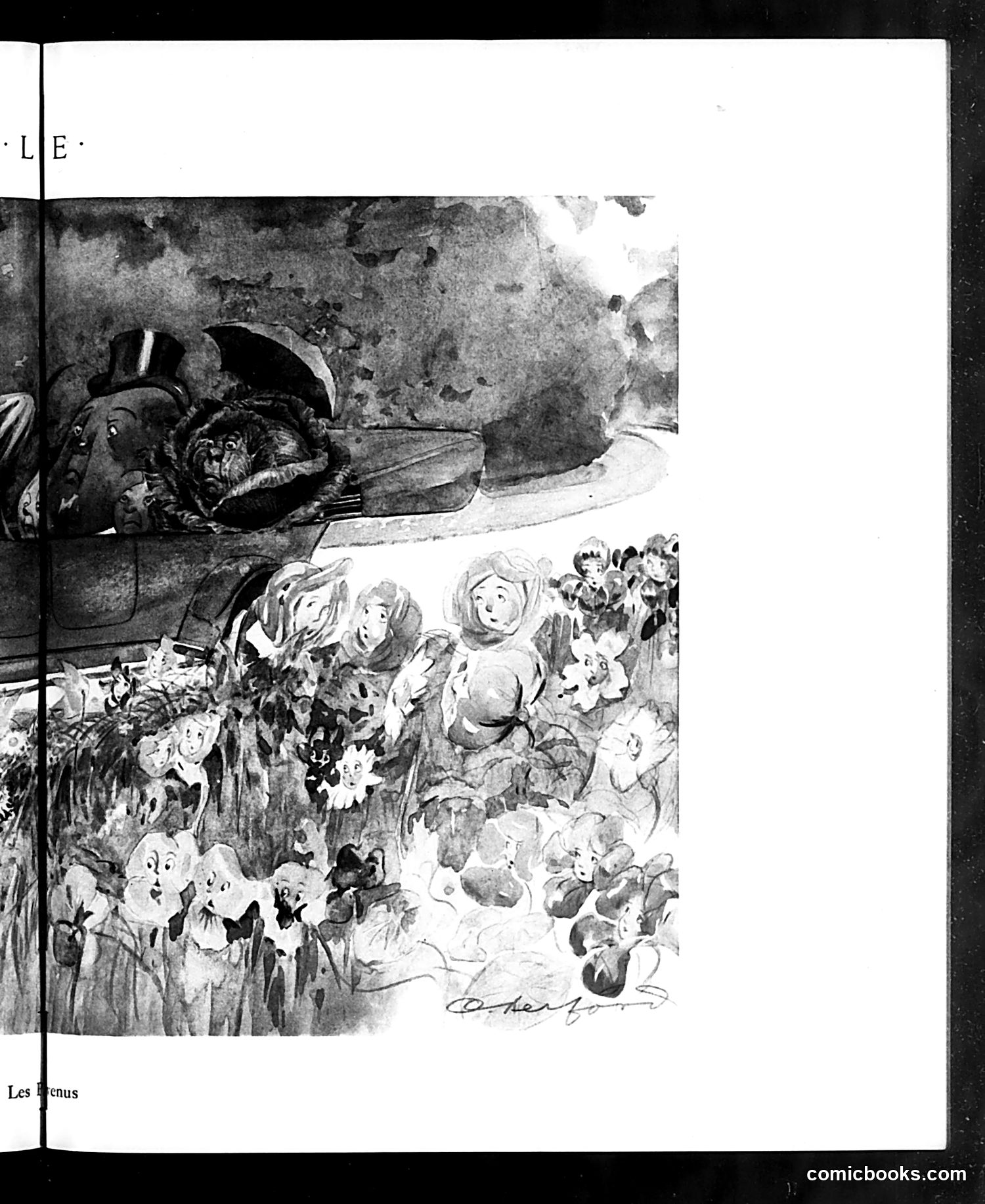
This appears to be a satirical illustration from *Life* magazine showing two caricatured figures in formal dress (top hats and coats) positioned above a garden of flowers with human faces. The figures appear to be looking down at or surveying the flowering garden below. The style suggests political or social satire, likely commenting on authority figures or power dynamics observing common people (represented by the anthropomorphic flowers). However, without clearer OCR text or visible title/caption, I cannot definitively identify the specific figures or the exact political event being referenced. The composition suggests commentary on surveillance, control, or condescension by those in power toward ordinary citizens, but the precise satirical point remains unclear from this image alone.
This is a monologue-style satirical piece about German-American identity during World War I (the references to the Lusitania and Kaiser indicate pre-1917 U.S. neutrality debates). **The Setup:** A German immigrant ("Ach Louie") runs a beer saloon. The narrator visits and notices Louie has dramatically Americanized—displaying American flags and portraits of Wilson, Lincoln, Teddy Roosevelt. **The Point:** When the narrator addresses him in German/accented English, Louie angrily insists he's American, not German. However, his passionate speech—still in thick accent—reveals the conflict: he initially felt detached from European conflicts, but now declares fierce commitment to fighting "against" German aggression if America enters the war. **The Satire:** The humor cuts both ways—mocking both the performative patriotism (the flags, rejection of his heritage) and the underlying tension: Louie must violently assert American loyalty precisely *because* he's German-born, fearing suspicion of dual loyalty during wartime anxiety.
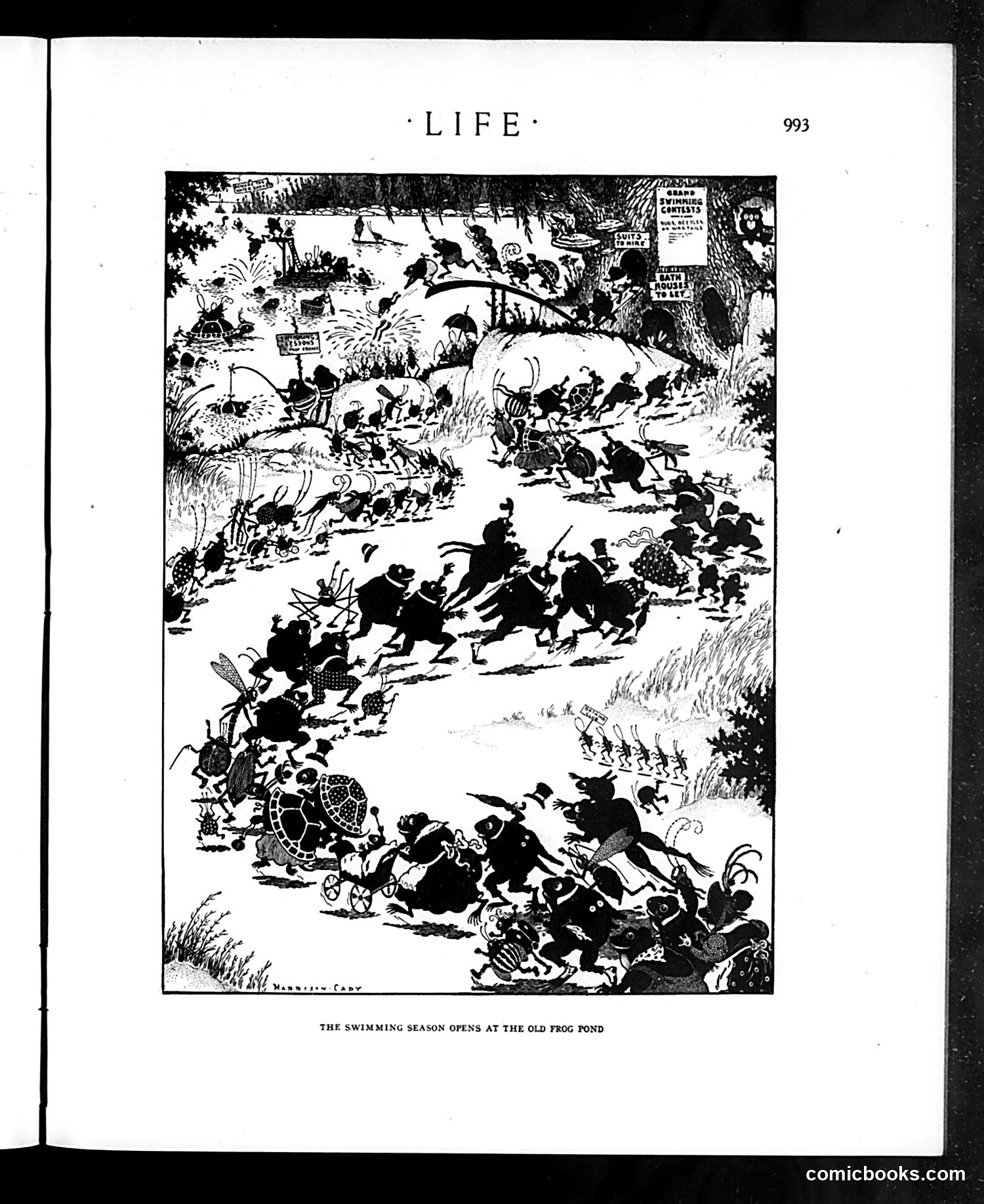
This is a humorous illustration depicting the opening of swimming season at a rural pond. The cartoon shows numerous anthropomorphized frogs and other pond creatures engaged in various activities around "the old frog pond"—swimming, diving, boating, and recreational pursuits. The satire appears to be gentle social commentary on human summer leisure activities, translated into a frog community. Signs visible in the background suggest organized recreation (swimming areas, rules). The chaotic, crowded scene with numerous creatures parodying human beach and pool culture—complete with what appears to be formal infrastructure and crowd management. The joke relies on the whimsical parallel between human seasonal traditions and how frogs might organize their own swimming season, creating a lighthearted, anthropomorphic commentary on contemporary leisure culture and social conventions.
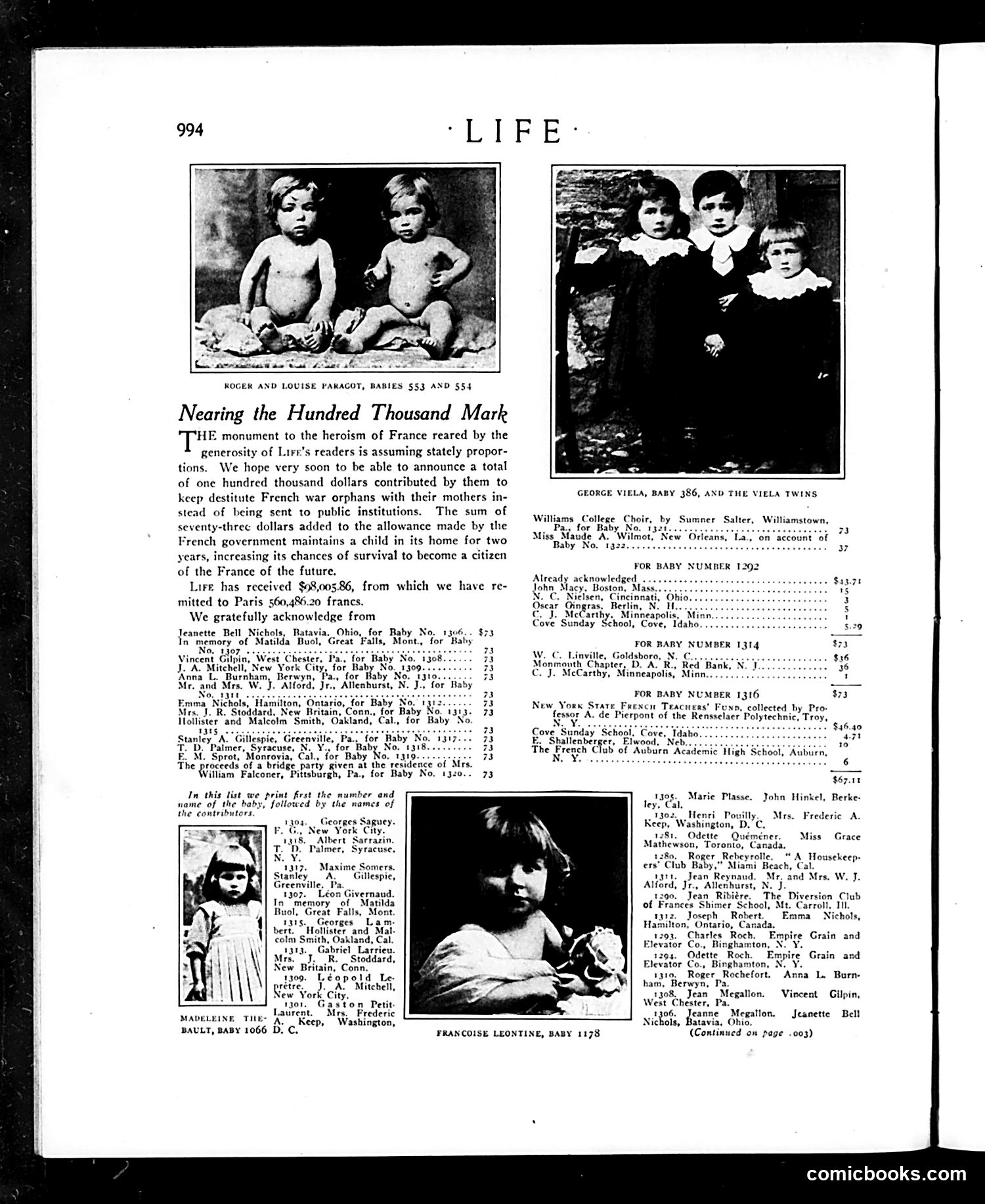
This page documents a fundraising campaign by *Life* magazine to support French war orphans—likely from World War I, given the historical reference to maintaining children "instead of being sent to public institutions." **The Central Campaign:** *Life* readers have donated over $98,000 toward a goal of $100,000. Each $73 contribution maintains one orphaned French child for two years in home care rather than institutional settings. The magazine lists donors and the specific babies they're supporting, creating a direct connection between American readers and named French children. **The Photographs:** Show the sponsored orphans—Roger and Louise Paraqot (babies 553-554), George Viela and the Viela twins (baby 386), Madeleine Bault (baby 1066D), and Françoise Leontine (baby 1128)—humanizing the cause. **The Satire/Point:** This appears less satirical than genuinely philanthropic—a common early *Life* magazine approach combining social advocacy with heartwarming human interest. The campaign appeals to American charitable sentiment while maintaining records of their humanitarian impact.
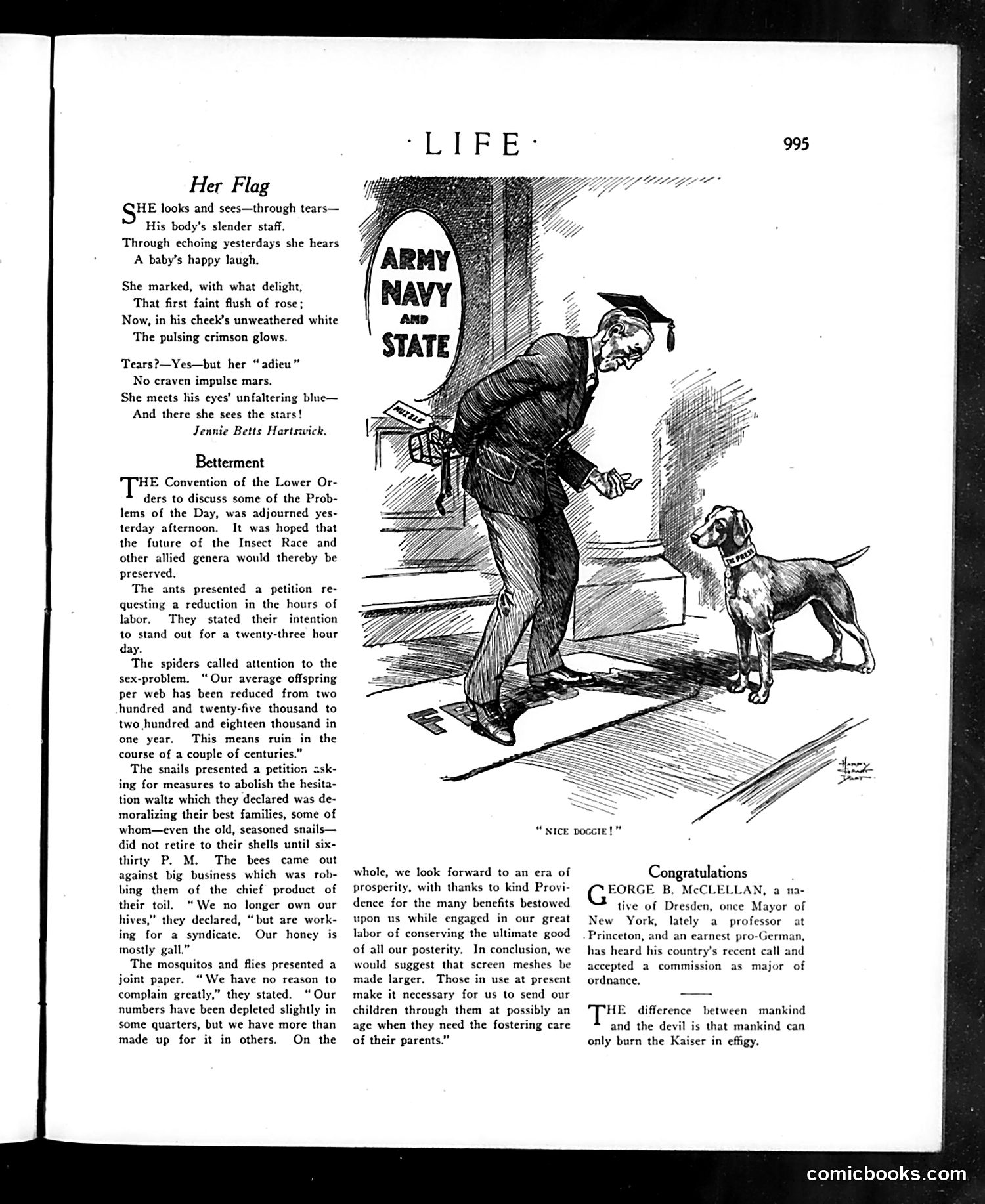
**"Her Flag"** is a sentimental poem about a woman bidding farewell to a soldier departing for war, likely WWI-era based on context. She struggles with tears but maintains composure, finding patriotic resolve in his eyes. **"Betterment"** is a satirical piece imagining insects holding a labor convention to address grievances: ants demand shorter work hours, spiders worry about declining reproduction, snails object to the "hesitation waltz," and bees protest corporate exploitation of their labor. The cartoon shows a well-dressed man with a dog labeled "Nice doggie!"—the satire appears to mock both labor activists' complaints and industrial society's indifference to workers' concerns by comparing them to insects' absurd demands. **"Congratulations"** celebrates George B. McClellan's (a known pro-German sympathizer) acceptance of a military commission, with a final quip about burning the Kaiser in effigy rather than actual conflict—dark humor about American reluctance regarding Germany during WWI.
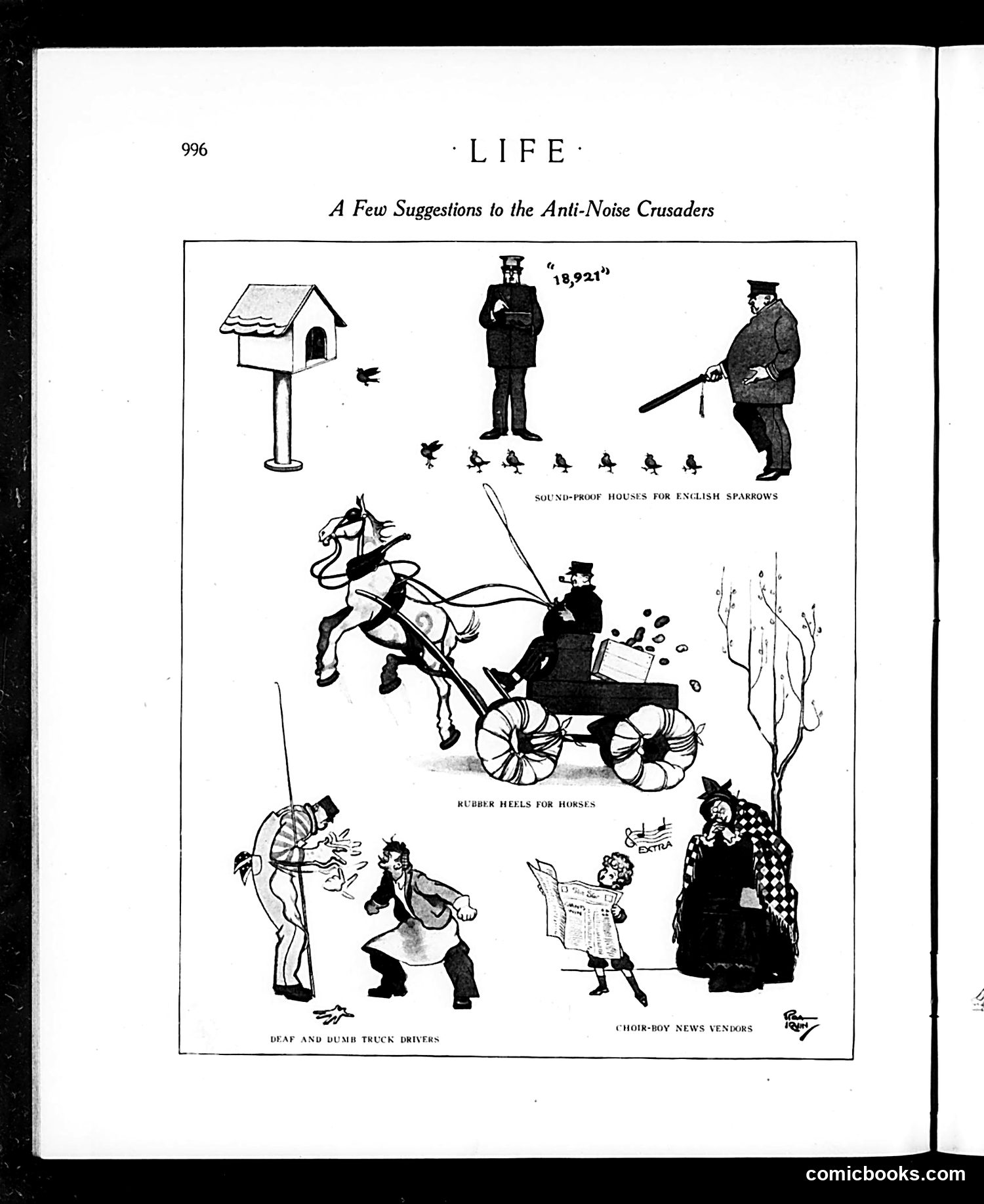
This satirical cartoon mocks the "Anti-Noise Crusaders"—apparently a contemporary movement to reduce urban noise pollution. The page presents absurd "solutions" through humorous illustrations: - **Sound-proof houses for English sparrows** (birds making noise) - **Rubber heels for horses** (reducing clatter) - **A man measuring noise at "19,921"** (quantifying the problem) - **Deaf and dumb truck drivers** (eliminating noise-makers) - **Choir-boy news vendors** (silent newsboys) - **Rubber-wheeled carriages** (quieter transport) The satire suggests that anti-noise campaigns are so extreme they'd require impossible or absurd measures—silencing animals, hiring disabled workers, or creating elaborate soundproofing. The cartoon ridicules both the crusaders' ambitions and the impracticality of eliminating urban noise in a busy modern city. It's a commentary on reform movements that the cartoonist considers naive or overreaching.
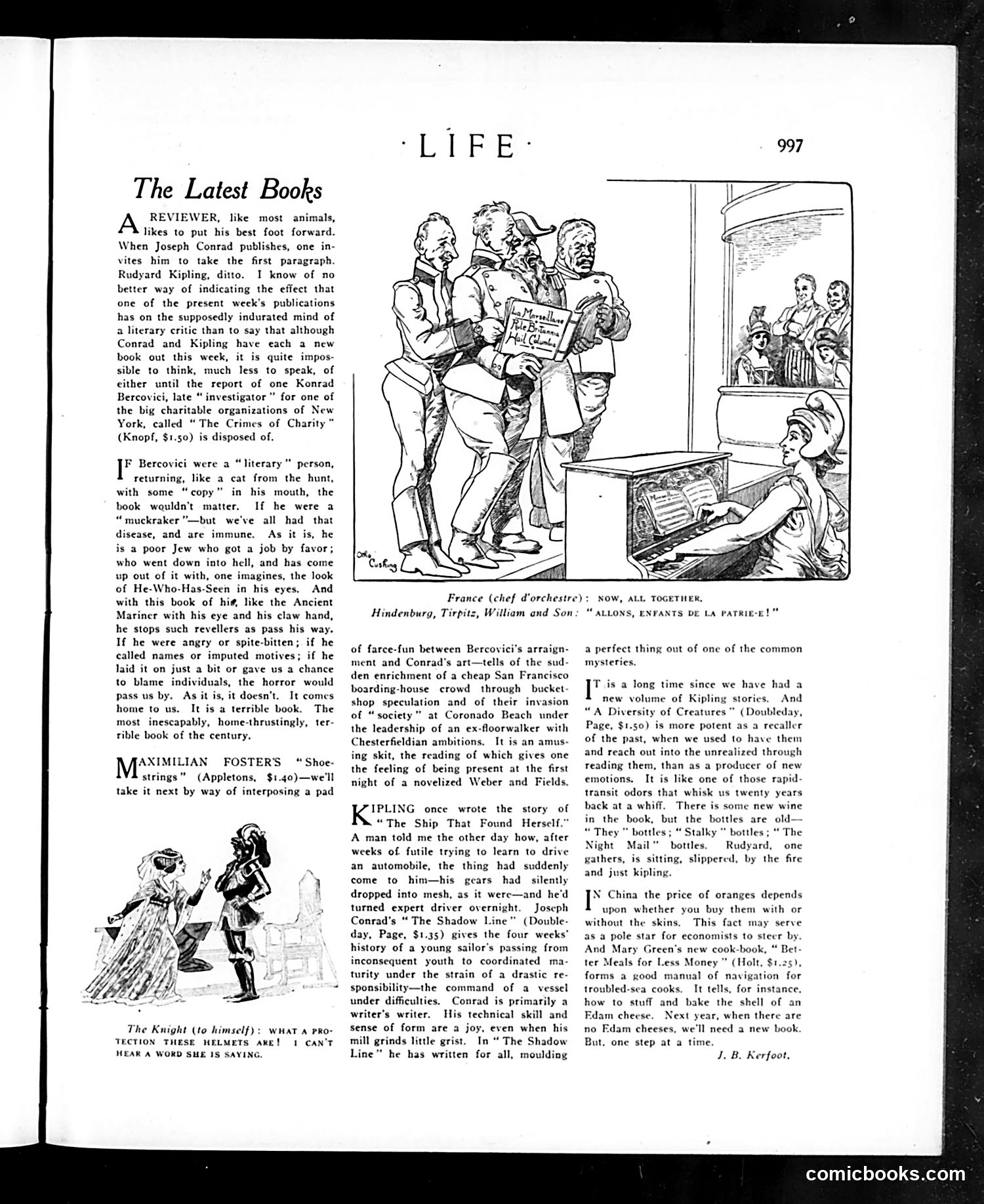
This page reviews recent books by Conrad, Kipling, and others, but the main cartoon depicts a military scene. The caption references "France (chef d'orchestre)" conducting "Hindenburg, Tirpitz, William and Son" with the French motto "Allons, enfants de la patrie!" ("Let's go, children of the fatherland!"). The cartoon satirizes World War I dynamics: France is portrayed as a conductor attempting to orchestrate the German military leadership (Hindenburg and Tirpitz, the Kaiser William II, and apparently his son) like musicians in an orchestra. The smaller cartoon above shows a knight claiming his helmet prevents him from hearing a woman speak—visual comedy about selective deafness. The satire suggests France's struggle to coordinate or control the German war effort, or perhaps mocks the chaotic military alliance. The piece dates from the WWI era when Life magazine regularly published anti-German political humor aimed at American audiences.
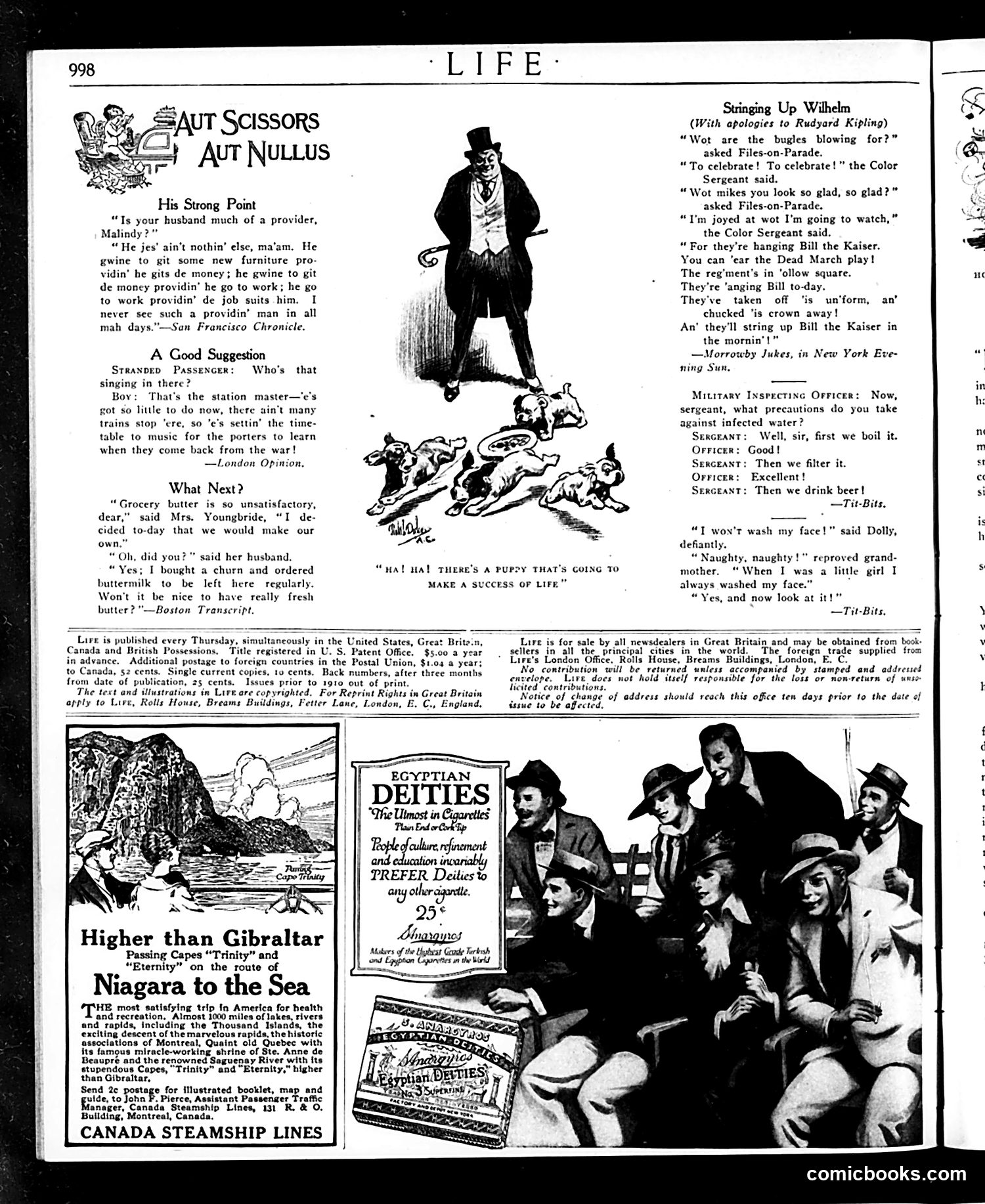
This page contains satirical humor pieces typical of Life's early 20th-century format, plus advertisements. **Main cartoons/jokes:** The "Aut Scissors Aut Nullus" section presents brief humorous dialogues mocking everyday situations—a husband who's all talk about providing, a bored station master during wartime. These are gentle domestic satire. **"Stringing Up Wilhelm"** is the political content: a poem celebrating the imminent execution of Kaiser Wilhelm II following World War I's end. The verse mimics Kipling's style and uses British soldier slang ("Files-on-Parade") to depict jubilation at the Kaiser's anticipated hanging. This reflects real post-WWI sentiment—though Wilhelm actually escaped to exile rather than face execution. **Other humor** includes brief jokes about homemade butter and a child refusing to wash her face, mocking her grandmother's cleanliness advice. **Advertisements** for Egyptian Deities cigarettes and Canada Steamship Lines occupy lower sections. The page is primarily light entertainment with one serious political reference to recent wartime events.
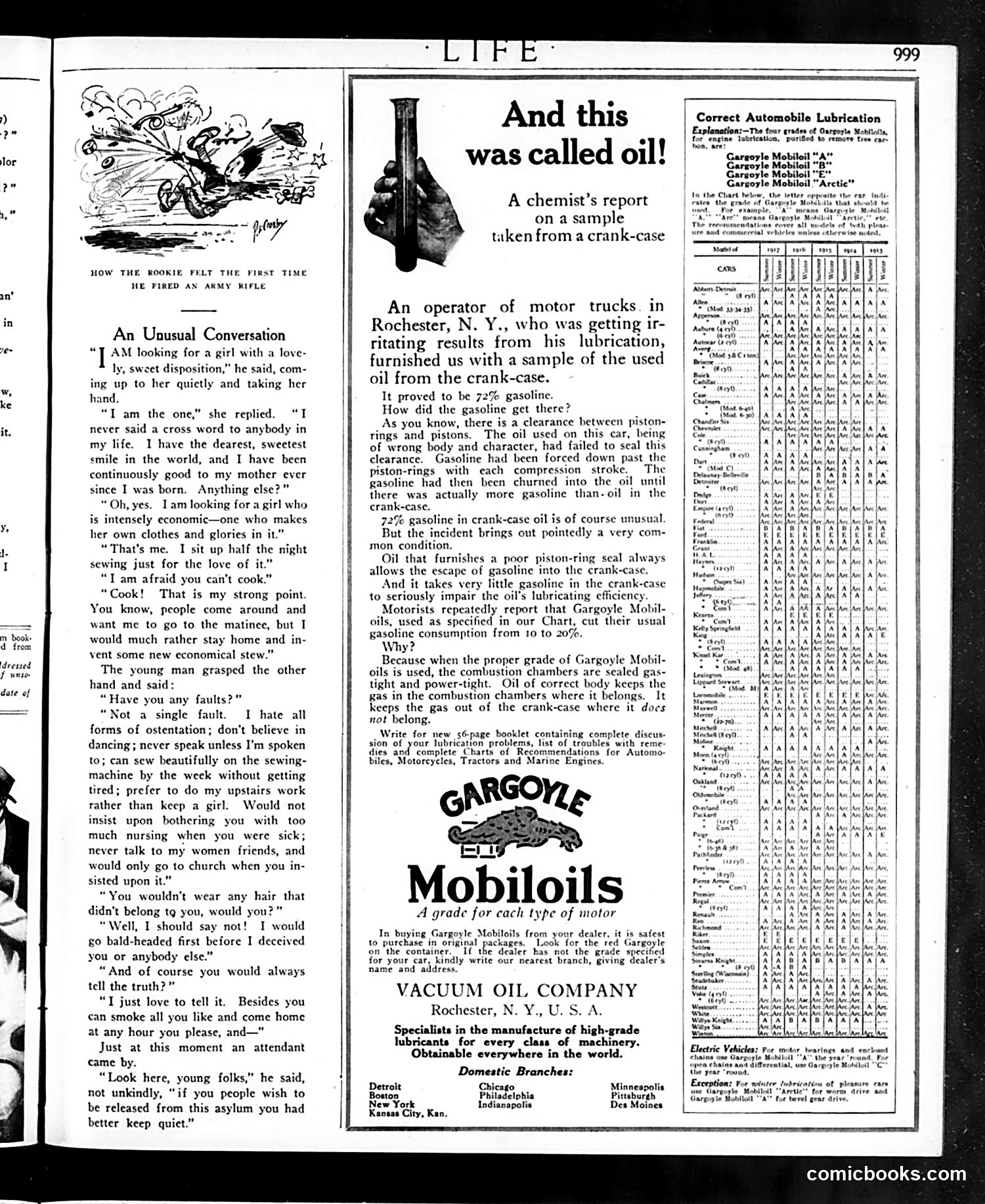
This page contains two unrelated items typical of Life magazine's format: **The Cartoon (top left):** "How the Rookie Felt the First Time He Fired an Army Rifle" shows a soldier violently recoiling from rifle fire—a humorous exaggeration of the shock of first experiencing a weapon's kick. The joke is straightforward physical comedy requiring no historical context. **The Dialogue (left column):** A satirical conversation where a man interviews an impossibly perfect woman—she's economical, beautiful, domestic, selfless, truthful, and obedient. The punchline reveals they're in an *asylum*, suggesting such a "perfect wife" exists only among the insane. This mocks both unrealistic male expectations and period ideals of feminine virtue. **The Advertisement (right side):** Gargoyle Mobiloils promotes proper motor oil by explaining how inferior oil allows gasoline to leak into the crankcase, reducing efficiency. This technical product pitch uses a chemist's report for credibility—standard early-20th-century marketing. The page is primarily advertising with incidental humor—typical of Life's commercial model.
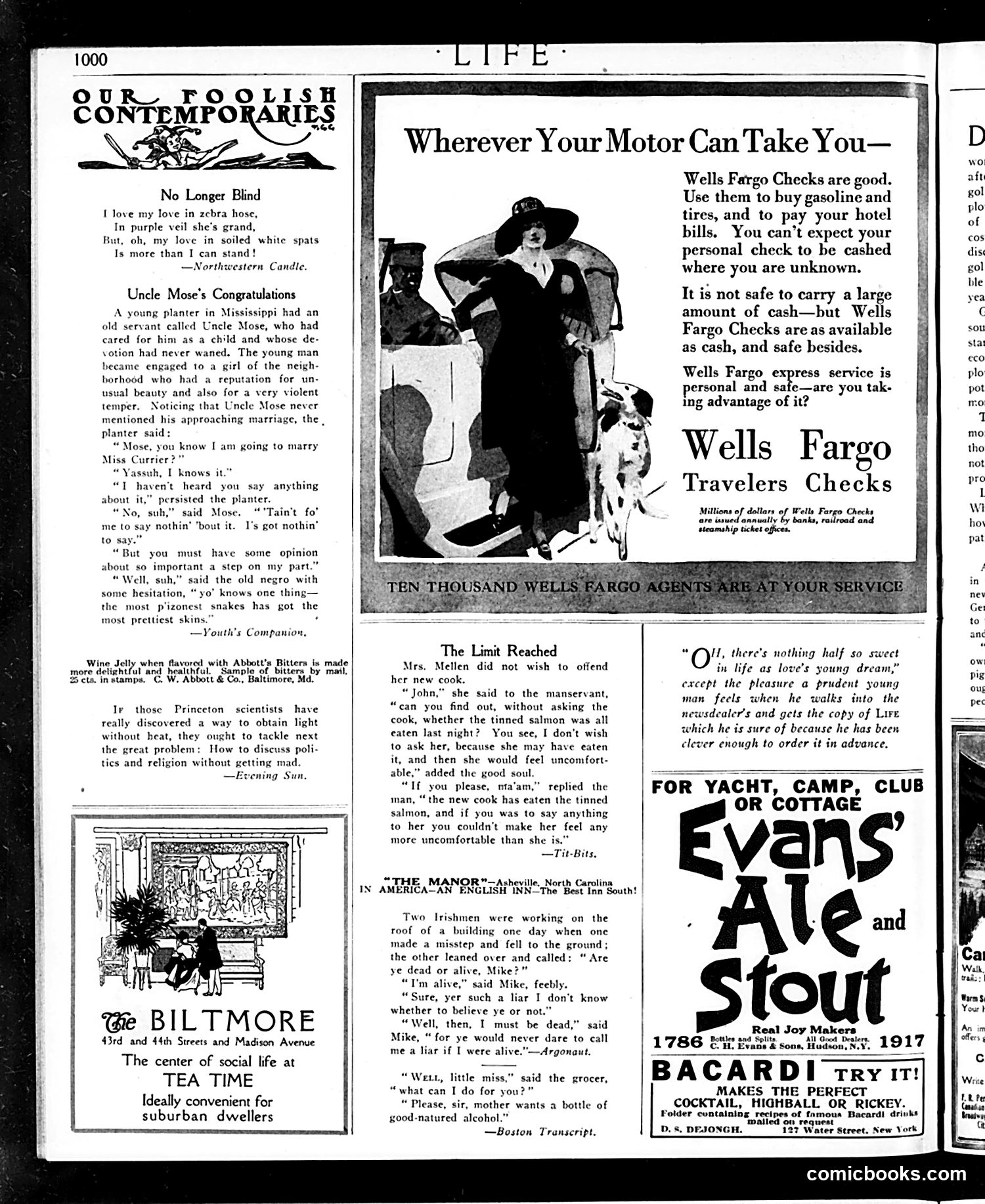
This page from *Life* magazine consists primarily of **humorous short stories and advertisements** rather than political cartoons. The "Our Foolish Contemporaries" section contains three brief satirical anecdotes: 1. **"No Longer Blind"**: A poetry snippet mocking fashion—a woman looks grand in purple veil but ridiculous in soiled white spats. 2. **"Uncle Mose's Congratulations"**: A dialect story featuring a Black servant who obliquely warns his young master against marrying a temperamental woman by comparing her to a venomous snake with pretty skin. This reflects the era's racial caricature conventions. 3. **Two Irish laborers**: A joke playing on Irish ethnic stereotypes about dishonesty. The dominant advertisement is **Wells Fargo Travelers Checks**—promoting financial security for automobile travelers, a modern convenience of the era. Minor ads include **Evans' Ale and Stout**, **The Biltmore hotel**, and **Abbott's Bitters**. The page reflects early 20th-century American humor standards, including ethnic and racial caricatures standard to the period.
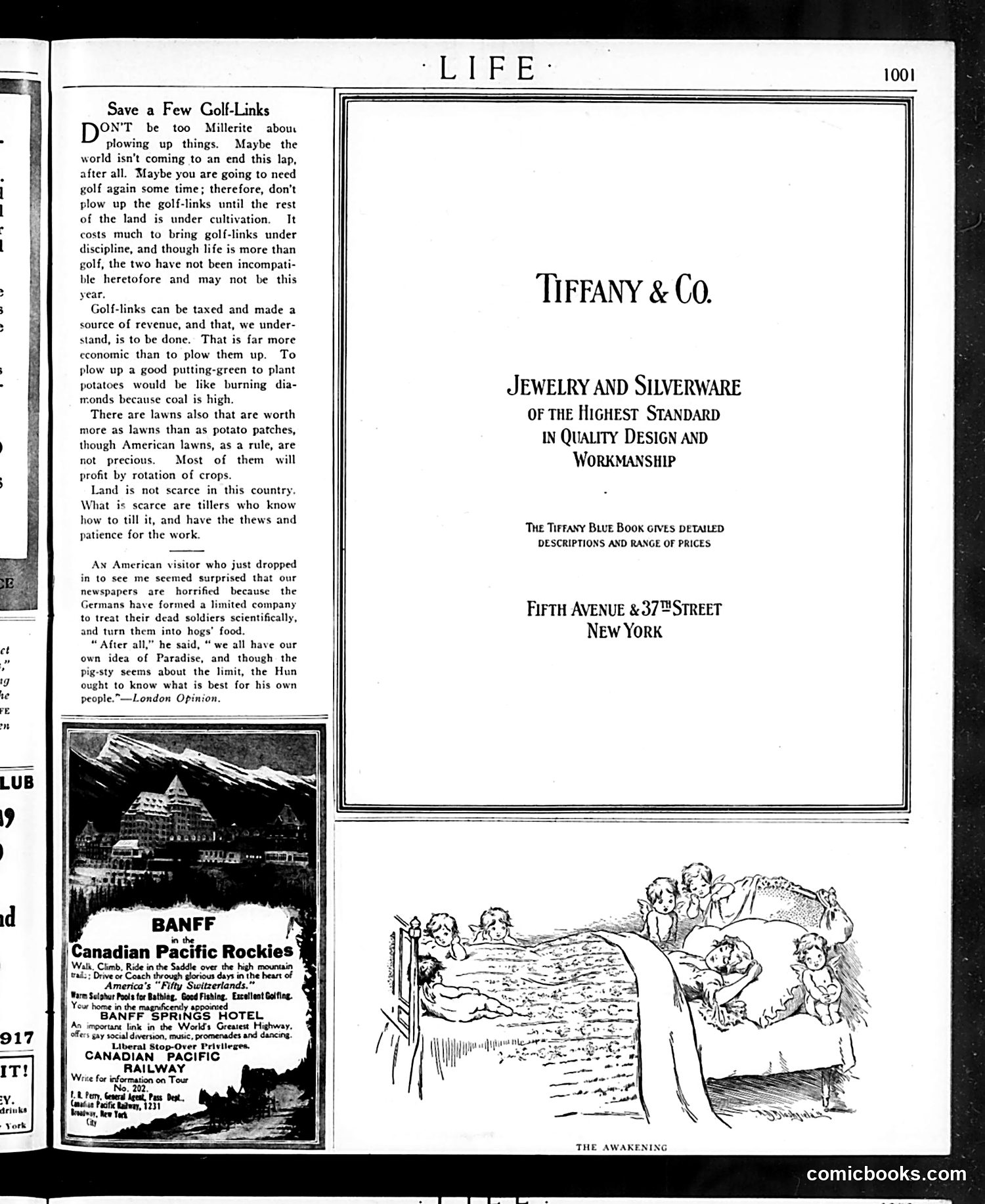
This is primarily a **title/advertising page** from Life magazine (page 1001), not a political cartoon page. The main content is a **humorous editorial** titled "Save a Few Golf-Links" that references "Millerites"—likely alluding to end-times predictions. The piece argues against plowing up golf courses for wartime agriculture, claiming golf-links are economically valuable and shouldn't be destroyed just because some predict the world's end. It's satirizing excessive wartime zealotry while defending leisure as a legitimate social good. A secondary piece mocks German treatment of war dead, quoting a cynical visitor defending German practices by saying each nation has its own moral standards—clearly satirizing both German conduct and moral relativism. The page includes advertisements for **Tiffany & Co.** (jewelry), **Banff Springs Hotel** (Canadian tourism), and the **Canadian Pacific Railway**. The illustration at bottom titled "The Awakening" depicts cherubs around a bed—its meaning is unclear without additional context.
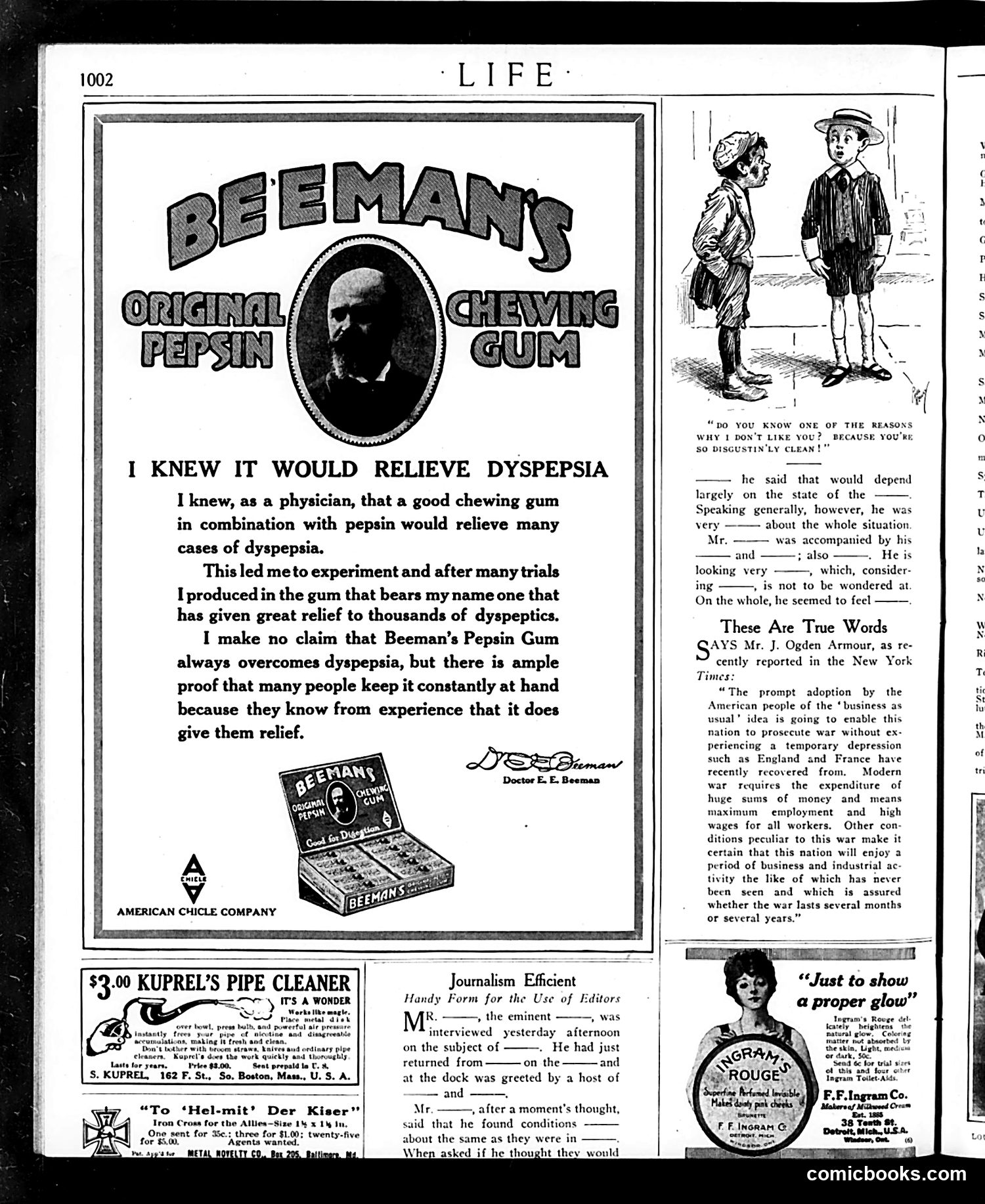
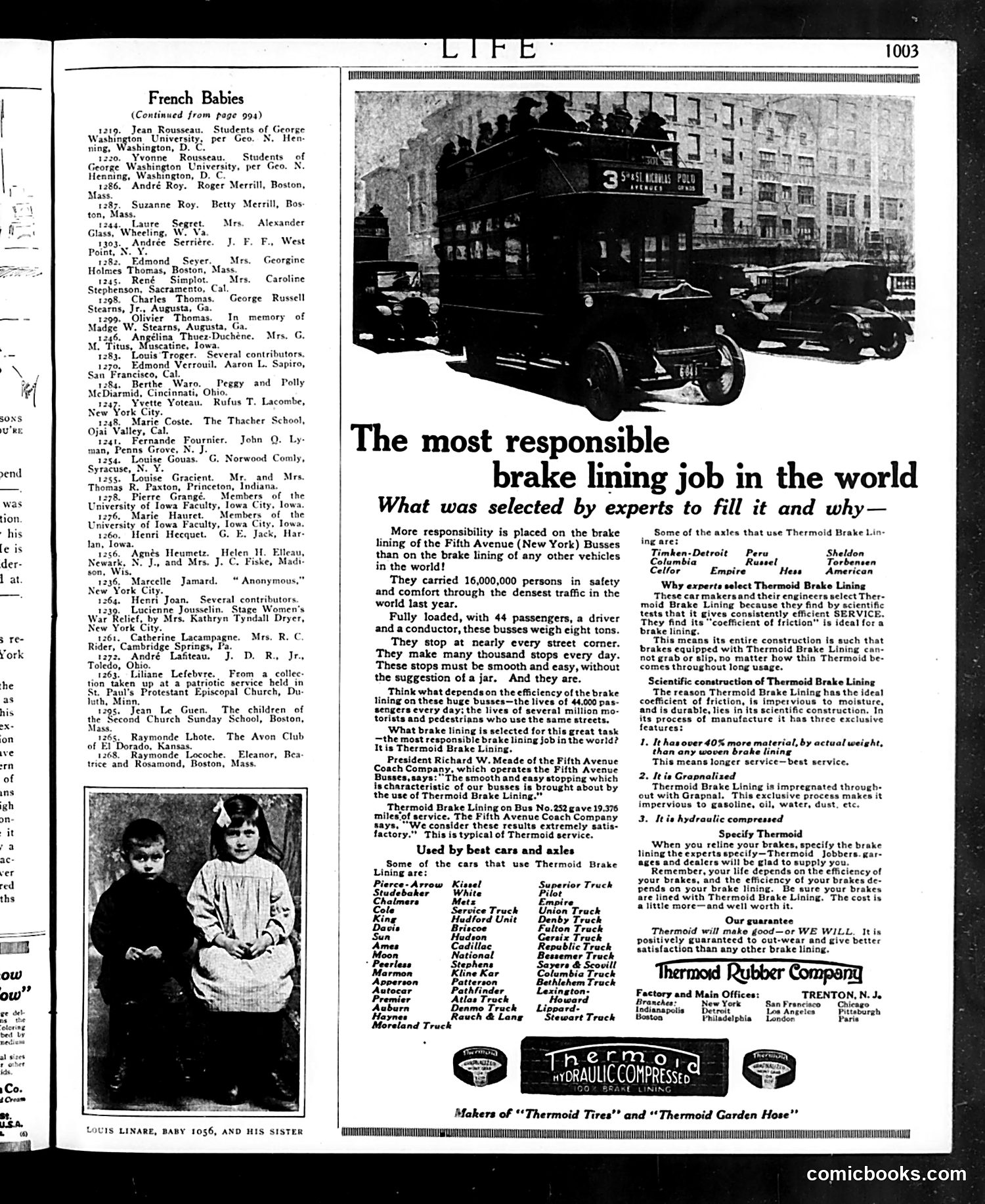
This page is primarily **advertising**, not satire or political commentary. The dominant content is a full-page advertisement for Thermoid Brake Lining, a commercial product. The ad emphasizes the responsibility and safety of brake linings used on Fifth Avenue buses in New York City, which carried 16 million passengers annually through dense traffic. It argues that Thermoid Brake Lining is superior because it enables smooth, reliable stops—critical for public safety with 44 passengers per bus plus pedestrians. The left column contains a list of French babies (continued from a previous page)—apparently children adopted or sponsored through Life magazine's charitable program. A photograph shows Louis Linare, baby 1056, and his sister. The page reflects early-20th-century American consumer confidence: a trust in branded products to solve modern urban safety problems, combined with sentimental charitable giving toward postwar French children.
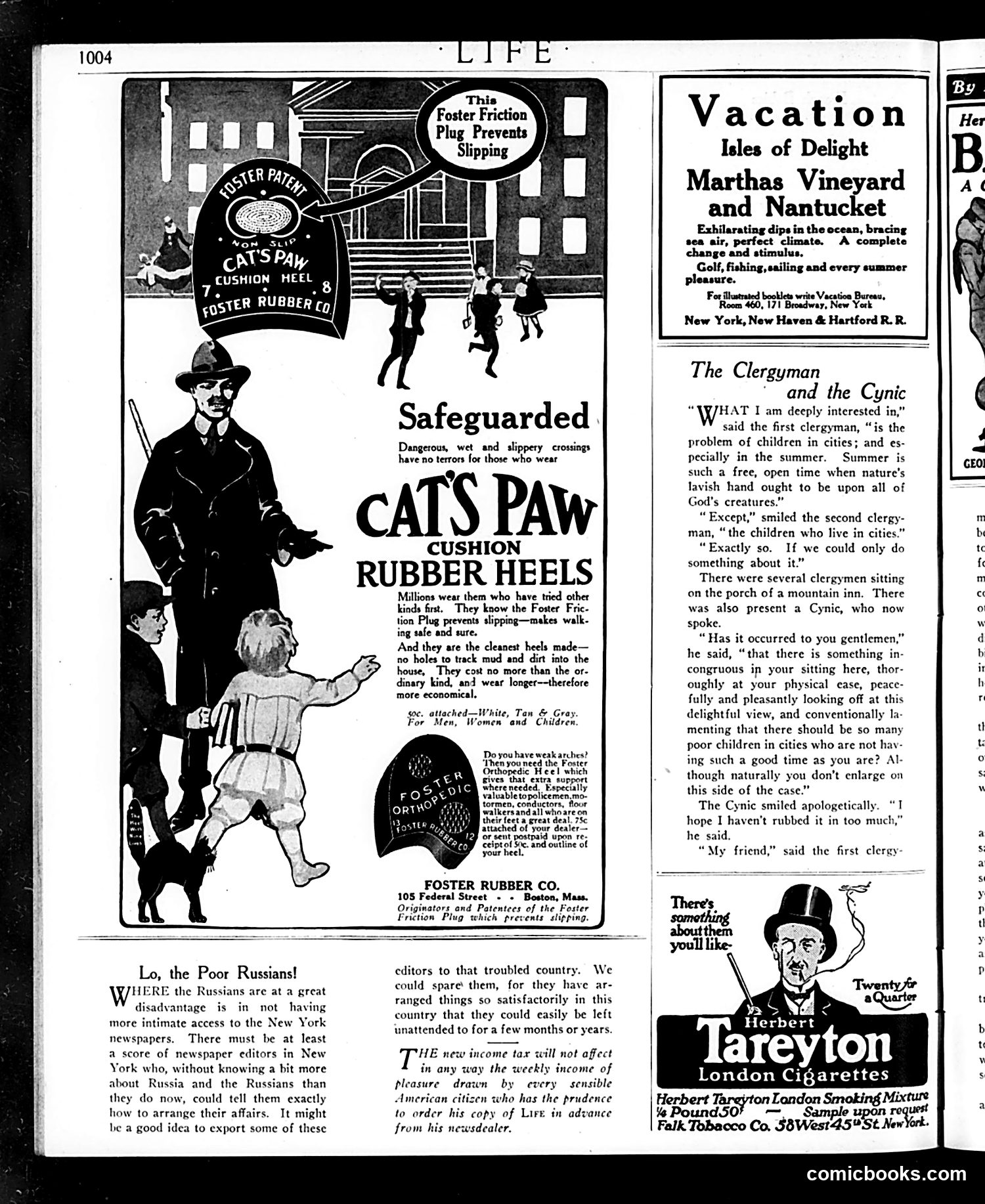
This page contains primarily **advertisements and light satirical commentary** rather than political cartoons. **Main Advertisement**: Cat's Paw Cushion Rubber Heels dominates the left side, featuring a man with a child and dog, emphasizing safety on wet, slippery surfaces—a practical consumer pitch. **"The Clergyman and the Cynic"**: A witty dialogue piece mocking clergy hypocrisy. Clergymen lament poor city children's hardships while luxuriating at a mountain resort. A "Cynic" character points out this incongruity—they enjoy comfort while sentimentally lamenting others' poverty without action. The satire targets self-satisfied moral posturing. **"Lo, the Poor Russians!"**: Satirizes American newspaper editors' presumption. Despite knowing little about Russia, editors confidently prescribe solutions for Russian affairs. The piece suggests exporting these meddling editors, implying American media arrogance about foreign policy. **Other content**: Standard vacation advertisements and cigarette ads typical of the era. The page reflects Life's trademark approach: mixing consumer advertising with gentle social satire targeting American pretension and superficiality.
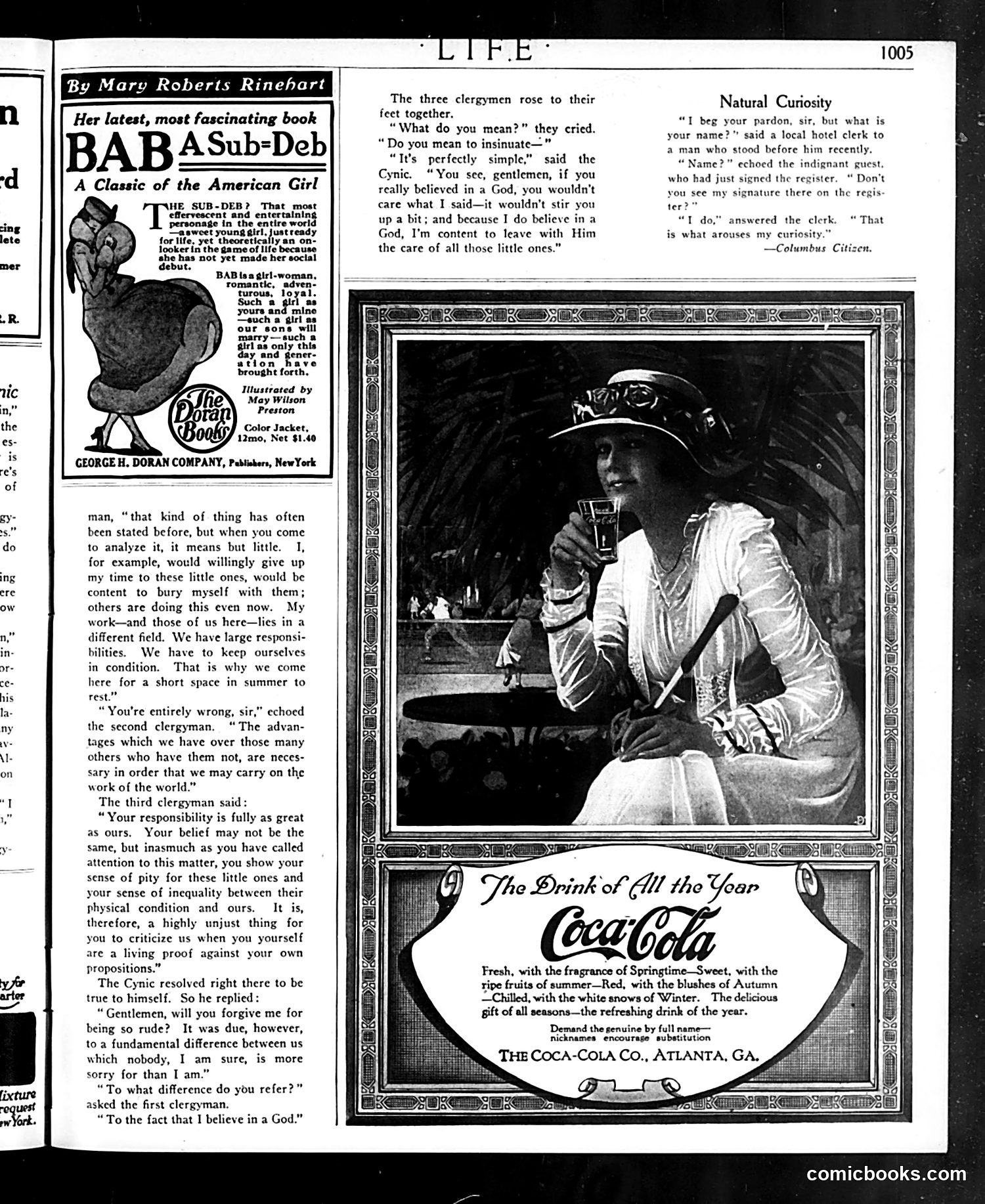
This page contains three distinct elements: **Left: Book Advertisement** An ad for Mary Roberts Rinehart's novel *Bab: A Sub-Deb*, about a young girl on the cusp of womanhood. "Sub-deb" (sub-debutante) refers to a girl not yet formally presented to society. The ad emphasizes her romantic, adventurous nature—targeting readers interested in stories about modern American girlhood. **Center: Satirical Anecdote** A philosophical dialogue between a "Cynic" and three clergymen debating social responsibility toward poor children. The clergymen justify their leisure time and privileged rest as necessary to maintain their capacity for important work. The Cynic's punchline—that he "believes in a God" and therefore trusts divine care for the poor, while they apparently don't—is a biting critique of the clergymen's self-serving rationalization. Their outrage at his remark reveals the contradiction in their arguments. **Right: Coca-Cola Advertisement** A period ad featuring an elegant woman, emphasizing Coca-Cola as "the drink of all the year" with poetic seasonal imagery. The satirical content critiques privileged hypocrisy regarding charitable responsibility.
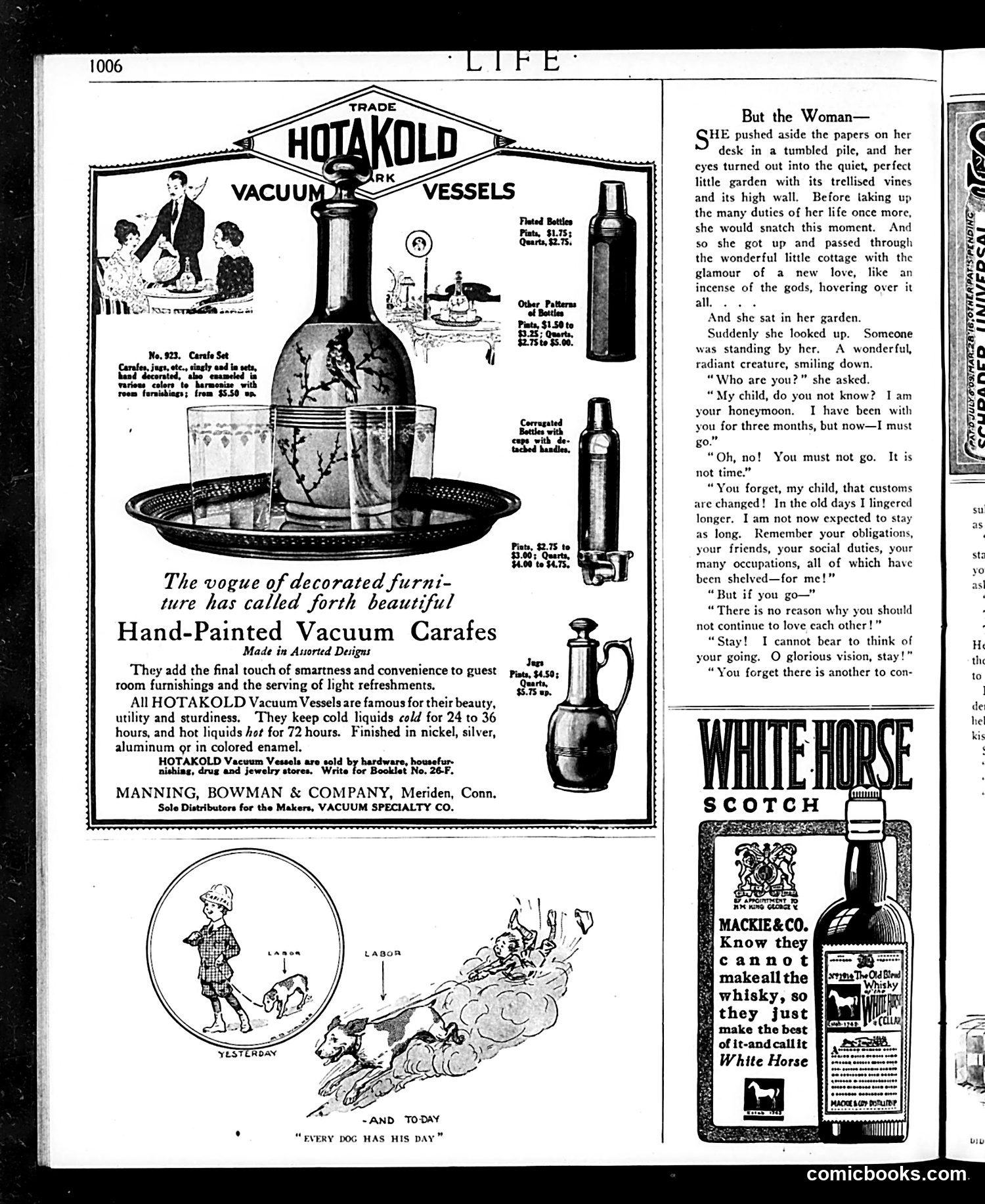
**Main Content:** This page primarily contains advertisements, notably for Hotakold Vacuum Carafes (decorative thermoses) and White Horse Scotch whisky. **Literary Fiction Excerpt:** The right column features a sentimental short story about a woman in her garden visited by the personified "Honeymoon," who announces he must leave after three months. The Honeymoon explains that modern social customs no longer permit extended honeymoons—women now have "obligations, friends, social duties, occupations" demanding attention. This appears social commentary on changing post-war roles for women, sardonically suggesting they must abandon romantic leisure for societal responsibilities. **Bottom Cartoon:** A simple two-panel comic titled "Every Dog Has His Day" shows a dog's perspective shifting from "Yesterday" (playing freely) to "To Day" (being put to work). This reflects the era's common sentimental humor about animals' diminished leisure. The page overall reflects early 20th-century anxieties about modernization, women's expanding roles, and nostalgia for simpler times.
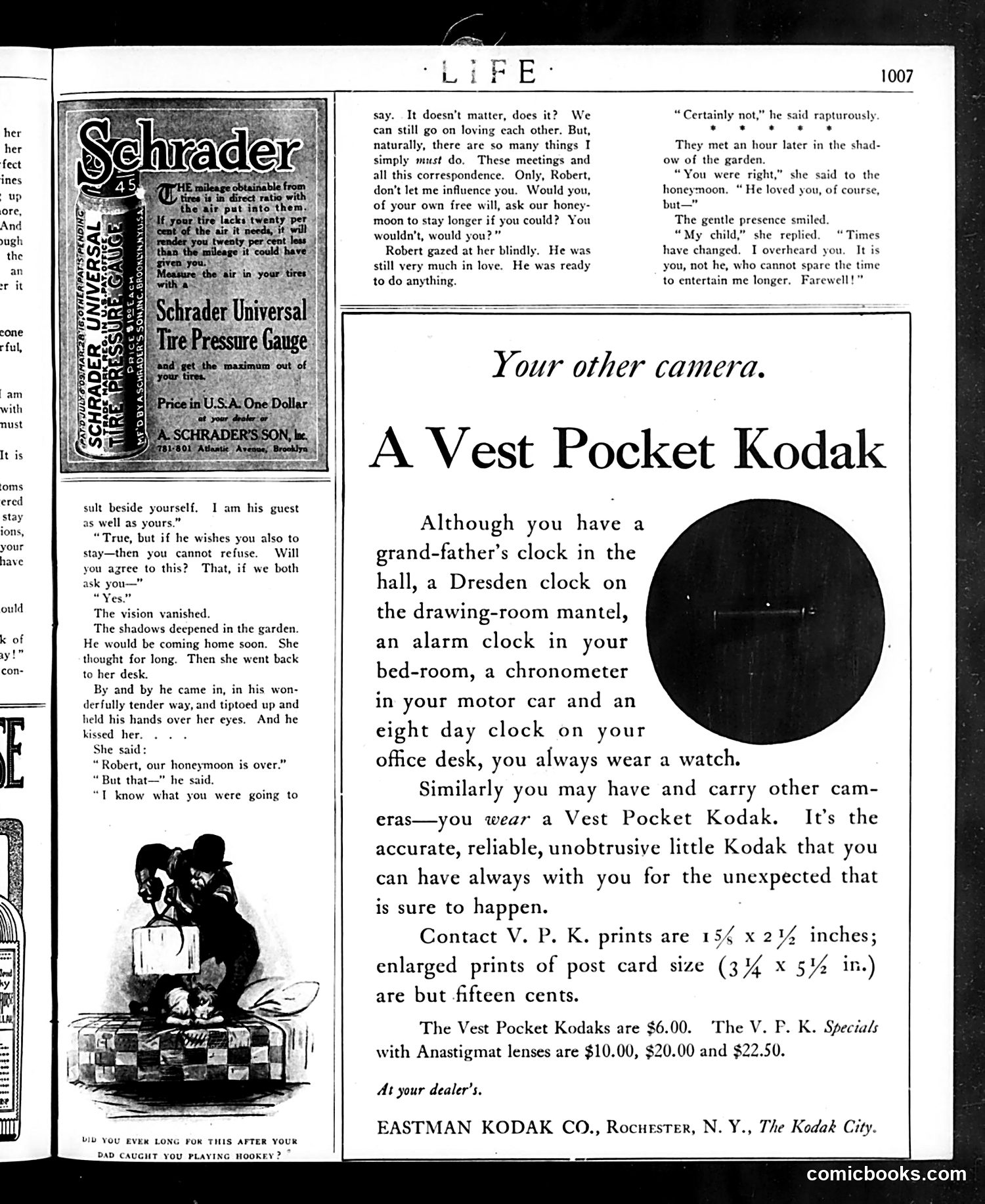
This page contains a serialized romance story and a Kodak advertisement. The story depicts a newlywed couple where the wife manipulates her husband by personifying their "honeymoon" as a sentient being she can negotiate with. She convinces Robert that their honeymoon should end early so she can attend to meetings and correspondence—revealing through dialogue that *she*, not he, lacks time for romance. The satire targets early 20th-century women's expanding social obligations and the tension between modern activism/engagement and traditional domestic roles. The personification device allows the story to comment ironically on how quickly post-marriage enthusiasm evaporates when real-world demands intrude. The accompanying Kodak advertisement uses similar logic: just as one wears a watch despite owning many clocks, one should carry a Vest Pocket Kodak alongside larger cameras for life's unexpected moments—a practical pitch for a portable, affordable camera.
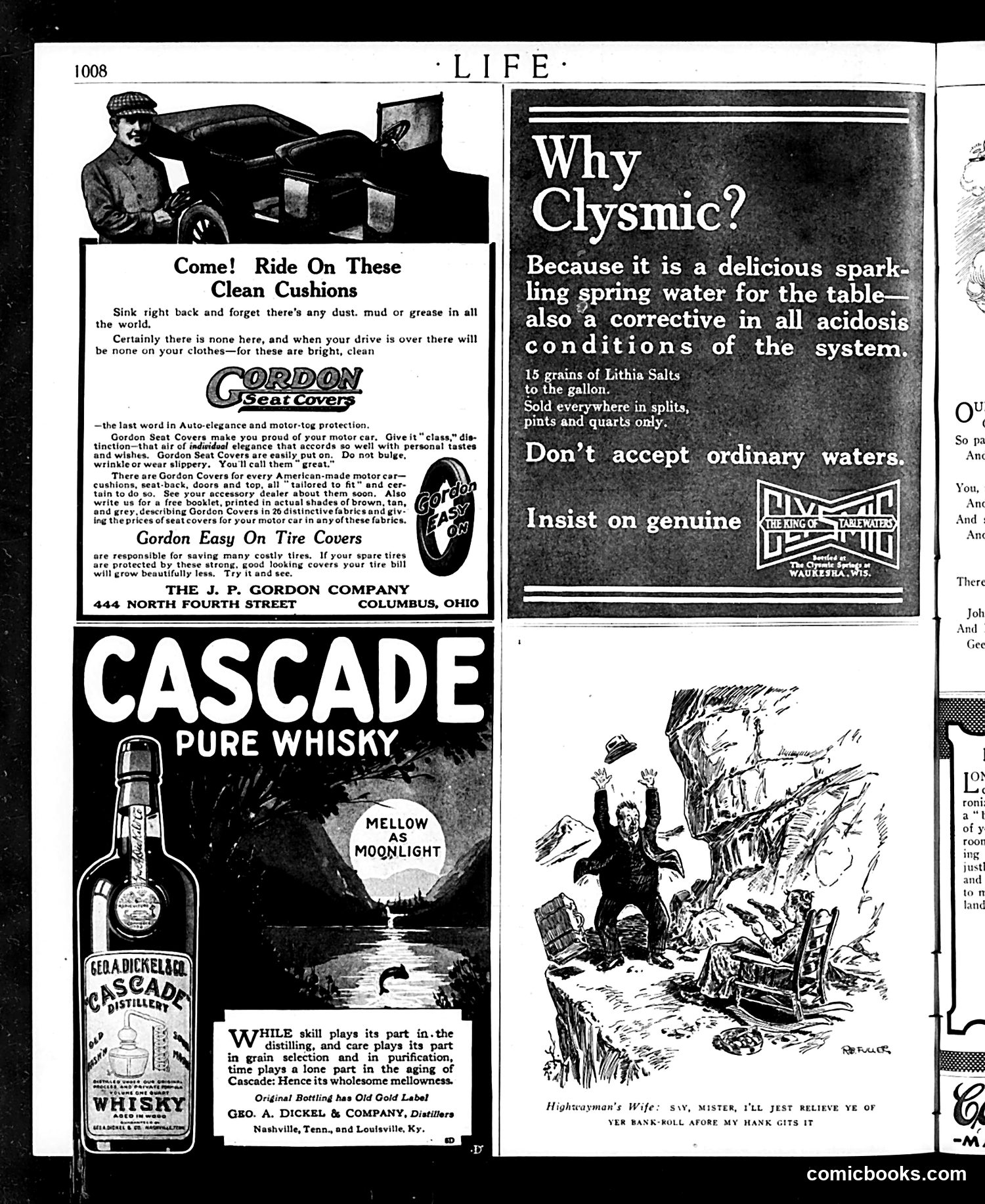
This page from *Life* magazine contains primarily **advertisements** rather than political satire or editorial cartoons. The ads promote: 1. **Gordon Seat Covers** — auto accessories emphasizing cleanliness and elegance for motor cars 2. **Clysmic** — a lithia-infused spring water marketed as a digestive aid for "acidosis conditions" 3. **Cascade Pure Whisky** — positioned as "mellow" and aged for quality The only cartoon is a small humorous sketch at bottom right titled "Highwayman's Wife," depicting a period bandit threatening to rob his wife before "my hank gits it" — a domestic joke about marital finances, unrelated to current events. The page reflects early 20th-century consumer culture: automobile ownership becoming common, patent medicines treating vague ailments (lithia salts), and prohibition-era whisky advertising. No specific political figures or events are referenced. This is primarily a **commercial publication page**, not political commentary.
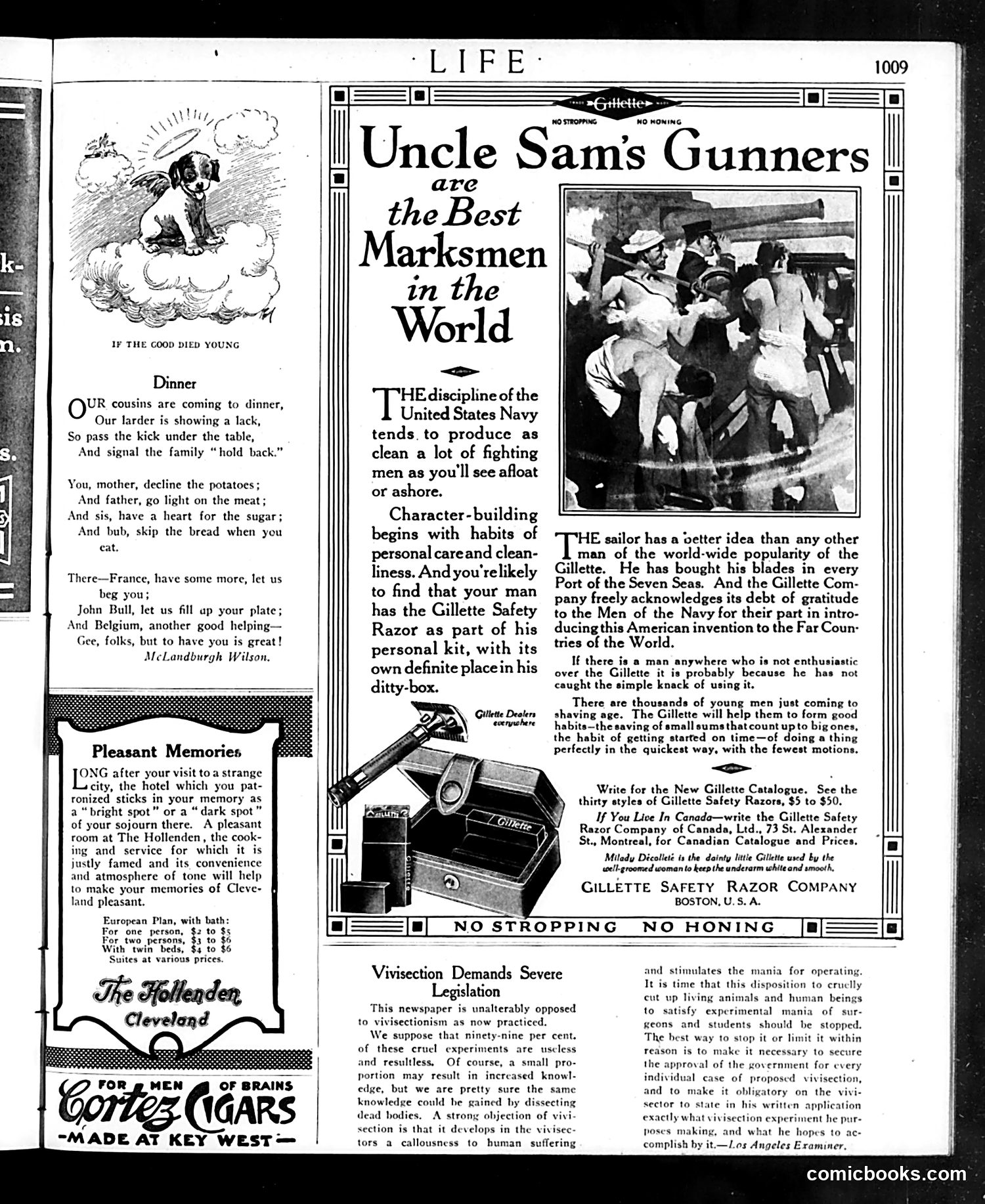
**"If the Good Died Young" (Dinner poem):** This satirical poem depicts wartime food rationing and sacrifice. Family members decline portions—potatoes, meat, bread, sugar—so that Allied guests (France, "John Bull" for Britain, Belgium) can eat well. It's a patriotic plea for American civilians to voluntarily ration during WWI, framing deprivation as honorable hospitality to struggling allies. **"Uncle Sam's Gunners" (Gillette advertisement):** This is primarily a commercial endorsement claiming U.S. Navy sailors are the world's best marksmen because they use Gillette Safety Razors. The ad links personal hygiene and discipline to military prowess—a common WWI-era advertising strategy connecting consumer products to patriotic virtue and national strength. **"Vivisection Demands Severe Legislation":** This editorial opposes animal experimentation, arguing 99% of vivisection is unnecessary and brutalizes surgeons and students. It calls for government oversight of all animal testing. The page juxtaposes patriotic wartime messaging (rationing, military excellence) with consumer advertising and animal welfare advocacy—typical of Life's satirical blend of social commentary and commercial content.
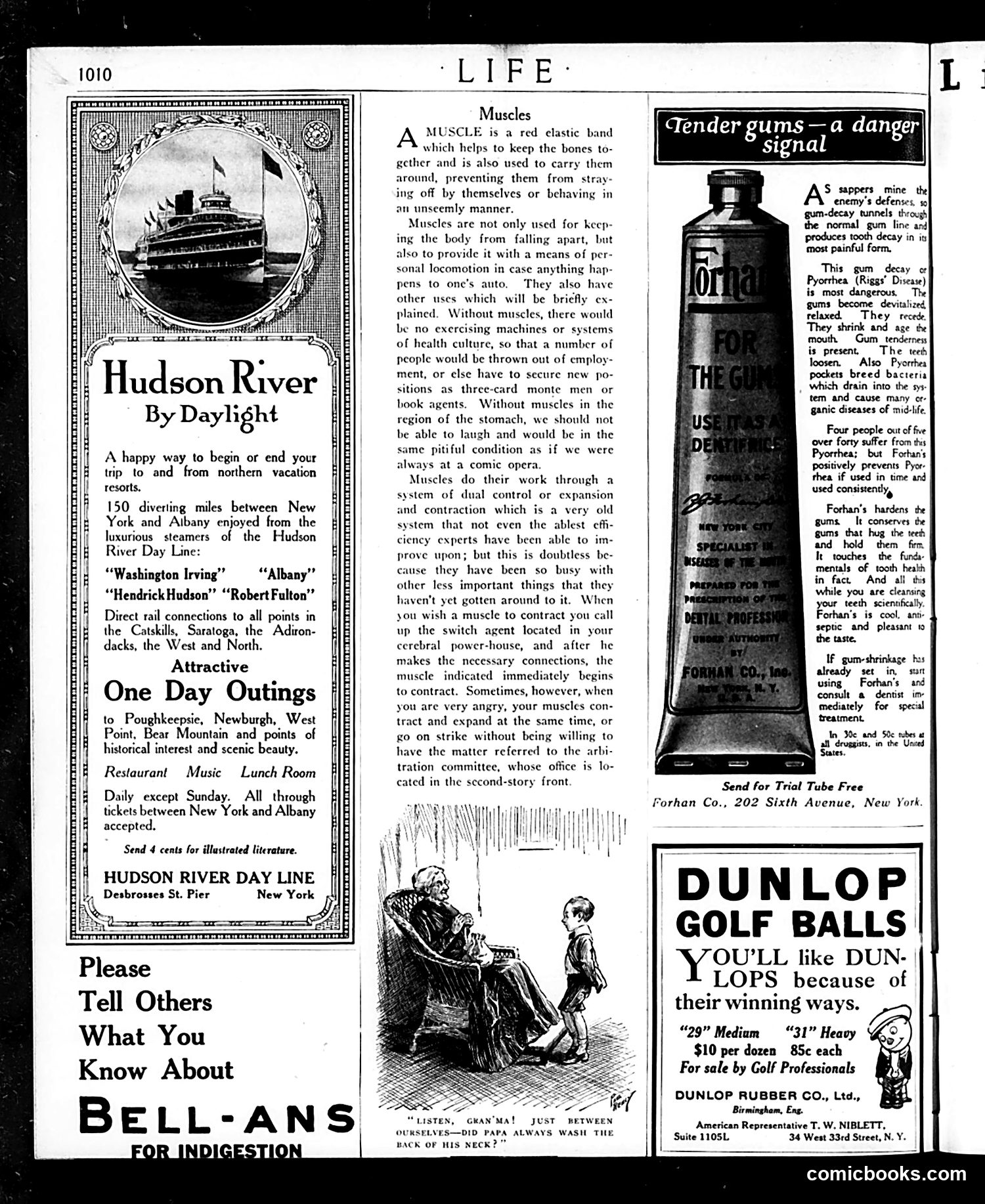
This page is primarily **advertising and educational content** with minimal satire. The main elements are: **Hudson River Day Line Advertisement** (left): A straightforward travel ad promoting scenic steamboat cruises between New York and Albany on historic vessels named after American figures (Washington Irving, Hendrick Hudson, Robert Fulton). **"Muscles" Educational Essay** (center): A humorous but genuinely informative piece explaining muscle function. The satire is mild—using absurdist comparisons (muscles "behaving in an unseemly manner," references to "three-card monte men") to make anatomy entertaining rather than pedantic. **Small Cartoon** (center-bottom): Shows a child asking an adult about neck anatomy—a gentle domestic joke accompanying the muscles article. **Product Advertisements** (right): Forhan's toothpaste (addressing pyorrhea/gum disease) and Dunlop golf balls—standard period advertising. The page reflects early 20th-century *Life* magazine's mix of light satire, practical information, and commerce. There is **no significant political content or caricature** here—it's a typical lifestyle/leisure issue page.