
Life, 1917-06-07 · page 18 of 42
Life — June 7, 1917 — page 18: what you’re looking at
What you’re looking at
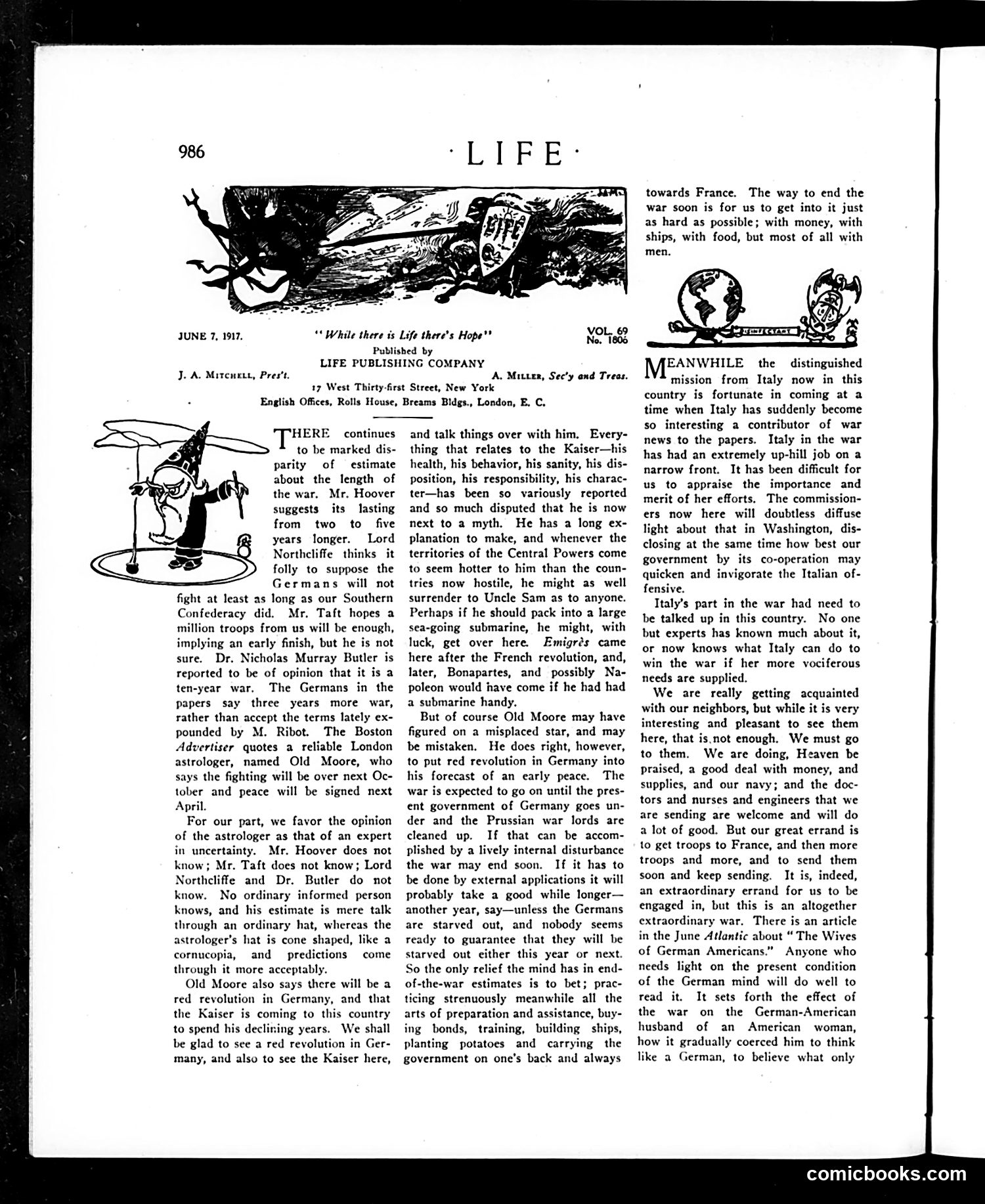
This page contains satirical commentary on World War I, published shortly after the U.S. entered the conflict (April 1917). **Main Cartoon/Editorial Focus:** The article mocks conflicting predictions about the war's duration. Various authorities—Herbert Hoover, Lord Northcliffe, William Howard Taft, and Nicholas Murray Butler—offer vastly different estimates (2-10 years). Life satirically endorses "Old Moore," a London astrologer, whose predictions seem as valid as anyone else's given the uncertainty. **The Satire:** The piece ridicules experts' inability to predict outcomes while praising the astrologer's "cone-shaped" hat (cornucopia) as appropriately shaped for dispensing predictions. Life then humorously suggests the Kaiser might flee to America via submarine, like French émigrés after their revolution, implying Germany's imminent internal collapse. **Context:** The astrologer figure represents wartime desperation—when genuine experts fail, even superstition seems reasonable. The piece advocates aggressive American war effort (money, ships, food, troops) as the fastest path to victory. **Italian Mission Reference:** The closing paragraph shifts to Italy's newly heightened importance as a war contributor.
📄 Transcribed text from this page (OCR, searchable)
Machine-transcribed from the original scan — historical spelling and the odd misread are preserved.
JUNE 7, 1917. “* While there is Life there’s Hope"’ Published by LIFE PUBLISHING COMPANY J. A. Mircnent, Pres’t. HERE continues to be marked dis- parity of estimate about the length of the war. Mr. Hoover suggests its lasting from two to five years longer. Lord Northcliffe thinks it folly to suppose the Germans will not fight at least as long as our Southern Confederacy did. Mr. Taft hopes a million troops from us will be enough, implying an early finish, but he is not sure. Dr. Nicholas Murray Butler is reported to be of opinion that it is a ten-year war, The Germans in the papers say three years more war, rather than accept the terms lately ex- pounded by M. Ribot. The Boston Advertiser quotes a reliable London astrologer, named Old Moore, who says the fighting will be over next Oc- tober and peace will be signed next April. For our part, we favor the opinion of the astrologer as that of an expert in uncertainty. Mr. Hoover does not know; Mr. Taft does not know; Lord Northcliffe and Dr. Butler do not know. No ordinary informed person knows, and his estimate is mere talk through an ordinary hat, whereas the astrologer’s hat is cone shaped, like a cornucopia, and predictions come through it more acceptably. Old Moore also says there will be a red revolution in Germany, and that the Kaiser is coming to this country to spend his declining years. We shall be glad to see a red revolution in Ger- many, and also to see the Kaiser here, A. Mutter, Sec’y end Treas. 17 West Thirty-first Street, New York English Offices, Rolls House, Breams Bldgs., London, E. C. and talk things over with him. Every- thing that relates to the Kaiser—his health, his behavior, his sanity, his dis- position, his responsibility, his charac- ter—has been so variously reported and so much disputed that he is now next to a myth. He has a long ex- planation to make, and whenever the territories of the Central Powers come to seem hotter to him than the coun- tries now hostile, he might as well surrender to Uncle Sam as to anyone. Perhaps if he should pack into a large sea-going submarine, he might, with luck, get over here. Emigrés came here after the French revolution, and, later, Bonapartes, and possibly Na- poleon would nave come if he had had a submarine handy. But of course Old Moore may have figured on a misplaced star, and may be mistaken, He does right, however, to put red revolution in Germany into his forecast of an early peace. The war is expected to go on until the pres- ent government of Germany goes un- der and the Prussian war lords are cleaned up. If that can be accom- plished by a lively internal disturbance the war may end soon. If it has to be done by external applications it will probably take a good while longer— another year, say—unless the Germans are starved out, and nobody seems ready to guarantee that they will be starved out either this year or next. So the only relief the mind has in end- of-the-war estimates is to bet; prac- ticing strenuously meanwhile all the arts of preparation and assistance, buy- ing bonds, training, building ships, planting potatoes and carrying the government on one’s back and always towards France. The way to end the war soon is for us to get into it just as hard as possible; with money, with ships, with food, but most of all with MEANWHILE the distinguished mission from Italy now in this country is fortunate in coming at a time when Italy has suddenly become so interesting a contributor of war news to the papers. Italy in the war has had an extremely up-hill job on a narrow front. It has been difficult for us to appraise the importance and merit of her efforts. The commission- ers now here will doubtless diffuse light about that in Washington, dis- closing at the same time how best our government by its co-operation may quicken and invigorate the Italian of- fensive. Ttaly’s part in the war had need to be talked up in this country. No one but experts has known much about it, or now knows what Italy can do to win the war if her more vociferous needs are supplied. We are really getting acquainted with our neighbors, but while it is very interesting and pleasant to see them here, that is.not enough. We must go to them. We are doing, Heaven be praised, a good deal with money, and supplies, and our navy; and the doc- tors and nurses and engineers that we are sending are welcome and will do a lot of good. But our great errand is to get troops to France, and then more troops and more, and to send them soon and keep sending. It is, indeed, an extraordinary errand for us to be engaged in, but this is an altogether extraordinary war. There is an article in the June Atlantic about “ The Wives of German Americans.” Anyone who needs light on the present condition of the German mind will do well to read it. It sets forth the effect of the war on the German-American husband of an American woman, how it gradually coerced him to think like a German, to believe what only comicbooks.com