
Life, 1917-06-07 · page 27 of 42
Life — June 7, 1917 — page 27: what you’re looking at
What you’re looking at
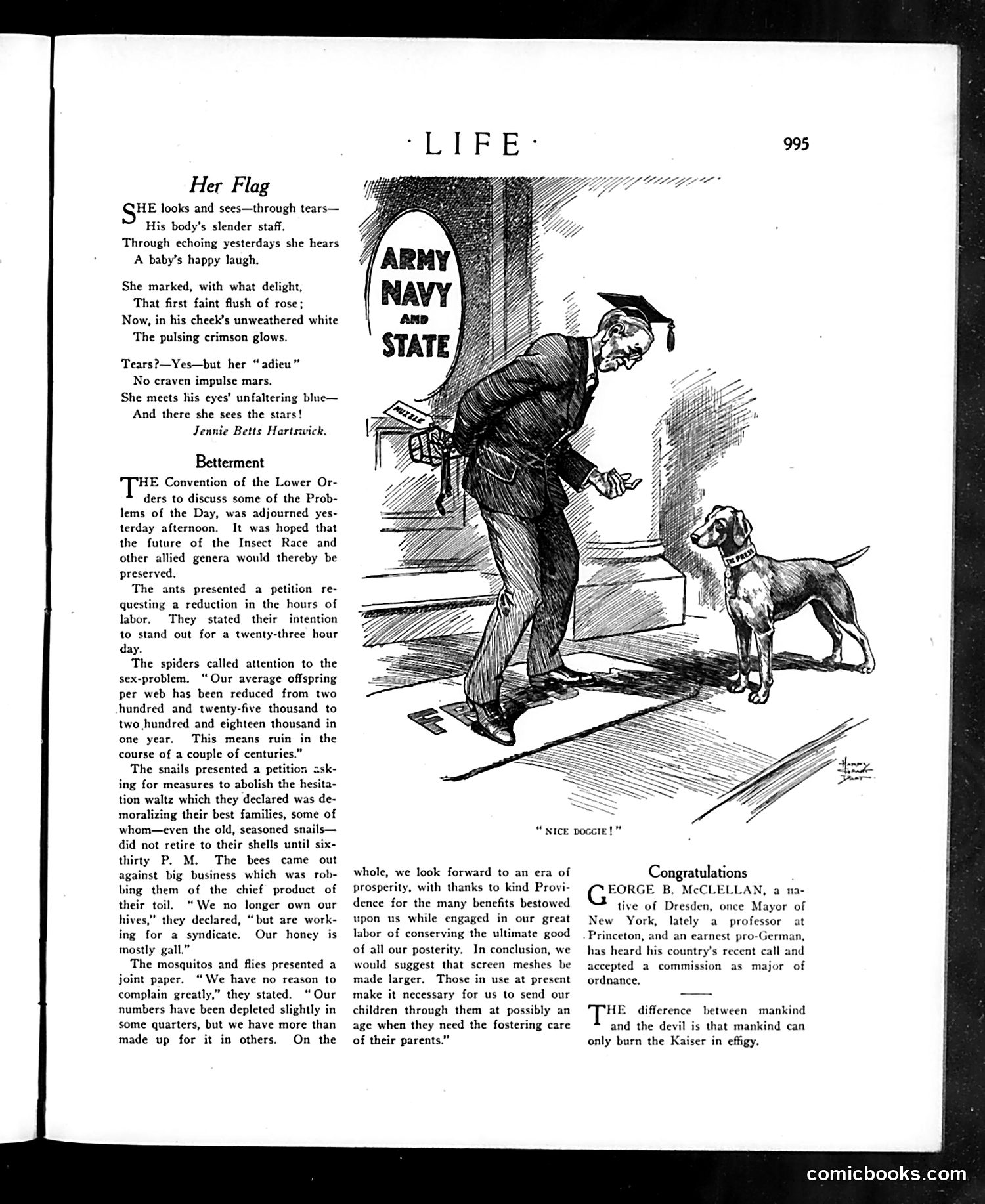
**"Her Flag"** is a sentimental poem about a woman bidding farewell to a soldier departing for war, likely WWI-era based on context. She struggles with tears but maintains composure, finding patriotic resolve in his eyes. **"Betterment"** is a satirical piece imagining insects holding a labor convention to address grievances: ants demand shorter work hours, spiders worry about declining reproduction, snails object to the "hesitation waltz," and bees protest corporate exploitation of their labor. The cartoon shows a well-dressed man with a dog labeled "Nice doggie!"—the satire appears to mock both labor activists' complaints and industrial society's indifference to workers' concerns by comparing them to insects' absurd demands. **"Congratulations"** celebrates George B. McClellan's (a known pro-German sympathizer) acceptance of a military commission, with a final quip about burning the Kaiser in effigy rather than actual conflict—dark humor about American reluctance regarding Germany during WWI.
📄 Transcribed text from this page (OCR, searchable)
Machine-transcribed from the original scan — historical spelling and the odd misread are preserved.
Her Flag SHE looks and sees—through tears— His body’s slender staff. Through echoing yesterdays she hears A baby’s happy laugh. She marked, with what delight, That first faint flush of rose; Now, in his cheek’s unweathered white The pulsing crimson glows. Tears?—Yes—but her “adieu” No craven impulse mars, She meets his eyes’ unfaltering blue— And there she sees the stars! Jennie Betts Hartswick. Betterment 'HE Convention of the Lower Or- ders to discuss some of the Prob- lems of the Day, was adjourned yes- terday afternoon. It was hoped that the future of the Insect Race and other allied genera would thereby be preserved. The ants presented a petition re- questing a reduction in the hours of labor, They stated their intention to stand out for a twenty-three hour day. The spiders called attention to the sex-problem, “Our average offspring per web has been reduced from two hundred and twenty-five thousand to two hundred and eighteen thousand in one year. This means ruin in the course of a couple of centuries.” The snails presented a petition ask- ing for measures to abolish the hesita- tion waltz which they declared was de- moralizing their best families, some of whom—even the old, seasoned snails— did not retire to their shells until six- thirty P. M. The bees came out against big business which was rob- bing them of the chief product of their toil. “We no longer own our hives,” they declared, “but are work- ing for a syndicate. Our honey is mostly gall.” The mosquitos and flies presented a joint paper. “We have no reason to complain greatly,” they stated. “Our numbers have been depleted slightly in some quarters, but we have more than made up for it in others. On the he a WOK ISS SOW “Nice poccie!” whole, we look forward to an era of prosperity, with thanks to kind Provi- dence for the many benefits bestowed upon us while engaged in our great labor of conserving the ultimate good of all our posterity. In conclusion, we would suggest that screen meshes be made larger. Those in use at present make it necessary for us to send our children through them at possibly an age when they need the fostering care of their parents.” Congratulations EORGE B. McCLELLAN, a na- tive of Dresden, once Mayor of New York, lately a professor at Princeton, and an earnest pro-German, has heard his country’s recent call and accepted a commission as major of ordnance, HE difference between mankind and the devil is that mankind can only burn the Kaiser in effigy. comicbooks.com