
Life, 1917-06-07 · page 29 of 42
Life — June 7, 1917 — page 29: what you’re looking at
What you’re looking at
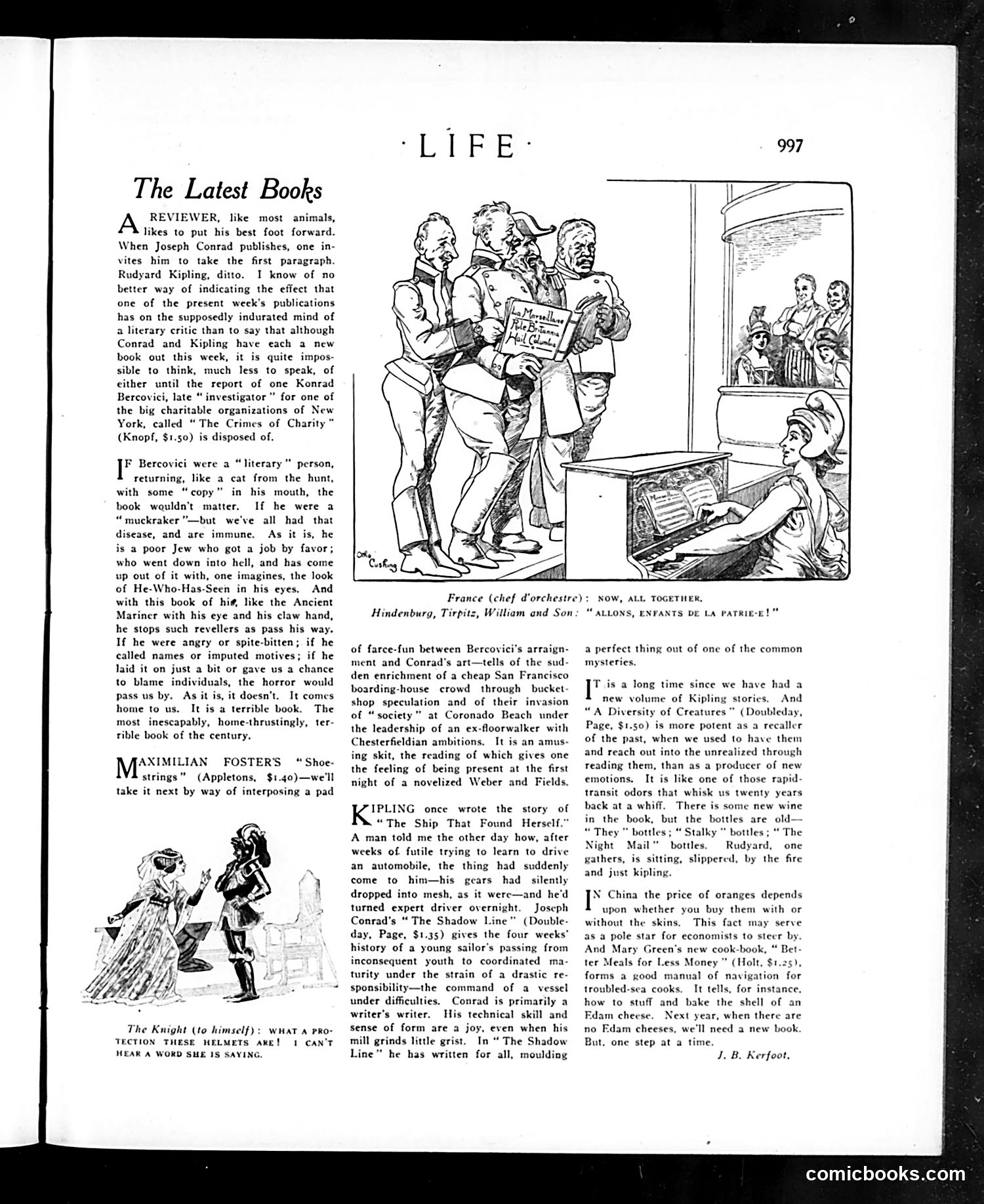
This page reviews recent books by Conrad, Kipling, and others, but the main cartoon depicts a military scene. The caption references "France (chef d'orchestre)" conducting "Hindenburg, Tirpitz, William and Son" with the French motto "Allons, enfants de la patrie!" ("Let's go, children of the fatherland!"). The cartoon satirizes World War I dynamics: France is portrayed as a conductor attempting to orchestrate the German military leadership (Hindenburg and Tirpitz, the Kaiser William II, and apparently his son) like musicians in an orchestra. The smaller cartoon above shows a knight claiming his helmet prevents him from hearing a woman speak—visual comedy about selective deafness. The satire suggests France's struggle to coordinate or control the German war effort, or perhaps mocks the chaotic military alliance. The piece dates from the WWI era when Life magazine regularly published anti-German political humor aimed at American audiences.
📄 Transcribed text from this page (OCR, searchable)
Machine-transcribed from the original scan — historical spelling and the odd misread are preserved.
The Latest Books REVIEWER, like most animals, likes to put his best foot forward. When Joseph Conrad publishes, one in- vites him to take the first paragraph. Rudyard Kipling, ditto. I know of no better way of indicating the effect that one of the present weck’s publications has on the supposedly indurated mind of a literary critic than to say that although Conrad and Kipling have each a new book out this week, it is quite impos- sible to think, much less to speak, of either until the report of one Konrad Bercovici, late “ investigator " for one of the big charitable organizations of New York, called “The Crimes of Charity (Knopf, $1.50) is disposed of. I Bercovici were a “literary person, returning, like a cat from the hunt, with some “copy” in his mouth, the book wouldn't matter. If he were a “muckraker "—but we've all had that disease, and are immune, As it is, he is a poor Jew who got a job by favor; who went down into hell, and has come up out of it with, one imagines, the look of He-Who-Has-Seen in his eyes. And with this book of hig, like the Ancient Mariner with his eye and his claw hand, he stops such revellers as pass his way. If he were angry or spite-bitten; if he called names or imputed motives; if he laid it on just a bit or gave us a chance to blame individuals, the horror would pass us by. As it is, it doesn't. It comes home to us. It is a terrible book. The most inescapably, home-thrustingly, ter- rible book of the century, XIMILIAN FOSTERS“ Shoe- strings” (Appletons, $1.40)—we'll take it next by way of interposing a pad The Knight (to himself): wnat a pRo- TECTION THESE HELMETS ARE! 1 CAN'T HEAR A WORD SHE 18 SAYIN France (chef d'orchestre): Now, ALL. TOGETHER, Hindenburg, Tirpitz, William end Son of farce-fun between Bercovici's arraign- ment and Conrad's art—tells of the sud- den enrichment of a cheap San Francisco boarding-house crowd through bucket shop speculation and of their invasion of “society” at Coronado Beach under the leadership of an ex-floorwalker with Chesterfieldian ambitions. It is an amus- ing skit, the reading of which gives one the feeling of being present at the first night of a novelized Weber and Fields, IPLING once wrote the story of “The Ship That Found Herself.” A man told me the other day how, after weeks of futile trying to learn to drive an automobile, the thing had suddenly come to him—his gears had silently dropped into mesh, as it were—and he'd turned expert driver overnight. Joseph Conrad's “ The Shadow Line” (Double- day, Page, $1.35) gives the four weeks’ history of a young sailor’s passing from inconsequent youth to coordinated ma- turity under the strain of a drastic re- sponsibility—the command of a vessel under difficulties. Conrad is primarily a writer's writer. His technical skill and sense of form are a joy, even when his mill grinds little grist. In “ The Shadow Line” he has written for all, moulding “ ALLONS, ENFANTS DE LA PaTRIE-E!” a perfect thing out of one of the common mysteries. T is a long time since we have had a new volume of Kipling stories, And “A Diversity of Creatures” (Doubleday, Page, $1.50) is more potent as a recaller of the past, when we used to have them and reach out into the unrealized through reading them, than as a producer of new emotions. It is like one of those rapid- transit odors that whisk us twenty years back at a whiff. There is some new wine in the book, but the bottles are old— “ They ™ bottles ; “ Stalky " bottles; “ The Night Mail” bottles. Rudyard, gathers, is sitting, slippered, by the fire and just kipling. one N China the price of oranges depends upon whether you buy them with or without the skins. This fact may serve as a pole star for economists to steer by. And Mary Green's new cook-book, “ Bet- ter Meals for Less Money ” (Holt, $1.25), forms a good manual of navigation for troubled-sea cooks. It tells, for instance. how to stuff and bake the shell of an Edam cheese. Next year, when there are no Edam cheeses, we'll need a new book But, one step at a time. J.B. Kerfoot. comicbooks.com