
A complete issue · 38 pages · 1917
Life — May 31, 1917
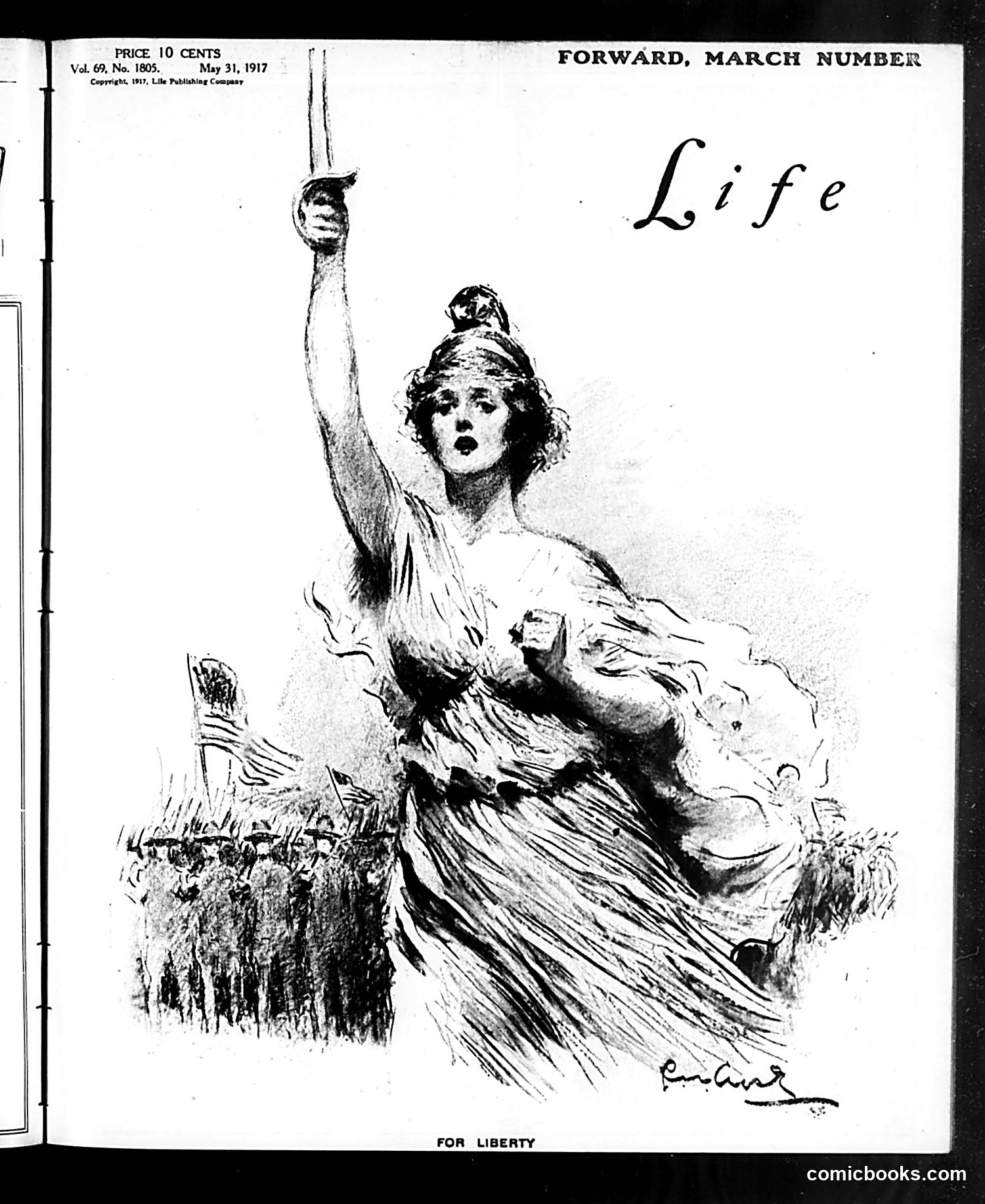
This is the cover of Life's "Forward, March Number," published during America's entry into World War I (declared April 1917). The allegorical female figure represents Liberty or America herself, raising a torch while wearing a Phrygian cap (a Revolutionary symbol). She stands triumphantly above marching soldiers visible in the background. The imagery celebrates American military mobilization and patriotic fervor at the war's outset. The composition echoes classical Liberty iconography, positioning the nation's cause as just and righteous. The artist's signature appears to read "Cobb" or similar. The overall message promotes American intervention as a patriotic imperative—"Life" magazine using its satirical platform to advocate for the military effort rather than critique it.
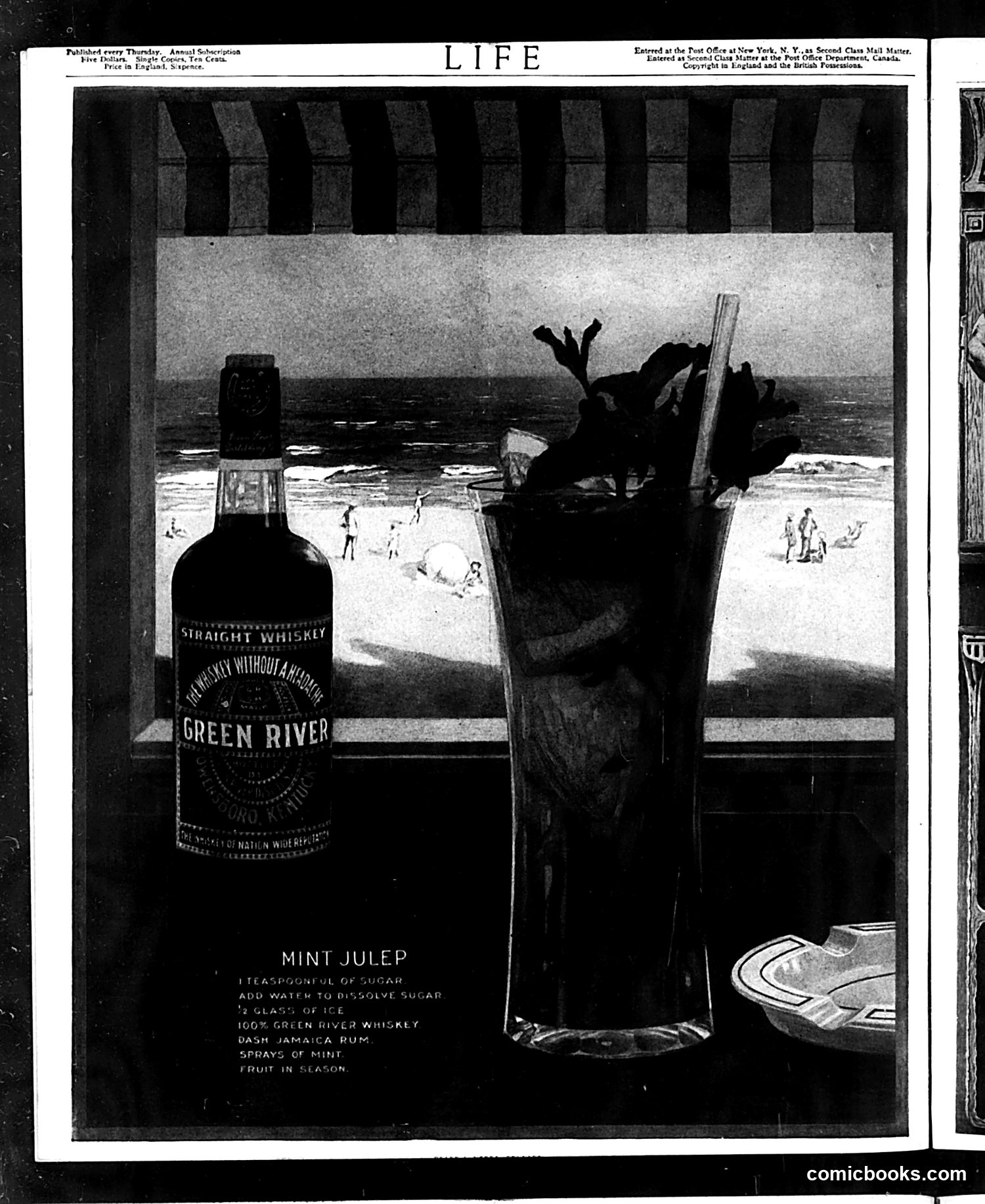
This is a **Green River Whiskey advertisement**, not political satire. The page shows a bottle of Green River straight whiskey positioned on what appears to be a beach pavilion or boardwalk, with a scenic ocean view and beachgoers visible behind it. A tall glass containing what the text identifies as a "Mint Julep" sits prominently in the foreground. The recipe lists the drink's ingredients: teaspoon of sugar, water, ice, Green River whiskey, Jamaica rum, mint sprays, and seasonal fruit. This represents early 20th-century American liquor advertising in *Life* magazine, before Prohibition. The composition—linking the product to leisure, seaside relaxation, and summer enjoyment—was typical marketing strategy of the era.
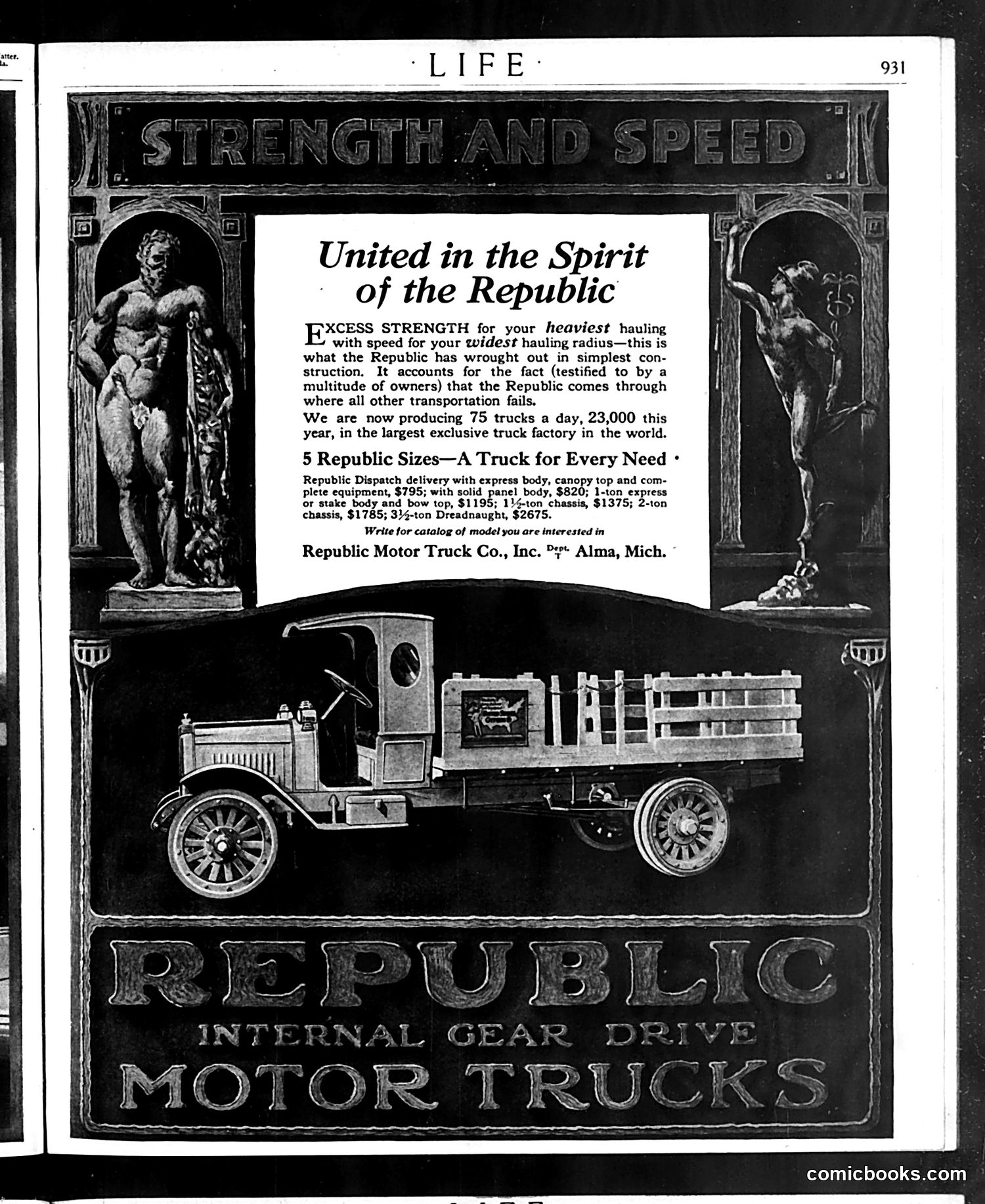
This page is primarily **advertising, not satire**. It's a Republic Motor Truck Company advertisement from *Life* magazine (page 931). The classical male figures flanking the text (appearing to represent Strength and Speed personified) are decorative elements meant to evoke classical ideals—a common advertising trope of the era. The headline "United in the Spirit of the Republic" uses patriotic language to market trucks. The ad emphasizes Republic's production capacity (75 trucks daily) and product range for different hauling needs, with specific pricing. The truck illustration shows a stake-bed design typical of early 1920s commercial vehicles. There is no political cartoon or satire here—just a straightforward vintage truck advertisement using classical iconography and nationalist rhetoric as marketing appeals.
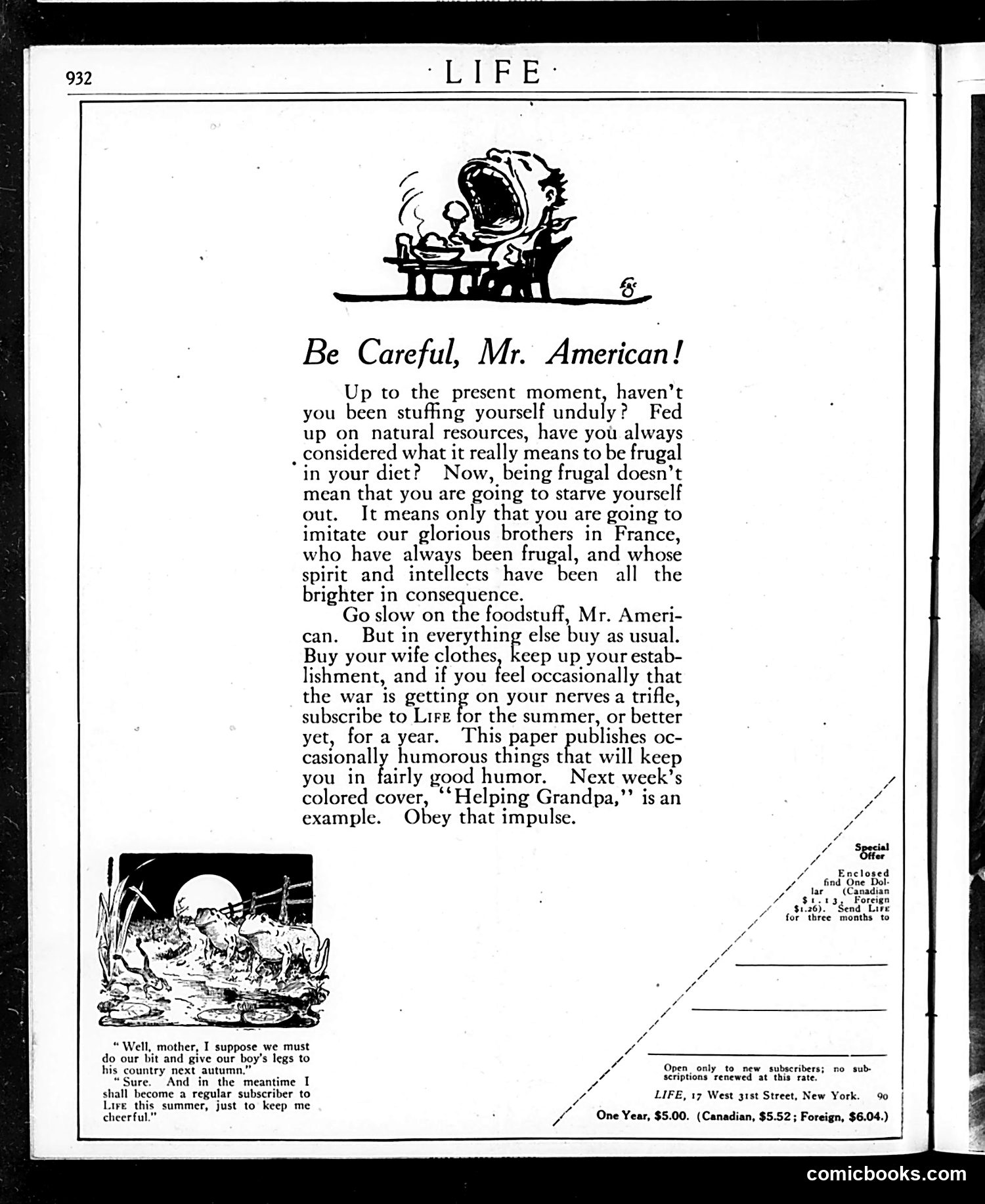
This Life magazine page from World War I era (likely 1917-1918, based on references to "the war") contains a satirical advertisement encouraging American frugality in food consumption. The headline "Be Careful, Mr. American!" urges readers to reduce food consumption, comparing their sacrifice to French citizens' established frugality. The rhetoric suggests wartime rationing messaging—Americans should "go slow on the foodstuff" while maintaining normal spending elsewhere. The lower cartoon shows a parent telling a child they must sacrifice for the war effort ("give our boy's legs to his country"), with the child's cheerful response about subscribing to Life magazine to "keep me cheerful." The satire works on multiple levels: promoting wartime sacrifice while also advertising the magazine itself as a morale-boosting purchase.
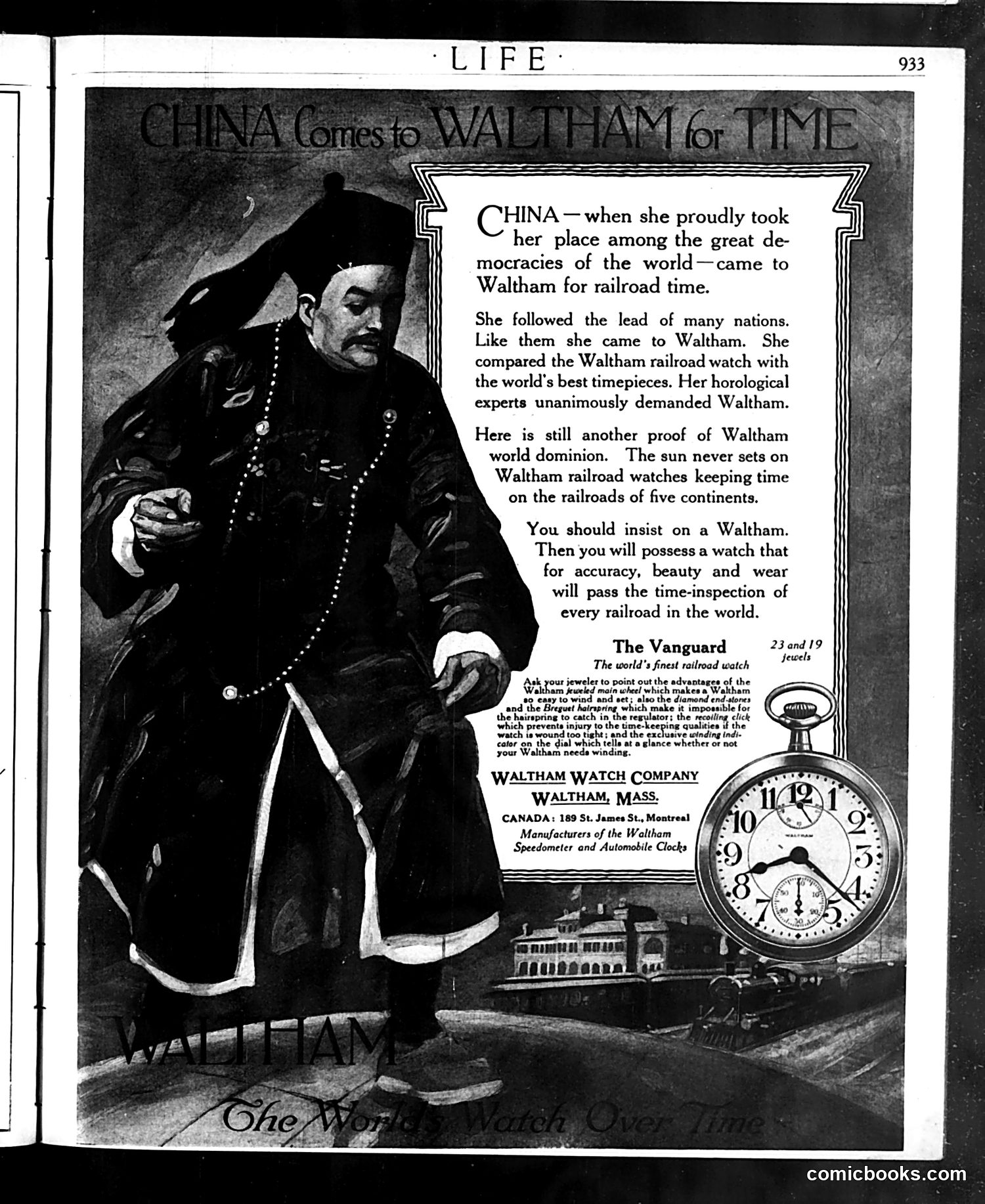
This is a **Waltham Watch Company advertisement** disguised as satirical content, not a political cartoon. The image depicts a Chinese official or dignitary in traditional formal dress, examining a pocket watch. The satire plays on early 20th-century colonial attitudes: China is portrayed as finally joining "great democracies of the world" and adopting Western standards—specifically, trusting Waltham watches for railroad timekeeping across continents. The joke assumes Western superiority in precision timekeeping and suggests China's modernization requires adopting American products. The advertisement conflates product reliability with civilization itself, using orientalist imagery and condescending language about China "proudly" taking its place among democracies—implying it previously lacked such status. This reflects period prejudices about non-Western nations.
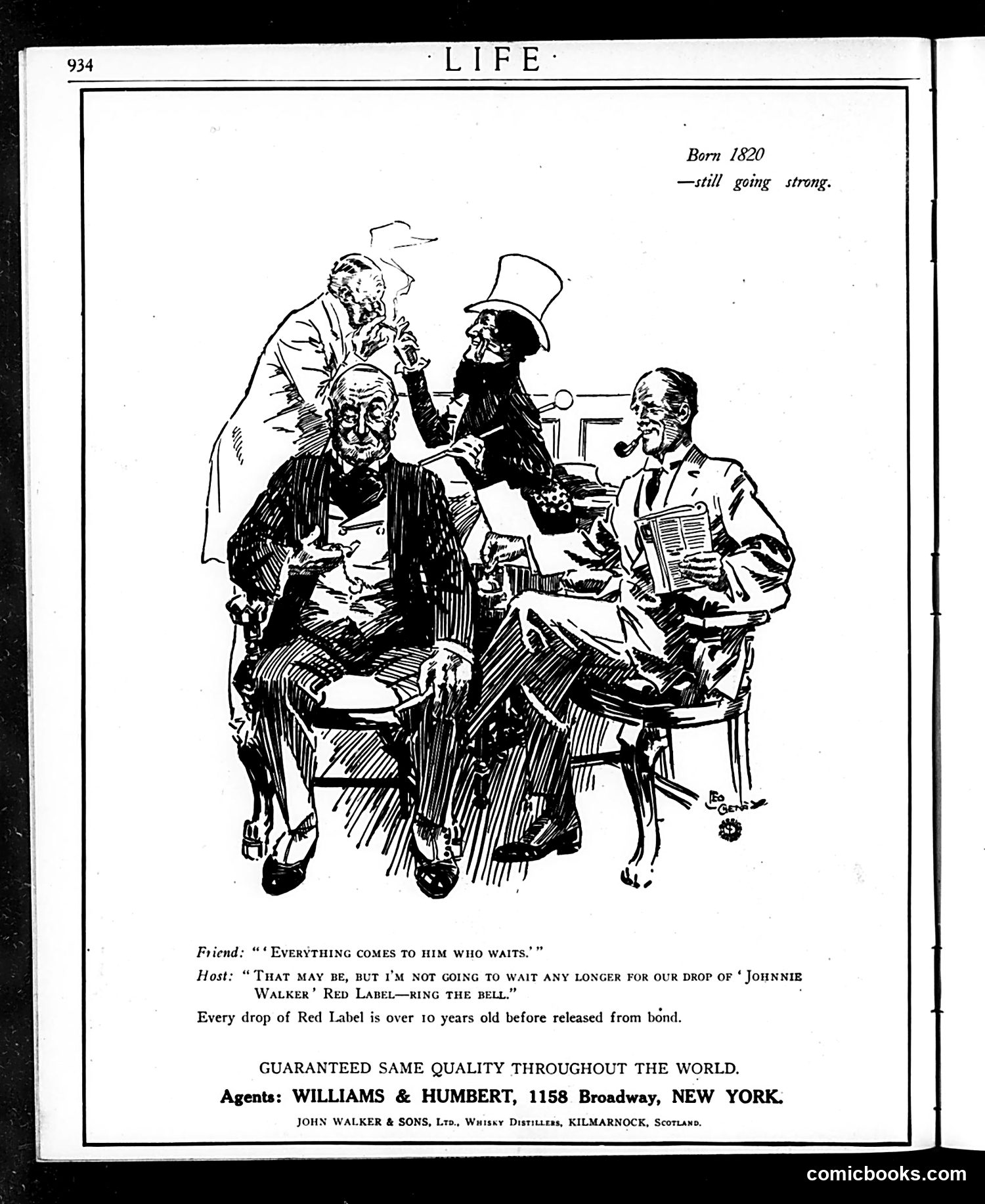
This is primarily a **whiskey advertisement** for Johnnie Walker Red Label, disguised as satirical editorial content in *Life* magazine. The cartoon depicts four men in 19th-century dress gathered socially. The caption's joke plays on the phrase "everything comes to him who waits"—the host insists he won't wait for Johnnie Walker whiskey delivery any longer, will "ring the bell" immediately. The header "Born 1820—still going strong" suggests the product's long history and durability. The advertisement emphasizes that Red Label whisky is aged over 10 years before release and maintains "guaranteed same quality throughout the world." The agents listed are Williams & Humbert (New York) and the Scottish distiller John Walker & Sons. This appears to be a transatlantic liquor marketing campaign targeting affluent American consumers during the early 20th century.
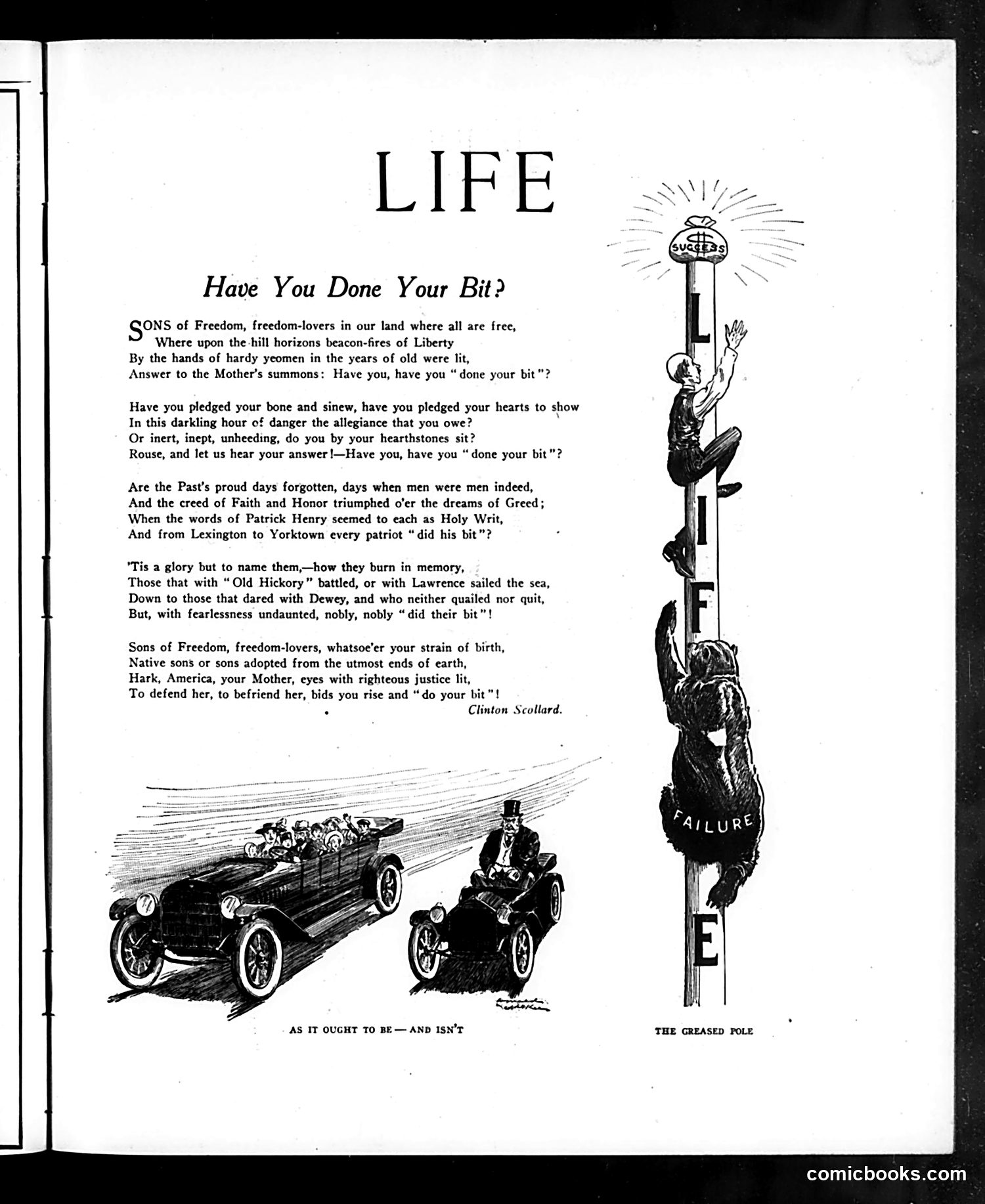
This page presents a patriotic poem by Clinton Scollard titled "Have You Done Your Bit?" addressing young American men to contribute to the war effort—likely World War I based on references to historical patriotic acts (Lexington, Yorktown, Patrick Henry). The two illustrations contrast patriotic duty with failure: **Left cartoon**: "As It Ought to Be—and Isn't" shows an automobile full of citizens, suggesting civic participation and energy moving forward. **Right cartoon**: "The Greased Pole" depicts a figure labeled "Failure" stuck on a slippery pole, unable to reach the Liberty torch above—symbolizing how lack of patriotic commitment prevents reaching national ideals. The satire criticizes Americans who don't actively support the national cause, portraying inaction as shameful failure.
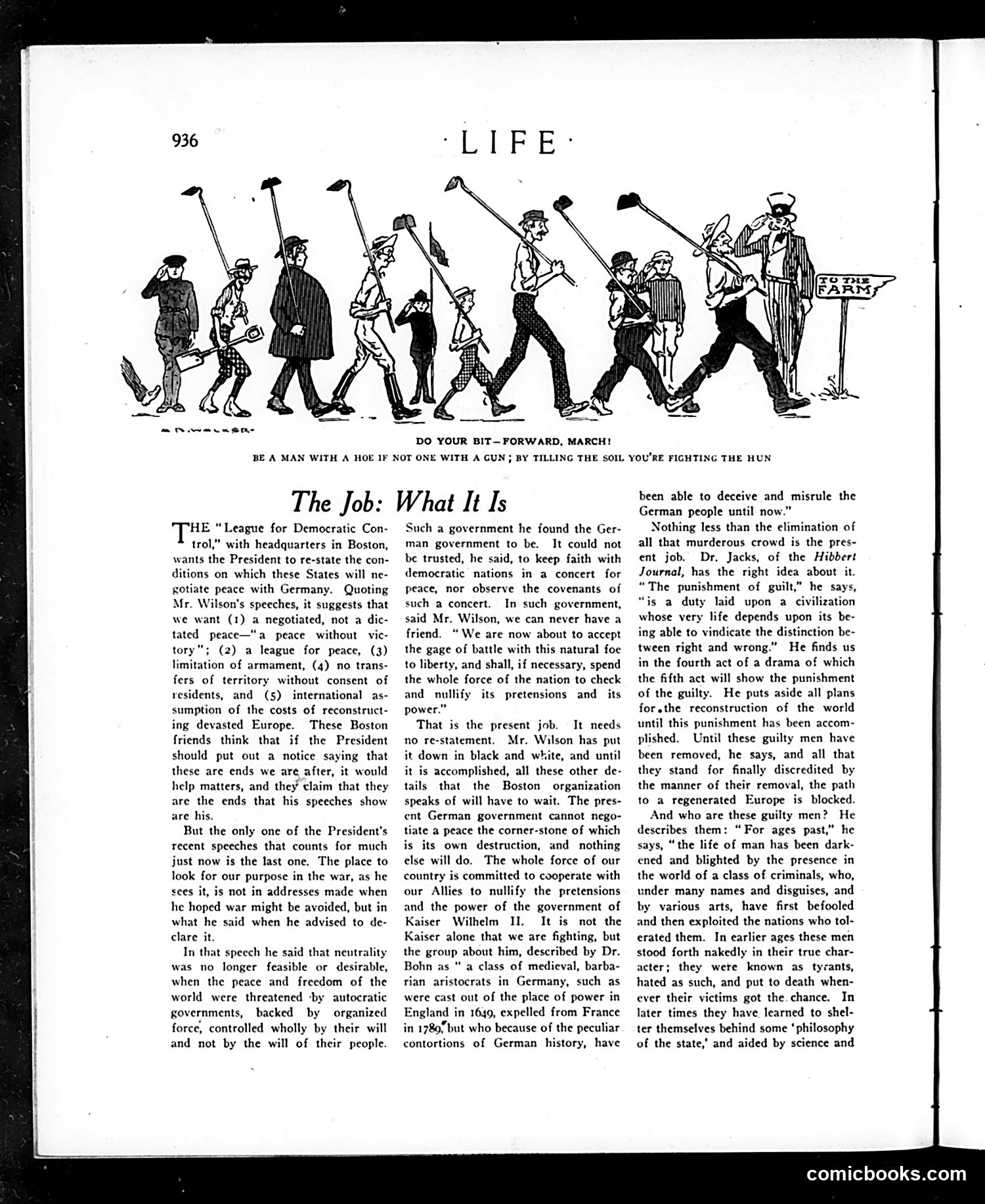
This 1918 WWI-era cartoon depicts a procession of figures marching leftward with farming tools (hoes) converted into weapons, progressing toward a "FARM" sign. The caption reads "DO YOUR BIT—FORWARD, MARCH!" with text about fighting "the Hun" through soil cultivation. The accompanying article discusses President Wilson's stated war aims, emphasizing that the war targets not Kaiser Wilhelm II but rather German aristocratic leaders described as "medieval, barbarian." The piece argues the conflict aims to eliminate autocratic rule and establish democratic governance. The cartoon satirizes the recruitment message conflating agricultural labor with military duty—suggesting Americans should support the war effort through farming production as equivalent to combat service.
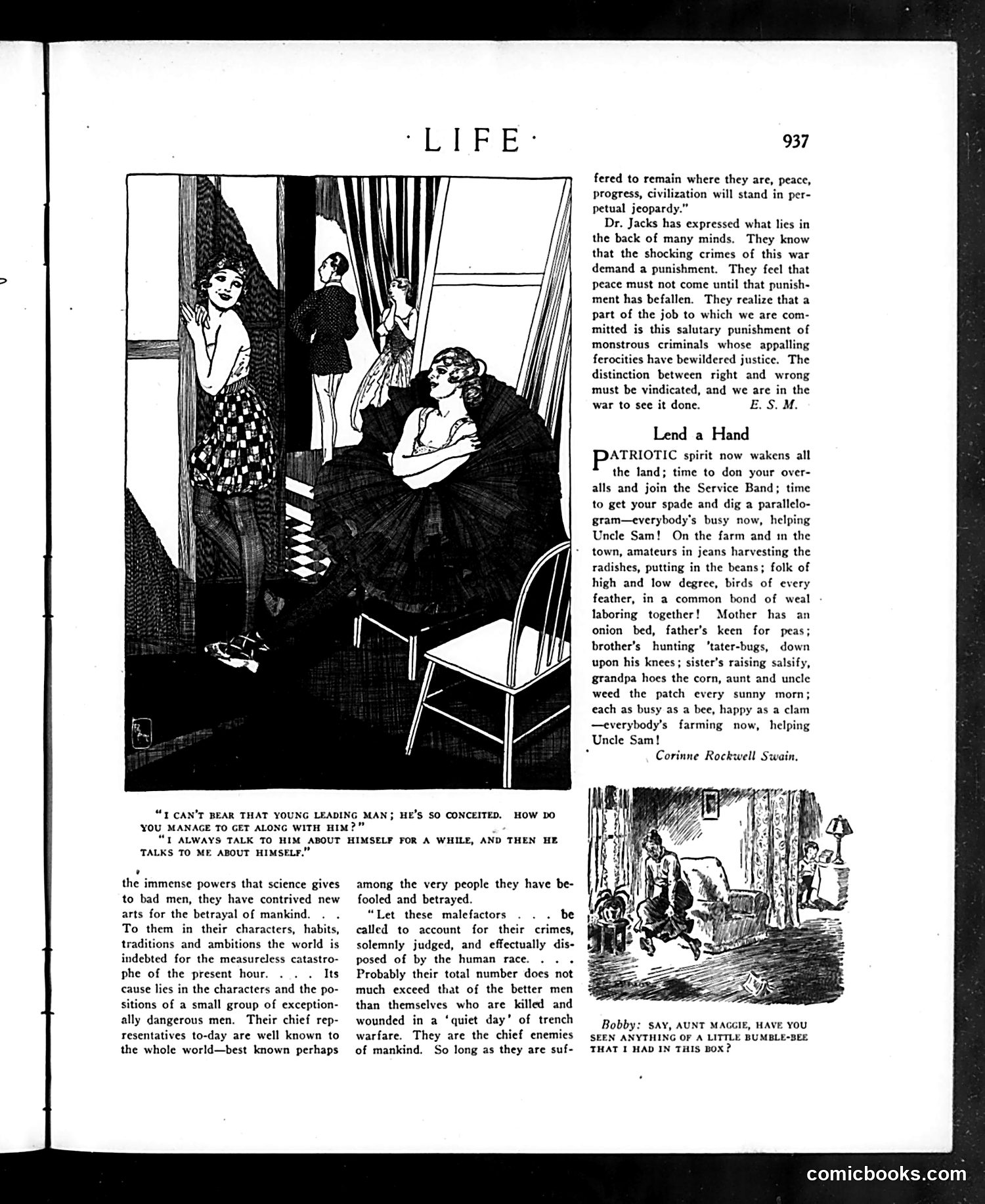
This page contains two distinct elements: **Main Illustration (top):** A social scene showing women in an interior setting. The caption criticizes a "young leading man" for being conceited and self-absorbed, suggesting he monopolizes conversations by talking about himself. This appears to be satirizing vanity and poor social etiquette among the wealthy or fashionable set. **Bottom Section:** An article titled "Lend a Hand" appeals to patriotic spirit during wartime (likely WWI, given references to "Uncle Sam" and farming efforts). It urges civilians—farmers, families, and workers of all classes—to contribute to the war effort through labor and sacrifice. The small illustration below shows what appears to be a domestic scene with a child and adult, accompanying a caption about a "humble-bee" in a box. The page blends social satire with patriotic wartime messaging.
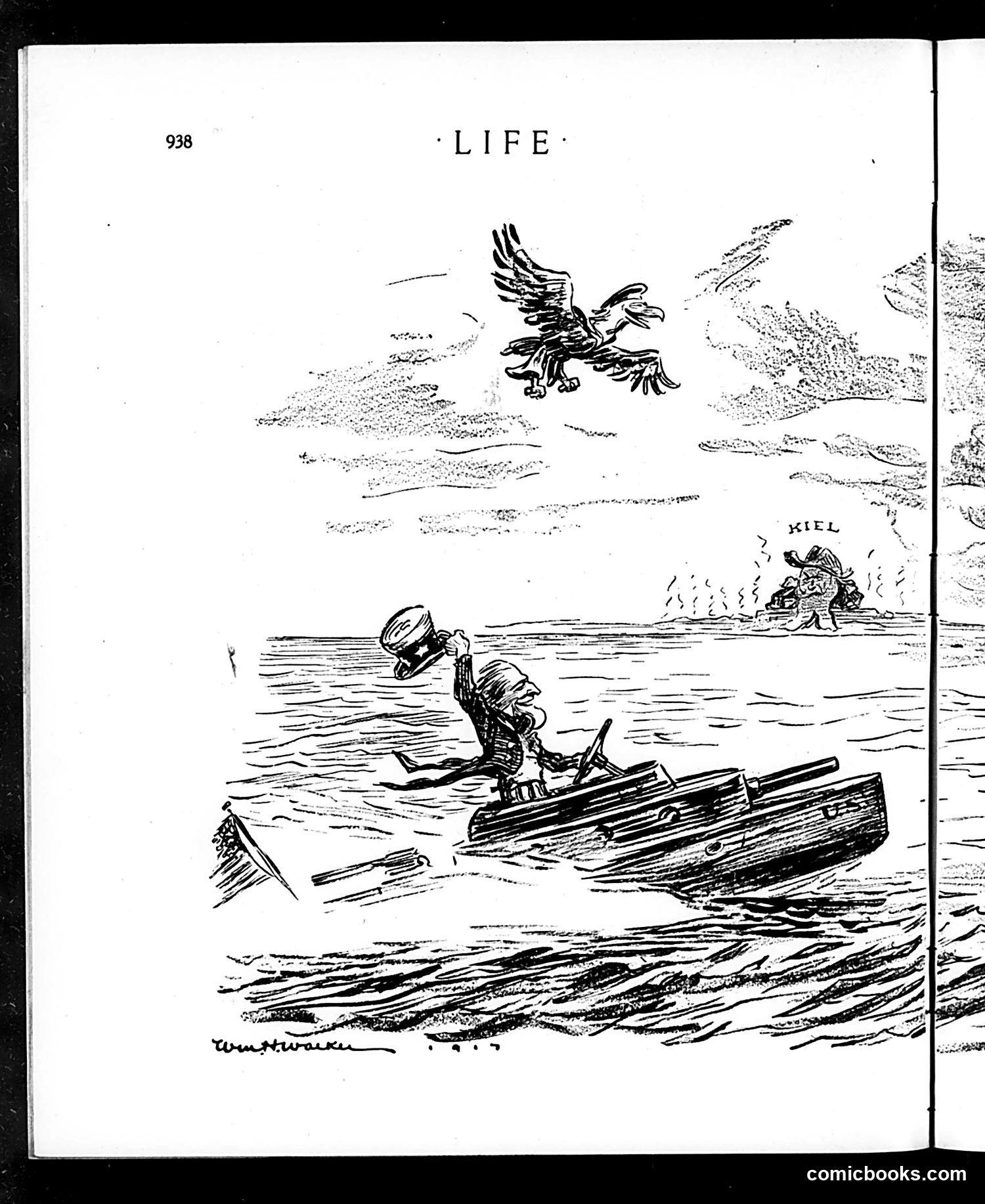
This page contains a single cartoon depicting a child playing in shallow water near a beach or riverbank. The child, wearing a hat, appears to be in a toy boat or makeshift vessel among driftwood and logs. In the background, another figure labeled "KIEL" sits on the shore, and a bird flies overhead. The satire likely references **Kiel, Germany**—a major naval port—suggesting a commentary on post-WWI naval matters or German military capacity. The child's naive play with boats contrasts with serious geopolitical concerns about German rearmament or naval power. The "KIEL" label and the play-versus-reality juxtaposition indicate this is political satire about German military ambitions, though the specific historical moment remains unclear without additional context.
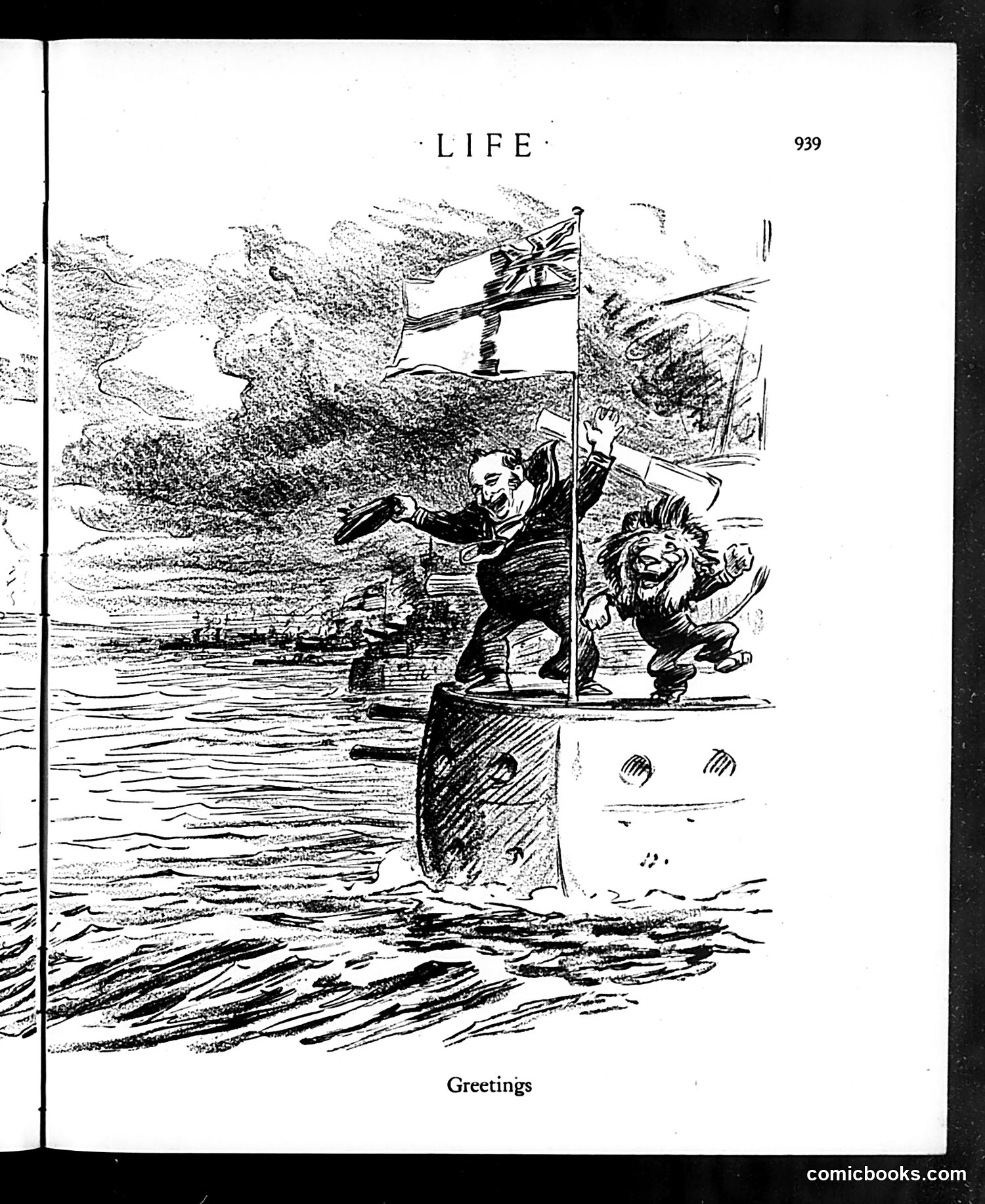
This page from *Life* magazine (page 939) shows a satirical illustration titled "Greetings." The cartoon depicts a figure in formal dress planting or raising a flag on what appears to be a post or fortification near water. A caricatured figure with exaggerated features—possibly representing a political opponent or satirical character—stands nearby gesturing enthusiastically. The scene suggests territorial claim-making or nationalist posturing, likely commentary on imperial expansion, colonialism, or aggressive foreign policy. The flag-planting gesture evokes colonial conquest imagery. Without the publication date visible, the specific political context remains unclear, though the satirical tone critiques some form of territorial ambition or nationalist "greeting" presented as aggressive or absurd.
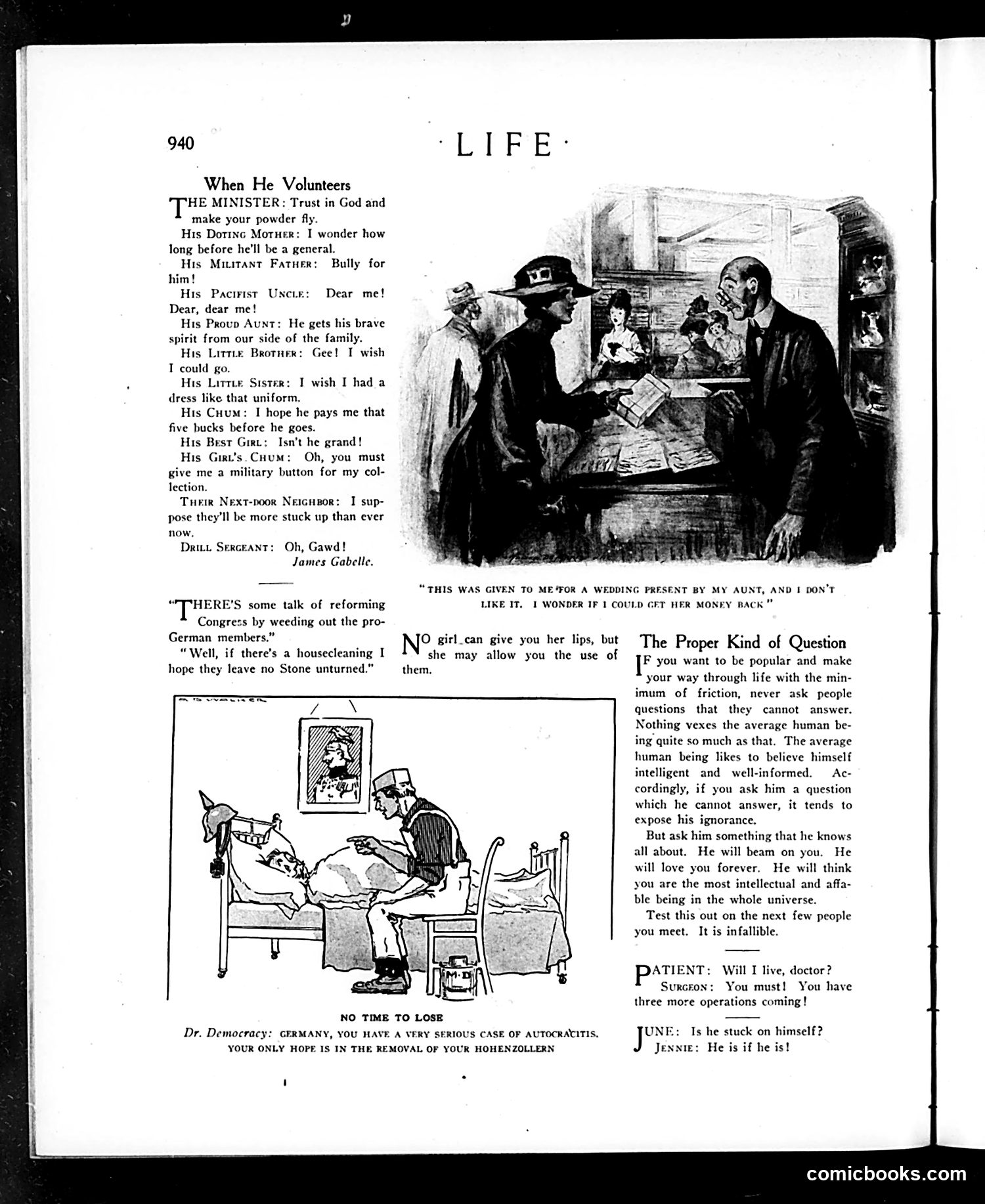
This cartoon satirizes **German autocracy** during World War I. The caption identifies the patient as "Dr. Democracy" suffering from "autocratitis," with the diagnosis that removal of the German Kaiser (Hohenzollern) is the only cure. The doctor represents Allied perspective, suggesting Germany's authoritarian government under Kaiser Wilhelm II is a disease requiring radical treatment—specifically, regime change. The cartoon advocates for eliminating the German monarchy as essential to winning the war and establishing democracy. The surrounding content mocks military volunteerism and includes social satire about proper etiquette. The overall page reflects American anti-German propaganda and pro-democratic messaging typical of WWI-era *Life* magazine editorial cartoons.
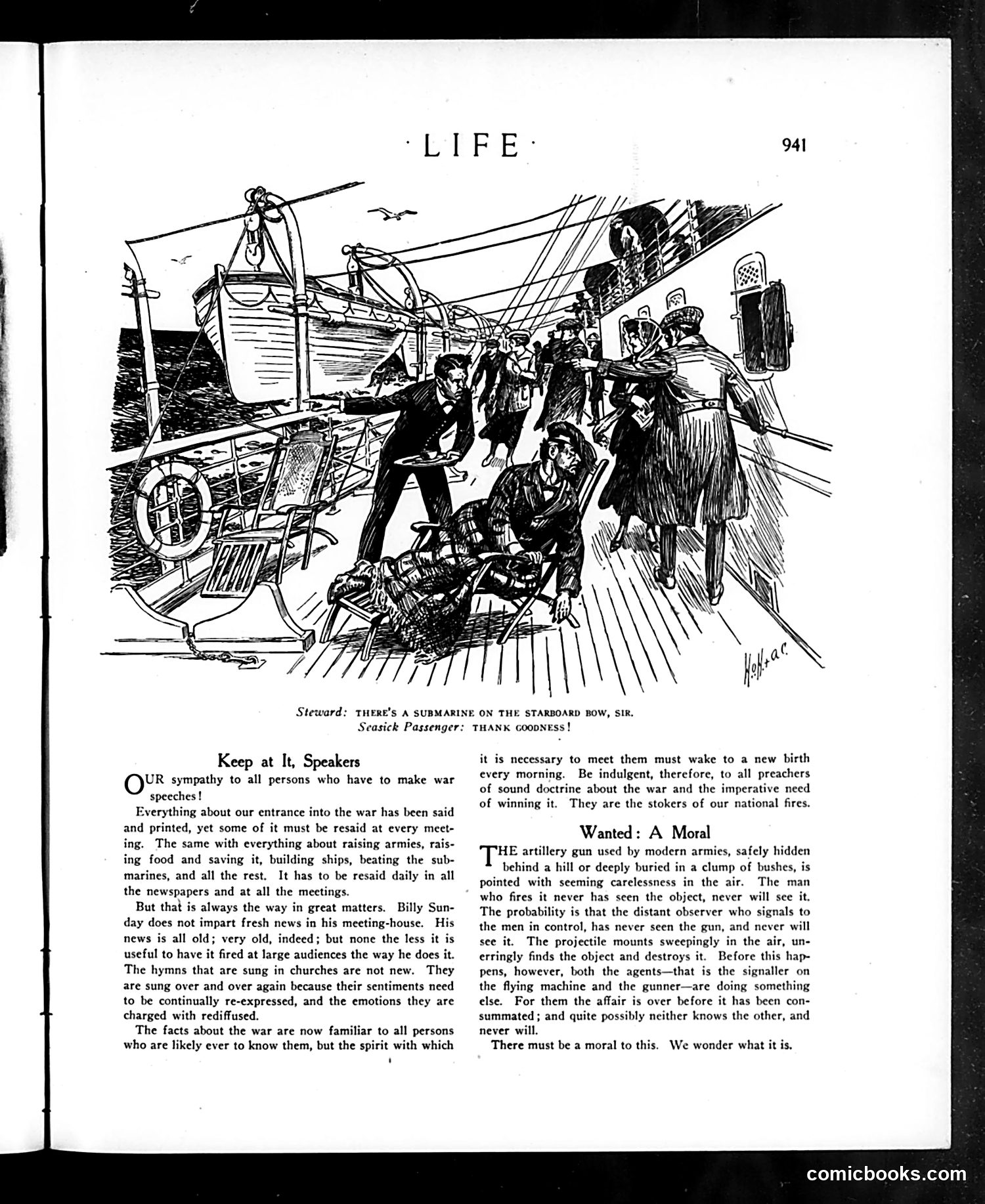
This page from *Life* magazine features a cartoon about wartime public speaking. The illustration shows a ship's deck crowded with well-dressed passengers and sailors, with one man addressing the crowd while others listen. The accompanying article critiques repetitive war propaganda. It argues that while public speeches about military recruitment, fundraising, and patriotic doctrine are necessary, they've become tedious through constant repetition. The author notes that Billy Sunday and other speakers rehash identical sentiments at every meeting, requiring audiences' emotions to be "continuously re-expressed and re-charged." The satire targets the mechanical, formulaic nature of wartime rhetoric rather than its necessity—audiences understand the facts, the article suggests, but speakers keep restating them anyway.
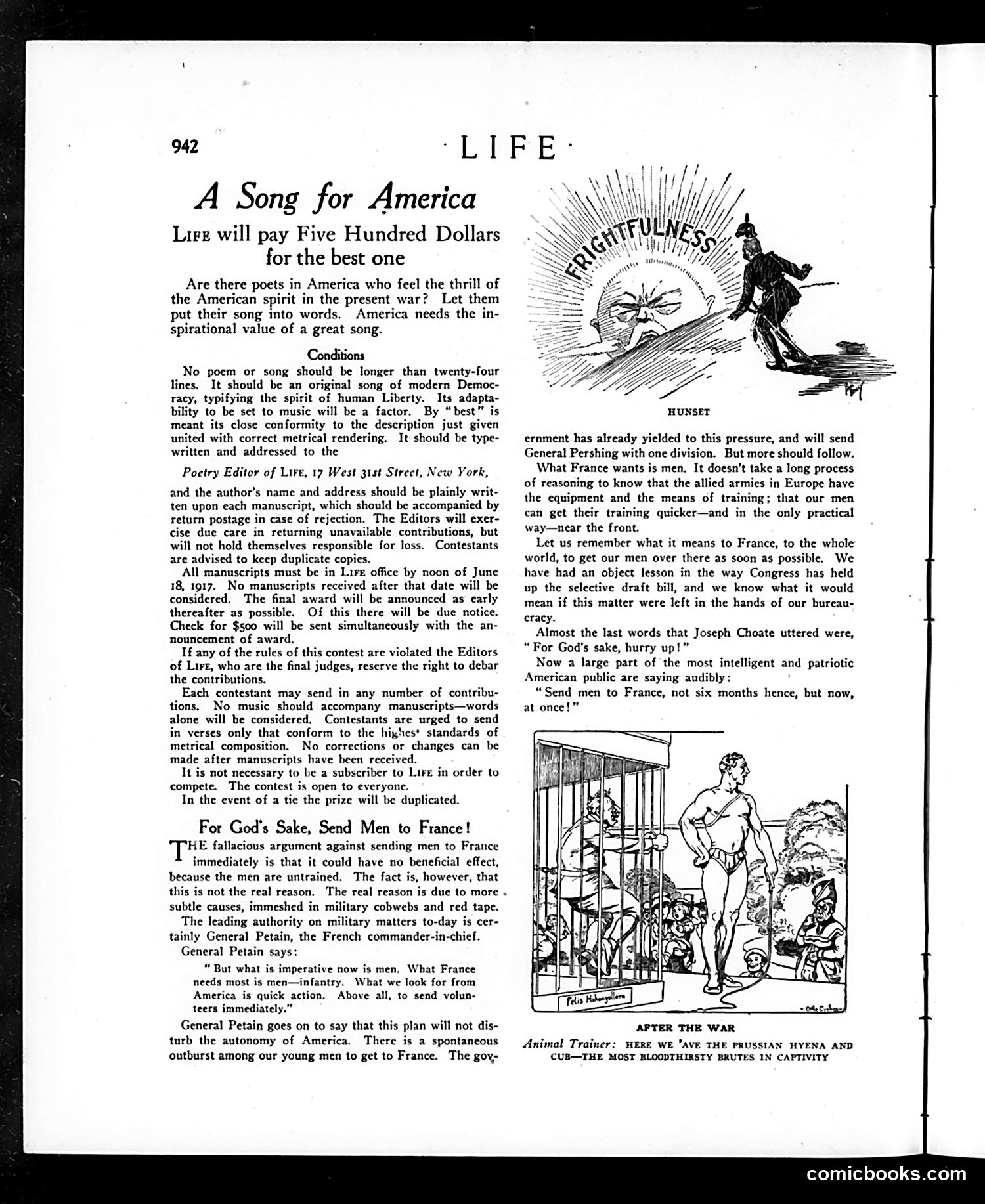
This page combines a poetry contest announcement with pro-war advocacy during World War I. Life offered $500 for the best patriotic song celebrating American spirit and "modern Democracy." The main cartoon, titled "After the War," depicts a caged nude male figure labeled as a "Prussian Hyena" and "Cub"—dehumanizing caricatures of German enemies as dangerous animals requiring captivity. This reflects wartime propaganda demonizing Germany. The accompanying text argues for immediate American military involvement in France, citing General Pershing as authority. It dismisses pacifist objections as "fallacious" and frames sending troops as urgently necessary. The page reflects 1917-era American jingoism, using both cultural competition (the song contest) and graphic imagery to mobilize public support for war participation.
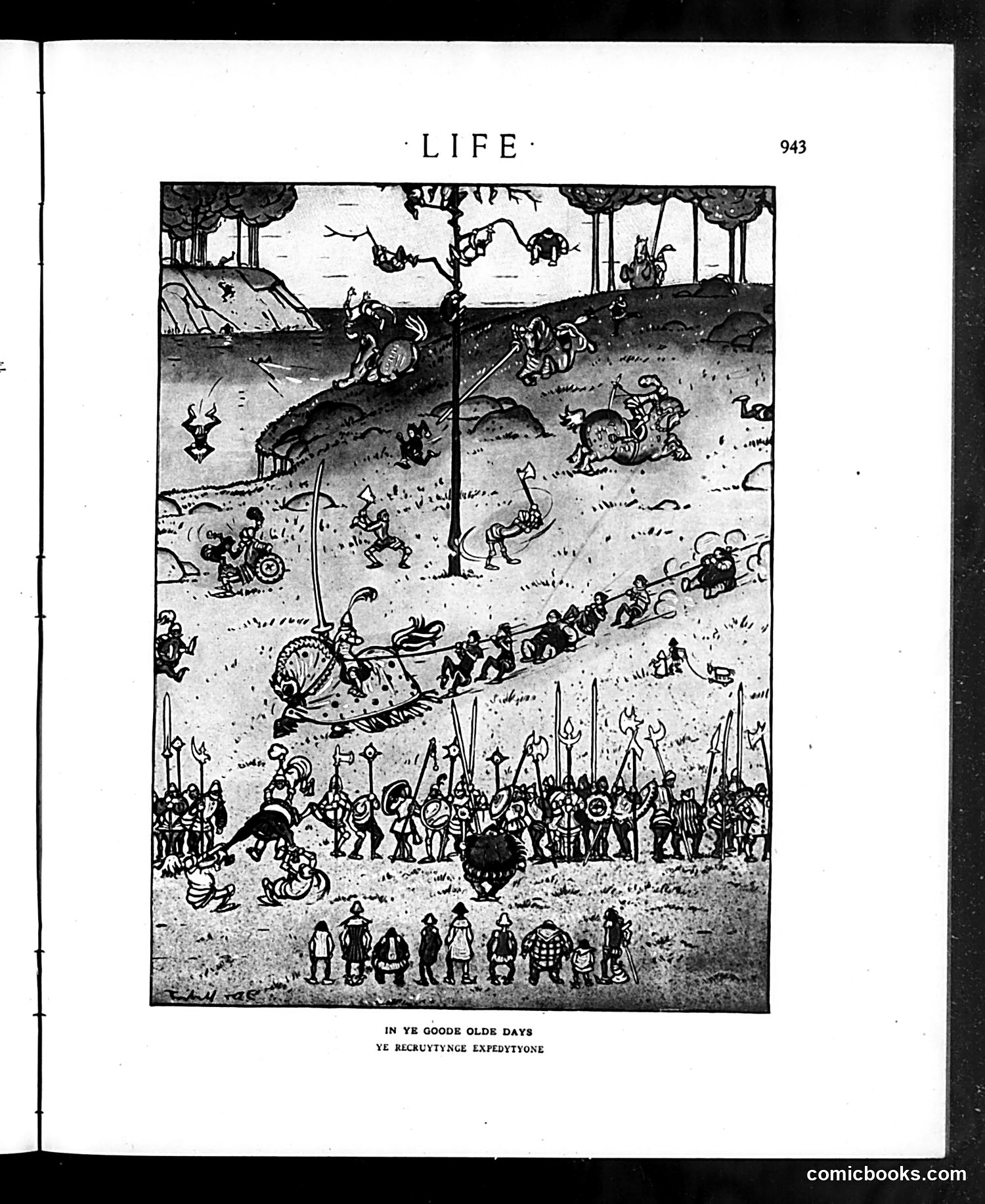
This is a satirical illustration titled "In Ye Goode Olde Days / Ye Recruitynge Expedityone," depicting military recruitment in medieval times. The cartoon shows armed soldiers with spears and shields at the bottom, while above them chaotic scenes illustrate various recruitment methods—people being chased, coerced, or otherwise forced into service. Flying creatures and fantastical elements fill the upper portions. The satire appears to criticize contemporary military recruitment practices by comparing them unfavorably to "the good old days," implying that modern recruitment is similarly coercive or underhanded. The joke suggests that forced conscription or aggressive recruiting tactics aren't new—they're as old as warfare itself. Without a visible date, the specific historical context of which recruitment crisis this references remains unclear.
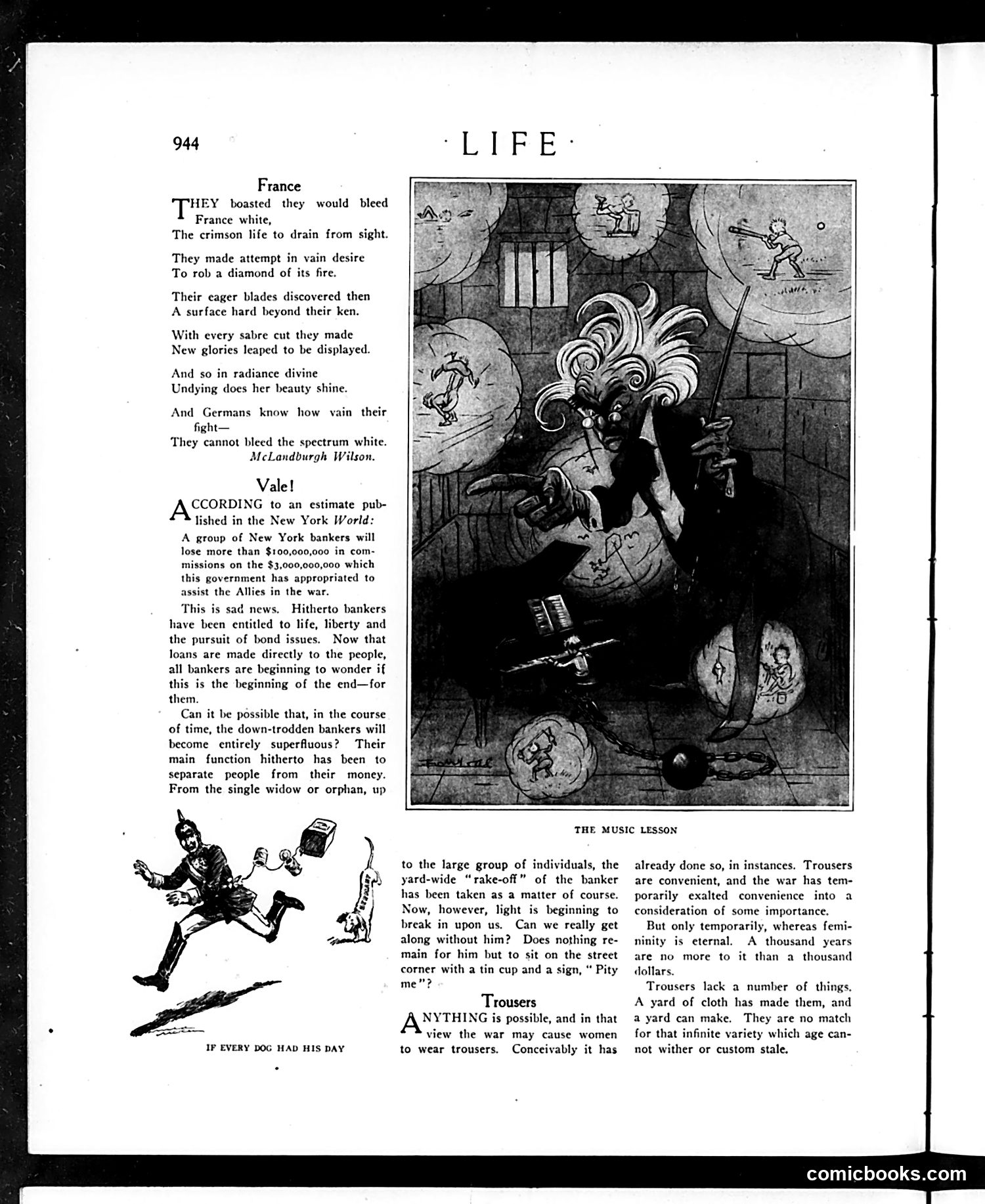
This page contains three satirical pieces from WWI-era Life magazine: **"France" (top poem):** Celebrates French resilience against German attack. The metaphor presents France as a precious diamond—German attempts to destroy it ("bleed" its color) only reveal its inner brilliance. Germans cannot defeat France's enduring beauty and strength. **"Vale!" (middle section):** Mocks American bankers losing $100 million in commissions because the government now loans directly to the public (for Allied war support) rather than through banking intermediaries. The satire suggests bankers' traditional role—extracting fees from ordinary people—may become obsolete, reducing them to street beggars. **"Trousers" (bottom):** Light commentary speculating that wartime convenience might cause women to adopt trousers. However, the piece dismisses this as temporary, arguing femininity is eternal and cannot be replaced by mere practicality. The reference to "infinite variety which age cannot wither" quotes Shakespeare, treating femininity as an ageless ideal transcending fashion.
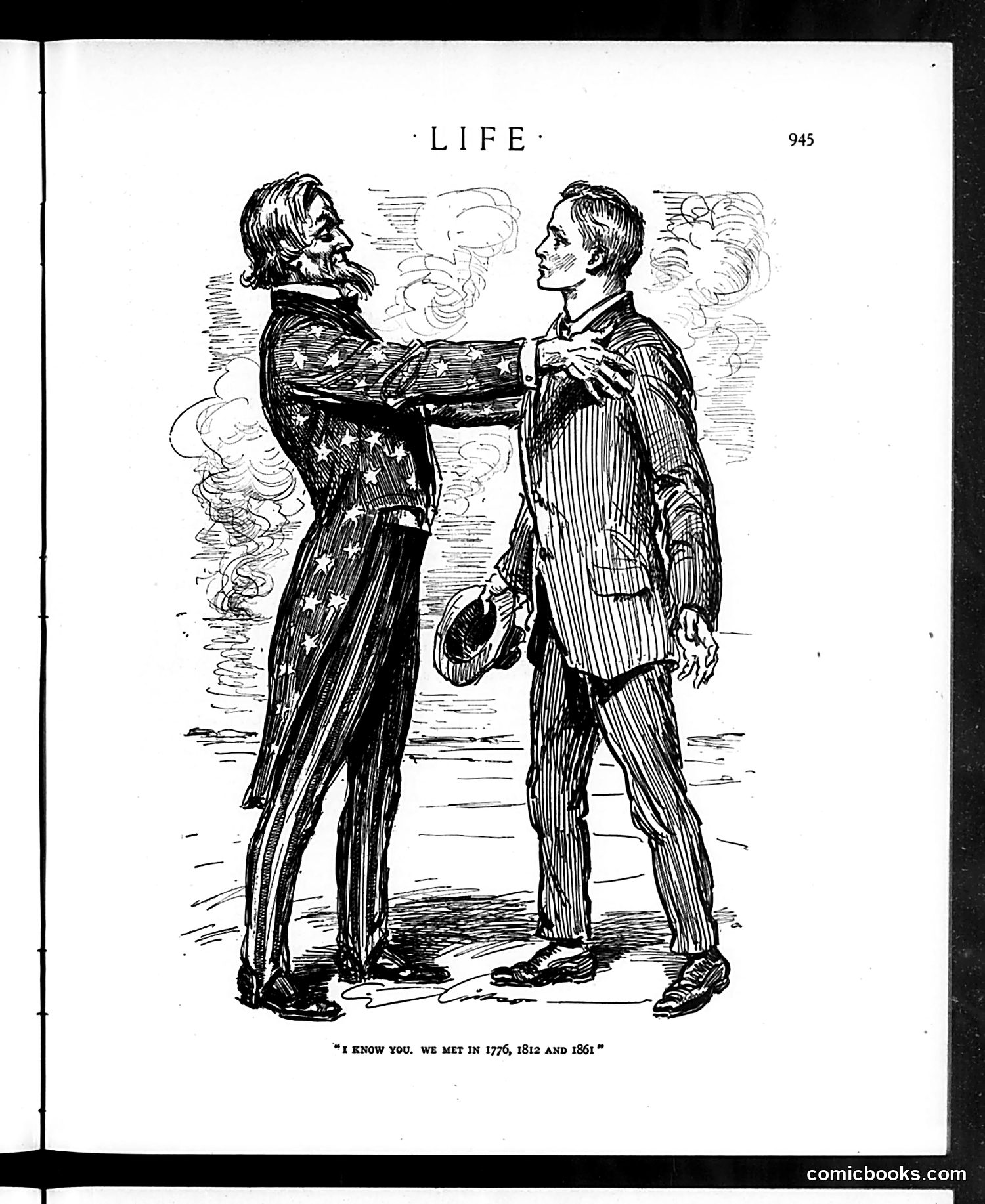
This cartoon depicts two gentlemen in formal 19th-century attire meeting and conversing. The caption reads: "I Know You. We Met in 1776, 1812 and 1861." The three dates reference major American conflicts: the Revolutionary War (1776), the War of 1812, and the Civil War (1861). The cartoon appears to personify these wars or their consequences as recurring acquaintances—suggesting that conflict and strife are persistent, unwelcome visitors to American life. The satire critiques America's cycle of warfare, implying that the nation repeatedly encounters the same destructive forces. One figure likely represents America or a American institution, while the other may embody War itself or international conflict, presented as an unwanted but repeatedly encountered companion throughout American history.
This page, published shortly after America's entry into World War I, discusses the deployment of General John Pershing to France with 25,000 troops. The text praises this decision, crediting former President Theodore Roosevelt's public agitation for pressuring President Wilson's administration into action—though Roosevelt himself will not accompany the expedition. The article defends the delayed military mobilization, explaining that Congress has just passed conscription laws (registration to occur in September). The author argues the war requires training an entire nation, not merely an army. Significantly, the text reveals and critiques Germany's apparent strategic ambitions: a "Pan-German plan" controlling territory from the North Sea through Austria, the Balkans, Turkey to Asia Minor—essentially dominating Southeastern Europe. The author argues America must fight not merely to defend these regions but to liberate them from German control, justifying American intervention in what might seem distant conflicts. The cartoon(s) accompanying this text are not clearly legible enough to identify specifically.
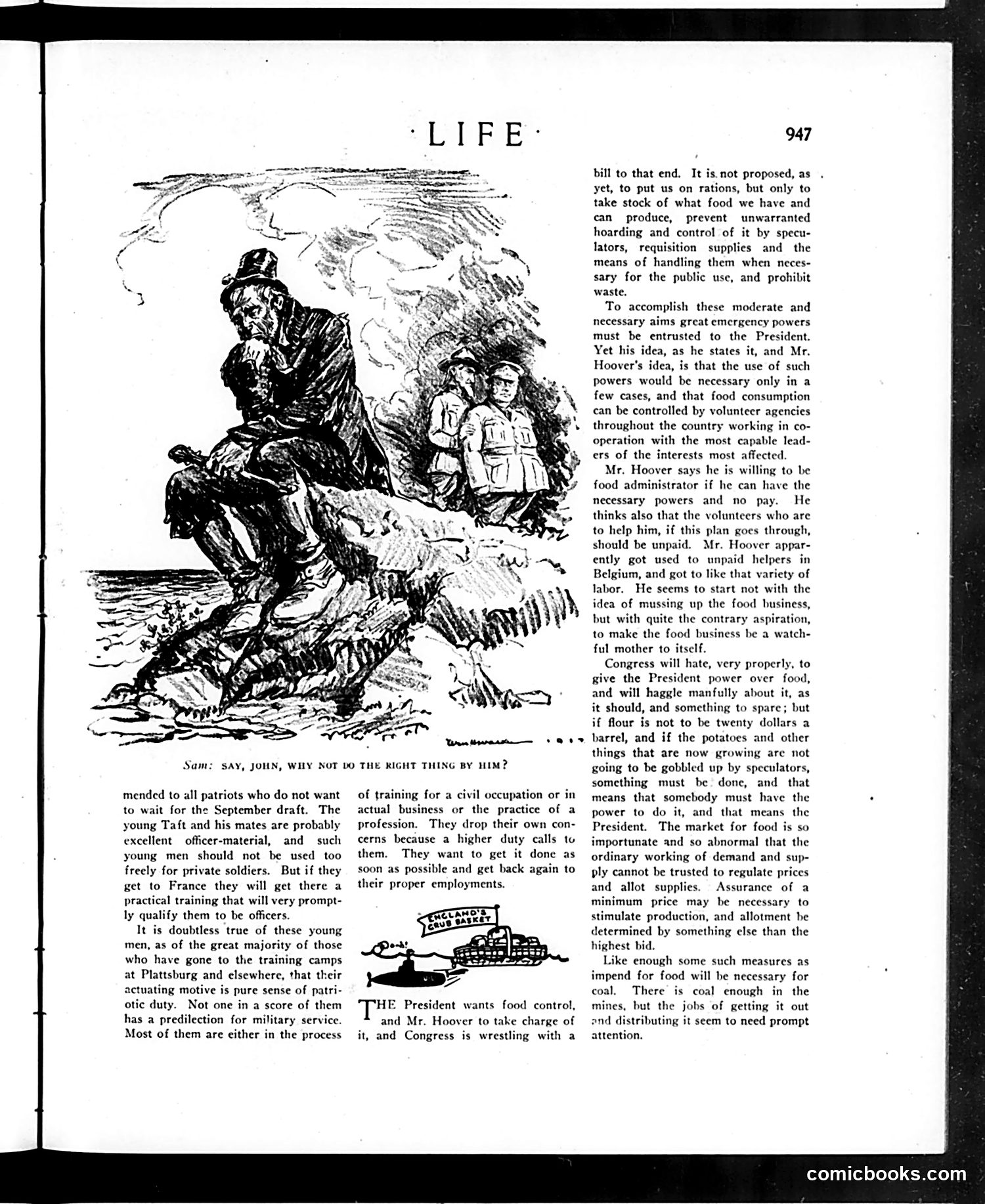
This page from *Life* magazine discusses President Woodrow Wilson's push for federal food control during World War I, with Herbert Hoover proposed as "food administrator." The cartoon caption—"Sam: Say, John, why not do the right thing by him?"—appears to depict a starving or struggling figure (possibly representing the poor or working class), sarcastically questioning why help isn't being given. The accompanying editorial argues that while food rationing isn't yet proposed, the government must prevent hoarding and speculation on food supplies. The author supports giving the President emergency powers to manage food distribution, though acknowledging Congressional resistance. The piece notes Hoover's willingness to serve without pay and use volunteer helpers—a model the author finds somewhat naive given market pressures. The broader context: WWI-era anxieties about food scarcity, inflation, and whether market forces or government intervention should control supplies. The satire questions whether voluntary measures and unpaid labor can truly address these urgent problems.
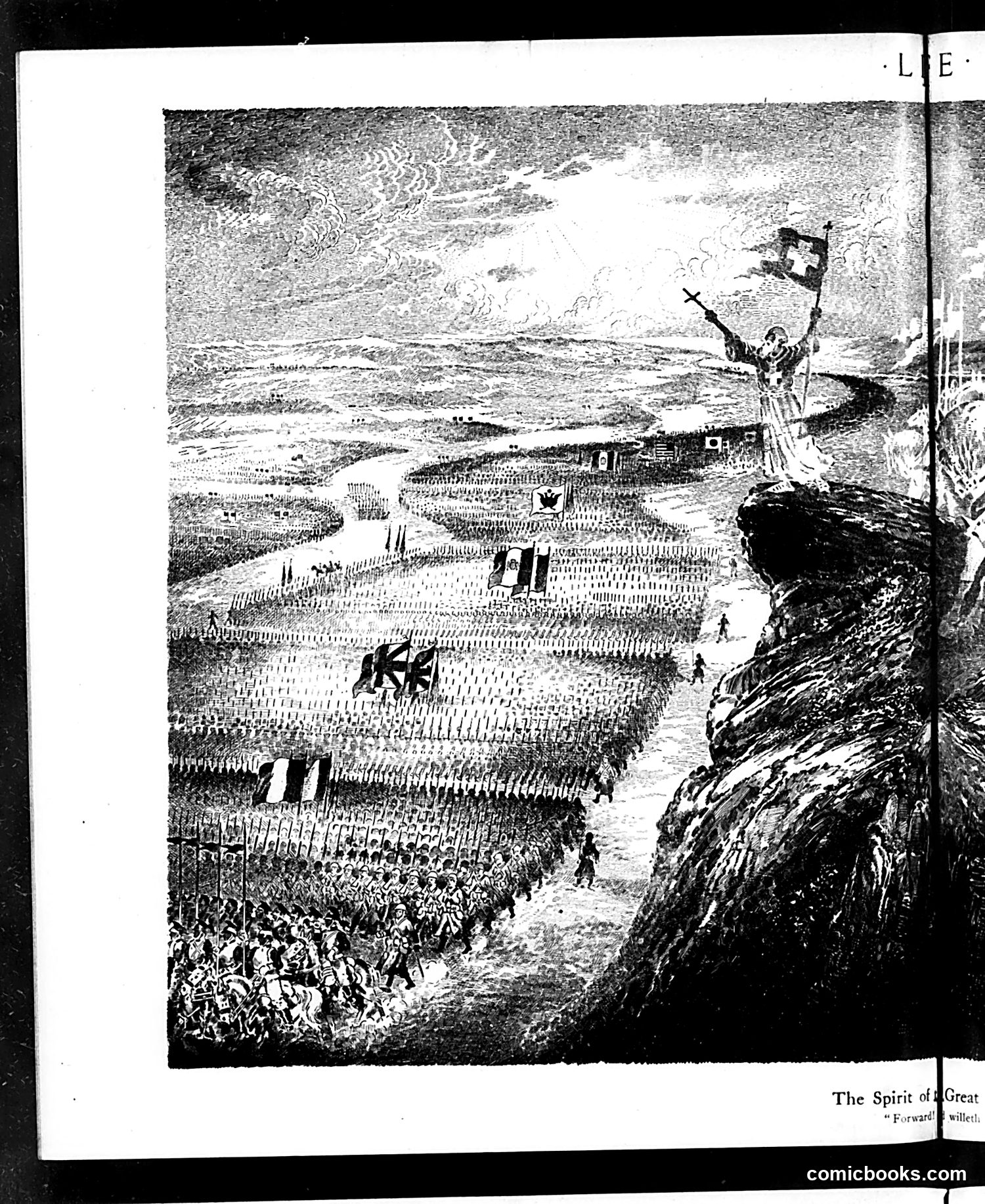
This appears to be a World War I-era satirical illustration from *Life* magazine. The image depicts a female allegorical figure (representing "the Spirit of Great" — likely "Great Britain" with OCR error) standing triumphantly on a cliff, holding a flag while surveying a vast military landscape below. The valley contains organized rows of soldiers, fortifications, and military encampments, representing massive troop mobilization. The composition suggests nationalist pride and military power during wartime. The satire likely critiques either the glorification of war's scale and destruction, or celebrates Allied military strength, depending on *Life*'s editorial stance at that moment. The allegorical female figure was a common propaganda device representing national character and resolve during WWI. Without clearer text, the specific satirical intent remains somewhat unclear, but the grandeur-meets-carnage juxtaposition suggests commentary on warfare's scope.
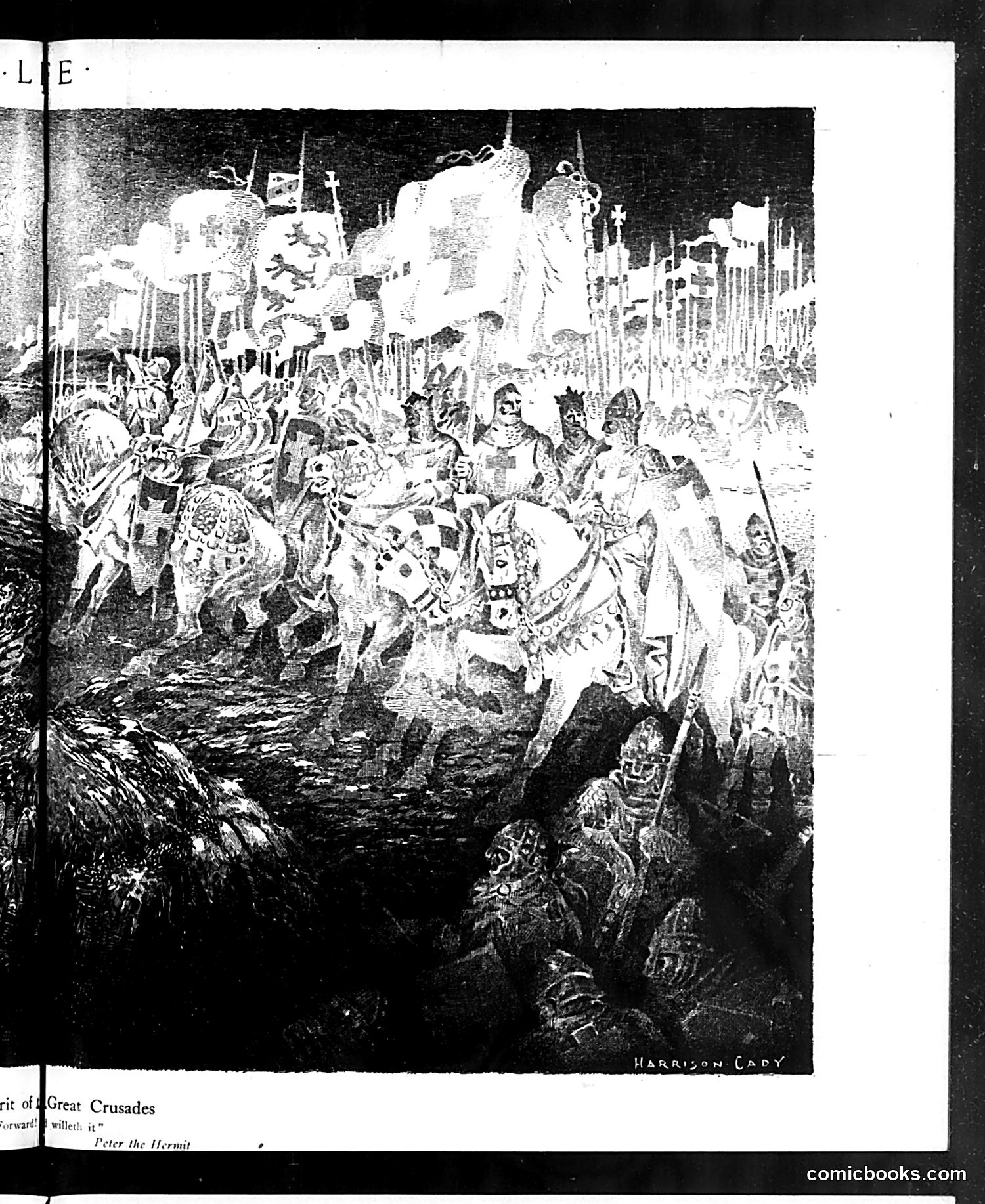
This illustration by Harrison Cady depicts a medieval crusade scene, specifically referencing **Peter the Hermit**, the famous preacher who inspired the First Crusade (1096). The image shows armored knights and soldiers with banners and crosses advancing in a massive procession. The caption's phrase "Spirit of Great Crusades" and "Forward! Willet it" suggests this is satirical commentary, likely comparing contemporary political or military movements to religious crusades. The text "Peter the Hermit" establishes the historical reference point. Without the full article context, the exact target of satire remains unclear, but Life magazine typically used such historical parallels to mock current political figures or policies by positioning them as misguided zealotry or false idealism. The massive, chaotic crowd suggests criticism of mob mentality or irrational fervor.
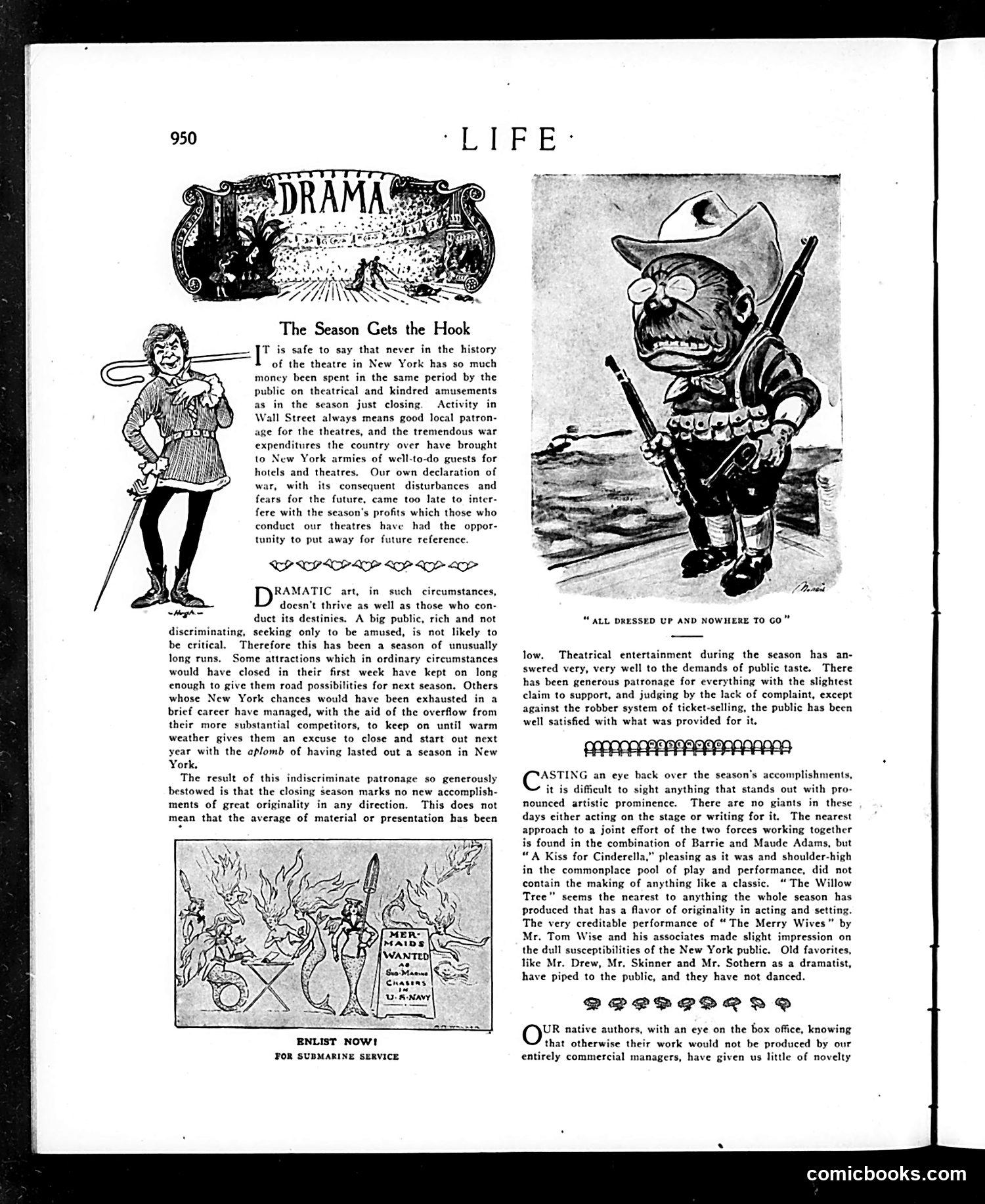
This page critiques the 1917 Broadway theatrical season. The main article argues that despite record-breaking box office revenue—fueled by wealthy Wall Street investors and military personnel during America's WWI mobilization—the season produced artistically mediocre work. The cartoons illustrate this disconnect: the top right image shows a caricatured figure labeled "All Dressed Up and Nowhere to Go," suggesting theatrically flashy but empty productions. The bottom left "Enlist Now! For Submarine Service" cartoon appears to be wartime propaganda. The article's core complaint: indiscriminate, wealthy audiences willing to pay for anything meant producers prioritized profit over artistic merit. Established stars like Drew and Sothern coasted on reputation. Even praised works like "A Kiss for Cinderella" (starring Maude Adams) merely occupied "the commonplace pool." The season lacked originality and "giants" in acting or playwriting—entertainment satisfied public demand but advanced no artistic boundaries.
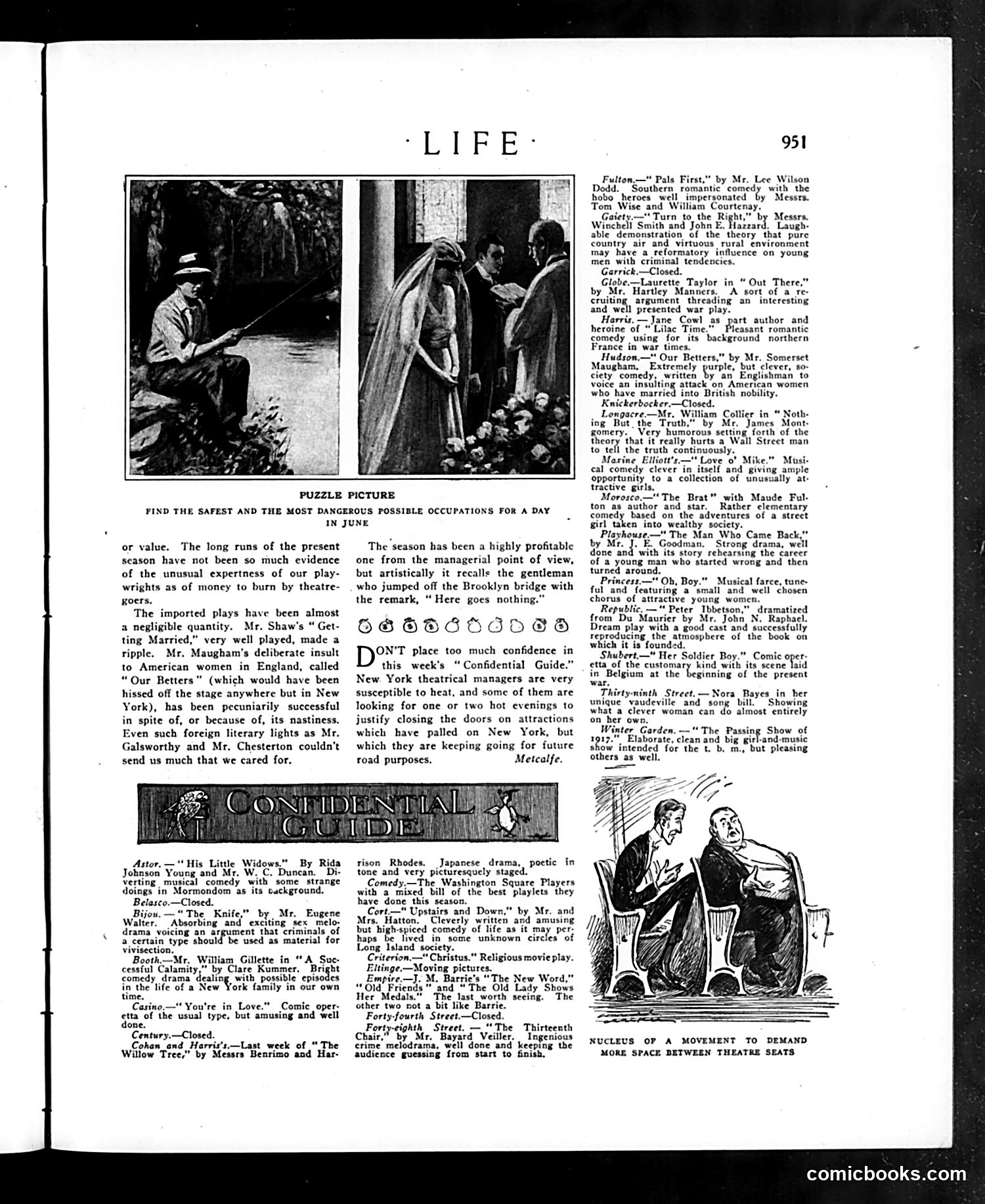
This page reviews New York theatrical productions from June (likely 1916-1920, based on references to war plays). The "Puzzle Picture" at top asks readers to identify the safest and most dangerous occupations for a day in June—the visual answer appears to show a man in one scene and two figures in another, though the specific occupations aren't clearly legible. The critic (likely theater reviewer Metcalfe) discusses the profitable but artistically weak Broadway season. He notes imported plays like Shaw's "Getting Married" and Maugham's "Our Betters" had commercial success despite questionable merit. The "Confidential Guide" warns that managers desperate to close underperforming shows during hot weather might cite heat as justification, while actually planning to tour productions on the road circuit. The cartoon below depicts patrons demanding better spacing in theater seating—a practical comfort complaint about crowded venues. The page is primarily theater listing and critical commentary rather than political satire.
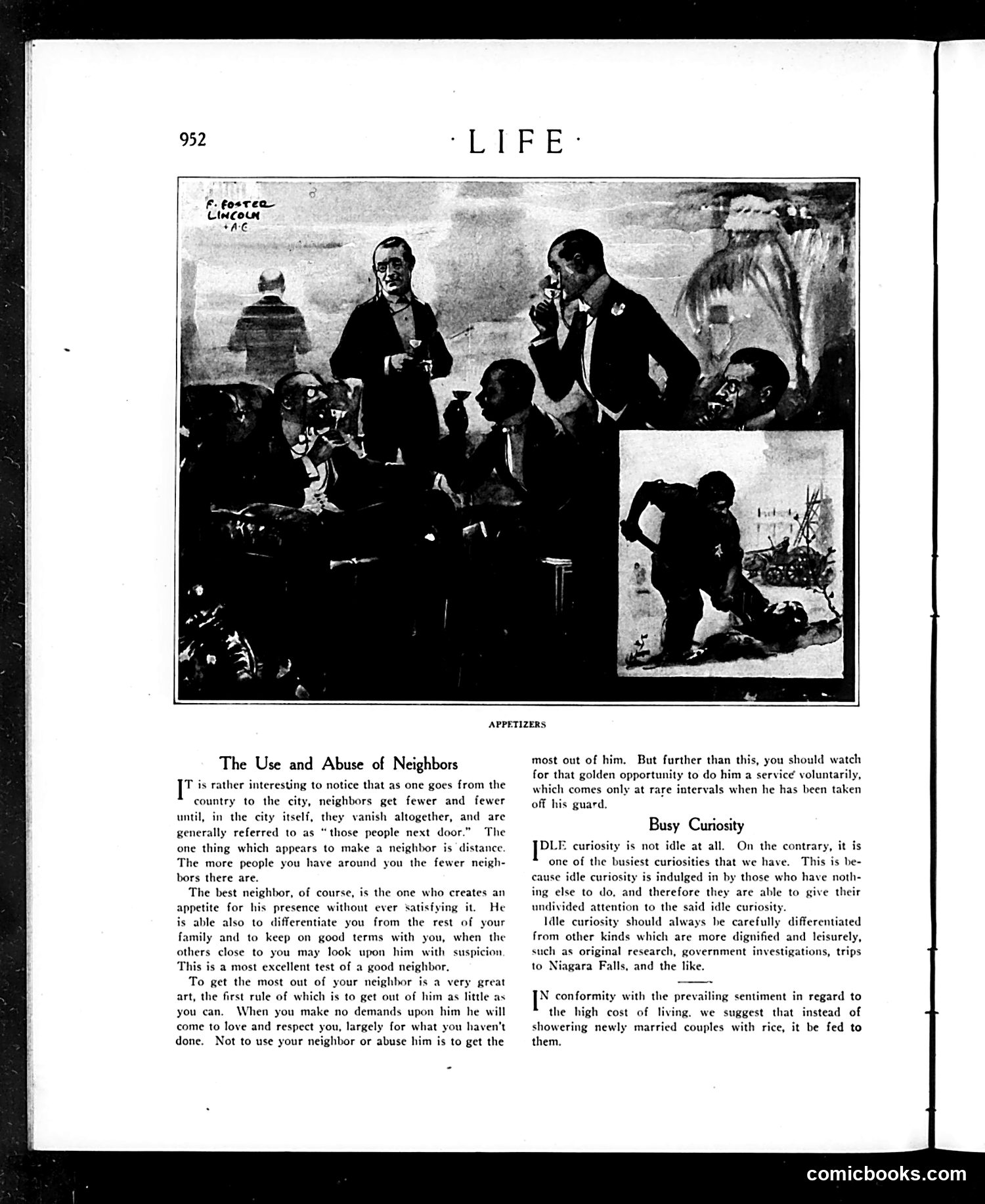
This page contains two separate satirical essays on social etiquette, illustrated by cartoons (artist F. Foster Lincolm). **"The Use and Abuse of Neighbors"** satirizes the paradox of urban life: in cities, neighbors are plentiful yet distant; the "best" neighbor is one whose company you crave but who makes minimal demands. The essay mocks the performative politeness of neighbor relations—respect comes from doing *nothing* rather than genuine connection. **"Busy Curiosity"** distinguishes between "idle" curiosity (petty gossip by the bored) and "dignified" curiosity (research, government work). It's a tongue-in-cheek defense of nosiness masquerading as refined interest. **Final joke:** The closing quip about feeding rice to newlyweds instead of throwing it reflects post-WWI economic concerns about the high cost of living—even wedding traditions must be economized. The cartoons appear to illustrate neighbors in awkward social situations, reinforcing the essay's themes of strained propriety and unspoken social rules.
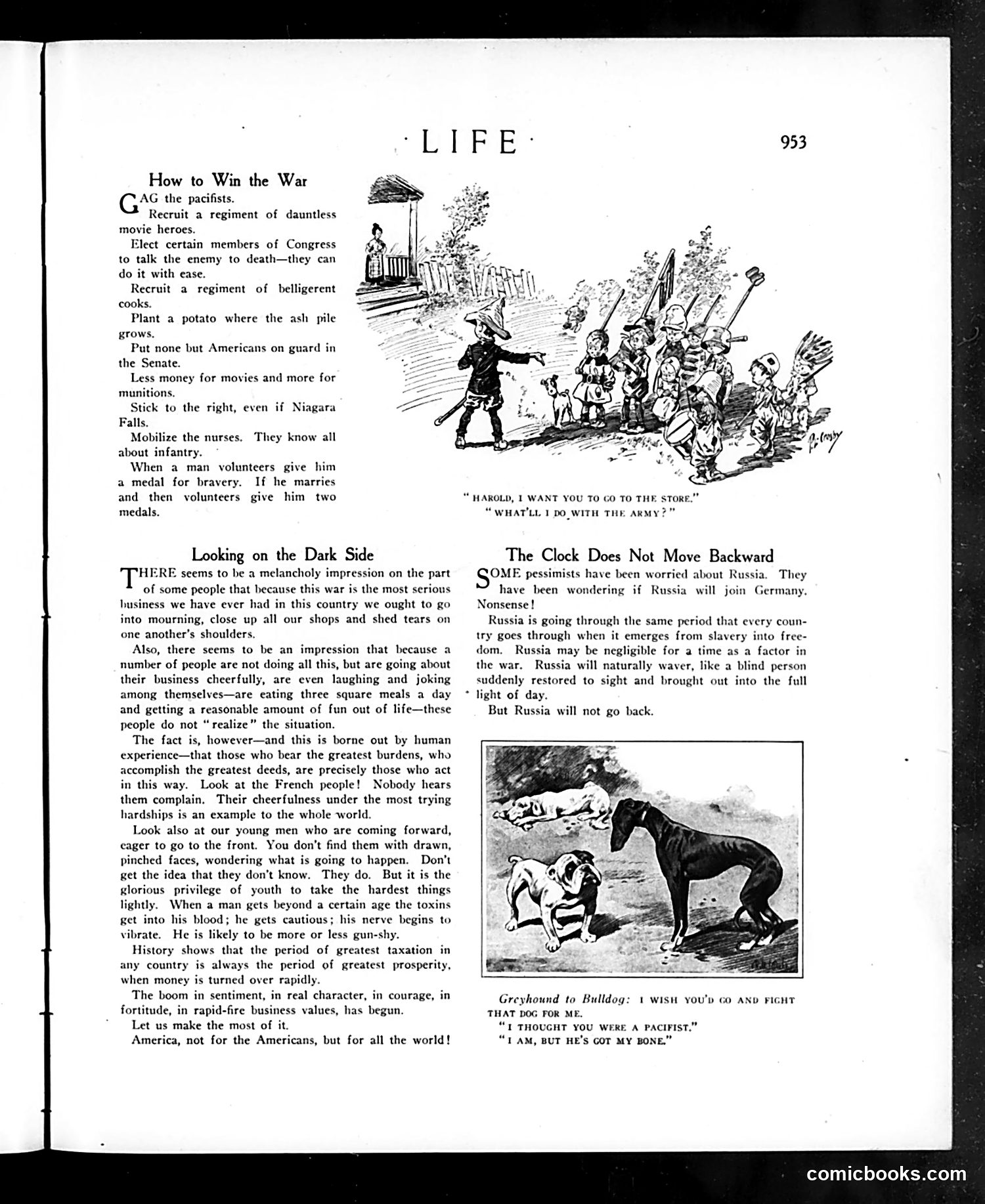
This WWI-era page contains humorous commentary on American war effort and attitudes. **"How to Win the War"** is satirical advice mocking pacifists and offering absurd military strategies (recruiting "movie heroes," "belligerent cooks," planting potatoes). The cartoon above depicts a soldier recruiting effort. **"Looking on the Dark Side"** counters pessimism about the war, arguing that those bearing the greatest burdens remain cheerful (citing French resilience). It defends citizens continuing normal life—eating, joking, working—as patriotic rather than unpatriotic, asserting this demonstrates courage rather than ignorance. **"The Clock Does Not Move Backward"** dismisses fears Russia might join Germany, arguing Russia, newly freed from tsarist "slavery," will naturally progress toward freedom despite temporary instability. It cannot regress. **The dog cartoon** shows a greyhound asking a bulldog to fight for a bone. The bulldog claims pacifism but admits fighting over the bone—satirizing selective pacifism or hypocrisy about non-violence.
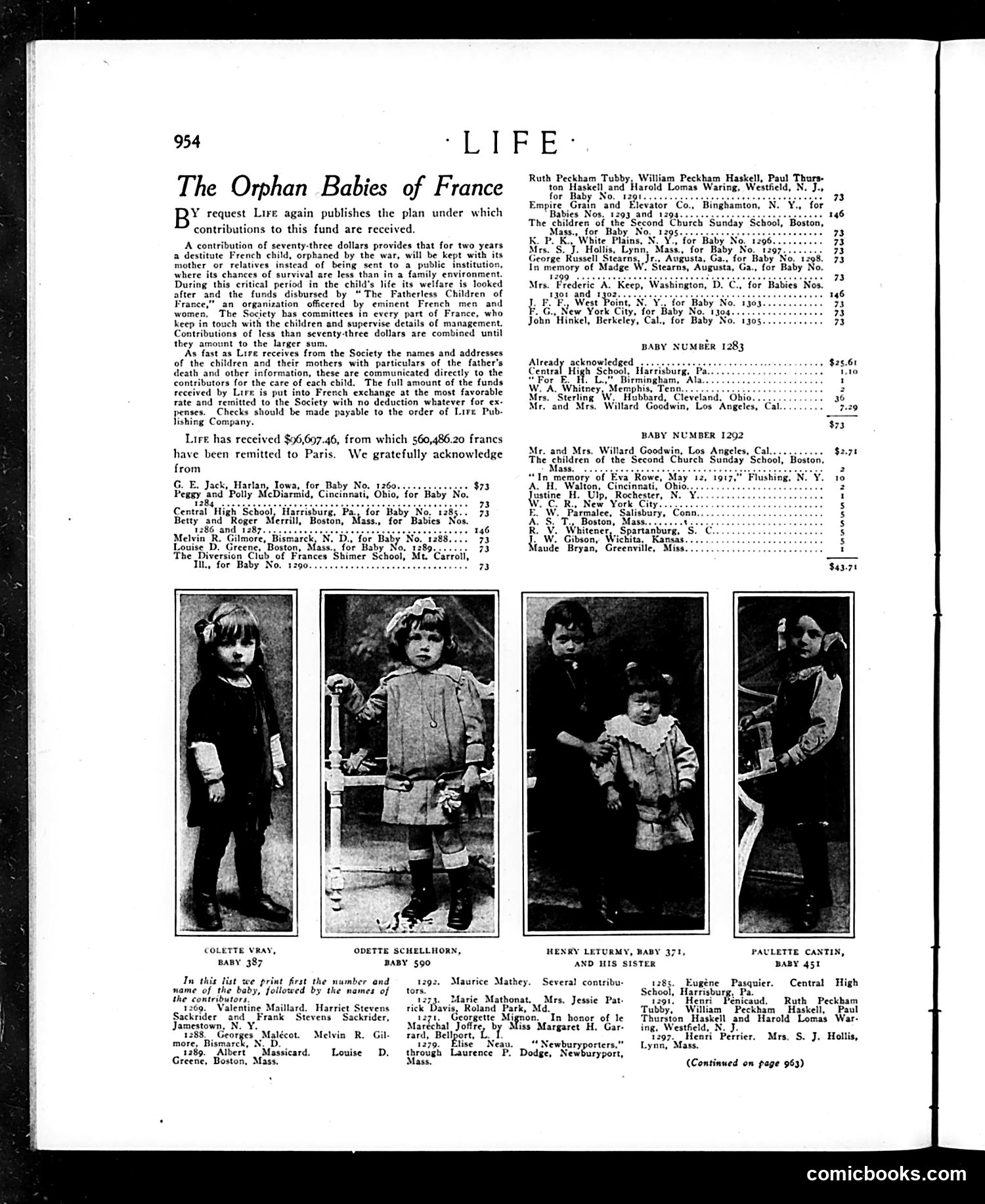
This page documents **Life magazine's charitable campaign to support French war orphans** following World War I. The text explains that contributions of $73 provide two years of care for a French child orphaned by the war, kept with family rather than institutionalized. The photographs show four actual French orphan children being supported through the fund—Colette Vray, Odette Schelhorn, Henry Leturmy and his sister, and Paulette Cantin. The bulk of the page lists **donors and the specific babies they're supporting**, creating a direct connection between American contributors and individual French children. This was a common humanitarian appeal strategy of the 1920s, personalizing distant suffering through named beneficiaries. Rather than satire, this represents **Life's serious philanthropic mission**—using its platform to raise funds for postwar European relief, a significant American concern during the 1920s.
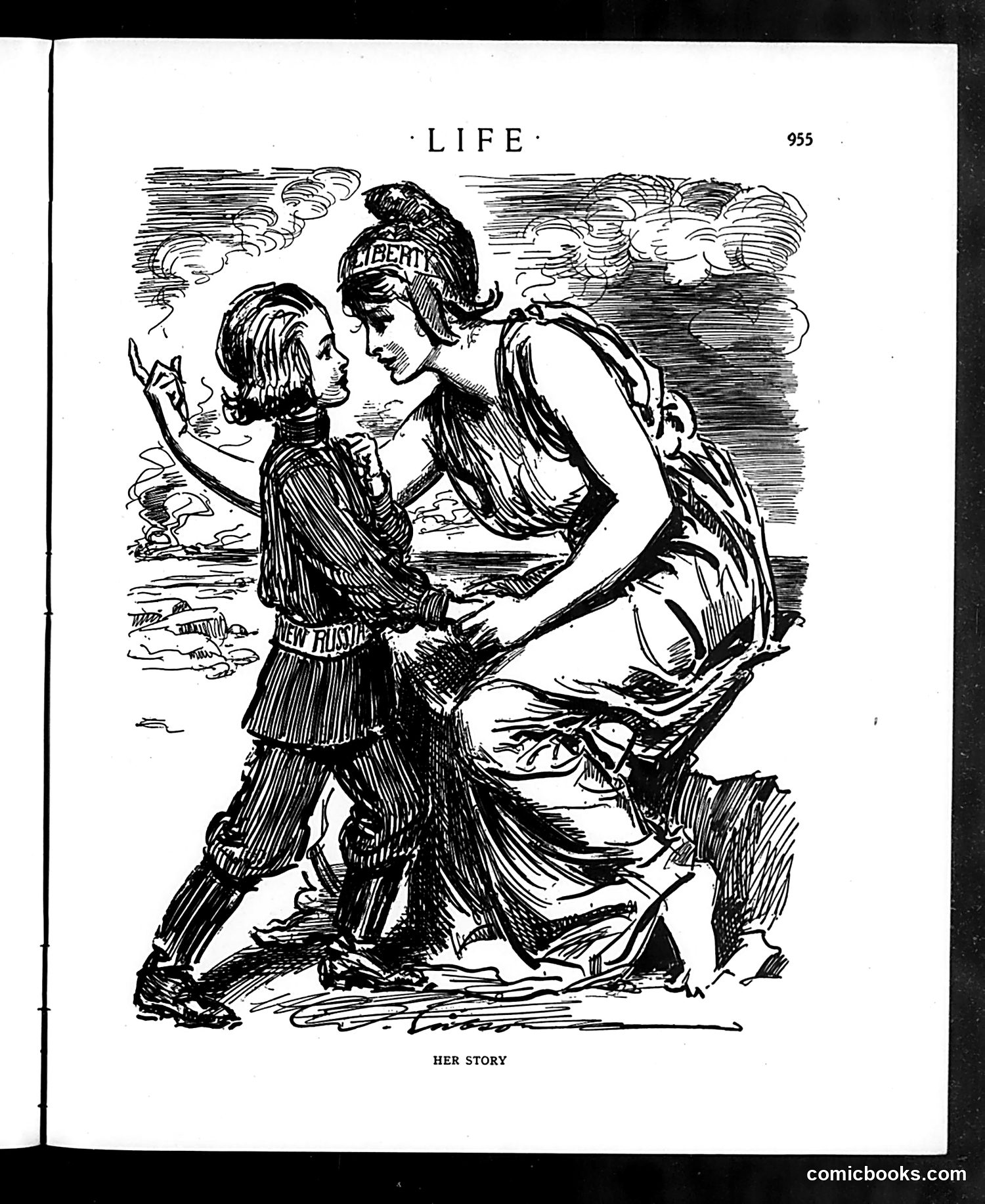
This cartoon depicts Lady Liberty (identifiable by her characteristic headband inscribed "LIBERTY") instructing or gesturing toward a young soldier in military uniform. The allegorical composition suggests a narrative about America's military ideals or patriotic duty. The title "Her Story" indicates this piece presents Liberty's perspective on American military involvement or national purpose. The intimate, instructional pose between the two figures suggests Liberty is imparting wisdom or moral direction to the armed forces. Without the publication date visible, the specific historical context remains unclear—this could reference WWI, WWII, or another American military engagement. The classical allegorical style was common in early-to-mid 20th-century American editorial cartooning.
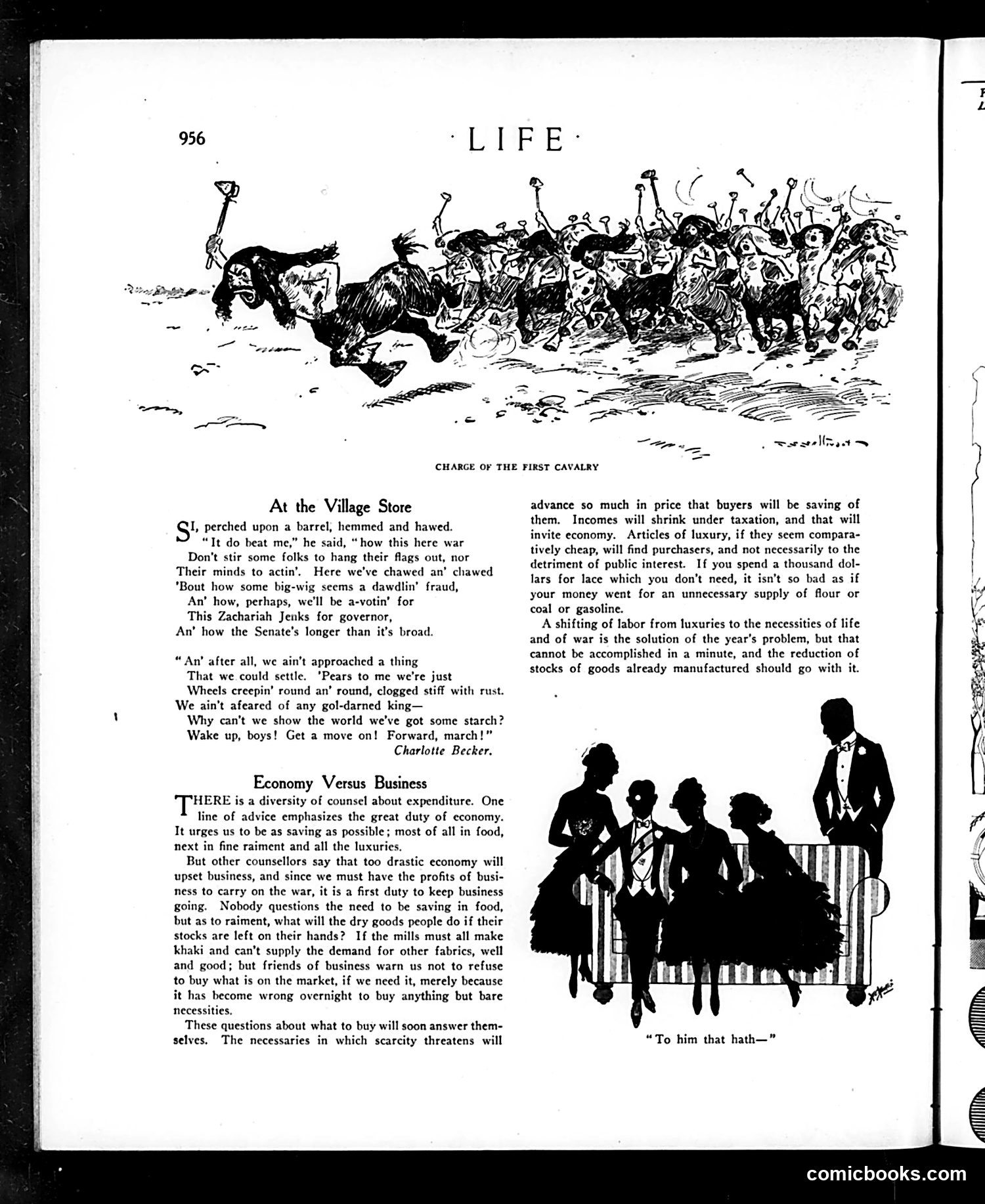
This page contains two satirical pieces about American life during World War I. **"At the Village Store"** (poem by Charlotte Becker) depicts small-town apathy about the war. A man sitting on a barrel complains that ordinary citizens aren't emotionally invested—they don't display flags or show patriotic fervor, instead just gossip endlessly about politics (mentioning governor candidate Zacharias Jenks and the Senate). He urges Americans to "show some starch" and take action, satirizing the disconnect between national crisis and civilian complacency. **"Economy Versus Business"** debates wartime economic policy. It mocks the contradiction between government calls for citizens to economize (especially on luxuries and food) and business interests wanting continued consumer spending to maintain profits and keep factories running. The caption "To him that hath—" (referencing the Biblical Matthew principle) sardonically notes that wealthy buyers will purchase luxuries regardless, while working people must sacrifice. Both pieces critique American hesitation and internal contradictions during WWI mobilization.
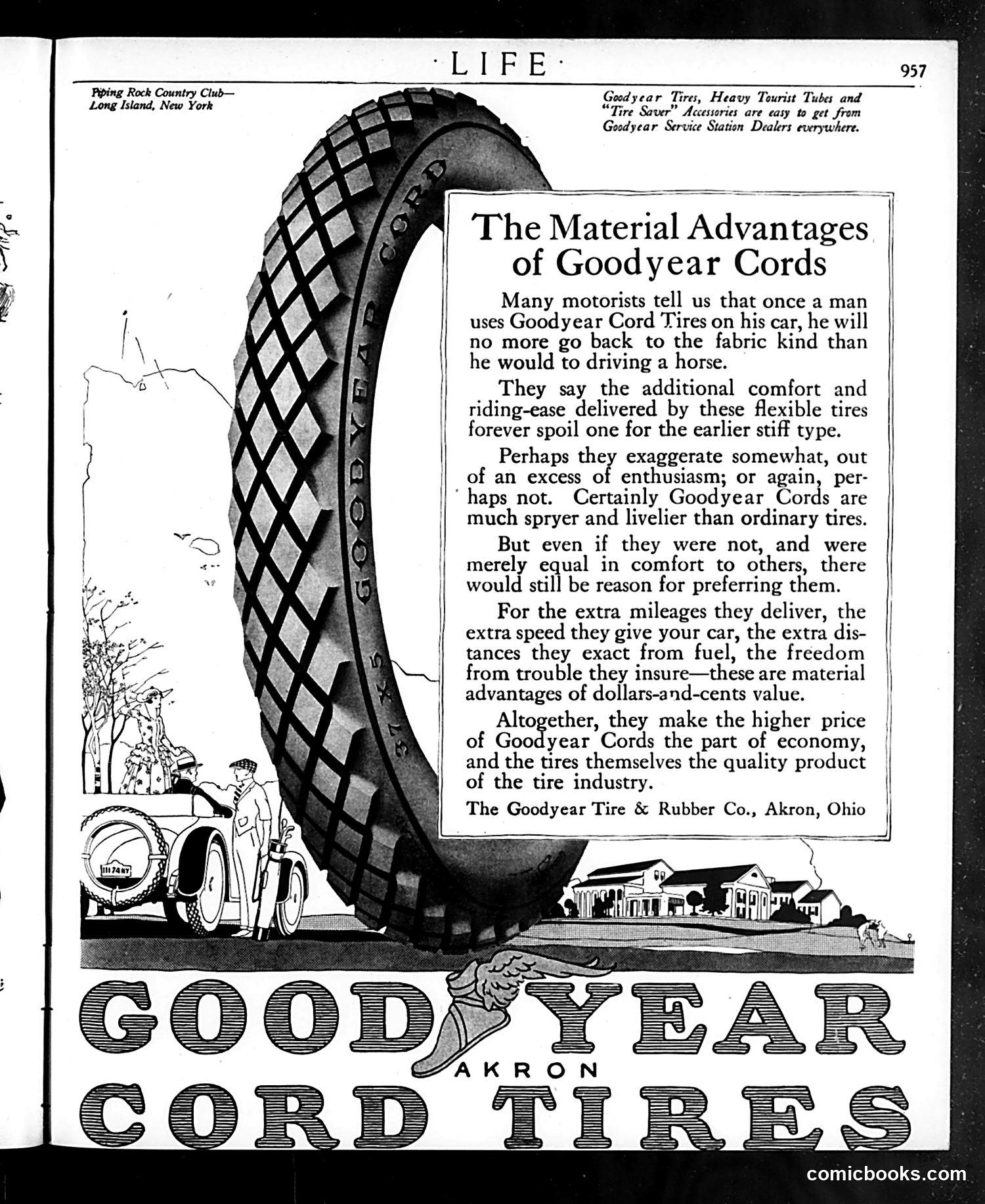
This is primarily a **product advertisement**, not political satire. The page features a massive Goodyear tire dominating the composition, with a vintage automobile and well-dressed motorist at its base for scale. The ad argues that Goodyear's cord tires—a newer technology than fabric tires—justify their premium price through superior comfort, mileage, speed, and fuel efficiency. The comparison to "driving a horse" humorously suggests fabric tires are obsolete. The setting at "Piping Rock Country Club" on Long Island signals an affluent audience. This appears designed for *Life* magazine's upscale readership to convince them that higher tire costs represent genuine economy through performance gains. There is no political cartoon or social satire here—it's straightforward early 20th-century automotive marketing emphasizing technological superiority and practical value to justify premium pricing.
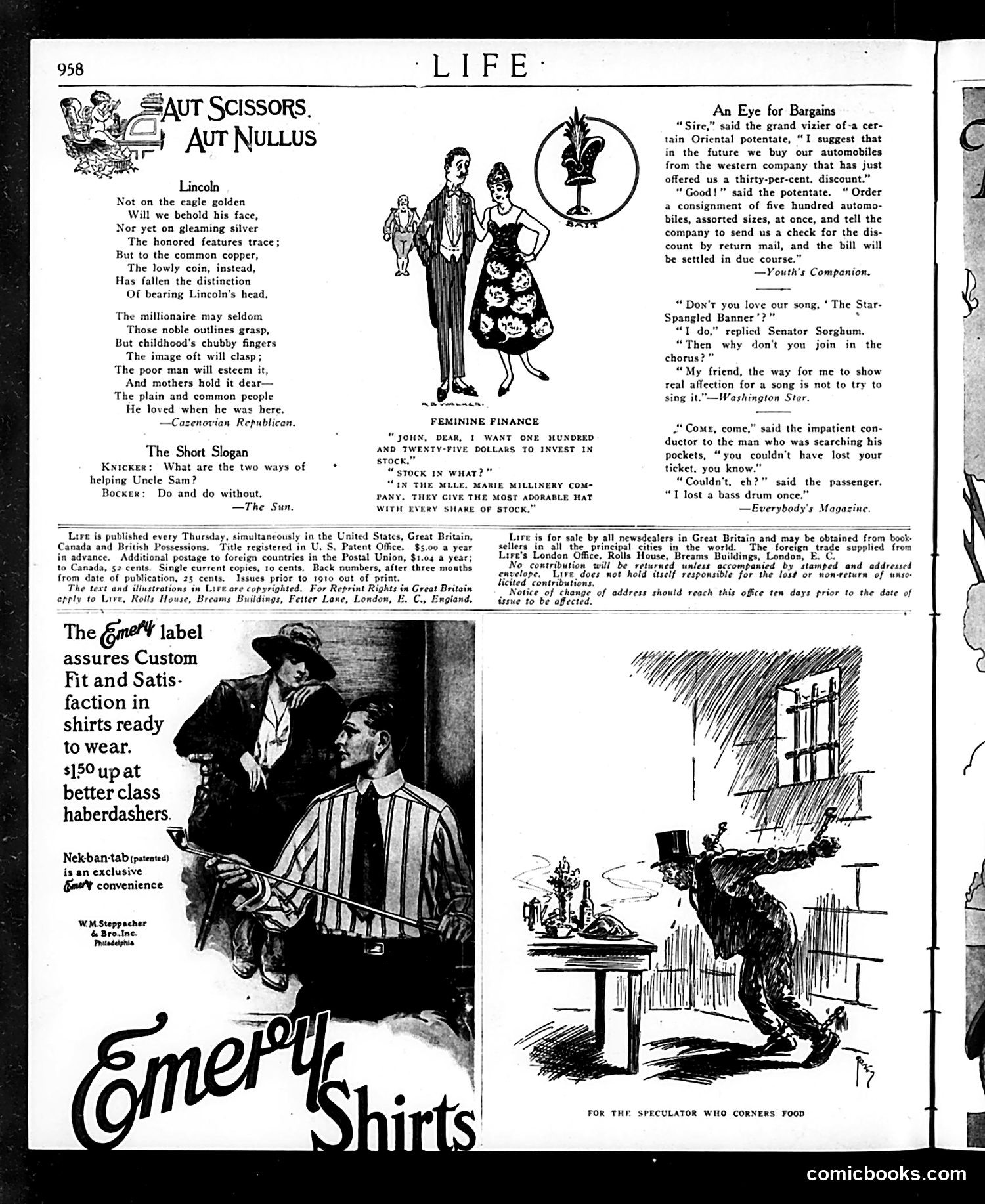
This page contains several brief satirical pieces typical of Life's humor: **"Feminine Finance"** mocks women's ignorance of investing. A husband questions his wife's stock purchase, and she replies she's investing in a millinery company because they give "the most adorable hat with every share of stock"—suggesting women care only about fashion, not actual financial returns. **"An Eye for Bargains"** satirizes greedy Oriental potentates. An Eastern ruler eagerly orders 500 automobiles at a 30% discount, then instructs the company to bill him later—implying he has no intention of paying. The joke suggests Eastern leaders are simultaneously shrewd (seeking discounts) and dishonest (planning nonpayment). **The bottom cartoon** depicts "the speculator who corners food"—a figure hoarding food supplies to artificially raise prices. This references real wartime profiteering concerns, showing a man gleefully exploiting food scarcity for profit. The page also includes a Lincoln tribute poem and advertisements for Emery shirts and neckwear.
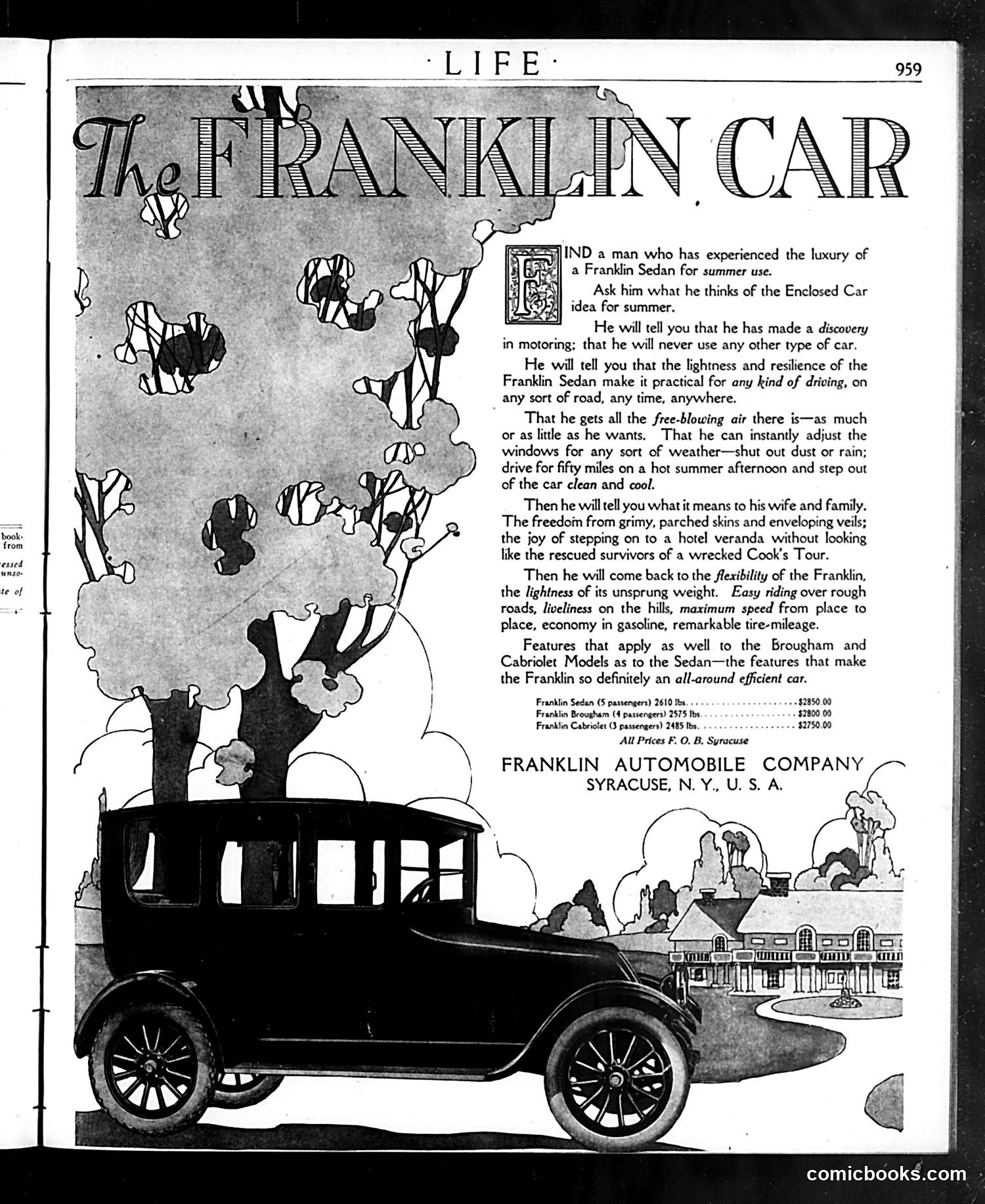
This is not political satire but a straightforward automobile advertisement from *Life* magazine. The page promotes the Franklin Sedan, emphasizing its advantages for summer driving: an enclosed car design that allows adjustable windows for ventilation and weather protection, lightweight construction for easy handling, and fuel economy. The decorative illustration shows flowers and trees above the vehicle, suggesting outdoor leisure and comfort. The ad's rhetorical strategy appeals to both practical (reliability, economy) and social concerns—particularly the comfort of wives and families who, the text implies, suffered from dust, heat, and the appearance of dishevelment when driving open cars (referenced mockingly as looking like "rescued survivors of a wrecked Cook's Tour"). This reflects early automotive marketing targeting middle and upper-class families considering enclosed vehicles as a luxury innovation for recreational driving.
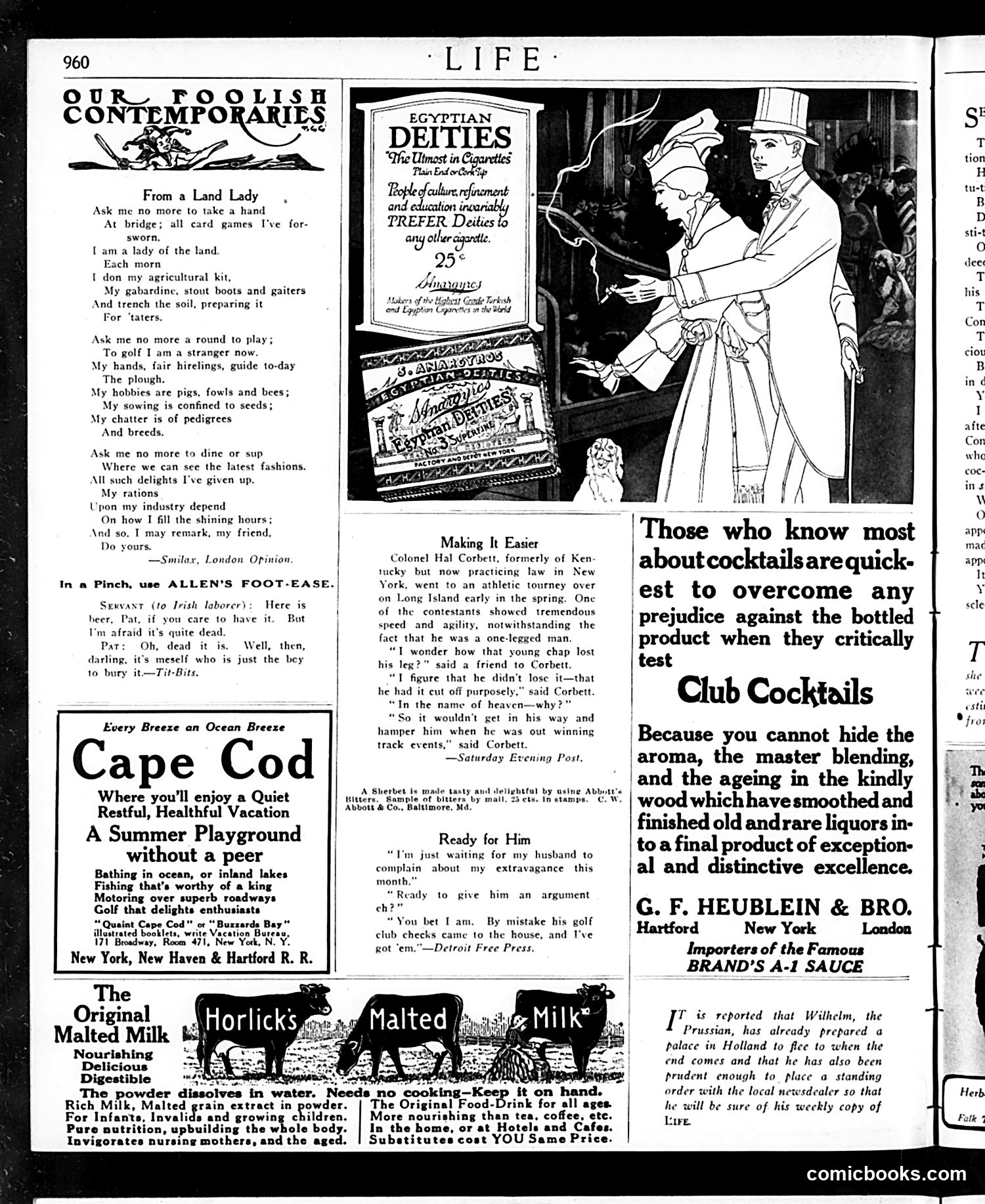
This page contains multiple elements: poems, advertisements, and brief humorous anecdotes typical of Life magazine's satirical format. **"From a Land Lady"** is a poem satirizing upper-class women who, during World War I (likely), abandoned leisure activities (bridge, golf, dining) to engage in agricultural work—plowing fields and raising livestock for the war effort. The satire suggests both admiration for their sacrifice and gentle mockery of their sudden transformation into farmers. **The anecdotes** offer light humor: an Irish laborer volunteering to bury dead beer; a joke about a one-legged athlete who "purposely" lost his leg to avoid handicaps; a wife preparing ammunition (her husband's golf club bills arriving instead of her spending) for marital argument. **Advertisements** dominate the lower half, promoting Egyptian Deities cigarettes, Cape Cod vacations, Horlick's Malted Milk, and Club Cocktails—typical early-20th-century consumer goods. **The final satirical note** jests that Kaiser Wilhelm has already arranged a Holland palace and standing orders for *Life* magazine—mocking his presumed inevitable defeat and exile while suggesting even enemies appreciate American humor.
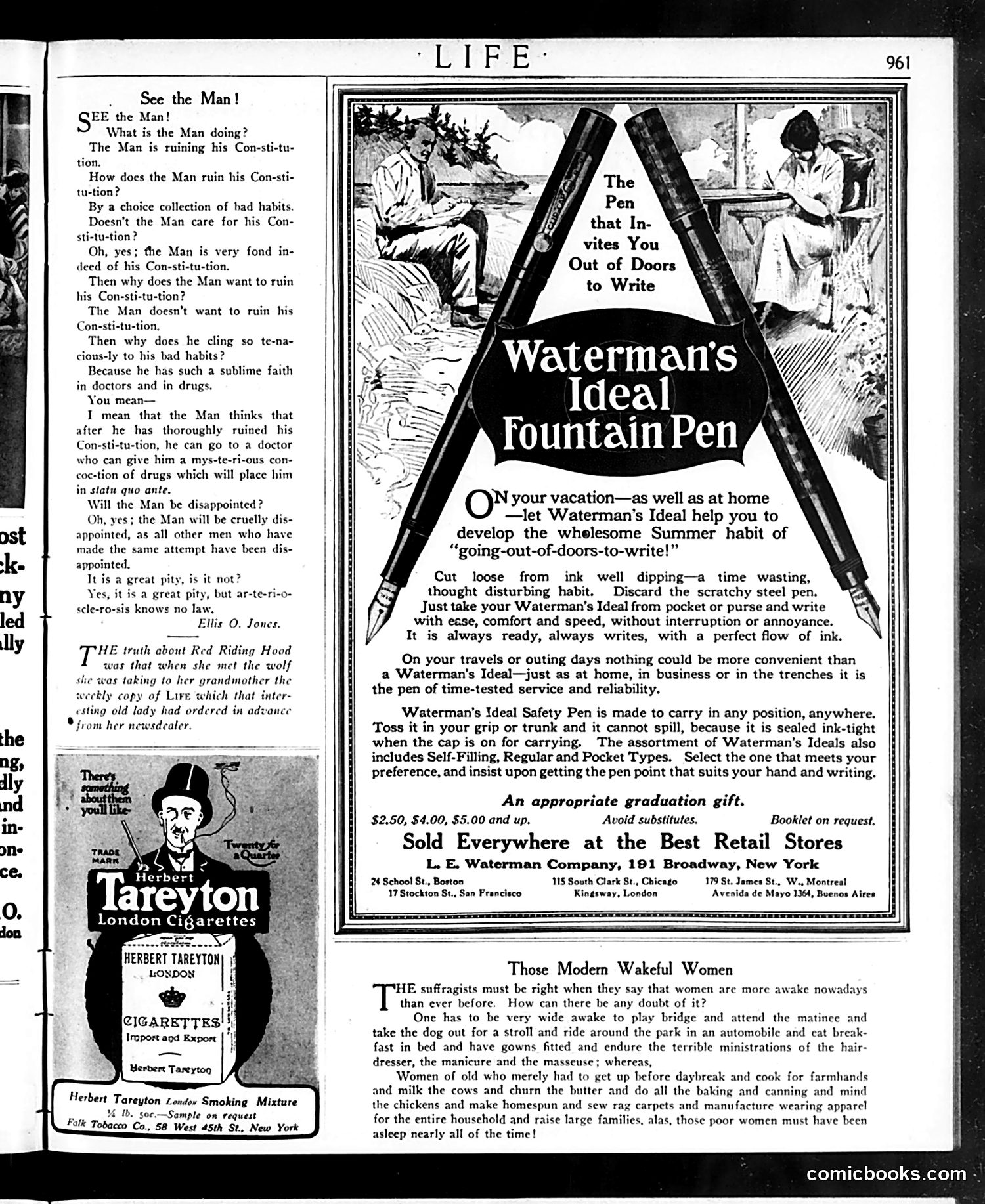
**"See the Man!" (Left Column):** This is a satirical dialogue by Ellis O. Jones mocking human self-destructiveness. It uses repetitive, primer-like language to critique men who knowingly ruin their health through bad habits, then naively trust doctors to fix them with mysterious drugs. The punchline—"ar-te-ri-o-scle-ro-sis knows no law"—suggests hardened arteries from poor habits are irreversible. The tone is mordant commentary on willful self-harm disguised as optimism. **"Those Modern Wakeful Women" (Bottom):** Ironic commentary on women's suffrage, sarcastically crediting women's "awakeness" to modern activities (bridge, matinees, automobile rides, salon treatments). The contrast with "women of old" who performed grueling farmwork is the joke: the author suggests modern women's busyness with leisure and vanity proves they're more "awake" than those who did actual labor—a backhanded criticism of both changing gender roles and modern priorities. **Advertisements:** Herbert Tareyton cigarettes and Waterman's Ideal fountain pens, typical period product placements.
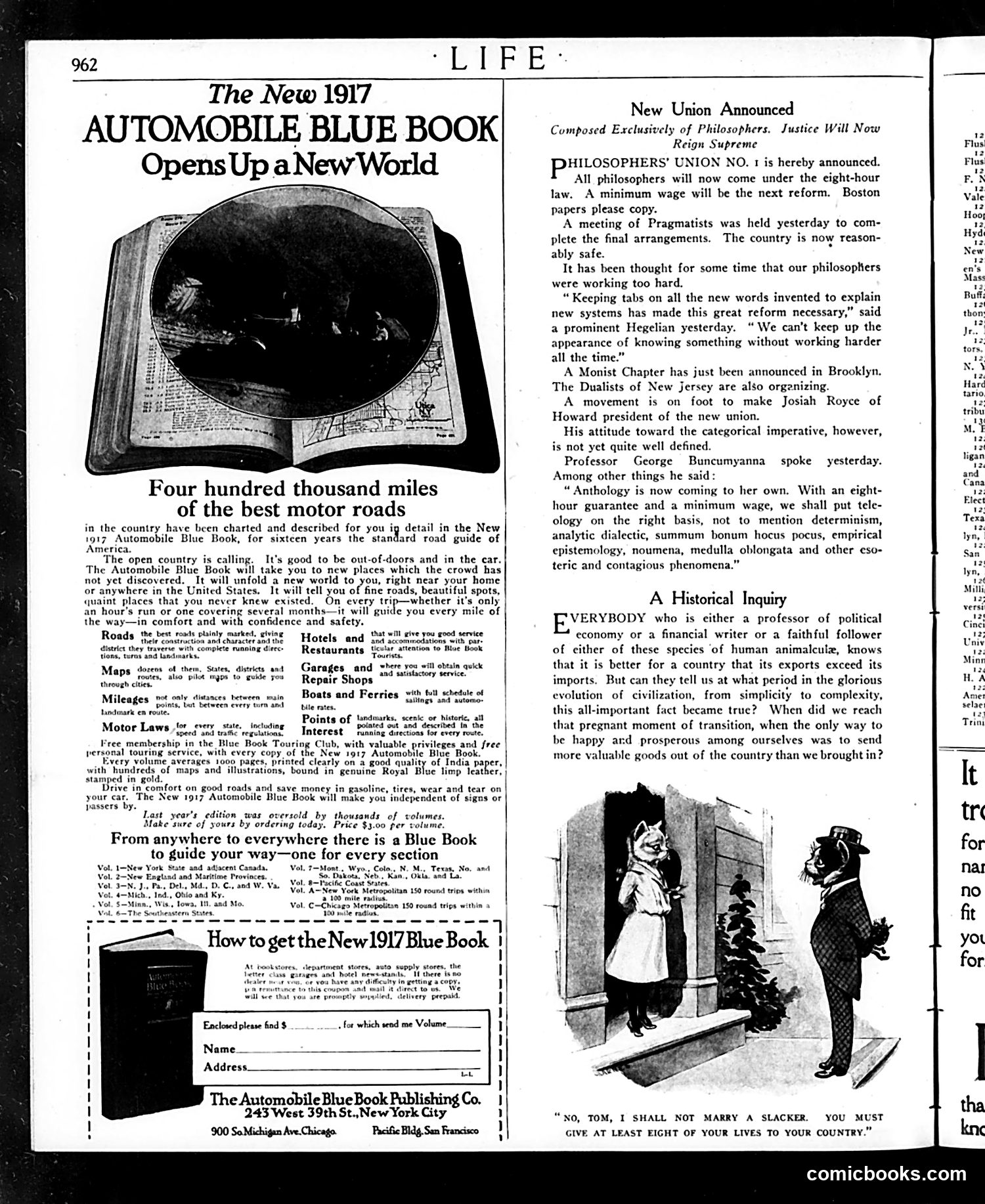
This page is primarily **advertising** for the 1917 Automobile Blue Book, a road guide promising 400,000 miles of charted American motor routes. The ad emphasizes leisure travel and discovery via automobile—a relatively novel luxury at this time. The satirical content appears in the **"New Union Announced"** section, which mocks academic philosophy through mock-serious prose. It announces "Philosophers' Union No. 1," subjecting abstract thinkers to industrial-era labor reforms (eight-hour workdays, minimum wage). The satire targets academic pretension—philosophers supposedly "working too hard" inventing complex terminology while pretending to knowledge. References to specific philosophical schools (Pragmatists, Hegelians, Monists, Dualists) and figures like Josiah Royce add period-specific academic in-jokes. The accompanying **cartoon** depicts a domestic scene: a woman at a doorway rejects a suitor, insisting he give "eight of your lives to your country" rather than marry her—likely a WWI recruitment joke, given the 1917 date. Both pieces use humor to critique society: one mocks armchair intellectuals, the other patriotic duty amid courtship.
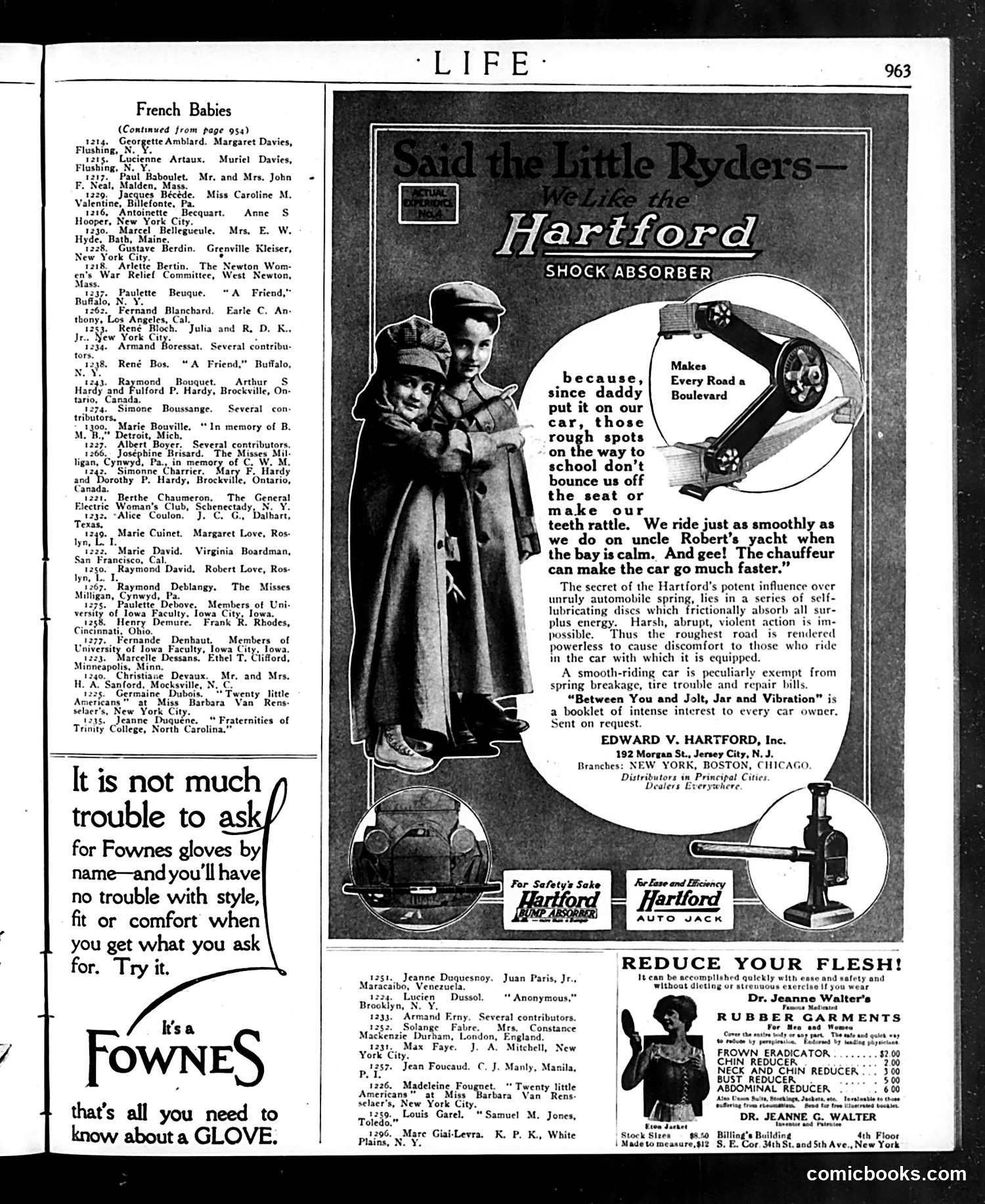
This page is primarily **advertising and donor acknowledgments**, not political satire. The main content consists of: 1. **"French Babies" donor list**: A continuation of acknowledgments for contributors who sponsored French infants' welfare during/after WWI—reflecting American charitable efforts toward war-devastated Europe. 2. **Three advertisements**: - **Fownes Gloves**: A straightforward luxury goods pitch emphasizing quality and fit - **Hartford Shock Absorber**: Features children praising smooth car rides; sells automobile safety technology to middle-class buyers concerned with comfort - **Dr. Jeanne Walter's Rubber Garments**: A weight-reduction product marketed to women The Hartford ad is notable for its appeal to family comfort and the novelty of automotive technology in the 1920s era. The "Reduce Your Flesh" garment ad reflects period attitudes toward women's bodies and fashion. **There is no political cartoon or satire on this page.** It represents commercial and philanthropic content typical of Life magazine's mixed editorial/advertising format from this era.
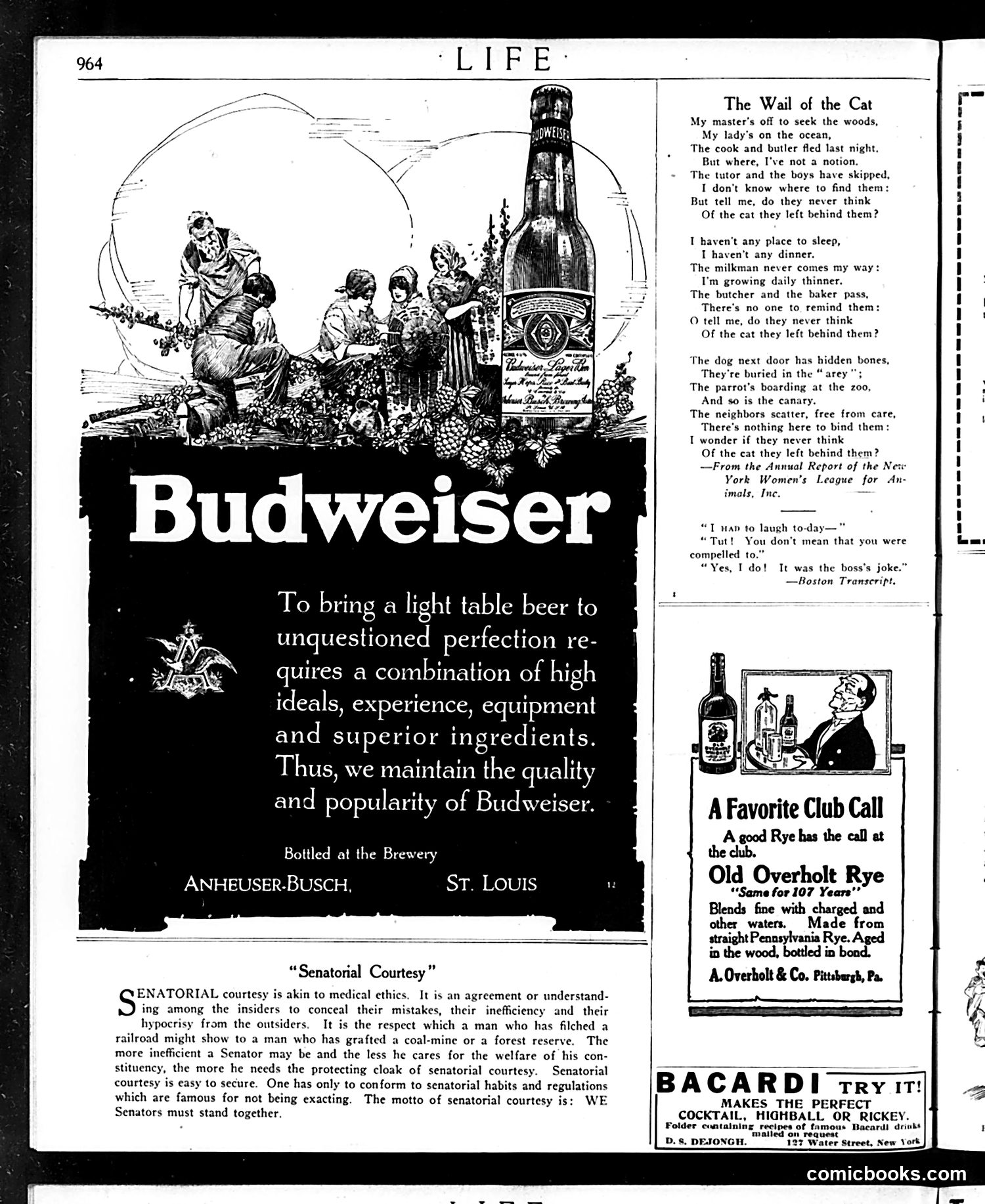
This page features a sentimental poem, likely from around 1910s-1920s, personifying an abandoned house cat whose family has fled for summer leisure. The cat complains of neglect while other pets receive care—the dog hides bones, the parrot and canary board at the zoo. The poem satirizes wealthy families' casual abandonment of pets during vacation season. It's attributed to the "New York Women's League for Animals," suggesting animal welfare advocacy. Below, a separate piece titled "Senatorial Courtesy" critiques political corruption, describing how senators protect each other's misdeeds (theft, graft) through an unspoken code of silence—comparing it to medical ethics but actually enabling hypocrisy and inefficiency. The motto "WE Senators must stand together" undercuts their claimed principles. The page is primarily **advertising** (Budweiser, Old Overholt Rye, Bacardi) alongside these satirical pieces typical of *Life* magazine's editorial content.
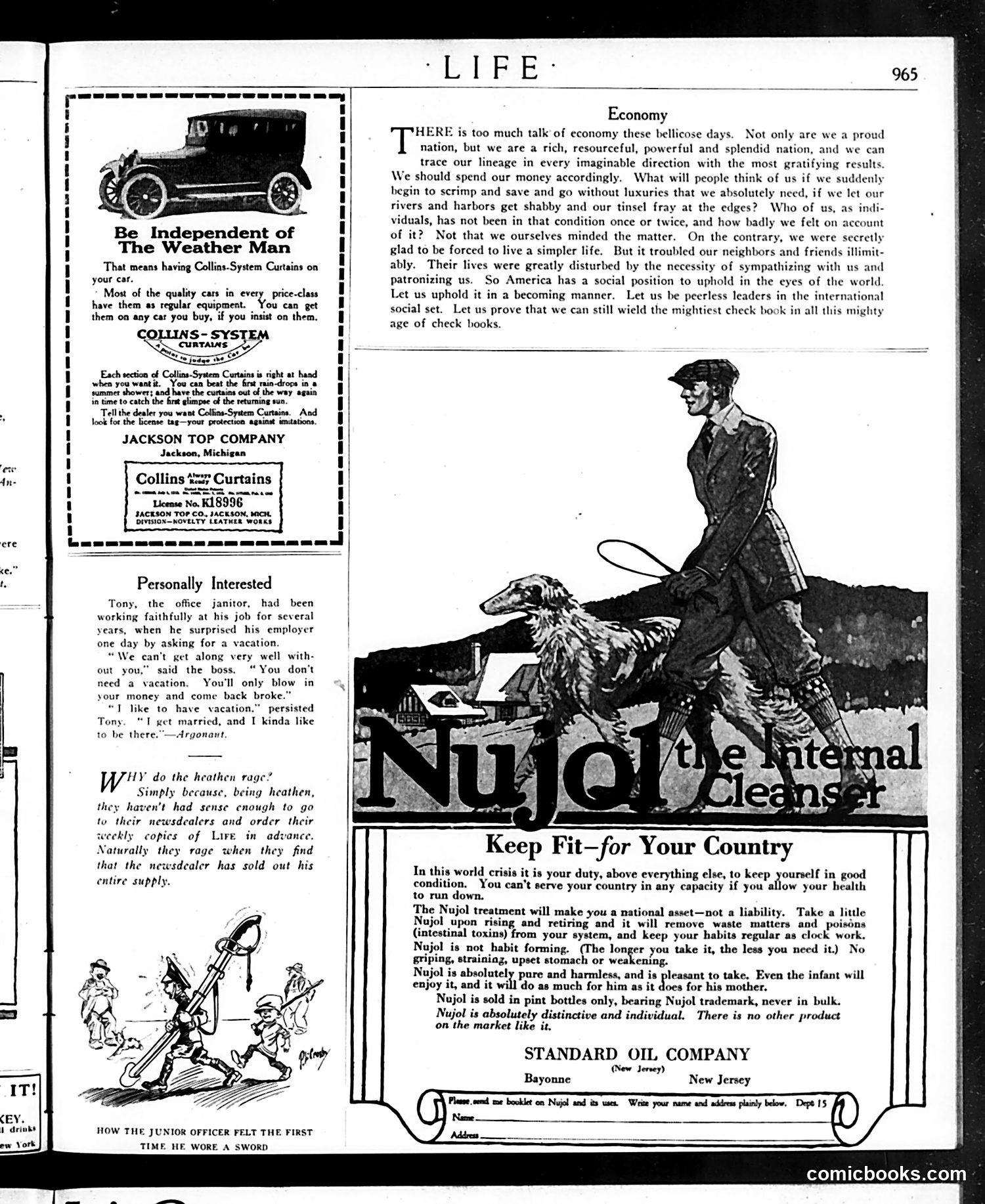
This Life magazine page (page 965) contains several distinct items: **"Economy" Essay (top right):** A satirical argument *against* belt-tightening during wartime. The author sarcastically claims America must maintain lavish spending to preserve its international social status, suggesting that frugality would embarrass neighbors and damage national prestige. The satire targets jingoistic nationalism and conspicuous consumption as patriotic duty—a critique of wartime excess disguised as serious argument. **Cartoons:** Minor humorous sketches include one about a junior officer uncomfortable wearing a sword for the first time, and another about "heathen" anger (likely a dig at those who don't subscribe to Life magazine). **Advertisements:** Collins-System car curtains, Jackson Top Company, and Nujol (a laxative marketed as patriotic health maintenance during "world crisis"). The page satirizes both nationalist fervor and commercial exploitation of wartime anxiety, with advertisers repurposing patriotic duty messaging to sell products.
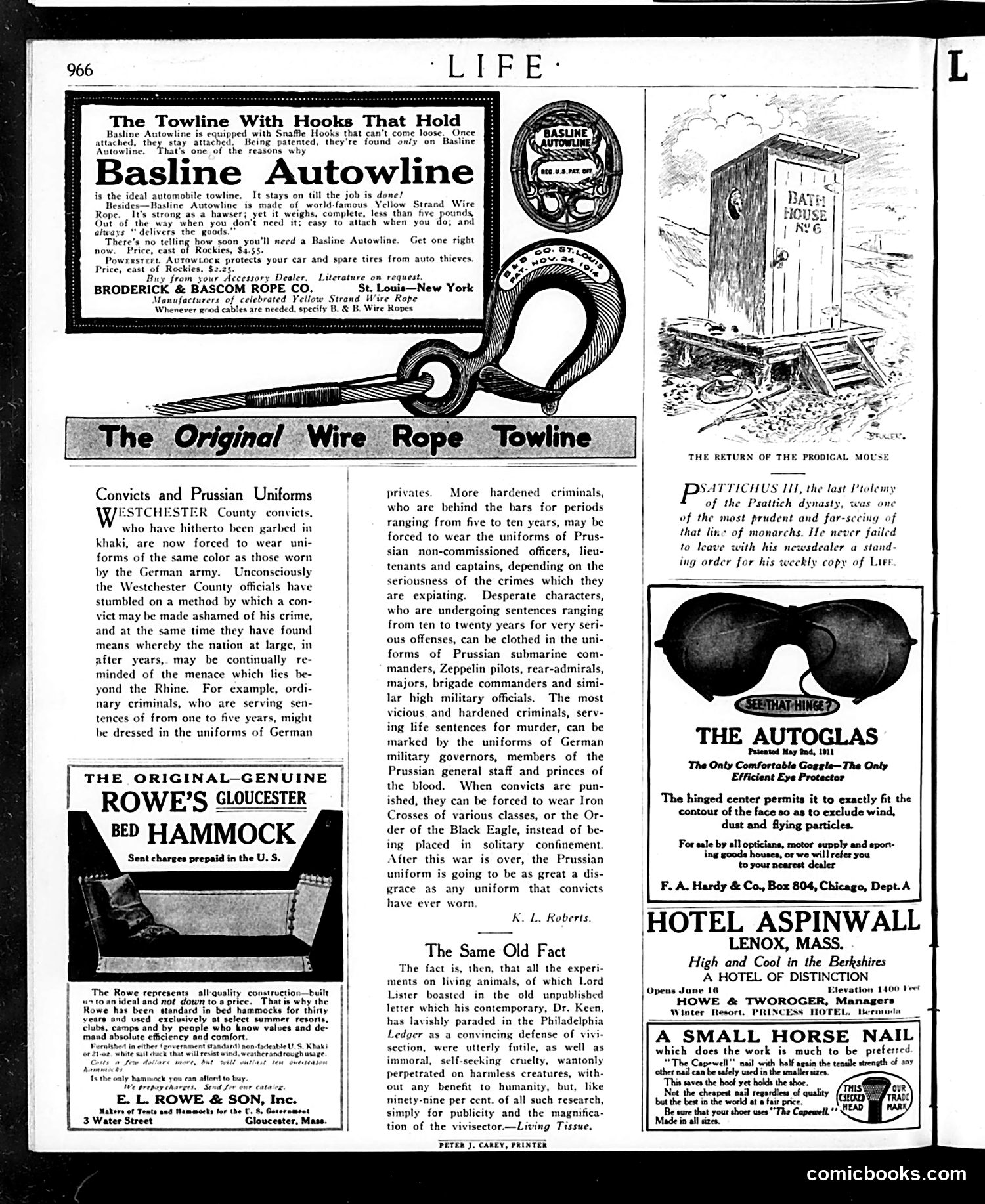
This page is primarily **advertisements** interspersed with two opinion pieces. The main satirical content appears in the article **"Convicts and Prussian Uniforms."** Written by K.L. Roberts, it's a **World War I-era proposal** suggesting that Westchester County convicts wear German military uniforms as punishment. The satire works by suggesting increasingly absurd costume assignments: ordinary criminals wear German private uniforms, more serious offenders wear Prussian officer uniforms, and the worst criminals wear uniforms of German generals and submarine commanders. The **joke is bitter and political**: by dressing American convicts in German uniforms, the author suggests this would simultaneously shame the criminals *and* remind Americans of German militarism as a foreign threat—a common rhetorical strategy when America was engaged with Germany in WWI. The remaining content is standard early-20th-century advertising for rope, hammocks, goggles, and hotels. One article discusses animal testing ethics, unrelated to satire.