
Life, 1917-05-31 · page 19 of 38
Life — May 31, 1917 — page 19: what you’re looking at
What you’re looking at
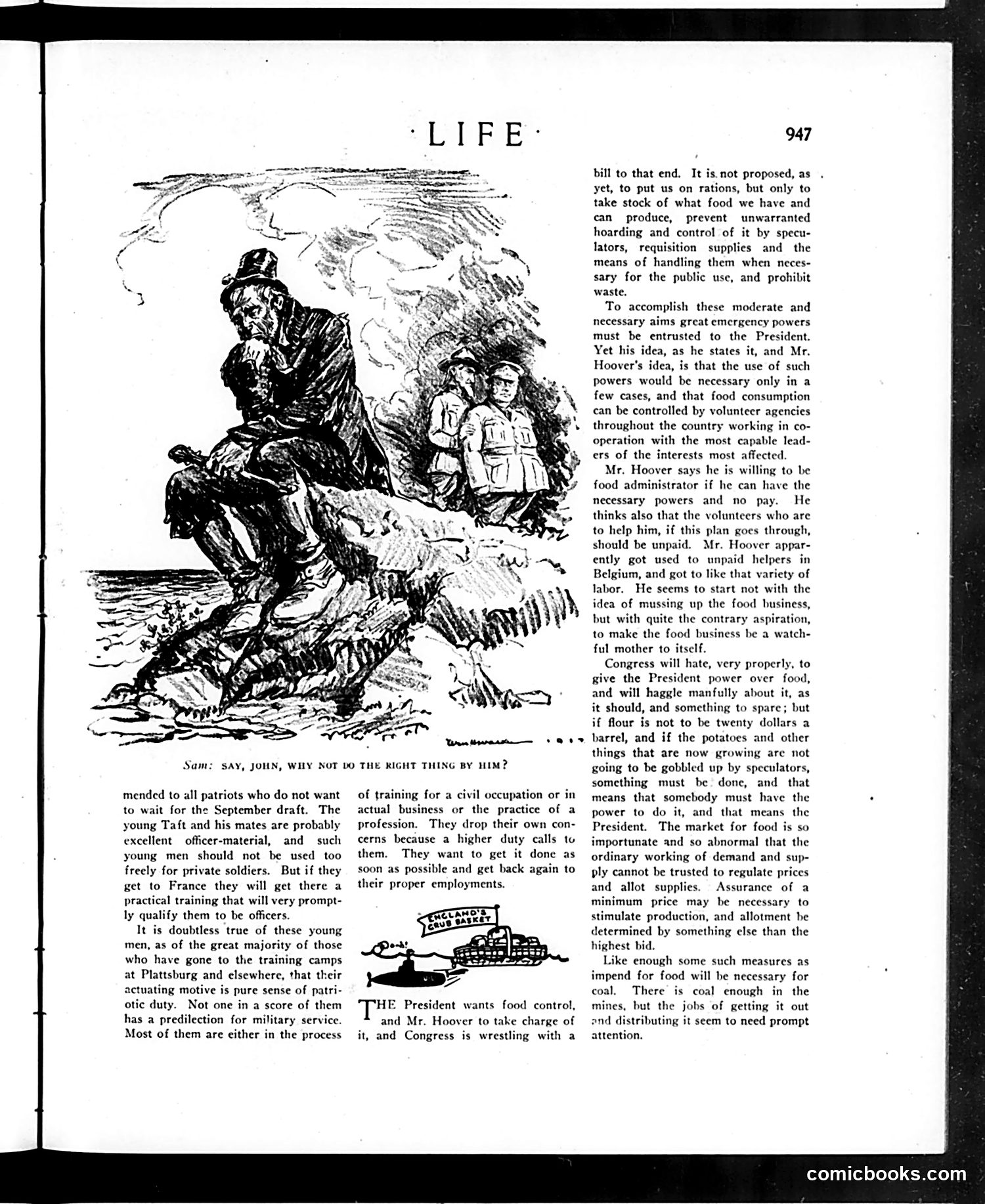
This page from *Life* magazine discusses President Woodrow Wilson's push for federal food control during World War I, with Herbert Hoover proposed as "food administrator." The cartoon caption—"Sam: Say, John, why not do the right thing by him?"—appears to depict a starving or struggling figure (possibly representing the poor or working class), sarcastically questioning why help isn't being given. The accompanying editorial argues that while food rationing isn't yet proposed, the government must prevent hoarding and speculation on food supplies. The author supports giving the President emergency powers to manage food distribution, though acknowledging Congressional resistance. The piece notes Hoover's willingness to serve without pay and use volunteer helpers—a model the author finds somewhat naive given market pressures. The broader context: WWI-era anxieties about food scarcity, inflation, and whether market forces or government intervention should control supplies. The satire questions whether voluntary measures and unpaid labor can truly address these urgent problems.
📄 Transcribed text from this page (OCR, searchable)
Machine-transcribed from the original scan — historical spelling and the odd misread are preserved.
Sam: SAy, JOUN, WHY NOT vO THE RIGHT THING BY HIM? mended to all patriots who do not want to wait for the September draft. The young Taft and his mates are probably excellent officer-material, and such young men should not be used too freely for private soldiers. But if they get to France they will get there a practical training that will very prompt- ly qualify them to be officers. It is doubtless true of these young men, as of the great majority of those who have gone to the training camps at Plattsburg and elsewhere, that their actuating motive is pure sense of patri- otic duty. Not one in a score of them has a predilection for military service. Most of them are either in the process of training for a civil occupation or in actual business or the practice of a profession. They drop their own con- cerns because a higher duty calls to them. They want to get it done as soon as possible and get back again to their proper employments. HE President wants food control, and Mr. Hoover to take charge of it, and Congress is wrestling with a 947 bill to that end. It is. not proposed, as yet, to put us on rations, but only to take stock of what food we have and can produce, prevent unwarranted hoarding and control of it by specu- lators, requisition supplies and the means of handling them when neces- sary for the public use, and prohibit waste. To accomplish these moderate and necessary aims great emergency powers must be entrusted to the President. Yet his idea, as he states it, and Mr. Hoover's idea, is that the use of such powers would be necessary only in a few cases, and that food consumption can be controlled by volunteer agencies throughout the country working in co- operation with the most capable lead- ers of the interests most affected. Mr. Hoover says he is willing to be food administrator if he can have the necessary powers and no pay. He thinks also that the volunteers who are to help him, if this plan goes through, should be unpaid. Mr. Hoover appar- ently got used to unpaid helpers in Belgium, and got to like that variety of labor. He seems to start not with the idea of mussing up the food business, but with quite the contrary aspiration, to make the food business be a watch- ful mother to itself. Congress will hate, very properly, to give the President power over food, and will haggle manfully about it, as it should, and something to spare; but if flour is not to be twenty dollars a barrel, and if the potatoes and other things that are now growing are not going to be gobbled up by speculators, something must be done, and that means that somebody must have the power to do it, and that means the President. The market for food is so importunate and so abnormal that the ordinary working of demand and sup- ply cannot be trusted to regulate prices and allot supplies. Assurance of a minimum price may be necessary to stimulate production, and allotment be determined by something else than the highest bid. Like enough some such measures as impend for food will be necessary for coal. There is coal enough in the mines, but the jobs of getting it out and distributing it seem to need prompt attention. comicbooks.com