
Life, 1917-05-31 · page 8 of 38
Life — May 31, 1917 — page 8: what you’re looking at
What you’re looking at
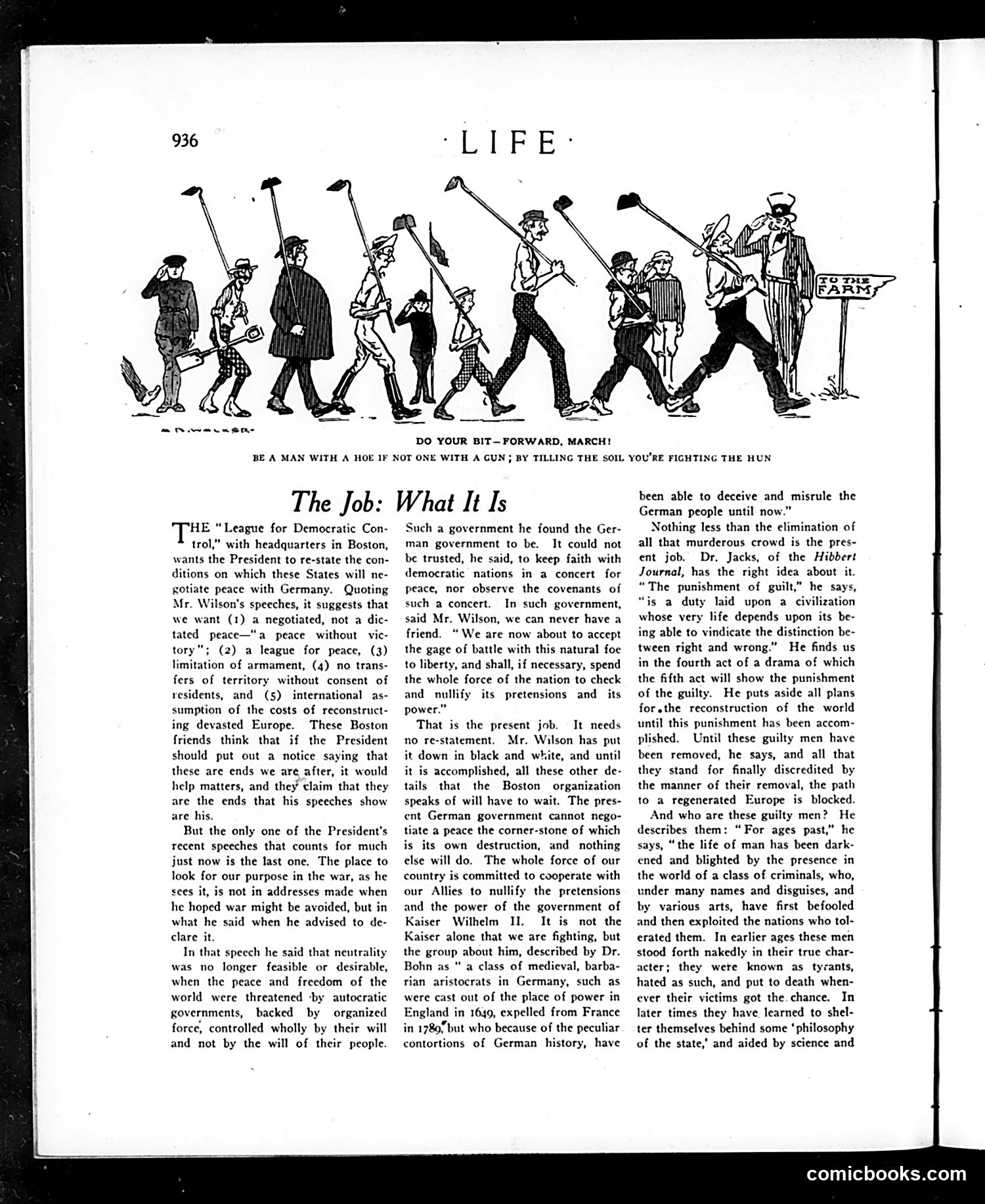
This 1918 WWI-era cartoon depicts a procession of figures marching leftward with farming tools (hoes) converted into weapons, progressing toward a "FARM" sign. The caption reads "DO YOUR BIT—FORWARD, MARCH!" with text about fighting "the Hun" through soil cultivation. The accompanying article discusses President Wilson's stated war aims, emphasizing that the war targets not Kaiser Wilhelm II but rather German aristocratic leaders described as "medieval, barbarian." The piece argues the conflict aims to eliminate autocratic rule and establish democratic governance. The cartoon satirizes the recruitment message conflating agricultural labor with military duty—suggesting Americans should support the war effort through farming production as equivalent to combat service.
📄 Transcribed text from this page (OCR, searchable)
Machine-transcribed from the original scan — historical spelling and the odd misread are preserved.
mn wacom DO YOUR BIT— FORWARD, MARCH! BE A MAN WITH A HOE IF NOT ONE WITH A GUN ; BY TILLING THE SOIL YOU'RE FIGHTING THE HUN The Job: What It Is 'HE “League for Democratic Con- trol,” with headquarters in Boston, wants the President to re-state the con- ditions on which these States will ne- gotiate peace with Germany. Quoting Mr. Wilson’s speeches, it suggests that we want (1) a negotiated, not a dic- tated peace—“a peace without vic- (2) a league for peace, (3) jon of armament, (4) no trans- fers of territory without consent of residents, and (5) international as- sumption of the costs of reconstruct- ing devasted Europe. These Boston friends think that if the President should put out a notice saying that these are ends we are after, it would help matters, and they claim that they are the ends that his speeches show are his. But the only one of the President's recent speeches that counts for much just now is the last one. The place to look for our purpose in the war, as he sees it, is not in addresses made when he hoped war might be avoided, but in what he said when he advised to de- clare it. In that speech he said that neutrality was no longer feasible or desirable, when the peace and freedom of the world were threatened ‘by autocratic governments, backed by organized force, controlled wholly by their will and not by the will of their people. Such a government he found the Ger- man government to be. It could not be trusted, he said, to keep faith with democratic nations in a concert for peace, nor observe the covenants of such a concert. In such government, said Mr. Wilson, we can never have a friend. “We are now about to accept the gage of battle with this natural foe to liberty, and shall, if necessary, spend the whole force of the nation to check and nullify its pretensions and_ its power.” That is the present job. It needs no re-statement. Mr. Wilson has put it down in black and white, and until it is accomplished, all these other de- tails that the Boston organization speaks of will have to wait. The pres- ent German government cannot nego- tiate a peace the corner-stone of which is its own destruction, and nothing else will do. The whole force of our country is committed to cooperate with our Allies to nullify the pretensions and the power of the government of Kaiser Wilhelm II. It is not the Kaiser alone that we are fighting, but the group about him, described by Dr. Bohn as “ a class of medieval, barba- rian aristocrats in Germany, such as were cast out of the place of power in England in 1649, expelled from France in 1780" but who because of the peculiar contortions of German history, have been able to deceive and misrule the German people until now.” Nothing less than the elimination of all that murderous crowd is the pres- ent job. Dr, Jacks, of the Hibbert Journal, has the right idea about it. “The punishment of guilt,” he says, “is a duty laid upon a civilization whose very life depends upon its be- ing able to vindicate the distinction be- tween right and wrong.” He finds us in the fourth act of a drama of which the fifth act will show the punishment of the guilty. He puts aside all plans for.the reconstruction of the world until this punishment has been accom- plished. Until these guilty men have been removed, he says, and all that they stand for finally discredited by the manner of their removal, the path to a regenerated Europe is blocked. And who are these guilty men? He describes them: “For ages past,” he says, “the life of man has been dark- ened and blighted by the presence in the world of a class of criminals, who, under many names and disguises, and by various arts, have first befooled and then exploited the nations who tol- erated them. In earlier ages these men stood forth nakedly in their true char- acter; they were known as tyrants, hated as such, and put to death when- ever their victims got the chance. In later times they have learned to shel- ter themselves behind some ‘philosophy of the state,’ and aided by science and comicbooks.com