
Life, 1917-05-31 · page 28 of 38
Life — May 31, 1917 — page 28: what you’re looking at
What you’re looking at
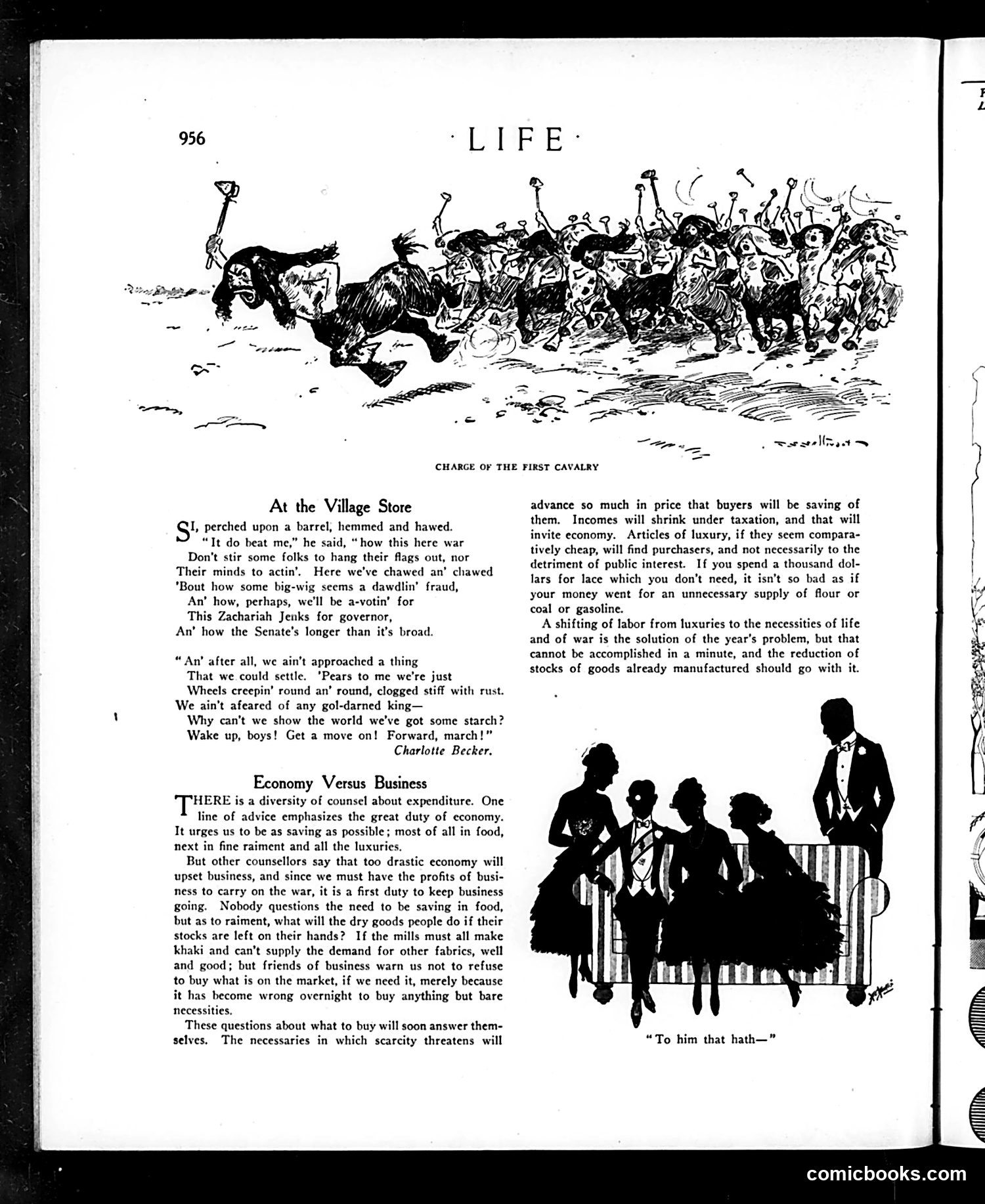
This page contains two satirical pieces about American life during World War I. **"At the Village Store"** (poem by Charlotte Becker) depicts small-town apathy about the war. A man sitting on a barrel complains that ordinary citizens aren't emotionally invested—they don't display flags or show patriotic fervor, instead just gossip endlessly about politics (mentioning governor candidate Zacharias Jenks and the Senate). He urges Americans to "show some starch" and take action, satirizing the disconnect between national crisis and civilian complacency. **"Economy Versus Business"** debates wartime economic policy. It mocks the contradiction between government calls for citizens to economize (especially on luxuries and food) and business interests wanting continued consumer spending to maintain profits and keep factories running. The caption "To him that hath—" (referencing the Biblical Matthew principle) sardonically notes that wealthy buyers will purchase luxuries regardless, while working people must sacrifice. Both pieces critique American hesitation and internal contradictions during WWI mobilization.
📄 Transcribed text from this page (OCR, searchable)
Machine-transcribed from the original scan — historical spelling and the odd misread are preserved.
(wor seedless CHARGE OF THE FIRST CAVALRY At the Village Store I, perched upon a barrel, hemmed and hawed. “It do beat me,” he said, “how this here war Don't stir some folks to hang their flags out, nor Their minds to actin’. Here we've chawed an’ chawed "Bout how some big-wig seems a dawdlin’ fraud, An’ how, perhaps, we'll be a-votin’ for This Zachariah Jenks for governor, An’ how the Senate's longer than it’s broad. “An! after all, we ain't approached a thing That we could settle. "Pears to me we're just Wheels creepin’ round an’ round, clogged stiff with rust. We ain't afeared of any gol-darned king— Why can't we show the world we've got some starch? Wake up, boys! Get a move on! Forward, march!” Charlotte Becker, Economy Versus Business HERE is a diversity of counsel about expenditure. One line of advice emphasizes the great duty of economy. It urges us to be as saving as possible; most of all in food, next in fine raiment and all the luxuries. But other counsellors say that too drastic economy will upset business, and since we must have the profits of busi- ness to carry on the war, it is a first duty to keep business going. Nobody questions the need to be saving in food, but as to raiment, what will the dry goods people do if their stocks are left on their hands? If the mills must all make khaki and can't supply the demand for other fabrics, well and good; but friends of business warn us not to refuse to buy what is on the market, if we need it, merely because it has become wrong overnight to buy anything but bare necessities. These questions about what to buy will soon answer them- selves, The necessaries in which scarcity threatens will advance so much in price that buyers will be saving of them. Incomes will shrink under taxation, and that will invite economy. Articles of luxury, if they seem compara- tively cheap, will find purchasers, and not necessarily to the detriment of public interest. If you spend a thousand dol- lars for lace which you don't need, it isn’t so bad as if your money went for an unnecessary supply of flour or coal or gasoline. A shifting of labor from luxuries to the necessities of life and of war is the solution of the year's problem, but that cannot be accomplished in a minute, and the reduction of stocks of goods already manufactured should go with it. “To him that hath—” | —— EX spe a <7 i comicbooks.com