
Life, 1917-05-31 · page 22 of 38
Life — May 31, 1917 — page 22: what you’re looking at
What you’re looking at
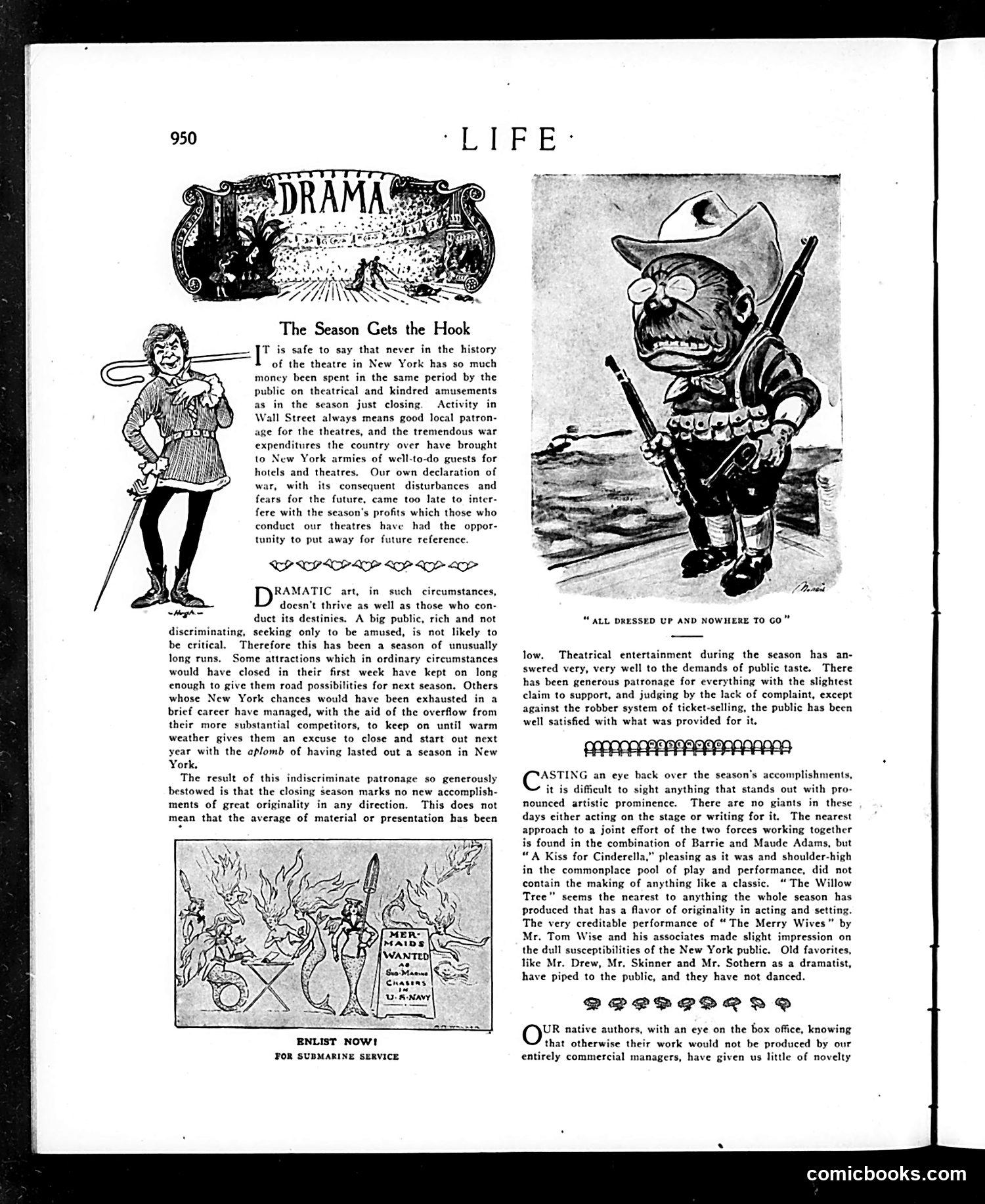
This page critiques the 1917 Broadway theatrical season. The main article argues that despite record-breaking box office revenue—fueled by wealthy Wall Street investors and military personnel during America's WWI mobilization—the season produced artistically mediocre work. The cartoons illustrate this disconnect: the top right image shows a caricatured figure labeled "All Dressed Up and Nowhere to Go," suggesting theatrically flashy but empty productions. The bottom left "Enlist Now! For Submarine Service" cartoon appears to be wartime propaganda. The article's core complaint: indiscriminate, wealthy audiences willing to pay for anything meant producers prioritized profit over artistic merit. Established stars like Drew and Sothern coasted on reputation. Even praised works like "A Kiss for Cinderella" (starring Maude Adams) merely occupied "the commonplace pool." The season lacked originality and "giants" in acting or playwriting—entertainment satisfied public demand but advanced no artistic boundaries.
📄 Transcribed text from this page (OCR, searchable)
Machine-transcribed from the original scan — historical spelling and the odd misread are preserved.
The Season Gets the Hook T is safe to say that never in the history of the theatre in New York has so much money been spent in the same period by the public on theatrical and kindred amusements as in the season just closing. Activity in Wall Street always means good local patron- age for the theatres, and the tremendous war expenditures the country over have brought to New York armies of well-to-do guests for hotels and theatres. Our own declaration of war, with its consequent disturbances and fears for the future, came too late to inter- fere with the season's profits which those who conduct our theatres have had the oppor- tunity to put away for future reference. LP ILE LEE OP LOO RAMATIC art, in such circumstances, doesn't thrive as well as those who con- duct its destinies. A big public, rich and not discriminating, seeking only to be amused, is not likely to be critical. Therefore this has been a season of unusually long runs, Some attractions which in ordinary circumstances would have closed in their first week have kept on long enough to give them road possibilities for next season, Others whose New York chances would have been exhausted in a brief career have managed, with the aid of the overflow from their more substantial competitors, to keep on until warm weather gives them an excuse to close and start out next year with the aplomb of having lasted out a season in New York. The result of this indiscriminate patronage so generously bestowed is that the closing season marks no new accomplish- ments of great originality in any direction. This does not mean that the average of material or presentation has been FOR SUBMARINE SERVICE “ALL DRESSED UP AND NOWHERE TO GO” low. Theatrical entertainment during the season has an- swered very, very well to the demands of public taste. There has been generous patronage for everything with the slightest claim to support, and judging by the lack of complaint, except against the robber system of ticket-selling, the public has been well satisfied with what was provided for it. CASTING an eye back over the season's accomplishments, it is difficult to sight anything that stands out with pro- nounced artistic prominence. There are no giants in these days either acting on the stage or writing for it. The nearest approach to a joint effort of the two forces working together is found in the combination of Barrie and Maude Adams, but “A Kiss for Cinderella,” pleasing as it was and shoulder-high in the commonplace pool of play and performance, did not contain the making of anything like a classic. “The Willow Tree" seems the nearest to anything the whole season has produced that has a flavor of originality in acting and setting. The very creditable performance of “The Merry Wives” by Mr. Tom Wise and his associates made slight impression on the dull susceptibilities of the New York public. Old favorites, like Mr. Drew, Mr, Skinner and Mr. Sothern as a dramatist, have piped to the public, and they have not danced. Q@PSPSBRASQVARD UR native authors, with an eye on the box office, knowing that otherwise their work would not be produced by our entirely commercial managers, have given us little of novelty comicbooks.com