
Life, 1917-05-31 · page 16 of 38
Life — May 31, 1917 — page 16: what you’re looking at
What you’re looking at
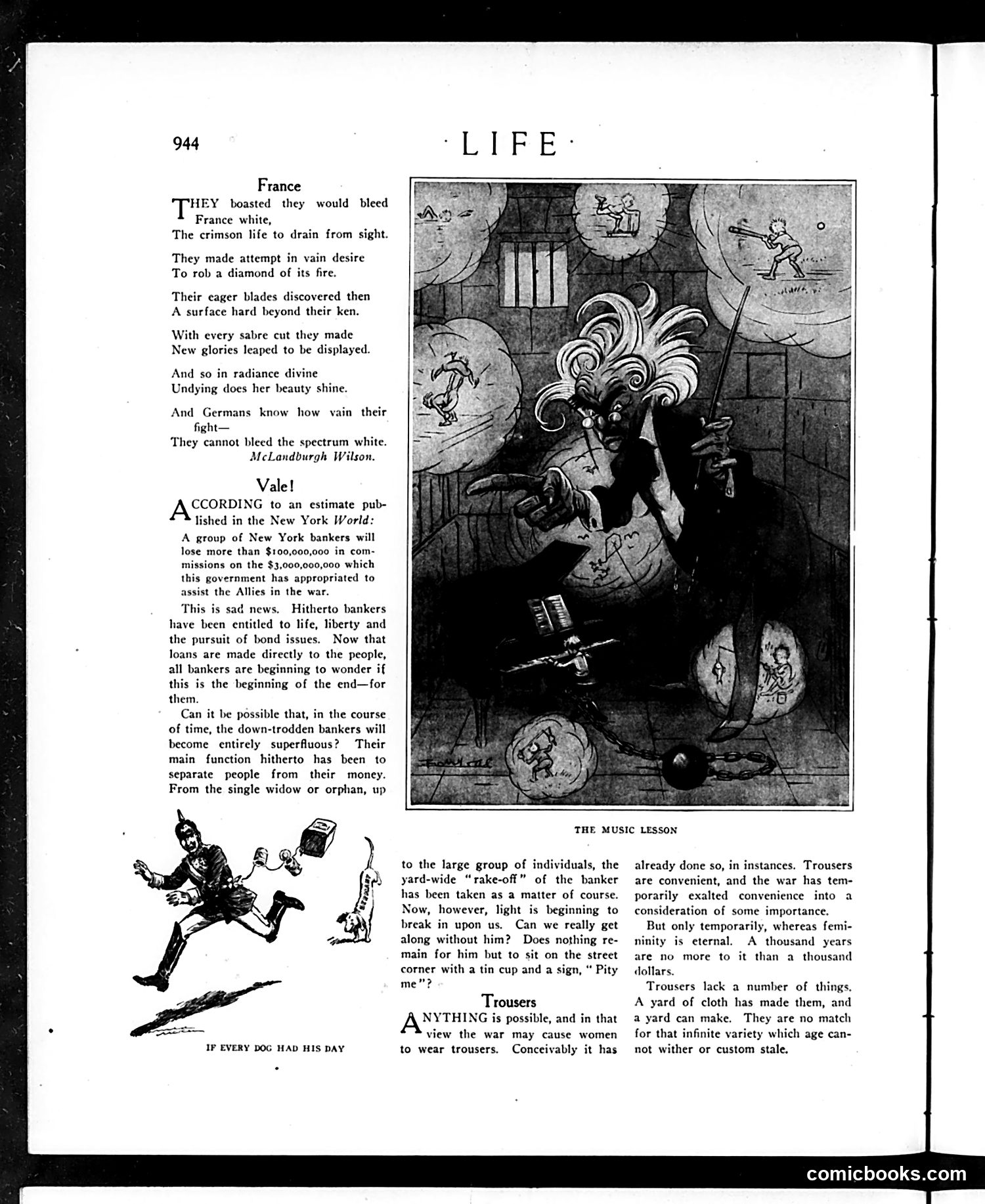
This page contains three satirical pieces from WWI-era Life magazine: **"France" (top poem):** Celebrates French resilience against German attack. The metaphor presents France as a precious diamond—German attempts to destroy it ("bleed" its color) only reveal its inner brilliance. Germans cannot defeat France's enduring beauty and strength. **"Vale!" (middle section):** Mocks American bankers losing $100 million in commissions because the government now loans directly to the public (for Allied war support) rather than through banking intermediaries. The satire suggests bankers' traditional role—extracting fees from ordinary people—may become obsolete, reducing them to street beggars. **"Trousers" (bottom):** Light commentary speculating that wartime convenience might cause women to adopt trousers. However, the piece dismisses this as temporary, arguing femininity is eternal and cannot be replaced by mere practicality. The reference to "infinite variety which age cannot wither" quotes Shakespeare, treating femininity as an ageless ideal transcending fashion.
📄 Transcribed text from this page (OCR, searchable)
Machine-transcribed from the original scan — historical spelling and the odd misread are preserved.
944 France HEY boasted they France white, The crimson life to drain from sight. would bleed They made attempt in vain desire To rob a diamond of its fire. Their eager blades discovered then A surface hard beyond their ken. With every sabre cut they made New glories leaped to be displayed. And so in radiance divine Undying does her beauty shine. And Germans know how vain their fight— They cannot bleed the spectrum white. McLandburgh Wilson. Vale! CCORDING to an estimate pub- lished in the New York World: A group of New York bankers will lose more than $100,000,000 in com- missions on the $3,000,000,000 which this government has appropriated to assist the Allies in the war. This is sad news. Hitherto bankers have been entitled to life, liberty and the pursuit of bond issues. Now that loans are made directly to the people, all bankers are beginning to wonder if this is the beginning of the end—for them. Can it be possible that, in the course of time, the down-trodden bankers will become entirely superfluous? Their main function hitherto has been to separate people from their money. From the single widow or orphan, up IF EVERY DOG HAD HIS DAY THE MUSIC LESSON to the large group of individuals, the yard-wide “rake-off” of the banker has been taken as a matter of course. Now, however, light is beginning to break in upon us, Can we really get along without him? Does nothing re- main for him but to sit on the street corner with a tin cup and a sign, “ Pity me"? Trousers NYTHING is possible, and in that view the war may cause women to wear trousers. Conceivably it has already done so, in instances. Trousers are convenient, and the war has tem- porarily exalted convenience into a consideration of some importance. But only temporarily, whereas femi- ninity is eternal. A thousand years are no more to it than a thousand dollars. Trousers lack a number of things. A yard of cloth has made them, and a yard can make. They are no match for that infinite variety which age can- not wither or custom stale, comicbooks.com