
Life, 1917-05-31 · page 24 of 38
Life — May 31, 1917 — page 24: what you’re looking at
What you’re looking at
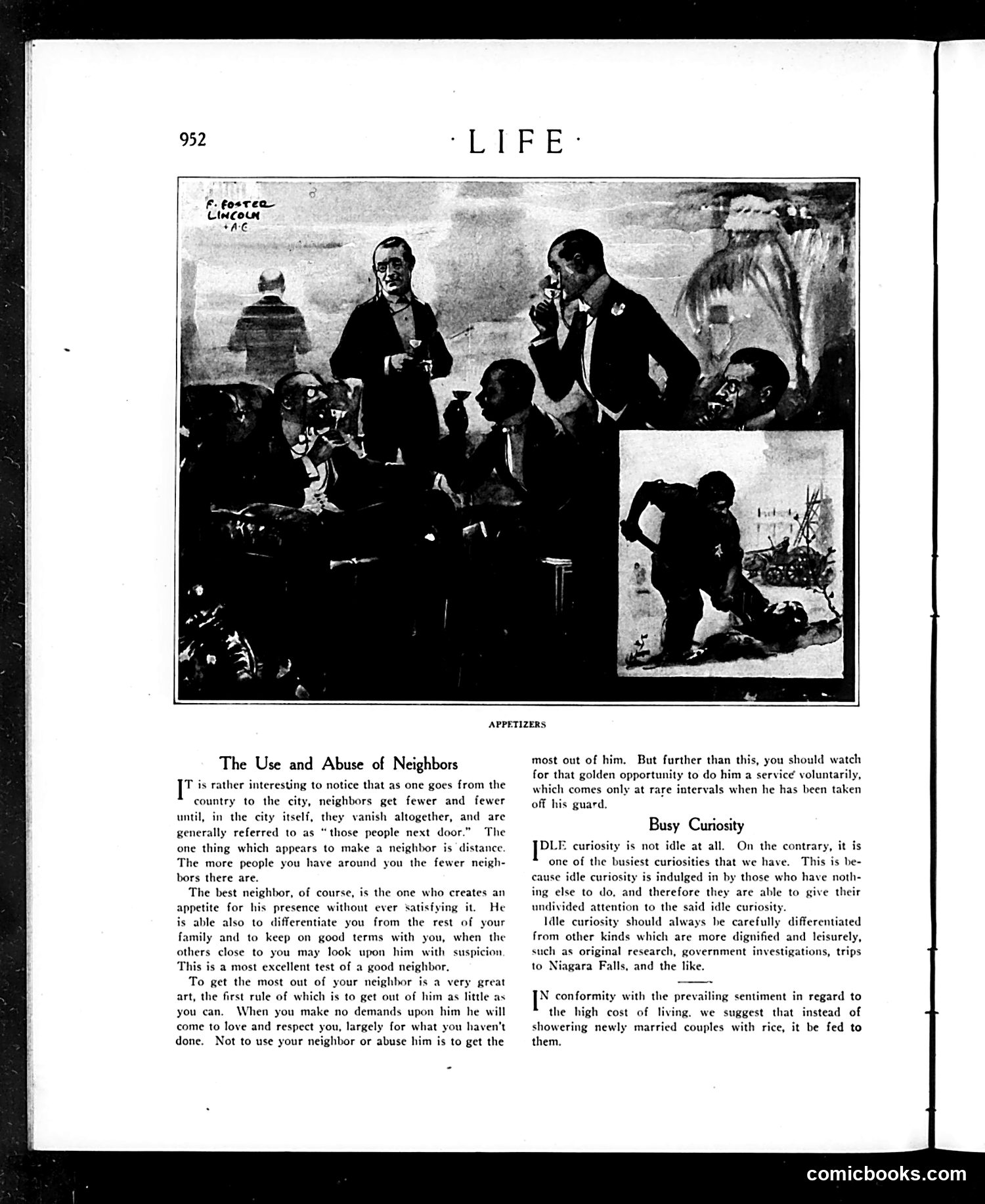
This page contains two separate satirical essays on social etiquette, illustrated by cartoons (artist F. Foster Lincolm). **"The Use and Abuse of Neighbors"** satirizes the paradox of urban life: in cities, neighbors are plentiful yet distant; the "best" neighbor is one whose company you crave but who makes minimal demands. The essay mocks the performative politeness of neighbor relations—respect comes from doing *nothing* rather than genuine connection. **"Busy Curiosity"** distinguishes between "idle" curiosity (petty gossip by the bored) and "dignified" curiosity (research, government work). It's a tongue-in-cheek defense of nosiness masquerading as refined interest. **Final joke:** The closing quip about feeding rice to newlyweds instead of throwing it reflects post-WWI economic concerns about the high cost of living—even wedding traditions must be economized. The cartoons appear to illustrate neighbors in awkward social situations, reinforcing the essay's themes of strained propriety and unspoken social rules.
📄 Transcribed text from this page (OCR, searchable)
Machine-transcribed from the original scan — historical spelling and the odd misread are preserved.
Ff. fostea Cincom +AG The Use and Abuse of Neighbors T is rather interesting to notice that as one goes from the country to the city, neighbors get fewer and fewer until, in the city itself, they vanish altogether, and are generally referred to as “those people next door.” one thing which appears to make a neighbor is ‘distance. The more people you have around you the fewer neigh- bors there are. The best neighbor, of course, is the one who creates an appetite for his presence without ever Satisfying it. He is able also to differentiate you from the rest of your family and to keep on good terms with you, when the others close to you may look upon him with suspicion This is a most excellent test of a good neighbor, To get the most out of your neighbor is a very great art, the first rule of which is to get out of him as little as you can. When you make no demands upon him he will come to love and respect you, largely for what you haven't done. Not to use your neighbor or abuse him is to get the most out of him. But further than this, you should watch for that golden opportunity to do him a service voluntarily, which comes only at rare intervals when he has been taken off his guard. Busy Curiosity DLE curiosity is not idle at all. On the contrary, it is one of the busiest curiosities that we have. This is be- cause idle curiosity is indulged in by those who have noth- ing else to do, and therefore they are able to give their undivided attention to the said idle curiosity. Idle curiosity should always be carefully differentiated from other kinds which are more dignified and leisurely, such as original research, government investigations, trips to Niagara Falls, and the like. IX conformity with the prevailing sentiment in regard to the high cost of living. we suggest that instead of showering newly married couples with rice, it be fed to them. comicbooks.com