
Life, 1917-05-31 · page 14 of 38
Life — May 31, 1917 — page 14: what you’re looking at
What you’re looking at
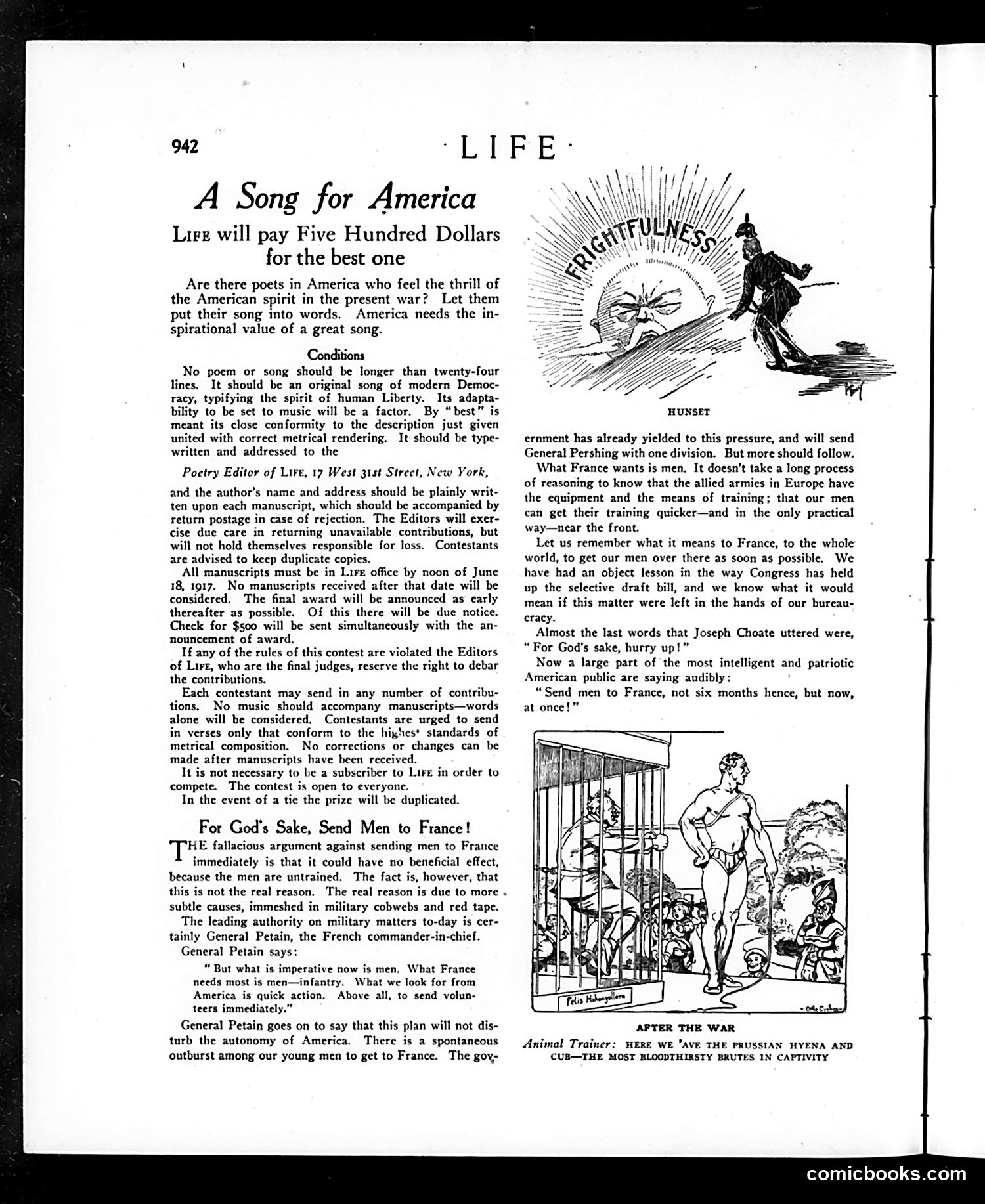
This page combines a poetry contest announcement with pro-war advocacy during World War I. Life offered $500 for the best patriotic song celebrating American spirit and "modern Democracy." The main cartoon, titled "After the War," depicts a caged nude male figure labeled as a "Prussian Hyena" and "Cub"—dehumanizing caricatures of German enemies as dangerous animals requiring captivity. This reflects wartime propaganda demonizing Germany. The accompanying text argues for immediate American military involvement in France, citing General Pershing as authority. It dismisses pacifist objections as "fallacious" and frames sending troops as urgently necessary. The page reflects 1917-era American jingoism, using both cultural competition (the song contest) and graphic imagery to mobilize public support for war participation.
📄 Transcribed text from this page (OCR, searchable)
Machine-transcribed from the original scan — historical spelling and the odd misread are preserved.
942 A Song for America Liz will pay Five Hundred Dollars for the best one Are there poets in America who feel the thrill of the American spirit in the present war? Let them put their song into words. America needs the in- spirational value of a great song. Conditions No poem or song should be longer than twenty-four lines. It should be an original song of modern Democ- racy, typifying the spirit of human Liberty. Its adapta- bility to be set to music will be a factor. By “best” is meant its close conformity to the description just given united with correct metrical rendering. It should be type- written and addressed to the Poetry Editor of Lire, 17 West 31st Street, New York, and the author’s name and address should be plainly writ- ten upon each manuscript, which should be accompanied by return postage in case of rejection. The Editors will exer- cise due care in returning unavailable contributions, but will not hold themselves responsible for loss. Contestants are advised to keep duplicate copies. All manuscripts must be in Lire office by noon of June 18, 1917. No manuscripts received after that date will be considered. The final award will be announced as early thereafter as possible. Of this there will be due notice. Check for $500 will be sent simultaneously with the an- nouncement of award. If any of the rules of this contest are violated the Editors of Lire, who are the final judges, reserve the right to debar the contributions. Each contestant may send in any number of contribu- tions. No music should accompany manuscripts—words alone will be considered. Contestants are urged to send in verses only that conform to the highes* standards of metrical composition. No corrections or changes can be made after manuscripts have been received. It is not necessary to be a subscriber to Lire in order to compete. The contest is open to everyone. In the event of a tie the prize will be duplicated. For God's Sake, Send Men to France! HE fallacious argument against sending men to France immediately is that it could have no beneficial effect, because the men are untrained. The fact is, however, that this is not the real reason. The real reason is due to more subtle causes, immeshed in military cobwebs and red tape. The leading authority on military matters to-day is cer- tainly General Petain, the French commander-in-chief. General Petain says: “ But what is imperative now is men. What France needs most is men—infantry. What we look for from America is quick action. Above all, to send volun- teers immediately.” General Petain goes on to say that this plan will not dis- turb the autonomy of America. There is a spontaneous outburst among our young men to get to France. The gov- EPR * ernment has already yielded to this pressure, and will send General Pershing with one division. But more should follow. What France wants is men. It doesn’t take a long process of reasoning to know that the allied armies in Europe have the equipment and the means of training; that our men can get their training quicker—and in the only practical way—near the front. Let us remember what it means to France, to the whole world, to get our men over there as soon as possible. We have had an object lesson in the way Congress has held up the selective draft bill, and we know what it would mean if this matter were left in the hands of our bureau- cracy. Almost the last words that Joseph Choate uttered were, “For God's sake, hurry up!” Now a large part of the most intelligent and patriotic American public are saying audibly: f “Send men to France, not six months hence, but now, at once!” AFTER THE WAR Animal Trainer: WERE WE ‘AVE THE PRUSSIAN HYENA AND CUB—THE MOST BLOODTHIRSTY BRUTES 1N CAPTIVITY comicbooks.com